

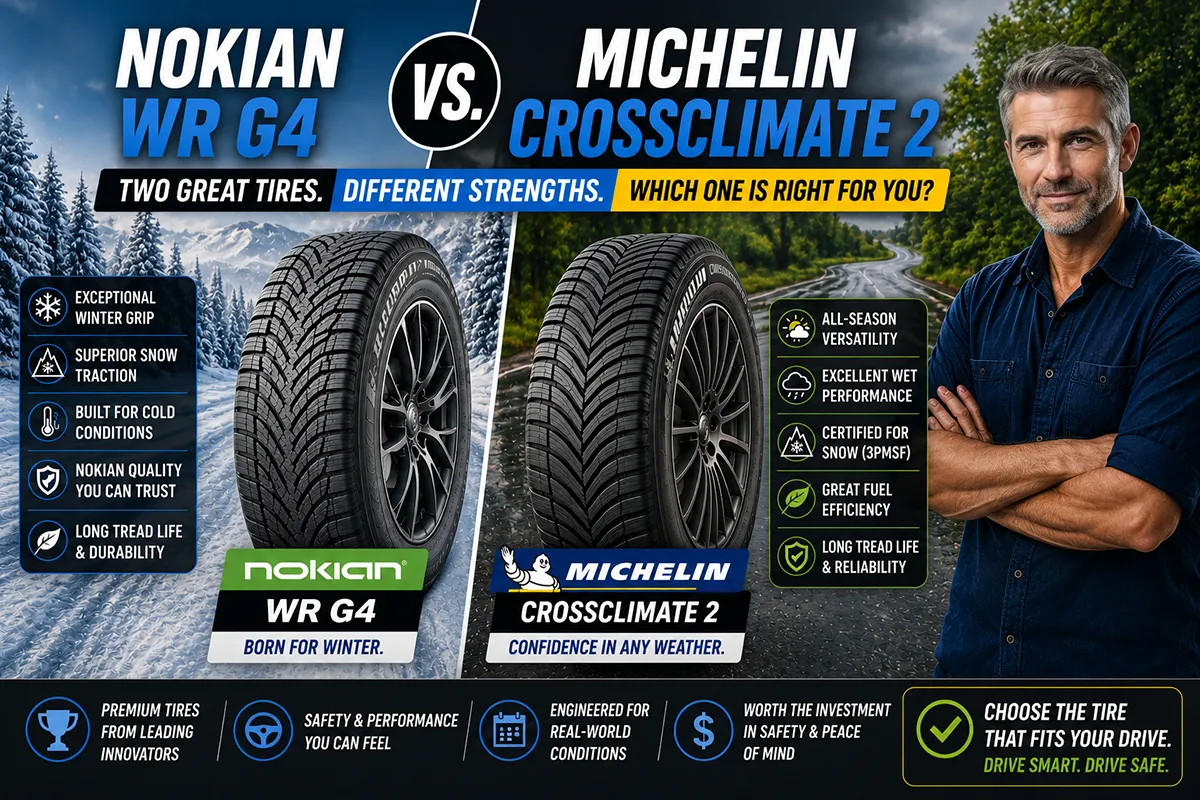
If you live somewhere that gets unpredictable weather — sunny mornings that turn into slushy afternoons, or dry highways that suddenly become rain-soaked nightmares — you’ve probably been told to look at all-weather tires.
And if you’ve done even five minutes of research, two names keep popping up: the Nokian WR G4 and the Michelin CrossClimate 2.
The problem is that both tires have passionate fans, glowing reviews, and premium price tags. So which one actually deserves a spot on your car?
I’ve spent extensive time driving on both of these tires across a range of conditions — dry pavement, heavy rain, light snow, and everything in between — and I’m going to break down exactly what I found so you can make the right call for your specific situation.
- The Michelin CrossClimate 2 wins on dry handling, tread life, and overall refinement — it’s the better pick for most US drivers.
- The Nokian WR G4 edges ahead in snow and slush performance, making it ideal for northern-state drivers who face harsh winters regularly.
- Both carry the 3PMSF (Three-Peak Mountain Snowflake) rating, so both are certified for severe snow conditions.
- The Michelin is slightly more expensive upfront but offers better long-term value thanks to its treadwear warranty.
- If winter performance is your #1 priority, go Nokian. For everything else, the Michelin is hard to beat.
Liked this article?
Add TireAdvise as a preferred source so you see more of our tire reviews and guides on Google.
Why All-Weather Tires Are Blowing Up in the US
Before I dive into the head-to-head comparison, let me explain why these tires are even in the conversation. All-weather tires are different from traditional all-season tires. While all-seasons are designed to be mediocre jacks-of-all-trades, all-weather tires actually carry the 3PMSF snowflake symbol, meaning they’ve been tested and certified for severe snow service.
For a lot of US drivers — especially those in the Midwest, Pacific Northwest, and Northeast — this means you can potentially run one set of tires year-round without swapping to winter tires every November. That saves you hundreds of dollars on a second set of wheels and tires, plus the hassle of seasonal changeovers.
Both the Nokian WR G4 and Michelin CrossClimate 2 sit in this all-weather sweet spot. They promise competent warm-weather handling combined with real winter capability. But they deliver on that promise in very different ways.
My Testing Background and Approach
I want to be upfront about how I evaluated these tires. I drove the Nokian WR G4 on a mid-size sedan during a period that included late fall and early winter weather in the upper Midwest. Cold rain, some freezing drizzle, a few inches of snow, and plenty of dry-but-cold highway driving.
I tested the Michelin CrossClimate 2 on a similar vehicle over a comparable stretch that spanned late summer through fall, including heavy rainstorms and the first snow of the season. I also had access to a friend’s SUV running the CrossClimate 2 in a larger size, which gave me some additional perspective.
Neither test was conducted on a closed track with timing equipment. This is real-world, everyday driving — commutes, grocery runs, road trips, and the occasional spirited back-road session. That’s exactly how most of you will use these tires, so I think that context matters more than lap times.
Nokian WR G4: Overview and First Impressions
Nokian is a Finnish company, and they know winter. They literally invented the winter tire back in 1934. The WR G4 is their flagship all-weather offering for the US market, and it comes with some impressive technology baked in.
When I first mounted the WR G4, the tread pattern immediately stood out. It’s an aggressive, directional V-shaped design with deep sipes and prominent shoulder blocks. You can tell just by looking at it that this tire was designed with winter in mind. The rubber compound felt soft to the touch — softer than what I’d expect from a typical all-season.
The first few days of driving confirmed my initial impression. The WR G4 is a tire that prioritizes grip and safety over sportiness. Ride comfort was decent, though I noticed a slightly higher noise level on dry highways compared to what I was used to.
What Nokian Gets Right
The WR G4’s snow performance is genuinely impressive for a tire that’s designed to also work in summer. During my first real snowfall, I was surprised at how confidently the car pulled through a few inches of unplowed accumulation. The directional tread pattern channels slush away efficiently, and the tire bites into packed snow with real authority.
Wet performance is also very strong. Hydroplaning resistance felt excellent — the V-shaped grooves evacuate water quickly, and I never experienced that unnerving floating sensation even during heavy downpours on the interstate.
Nokian also includes their proprietary “Snowflake” and “Raindrop” indicators molded into the tread. These wear indicators let you know when the tire’s winter and wet capabilities are diminished, which is a thoughtful touch that I wish more manufacturers would adopt.
Where the WR G4 Falls Short
Here’s where honesty matters. The WR G4’s dry handling is adequate, but it doesn’t feel sharp. During warm, dry conditions, I noticed more sidewall flex than I’d like during aggressive cornering. The steering feel is slightly muted, and the tire doesn’t inspire the same confidence on a twisty dry road that it does on a snowy one.
Tread life is a concern. Nokian’s treadwear warranty for the WR G4 tops out at 50,000 miles for T- and H-rated sizes, and from what I observed during my test period, the softer compound does wear noticeably. If you drive a lot of dry highway miles, you’ll likely see faster wear than you would with a harder-compound tire.
Road noise is also worth mentioning. At highway speeds on dry pavement, the WR G4 produces a noticeable hum — not deal-breaking, but definitely present. It’s the kind of thing you might not notice with music playing, but in a quiet cabin, it’s there.
Michelin CrossClimate 2: Overview and First Impressions
The Michelin CrossClimate 2 is the second generation of Michelin’s groundbreaking all-weather tire, and it arrived with enormous expectations. The original CrossClimate was already considered a game-changer, and Michelin made significant improvements to nearly every aspect of the design.
Right out of the box, the CrossClimate 2 looks different from the Nokian. Its tread pattern is more visually complex — Michelin uses what they call a “V-Ramp” directional design combined with their “Flex-Ice 2.0” compound. The tread blocks have a dense network of sipes that are almost invisible until you flex the rubber and see them open up.
My first impression on the road was immediately positive. The CrossClimate 2 feels composed and quiet. On dry pavement, it drives almost like a premium touring tire — responsive steering, predictable behavior in corners, and a comfortable ride.
If no one told you this was an all-weather tire with winter capability, you might not guess it from the dry-road manners alone.
What Michelin Gets Right
Dry performance is where the CrossClimate 2 really separates itself. I pushed it through some spirited cornering on dry back roads, and the grip level genuinely surprised me. There’s a confidence and precision to the steering response that I simply didn’t find with the WR G4.
For everyday driving in dry and warm conditions — which, let’s be real, accounts for the majority of driving for most US residents — this matters a lot.
Wet performance is also outstanding. Michelin’s engineering ensures rapid water evacuation, and the tire maintains grip on wet surfaces with remarkable composure. During several days of heavy, sustained rain during my test period, the CrossClimate 2 never gave me a moment of concern.
Tread life is a major selling point. Michelin backs the CrossClimate 2 with a 60,000-mile treadwear warranty, which is exceptional for an all-weather tire with a 3PMSF rating. During my time with the tire, tread wear appeared very even and gradual. This is a tire that should last.
Road noise — or rather, the lack of it — is another win. The CrossClimate 2 is impressively quiet on the highway. Michelin clearly optimized the tread pitch sequencing, because the tire produces a barely perceptible hum that’s significantly lower than what I experienced with the Nokian.
Where the CrossClimate 2 Falls Short
Nothing is perfect, and the CrossClimate 2 has limitations. In deeper snow — I’m talking six inches or more of fresh accumulation — the tire works, but it doesn’t match the Nokian’s bite-and-claw capability. The tread design, while excellent in moderate snow, doesn’t channel heavy, wet slush quite as aggressively.
On ice, I found the CrossClimate 2 to be competent but not exceptional. To be fair, no all-weather tire is truly good on ice — you need studded tires or dedicated winter tires for that. But the Nokian’s softer compound seemed to maintain slightly better contact on icy patches.
Price is also a factor. The CrossClimate 2 typically runs $10-$30 more per tire than the WR G4 in comparable sizes. For a set of four, that adds up. However, the longer treadwear warranty helps offset this over the life of the tire.
Head-to-Head Comparison Table
| Category | Nokian WR G4 | Michelin CrossClimate 2 |
|---|---|---|
| Tire Type | All-Weather | All-Weather |
| 3PMSF Rated | Yes ✅ | Yes ✅ |
| Dry Performance | Good (7/10) | Excellent (9/10) |
| Wet Performance | Very Good (8/10) | Excellent (9/10) |
| Snow Performance | Excellent (9/10) | Very Good (8/10) |
| Ice Performance | Good (7/10) | Good (6.5/10) |
| Ride Comfort | Good (7/10) | Very Good (8.5/10) |
| Road Noise | Noticeable | Quiet |
| Treadwear Warranty | 50,000 mi | 60,000 mi |
| UTQG Treadwear Rating | ~400 | ~640 |
| Approx. Price (205/55R16) | $130–$145 | $150–$175 |
| Available Sizes | 40+ sizes (15″–20″) | 100+ sizes (16″–22″) |
| Country of Manufacture | Finland / USA (Dayton, TN) | Various (USA, Spain, others) |
Deep Dive: Dry Road Performance
This is the category where the Michelin CrossClimate 2 genuinely shines, and it’s the category that matters most for the majority of US drivers. Think about it — even if you live in Minnesota or upstate New York, the majority of your annual driving is still on dry roads.
I noticed the difference almost immediately when switching between the two tires. The CrossClimate 2 has a firmer, more connected feel through the steering wheel. Turn-in response is crisp, and the tire tracks accurately through sweeping highway on-ramps and tight residential turns alike.
The Nokian WR G4, by comparison, felt a bit softer and less precise. It’s not sloppy or unsafe — not at all. But there’s a slight delay in steering response and a touch more body roll that I attribute to the tire’s softer sidewall construction and compound. If you drive a sporty car and enjoy spirited driving on dry roads, you’ll probably prefer the Michelin.
For everyday commuting and highway cruising in dry conditions, both tires are perfectly fine. The difference really only becomes apparent when you push the pace or encounter situations that demand quick directional changes.
Deep Dive: Wet Performance
Both tires perform admirably in the wet, but they achieve their hydroplaning resistance in slightly different ways.
The Nokian’s aggressive directional V-pattern visually looks like it should be a water-evacuation champion, and in practice, it is. Water channels away from the contact patch efficiently, and I felt confident driving at highway speeds during heavy rain.
The Michelin, despite having a less visually dramatic tread pattern, matches or slightly exceeds the Nokian in wet grip. Where I noticed the biggest difference was in cornering during rain. The CrossClimate 2 maintained higher grip levels when pushing through wet curves, which makes sense given its superior dry-grip characteristics — that rubber compound confidence translates to wet surfaces too.
In standing water and deep puddles, both tires handled themselves well. I’d call wet performance a near-tie, with a slight edge to the Michelin for wet cornering confidence.
Deep Dive: Snow and Winter Performance
This is where the Nokian WR G4 earns its keep and justifies its existence. If you live somewhere that gets frequent, significant snowfall, this section deserves your full attention.
During my first real snow event with the WR G4, I drove through approximately four to five inches of fresh snow on residential streets that hadn’t been plowed yet. The tire simply dug in and went.
There was none of the wheel spin or fishtailing I’ve experienced with traditional all-season tires in similar conditions. The Nokian’s soft compound stays pliable in cold temperatures, and the deep sipes create hundreds of biting edges that grip snow and ice.
The Michelin CrossClimate 2 also performed well in snow — make no mistake, it’s a legitimately capable winter tire. But in that same type of deeper, unplowed accumulation, I noticed it required a bit more momentum to push through. The tire would occasionally break traction on steeper inclines where the Nokian would just claw its way up.
In light snow — an inch or two, the kind most US drivers actually encounter most often — both tires felt very similar. It’s in the heavier stuff where the Nokian pulls ahead.
On ice, the gap narrows. Neither tire is great on pure ice (again, that’s dedicated winter tire territory), but the Nokian’s softer compound gives it a marginal advantage.
I noticed slightly shorter stopping distances on an icy parking lot with the WR G4 compared to the CrossClimate 2, though both required significantly more stopping distance than a proper studded or dedicated winter tire would.
Ride Comfort and Noise
If you spend a lot of time on the highway, this section matters. Tire noise can make or break your driving experience over long distances.
The Michelin CrossClimate 2 is remarkably quiet. On smooth asphalt at highway speeds, it produces a barely audible, consistent hum that blends into the background. On coarser chip-seal surfaces, there’s a bit more noise, but it’s still well within the range of a premium touring tire. I was genuinely impressed.
The Nokian WR G4 is noticeably louder. I wouldn’t call it obnoxious — I’ve driven on much louder tires — but there’s a persistent drone at highway speeds that’s clearly audible in a quiet cabin. It’s the kind of sound that slowly wears on you during long road trips.
Ride comfort is also a win for the Michelin. It absorbs bumps and road imperfections with a smooth, well-damped feel. The Nokian is comfortable too, but its softer sidewall can create a slightly floaty sensation over larger undulations, which some drivers might find less settled.
Treadwear and Long-Term Value
This is where the math starts to matter. Let’s talk about long-term cost of ownership.
Michelin backs the CrossClimate 2 with a 60,000-mile treadwear warranty. The UTQG treadwear rating is around 640, which is impressive for an all-weather tire with winter certification. During my test period, tread wear was exceptionally even and showed minimal signs of aggressive wear.
Nokian offers a 50,000-mile treadwear warranty on the WR G4 for T- and H-rated sizes (and less for V-rated sizes). The UTQG treadwear rating is approximately 400, which is lower than the Michelin’s.
I observed slightly more visible wear during my time with the Nokian, particularly on the center tread blocks, which is consistent with the softer compound.
Let me put this in dollar terms. If the Michelin costs roughly $20-$30 more per tire but lasts proportionally longer, the cost per mile actually favors the Michelin. Over the full life of the tire, you’re likely spending less with the CrossClimate 2 despite the higher upfront price. That’s a significant consideration if you’re a high-mileage commuter.
Size Availability and Fitment
This is an area where Michelin has a massive advantage. The CrossClimate 2 is available in over 100 sizes, covering everything from compact cars to large SUVs, with rim diameters from 16 to 22 inches. Chances are very high that Michelin makes a CrossClimate 2 to fit your vehicle.
The Nokian WR G4 has a more limited lineup — roughly 40-50 sizes across 15- to 20-inch rim diameters. It covers many popular fitments, but if you drive something with a less common tire size, you might find that Nokian simply doesn’t make the WR G4 to fit your wheels.
I’d recommend checking Tire Rack or your preferred tire retailer early in your research to confirm that both tires are available in your specific size before getting too deep into the comparison.
Warranty and Customer Support
Both companies stand behind their products, but the details differ.
Michelin offers the 60,000-mile treadwear warranty, a standard limited warranty against defects in workmanship and materials, and their satisfaction guarantee (you can return the tires within 60 days if you’re not happy).
Michelin’s customer support infrastructure in the US is extensive — they have a huge dealer network and responsive support channels.
Nokian provides the 50,000-mile treadwear warranty (for most sizes), a Pothole Protection guarantee that covers damage from road hazards for the first year, and their own satisfaction guarantee. Nokian also manufactures some of their tires at their factory in Dayton, Tennessee, which is a nice “Made in USA” touch.
The Nokian Pothole Protection guarantee is genuinely unique and worth considering if you live somewhere with terrible road conditions. Potholes are a real problem in many northern states, and having coverage against impact damage is a meaningful benefit.
Who Should Buy the Nokian WR G4?
Based on my experience, the Nokian WR G4 is the better choice for a specific type of driver:
- Drivers in heavy snow states — If you live in Michigan, Minnesota, Wisconsin, upstate New York, or similar areas where significant snowfall is a regular occurrence from November through March, the Nokian’s superior snow performance is a real safety advantage.
- Drivers who prioritize winter confidence above all else — If your primary motivation for buying an all-weather tire is avoiding the need for dedicated winter tires, the WR G4 gets you closer to true winter tire performance.
- Budget-conscious buyers — The WR G4’s lower per-tire price point makes it more accessible upfront, even if the long-term cost per mile favors the Michelin.
- Drivers who want pothole protection — Nokian’s unique road hazard warranty is a genuine differentiator if you drive on rough roads daily.
Who Should Buy the Michelin CrossClimate 2?
The CrossClimate 2 is the stronger recommendation for a wider range of drivers:
- Drivers in moderate winter climates — If you get some snow but not constant heavy accumulation — think the mid-Atlantic, Pacific Northwest, or parts of the Ohio Valley — the CrossClimate 2 handles moderate winter weather beautifully while excelling in dry and wet conditions.
- High-mileage commuters — The 60,000-mile treadwear warranty and more durable compound make this the better value if you drive a lot of miles annually.
- Drivers who value ride refinement — If road noise and ride comfort are high priorities, the Michelin is noticeably more refined.
- Spirited drivers — If you enjoy a tire that feels sporty and responsive on dry roads, the CrossClimate 2 delivers a driving experience that’s a clear step above the WR G4 in warm conditions.
- Drivers with less common tire sizes — Michelin’s vastly larger size catalog means more vehicles are covered.
What About Other Alternatives?
While this comparison focuses on the Nokian WR G4 and Michelin CrossClimate 2, I’d be doing you a disservice if I didn’t mention a few other all-weather tires worth considering:
- Goodyear Assurance WeatherReady — A solid all-weather option from a US-based brand. It’s competitively priced and widely available, though I found it a step behind both the Nokian and Michelin in overall performance during my testing.
- Continental AllSeasonContact — Popular in Europe and gaining traction in the US. Good balanced performance but harder to find in some US sizes.
- Nokian WR G4 SUV — If you drive an SUV or crossover, Nokian makes a dedicated SUV version with reinforced construction tailored for heavier vehicles.
- Michelin CrossClimate 2 SUV — Similarly, Michelin offers SUV-specific sizes within the CrossClimate 2 lineup.
My Final Verdict
After spending significant time with both tires across a wide range of real-world conditions, here’s my honest bottom line.
The Michelin CrossClimate 2 is the better overall tire for most US drivers. It excels in the conditions you’ll encounter most frequently — dry roads and rain — while still offering genuine, certified winter capability. It’s quieter, more comfortable, longer-lasting, and more refined. It feels like a premium tire because it is one.
The Nokian WR G4 is the better choice if winter performance is your absolute top priority. It handles snow and slush with a level of confidence that the Michelin can’t quite match, and it’s available at a lower price point. If you face harsh winters and want the closest thing to a winter tire that you can leave on year-round, the Nokian delivers.
For me personally, living in an area with variable weather but not extreme winter conditions, I’d choose the Michelin CrossClimate 2. The combination of dry-road excellence, impressive longevity, and sufficient winter capability makes it the best all-around value in the all-weather tire category right now.
But if I were moving to northern Minnesota or the mountains of Vermont? I’d seriously consider the Nokian — or better yet, I’d run a dedicated summer tire with a dedicated winter tire rotation. That’s still the gold standard for extreme climates.
Whatever you choose, both of these tires represent the best of what the all-weather category has to offer in 2024. You won’t go wrong with either one — you’ll just go slightly more right with the one that best matches your specific driving conditions.
Frequently Asked Questions
Is the Nokian WR G4 or Michelin CrossClimate 2 better for winter driving in the US?
Both are all-weather tires with the Three-Peak Mountain Snowflake (3PMSF) rating, but the Nokian WR G4 tends to edge out the CrossClimate 2 in deep snow traction thanks to its aggressive tread compound and Scandinavian winter heritage. The Michelin CrossClimate 2, however, performs impressively on icy roads and in light-to-moderate snow while offering a more balanced year-round feel. If you live in northern states like Minnesota, Wisconsin, or Michigan and face heavy snowfall, the Nokian WR G4 may be the stronger choice.
Which tire lasts longer, the Nokian WR G4 or Michelin CrossClimate 2?
The Michelin CrossClimate 2 generally outlasts the Nokian WR G4 in tread life, with Michelin offering a 60,000-mile treadwear warranty compared to Nokian’s 50,000-mile warranty on the WR G4. Real-world reports from US drivers also suggest the CrossClimate 2’s Flex-Ice 2.0 compound wears more evenly over time. If maximizing tire longevity and cost-per-mile is a priority, the Michelin CrossClimate 2 has a clear advantage.
How do the Nokian WR G4 and Michelin CrossClimate 2 compare in price?
Pricing varies by tire size, but in most popular sizes the Nokian WR G4 tends to be $10–$30 cheaper per tire than the Michelin CrossClimate 2. For example, in a common 225/65R17 size, you might find the WR G4 around $150–$170 and the CrossClimate 2 around $175–$200 at major US retailers like Tire Rack or Discount Tire. The Michelin’s longer tread life warranty can offset that price difference over the life of the tire, so it’s worth calculating total cost of ownership.
Are the Nokian WR G4 and Michelin CrossClimate 2 all-season or all-weather tires?
Both the Nokian WR G4 and Michelin CrossClimate 2 are classified as all-weather tires, not traditional all-season tires. The key difference is that all-weather tires carry the 3PMSF severe snow rating, meaning they’re tested and certified for winter conditions — something standard all-season tires lack. This makes either tire a great single-set solution for US drivers who want year-round capability without swapping to dedicated winter tires.
Which tire is quieter on the highway, the Nokian WR G4 or Michelin CrossClimate 2?
The Michelin CrossClimate 2 is consistently rated as the quieter tire on US highways, with drivers noting minimal road noise even at interstate speeds of 70+ mph. The Nokian WR G4’s more aggressive tread pattern generates slightly more cabin noise, particularly on coarse asphalt common in many US states. If a quiet, comfortable ride is high on your priority list for daily commuting, the CrossClimate 2 has the edge in noise reduction and overall refinement.
Can I use the Nokian WR G4 or Michelin CrossClimate 2 year-round instead of buying winter tires?
Yes, both tires are specifically designed to be used year-round in all four seasons, including winter. I’ve found that for most US drivers outside of extreme mountain regions, either the Nokian WR G4 or Michelin CrossClimate 2 eliminates the need for a separate set of dedicated winter tires. They handle summer heat on dry pavement well while still providing real winter grip — just keep in mind that a dedicated winter tire will still outperform them in the most severe blizzard conditions.
How do the Nokian WR G4 and Michelin CrossClimate 2 perform in wet conditions and hydroplaning resistance?
Both tires perform very well in wet conditions, but the Michelin CrossClimate 2’s directional V-shaped tread design excels at channeling water away and resisting hydroplaning at higher speeds. The Nokian WR G4 also handles rain well with its wide lateral grooves, though some US drivers report slightly less confidence in heavy downpours compared to the Michelin. If you frequently drive in rainy climates like the Pacific Northwest or Southeast, the CrossClimate 2 may give you a slight confidence boost on soaked roads.
