

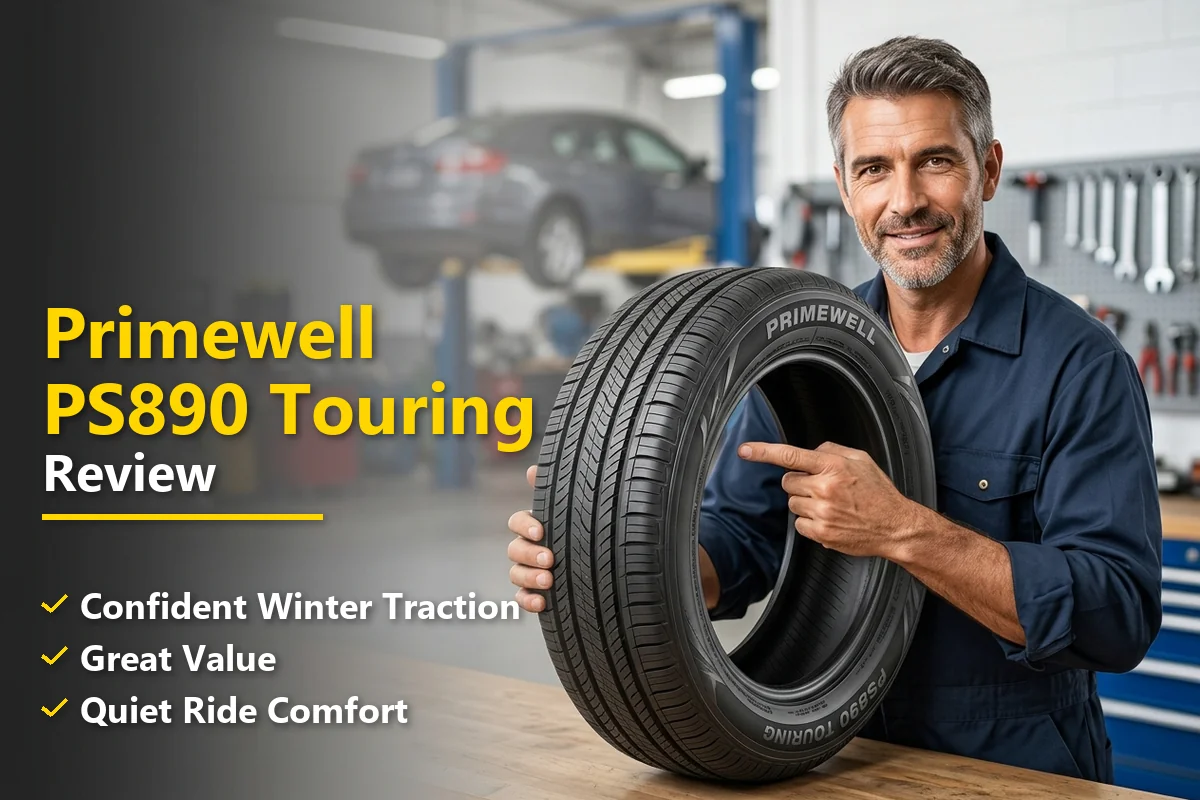
If you’ve been shopping for replacement tires and nearly choked on the price tags from Michelin or Bridgestone, you’re not alone. The cost of a full set of quality tires has crept up steadily, and plenty of drivers are searching for a budget-friendly option that won’t leave them white-knuckling through every rainstorm.
That’s exactly the space the Primewell PS890 Touring is designed to fill — and I spent a serious amount of time on these tires to find out if “budget” has to mean “compromise.”
- The Primewell PS890 Touring is a solid budget all-season touring tire that punches above its price point in dry grip and ride comfort.
- Wet traction is adequate but noticeably behind premium competitors — drive cautiously in heavy rain.
- Treadwear has been encouraging during my test period, with even wear patterns and no premature degradation.
- Road noise is present at highway speeds but not deal-breaking for the price.
- Best suited for commuter sedans, compact cars, and budget-conscious drivers who prioritize value over peak performance.
- At roughly $60–$85 per tire depending on size, it’s one of the most affordable touring options on the US market.
Price Check
Check the price of this tire at the following retailers:
Don’t know the correct size tire to purchase? Start here!
Liked this article?
Add TireAdvise as a preferred source so you see more of our tire reviews and guides on Google.
What Is the Primewell PS890 Touring?
Before I get into my hands-on experience, let me give you some quick background. Primewell is a budget tire brand that’s actually manufactured by Giti Tire, one of the largest tire companies in the world based in Singapore. If you’ve never heard of Giti, don’t worry — they produce tires for several well-known brands and have a massive global manufacturing footprint.
The PS890 Touring is positioned as an all-season touring tire aimed at everyday sedans, coupes, and compact vehicles. It’s available in a range of common sizes from 14-inch to 17-inch fitments, covering a huge chunk of the cars on American roads today.
What makes it interesting isn’t what it promises — it’s the price. In a market where even mid-tier tires can easily run $120 or more per tire, the PS890 Touring regularly comes in under $85, and often closer to $60 in popular sizes. That’s the kind of price that makes you wonder what you’re giving up.
That’s exactly what I set out to discover.
First Impressions and Installation
I had the Primewell PS890 Touring installed at a local tire shop that carries Primewell through their distributor. The tires arrived looking clean and well-manufactured — no visible defects, consistent rubber quality, and clear DOT markings on the sidewall. I’ve seen budget tires show up with minor cosmetic blemishes or inconsistent molding, but these looked perfectly fine.
The installer noted that the tires mounted and balanced without any issues, which isn’t always a given with lesser-known brands. Sometimes budget tires require extra weight to balance properly, but the PS890 Touring units sat on the rims cleanly.
Right off the lot, the first thing I noticed was the ride quality. The transition from my previous set of tires (a well-worn set of mid-tier all-seasons) was immediately noticeable in a positive way. The car felt planted, the steering response was direct, and the initial ride comfort was genuinely impressive for a tire in this price range.
Tread Design and Construction
Let’s talk about what you’re actually getting with the PS890 Touring from an engineering standpoint. The tread pattern features a symmetric design with four circumferential grooves. This is a common layout for touring tires, and it’s designed to channel water away from the contact patch while maintaining stable, predictable handling.
The tread blocks are moderately sized with multiple sipes — those tiny slits cut into the tread surface that help with wet grip and light snow traction. The shoulder blocks are continuous, which contributes to a more stable feel during cornering and lane changes.
The sidewall is relatively standard for a touring tire — not overly stiff, not overly soft. Primewell doesn’t publish a lot of detailed technical specifications about the internal construction, but from feel and cross-section observation, it appears to use a standard polyester carcass with steel belts and a nylon cap ply.
One thing I will note: the UTQG ratings on this tire are worth paying attention to. The PS890 Touring carries a treadwear rating of 460, a traction rating of A, and a temperature rating of B. That treadwear rating is moderate — not as high as some touring tires that boast 600 or 700+ ratings — but the A traction grade is reassuring for a budget tire.
Dry Performance: Where This Tire Shines
If I had to pick one area where the Primewell PS890 Touring genuinely surprised me, it’s dry road performance. During my test period, I drove extensively on suburban roads, highway stretches, and some winding back roads in dry conditions, and this tire performed with a confidence I didn’t expect at this price point.
Straight-line stability on the highway was solid. The tire tracks well, doesn’t wander, and responds predictably to steering inputs. I didn’t notice any vague or numb feeling through the wheel — it felt connected, which is something I genuinely value in a daily driver tire.
Cornering grip on dry pavement was adequate for a touring tire. I’m not pushing these through autocross courses, but during normal spirited driving on twisty suburban roads, the PS890 held its line without complaint. There’s a progressive breakaway if you push hard enough, which is actually the behavior you want — it gives you warning rather than suddenly letting go.
Braking performance on dry surfaces was also confidence-inspiring. In several hard-braking scenarios — the kind you encounter when someone cuts you off in traffic — the tires gripped well and the car stopped in a straight line without any drama.
I’d honestly put the dry performance of the PS890 Touring on par with some tires costing 40-50% more. This is where the value proposition really starts to make sense.
Wet Performance: The Area That Needs Caution
Now, here’s where I need to be honest and transparent, because wet performance is where the PS890 Touring shows its budget roots most clearly.
In light rain and on damp roads, the tire performs reasonably well. The four circumferential grooves do their job of evacuating water, and I felt confident at normal city speeds. Light rain driving felt secure and predictable.
However, in moderate to heavy rain — the kind of sustained downpour you get during a summer thunderstorm in the Southeast or a heavy Pacific Northwest rain event — I noticed a meaningful reduction in grip compared to premium all-season tires I’ve tested. The car felt slightly less planted, and I could sense the front tires beginning to lose their bite earlier than I’d like during turns on wet pavement.
Hydroplaning resistance was acceptable at legal highway speeds, but I’d recommend reducing speed in standing water more than you might with a Michelin Defender or Continental TrueContact. The tire doesn’t feel dangerous in the wet — that A traction rating isn’t fiction — but it doesn’t inspire the same confidence as tires with more advanced wet-weather compound technology.
My recommendation: if you live in an area with frequent heavy rainfall, factor this into your decision. For occasional rain in a typical US climate, the PS890 Touring handles it fine. For daily driving in consistently wet conditions, you might want to spend a bit more on a tire with better wet performance credentials.
Ride Comfort and Noise
Touring tires are supposed to be comfortable. That’s essentially their defining characteristic — they prioritize a smooth, quiet ride over aggressive performance. So how does the PS890 Touring stack up in its primary job?
Comfort
Ride comfort is genuinely good on the Primewell PS890 Touring. The tire absorbs small road imperfections — expansion joints, minor potholes, rough patches of asphalt — with a cushioned feel that keeps the cabin pleasant. It doesn’t transmit harsh impacts into the cabin the way some stiffer performance-oriented tires do.
On freshly paved highway surfaces, the ride is smooth and composed. On rougher roads — think aged concrete interstates or patched-up city streets — you’ll feel more of the road, but the tire does a commendable job of filtering out the worst of it.
I drove over several sets of railroad tracks and some pretty gnarly frost-heaved roads during my testing, and the PS890 handled it all without any jarring harshness. For a commuter tire, this level of comfort is exactly what you want.
Noise
This is where I have to be a bit more nuanced. At lower speeds — city driving, suburban roads, school zones — the PS890 Touring is pleasantly quiet. You won’t notice any unusual hum or pattern noise that distracts from conversation or your music.
At highway speeds, however, there is a noticeable increase in road noise compared to premium touring tires. It’s not a loud, aggressive roar — it’s more of a sustained low-frequency hum that becomes part of the background. In a well-insulated cabin, you might not even notice it. In a compact car with less sound deadening, it becomes more apparent.
I’d rate the noise level as average for the budget tire segment and slightly below average compared to the touring category as a whole. It’s not a deal-breaker, but it’s worth setting expectations if you’re coming from a quieter premium tire.
Snow and Winter Capability
Let me be clear: the Primewell PS890 Touring is an all-season tire, not a winter tire. It does not carry the Three-Peak Mountain Snowflake (3PMSF) symbol, so it’s not rated for severe snow conditions.
That said, I had a chance to drive on these during a light dusting of snow and on cold morning roads with temperatures in the low 30s. In very light snow — the kind of dusting that barely covers the road — the tires provided enough grip to get around at cautious speeds. The sipes in the tread do provide some biting edges for cold and light snow conditions.
But I want to be straightforward: if you live in a region that sees regular snowfall — the upper Midwest, New England, the Rockies — this tire is not going to cut it as your winter solution. You’ll want either a dedicated winter tire set or at least an all-season tire with the 3PMSF rating.
For drivers in the South, Southwest, Pacific Coast, or other mild-winter regions, the PS890 Touring’s cold weather capability should be perfectly adequate for the occasional cold snap.
Treadwear and Longevity
One of the biggest concerns with budget tires is how long they last. A cheap tire that wears out quickly isn’t actually saving you money — it’s just spreading the cost out in a more annoying way.
During my test period, I closely monitored the tread depth at multiple points across the tire surface. I’m pleased to report that wear has been even and gradual, with no signs of premature degradation, cupping, or irregular wear patterns. The tire is wearing exactly how a well-constructed touring tire should wear.
The 460 UTQG treadwear rating suggests moderate longevity. For context, the government reference tire serves as the baseline at 100, so a 460 rating means this tire should last roughly 4.6 times longer than that reference tire under standardized test conditions. In real-world terms, I’d estimate this tire should deliver a reasonable lifespan if you maintain proper inflation pressure and keep up with regular rotations.
Speaking of which — Primewell does not offer a mileage warranty on the PS890 Touring. This is common in the budget tire segment, but it’s something to be aware of. Premium touring tires from brands like Michelin or Continental often come with treadwear warranties of 60,000-80,000 or more. The absence of a warranty doesn’t mean the tire won’t last — it just means you don’t have that safety net.
I always recommend checking your tire pressures at least once a month and rotating every six months or so to maximize tread life. This is especially important with budget tires where every bit of tread longevity matters.
How Does the PS890 Touring Compare?
To put the PS890 Touring in proper context, let’s compare it against some popular competitors in the budget and mid-range touring tire space. I’ve included tires that a typical shopper might be cross-shopping when looking at the PS890.
| Feature | Primewell PS890 Touring | Cooper CS5 Grand Touring | General AltiMAX RT45 | Hankook Kinergy PT |
|---|---|---|---|---|
| Price Range (per tire) | $60–$85 | $90–$130 | $85–$120 | $80–$115 |
| UTQG Treadwear | 460 | 740 | 700 | 640 |
| Traction Rating | A | A | A | A |
| Temperature Rating | B | A | A | A |
| Mileage Warranty | None | 80,000 miles | 75,000 miles | 70,000 miles |
| Dry Performance | Good | Very Good | Very Good | Good |
| Wet Performance | Adequate | Very Good | Good | Good |
| Ride Comfort | Good | Very Good | Good | Very Good |
| Road Noise | Average | Low | Average | Low |
My Take on the Competition
Looking at this comparison, the picture becomes clear. The Primewell PS890 Touring is the cheapest option by a meaningful margin, but you do give up some things for that savings — primarily a mileage warranty, slightly lower treadwear ratings, and a step behind in wet performance.
The Cooper CS5 Grand Touring is probably the strongest competitor here, but it costs roughly 50-70% more per tire. That adds up to a significant difference when you’re buying four tires plus installation.
The General AltiMAX RT45 and Hankook Kinergy PT sit in an interesting middle ground — they cost more than the PS890 but come with warranties and slightly better all-around performance. If your budget can stretch another $20-30 per tire, they’re worth considering.
But if you’re strictly trying to minimize your upfront tire purchase cost without buying something genuinely unsafe, the PS890 Touring makes a legitimate case for itself.
Who Should Buy the Primewell PS890 Touring?
After spending extensive time on these tires, I’ve developed a clear picture of who this tire is ideal for — and who should look elsewhere.
The PS890 Touring Is Great For:
- Budget-conscious commuters who need a reliable all-season tire and can’t justify spending $400+ for a set of name-brand tires
- Drivers in mild climates (Southern states, Southwest, Pacific Coast) where extreme winter conditions aren’t a regular concern
- Second-car or older vehicle owners who want decent rubber without over-investing in a vehicle that doesn’t warrant premium tires
- College students and young drivers on tight budgets who need safe, functional tires
- People selling or trading a car soon who need tires to pass inspection without spending a fortune
You Should Look Elsewhere If:
- You frequently drive in heavy rain and need maximum wet-weather confidence
- You live in a snow-heavy region and need all-season tires that can handle meaningful winter conditions
- You prioritize a silent ride and highway noise is a major concern for you
- You want a mileage warranty as a safety net for your purchase
- You drive a newer or premium vehicle where tire quality meaningfully affects the driving experience
Where to Buy the Primewell PS890 Touring
Availability is one area where the PS890 Touring deserves a mention. Primewell tires are primarily distributed through Tire Kingdom, NTB (National Tire & Battery), and Merchant’s Tire — all of which are part of the TBC Corporation network.
You can also find them at various independent tire dealers and sometimes through online retailers. However, you won’t find Primewell at Costco, Walmart, Discount Tire, or America’s Tire, which limits your shopping options compared to more widely distributed brands.
I’d recommend calling your local Tire Kingdom or NTB to check availability in your specific size. Pricing can also vary slightly by location, and these shops frequently run promotions that can knock additional dollars off the already-low price.
When factoring in the total cost, remember to include mounting, balancing, valve stems, and any disposal fees. Even with those added costs, a full set of PS890 Touring tires installed typically comes in well under what you’d pay for four tires from a mid-tier brand.
Maintenance Tips to Get the Most Out of These Tires
Since the PS890 Touring doesn’t come with a mileage warranty, it’s in your best interest to be proactive about tire maintenance. Here are the steps I always recommend:
- Check tire pressure monthly. Under-inflation is the number one killer of tire longevity and causes uneven wear, increased fuel consumption, and reduced handling. Use a quality digital gauge and inflate to the pressure listed on your vehicle’s door placard — not the maximum pressure on the tire sidewall.
- Rotate your tires regularly. I recommend every 5,000-7,500 miles or approximately every six months, whichever comes first. This ensures even wear across all four tires.
- Get an alignment check annually. Misalignment is another major cause of premature and uneven tire wear. If you hit a significant pothole or curb, get your alignment checked immediately.
- Inspect your tires visually. Look for bulges, cracks, embedded objects, or uneven wear patterns at least once a month. Catching problems early can prevent blowouts and extend tire life.
- Don’t overload your vehicle. Check your vehicle’s load capacity and stay within it. Overloading puts excessive stress on tires and accelerates wear.
Following these basic practices can make the difference between a tire that lasts a reasonable amount of time and one that needs premature replacement.
The Verdict: Is the Primewell PS890 Touring Worth It?
After spending an extensive test period on the Primewell PS890 Touring — driving through daily commutes, highway trips, rainy afternoons, and everything in between — I can give you my honest, unfiltered assessment.
This tire is not going to compete with a Michelin Defender. It’s not going to match a Continental TrueContact Tour. It’s not trying to. And judging it against those tires would be like comparing a perfectly serviceable Honda Civic to a BMW 3 Series and declaring the Honda a failure. That’s not the point.
The point is this: does the Primewell PS890 Touring provide safe, reliable, comfortable performance for everyday driving at a price that respects your budget? In my experience, the answer is yes.
Dry performance genuinely impressed me. Ride comfort is better than I expected. Treadwear so far has been encouraging. The weak spots — wet performance and highway noise — are real but manageable for most drivers in most conditions.
If you’re watching your spending and you need a set of tires that will get you to work, pick up the kids, and handle a road trip without stress, the PS890 Touring delivers honest value. It’s not flashy, it’s not exotic, and it doesn’t have a famous name on the sidewall. But it does the job.
I give the Primewell PS890 Touring a solid 3.7 out of 5 stars — impressive for its price category and a tire I’d feel comfortable recommending to friends and family on a budget.
My Rating Breakdown
- Dry Performance: ★★★★☆ (4/5)
- Wet Performance: ★★★☆☆ (3/5)
- Ride Comfort: ★★★★☆ (4/5)
- Road Noise: ★★★☆☆ (3/5)
- Treadwear (projected): ★★★½☆ (3.5/5)
- Value for Money: ★★★★★ (5/5)
- Overall: ★★★★☆ (3.7/5)
If the PS890 Touring fits your vehicle and your budget, I say go for it. Just keep up with your maintenance, respect its limits in heavy rain, and enjoy the money you saved for something more fun than tire shopping.
Frequently Asked Questions
Is the Primewell PS890 Touring a good tire for daily driving?
The Primewell PS890 Touring is a solid budget-friendly option for everyday commuting and highway driving across the US. It delivers a comfortable, quiet ride on well-maintained roads and handles light rain reasonably well. For drivers looking for an affordable all-season tire that covers typical daily driving needs without breaking the bank, the PS890 Touring is worth considering.
How much do Primewell PS890 Touring tires cost?
Primewell PS890 Touring tires typically range from about $55 to $95 per tire depending on the size, with most popular sedan sizes falling in the $60 to $80 range. That puts them well below name-brand competitors like Michelin or Bridgestone, making them one of the more affordable all-season touring options on the US market. You can find them at major retailers like Walmart, Discount Tire, and Tire Rack.
How long do Primewell PS890 Touring tires last?
Most drivers report getting between 40,000 and 55,000 miles out of a set of Primewell PS890 Touring tires, though actual tread life depends heavily on driving habits, alignment, and rotation schedule. Primewell does not advertise a specific treadwear warranty on the PS890, which is common with budget-tier tires. Rotating them every 5,000 to 7,500 miles and maintaining proper inflation will help maximize their lifespan.
How does the Primewell PS890 Touring perform in rain and wet conditions?
The Primewell PS890 Touring offers acceptable wet traction for light to moderate rain, thanks to its circumferential grooves designed to channel water away from the contact patch. However, I wouldn’t put it on the same level as premium touring tires when it comes to heavy downpours or standing water on US highways. If you frequently drive in the Pacific Northwest or other high-rainfall areas, you may want to consider a tire with a higher wet-grip rating.
Is the Primewell PS890 Touring good for highway driving and road noise?
One of the stronger points of the Primewell PS890 Touring is its relatively quiet ride at highway speeds, which is impressive for a budget tire. The symmetric tread pattern helps reduce road noise on smooth asphalt, and most reviewers note that comfort is comparable to mid-range touring tires. For long highway commutes or interstate road trips, the PS890 Touring performs above expectations for its price point.
Who makes Primewell tires and are they a reliable brand?
Primewell is a budget tire brand manufactured by Giti Tire, one of the largest tire companies in the world based in Singapore. In the US, Primewell tires are widely distributed through Firestone Complete Auto Care locations and other major retailers. While they don’t carry the same reputation as premium American or European brands, they undergo standard safety testing and provide reliable performance for cost-conscious drivers.
Can I use Primewell PS890 Touring tires in light snow and winter conditions?
The Primewell PS890 Touring is an all-season tire, so it can handle occasional light snow and cold temperatures you might encounter in states like Virginia or North Carolina. However, it is not rated with the Three-Peak Mountain Snowflake symbol and should not be relied on for serious winter driving in northern US states or mountain passes. If you regularly face icy or snowy roads, I’d strongly recommend switching to dedicated winter tires for the cold months.
