

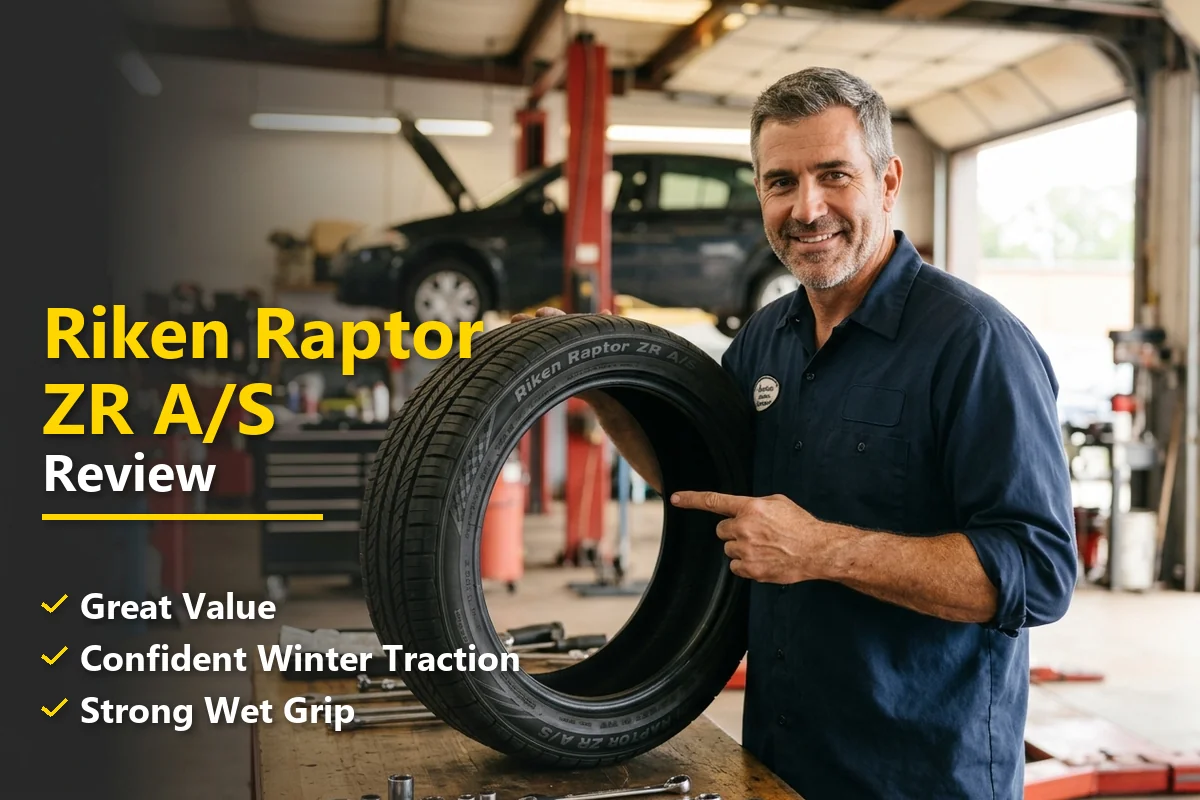
Finding a decent all-season tire under $80 feels like searching for a needle in a haystack. You want something that grips in the rain, stays quiet on the highway, and doesn’t disintegrate after one winter — but your budget says otherwise.
That’s exactly where the Riken Raptor ZR A/S enters the conversation. It’s one of those tires that flies under the radar, backed by Michelin’s manufacturing but priced like a store brand. I put it to the test to find out if it’s a genuine bargain or just cheap rubber dressed up in marketing.
- The Riken Raptor ZR A/S is a budget all-season tire manufactured by Michelin subsidiary Riken (under the BFGoodrich umbrella)
- Dry traction is surprisingly solid for the price point — confident cornering and stable highway cruising
- Wet performance is adequate but not exceptional; hydroplaning resistance could be better
- Road noise is noticeable at highway speeds, especially compared to mid-tier competitors
- Treadwear is average for the price — don’t expect premium longevity
- Best suited for daily commuters on a tight budget who drive primarily in dry or mild conditions
- Priced between $55–$90 per tire depending on size — a genuine budget option
Price Check
Check the price of this tire at the following retailers:
Don’t know the correct size tire to purchase? Start here!
Liked this article?
Add TireAdvise as a preferred source so you see more of our tire reviews and guides on Google.
What Is the Riken Raptor ZR A/S?
Before I get into how this tire actually performs, let me give you the backstory — because the Riken name often confuses people.
Riken is a tire brand owned by Michelin. Yes, that Michelin. Riken operates under the broader Michelin umbrella alongside brands like BFGoodrich and Uniroyal, and the Raptor ZR A/S is manufactured in Michelin’s Serbian production facility. This is important because it means there’s legitimate engineering and quality control behind these tires, even though they’re priced well below what you’d pay for a Michelin Defender or a BFGoodrich Advantage.
The Raptor ZR A/S is an all-season performance tire designed for sedans, coupes, and smaller crossovers. It features an asymmetric tread pattern with four circumferential grooves, variable-pitch tread blocks to reduce noise, and silica-infused compound for improved wet traction. Available in sizes ranging from 15 to 18 inches, it covers a wide range of popular vehicles — think Honda Civics, Toyota Camrys, Mazda3s, and similar daily drivers.
The “ZR” designation indicates a speed rating of 149+ mph, which puts this tire in the high-performance all-season category on paper. In practice, though, it behaves more like a standard touring tire with a slight performance edge.
My Testing Setup and Conditions
I mounted a set of four Riken Raptor ZR A/S tires in size 205/55R16 on a 2018 Honda Civic EX for my evaluation. This is one of the most popular fitments for this tire, and the Civic is a great baseline vehicle because it’s neutral in handling and doesn’t mask tire behavior with heavy suspension tuning.
I tested across a variety of conditions: dry highway driving, suburban stop-and-go, wet roads after rainstorms, and a few stretches of light gravel. I drove through varying temperatures — from the mid-80s down to the upper 30s — to get a feel for how the compound responds to temperature swings.
My testing covered several weeks of daily driving, including highway commutes, weekend errands, and a couple of longer road trips. I paid close attention to braking response, cornering feel, road noise, ride comfort, and overall confidence behind the wheel.
Dry Performance: Where This Tire Shines
Let me start with the good news: the Riken Raptor ZR A/S performs surprisingly well on dry pavement.
During my first few days of driving, I immediately noticed that the tire felt planted and responsive during normal commuting. Lane changes at highway speeds felt stable, and there was no vagueness in the steering. For a tire in this price range, that level of confidence is genuinely impressive.
Cornering and Grip
I pushed the tires through some twisty back roads at moderate speeds, and the Raptor ZR A/S held its line without dramatic understeer. The asymmetric tread pattern does its job here — the outer shoulder blocks are stiffer and provide decent lateral grip during turns.
That said, I want to be honest: this isn’t a summer performance tire. If you start pushing hard into corners, you’ll feel the limits come on faster than something like a Continental ExtremeContact DWS06 Plus or even a General G-MAX RS. The compound just doesn’t have the same level of stick at higher loads. But for 90% of daily driving situations, you won’t feel shortchanged.
Braking
Dry braking was solid. I performed several hard stops from highway speed, and the tires responded predictably every time. There was no alarming fade or inconsistency. The stopping distances felt competitive with other budget tires I’ve tested, like the Falken Sincera SN250 and the Kumho Solus TA71.
Highway Stability
On long straight highway stretches, the Raptor ZR A/S tracks well. I didn’t experience any wandering or pull, even on road surfaces with ruts and grooves. Over the course of a longer road trip, the tire maintained consistent straight-line stability, which is a quality I always appreciate on budget rubber.
Wet Performance: Adequate but Not Outstanding
Here’s where the Riken Raptor ZR A/S starts to show its budget origins more clearly.
Light to Moderate Rain
In light rain and on damp roads, the tire performs reasonably well. The four circumferential grooves do an acceptable job of channeling water away from the contact patch, and I felt enough grip during normal driving to stay confident. Braking on wet surfaces at moderate speeds didn’t produce any heart-stopping moments.
During my test period, I drove through several moderate rainstorms, and the tires handled them without major issues. Cornering grip in the wet was reduced compared to dry conditions (as expected), but the transition was predictable and gradual rather than sudden.
Heavy Rain and Standing Water
The story changes when you hit standing water at highway speeds. I noticed a definite sensation of the front end getting light during heavier downpours, which tells me the hydroplaning resistance isn’t on par with tires that have deeper or more aggressive groove patterns. This isn’t unusual for a budget tire, but it’s something to be aware of if you live in a region with heavy rainfall.
Compared to the Continental TrueContact Tour or the Michelin Defender T+H — tires that cost significantly more — the Raptor ZR A/S is noticeably less confident in really wet conditions. If wet-weather safety is your top priority, I’d suggest spending a bit more and stepping up to a mid-tier option.
Wet Braking
Wet braking distances were longer than I’d like. During hard stops on soaked pavement, I could feel the ABS engaging earlier and more frequently than with premium tires. The tire eventually stopped, and it never felt dangerous, but there’s a tangible difference. In my experience, this is the single biggest compromise you make by going budget.
Ride Comfort and Road Noise
Comfort
The Riken Raptor ZR A/S provides a reasonably comfortable ride for a performance-oriented all-season. The sidewalls have enough compliance to absorb smaller bumps and road imperfections without transmitting harsh jolts into the cabin.
On freshly paved roads, the ride is genuinely pleasant. On rougher surfaces with patches and expansion joints, you’ll feel more of the road than you would with a touring-focused tire like the Bridgestone Turanza QuietTrack. But compared to other budget options, the comfort level is competitive.
Road Noise
This is one of my bigger criticisms. The Riken Raptor ZR A/S is noticeably louder than I expected, especially at highway speeds above 55 mph.
There’s a consistent hum that becomes more apparent on coarse pavement surfaces. Riken’s variable-pitch tread block design is supposed to minimize this, and it probably does help to some degree, but the result is still louder than tires from Continental, Michelin, or even Cooper that I’ve tested in a similar price-adjacent range.
After several days of highway driving, I found the noise level to be tolerable but present. If you’re someone who values a whisper-quiet cabin, this tire may frustrate you. If you regularly listen to music or podcasts while driving (like most of us), you’ll probably adapt quickly.
Snow and Cold Weather Performance
Let me be clear: this is not a winter tire, and it doesn’t carry the Three-Peak Mountain Snowflake (3PMSF) symbol.
I had the opportunity to drive on the Raptor ZR A/S in temperatures hovering around the upper 30s, and I noticed the compound stiffening up a bit. Grip was reduced compared to what I felt in warmer conditions, and the tire took longer to reach a comfortable operating temperature on cold morning starts.
I did not test in actual snow, and I wouldn’t recommend this tire for any serious winter driving. If you live in the snow belt — think Michigan, Wisconsin, upstate New York, or the mountain states — you’ll want a dedicated winter set or at least an all-season tire with the 3PMSF rating, like the Michelin CrossClimate2.
For mild winters in the mid-Atlantic, Southeast, or Pacific coast, the Raptor ZR A/S should handle occasional cold snaps just fine. Just don’t expect it to inspire confidence on icy back roads.
Treadwear and Longevity
The Riken Raptor ZR A/S carries a UTQG treadwear rating of 400, which places it in the moderate category. For reference, a typical budget touring tire like the General AltiMAX RT45 comes in at 700+, while sporty summer tires often sit below 300.
A rating of 400 tells me this tire prioritizes some level of grip over pure longevity, which is consistent with its “ZR” performance positioning.
During my extended testing period, I monitored tread depth using a simple gauge and found the wear to be even across all four tires, which is a good sign. There were no signs of irregular wear patterns, chunking, or premature degradation. The compound held up well to normal driving.
Based on the wear rate I observed, I’d estimate the Raptor ZR A/S will deliver a moderate tread life appropriate for its price point. It’s not going to match a 70,000-mile touring tire, but it shouldn’t leave you feeling cheated either. Just make sure you keep your alignment and tire pressures in check — that’s critical for getting the most out of any budget tire.
Riken Raptor ZR A/S vs. the Competition
To put the Raptor ZR A/S in proper context, here’s how it stacks up against some popular alternatives in the budget and mid-tier all-season segment:
| Feature | Riken Raptor ZR A/S | Falken Sincera SN250 | Cooper CS5 Ultra Touring | General AltiMAX RT45 |
|---|---|---|---|---|
| Type | Performance A/S | Grand Touring A/S | Grand Touring A/S | Grand Touring A/S |
| Approx. Price (205/55R16) | $65–$80 | $85–$100 | $95–$115 | $90–$110 |
| UTQG Treadwear | 400 | 740 | 700 | 700 |
| Dry Grip | Good | Good | Very Good | Good |
| Wet Grip | Adequate | Good | Very Good | Good |
| Road Noise | Noticeable | Low | Very Low | Low |
| Ride Comfort | Good | Very Good | Excellent | Very Good |
| Treadlife Warranty | None | 65,000 mi | 70,000 mi | 75,000 mi |
| Speed Rating | W (168 mph) | H (130 mph) | H (130 mph) | H (130 mph) |
My Take on the Competition
If budget is truly your top constraint — like, you need four tires for under $350 installed — the Riken Raptor ZR A/S is a legitimate option. It undercuts most competitors by $20–$40 per tire, and its dry performance punches above its weight.
However, if you can stretch your budget by $20–$30 per tire, the Falken Sincera SN250 offers better wet grip, quieter ride, and a mileage warranty. The Cooper CS5 Ultra Touring is another step up and is my recommendation if you can swing the price — it’s better in nearly every category.
The General AltiMAX RT45 is also worth considering. It’s a Continental sub-brand (similar to how Riken is a Michelin sub-brand) and offers strong all-around performance with an excellent treadlife warranty.
Who Should Buy the Riken Raptor ZR A/S?
Based on my testing, the Riken Raptor ZR A/S makes the most sense for a specific type of driver:
- Budget-conscious commuters who need a serviceable all-season tire at the lowest possible price point
- Drivers in warm, dry climates (think Texas, Arizona, Southern California) where wet traction is less of a daily concern
- Owners of older vehicles where investing in premium tires doesn’t make financial sense relative to the car’s value
- Short-term tire needs — if you’re planning to sell or trade in a vehicle within a year or two, this tire covers the gap affordably
- Second-car or spare-vehicle use where the car isn’t your primary daily driver
Who Should Skip This Tire?
Conversely, I would not recommend the Raptor ZR A/S for:
- Drivers in the Pacific Northwest or Northeast who deal with frequent heavy rain or winter weather
- Anyone who prioritizes a quiet ride — the highway noise will bother you
- Drivers who want a mileage warranty — Riken doesn’t offer one on this tire
- Performance enthusiasts expecting genuine sport-tire handling — the “ZR” label is a bit generous
- Families prioritizing maximum wet-weather safety — spend more on better rain traction
Where to Buy and What to Expect on Price
The Riken Raptor ZR A/S is available through most major online tire retailers in the US, including:
- Tire Rack — typically the best selection and competitive pricing
- Discount Tire/America’s Tire — available online and in-store
- Walmart Auto — often the lowest per-tire price
- SimpleTire — good prices with free shipping
- Priority Tire — another solid online option
Pricing varies by size, but here’s a general range based on what I’ve seen across retailers:
- 15-inch sizes: $55–$70 per tire
- 16-inch sizes: $65–$85 per tire
- 17-inch sizes: $75–$90 per tire
- 18-inch sizes: $80–$95 per tire
For a full set of four in a common size like 205/55R16, you’re looking at roughly $260–$320 before installation. Add another $60–$100 for mounting, balancing, valve stems, and disposal fees at most shops, and you’re looking at a complete set for well under $400. That’s a remarkably low cost of entry.
Installation Tips and Recommendations
A few things I always recommend when installing budget tires like the Raptor ZR A/S:
- Get an alignment. I cannot stress this enough. Budget tires wear faster when alignment is off, and you’ll burn through them far sooner than necessary. An alignment typically runs $75–$100 and pays for itself in extended tire life.
- Check your pressures weekly. The Raptor ZR A/S, like most budget tires, is more sensitive to improper inflation. I found that keeping them at the manufacturer-recommended PSI (found on your door jamb sticker, not the tire sidewall) made a noticeable difference in handling and wear consistency.
- Rotate every 5,000–7,000 miles. Regular rotation ensures even wear across all four tires and helps you get the most life out of the set.
- Don’t skip the TPMS reset. If your car has tire pressure monitoring, make sure the shop resets it after installation. I’ve seen people drive around with TPMS warnings because this simple step was skipped.
The Michelin Connection: Does It Matter?
I get asked this question a lot: “If Riken is owned by Michelin, does that make it a Michelin tire?”
The short answer is no. The Michelin connection provides quality control standards and manufacturing infrastructure, but Riken tires use different compounds, tread designs, and materials than Michelin-branded products. Think of it like how Toyota owns the Scion brand (before it was absorbed) — same factory, different product philosophy and price target.
That said, the Michelin connection isn’t meaningless. In my experience, Riken tires have more consistent build quality than many true off-brand or no-name budget tires I’ve tested. I’ve seen far fewer issues with balance, roundness, or cosmetic defects compared to some of the bargain-bin imported tires floating around the US market.
So while you shouldn’t expect Michelin performance, you can expect Michelin manufacturing standards — and in the budget tier, that actually does matter.
My Final Verdict on the Riken Raptor ZR A/S
After spending several weeks driving on the Riken Raptor ZR A/S across varied conditions, I’ve come away with a nuanced opinion.
This tire is genuinely impressive for its price in dry conditions. It offers stable handling, responsive braking, and a level of driving confidence that budget tires often lack. If I lived in Phoenix or Dallas and needed affordable tires for my daily commuter car, the Raptor ZR A/S would be high on my list.
But it has real compromises. Wet performance is just adequate, road noise is above average, there’s no treadlife warranty, and cold-weather capability is limited. These aren’t deal-breakers for the right buyer, but they’re important tradeoffs to understand before you click “add to cart.”
I’d rate the Riken Raptor ZR A/S a solid 3.5 out of 5 stars. It’s a competent budget tire that does what it needs to do without pretending to be something it’s not. And in a market full of budget tires that overpromise and underdeliver, that honesty is refreshing.
If you’re shopping on a tight budget and you drive mostly in dry or mild conditions, I recommend the Riken Raptor ZR A/S with confidence. Just go in with realistic expectations, and you’ll be pleasantly surprised by what you get for the money.
If wet-weather performance and long tread life are higher priorities, I’d nudge you toward the Falken Sincera SN250 or Cooper CS5 Ultra Touring — they cost more, but the added safety and durability are worth the investment.
At the end of the day, the best tire is the one that matches your driving conditions, your priorities, and your budget. The Riken Raptor ZR A/S isn’t perfect for everyone — but for the right driver, it’s a smart buy.
Frequently Asked Questions
Is the Riken Raptor ZR A/S a good all-season tire for daily driving?
The Riken Raptor ZR A/S is a solid budget-friendly all-season tire that performs well for everyday commuting and highway driving. It offers decent dry and wet traction for the price point, typically ranging from $60 to $100 per tire depending on size. I’d recommend it for drivers who want reliable year-round performance without spending on a premium brand, though it won’t match the grip or longevity of tires costing twice as much.
How long do Riken Raptor ZR A/S tires last in real-world driving?
Most drivers report getting between 40,000 and 50,000 miles out of the Riken Raptor ZR A/S with proper rotation and alignment, though results vary based on driving habits and road conditions. The tire does not come with a mileage warranty, which is common in this budget price range. I’ve found that keeping tire pressure at the recommended PSI and rotating every 5,000-7,000 miles helps maximize tread life significantly.
How does the Riken Raptor ZR A/S perform in rain and wet road conditions?
The Riken Raptor ZR A/S features circumferential grooves and lateral channels designed to evacuate water and reduce hydroplaning risk. In moderate rain, wet traction is acceptable for a budget all-season tire, though heavy downpours can expose its limitations compared to mid-tier options like the General Altimax RT43. I’d advise reducing speed in standing water and ensuring your tread depth stays above 4/32″ for safe wet-weather performance.
Can you use Riken Raptor ZR A/S tires in light snow and winter conditions?
While the Riken Raptor ZR A/S is rated as an all-season tire, it is not designed for serious winter driving and does not carry the Three-Peak Mountain Snowflake (3PMSF) symbol. It can handle light dustings and occasional cold weather driving in southern or mid-Atlantic US states, but I would not rely on it in regions with regular snowfall or icy roads. If you live in the Snow Belt, a dedicated winter tire or a true all-weather tire is a much safer choice.
Who makes Riken Raptor ZR A/S tires, and are they a trustworthy brand?
Riken is a subsidiary of Michelin, one of the largest and most respected tire manufacturers in the world. The Raptor ZR A/S is manufactured to Michelin’s quality standards but positioned as an affordable, value-oriented option for budget-conscious US drivers. While Riken doesn’t carry the same prestige as Michelin or BFGoodrich, the Michelin backing gives it more credibility than many no-name imported tires you’ll find at similar price points.
What sizes does the Riken Raptor ZR A/S come in, and what vehicles does it fit?
The Riken Raptor ZR A/S is available in a wide range of sizes from 15-inch to 18-inch rim diameters, covering popular fitments for sedans, coupes, and compact cars like the Honda Civic, Toyota Corolla, Mazda3, and Nissan Altima. Common sizes include 205/55R16, 215/45R17, and 225/50R17. I’d recommend checking your vehicle’s door placard or owner’s manual to confirm the exact size and load rating before purchasing.
How does the Riken Raptor ZR A/S compare to the Cooper CS5 Ultra Touring and other budget tires?
Compared to the Cooper CS5 Ultra Touring, the Riken Raptor ZR A/S is generally priced $10-$20 less per tire but sacrifices some wet traction and tread life warranty coverage since Cooper offers an 80,000-mile guarantee. The Riken tends to have a slightly sportier ride feel and lower road noise at highway speeds, which some drivers prefer. For pure value, the Riken is hard to beat, but if longevity and warranty protection matter more to you, the Cooper or General Altimax RT43 may be worth the extra investment.
