

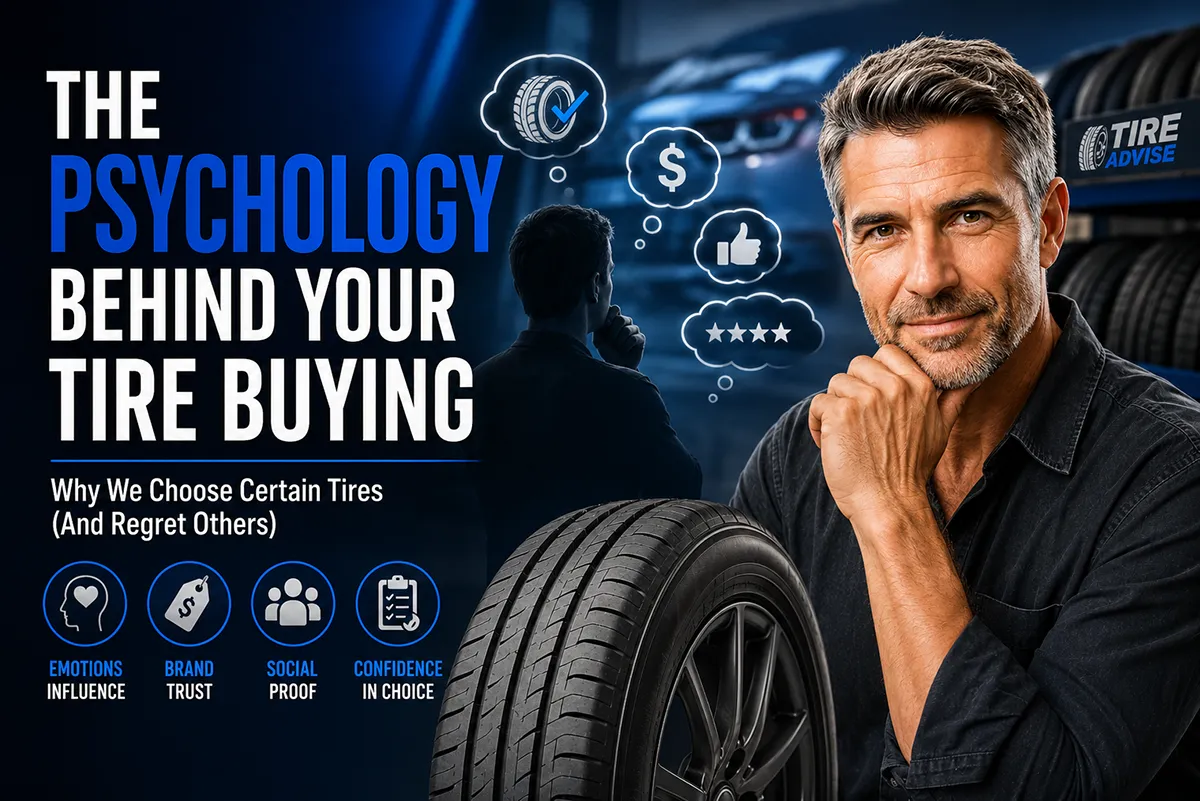
Most people think they buy tires based on logic — price, tread life, performance ratings. But after spending years reviewing tires and watching how real buyers make decisions, I can tell you something surprising: your tire purchase is mostly emotional.
I’ve stood in tire shop lobbies and watched people override their own research in seconds. A salesperson mentions “safety” and suddenly the budget jumps $400. A friend recommends a brand, and all that comparison shopping goes out the window.
Understanding the psychology behind your tire buying isn’t just interesting — it’s the key to making a smarter purchase that actually fits your needs and budget.
- Most tire purchases are driven by emotion (fear, brand loyalty, social proof) rather than data
- The “safety guilt trip” is the #1 psychological lever that makes you overspend
- Brand loyalty often costs you 20-40% more without a proportional performance gain
- Anchoring bias makes you think a mid-tier tire is a “deal” when it’s exactly what the shop wanted to sell you
- Decision fatigue is real — too many choices leads to impulse buying or defaulting to the most expensive option
- Understanding these mental traps helps you buy the right tire at the right price
Liked this article?
Add TireAdvise as a preferred source so you see more of our tire reviews and guides on Google.
Why I Started Paying Attention to Tire Buying Psychology
I’ve been reviewing tires for years now. I test them on real roads in real conditions — wet highways, gravel shoulders, scorching summer asphalt, and icy winter mornings. But somewhere along the way, I noticed something that fascinated me more than tread compounds and siping patterns.
I noticed that the tires people actually bought almost never matched the tires they said they wanted. A driver would tell me they wanted the best value all-season tire. Then they’d walk into a Discount Tire and leave with a set of premium Michelins that cost twice their stated budget.
That gap — between intention and action — is pure psychology. And once I started recognizing the patterns, I saw them everywhere. In my own buying decisions, in the readers who email me, and in the broader tire market itself.
This article isn’t about which tire you should buy. It’s about understanding the invisible forces that shape which tire you will buy — so you can take back control.
The Fear Factor: How Safety Anxiety Drives Overspending
Let me be blunt: fear is the single most powerful force in tire buying. And the tire industry knows it.
Tires are the only part of your car that touches the road. That fact alone carries enormous psychological weight. When a salesperson says, “This is what’s keeping your family safe,” your rational brain shuts down and your protective instincts kick in.
I’ve experienced this myself. During one of my early tire buying experiences — before I started reviewing tires professionally — I went into a shop planning to spend around $500 for a set of four. The salesperson casually mentioned that my chosen tire had “okay” wet braking performance, then pointed me to a set that was $180 more total. “If it were my kids in that car,” he said, “I know which one I’d pick.”
I bought the more expensive set. And here’s the thing — when I later tested both tires, the braking difference was marginal. Not zero, but nowhere near worth the premium for the average driver in normal conditions.
The Safety-Premium Trap
This is what I call the safety-premium trap. It works like this:
- A baseline tire is presented as “adequate” or “budget-friendly” (subtle code for “risky”)
- A more expensive tire is framed as the “safe choice” or “peace of mind” option
- You feel guilty choosing the cheaper option because it feels like you’re gambling with safety
- You pay more, not because the data demanded it, but because your fear demanded it
Am I saying you should ignore safety? Absolutely not. I always recommend checking NHTSA ratings and real-world braking test data. What I’m saying is that “safer” and “most expensive” are not synonyms. In my testing, I’ve found mid-range tires that outperform premium tires in specific safety-critical categories.
The key is to separate genuine safety data from emotional safety marketing.
Brand Loyalty: The Most Expensive Habit in Tire Buying
If I had a dollar for every person who told me “I only buy Michelin” or “My family has always run Goodyear,” I could buy a warehouse full of tires.
Brand loyalty in the tire market is staggeringly strong. According to consumer surveys, nearly 50% of tire buyers start their search already committed to a brand. They’re not comparison shopping — they’re confirmation shopping.
I get it. I have brand preferences too. After testing dozens and dozens of tires over the years, certain brands have earned my trust through consistent performance. But here’s the critical distinction: my preferences are based on accumulated test data, not habit or heritage.
What Brand Loyalty Actually Costs You
Let me put this in real numbers. A set of four Michelin Defender 2 tires in a popular size (225/65R17) runs about $680-$760 installed. A set of Continental TrueContact Tour in the same size — which performs within a whisker of the Michelin in most categories I test — runs about $560-$640.
That’s roughly $100-$120 in savings. For comparable performance.
Now multiply that by every tire purchase over a lifetime of driving. The brand premium adds up to thousands of dollars — money spent not on better performance, but on a name.
| Psychological Factor | How It Influences You | What to Do Instead |
|---|---|---|
| Brand Loyalty | You default to the same brand regardless of current offerings | Compare 3+ brands using current test data for your specific tire size |
| Fear/Safety Guilt | You overspend because cheaper feels unsafe | Check actual wet/dry braking data, not marketing claims |
| Anchoring Bias | The first price you see sets your mental benchmark | Research prices online before visiting a shop |
| Decision Fatigue | Too many options leads to impulse buying | Narrow to 3 finalists before shopping in person |
| Social Proof | You buy what friends, family, or online reviews recommend | Value expert testing over anecdotal reviews |
| Loss Aversion | You fear “losing” by making the wrong choice more than you value “winning” with the right one | Remember: most modern tires are safe and competent — there’s rarely a truly “wrong” choice |
When Brand Loyalty Makes Sense
I want to be fair here. Brand loyalty isn’t always irrational. If you’ve had a genuinely great experience with a specific tire line — not just the brand, but the exact model — that’s valid experiential data. I personally keep coming back to certain tire lines because they’ve performed well across multiple test cycles.
The problem is when loyalty transfers blindly. Just because the Michelin Pilot Sport 4S is an incredible performance tire doesn’t mean every Michelin product is the best in its category. Brands have hits and misses across their lineups, and I see this constantly in my testing.
Anchoring Bias: The Pricing Trick That Gets You Every Time
Anchoring is one of the most well-documented cognitive biases in behavioral economics. And it’s absolutely rampant in tire retail.
Here’s how it works in a tire shop. You walk in, and the first tire the salesperson shows you is the top-of-the-line option — let’s say $220 per tire. Your brain registers that number. It becomes the “anchor.” Then they show you a mid-range option at $155 per tire. Suddenly, $155 feels like a deal. It feels reasonable. You feel smart for not buying the expensive one.
But here’s the truth: $155 per tire might be exactly what the shop wanted to sell you from the start. The $220 tire was never the real recommendation. It was the anchor — a psychological tool to make $155 feel like a bargain.
I fell for this early in my tire buying life. I remember feeling genuinely proud of myself for “negotiating down” to the mid-tier option. In reality, I’d been guided there from the moment I walked through the door.
How to Beat Anchoring
My approach now — and what I recommend to every reader — is simple: do your price research before you set foot in a store. Use Tire Rack, Discount Tire’s website, or even Amazon to establish your own anchor.
When you know that the tire you want retails for $130 online, a salesperson quoting $155 doesn’t feel like a deal anymore. You’ve set your own reference point, and that changes the entire negotiation dynamic.
Decision Fatigue: Why Too Many Choices Leads to Bad Choices
Type your tire size into any major retailer’s website. Go ahead, I’ll wait.
You probably got back 40 to 80+ results. Touring tires, performance tires, all-seasons, all-weathers, highway tires, eco tires — the sheer volume is paralyzing. And that paralysis has a name: decision fatigue.
When your brain gets overloaded with options, one of two things happens. Either you default to the safest-seeming choice (usually the most expensive or most recognized brand), or you grab whatever the salesperson recommends just to make the pain stop.
I’ve tested this informally with friends and family. When I gave someone a curated list of three tires with a brief explanation of each, they made a confident, informed choice in minutes. When I sent them to a website with dozens of options, they either froze up and asked me to just pick, or they defaulted to the bestseller without reading a single review.
My Three-Finalist Method
Here’s the system I use personally and recommend to readers:
- Step 1: Identify your tire type (all-season, winter, performance, etc.) based on your actual driving conditions
- Step 2: Filter by your tire size and budget range
- Step 3: Read expert reviews (not just consumer reviews) and narrow to exactly three options
- Step 4: Compare those three on the specific criteria that matter most to you — wet grip, tread life, road noise, whatever your priority is
- Step 5: Buy with confidence, knowing you made a research-backed decision
Three options is the sweet spot. It’s enough to feel like you’ve compared, but not so many that your brain checks out.
Social Proof: The Hidden Power of Reviews and Recommendations
Humans are social creatures. We look to others for guidance, especially when we’re making decisions in areas where we don’t feel like experts. And let’s be honest — most people don’t feel like tire experts.
This is why online reviews have so much power. A tire with 4.7 stars and 2,000 reviews feels safe. A tire with 4.3 stars and 150 reviews feels risky. But in my experience testing tires, those ratings don’t always tell the full story.
The Problem with Consumer Tire Reviews
Here’s something I’ve observed after years of comparing my own test results to consumer ratings: there’s often a significant disconnect.
Consumer reviews are written by people at different points in their tire’s life. Some are reviewing after a few days of driving and are still in the “new tire honeymoon” phase. Others are frustrated because their tires wore unevenly — which might be an alignment issue, not a tire issue. The noise complaints I see are often influenced by the reviewer’s previous tire, their car’s cabin insulation, and even the roads they drive.
I once tested a tire that had mediocre consumer reviews (4.1 stars) because people complained about road noise. When I put it on my test vehicle, the noise was barely noticeable. More importantly, its wet braking performance was excellent — something most consumer reviewers never objectively measure.
The star rating is a starting point, not a verdict. I always encourage readers to read the content of reviews critically, looking for specific, measurable observations rather than vague praise or complaints.
Loss Aversion: Why You’re More Afraid of Buying Wrong Than Excited About Buying Right
Behavioral economists have shown that the pain of losing is roughly twice as powerful as the pleasure of gaining. This principle — loss aversion — shapes tire buying in a profound way.
When you’re shopping for tires, you’re not thinking, “I can’t wait to enjoy the great performance of my new tires!” You’re thinking, “What if I pick the wrong one and waste $600?”
That fear of making a wrong choice is why people gravitate toward “safe” options. The bestseller. The brand everyone knows. The tire the salesperson recommends. None of these might be the best fit for your car, your driving style, or your climate — but they feel safe because if something goes wrong, you can tell yourself, “Well, everyone buys that tire.”
I’ve noticed this in myself. Even with all my testing experience, there’s a moment of anxiety every time I commit to a tire purchase. The difference is that I’ve learned to recognize that anxiety for what it is — loss aversion, not genuine risk assessment.
Reframing the Decision
Here’s a mental shift that’s helped me, and I hope it helps you: instead of framing the purchase as “I need to avoid the wrong tire,” reframe it as “I need to find a tire that’s good enough for my specific needs.”
The truth is that the modern tire market is remarkably competent. Even budget tires from reputable brands (Cooper, General, Falken) perform well in basic safety tests. You’re not choosing between “safe” and “dangerous.” You’re choosing between varying degrees of good — differences in wet braking distance, tread life, comfort, and noise.
When you internalize that, the pressure drops. The decision becomes manageable. And you stop overpaying for psychological comfort.
The Urgency Trap: How Time Pressure Destroys Good Decisions
You know the worst time to buy tires? When you need them right now.
I’ve received countless emails from readers who blew a tire, or got told at an oil change that their tread was dangerously low, and then made a rushed purchase they later regretted. Urgency is the enemy of rational decision-making.
When you’re under time pressure, every cognitive bias intensifies. You don’t comparison shop. You don’t read reviews. You accept the first option presented. You pay whatever the shop quotes. And the tire industry — particularly the brick-and-mortar retail side — profits enormously from this dynamic.
My Prevention Strategy
I check my tread depth every few months using a simple tread depth gauge (they cost about $5 at any auto parts store). When I see my tires approaching 4/32″ of remaining tread, I start researching replacements.
That gives me weeks or even months to compare options, wait for sales (Memorial Day, Labor Day, and Black Friday are the best times for tire deals in the US), and make a calm, informed decision. I’m not standing in a Firestone lobby on a Tuesday morning being told my car isn’t safe to drive.
If there’s one piece of actionable advice I could give every driver, it’s this: buy your tires before you have to. The psychological difference between proactive shopping and reactive shopping is worth hundreds of dollars.
The Sunk Cost Fallacy and Tire Replacement
Here’s a psychology trap that actually delays tire buying rather than accelerating it.
The sunk cost fallacy makes you reluctant to replace tires because you feel like you haven’t “gotten your money’s worth” yet. I hear this all the time: “I paid $800 for these tires — I need to get every last bit out of them.”
But driving on worn tires doesn’t recover your investment. That $800 is gone whether you replace them now or push them for a few more months. What driving on worn tires does is increase your risk of hydroplaning, blowouts, and longer stopping distances.
I’ve been guilty of this myself. During one particularly stubborn stretch, I held onto a set of tires well past their prime because I felt like I’d overpaid for them and wanted to “justify” the cost. In hindsight, the risk wasn’t worth the extra time I squeezed out of them.
The money you spent is a sunk cost. The only question that matters is: are these tires still performing safely right now?
How Marketing Language Manipulates Your Perception
Tire marketing is a masterclass in psychological framing. I’ve reviewed enough tires to recognize the patterns instantly now, but for the average consumer, the language is carefully designed to push emotional buttons.
Common Marketing Triggers
- “Premium” and “Ultra” — These words create automatic associations with quality and exclusivity. A tire labeled “Ultra High Performance” sounds dramatically better than “High Performance,” even though the actual performance difference might be minimal for everyday driving.
- “All-Season” vs. “All-Weather” — This distinction genuinely matters (all-weather tires carry the 3PMSF snowflake symbol for winter capability), but the naming convention is designed to make “all-season” sound sufficient for everything, which it isn’t in serious winter conditions.
- “Advanced silica compound” and “Variable pitch tread” — Technical-sounding features that are actually standard across most modern tires. They sound innovative, but they’re table stakes.
- “Tested in extreme conditions” — Every performance claim was tested in some condition. The question is whether those conditions resemble your daily commute in Ohio or Texas.
I’m not saying tire companies are lying. The features are real. But the language is chosen to create emotional impressions that go far beyond the technical reality. When I review a tire, I try to translate marketing claims into practical, everyday terms. “Advanced wet-grip compound” means I test it on a wet road and tell you exactly how it felt under braking and cornering.
The Gender and Demographics Factor
I want to address something I’ve observed but that’s rarely discussed in tire content: tire buying psychology differs based on demographics, and the retail experience can exploit those differences.
In my experience, women shopping for tires alone are more likely to be upsold on premium options using safety-based language. I’ve witnessed this in tire shops, and I’ve heard about it from female readers dozens of times. The safety guilt trip is deployed more aggressively, and the technical intimidation factor is higher.
Younger buyers tend to be more influenced by online reviews and social media. If a tire goes viral on a car forum or YouTube channel, I see a spike in questions about it — regardless of whether it’s actually a good fit for the person asking.
Older buyers lean heavily on brand loyalty and past experience, sometimes ignoring significantly improved newer options from brands they’ve never tried.
None of these tendencies are absolute, of course. But being aware of how your own demographic profile might make you more susceptible to certain tactics is genuinely useful self-knowledge.
Online vs. In-Store: Two Different Psychological Battlegrounds
The psychology of tire buying shifts dramatically depending on whether you’re shopping online or in a physical store.
In-Store Psychology
In a tire shop, you’re dealing with interpersonal pressure. A salesperson is reading your body language, gauging your knowledge level, and adapting their pitch accordingly. The tires are physically present — you can touch them, which creates a stronger sense of ownership and desire. And there’s often implicit time pressure because you drove there and don’t want to leave empty-handed.
Online Psychology
Online, the pressures are different but equally real. You’re dealing with overwhelming choice, star ratings, review counts, “bestseller” badges, and limited-time promotions. The algorithm shows you the most popular or highest-margin tires first. And there’s no human to ask questions — which can either liberate you to research freely or leave you feeling lost and unsupported.
In my experience, the best approach combines both. Research online, where you can take your time without social pressure. Then buy either online (and have them shipped to a local installer) or in-store, where you can negotiate with the confidence of knowing exactly what you want and what it should cost.
Practical Steps to Outsmart Your Own Brain
After spending years immersed in both tire testing and the psychology of tire buying, here’s my distilled advice for making a smarter purchase:
- Set your budget before you start shopping. Write it down. Commit to it. This prevents anchoring and fear-based upselling from inflating your spend.
- Check your tires proactively. Inspect tread depth and sidewall condition regularly so you’re never forced into an emergency purchase.
- Use the three-finalist method. Research and narrow to three options before you ever talk to a salesperson or click “add to cart.”
- Separate safety data from safety marketing. Look at actual test results — wet braking distances, hydroplaning resistance scores, NHTSA ratings — not vague claims about “enhanced safety.”
- Question your brand loyalty. If you’ve always bought the same brand, spend 15 minutes looking at alternatives. You might be surprised.
- Recognize urgency for what it is. If a salesperson is pressuring you to decide now, that’s a red flag. Good tires will still be available tomorrow.
- Talk to people who test tires, not just people who sell them. Salespeople have financial incentives. Independent reviewers and testing organizations (Tire Rack’s testing program, for example) don’t profit from your specific choice.
The Bottom Line: Awareness Is Your Best Tire Buying Tool
I’ve tested more tires than I can count at this point. I’ve driven on budget all-seasons and premium performance rubber. I’ve felt the difference between a great wet-grip tire and a mediocre one in real rain on real highways.
But the single most valuable thing I’ve learned in this career isn’t about tread patterns or rubber compounds. It’s that knowing how your brain works during a purchase is just as important as knowing how a tire works on the road.
Every single cognitive bias I’ve described in this article has affected my own buying decisions at some point. I’m not immune. Nobody is. The difference is that once you can name the bias, you can catch it in the act.
You don’t need to become a tire expert to buy great tires. You just need to understand why you’re drawn to certain choices — and whether that pull is coming from genuine need or psychological manipulation.
Next time you’re shopping for tires, take a breath. Remember this article. And ask yourself one simple question: “Am I buying this tire because of data, or because of a feeling?”
That question alone is worth more than any rebate or sale price. It’s the starting point of a smarter, more confident tire purchase — and in my experience, it consistently leads to better tires at better prices.
Frequently Asked Questions
Why do I feel overwhelmed when shopping for replacement tires?
Tire buying triggers what psychologists call choice overload — the average US tire shop offers 40+ options per vehicle, and our brains struggle to compare technical specs like treadwear ratings, speed ratings, and load indexes all at once. This decision fatigue often pushes shoppers toward either the cheapest option or the most expensive one, skipping the mid-range tires that may actually be the best value. Recognizing this pattern can help you narrow your search to 3-4 models based on your actual driving conditions before you ever walk into a store.
Do tire brands really matter or am I just paying for the name?
Brand loyalty plays a huge psychological role in tire buying — studies show US drivers overwhelmingly gravitate toward names like Michelin, Goodyear, and Bridgestone because familiarity feels safe. While premium brands do invest heavily in R&D and often deliver better wet-weather performance and tread life, mid-tier brands like General Tire, Cooper, and Falken frequently score within 5-10% of top brands in independent testing at $30-$60 less per tire. I always recommend checking Consumer Reports or Tire Rack ratings rather than relying on brand recognition alone.
Why do I keep buying the cheapest tires even when I know better?
This is a classic case of present bias — your brain prioritizes saving $200-$400 today over the long-term cost of replacing cheap tires 15,000 miles sooner or the safety risk of inferior wet braking performance. Budget tires priced under $70 each often have shorter treadwear warranties and weaker stopping distances, which can actually cost more per mile driven. Reframing the purchase as a cost-per-mile calculation instead of a lump sum helps break this psychological trap and usually points toward a solid mid-range tire in the $120-$160 range.
How does anchoring bias affect how much I spend on tires?
Anchoring bias kicks in the moment you see the first price — if a tire shop leads with a $300-per-tire premium option, suddenly a $180 tire feels like a bargain even if it is overpriced for what you need. Dealerships and some chain shops in the US use this tactic by presenting good-better-best tiers where the middle option is engineered to look like the sweet spot. To fight this, research average prices for your tire size on Tire Rack or Discount Tire’s website before visiting a shop so you walk in with your own anchor.
Should I buy tires based on online reviews or a mechanic’s recommendation?
Both sources carry psychological weight but for different reasons — online reviews tap into social proof where hundreds of 5-star ratings make a tire feel validated, while a mechanic’s recommendation leverages authority bias. The catch is that some shops push specific brands because of dealer incentives or higher margins, not necessarily because they are the best fit for your driving habits. I suggest cross-referencing your mechanic’s suggestion with verified purchase reviews on Tire Rack and prioritizing feedback from drivers in similar US climates and conditions as yours.
Why do I procrastinate replacing worn tires even when they are unsafe?
Procrastination on tire replacement is driven by loss aversion — spending $600-$1,000 on something that does not feel like an upgrade triggers psychological pain, unlike buying a new gadget or accessory. Many US drivers push tires well past the 2/32-inch tread depth legal minimum because the current tires still look okay to the untrained eye. Setting a reminder to check tread depth with a quarter test every 5,000 miles creates a concrete action trigger that bypasses the mental resistance to scheduling and paying for new tires.
How do seasonal tire sales and rebates influence my tire buying decisions?
Tire manufacturers like Michelin, Goodyear, and Continental run $70-$100 mail-in rebate promotions in spring and fall specifically because these seasonal cues create urgency bias — your brain tells you the deal will disappear even if similar promotions run every year. This manufactured urgency can actually work in your favor if you were already planning to buy, but it can also push you into purchasing a set you do not need yet or choosing a brand based on the rebate rather than performance. I recommend tracking rebate cycles and pairing them with your tire’s actual remaining tread life so you buy on your timeline, not the manufacturer’s marketing calendar.
