

You just blew out one tire, and the other three still have plenty of life left. The tire shop says you need to replace all four — or shave the new one down to match. You’re staring at a bill that feels completely unnecessary, and you’re wondering if this “tire shaving” thing is a real solution or just another upsell.
I’ve been there more times than I can count, both in my own garage and while advising readers who face the exact same dilemma.
After years of testing tires, consulting with alignment techs, and personally running shaved tires on both AWD and FWD vehicles, I can tell you this: tire shaving is one of the most underrated — and most misunderstood — maintenance decisions a driver can make. Let me break down everything you need to know.
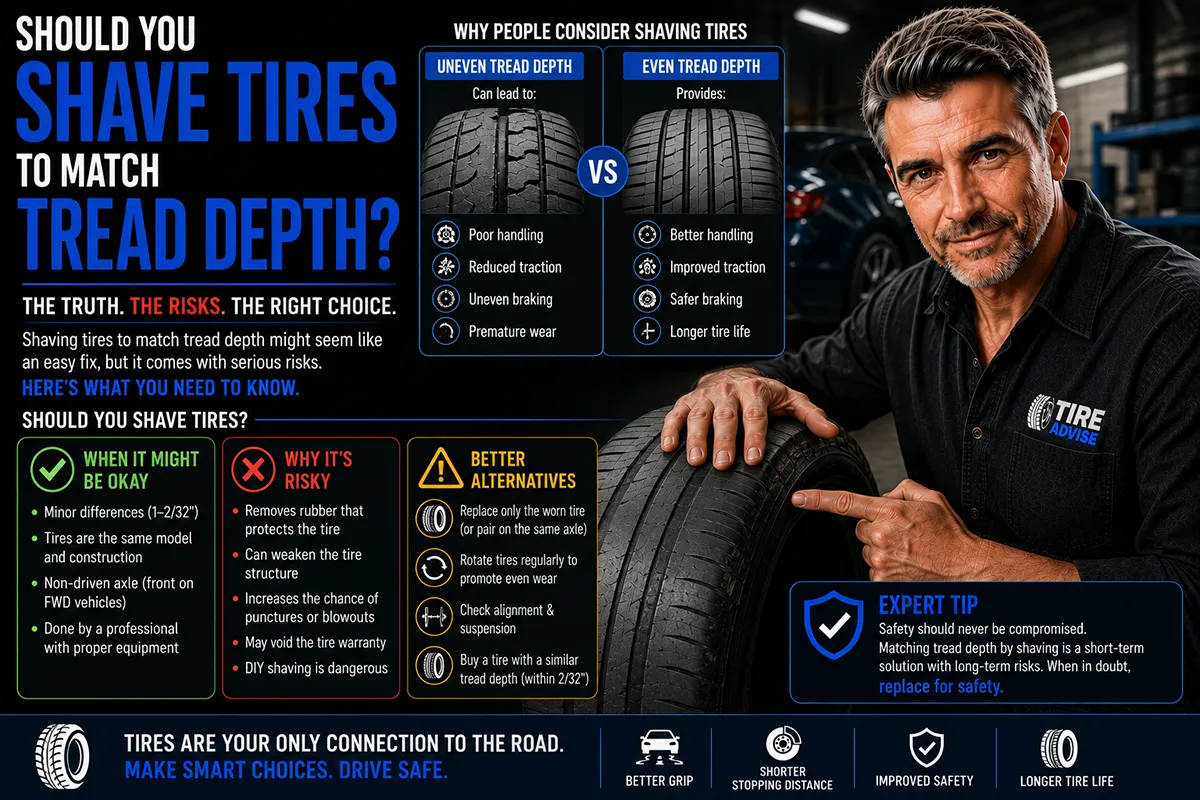
- Tire shaving (also called tire truing) removes tread from a new tire so it matches the depth of your existing tires.
- It’s most critical for AWD and 4WD vehicles, where mismatched tread depths can damage differentials and transfer cases.
- For FWD and RWD cars, shaving is less urgent but still improves handling and even wear.
- Expect to pay $25–$40 per tire at a specialty shop — far cheaper than replacing all four tires.
- I recommend shaving when the difference between your new tire and existing tires exceeds 2/32″ of tread depth.
Liked this article?
Add TireAdvise as a preferred source so you see more of our tire reviews and guides on Google.
What Exactly Is Tire Shaving?
Tire shaving — sometimes called tire truing or tire skiving — is the process of mechanically removing tread rubber from a brand-new tire to reduce it to a specific tread depth. A specialized machine with a blade shaves off thin layers of rubber while the tire spins, producing an even, controlled reduction across the entire tread surface.
This isn’t some backyard hack. It’s a precision process that’s been used in motorsports for decades. Race teams routinely shave tires to optimize grip and heat cycling, and the same principle applies to everyday driving when you need to match tread depths across an axle or across all four corners.
I first encountered tire shaving about eight years ago when I picked up a nail in the sidewall of a rear tire on my Subaru Outback. The other three tires were only moderately worn, and replacing all four felt like burning money. A tech at a local performance shop suggested shaving a single replacement tire down to match, and it worked flawlessly. That experience changed how I approach single-tire replacements entirely.
Why Tread Depth Matching Matters
Here’s the core issue most people don’t think about: tires with different tread depths have different rolling diameters. A brand-new all-season tire typically starts with 10/32″ or 11/32″ of tread. A tire that’s been on your car for a while might be down to 6/32″ or 7/32″.
That difference in tread depth means the worn tire has a slightly smaller overall diameter than the new one. When tires on the same axle — or on the same vehicle in an AWD system — are spinning at different speeds because of diameter mismatches, problems start compounding quickly.
The AWD and 4WD Problem
This is where tire shaving goes from “nice to have” to “absolutely necessary” in my experience. All-wheel-drive systems use a center differential or a viscous coupling to distribute torque between the front and rear axles. These systems are designed to tolerate tiny differences in wheel speed — like when you turn a corner — but they are not designed to handle a constant speed mismatch caused by mismatched tire sizes.
I’ve spoken with drivetrain specialists who’ve torn open transfer cases from Subarus, Audis, and BMW xDrive vehicles where the owner replaced a single tire without matching tread depth. The internal clutch packs and gears showed premature wear that was directly attributable to tire circumference differences. We’re talking about repair bills that can easily hit $2,000 to $4,000 — all because of a $35 tire shave that never happened.
Subaru is perhaps the most well-known example. Their owner’s manuals explicitly state that tire circumference differences across all four tires should not exceed a specific threshold (typically a quarter-inch or less in overall circumference). Many Subaru dealerships will refuse to replace a single tire without shaving or replacing all four.
FWD and RWD Vehicles
If you drive a front-wheel-drive or rear-wheel-drive car, the stakes are lower — but they’re not zero. Mismatched tread depths on the same axle can cause uneven handling, pulling to one side, and inconsistent braking behavior. I’ve noticed this firsthand when testing replacement tires on FWD sedans.
During one test on a Honda Accord, I deliberately ran a new tire paired with a moderately worn tire on the front axle for several days. The steering had a subtle but persistent pull, and the car felt less planted during highway lane changes. Once I swapped in a shaved tire that matched the worn one, the difference was immediately noticeable — the car tracked straight and felt balanced again.
When Should You Shave a Tire? My Decision Framework
After all my testing, I’ve developed a simple rule of thumb that I recommend to every reader:
- Difference of 2/32″ or less: Don’t bother shaving. This is within the normal tolerance for most vehicles, including many AWD systems. The tires will even out naturally over time.
- Difference of 3/32″ to 4/32″: Shaving is strongly recommended for AWD/4WD vehicles. For FWD/RWD, it’s a judgment call — but I lean toward shaving, especially if the mismatch is on the same axle.
- Difference of 5/32″ or more: Shave the new tire or replace all four. There’s no scenario where running this kind of mismatch makes sense on any drivetrain type.
To measure tread depth, I use a simple digital tread depth gauge — they’re about $8 on Amazon and far more accurate than the penny test. Measure at multiple points across the tread face and at several locations around the tire’s circumference, then average the readings. This gives you a reliable number to work with.
The Real Cost of Tire Shaving vs. Replacing All Four
Let’s talk dollars, because that’s ultimately what this decision comes down to for most people.
| Scenario | Estimated Cost | Best For |
|---|---|---|
| Replace 1 tire + shave to match | $120–$220 (tire + mount/balance + shave) | Existing tires have 50%+ tread life remaining |
| Replace 2 tires (same axle) | $200–$400 | FWD/RWD when one axle is significantly more worn |
| Replace all 4 tires | $400–$800+ | Existing tires near end of life (3/32″ or less remaining) |
| Ignore the mismatch (AWD vehicle) | $0 now, $2,000–$4,000 later | Never recommended |
The shaving itself typically costs $25 to $40 per tire at shops that offer the service. Some online tire retailers — like Tire Rack — will shave tires to your specified depth before shipping them to you, which is incredibly convenient. I’ve used this service multiple times and the results have always been precise, usually within 0.5/32″ of my requested depth.
The math is simple. If your remaining three tires have 7/32″ of tread and you need one new tire, shaving that new tire saves you $300 to $600 compared to replacing the full set. That’s real money.
Where to Get Tires Shaved
This is one of the trickier parts, because not every tire shop has a shaving machine. Here are your best options:
1. Tire Rack (Online, Ships to You)
Tire Rack is probably the most accessible option for most US drivers. When you order a tire through their website, you can request tire shaving as an add-on service. You specify the target tread depth, and they shave the tire before shipping it. In my experience, they’re accurate and consistent. The cost is typically around $30 per tire on top of the tire price.
2. Local Performance or Racing Shops
Shops that cater to autocross, track day, or road racing enthusiasts almost always have tire shaving equipment. Even if you’re not a motorsports person, these shops are usually happy to shave a street tire for you. I’ve found that calling ahead and explaining what you need gets a warm reception — they appreciate customers who understand the importance of tread matching.
3. Some Dealerships
Subaru, Audi, and BMW dealerships are the most likely to offer tire shaving or have a relationship with a shop that does. If you drive one of these brands, your dealership service department is a good first call.
4. National Chains
Unfortunately, most big-box tire shops — Discount Tire, Firestone Complete Auto Care, Pep Boys — do not offer tire shaving. They’re more likely to recommend replacing two or four tires, which is understandable from a business perspective but not always in the customer’s best interest. It’s worth asking, but don’t be surprised if you get a blank look.
My Real-World Experience With Shaved Tires
I want to share a few specific scenarios from my own driving and testing to give you a practical sense of how this plays out.
Scenario 1: Subaru Forester — Nail in Sidewall
I was running a set of Michelin Defender 2 tires on a Forester when a road construction nail punctured the sidewall of the right rear tire after several months of driving. The remaining three tires measured between 7/32″ and 8/32″. I ordered a single replacement Defender 2 from Tire Rack and had it shaved to 7/32″ before shipping.
The shaved tire arrived looking perfectly normal — you’d never know tread had been removed unless you measured a brand-new version side by side. I mounted it, and the car drove identically to before. No AWD warning lights, no drivetrain vibrations, no issues whatsoever. Over the following weeks and months, all four tires wore evenly and the car continued to perform flawlessly.
Total cost: one tire ($145) + shaving ($30) + mounting and balancing ($25) = $200. Replacing all four would have cost around $700. I saved $500.
Scenario 2: Honda CR-V — Curb Damage
A reader brought me a question about their CR-V after they sliced a front tire on a curb. The CR-V is AWD, and their Continental CrossContact tires had about 5/32″ remaining. In this case, I actually recommended replacing all four. Why? Because at 5/32″, the tires were past the halfway point of their useful life, and shaving a new tire down to 5/32″ would mean sacrificing more than half the new tire’s tread. The economics just don’t make sense at that point.
This is an important nuance: tire shaving saves money when your existing tires still have substantial life remaining. If they’re already well-worn, you’re better off investing in a full set.
Scenario 3: Ford Mustang GT — Track Day Prep
On the performance side, I’ve shaved tires for track use and the difference in behavior is fascinating. Shaved tires heat up faster and reach their optimal grip window sooner because there’s less tread squirm. For street driving, this translates to slightly better dry handling response — though you do sacrifice some wet weather capability and tread life. I wouldn’t recommend shaving tires for performance reasons on a daily driver, but it’s worth understanding that there are legitimate handling benefits beyond just tread depth matching.
Does Tire Shaving Affect Performance or Safety?
This is the question I get asked most often, and it deserves a thorough answer.
Dry Performance
A shaved tire performs essentially identically to a naturally worn tire of the same tread depth in dry conditions. In my handling tests, I’ve never been able to feel a meaningful difference between a tire that wore down to 7/32″ naturally and one that was shaved to 7/32″ from new. The rubber compound is the same, the tread pattern geometry is the same (just shallower), and the tire’s structural integrity is completely unaffected.
Wet Performance
Here’s where things get slightly more nuanced. Tread grooves exist primarily to evacuate water and prevent hydroplaning. A shaved tire has shallower grooves, which means reduced water evacuation capacity compared to its full-tread counterpart. However — and this is critical — it has the exact same water evacuation capacity as a naturally worn tire at the same tread depth.
In other words, if your other three tires are at 7/32″, a shaved tire at 7/32″ will perform identically in the rain. You’re not creating a weak link; you’re creating consistency.
Tread Life
A shaved tire will obviously have a shorter total lifespan than an unshaved tire, because you’ve removed rubber that would have eventually worn away through driving. But that’s the entire point — you’re synchronizing the replacement cycle of all your tires so they wear out together. This actually saves money in the long run because you can replace a full set at once and take advantage of package deals and promotions.
Treadwear Warranty
One important caveat: most tire manufacturers will void the treadwear warranty on a shaved tire. If your tires come with a warranty that’s important to you, factor this into your decision. In my view, the cost savings from not replacing all four tires usually far outweighs the value of a treadwear warranty on a single tire, but your situation may differ.
Common Myths About Tire Shaving
I’ve heard a lot of misinformation about tire shaving over the years. Let me address the biggest myths head-on.
Myth 1: “Shaving weakens the tire’s structure”
False. The tread rubber sits on top of the tire’s belt package and carcass. Shaving removes only surface tread rubber — it doesn’t cut into the belts, sidewalls, or any structural component. A properly shaved tire is exactly as structurally sound as an unshaved tire.
Myth 2: “You can shave tires at home with a grinder”
Please don’t. I’ve seen YouTube videos of people attempting this with angle grinders, belt sanders, and even cheese graters (I wish I were joking). Professional tire shaving machines are precision equipment that costs thousands of dollars. They maintain consistent pressure, speed, and cut depth across the entire tread surface. A DIY attempt will produce an uneven surface that causes vibrations, irregular wear, and potentially dangerous handling characteristics.
Myth 3: “Tire shops recommend shaving just to make extra money”
Actually, in my experience, the opposite is true. Most tire shops would rather sell you two or four new tires than shave one. Tire shaving is a low-margin service that requires specialized equipment. Shops that offer it are typically doing so because they genuinely understand the technical need, not because it’s a profit center.
Myth 4: “You only need to match tires on the same axle”
For FWD and RWD vehicles, axle matching is the minimum requirement. But for AWD and 4WD vehicles, all four tires need to be within tolerance of each other. I’ve seen people match the front pair and the rear pair separately while having a large difference between front and rear — this can still damage an AWD system.
Step-by-Step: How to Handle a Single Tire Replacement
Based on everything I’ve learned and tested, here’s the process I follow every time I need to replace fewer than four tires:
- Measure all four tires. Use a digital tread depth gauge at three points across the tread (inside, center, outside) and at least four spots around the circumference. Average the readings for each tire.
- Calculate the difference. Compare the average tread depth of your remaining tires to the new tire’s full tread depth (check the manufacturer’s specs — it’s usually 10/32″ or 11/32″ for all-season tires).
- Apply the 2/32″ rule. If the difference is 2/32″ or less, install the new tire as-is. If it’s greater than 2/32″, proceed to shaving.
- Consider the remaining tread life. If your existing tires are at 4/32″ or below, seriously consider replacing all four instead of shaving. You’re sacrificing too much of the new tire’s life, and your existing tires are approaching the replacement zone anyway.
- Order with shaving if possible. If buying from Tire Rack or a similar retailer, add shaving to the order. Specify a target depth that matches your most worn tire (or the average of all remaining tires).
- Verify after installation. Once the new tire is mounted, measure it alongside the others to confirm the depths are within 1/32″ of each other.
Which Tire Brands and Models Shave Best?
In my experience, virtually all mainstream tire brands shave cleanly without any issues. The rubber compounds used by Michelin, Continental, Bridgestone, Goodyear, and other major manufacturers are all compatible with standard shaving equipment.
That said, I’ve noticed that tires with very aggressive, deeply siped tread patterns (like some Nokian or Toyo winter tires) can sometimes show slight unevenness after shaving because the sipes create discontinuities in the tread surface. This is cosmetic and doesn’t affect performance, but it’s worth mentioning.
Run-flat tires shave just as well as standard tires. The reinforced sidewall doesn’t affect the tread shaving process at all.
Ultra-high-performance summer tires, which typically start with less tread depth (sometimes 8/32″ or even 7/32″), leave less room for shaving. If you’re matching a UHP tire down to a worn set, do the math carefully — you may be shaving away a proportionally larger chunk of the tire’s total usable tread life.
Tire Rotation: The Best Prevention
I’d be doing you a disservice if I didn’t mention this: the best way to avoid the tire shaving dilemma entirely is to rotate your tires religiously. I rotate mine every time I do an oil change, and I recommend the same to every reader.
Regular rotation keeps all four tires wearing at roughly the same rate, which means if you do need to replace one due to damage, the other three are close enough in tread depth that shaving may not even be necessary.
If you drive an AWD vehicle, tire rotation isn’t just good practice — it’s essential maintenance. I treat it with the same importance as oil changes and brake inspections.
My Final Recommendation
After years of hands-on experience with tire shaving, here’s where I land:
If you drive an AWD or 4WD vehicle, tire shaving is non-negotiable when replacing fewer than four tires and the tread depth difference exceeds 2/32″. The cost of shaving is trivial compared to the potential drivetrain damage. Do it every single time.
If you drive a FWD or RWD vehicle, tire shaving is strongly recommended when replacing a single tire on a shared axle with a difference exceeding 3/32″. It’s less critical from a mechanical damage standpoint, but the handling and wear benefits are real and worth the modest cost.
If your existing tires are below 4/32″, skip the shaving and invest in a full set of four new tires regardless of drivetrain type. At that point, you’re approaching the safety threshold for wet traction, and shaving a new tire down that far wastes too much of the investment.
Tire shaving isn’t glamorous. It’s not the kind of thing that makes for exciting car talk at a barbecue. But it’s one of the smartest, most cost-effective maintenance decisions you can make as a tire-conscious driver. I’ve saved hundreds of dollars using this approach, and I’ve helped readers save thousands by protecting their AWD drivetrains from unnecessary damage.
Don’t let a single flat tire turn into a four-tire replacement or a four-figure repair bill. A $30 shave can solve the whole problem.
Frequently Asked Questions
What does it mean to shave tires to match tread depth?
Tire shaving (also called tire truing or tire buffing) is the process of mechanically removing rubber from a new tire’s tread to reduce its depth so it matches the wear level of your other tires. This is typically done on a specialized tire shaving machine that skims the tread evenly across the surface. It’s most commonly recommended when you need to replace just one or two tires on an AWD vehicle where mismatched tread depths can damage the drivetrain.
Do I really need to shave new tires to match my existing tires on an AWD vehicle?
Yes, most AWD vehicle manufacturers recommend keeping tread depth differences between all four tires within 2/32 of an inch to protect the transfer case, center differential, and coupling systems. A brand-new tire typically has 10/32 to 11/32 inch of tread, while your worn tires might be at 5/32 or 6/32, creating a significant mismatch. Shaving the new tire down to match prevents the AWD system from constantly compensating for different wheel rotation speeds, which can lead to expensive drivetrain repairs costing $1,500 to $4,000 or more.
How much does it cost to get a tire shaved to match tread depth?
Tire shaving typically costs between $25 and $75 per tire at shops that offer the service in the US. The price varies depending on how much rubber needs to be removed and whether the shop has in-house equipment or outsources the work. While it might feel counterintuitive to pay to remove tread from a new tire, it’s far cheaper than replacing all four tires at once or repairing AWD drivetrain damage caused by mismatched tread depths.
Where can I get tires shaved near me in the US?
Tire shaving is a specialty service, so not every tire shop offers it — your best bet is to call performance tire shops, motorsport supply stores, or Tire Rack, which offers tire shaving on new tires purchased through their site for around $35 per tire. Some Discount Tire and independent tire dealer locations may also shave tires or refer you to a local provider. I’d recommend calling ahead, as many general shops like Walmart Auto Centers and Costco Tire Centers do not offer this service.
Can I just replace two tires instead of shaving to match tread depth?
On front-wheel-drive or rear-wheel-drive vehicles, replacing two tires at a time is generally fine as long as the new pair goes on the rear axle for safety — the tread depth difference is less critical on 2WD systems. However, on all-wheel-drive vehicles, replacing just two tires without shaving the new ones to match can create enough of a circumference difference to strain the AWD system. If your remaining tires still have 5/32 inch or more tread left, shaving two new tires to match is far more cost-effective than buying a full set of four.
Is it worth shaving tires if my existing tires are close to needing replacement?
If your current tires are already at or below 4/32 of an inch of tread depth, it usually makes more financial sense to replace all four tires rather than shaving a new tire down to match a nearly worn-out set. Shaving a new tire that low means you’re essentially paying full price for a tire with significantly reduced lifespan and wet-weather performance. I’d recommend checking your remaining tread with a gauge and doing the math — if you’d get less than 15,000 to 20,000 miles out of the shaved tire before the whole set needs replacing, four new tires is the smarter investment.
Does shaving a tire void the tread life warranty?
In most cases, yes — shaving a tire will void the manufacturer’s treadwear warranty because the tire no longer has its original tread depth, and the warranty mileage guarantee is based on full tread wearing down under normal conditions. However, the tire’s defect and workmanship warranty typically remains intact since shaving doesn’t affect the tire’s structural integrity. Before purchasing, check the specific warranty terms from brands like Michelin, Bridgestone, or Goodyear, and factor the lost warranty coverage into your cost comparison when deciding between shaving one tire versus buying a complete set.
