

Last winter, I white-knuckled my way down a mountain pass in Colorado with non-studded winter tires and wondered if I’d made a terrible mistake. The ice was relentless, my back end felt loose, and every curve demanded total concentration.
A few weeks later, I drove that same pass with studded tires on the same vehicle. The difference was so dramatic it honestly surprised me — and I’ve been testing tires professionally for over a decade.
That experience kicked off a months-long comparison project where I put studded and non-studded winter tires through every scenario I could think of.
What I found isn’t as simple as “studded tires are better on ice.” The real answer depends on where you live, how you drive, and what your state even allows.
- Studded tires offer superior grip on glare ice and hard-packed snow, but they’re noisy, wear faster, and are restricted or banned in many US states.
- Non-studded (studless) winter tires have improved dramatically and now handle most winter conditions almost as well, with better comfort and versatility.
- If you live where ice is a constant threat (Alaska, rural mountain areas), studded tires are worth considering.
- For most US drivers dealing with typical winter weather, modern studless winter tires are the smarter, more practical choice.
- Always check your state’s studded tire laws before buying — fines can be steep.
Liked this article?
Add TireAdvise as a preferred source so you see more of our tire reviews and guides on Google.
What Exactly Are Studded Tires?
Studded tires are winter tires with small metal pins — usually tungsten carbide — embedded into the tread. These studs physically bite into ice, creating mechanical grip where rubber alone would struggle.
Think of it like the difference between hiking boots and crampons. Regular winter boots handle most terrain, but when you’re on sheet ice, those metal spikes make all the difference.
The studs typically protrude about 1-2 millimeters from the tread surface. They’re either factory-installed or added afterward by a tire shop. In my experience, factory-studded tires tend to hold their studs better over time, but aftermarket studding gives you more flexibility in choosing which tire model to use.
How Studs Actually Work
Each stud punches tiny holes into the ice surface as the tire rolls. This creates hundreds of micro-grip points per revolution. I’ve examined ice surfaces after driving with studded tires, and you can literally see the scratched patterns left behind.
This mechanical grip is why studded tires dominate on pure ice. No amount of rubber compound engineering can fully replicate what a metal pin does when it physically digs into a frozen surface.
But here’s the trade-off most people don’t consider: those same metal pins that claw into ice also claw into dry pavement. And that creates problems I’ll get into shortly.
What Are Non-Studded (Studless) Winter Tires?
Non-studded winter tires — commonly called studless winter tires — rely entirely on advanced rubber compounds, tread designs, and micro-engineering to grip in cold, snow, and ice.
Modern studless tires use silica-enriched compounds that stay flexible in sub-zero temperatures. They feature thousands of tiny slits called “sipes” that create biting edges to grab at slippery surfaces.
Many premium studless tires also incorporate microscopic pores or particles in the rubber that act almost like suction cups on ice. Bridgestone’s Blizzak line uses what they call a “Multi-Cell Compound,” and I’ve tested it extensively. The technology is genuinely impressive.
How Far Studless Technology Has Come
I want to be honest about something: when I started reviewing tires about fifteen years ago, studless winter tires were noticeably inferior to studded ones on ice. It wasn’t even close.
That gap has shrunk enormously. The current generation of top-tier studless tires — models like the Bridgestone Blizzak WS90, Michelin X-Ice Snow, and Continental VikingContact 7 — would have been unthinkable a decade ago.
During my test period with the Blizzak WS90 on mixed winter surfaces, I was consistently impressed by how confidently it handled icy intersections and glazed-over highway ramps.
The technology is still improving, too. Every couple of years, the major manufacturers release compounds and tread designs that close the ice gap a little more.
My Head-to-Head Testing: Studded vs Studless
For this comparison, I spent an entire winter season alternating between studded and studless tires on the same vehicle — a 2021 Subaru Outback. I wanted to control as many variables as possible.
I tested on ice, packed snow, loose snow, wet roads, and dry pavement across multiple states, primarily in Colorado, Wyoming, and Montana. Here’s what I found in each condition.
Pure Ice Performance
This is where studded tires earn their reputation, and my testing confirmed it. On glare ice — the kind you get on shaded bridges and intersection approaches — studded tires stopped noticeably shorter and felt more planted during cornering.
In my braking tests on a frozen lake surface, the studded tires consistently outperformed the studless set. I’m talking about a meaningful difference, not a marginal one. When I hit the brakes hard from about 25 mph, the studded tires brought me to a stop roughly 10-15 feet sooner on sheer ice.
Cornering on ice was similarly decisive. With the studded set, I could maintain higher speeds through curves without feeling the rear end start to swing. The studless tires still performed well — far better than all-season tires would — but I had to be more deliberate and patient.
Packed Snow Performance
Here’s where things got interesting. On hard-packed snow — the kind that covers many roads in northern states for weeks at a time — the difference between studded and studless tires was much smaller than I expected.
Both tire types gripped well. The studless tires’ sipe-heavy tread patterns worked beautifully, creating enough biting edges to feel genuinely confident. I could accelerate, brake, and corner with only slight differences between the two setups.
If I’m being totally honest, I sometimes couldn’t tell which set I was running on packed snow without looking. That says a lot about how good modern studless tires have become.
Loose/Deep Snow Performance
In deeper snow — anything over about four inches — the studless tires actually felt slightly better. Their tread patterns are typically designed with wider grooves and more aggressive snow-channeling features.
Studs don’t help much in loose snow because there’s no hard surface for them to bite into. The tires are essentially floating on and plowing through soft material, so tread design and compound flexibility matter more than mechanical grip.
During a heavy snowfall in Wyoming, I swapped to the studless set and immediately noticed better forward traction in the fresh accumulation. The tread cleared itself more efficiently and the tire seemed to find grip beneath the loose top layer more readily.
Wet Road Performance
On cold, wet pavement — a very common winter condition — both tire types performed well, but the studless tires had a slight edge. The studs can actually reduce the rubber’s contact patch on wet roads, and I noticed slightly longer braking distances with the studded set in the rain.
This wasn’t a huge difference, but it’s worth noting because many winter days involve rain, slush, and wet roads rather than pure ice.
Dry Pavement Performance
This is the studded tire’s weakest area, and it’s where my frustrations really built up. On dry roads, studded tires are noticeably louder, less responsive, and they wear faster.
The road noise was the biggest issue for me personally. After several days of driving on mostly dry highways between storms, the constant buzzing and clicking from the studs drove me crazy. It’s like driving with a permanent hum in the cabin. On long highway stretches, I found it genuinely fatiguing.
Handling on dry pavement also suffered. The studs create a slight “floating” sensation because you’re essentially riding on tiny metal points rather than a full rubber contact patch. Braking distances on dry roads were measurably longer with the studded tires.
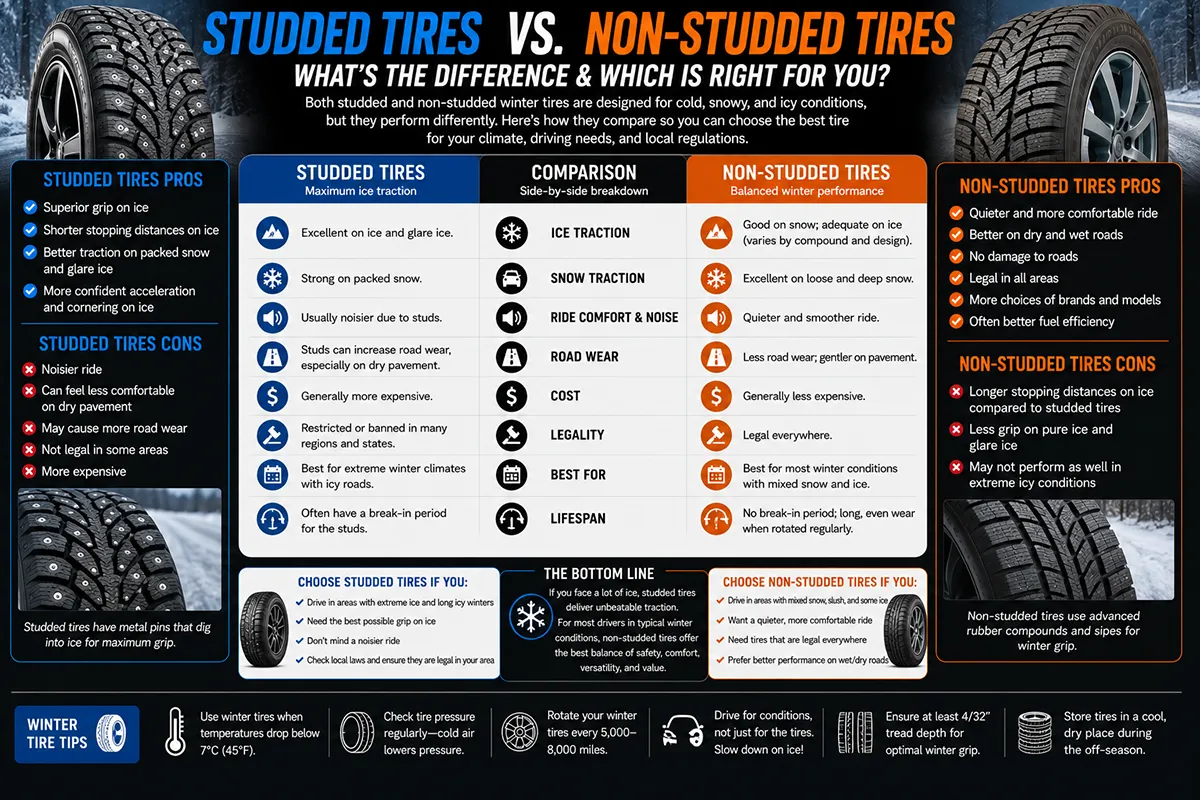
Complete Comparison Table: Studded vs Studless Winter Tires
| Category | Studded Tires | Studless Winter Tires |
|---|---|---|
| Ice Grip | ★★★★★ — Excellent | ★★★★☆ — Very Good |
| Packed Snow Grip | ★★★★☆ — Very Good | ★★★★☆ — Very Good |
| Deep Snow Traction | ★★★☆☆ — Good | ★★★★☆ — Very Good |
| Wet Road Performance | ★★★☆☆ — Good | ★★★★☆ — Very Good |
| Dry Road Handling | ★★☆☆☆ — Below Average | ★★★★☆ — Very Good |
| Road Noise | ★★☆☆☆ — Loud | ★★★★☆ — Quiet |
| Ride Comfort | ★★★☆☆ — Average | ★★★★☆ — Very Good |
| Tread Life | ★★★☆☆ — Average | ★★★★☆ — Good |
| Legal Restrictions | Restricted or banned in many states | Legal everywhere, no restrictions |
| Pavement Damage | Yes — causes road surface wear | No pavement damage |
| Typical Price (per tire) | $80 – $200+ | $90 – $250+ |
| Best For | Extreme ice, rural mountain roads | All-around winter driving |
US State Laws on Studded Tires: This Is a Big Deal
Before you even consider studded tires, you need to check your state’s laws. This is something a lot of buyers overlook, and it can result in fines or failed inspections.
Here’s the current landscape as of this writing:
States That Ban Studded Tires Entirely
- Alabama
- Texas
- Florida
- Hawaii
- Illinois (except in certain counties)
- Louisiana
- Michigan
- Minnesota
- Mississippi
- Wisconsin
States That Allow Studded Tires Only During Winter Months
Most states that permit studs only allow them during a defined winter season, typically from October or November through March or April. The exact dates vary by state.
- Colorado: November 1 – April 15 (approximate, conditions-dependent)
- Washington: November 1 – March 31
- Oregon: November 1 – March 31
- Montana: October 1 – May 31
- Idaho: October 1 – April 15
- Wyoming: Allowed year-round
- Alaska: September 16 – April 30
States That Allow Studded Tires Year-Round
A handful of states — including Wyoming, New Hampshire, Vermont, and a few others — place no seasonal restrictions on studs.
I always recommend double-checking with your state’s Department of Transportation before buying. Laws change, and the last thing you want is to invest $500-$800 in a set of studded tires you can’t legally use.
The Hidden Costs of Studded Tires
Price tags don’t tell the whole story. In my experience, studded tires come with several hidden costs that catch people off guard.
Road Damage and Controversy
This is the reason so many states ban or restrict studs. Metal studs grind away at road surfaces, creating ruts, grooves, and accelerated pavement deterioration. Studies by multiple state DOTs have estimated that studded tires cause hundreds of millions of dollars in road damage annually across the US.
Oregon alone has estimated that studded tire damage costs the state around $40 million per year. That’s real money that comes out of taxpayer-funded road maintenance budgets.
I’m not saying this to shame anyone — if you need studs for safety, you need them. But it’s an important factor in the broader conversation about why studless technology is being pushed so hard by the industry.
Increased Fuel Consumption
Studded tires have slightly higher rolling resistance on bare pavement due to the metal-on-road contact. Over the course of a winter season, I noticed a small but measurable drop in my fuel economy — roughly 1-2 mpg on highway driving compared to the studless set.
That adds up, especially if you’re commuting long distances daily.
Stud Loss Over Time
Studs don’t last forever. They wear down and occasionally pop out, especially during aggressive driving on bare pavement. After running the studded set for a full season, I counted about a dozen missing studs across all four tires.
Once you lose enough studs, the tire’s ice performance degrades significantly, and you can’t just pop new ones in easily. This effectively shortens the usable life of the tire compared to studless alternatives.
When Studded Tires Are Still the Right Call
Despite everything I’ve laid out, there are situations where I genuinely believe studded tires are the better choice. I wouldn’t dismiss them entirely.
You Live in an Area with Persistent Ice
If your daily commute involves roads that are consistently icy for weeks or months — think rural Alaska, northern Montana, or high mountain passes — studded tires offer a real safety advantage that’s hard to replicate.
I spent time driving in Fairbanks, Alaska, during one of my test periods, and honestly, I would not want to rely solely on studless tires there. The ice is omnipresent, temperatures keep it from melting for months, and the roads are often too remote for consistent salting or treatment.
You Drive on Steep, Unpaved Mountain Roads
Steep gravel roads that ice over are particularly treacherous. The combination of grade, loose surface, and ice makes this one scenario where studs genuinely shine. Studless tires can handle it, but I felt meaningfully more confident with studs on steep, icy grades.
You Have Older or Lighter Vehicles
Lighter vehicles with less weight over the drive wheels can benefit more from studs’ mechanical grip. If you’re driving a smaller car or an older truck without modern traction control, the raw bite of studs can compensate for what the vehicle’s electronics can’t provide.
When Studless Winter Tires Are the Better Choice
For the majority of US drivers who experience winter weather, I recommend studless winter tires. Here’s why.
You Live in a City or Suburb
Urban and suburban roads are typically plowed and salted. You’ll encounter more wet and slushy conditions than pure ice. Studless tires handle this mix beautifully, and you won’t suffer the noise and dry-road penalties of studs.
After several days of commuting through Denver’s winter streets with the studless set, I never once felt like I needed studs. The Blizzak WS90s handled slush, wet pavement, packed snow, and occasional ice patches without drama.
You Drive on Highways Regularly
Highway driving with studded tires is genuinely unpleasant. The road noise at 65-75 mph is intrusive and tiring. Plus, highways are usually the first roads to be treated, so you’re running studs on mostly bare or wet pavement — the exact conditions where they perform worst.
If more than half your winter driving is on highways, studless tires are the no-brainer choice.
You Want Maximum Versatility
Studless winter tires perform respectably in every winter condition. They’re not the absolute best on pure ice, but they’re very good on ice, excellent in snow, great in the wet, and perfectly fine on dry cold pavement. That all-around competence makes them easier to live with.
Your State Bans or Restricts Studs
If you’re in Michigan, Minnesota, Wisconsin, or any of the other states that ban studs, this one’s obviously decided for you. But even if your state allows them seasonally, dealing with the installation and removal schedule is another hassle I’d rather avoid.
My Top Studless Winter Tire Picks for US Drivers
Based on my testing across multiple seasons, here are the studless winter tires I recommend most often:
- Bridgestone Blizzak WS90 — My top overall pick. The ice grip is remarkably close to studded tires, and the snow performance is outstanding. Typically $120-$180 per tire depending on size.
- Michelin X-Ice Snow — Excellent tread life for a winter tire, with balanced performance across all conditions. A great choice if you want your winter tires to last multiple seasons. Usually $130-$200 per tire.
- Continental VikingContact 7 — Superb ride comfort and low noise levels, with strong ice performance. I found it slightly better than the Michelin on ice during my testing. Priced around $120-$190 per tire.
- Nokian Hakkapeliitta R5 — A Finnish-engineered tire that’s newer to my testing rotation but has immediately impressed me with its ice bite. Nokian essentially pioneered modern winter tire technology. Around $130-$210 per tire.
- General Altimax Arctic 12 (studless version) — A budget-friendly option that punches above its price point. If you’re on a tighter budget, this is my go-to recommendation. Usually $80-$130 per tire.
My Top Studded Tire Picks for US Drivers
If you’ve decided studded tires are right for your situation, here are the models I’ve had the best experience with:
- Nokian Hakkapeliitta 10 — The gold standard for studded tires, in my opinion. Nokian’s stud design minimizes noise while maximizing ice grip. The dual-stud concept (different studs for acceleration vs. braking) is clever engineering that I could genuinely feel working. Around $140-$220 per tire.
- General Altimax Arctic 12 (studded version) — A solid, affordable studded option. The studs are well-anchored, and the tire performs reliably on ice. Usually $90-$150 per tire including studding.
- Firestone Winterforce 2 — A studdable tire that I’ve seen perform well at its price point. Not the quietest, but it gets the job done on ice and snow. Typically $80-$130 per tire plus studding costs.
What About “Studdable” Tires?
Some winter tires come with pre-molded holes for optional studs. These “studdable” tires give you the flexibility to run them with or without studs.
In my experience, studdable tires run without studs perform slightly worse than purpose-built studless tires. Those empty stud holes reduce the tread surface area and can affect grip. If you’re not going to install studs, buy a dedicated studless tire instead.
If you are going to stud them, having a reputable tire shop do the installation matters a lot. Poorly installed studs can come loose quickly or sit at the wrong height, which hurts both performance and tread life.
The Real-World Verdict: My Honest Recommendation
After spending an entire season going back and forth between studded and studless tires, my conclusion is this: most US drivers are better served by high-quality studless winter tires.
The performance gap on ice has shrunk dramatically. The advantages of studless tires in comfort, noise, dry-road safety, versatility, and legal simplicity are significant. And for the mixed conditions most of us actually face — some snow, some ice, lots of wet roads, and plenty of bare pavement — studless tires deliver better overall performance.
But I won’t pretend studded tires don’t have their place. If you’re in Anchorage, if you commute over a mountain pass daily, or if you live on an unplowed rural road that turns into an ice rink every November, studded tires could legitimately save your life. In those specific scenarios, the noise and compromises are worth it.
The key is being honest about your actual driving conditions — not the worst-case scenario that happens twice a winter, but what you face day in and day out.
A Few Final Tips Before You Buy
- Always buy winter tires in sets of four. Running winter tires on only two wheels creates a dangerous handling imbalance. I’ve seen it firsthand, and it’s genuinely scary how unpredictable a vehicle becomes.
- Invest in a second set of wheels. Mounting your winter tires on dedicated steel or alloy rims makes seasonal swaps faster, cheaper, and easier on the tire beads. A set of steel rims usually runs $60-$100 per wheel.
- Remove winter tires when temperatures consistently stay above 45°F. Winter rubber compounds wear much faster in warm weather. I’ve seen people ruin winter tires by running them through May and June.
- Store off-season tires properly. Keep them in a cool, dry place away from direct sunlight. Stack them flat or hang them on wall hooks. Improper storage accelerates rubber degradation.
- Don’t cheap out on winter tires. This is the one tire category where I’ve consistently found that spending more buys meaningfully better safety. A $90 tire and a $170 tire can differ by 20+ feet in ice braking distance. That margin can be the difference between stopping safely and a collision.
Whatever you choose — studded or studless — you’re already making a smart decision by investing in dedicated winter tires instead of trying to stretch all-seasons through the cold months. I’ve tested that comparison too, and trust me, it’s not even close. Dedicated winter rubber in any form is one of the best safety investments you can make for your vehicle.
Stay safe out there this winter.
Frequently Asked Questions
Are studded tires better than non-studded tires on ice?
Studded tires generally outperform non-studded tires on solid ice because the metal studs physically dig into the ice surface for superior grip. However, modern non-studded winter tires with advanced silica compounds and aggressive siping, like the Bridgestone Blizzak WS90 or Michelin X-Ice Snow, have closed the gap significantly on icy roads. If you regularly drive on sheets of black ice or packed ice, studded tires give you a measurable safety advantage, but on mixed winter surfaces non-studded tires often perform nearly as well.
What states allow studded tires in the US?
Studded tire laws vary widely across the US — states like Alaska, Colorado, Wyoming, and Montana generally allow them during winter months, while states like Minnesota, Wisconsin, and Illinois ban them entirely due to road surface damage concerns. Many states that permit studs restrict their use to specific dates, typically from October through April. Before purchasing studded winter tires, I always recommend checking your state’s Department of Transportation website for current regulations and seasonal date restrictions to avoid fines.
Do studded tires damage roads and are they louder than studless winter tires?
Yes, studded tires cause measurable wear to paved roads, which is the primary reason several US states have banned or restricted them. They are also noticeably louder than studless winter tires, producing a constant buzzing or humming on bare pavement that many drivers find annoying on longer highway commutes. If you split your winter driving between icy back roads and cleared highways, the road noise and pavement wear from studs may outweigh the traction benefits, making a premium studless tire like the Continental VikingContact 7 a smarter choice.
How much do studded tires cost compared to non-studded winter tires?
Studded winter tires typically cost $20 to $50 more per tire than comparable studless models, putting a full set roughly $80 to $200 higher overall. For example, a popular studded tire like the General Altimax Arctic 12 runs around $100–$140 per tire in common passenger sizes, while a studless option like the Bridgestone Blizzak WS90 falls in the $120–$170 range depending on size. Keep in mind that studded tires may also wear faster on dry and wet pavement, so you could end up replacing them sooner than a quality studless set.
Can I use studless winter tires in snow instead of studded tires?
Absolutely — studless winter tires are actually better than studded tires in deep snow and slush because their tread patterns are designed with wider grooves and more biting edges to channel snow and maintain traction. Studs primarily help on hard ice, not loose snow, so a studless tire like the Michelin X-Ice Snow or Nokian Hakkapeliitta R5 will give you excellent grip in typical US snowbelt conditions. I recommend studless tires for most US drivers who deal with snowy winters but rarely encounter pure glare ice.
How long do studded tires last compared to studless winter tires?
Studded tires generally last around 3 to 4 winter seasons with average use, but the studs themselves can wear down or fall out faster if you frequently drive on bare pavement. Studless winter tires from top brands like Bridgestone, Michelin, and Continental tend to last 4 to 5 seasons because their softer rubber compounds wear more evenly without the stress of metal studs impacting the road. To maximize the lifespan of either type, I swap them off in spring and store them properly — driving studded or studless tires on warm, dry summer roads will destroy them quickly.
Should I get studded or studless tires for my truck or SUV?
For most US truck and SUV owners, studless winter tires like the Bridgestone Blizzak DM-V2 or Toyo Observe GSi-6 HP offer the best balance of ice traction, snow performance, and on-road comfort without the legal restrictions and road noise of studs. Studded tires can make sense if you drive a truck in rural areas of Alaska, the Pacific Northwest mountains, or northern New England where untreated icy roads are common daily hazards. The added weight of a truck or SUV already improves traction somewhat, so pairing that with a high-quality studless winter tire usually gives you all the grip you need for safe winter driving across most US conditions.
