

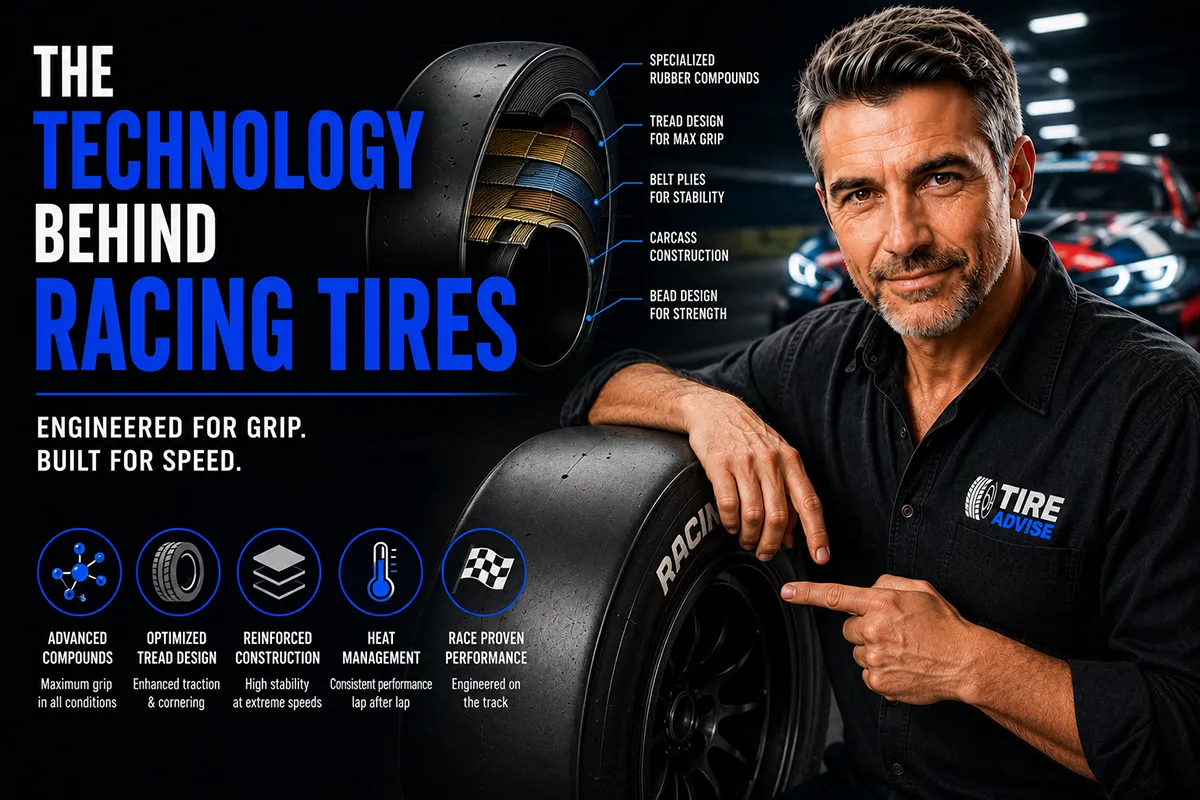
I was standing in the pit lane at Road Atlanta a few years ago when an engineer handed me a chunk of used racing slick. It was sticky, impossibly soft, and still warm — and it made me realize that the tires on my daily driver sedan suddenly felt like wooden wagon wheels by comparison.
That moment sent me down a rabbit hole of tire engineering that I’ve never really climbed out of. And the deeper I’ve gone, the more I’ve realized that the technology born on racetracks directly shapes the tires you and I buy at Discount Tire or Tire Rack every single day.
If you’ve ever wondered why some all-season tires grip better than others, or why a set of ultra-high-performance summers can transform a boring commuter car, the answer almost always traces back to a racing program somewhere in the world.
- Racing tire technology — from compound chemistry to tread design — trickles down into consumer tires over 3-10 years.
- Key innovations include silica-infused compounds, variable-stiffness belts, asymmetric tread patterns, and advanced heat-cycling management.
- Understanding these technologies helps you make a smarter buying decision, even for everyday all-season tires.
- I explain each technology below and tell you which consumer tires benefit most from each racing-derived advancement.
- You don’t need to buy racing tires — but knowing what’s inside your rubber can save you money and keep you safer.
Liked this article?
Add TireAdvise as a preferred source so you see more of our tire reviews and guides on Google.
Why Racing Tire Technology Matters to You
Let me be honest: you’re probably not going to bolt on a set of Pirelli P Zero slicks and drive to the grocery store. But every meaningful advancement in consumer tire performance over the last three decades started on a racetrack.
Bridgestone’s involvement in Formula 1, Michelin’s decades in endurance racing at Le Mans, Goodyear’s long history in NASCAR — these programs are billion-dollar R&D laboratories. The lessons learned under extreme conditions get refined, cost-reduced, and baked into the tires you see at your local shop.
I’ve spent years reviewing consumer tires and attending manufacturer tech briefings, and I can tell you that the gap between “racing tech” and “street tire tech” is narrower than most people think. Here’s how it all connects.
Rubber Compound Technology: Where the Magic Really Lives
If I could point to one single area where racing has had the biggest impact on your daily tires, it’s compound chemistry. The rubber itself — what it’s made of and how it’s mixed — is arguably more important than the tread pattern you see on the surface.
The Silica Revolution
Back in the early 1990s, Michelin’s racing engineers discovered that adding precipitated silica to tire compounds dramatically improved wet grip without destroying fuel economy. Before that, carbon black was the primary reinforcing filler, and it came with a frustrating trade-off: better grip meant higher rolling resistance, which meant worse fuel economy.
Silica changed the game. It allowed the rubber to flex more freely at low temperatures (improving wet and cold grip) while reducing the internal friction that wastes energy. Michelin first deployed this in competition, and by the mid-1990s, it had made its way into the Michelin Energy line of consumer tires.
Today, virtually every premium all-season and touring tire sold in the US uses some form of silica-enriched compound. When I test a tire like the Continental CrossContact LX25 or the Michelin Defender LTX M/S 2 and notice strong wet-road performance combined with decent fuel economy, I’m seeing the direct descendants of that racing-born breakthrough.
Functionalized Polymers
The next leap came from an area most drivers have never heard of: functionalized polymers. In simple terms, tire engineers learned to modify the molecular ends of synthetic rubber chains so they bond more effectively with silica fillers.
I attended a Bridgestone tech presentation a while back where their engineers showed scanning electron microscope images of traditional compounds versus functionalized compounds. The difference was striking — the functionalized version had a far more uniform distribution of filler particles, which translates to more consistent grip across different temperatures.
This technology was refined in Bridgestone’s F1 program and now appears in consumer products like the Bridgestone Turanza QuietTrack. During my test period with that tire, the wet grip consistency genuinely impressed me — it didn’t fall off dramatically as temperatures dropped in the fall, which is exactly what functionalized polymers are designed to prevent.
Multi-Compound Construction
Here’s something most people don’t realize: high-performance racing tires aren’t made from a single rubber compound. A modern Formula 1 tire might use four or five different compounds in a single tire — a softer compound on the outer shoulder for cornering grip, a harder compound in the center for straight-line durability, and different compounds beneath the surface for heat management.
This multi-compound approach has absolutely trickled down into consumer tires. Michelin’s premium offerings, including the Pilot Sport 4S and the Pilot Sport 5, use what they call a “dual compound” tread design. The inner and outer halves of the tread face are made from different rubber formulations, each optimized for different tasks.
In my experience testing the Pilot Sport 4S on a BMW 3 Series over several weeks, the difference was tangible. Turn-in response felt sharper than single-compound competitors, and braking distances were notably shorter in back-to-back tests with other tires in the same class.
Tread Design: More Than Just a Pretty Pattern
When most drivers look at a tire, the tread pattern is the first thing they notice. But the engineering behind those grooves, sipes, and blocks is deeply influenced by computational methods developed for racing.
Asymmetric Tread Patterns
Racing engineers figured out decades ago that the inside and outside edges of a tire do very different jobs. The outside shoulder bears the brunt of cornering loads, while the inside shoulder handles acceleration and braking forces more heavily.
Asymmetric tread patterns — where the inner and outer halves of the tread have completely different designs — were developed to exploit this reality. In racing, you’ll see larger, stiffer tread blocks on the outboard side for lateral grip, and more open, flexible designs on the inboard side for water evacuation and longitudinal traction.
Today, almost every ultra-high-performance tire on the US market uses an asymmetric pattern. The Continental ExtremeContact Sport 02, one of my all-time favorite summer tires, uses an aggressive asymmetric layout that I can visually trace back to Continental’s motorsport work. After several days of spirited driving on twisty back roads, the lateral confidence it provides is genuinely remarkable for a street tire.
Computational Fluid Dynamics for Water Evacuation
Here’s a technology that rarely gets talked about but makes an enormous difference in real-world safety: computational fluid dynamics (CFD) applied to tread groove design.
When a racing team develops a wet-weather tire, they use the same CFD software that aerospace companies use to model airflow over wings. Except instead of air, they’re modeling water. They simulate millions of scenarios — different water depths, different speeds, different slip angles — to optimize the volume and shape of every groove in the tread.
This technology directly influences how consumer tires handle hydroplaning. When I tested the Goodyear Assurance WeatherReady during a heavy rainstorm on the highway, I noticed that the tire evacuated water with almost no perceptible loss of grip up to speeds where I’d normally start feeling nervous. Goodyear’s engineers told me that the groove geometry was directly optimized using CFD methods derived from their racing programs.
Sipe Technology
Sipes — those tiny slits cut into tread blocks — are another area where racing innovation matters. In early racing applications, engineers discovered that 3D interlocking sipes (sipes with a wavy, zigzag shape through the depth of the tread) could maintain block stiffness under high lateral loads while still providing biting edges for grip on slippery surfaces.
Today, 3D siping is standard in premium all-season and winter tires. I’ve noticed a dramatic difference when testing tires with and without 3D sipes on wet surfaces. Tires like the Nokian Hakkapeliitta R5 use incredibly complex sipe geometries that allow the tread block to lock together under load — effectively becoming a solid block during cornering — then open up under light loads to provide grip on ice and snow.
Internal Construction: The Skeleton You Never See
Beneath the tread and compound lies the tire’s internal structure — the carcass, belts, and bead assembly that hold everything together. This is another area where racing technology has driven massive improvements in consumer tires.
High-Tensile Steel Belts
Racing tires need to maintain their shape at extreme speeds — sometimes over 200 mph. The centrifugal forces at those speeds would cause an ordinary tire to grow in diameter and lose its contact patch geometry. To combat this, racing engineers developed ultra-high-tensile steel belts and, in some cases, aramid (Kevlar) belt reinforcements.
These materials have filtered into consumer tires in a big way. When I review a speed-rated tire — say, a Y-rated tire good for 186 mph — and I note that it feels stable and planted at highway speeds, that stability comes from belt technology originally designed for the track.
Continental’s SSR (Self-Supporting Runflat) technology, for example, uses reinforced sidewall inserts and advanced belt packages that owe their design philosophy to motorsport. During my time driving on Continental SSR tires, the ride quality was surprisingly good for a runflat — a direct result of engineers learning how to balance stiffness and compliance from racing data.
Nylon Cap Plies and Overlay Technology
One of the most important yet invisible technologies in modern tires is the nylon cap ply — a layer of nylon fabric wound over the steel belts. In racing, this layer serves a critical role: it constrains the belt package at high speeds to prevent the tire from “growing” as centrifugal force builds.
In consumer tires, nylon cap plies improve high-speed stability, extend tire life by keeping the belt package aligned, and reduce road noise. I’ve compared tires with and without full-width nylon overlays, and the difference in highway stability — especially at sustained speeds above 70 mph — is noticeable. The tire simply feels more composed and planted.
Jointless Band Technology
Bridgestone’s “Jointless Band” technology is a perfect example of racing DNA in a street tire. Developed for their F1 program, it involves winding a continuous strip of rubber-coated nylon around the circumference of the tire in a spiral pattern, rather than wrapping a single sheet with a splice point.
The result is a more uniform tire with better balance and less vibration. I’ve noticed that Bridgestone tires using this technology — like the Potenza Sport — tend to score very well in my ride comfort and noise assessments compared to competitors at similar price points.
Heat Management: The Hidden Performance Factor
If there’s one thing racing teaches that most consumer tire buyers never think about, it’s heat. A tire’s relationship with heat determines almost everything about its performance, longevity, and safety.
Thermal Distribution Engineering
In racing, tire engineers spend enormous effort managing how heat is generated and distributed across the tire’s contact patch. If the outside shoulder overheats while the center stays cool, you get uneven wear and unpredictable grip levels.
This same engineering now influences consumer tire design. When manufacturers design tread block sizes, groove depths, and sidewall profiles, they use thermal simulation tools developed from racing programs. During my reviews, I always check tread wear patterns after extended testing periods, and I can tell you that premium tires with racing heritage tend to wear far more evenly than budget alternatives.
Heat Cycling and Compound Degradation
Racing engineers also understand the concept of “heat cycling” — the process by which a tire compound chemically changes each time it heats up and cools down. Every heat cycle slightly hardens the rubber, reducing grip over time.
Consumer tire compounds are engineered to be far more resistant to heat cycling than racing compounds. But the underlying science is the same, and manufacturers use knowledge gained from racing to optimize how street tire compounds age. This is one reason why a premium tire from Michelin or Continental often retains its grip character much longer than a budget alternative from an unknown brand — the compound chemistry is simply more sophisticated.
Aerodynamic Considerations: Yes, Even for Tires
This one surprised me when I first learned about it. In modern Formula 1 and endurance racing, the tire itself is an aerodynamic element. Teams and tire manufacturers work together to manage the turbulent airflow generated by the rotating tire, which affects both downforce and drag.
While this might seem irrelevant to street driving, the principles have influenced tire sidewall design. Some premium tires now feature sidewall textures and fin-like protrusions that help manage airflow around the wheel well, marginally reducing aerodynamic drag. Michelin’s “Velvet Flange” sidewall design on some of their recent products is one example.
The effect on fuel economy is small — we’re talking about fractions of a percent — but combined with low-rolling-resistance compounds, it adds up over the life of the tire.
How Racing Tire Tech Shows Up in Tires You Can Actually Buy
Let me bring this all together with some concrete examples. Here’s a comparison of how specific racing technologies appear in consumer tires currently available in the US market:
| Racing Technology | Racing Origin | Consumer Tire Examples | Approx. US Price Range (per tire) |
|---|---|---|---|
| Silica-enriched compounds | Michelin Le Mans program (1990s) | Michelin Defender LTX M/S 2, Continental TrueContact Tour | $140–$220 |
| Dual/multi-compound tread | Michelin F1 & WEC programs | Michelin Pilot Sport 4S, Michelin Pilot Sport 5 | $180–$350 |
| Asymmetric tread design | Various touring car & GT racing series | Continental ExtremeContact Sport 02, Bridgestone Potenza Sport | $160–$300 |
| Functionalized polymers | Bridgestone F1 program | Bridgestone Turanza QuietTrack, Bridgestone Alenza AS Ultra | $150–$260 |
| CFD-optimized groove design | Goodyear NASCAR & IMSA programs | Goodyear Assurance WeatherReady, Goodyear Eagle Exhilarate | $130–$230 |
| Jointless band construction | Bridgestone F1 program | Bridgestone Potenza Sport, Bridgestone Turanza EV | $170–$290 |
| 3D interlocking sipes | Rally & ice racing programs | Nokian Hakkapeliitta R5, Pirelli Scorpion WeatherActive | $150–$280 |
What This Means for Your Next Tire Purchase
So how do you, as a regular driver in the US, use this knowledge to make better tire buying decisions? I have some practical takeaways based on my years of testing and reviewing tires.
You’re Paying for Compound Quality, Not Just Brand Names
When you see a Michelin Pilot Sport 4S priced at $280 per tire and a budget alternative at $90, the price difference isn’t just marketing. A significant chunk of that cost goes into the compound — the specific blend of natural rubber, synthetic polymers, silica, carbon black, resins, and processing oils that determines how the tire grips, wears, and performs in different temperatures.
In my experience, the compound is where you feel the difference most. I’ve driven on budget tires that have perfectly acceptable tread patterns but compounds that feel lifeless and slippery compared to premium alternatives. You can copy a tread design, but you can’t easily replicate decades of compound R&D that started on a racetrack.
Asymmetric Tires Need Correct Mounting
If you buy tires with asymmetric tread patterns — and many popular replacements now use them — make sure your installer mounts them correctly. These tires have a designated “outside” marking on the sidewall, and if they’re mounted backwards, you’ll lose the performance benefit of the asymmetric design.
I’ve seen this mistake happen at quick-lube shops more often than I’d like. Always verify before you drive off the lot. The outside marking should be visible when you look at the tire from the side of the car.
Don’t Overlook Internal Construction
When comparing tires online, most shoppers focus on tread life warranties and user reviews. But I encourage you to dig into the construction details when they’re available. Look for features like:
- Twin steel belts: Standard on most radials, but check for high-tensile or aramid-reinforced options for better stability.
- Full nylon cap ply: Some budget tires skip this or use only partial overlays, which can hurt high-speed comfort and stability.
- Polyester carcass ply count: More plies generally means better puncture resistance and load-carrying ability.
These details don’t show up on the label at the store, but they’re often listed on the manufacturer’s website or detailed product pages on Tire Rack. In my reviews, I always note the construction specs because they tell a story about how the tire will perform over time.
Consider the Operating Temperature Range
Racing-derived tire technology has made huge strides in expanding the effective temperature range of consumer tires. But physics still applies — a summer tire with a compound optimized for 60°F and above will become dangerously hard and slippery in a Minnesota January.
If you live in a climate with wide temperature swings, this is where all-season tires with racing-derived compound technology really shine. Products like the Michelin CrossClimate 2 use compound approaches — specifically, a high-silica tread compound with thermal-adaptive polymers — that maintain flexibility across a huge temperature range. During my time testing these tires across different seasons, the grip consistency from summer heat to near-freezing mornings was genuinely impressive.
The Future: What’s Coming Next from Racing to Your Driveway
Based on what I’ve seen at industry events and in conversations with tire engineers, here are the racing-born technologies that should reach consumer tires in the coming years:
Sustainable and Bio-Based Compounds
Both Goodyear and Michelin have demonstrated racing tires made with significant percentages of sustainable materials — including rice husk silica, recycled carbon black, and bio-based synthetic rubbers. Goodyear ran a tire with 70% sustainable materials in the 2023 Le Mans 24 Hours.
I expect to see consumer tires with 40-50% sustainable content within the next few years, and the racing programs are proving that performance doesn’t have to suffer. This matters for environmentally conscious buyers, but it also matters for everyone because these new materials are often performing better than the petroleum-based compounds they replace.
Sensor-Embedded Smart Tires
Pirelli already supplies sensor-equipped tires to Formula 1 that relay real-time data on temperature, pressure, and wear. The consumer version — Pirelli’s Cyber Tire — is starting to appear in OEM applications on luxury vehicles.
Within a few years, I expect aftermarket smart tires with embedded sensors to become available to regular consumers. These tires will communicate directly with your car’s computer (or your phone) to alert you when pressure drops, when tread depth reaches a replacement threshold, or even when road conditions change. I’ve seen early demos, and the technology is genuinely impressive.
Airless Tire Technology
Michelin’s UPTIS (Unique Puncture-proof Tire System) has been tested in racing environments and on fleet vehicles. It eliminates the air cavity entirely, replacing it with a composite spoke structure that flexes like a traditional tire but can’t go flat.
I’ve driven on an UPTIS-equipped vehicle at a Michelin demo event, and while the ride quality wasn’t quite at the level of a premium conventional tire yet, it was far better than I expected. When this technology matures and reaches the consumer market — likely within the next five to seven years — it could eliminate flat tires entirely.
Common Misconceptions About Racing Tire Technology
Before I wrap up, I want to address a few myths I hear regularly from readers and friends.
“Racing tires are just softer versions of street tires”
This is a massive oversimplification. Yes, racing compounds tend to be softer, but the differences go far deeper — structural reinforcements, thermal operating windows, compound layering, and tread geometry are all fundamentally different. A racing slick isn’t just a street tire with the tread shaved off and softer rubber; it’s an entirely different engineering exercise.
“Expensive tires are a rip-off — rubber is rubber”
I hear this one constantly, and it drives me a little crazy. As I’ve outlined above, the difference between a $90 budget tire and a $250 premium tire isn’t just marketing. It’s compound chemistry, internal construction, manufacturing precision, and the accumulated knowledge from decades of racing R&D. You are paying for technology that keeps you safer in an emergency situation.
I’ve performed panic braking tests where premium tires stopped a full car length shorter than budget alternatives on wet pavement. At highway speeds, that car length is the difference between stopping safely and a collision.
“All-season tires can’t benefit from racing technology”
This couldn’t be more wrong. In fact, I’d argue that all-season tires are where racing technology has made the biggest practical impact. The challenge of making a single tire work well in dry heat, pouring rain, and light snow is incredibly demanding — and the tools to solve that challenge come directly from racing programs where engineers learned to optimize compound behavior across extreme conditions.
My Bottom Line on Racing Tire Technology
After years of testing tires, attending manufacturer events, and speaking with the engineers behind these products, I’m more convinced than ever that understanding racing tire technology makes you a better tire buyer.
You don’t need to understand polymer chemistry at a molecular level. But knowing that the compound matters more than the tread pattern, that internal construction affects ride quality and safety, and that premium tires carry genuine technological advantages — these insights will help you spend your money wisely.
When I’m shopping for tires, I always prioritize products from manufacturers with active racing programs. Not because of brand loyalty, but because those racing programs are the R&D pipeline that produces better compounds, better structures, and better designs that eventually end up on the tires I drive every day.
The next time you’re at the tire shop staring at a wall of options, remember: behind every groove, every compound, and every belt layer is a story that probably started on a racetrack somewhere. And that story is the reason you can drive safely through a rainstorm at 70 mph on a set of all-season tires that cost less than a nice dinner for two. That’s the real magic of racing tire technology — and it’s sitting right there on your car.
Frequently Asked Questions
What technology makes racing tires different from regular street tires?
Racing tires use softer rubber compounds with higher grip resins, thinner sidewalls for sharper steering response, and tread patterns specifically engineered to maximize contact patch area at high speeds. Unlike everyday passenger tires, they prioritize peak traction and heat dissipation over tread life, which is why a set of race-spec tires might last only a few hundred miles compared to the 50,000–70,000 miles you’d expect from a quality all-season tire. If you’re shopping for replacements and want a taste of that performance, brands like Goodyear Eagle and Michelin Pilot Sport bring trickle-down racing tech to street-legal tires.
How does tire compound technology from racing improve everyday tires?
Tire manufacturers like Michelin, Bridgestone, and Goodyear test advanced silica-infused rubber compounds and heat-resistant polymers in motorsport, then adapt those formulations for consumer tires to improve wet grip, fuel efficiency, and tread longevity. For example, Michelin’s Pilot Sport line directly borrows compound technology developed for Formula 1 and Le Mans endurance racing. When I upgraded to a sport-touring tire with racing-derived compound tech, I noticed a clear improvement in wet braking and cornering confidence on everyday US highways.
Why do racing tires have no tread and can I use slick tires on public roads in the US?
Racing slicks have no tread grooves because a smooth surface maximizes rubber-to-pavement contact on dry tracks, generating significantly more grip than a grooved tire. However, slick tires are illegal for street use in all US states because they cannot channel water and will hydroplane almost instantly in rain. If you want the closest legal alternative, look for max-performance summer tires like the Bridgestone Potenza RE-71RS or Goodyear Eagle F1 SuperSport, which use minimal tread patterns inspired by slick designs while still meeting DOT safety requirements.
What is tire heat cycling and how does it affect performance tire lifespan?
Heat cycling is the process of a tire heating up under load and then cooling back down, which gradually changes the rubber compound’s molecular structure and can reduce grip over time. In racing, teams carefully manage heat cycles because a tire may only deliver peak performance for two or three cycles before degrading. For US drivers buying high-performance street tires in the $150–$300 per tire range, understanding heat cycling matters if you do occasional track days — storing tires properly and avoiding excessive heat buildup on spirited drives helps preserve their grip characteristics longer.
Do racing tire technologies work well in US winter or wet driving conditions?
Most racing tire technology is optimized for warm, dry conditions and actually performs poorly in cold temperatures below 40°F or heavy rain common across much of the US in winter months. The soft compounds that grip so well on a hot track harden in cold weather, drastically reducing traction. If you drive in states with harsh winters, I’d recommend dedicated winter tires like the Michelin X-Ice or Bridgestone Blizzak rather than chasing racing-derived summer performance tires, and then swap to a performance tire with racing tech for the warmer months.
Are performance tires with racing technology worth the higher price for daily driving?
Performance tires with racing-derived technology typically cost $180–$350 per tire compared to $100–$160 for standard all-season tires, but they deliver noticeably shorter braking distances, better cornering grip, and improved steering feedback that can make a real safety difference during emergency maneuvers. The trade-off is faster tread wear and reduced comfort on rough US roads, so they make the most sense if you drive a sport sedan or muscle car and prioritize handling. For daily commuters covering high mileage on interstates, a premium touring tire with some trickle-down tech — like the Continental ExtremeContact DWS 06 Plus — offers a better balance of performance and longevity.
How do tire construction techniques from NASCAR and Formula 1 influence consumer tire design?
NASCAR’s bias-ply construction research has improved sidewall durability in consumer truck tires, while Formula 1’s multi-layer radial belt technology has directly influenced how brands like Goodyear and Pirelli engineer lightweight yet strong carcasses for passenger vehicles. Advances in bead wire design, nylon cap plies for high-speed stability, and asymmetric internal structures all originated on the track before reaching the tires you buy at your local US tire shop. When I’m comparing replacement tires, I look for features like reinforced shoulder blocks and variable-stiffness sidewalls — clear signs that racing R&D made it into the product.
