

If you’ve ever white-knuckled your way through a February commute on bald all-seasons, you already know that not all tires are created equal when winter hits.
But once you start shopping for dedicated winter tires, you slam into a confusing fork in the road: studless or studdable?
I’ve spent years testing both types across some of the nastiest winter conditions the US has to offer — from icy mountain passes in Colorado to slushy city streets in the Midwest. And I can tell you that the “right” answer depends on a lot more than most tire shops will tell you.
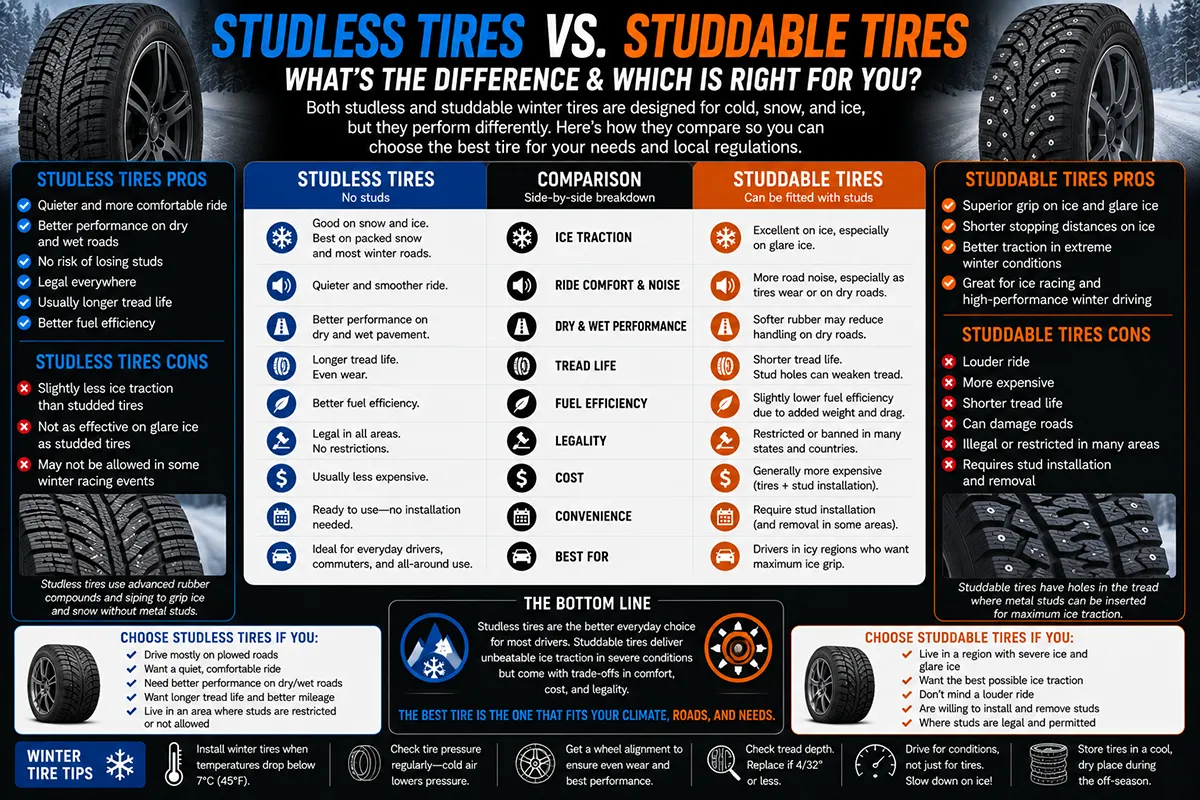
- Studless tires are the better choice for most US drivers — they’re quieter, legal everywhere, and modern compounds grip ice surprisingly well.
- Studdable tires (with studs installed) shine on pure glare ice and remote roads that rarely see a plow, but they’re banned or restricted in many states.
- Studdable tires without studs installed perform worse than dedicated studless tires — the empty stud holes reduce traction.
- Budget around $120–$200 per tire for quality studless options and $100–$180 per tire for studdable (plus $15–$25/tire for stud installation).
- If you live anywhere south of the snow belt or drive mostly on plowed highways, studless is the clear winner.
Liked this article?
Add TireAdvise as a preferred source so you see more of our tire reviews and guides on Google.
What Are Studless Winter Tires?
Studless winter tires are engineered to grip snow and ice using advanced rubber compounds and intricate tread designs — no metal studs needed. They rely on a softer, silica-rich rubber that stays pliable in freezing temperatures, combined with thousands of tiny slits called “sipes” that bite into icy surfaces.
I remember the first time I drove on a set of Bridgestone Blizzak WS90s after years of using studded tires. I genuinely couldn’t believe how well they hooked up on a frozen parking lot. The technology has come a long way from the early days when “studless” basically meant “less grip.”
Modern studless tires use what the industry calls a “multicell compound” — microscopic pores in the rubber that act like tiny suction cups on ice. Bridgestone pioneered this, but Michelin, Continental, and others have their own versions.
Pros of Studless Winter Tires
- Legal in all 50 states — no restrictions, no seasonal deadlines to worry about
- Excellent on packed snow — the deep tread and sipe patterns are purpose-built for this
- Surprisingly good on ice — modern compounds have closed the gap with studded tires significantly
- Quiet ride — no metal-on-pavement clicking or buzzing
- Better on wet and dry cold pavement — more rubber actually contacts the road
- No road damage — won’t chew up your state’s asphalt (or your garage floor)
Cons of Studless Winter Tires
- Slightly less grip on pure glare ice compared to properly studded tires
- Premium pricing — the best studless tires (Blizzak, X-Ice) tend to cost more
- Softer compound wears faster in warmer temperatures — don’t run them past spring
What Are Studdable Winter Tires?
Studdable tires come with pre-molded holes in the tread where small metal studs can be inserted. The studs — typically made of tungsten carbide — protrude slightly from the tire surface and physically dig into ice like tiny cleats.
Here’s what a lot of people don’t realize: studdable tires are designed to accept studs, but they’re often sold without studs installed. You have to either request stud installation at the tire shop or buy them pre-studded. This is a critical distinction I’ll come back to later.
I’ve run studdable tires both with and without studs, and the difference is night and day. With studs, they’re absolutely vicious on ice. Without studs, those empty holes actually become a liability.
Pros of Studdable Tires (With Studs Installed)
- Best-in-class ice traction — nothing beats metal biting into a glare ice surface
- Confidence on unpaved icy roads — ideal for rural and remote driving
- Generally less expensive than premium studless tires (before stud installation costs)
- Long track record — proven technology that’s been used for decades
Cons of Studdable Tires
- Legal restrictions in many states — outright banned in some, seasonal-only in others
- Loud on bare pavement — the constant clicking and buzzing gets old fast
- Worse on dry and wet pavement — studs reduce the rubber-to-road contact patch
- Road damage — studs tear up asphalt, which is why many states restrict them
- Additional cost for stud installation — typically $15–$25 per tire
- Without studs, performance is worse than studless — those empty holes reduce traction
The Critical Mistake: Running Studdable Tires Without Studs
This is the single biggest mistake I see people make, and I want to address it head-on because I’ve made it myself.
A few years back, I picked up a set of studdable winter tires on sale and figured I’d save money by skipping the stud installation. My logic was simple: “It’s still a winter tire with a winter compound, so it’ll be fine, right?”
Wrong.
Those empty stud holes in the tread actually reduce the tire’s contact with the road. Think of it this way — where a studless tire has solid rubber and sipes working together to grip ice, a studdable tire without studs has dozens of small voids where rubber should be but isn’t.
The tread pattern was designed around the assumption that studs would fill those holes and provide the grip.
During my test period on those unstudded studdable tires, I noticed meaningfully longer stopping distances on ice compared to a proper studless tire. On snow, the difference was less dramatic but still noticeable. It was an expensive lesson.
Bottom line: if you buy studdable tires, install the studs. If you don’t want studs, buy dedicated studless tires.
Head-to-Head Comparison: Studless vs Studdable (Studded)
I’ve put together this comparison table based on my hands-on testing experience across multiple winters. These ratings reflect real-world performance, not lab data.
| Performance Category | Studless Winter | Studdable (With Studs) | Studdable (No Studs) |
|---|---|---|---|
| Glare Ice Grip | ★★★★☆ | ★★★★★ | ★★★☆☆ |
| Packed Snow Traction | ★★★★★ | ★★★★☆ | ★★★★☆ |
| Deep Snow | ★★★★☆ | ★★★★☆ | ★★★☆☆ |
| Wet Pavement | ★★★★☆ | ★★★☆☆ | ★★★☆☆ |
| Dry Cold Pavement | ★★★★☆ | ★★★☆☆ | ★★★☆☆ |
| Road Noise | Quiet | Loud | Moderate |
| Legality (US) | All 50 states | Varies by state | All 50 states |
| Avg. Price Per Tire | $120–$200 | $100–$180 + studs | $100–$180 |
| Tread Life | Good | Moderate | Moderate |
Stud Laws in the US: Where Are Studded Tires Legal?
This is a deal-breaker for a lot of people, and honestly, it should be one of the first things you check before even considering studdable tires.
As of my most recent research, studded tires are completely banned in a handful of states, including Alabama, Texas, Florida, Hawaii, Illinois, Louisiana, Maryland, Michigan, Minnesota, Mississippi, and Wisconsin. Yes — Minnesota and Michigan, two of the snowiest states, have banned studs because of the road damage they cause.
Most other northern and western states allow studs only during certain months, typically from October through April (the exact dates vary). States like Alaska, Colorado, Wyoming, Montana, and Washington allow seasonal use.
A few states have no restrictions at all, but they’re mostly in the rural Mountain West.
My advice: check your specific state’s DOT website before buying. And if you regularly cross state lines for work or travel, keep in mind that you could be legal in your home state but illegal in the next state over. I’ve seen this catch people off guard, especially in the Northeast.
My Real-World Testing Experience
Let me walk you through what I’ve actually felt behind the wheel, because specs and ratings only tell part of the story.
Studless: Bridgestone Blizzak WS90
I tested the Blizzak WS90 on my daily driver (a midsize sedan) during one of the harshest winters I’ve experienced in the upper Midwest. After several days of driving through a mix of conditions — fresh snow, packed snow, slush, black ice, and cold dry pavement — I came away genuinely impressed.
The ice traction was the standout for me. On a frozen lake parking area (a Midwestern tradition), I did some controlled braking tests and the WS90s stopped noticeably shorter than the all-season tires I’d been running.
The multicell compound really does work. You can feel the tire “grab” in a way that all-seasons simply can’t replicate.
On snow-covered highways, they inspired serious confidence. Lane changes felt stable, braking was progressive and predictable, and I never once felt the rear end stepping out unexpectedly. Road noise on clear pavement was minimal — just a soft hum, nothing annoying.
The one area where I noticed a limit was on pure glare ice at intersections — those polished-smooth patches where traffic has compressed and melted the snow into a skating rink. The Blizzaks handled it far better than any all-season, but I could feel them searching for grip in a way that studded tires simply don’t.
Studded: General Altimax Arctic (With Studs)
I ran a set of General Altimax Arctic tires with factory-installed studs on the same vehicle during a different winter for direct comparison. The difference on ice was immediately noticeable from the first drive.
On that same type of polished intersection ice, the studded Generals felt planted and confident. The studs dug in with a reassuring grip that gave me shorter stopping distances on pure ice.
During my test period on icy back roads, I could accelerate from a stop on a hill with noticeably less wheelspin than I’d experienced with the studless Blizzaks.
But here’s the trade-off that most reviews gloss over: the noise. On bare pavement — which, let’s be honest, makes up a significant portion of your winter driving even in snow-heavy states — studded tires are loud. It’s a constant, rhythmic buzzing that gets louder with speed.
After a few days, I found it genuinely fatiguing on highway drives. I started turning up the radio more than usual, which tells you something.
Braking performance on dry cold pavement was also worse with the studded tires. The studs slightly reduce the rubber contact patch, and I could feel the tires take a fraction of a second longer to bite during hard stops on clear highways.
The Verdict From Behind the Wheel
If I had to summarize my experience in one sentence: studded tires are better on ice but worse at almost everything else.
For the mix of conditions most US drivers actually face — plowed highways with occasional icy patches, snowy side streets, cold rain, and those random 45°F January days — studless tires deliver a better overall package.
The gap on ice has narrowed dramatically, and the advantages in noise, legality, and dry-road performance make studless the smarter choice for most people.
Who Should Buy Studless Tires?
Based on everything I’ve tested and observed, studless winter tires are the right call if you:
- Live in a state that bans or restricts studded tires
- Do most of your driving on paved, plowed roads
- Commute on highways where dry pavement is common even in winter
- Value a quiet, comfortable ride
- Want a “set it and forget it” winter tire with no legal headaches
- Drive in a mix of snow, ice, slush, and cold rain
This covers the vast majority of US drivers, including those in heavy snowfall areas like the Great Lakes region, New England, and the Pacific Northwest lowlands.
My Top Studless Tire Picks for US Drivers
- Bridgestone Blizzak WS90 — The benchmark. Best ice performance in the studless category. ~$140–$180/tire depending on size.
- Michelin X-Ice Snow — Excellent all-around performer with better tread life than the Blizzak. Slightly less ice grip but better on dry roads. ~$150–$200/tire.
- Continental VikingContact 7 — Underrated option that I found incredibly well-balanced. Great snow traction and impressively low road noise. ~$130–$175/tire.
- Nokian Hakkapeliitta R5 — Finnish engineering at its finest. Premium price but outstanding performance. ~$150–$210/tire.
Who Should Buy Studdable Tires?
Studdable tires (with studs installed) make sense for a narrower group of drivers:
- You live in a rural area with roads that are rarely plowed or salted
- Your daily commute involves steep, icy hills or mountain passes
- You live in a state that allows studded tires (and you don’t regularly cross into one that doesn’t)
- You frequently drive on unpaved roads that freeze solid in winter
- You prioritize maximum ice traction above all else, including noise and dry-road performance
This profile fits a lot of drivers in Alaska, parts of Montana, rural Idaho, mountainous areas of Colorado and Wyoming, and remote areas of northern New England.
My Top Studdable Tire Picks for US Drivers
- Nokian Hakkapeliitta 10 — The gold standard for studded tires. Nokian has been perfecting studs for decades in Finland, and it shows. ~$150–$200/tire + stud installation.
- General Altimax Arctic 12 — Excellent budget-friendly option with solid studdable performance. ~$100–$140/tire + studs.
- Firestone Winterforce 2 — A tried-and-true studdable option that’s widely available and affordable. ~$90–$130/tire + studs.
Cost Comparison: What Will You Actually Spend?
Let’s break down the real-world costs because the sticker price doesn’t tell the whole story.
Studless Tire Total Cost (Set of 4)
- Tires: $480–$800
- Mounting and balancing: $60–$100
- Dedicated winter wheels (optional but recommended): $300–$600 for steel wheels
- Total without wheels: $540–$900
- Total with dedicated wheels: $840–$1,500
Studdable Tire Total Cost (Set of 4, With Studs)
- Tires: $400–$720
- Stud installation: $60–$100 (for all 4 tires)
- Mounting and balancing: $60–$100
- Dedicated winter wheels (optional but recommended): $300–$600 for steel wheels
- Total without wheels: $520–$920
- Total with dedicated wheels: $820–$1,520
As you can see, the total cost is actually very similar once you factor in stud installation. The studdable tires themselves tend to be slightly cheaper, but the labor to install studs eats up most of that savings.
I always recommend getting a dedicated set of steel wheels for your winter tires. It makes seasonal swaps faster, cheaper, and easier — and it pays for itself within a couple of seasons since you avoid paying for mounting and balancing twice a year.
How Long Do They Last?
In my experience, both types of winter tires last a similar number of seasons if you use them properly — meaning you mount them when temperatures consistently drop below 45°F and remove them when spring arrives.
Studless tires from premium brands like Bridgestone, Michelin, and Continental have given me solid performance across multiple winter seasons before needing replacement. The key is removing them promptly in spring — their soft compound wears fast in warm weather.
Studded tires can actually lose studs over time, especially if driven extensively on bare pavement. I’ve noticed studs beginning to pop out or wear down after several seasons of use. Once you start losing studs, the tire’s ice performance degrades unevenly, which isn’t ideal.
One tip from hard-won experience: store your off-season tires in a cool, dry place away from direct sunlight. I use tire totes in my garage, and it noticeably extends the life of the compound.
Common Myths I Want to Bust
Myth 1: “Studded tires are always better in winter.”
This hasn’t been true for at least a decade. Modern studless compounds have closed the ice-traction gap significantly. Studded tires are only meaningfully better on pure glare ice — and for every other winter condition, studless tires match or beat them.
Myth 2: “All-wheel drive means I don’t need winter tires.”
I hear this constantly and it drives me crazy. AWD helps you accelerate, but it does absolutely nothing for braking or cornering. I’ve tested vehicles with AWD and all-seasons against front-wheel-drive cars with proper winter tires, and the winter-tire-equipped cars stopped shorter every single time. Every. Single. Time.
Myth 3: “Studdable tires without studs are basically the same as studless tires.”
No. As I explained earlier, the empty stud holes compromise the tread’s ability to grip. If you’re not installing studs, buy a purpose-built studless tire. You’ll get better performance for similar money.
Myth 4: “Winter tires are only for people in the Snow Belt.”
If temperatures regularly drop below 45°F where you live, winter tires will outperform all-seasons — even on dry pavement. The rubber compound is the key difference. All-season rubber hardens in cold weather and loses grip. Winter rubber stays flexible. I’ve felt this difference firsthand driving in places like Virginia and Tennessee, where snow is rare but cold snaps are common.
My Final Recommendation
After years of testing both types, here’s my straightforward advice:
For 80-90% of US drivers who deal with winter weather, buy studless winter tires. Specifically, I’d point most people toward the Bridgestone Blizzak WS90 or the Michelin X-Ice Snow. Both are widely available at Tire Rack, Discount Tire, Costco, and most local shops. They deliver outstanding winter performance without the noise, legality concerns, or pavement damage that comes with studs.
For the 10-20% of drivers who live in remote, icy areas with minimal road maintenance, studdable tires with studs are worth it. The Nokian Hakkapeliitta 10 is my top pick if your budget allows. The General Altimax Arctic 12 is a solid budget alternative.
And whatever you do, please don’t try to split the difference by running studdable tires without studs. You’re getting the worst of both worlds. Commit to one approach or the other.
Winter tires are an investment in your safety and the safety of everyone else on the road. In my experience, they’re the single best upgrade you can make to your vehicle for cold-weather driving — more impactful than AWD, more useful than traction control, and worth every penny when the snow starts falling.
Stay safe out there.
Frequently Asked Questions
What is the difference between studless and studdable winter tires?
Studless winter tires use advanced rubber compounds and specialized tread patterns with biting edges to grip ice and snow without metal studs. Studdable tires have pre-drilled holes in the tread that allow you to install metal studs for extra traction on hard-packed ice. The key trade-off is that studless tires perform better on a wider range of winter surfaces including wet roads, while studdable tires with studs installed offer superior grip specifically on solid ice.
Are studless winter tires good enough for ice without studs?
Modern studless winter tires from brands like Bridgestone Blizzak, Michelin X-Ice, and Continental VikingContact have improved dramatically and handle most icy conditions very well for everyday US drivers. They use silica-rich compounds that stay flexible in extreme cold and micro-bite technology that grips ice at a molecular level. For the majority of drivers in states like Minnesota, Wisconsin, or Michigan, I’d say studless tires provide more than enough ice traction for commuting and highway driving without the downsides of studs.
Are studded tires legal in my state, and where are they banned in the US?
Studded tire laws vary widely across the US, and roughly 10 states either ban them outright or severely restrict their use, including Alabama, Texas, Florida, Hawaii, and Illinois. States that allow studs typically enforce seasonal restrictions, for example Oregon permits them from November 1 through March 31. Before buying studdable tires, I strongly recommend checking your specific state’s Department of Transportation website because fines for running studs outside legal dates or in banned states can be significant.
Do studless tires last longer than studdable tires with studs installed?
Studless winter tires generally last longer because the tread wears more evenly without metal studs creating uneven contact with the road surface. Studdable tires with studs installed tend to wear faster, especially when driven on bare pavement, and the studs themselves can loosen or fall out over time. Most studless tires like the Bridgestone Blizzak WS90 or Michelin X-Ice Snow deliver around 40,000-50,000 miles of tread life, while studded tires typically need replacement sooner due to accelerated wear patterns.
How much do studless winter tires cost compared to studdable tires?
Studless winter tires typically range from $100 to $250 per tire for popular sizes, with top-rated options like the Michelin X-Ice Snow averaging around $150-$200 per tire. Studdable tires are often slightly cheaper at $80 to $180 per tire, but you need to factor in the cost of stud installation, which usually runs $15-$30 per tire at a local tire shop. When you add up the stud installation cost and potentially shorter tread life, the total cost of ownership for studded tires is often comparable to or higher than studless alternatives.
Can you drive studdable tires without installing the studs?
Yes, you can run studdable tires without studs and many drivers do exactly that, essentially using them as a standard winter tire. However, studdable tires without studs generally underperform true studless winter tires on ice because the empty stud holes reduce the tread contact area and the rubber compound is typically not as advanced. If you don’t plan to install studs, I’d recommend spending your money on a dedicated studless winter tire instead, as you’ll get better all-around winter traction and a quieter ride.
Should I buy studless or studdable tires for driving in the Pacific Northwest or Northeast?
For most drivers in the Pacific Northwest where you encounter wet snow, slush, and rain-soaked roads more often than hard ice, studless winter tires are the better choice because they excel across varied winter conditions. In the Northeast, studless tires also work well for the majority of drivers, though those living in rural areas of Vermont, New Hampshire, or Maine with long stretches of untreated icy roads may benefit from studdable tires with studs installed. I recommend studless tires as the default for US drivers in both regions unless you regularly face sustained black ice conditions that studs specifically address.
