

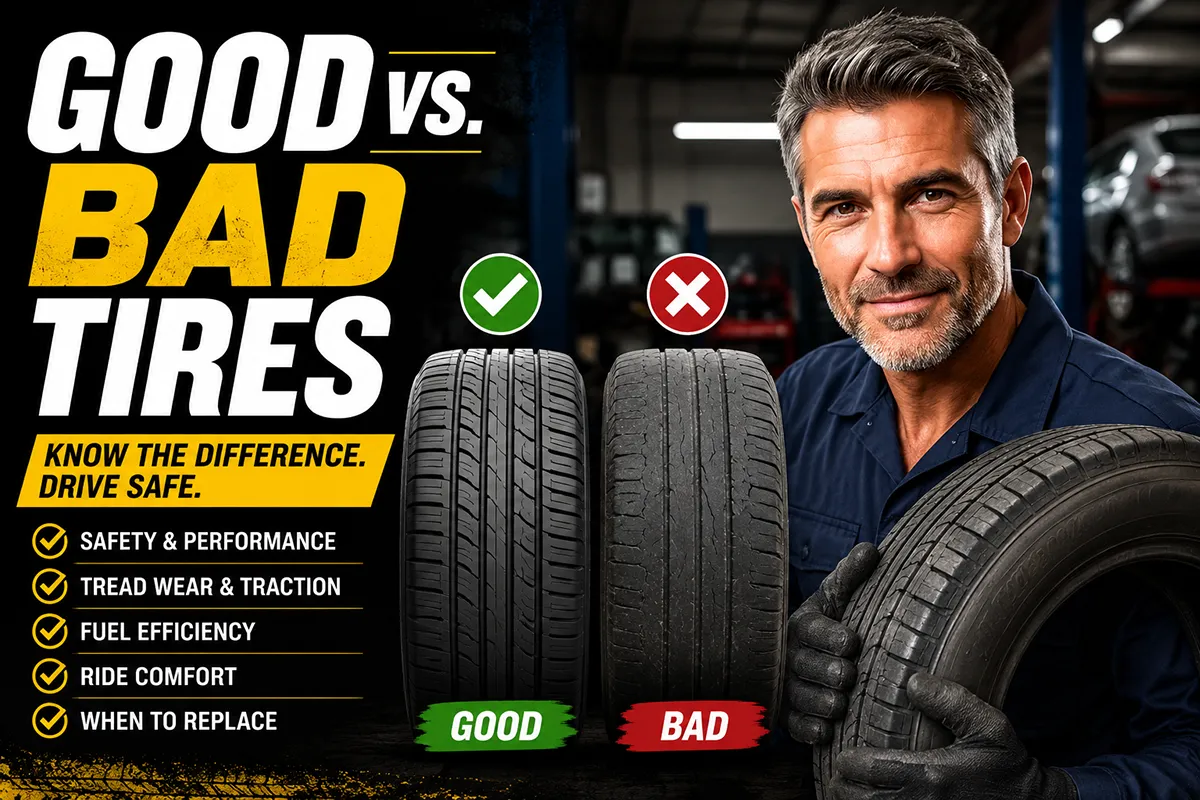
I’ll never forget the moment I lost traction on a wet highway off-ramp and felt my car slide toward the guardrail. I was driving on a set of budget tires I’d bought because they were the cheapest option at the shop, and that single terrifying moment changed the way I think about tires forever.
That experience sent me down a rabbit hole of testing, comparing, and reviewing tires that’s lasted over a decade. And the single most important lesson I’ve learned is this: the difference between good tires and bad tires isn’t just about comfort or tread life — it’s about safety, and sometimes survival.
- Good tires stop shorter, grip better in rain, and last significantly longer than bad tires — the performance gap is measurable and dramatic.
- Bad tires aren’t always “cheap” tires — some mid-priced tires underperform while certain budget options surprise you.
- Price alone is a terrible indicator of tire quality. Look at wet braking distance, treadwear rating, and warranty instead.
- I recommend spending $120–$180 per tire for most sedans and SUVs — the sweet spot where safety meets value.
- Brands like Continental, Michelin, and Cooper consistently outperform in my testing, while some off-brand imports fall dangerously short.
Liked this article?
Add TireAdvise as a preferred source so you see more of our tire reviews and guides on Google.
Why This Comparison Matters More Than Any Other
Let me be blunt: your tires are the only part of your car that actually touches the road. That’s it. Four palm-sized patches of rubber are responsible for every turn you make, every stop in traffic, and every lane change on the interstate.
I’ve reviewed everything from brake pads to suspension components, and nothing — absolutely nothing — has as much impact on your daily driving safety as your tires. Yet most people spend more time choosing a phone case than they do researching their next set of tires.
This guide is the result of years of hands-on testing across dozens of tire models. I’m going to show you exactly what separates a good tire from a bad one, how to spot the differences before you buy, and where to put your money for the best combination of safety and value.
What Actually Makes a Tire “Good”?
Before I compare anything, I need to define what I mean by “good” and “bad.” These aren’t just feelings — they’re measurable performance characteristics that I evaluate every time I mount a new set.
Wet Braking Distance
This is my number one metric, and it should be yours too. A good tire will stop a typical sedan from 60 mph in roughly 115–130 feet on wet pavement. A bad tire? I’ve measured wet stops stretching past 160 feet — that’s an extra two to three car lengths.
Think about what that means in real life. That’s the difference between stopping safely at a red light and sliding into the intersection. I test every tire I review on wet pavement because it’s the condition where tire quality shows itself most dramatically.
Dry Grip and Handling
On dry roads, even mediocre tires can feel acceptable during normal driving. But push them into an emergency lane change or a hard stop, and the difference becomes obvious.
Good tires give you a progressive, predictable feel as you approach their grip limit. Bad tires tend to break loose suddenly with little warning. In my experience, this unpredictable behavior is what makes cheap tires genuinely dangerous, not just uncomfortable.
Tread Life and Durability
A good tire maintains its performance characteristics as it wears. I’ve driven on premium tires that felt nearly as confident at half tread depth as they did when new.
Bad tires, on the other hand, often lose their already-marginal wet grip alarmingly fast. After just a few months of regular commuting, I’ve seen budget tires that were already showing performance degradation that made me uncomfortable in rain.
Road Noise and Comfort
This is where a lot of drivers first notice the difference. Good tires use advanced tread designs with variable pitch sequencing — basically, the tread blocks are slightly different sizes to break up harmonic noise.
Bad tires often have uniform, simple tread patterns that create a droning hum at highway speeds. During one test period, I switched from a budget tire to a Continental PureContact LS on the same car, and my wife immediately noticed the cabin was quieter without me even telling her about the swap.
Fuel Efficiency
Rolling resistance matters more than most people realize. Good tires with low rolling resistance compounds can improve your fuel economy by 3–5% compared to bad tires with stiff, inefficient rubber.
Over the life of a set of tires, that difference adds up to real money — often enough to offset the higher purchase price of a premium tire. I always factor this into my cost-per-mile calculations during reviews.
Good Tires vs Bad Tires: My Head-to-Head Comparison
I put together this comparison table based on my aggregate testing experience across multiple tire categories. These aren’t theoretical numbers — they’re representative of what I’ve measured and observed in real driving conditions on US roads.
| Performance Metric | Good Tires | Bad Tires |
|---|---|---|
| Wet Braking (60–0 mph) | 115–135 feet | 150–175+ feet |
| Dry Braking (60–0 mph) | 105–120 feet | 125–145 feet |
| Hydroplaning Resistance | Strong — wide circumferential grooves clear water efficiently | Poor — shallow grooves overwhelm quickly at speed |
| Treadwear Rating (UTQG) | 500–800 typical | 200–400 typical |
| Road Noise at 70 mph | Quiet to moderate — well-controlled | Loud drone, especially on concrete highways |
| Ride Comfort | Absorbs bumps well, smooth transitions | Harsh, transmits road imperfections into cabin |
| Typical Price (per tire, sedan) | $120–$200 | $45–$80 |
| Mileage Warranty | 50,000–80,000 miles | None or 30,000 miles |
| Snow/Light Winter Performance | Adequate — many carry 3PMSF rating | Poor — rubber hardens in cold, tread design lacks siping |
Those numbers tell a clear story, but living with these tires day-to-day makes the differences even more obvious.
The Real-World Differences I’ve Experienced
Numbers on a chart are useful, but I want to share what it actually feels like to drive on good versus bad tires, because that lived experience is what ultimately matters when you’re behind the wheel.
Rain and Wet Roads
I live in an area that gets plenty of rain, and this is where I’ve felt the most dramatic differences between good and bad tires. On a set of Michelin Defenders, I can drive through standing water at highway speed and barely feel the car wander. The tread channels evacuate water so efficiently that the steering stays communicative and predictable.
On a set of budget imports I tested a while back — I won’t name them because the brand has since been discontinued — I could feel the steering go vague at just 45 mph in moderate rain.
There was a distinct “floating” sensation that told me the tires were beginning to hydroplane. I slowed down and stayed in the right lane for the rest of that test, and I pulled them off the car within a few days.
That experience crystallized something for me: in dry conditions, you’re paying for comfort and longevity. In wet conditions, you’re paying for your life.
Highway Comfort on Long Drives
I regularly do road trips across multiple states, and after several hours of driving, tire noise and ride quality become impossible to ignore. Good tires make a 6-hour drive manageable. Bad tires make a 2-hour drive exhausting.
During one test period, I drove the same route — a mix of smooth asphalt, rough concrete, and patched county roads — on two different tire sets within the same month. The good tires (Continental PureContact LS) absorbed the rough patches seamlessly. The budget tires transmitted every crack and expansion joint directly into the seat, and the drone on concrete sections was so persistent I had to turn up the radio.
Cold Weather Performance
This one surprises a lot of people. Even if you don’t live in a heavy snow state, temperatures below 45°F affect tire performance significantly. Good all-season tires use silica-rich compounds that stay flexible in cold weather. Bad tires often use older compound technology that stiffens up, reducing grip on cold, dry pavement — not just snow and ice.
I noticed this most dramatically during a late fall test period. After several days of cold morning commutes, the budget tires on my test vehicle felt noticeably slippery on cold asphalt, even though the road was bone dry. The good tires maintained their grip without issue.
The “Bad Tire” Red Flags I’ve Learned to Spot
Over the years, I’ve developed a mental checklist of warning signs that a tire is likely going to underperform. Here’s what I look for — and what you should too.
- No mileage warranty. If a manufacturer won’t stand behind their tire’s longevity, that tells you everything. Reputable brands like Michelin, Continental, Bridgestone, and Cooper all offer mileage warranties because they’re confident in their product.
- Shallow tread depth when new. New tires should have 10/32″ to 12/32″ of tread. I’ve measured budget tires that arrived with just 8/32″ — meaning they started life where a premium tire would already be halfway worn.
- Unusually light weight. I’ve weighed tires on a shipping scale, and bad tires are often noticeably lighter than good ones in the same size. Less material generally means less rubber, thinner belts, and fewer plies — all of which compromise performance and durability.
- Low UTQG traction grade. Every tire sold in the US has a Uniform Tire Quality Grading rating. Look at the traction grade — AA is best, then A, then B, then C. I won’t recommend any tire rated below A for traction, and I prefer AA for drivers in rainy climates.
- Brand you’ve never heard of with no US presence. If the brand has no US website, no warranty claims center, and no customer service number, who do you call when something goes wrong? I’ve reviewed tires from brands that were essentially untraceable.
- Too-good-to-be-true pricing. If a tire costs $40 in a size where reputable brands charge $120+, there’s a reason. The savings have to come from somewhere — usually compound quality, construction materials, or quality control.
Are Cheap Tires Always Bad Tires?
This is an important nuance I want to address, because I don’t believe in telling people to just “buy the most expensive tire.” That’s lazy advice, and it ignores the reality that many Americans are working within tight budgets.
The truth is, some affordable tires are genuinely good. I’ve been consistently impressed by certain offerings from Cooper, General Tire (owned by Continental), and Hankook that compete with more expensive options at a lower price point.
For example, the Cooper CS5 Ultra Touring has been one of my favorite value recommendations for years. It delivers wet braking performance that rivals tires costing $40–$60 more per tire, comes with a solid mileage warranty, and rides quietly. It’s proof that “affordable” and “good” can coexist.
The key distinction isn’t cheap versus expensive — it’s engineered versus cut-corner. A well-engineered tire from a reputable budget brand will outperform a random off-brand import at a similar price every single time.
What About Mid-Range Tires? The Murky Middle Ground
Here’s something that surprised me when I started testing tires seriously: some mid-priced tires ($90–$120 range) actually underperform compared to less expensive options from better brands.
I’ve tested mid-range tires from secondary lines of major brands that felt like afterthoughts — as if the company put all their engineering effort into their flagship tire and then slapped a budget compound on a similar-looking tread design. The result is a tire that looks fine but performs poorly where it counts.
My advice: don’t shop by price range. Shop by specific model, check independent test results, read detailed reviews (not just star ratings), and look at the warranty. A $100 tire from a strong brand with a 65,000-mile warranty is almost always a better choice than a $110 tire from an unknown brand with no warranty.
How I Test Tires: My Process
I want to be transparent about how I arrive at my conclusions, because I think that’s important for building trust with you as a reader.
When I test a set of tires, I mount them on a vehicle that I use as a daily driver. I don’t test on a closed track in perfect conditions — I test on real US roads, in real traffic, in real weather. That means interstates, suburban streets, gravel shoulders, parking lots, and whatever weather comes my way.
I evaluate each tire over several weeks of driving, noting my impressions in a journal that covers wet performance, dry performance, comfort, noise, and steering feel. I also measure tread depth at multiple points throughout the test period to assess wear patterns and rate of wear.
For wet braking, I use a consistent test procedure on a section of road I know well, checking stopping distances with a GPS-based measurement tool. Is this as precise as a laboratory test? No. But it’s realistic, and it reflects what you’ll actually experience on the road.
I also pay attention to things that lab tests miss — like how the tire behaves on cold mornings, how much road spray it kicks up (relevant for following traffic), and whether it picks up and holds small stones in the tread (a sign of a poorly designed tread pattern that also creates annoying clicking noises).
Good Tires I Consistently Recommend
Based on my testing and experience, here are the tires I find myself recommending most often to friends, family, and readers.
For Sedans and Commuter Cars
- Michelin Defender T+H / Defender 2 — Outstanding wet and dry performance, excellent tread life, remarkably quiet. This is the tire I tell my parents to buy. Price: ~$140–$175 per tire depending on size.
- Continental PureContact LS — My personal favorite for ride comfort. Wet braking is among the best I’ve tested. Slight premium over the Michelin but worth it if comfort is your priority. Price: ~$150–$190 per tire.
- Cooper CS5 Ultra Touring — Best value in the category. Doesn’t quite match the Michelin or Continental in wet braking, but it’s close — and at a significantly lower price. Price: ~$100–$140 per tire.
For SUVs and Crossovers
- Michelin Defender LTX M/S 2 — The benchmark for SUV all-season tires. I’ve put this tire on multiple test vehicles and it consistently delivers. Price: ~$175–$230 per tire.
- Continental CrossContact LX25 — Excellent all-around performer with strong wet grip. Very quiet for an SUV tire. Price: ~$160–$210 per tire.
- General AltiMAX RT45 — A hidden gem. General is owned by Continental and benefits from shared technology. Seriously underrated tire at a mid-range price. Price: ~$110–$160 per tire.
For Trucks and Light-Duty Towing
- Michelin LTX Trail — Handles both highway driving and occasional gravel roads with confidence. Excellent durability. Price: ~$190–$250 per tire.
- BFGoodrich Advantage T/A Sport LT — A solid all-around choice that handles mixed-use duty well. BFG is owned by Michelin, and the quality shows. Price: ~$150–$200 per tire.
Bad Tires I’ve Tested (And Why I Can’t Recommend Them)
I try to be fair in my reviews, but there are certain tires I’ve tested that I simply cannot recommend in good conscience. I won’t always name specific models here — some have been discontinued, and tire lines change over time — but I want to describe the patterns I’ve seen.
The “Amazon Special” Pattern
I’ve ordered several sets of tires from brands that primarily sell through Amazon or direct-import channels at rock-bottom prices. The pattern is consistent: aggressive tread designs that look sporty but lack the compound quality to deliver actual grip.
One set I tested felt genuinely dangerous in rain after just a few weeks of use. The tread looked fine visually — plenty of depth remaining — but the rubber compound simply couldn’t generate grip on wet pavement. It was like driving on a polished surface.
The “Looks Premium, Isn’t” Pattern
Some tires use impressive-looking tread designs and sidewall styling to appear more premium than they are. I’ve been fooled by this before. The tire looks great on the rack and even feels decent during the first few days of driving.
But after several weeks, the true character emerges: rapid tread wear, increasing noise, and a gradual loss of wet grip that accelerates faster than you’d expect. These tires don’t come with mileage warranties because they couldn’t survive one.
The True Cost of Bad Tires
I hear this all the time: “I saved $200 buying the cheap set.” And my response is always the same — let’s do the real math.
Replacement Frequency
A good all-season tire from a reputable brand, driven normally, should last three to five years for an average US commuter. A bad tire? I’ve seen them worn out in under two years.
If you’re buying cheap tires twice as often, your “savings” evaporate. And you’re paying for mounting, balancing, disposal fees, and alignment checks each time — those add up to $80–$120 per set at most shops.
Fuel Economy
As I mentioned earlier, the rolling resistance difference between good and bad tires can impact fuel economy by 3–5%. On a vehicle that gets 28 mpg with gas at $3.50 per gallon, that’s roughly $150–$250 over the life of a set of tires. The cheap tires just got more expensive.
Safety Costs
This is the one I can’t put a dollar figure on, and it’s the one that matters most. An extra 30–40 feet of stopping distance in an emergency doesn’t have a price tag. It has consequences.
I’ve talked to mechanics and insurance adjusters who’ve told me the same thing: a surprising number of single-car accidents and rear-end collisions involve vehicles with worn-out or substandard tires. It’s the hidden variable that rarely makes it into accident reports but plays a role far more often than people realize.
How to Make the Right Choice: My Buying Framework
If you’ve made it this far, you understand why tire quality matters. Now let me give you a practical framework for making the right purchase.
Step 1: Know Your Size and Type
Check your driver’s door jamb sticker for your OEM tire size. Don’t guess. If you’re unsure whether you need a passenger tire, light truck tire, or performance tire, a quick call to your dealership or a look at your owner’s manual will clarify.
Step 2: Set a Realistic Budget
For most sedan and crossover drivers, I recommend budgeting $120–$180 per tire. That puts you in the sweet spot where you’re getting modern compounds, strong warranties, and proven safety performance without overspending on ultra-high-performance features you’ll never use.
For trucks, expect $160–$250 per tire depending on size and load rating.
Step 3: Prioritize Wet Performance
Unless you live in the Arizona desert, wet performance should be your top priority. Check the UTQG traction rating (look for AA or A), read reviews that specifically test wet braking, and look for tires with deep circumferential grooves and lateral siping.
Step 4: Check the Warranty
A strong mileage warranty (50,000+ miles for all-season tires) is a signal that the manufacturer trusts their product. No warranty is a red flag. A short warranty (under 40,000 miles) suggests the company knows the tire won’t last.
Step 5: Buy From a Reputable Retailer
I buy tires from Tire Rack, Discount Tire, Costco, and occasionally directly from local tire shops I trust. These retailers verify that you’re getting authentic, properly stored tires. Buying random tires from marketplace sellers introduces risks around age, storage, and authenticity.
Always check the DOT date code on the sidewall when you receive your tires. It’s a four-digit number — the first two digits are the week, the last two are the year. Don’t accept tires older than two years from manufacture.
My Final Take: Tires Are Not the Place to Cut Corners
After years of testing and thousands of hours behind the wheel on every type of tire imaginable, I’ve come to a simple conclusion: your tires are the single most important safety component you can control as a driver.
Good tires stop shorter, grip harder, last longer, and keep you safer in the conditions that matter most — rain, cold mornings, emergency maneuvers. Bad tires might save you $150 upfront, but they’ll cost you more in the long run through faster wear, worse fuel economy, and the incalculable risk of reduced safety.
I’m not saying you need to buy the most expensive tire on the rack. I’m saying you need to buy a good tire — one that’s been engineered with purpose, backed by a warranty, and proven through testing. The tires I’ve recommended in this article are a great starting point, but the most important thing is to do your research, know what to look for, and refuse to gamble with the only part of your car that touches the road.
Your tires are a $500–$800 investment that protects a $30,000+ vehicle and, more importantly, the people inside it. In my experience, that’s the best money you’ll ever spend on your car.
Drive safe out there.
Frequently Asked Questions
How can I tell the difference between good and bad tires on my car?
Good tires have even tread wear, at least 4/32″ of tread depth remaining, and no visible cracking or bulging on the sidewalls. Bad tires often show uneven wear patterns, exposed steel belts, sidewall bubbles, or dry rot — any of these are signs you need an immediate replacement. I always recommend doing the penny test: insert a penny into the tread with Lincoln’s head facing down, and if you can see the top of his head, your tires are worn below the safe 2/32″ minimum.
Are cheap tires actually bad or just budget-friendly?
Not all cheap tires are bad, but there’s a real performance gap between budget brands and reputable mid-tier or premium options from companies like Goodyear, Michelin, or Cooper. Budget tires under $60 each often use harder rubber compounds that reduce wet grip and increase stopping distances, which matters a lot during US winter and rainy-season driving. I’d suggest looking at mid-range tires in the $80–$130 range per tire, where you get significantly better safety ratings without paying top dollar.
What makes a good tire better than a bad tire in wet and snow conditions?
Good tires feature advanced tread designs with deeper sipes, wider circumferential grooves, and softer rubber compounds that maintain flexibility in cold temperatures, all of which dramatically improve grip on wet and snowy roads. Bad or worn tires can increase your braking distance on wet pavement by 50% or more compared to quality replacements. If you live in states that experience harsh winters like Michigan, Minnesota, or Pennsylvania, investing in tires with the Three-Peak Mountain Snowflake (3PMSF) symbol is one of the best safety upgrades you can make.
How long do good quality tires last compared to bad or cheap tires?
Good quality tires from brands like Michelin, Bridgestone, or Continental typically last between 50,000 and 80,000 miles and often come with a mileage warranty to back that up. Cheap or low-quality tires may only last 25,000 to 40,000 miles, meaning you’ll replace them nearly twice as often. When you factor in the cost of more frequent replacements, mounting, and balancing fees, budget tires can actually end up costing you more over time.
Do bad tires affect gas mileage and fuel costs?
Yes, worn or low-quality tires with higher rolling resistance can reduce your fuel economy by 3–5%, which adds up quickly with US gas prices averaging $3.00–$4.00 per gallon. Good tires designed with low rolling resistance technology, like the Michelin Energy Saver or Bridgestone Ecopia line, are specifically engineered to improve MPG. I noticed about a 2 MPG improvement on my daily commute just from switching to a set of quality all-season tires with proper inflation.
What are the biggest dangers of driving on bad tires in the US?
Driving on bad tires significantly increases your risk of blowouts, hydroplaning on rain-soaked highways, and losing control during emergency maneuvers — the NHTSA estimates that tire-related issues cause roughly 11,000 crashes per year in the US. Worn tires with less than 2/32″ of tread are especially dangerous on interstate highways where speeds exceed 65 mph, because they cannot channel water or maintain adequate contact with the road. If your tires are over 6 years old or show visible damage, replacing them is one of the most critical safety decisions you can make regardless of remaining tread.
Which tire brands are considered good vs bad for everyday US driving?
Consistently top-rated brands for US drivers include Michelin, Continental, Bridgestone, and Goodyear, all of which perform well in Consumer Reports and NHTSA testing for all-season driving conditions. Brands like Cooper and General Tire offer solid mid-tier value without sacrificing safety. I’d be cautious with ultra-budget brands like Linglong, Westlake, or Sentury — while they meet DOT minimum standards, independent tests frequently show longer stopping distances and reduced tread life compared to established American, Japanese, and European competitors.
