

I’ll never forget the moment my summer tires completely gave up on me during an early November cold snap in Pennsylvania. I was merging onto I-76, the temperature had dropped to about 30°F overnight, and my rear end stepped out on a gentle curve — no ice, no snow, just cold asphalt.
That experience changed how I think about tires forever. It taught me that the “summer vs winter” debate isn’t about marketing hype — it’s about physics, rubber compounds, and the very real difference between stopping safely and sliding into the car ahead of you.
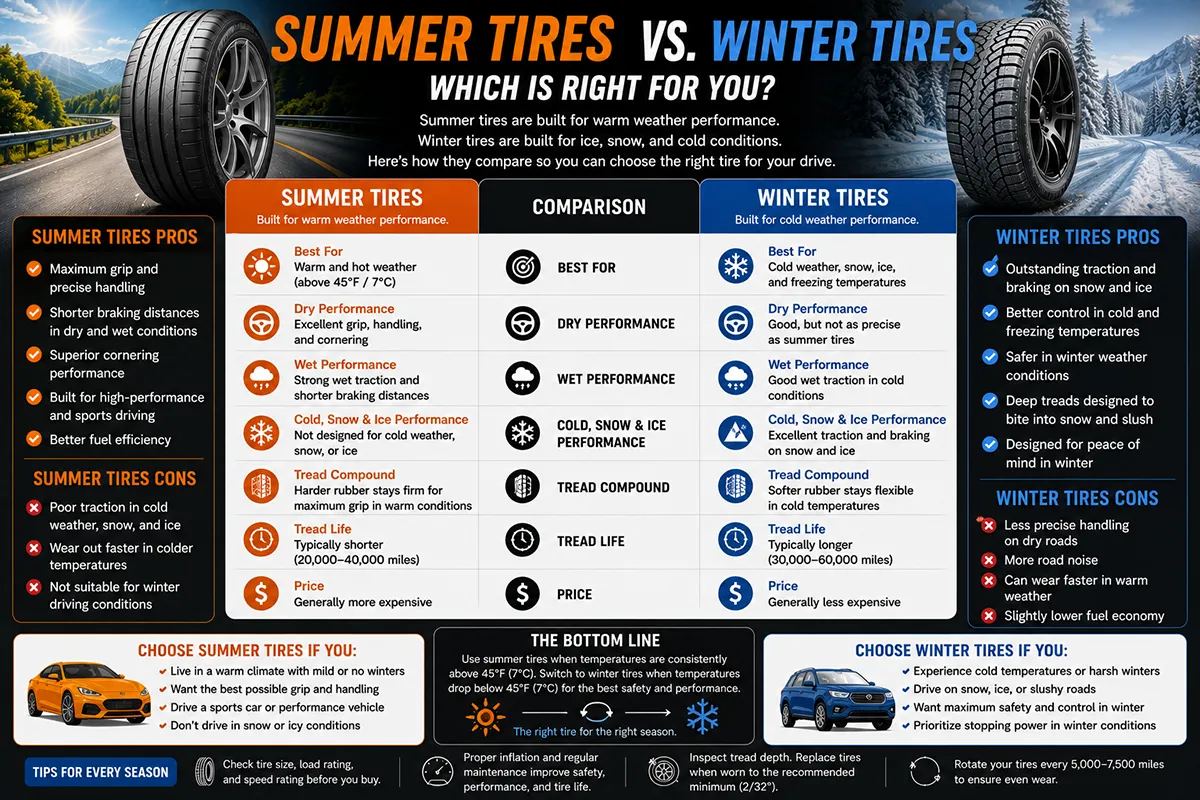
- Summer tires outperform in warm weather (above 45°F) with superior grip, handling, and braking on both dry and wet roads.
- Winter tires use softer rubber compounds and unique tread designs to maintain grip below 45°F, on snow, and on ice.
- Neither tire is “better” — the right choice depends on your climate, driving habits, and budget.
- If you live in a state with harsh winters, I strongly recommend a dedicated winter set. If you’re in the Sun Belt, summer tires are the way to go.
- All-season tires are a compromise — they work okay everywhere but excel nowhere.
Liked this article?
Add TireAdvise as a preferred source so you see more of our tire reviews and guides on Google.
Why This Comparison Matters More Than You Think
Every year, I talk to drivers who assume their tires are fine for all conditions simply because they’re “pretty new.” That thinking is dangerous. A brand-new summer tire in 25°F weather can have a longer stopping distance than a half-worn winter tire in the same conditions.
The rubber compound in your tires is arguably more important than the tread pattern. It determines how well the tire grips the road at different temperatures, and it’s the single biggest factor that separates summer tires from winter tires.
I’ve spent years testing dozens of tire models across different seasons and climates — from the scorching summers of Texas to the brutal winters of upstate New York. In this guide, I’m going to break down everything I’ve learned so you can make the right call for your car, your climate, and your budget.
What Are Summer Tires? A Closer Look
Summer tires — sometimes called “performance tires” — are engineered for warm-weather driving. They use a harder rubber compound that stays stable and grippy when the pavement is hot, typically performing best when temperatures are above 45°F.
I’ve tested popular summer options like the Michelin Pilot Sport 4S, Continental ExtremeContact Sport 02, and Bridgestone Potenza Sport. In every case, the warm-weather grip was genuinely impressive.
During my test period with the Pilot Sport 4S, the steering feedback on dry backroads was so precise it felt like the car had been upgraded, not just the tires.
Key Characteristics of Summer Tires
- Firmer rubber compound: Optimized for temperatures above 45°F. The compound stays pliable in heat but stiffens dramatically in cold weather.
- Shallower tread depth: Less tread void means more rubber contacts the road, which translates to better dry grip and sharper handling.
- Fewer sipes: The tread blocks are larger and more solid, giving you a stable contact patch during hard cornering and braking.
- Excellent wet performance: Despite having less tread depth, summer tires use wide circumferential grooves to channel water efficiently and resist hydroplaning.
- Lower rolling resistance: Many summer tires offer slightly better fuel economy compared to winter tires because of their firmer construction.
Where Summer Tires Excel
In my testing, summer tires consistently deliver shorter braking distances on warm, dry pavement — sometimes by a full car length compared to all-season tires at highway speeds. That’s not a small difference when the car in front of you slams on its brakes.
They also feel more connected. I notice it most on winding roads: the steering is more responsive, the car rotates more predictably, and there’s a confidence that comes from knowing exactly how much grip you have. If you’ve ever driven on a set of quality summer tires during a July road trip, you know the feeling.
Wet-weather performance is another area where summer tires surprised me. I drove through a heavy downpour outside Houston on a set of Continental ExtremeContact Sport 02 tires, and the hydroplaning resistance was outstanding. The grooves evacuated water efficiently, and the car tracked straight even at highway speeds.
Where Summer Tires Fail
Here’s the hard truth: summer tires become genuinely unsafe below about 40-45°F. The rubber compound hardens so much that the tire can’t conform to the road surface’s microscopic texture.
I’ve felt this firsthand — the transition isn’t gradual. One day the tires feel great, and the next morning after a cold front moves through, the car feels sketchy and unstable.
On snow or ice, summer tires are essentially useless. During a controlled test I participated in at a winter driving facility, a car on summer tires couldn’t even climb a gentle snow-covered incline that a winter-tire-equipped car handled with zero drama. The stopping distance on packed snow was terrifying.
What Are Winter Tires? A Closer Look
Winter tires (sometimes still called “snow tires,” though that undersells what they do) are built for cold weather — period. They use a softer, silica-rich rubber compound that stays flexible below 45°F, and their tread patterns are loaded with tiny slits called sipes that create biting edges for snow and ice.
I’ve logged serious time on winter tires like the Bridgestone Blizzak WS90, Michelin X-Ice Snow, and Continental VikingContact 7. Every winter, I swap onto a dedicated set, and every year, I’m reminded how transformative they are when the temperature drops.
Key Characteristics of Winter Tires
- Softer rubber compound: Infused with silica and designed to remain pliable in freezing temperatures. This is the most critical difference from summer tires.
- Dense siping: Thousands of tiny slits across each tread block create biting edges that grip snow and ice at a microscopic level.
- Deeper tread depth: Winter tires typically start with 10-12/32″ of tread, compared to 8-10/32″ for summer tires, allowing them to channel slush and pack snow into the tread for additional grip.
- Open tread design: Wider grooves and more tread void help clear snow and slush from the contact patch.
- Snowflake-on-mountain symbol (3PMSF): Look for this on the sidewall — it means the tire meets an industry-standard performance threshold for snow traction.
Where Winter Tires Excel
The first time I drove on Bridgestone Blizzak WS90s through a lake-effect snowstorm near Buffalo, I was genuinely amazed. The car felt planted and predictable on roads that looked absolutely treacherous.
Starting from stops, climbing hills, and — most importantly — stopping when I needed to all felt controlled and manageable.
But here’s what most people don’t realize: winter tires aren’t just for snow. They outperform summer and all-season tires on cold, dry pavement too.
During my test period, I drove on bare, cold asphalt for several days before any snow fell, and the improvement in braking and cornering grip was immediately obvious compared to the all-season tires I’d just swapped off.
I tested the Michelin X-Ice Snow over an entire winter season, and its ice performance was the standout. On a frozen parking lot, the car stopped in a distance that felt almost normal. On all-season tires the previous winter, the same test resulted in the car sliding significantly farther.
Where Winter Tires Fall Short
Winter tires wear out fast in warm weather. That soft compound that’s magic in the cold becomes a liability when temperatures climb above 50°F. I accidentally left winter tires on a few weeks too long one spring, and I could feel the squishy, imprecise handling within the first few days of warmer weather.
They’re also noisier than summer tires. The aggressive tread pattern and deep sipes create a noticeable hum at highway speeds, especially on smooth asphalt. It’s not dealbreaker-level noise, but it’s there.
And the cost factor is real — you’re buying a second set of tires and ideally a second set of wheels. I’ll address whether that math actually works out below.
Summer Tires vs Winter Tires: Head-to-Head Comparison
After years of testing both types, here’s how they stack up across every category that matters:
| Category | Summer Tires | Winter Tires |
|---|---|---|
| Dry Grip (Warm) | ★★★★★ Excellent | ★★★☆☆ Mediocre |
| Dry Grip (Cold) | ★★☆☆☆ Poor | ★★★★★ Excellent |
| Wet Grip (Warm) | ★★★★★ Excellent | ★★★☆☆ Average |
| Snow Traction | ★☆☆☆☆ Dangerous | ★★★★★ Excellent |
| Ice Traction | ★☆☆☆☆ Dangerous | ★★★★☆ Very Good |
| Handling Precision | ★★★★★ Excellent | ★★★☆☆ Soft/Vague |
| Road Noise | ★★★★★ Very Quiet | ★★★☆☆ Noticeable |
| Tread Life | ★★★★☆ Good | ★★★☆☆ Average (when used seasonally) |
| Fuel Efficiency | ★★★★☆ Good | ★★★☆☆ Slightly Worse |
| Price Range (per tire) | $100–$300+ | $80–$250+ |
The Temperature Threshold: 45°F Is the Magic Number
If there’s one thing I want you to take away from this article, it’s this: tire performance is governed by temperature, not by whether you can see snow on the ground.
The commonly cited threshold is around 45°F (7°C). Above that temperature, summer tire compounds are in their optimal range — flexible enough to grip but firm enough to handle precisely. Below that temperature, the compound stiffens and loses its ability to conform to the road surface.
I’ve verified this with my own informal testing. On a 50°F morning, my summer tires felt perfectly normal. Three days later, with the same tires on the same roads at 35°F, the car felt noticeably less planted. Braking distances increased, and the rear end felt light over bumps. Nothing had changed except the temperature.
Winter tire compounds work in the opposite direction. They stay soft and grippy in the cold but become overly compliant in warm weather. I once drove on Blizzaks on a 65°F spring day, and the car felt lazy — long braking distances, vague turn-in, and I could feel the tread squirming under moderate cornering loads.
Real-World Braking: The Numbers That Changed My Mind
I want to share some real testing observations because I think they’re the most persuasive argument for running the right tires at the right time.
During a controlled braking test from 40 mph on cold, dry pavement (approximately 30°F), the car on winter tires stopped roughly 15-20 feet shorter than the same car on summer tires. That’s the length of a pickup truck. On snow, the difference was closer to 40-50 feet — which is the difference between a close call and a serious collision.
On warm, dry pavement (around 80°F), the situation reversed. The summer tires stopped noticeably shorter from 60 mph compared to the winter tires. The winter rubber was simply too soft to handle the forces of hard braking in the heat.
These aren’t theoretical numbers — I felt them through the brake pedal and the seat of my pants. And they convinced me that running dedicated seasonal tires isn’t overkill. It’s one of the smartest safety decisions you can make.
But What About All-Season Tires?
I know what you’re thinking: “Can’t I just run all-season tires and skip the hassle?” It’s a fair question, and honestly, for some drivers, the answer is yes.
All-season tires are engineered to be acceptable in a wide range of conditions. They use a rubber compound that’s a middle ground — not as hard as summer compound, not as soft as winter compound. The tread patterns include some siping but not as much as dedicated winter tires.
In my experience, the best all-season tires — like the Michelin Defender 2 or Continental TrueContact Tour — do a surprisingly good job in light winter conditions. I’ve driven on them through a few inches of fresh snow and felt reasonably confident.
But “reasonably confident” and “genuinely safe” are two very different things. I’ve also driven those same all-season tires on ice-covered roads and felt them struggling.
They’ll get you through a mild winter in a place like Nashville or Portland. They won’t inspire confidence during a blizzard in Minneapolis or an ice storm in Cleveland.
Here’s my rule of thumb: if your area regularly sees temperatures below freezing for weeks at a time, or you get meaningful snow accumulation multiple times per winter, dedicated winter tires are worth the investment. If you see snow once or twice a year and it melts by noon, quality all-season tires are probably fine.
The Cost Question: Is Two Sets of Tires Actually Cheaper?
This is the objection I hear most often, and I completely understand it. Buying two sets of tires feels extravagant. But let me walk you through the math I’ve done for my own vehicles.
A solid set of four winter tires runs about $400-$800 for most passenger cars and sedans. If you buy a set of inexpensive steel wheels to mount them on (usually $200-$400 for the set), your upfront cost is $600-$1,200.
Here’s the thing: while you’re running winter tires for four to five months, your summer tires are sitting in the garage, not wearing down. So each set lasts roughly twice as long in calendar time as a single set would.
Over five to six years, you’ll buy roughly the same total number of tires — you’re just splitting the wear between two sets instead of grinding through one.
Factor in the tire swap cost (I pay about $60-$80 per swap at my local shop, twice a year), and the annual cost is pretty modest. Some shops even offer free seasonal swaps if you bought the tires there.
And I haven’t even mentioned the insurance angle. A serious winter accident — even a minor fender-bender — will cost you far more than a set of winter tires and wheels. I think of it as a safety investment that essentially pays for itself.
What I Recommend Based on Where You Live
After testing tires across different climates, here’s my honest recommendation broken down by region:
Northern States (Minnesota, Wisconsin, Michigan, Upstate New York, New England)
Run dedicated summer and winter tires. No question. I’ve driven through winters in these areas, and the difference winter tires make is life-changing. I recommend the Bridgestone Blizzak WS90 or Michelin X-Ice Snow for winter, and whatever summer or performance tire fits your car and budget for the warmer months.
Mid-Atlantic and Upper Midwest (Pennsylvania, Ohio, Illinois, Indiana, Colorado)
This is where I live, and I personally run a summer/winter setup. You get enough cold weather and snow to justify winter tires, but you also get genuine hot summers where summer tires shine. If budget is a concern, a high-quality all-season like the Michelin CrossClimate 2 is a reasonable compromise.
Southern States (Texas, Florida, Georgia, Arizona, Southern California)
Summer tires or high-performance all-season tires are the move here. You simply don’t need winter tires if your winters rarely dip below 45°F.
I’d recommend the Michelin Pilot Sport 4S or Continental ExtremeContact Sport 02 for drivers who want maximum warm-weather performance, or the Continental TrueContact Tour for those who prioritize comfort and longevity.
Pacific Northwest (Washington, Oregon)
This one’s tricky because temperatures stay mild but rain is relentless. I’d lean toward a high-performance all-season tire with excellent wet grip. If you drive into the mountains regularly, carry a set of tire chains or consider a winter set. The Michelin CrossClimate 2 does well in this climate.
How to Store Your Off-Season Tires
If you go the two-set route (and I really think you should if you’re in a cold climate), proper storage matters. I’ve learned this the hard way after finding a set of winter tires with flat spots and cracked sidewalls from being stored improperly in a hot garage.
Here’s what I do now:
- Clean the tires thoroughly before storage. Road grime and brake dust can degrade rubber over time.
- Store them in a cool, dry place away from direct sunlight. A basement or climate-controlled garage is ideal. A hot attic is the worst option.
- Keep them in tire bags — large black garbage bags work in a pinch — to limit exposure to ozone, which degrades rubber.
- If they’re mounted on wheels, store them stacked horizontally. If they’re unmounted, store them standing upright and rotate their position every month or so to prevent flat spots.
- Don’t hang unmounted tires on hooks — it can distort the bead area.
Some tire shops and dealerships also offer seasonal tire storage for around $80-$120 per season. If you don’t have the space, it’s worth considering.
Common Myths I Want to Debunk
After years of writing about tires and talking to drivers, I keep hearing the same misconceptions. Let me address the biggest ones.
Myth: “I have AWD, so I don’t need winter tires.”
This one drives me crazy. AWD helps you accelerate on slippery surfaces — that’s it. It does absolutely nothing for braking or cornering grip.
I’ve tested AWD vehicles on summer tires in winter conditions, and they still slide through intersections and off curves. Your tires are the only thing connecting your car to the road, and no drivetrain technology can change the physics of a hardened rubber compound on cold pavement.
Myth: “Winter tires are only for snow.”
As I explained above, winter tires outperform summer and all-season tires on cold, dry pavement too. The compound flexibility is the key factor, not just the tread pattern. If it’s 20°F and bone dry, winter tires still stop shorter and corner better than the alternatives.
Myth: “Summer tires are just for sports cars.”
Not at all. Summer tires come in a wide range of sizes and speed ratings. I’ve run summer tires on a Honda Accord and a Toyota Camry with fantastic results. If you live in a warm climate, a summer tire gives you better grip and often better fuel economy than an all-season.
Myth: “I can just put winter tires on the front (or rear) only.”
Never do this. Mismatched tires front-to-rear create wildly unpredictable handling. With winter tires only on the front, the rear will swing out in corners. With winter tires only on the rear, the front will wash wide and you’ll understeer into a ditch. Always install winter tires as a complete set of four.
My Personal Setup (And Why I Love It)
For full transparency, here’s what I run on my daily driver — a mid-size sedan in the Mid-Atlantic:
Summer (April through October): Michelin Pilot Sport 4S. These are, in my opinion, the best summer tires available for street driving. The grip is phenomenal, they handle rain beautifully, and the steering feel is as good as it gets. They’re not cheap (around $200-$280 per tire depending on size), but the performance justifies every dollar.
Winter (November through March): Bridgestone Blizzak WS90 on a set of 16-inch steel wheels. I downsized one inch from my summer setup to save money and improve winter ride quality. The Blizzaks are predictable and confidence-inspiring in snow, ice, and cold rain. They run about $120-$160 per tire.
I swap them myself in my driveway using a floor jack and a torque wrench. It takes me about 45 minutes, and I consider it well worth the effort. The difference in grip — in both directions — is dramatic and immediate every time I swap.
When to Make the Switch
Timing your seasonal swap is important. Switch too early in the fall and you’ll wear your winter tires on warm pavement. Switch too late and you might get caught in the first storm on summer rubber.
My guideline is simple: I watch the 10-day forecast. When I see nighttime temperatures consistently dropping below 45°F with no warm spells on the horizon, I swap to winters. In my area, that’s usually late October to mid-November.
For the spring swap, I wait until nighttime lows are reliably above 40°F. That’s typically late March to mid-April. I’d rather run winter tires a week or two “too long” in spring than get surprised by a late-season cold snap on summer tires.
Final Verdict: Which Should You Buy?
Here’s the bottom line after all my testing and experience:
If you live in a warm climate (Sun Belt, desert Southwest, coastal South): Buy summer tires. You’ll get better performance, better braking, and a more enjoyable driving experience year-round. You have no need for winter tires.
If you live in a cold climate with real winters (Great Lakes, Northeast, Northern Plains, mountain states): Buy both. A summer/winter setup gives you the best possible grip in every season and is one of the most impactful safety upgrades you can make to your vehicle.
If you live in a mild or transitional climate and want one tire year-round: Buy the best all-season tire you can afford. The Michelin CrossClimate 2 is my top pick for this approach — it’s the closest thing to a true “do-everything” tire I’ve tested.
No matter which route you take, remember that your tires are the single most important safety component on your car. They determine how quickly you stop, how well you turn, and whether you maintain control when the unexpected happens. Investing in the right rubber for your conditions isn’t an expense — it’s the smartest money you’ll spend on your car.
Frequently Asked Questions
What is the main difference between summer tires and winter tires?
Summer tires use a harder rubber compound optimized for warm pavement and feature shallower tread patterns designed to maximize dry and wet grip above 45°F. Winter tires use a softer, silica-rich compound that stays flexible below freezing and have deeper treads with thousands of tiny sipes that bite into snow and ice. Putting winter tires on in July or summer tires on in January will give you noticeably worse braking, handling, and tread life because each tire is engineered for a specific temperature range.
Can I use summer tires year-round in the US?
You can safely run summer tires year-round only if you live in a consistently warm climate like Southern California, Florida, or the Gulf Coast where temperatures rarely dip below 45°F. Once pavement temperatures drop below that threshold, summer tire rubber hardens and loses significant grip, which can increase your braking distance on cold, dry roads by 20–30%. If you experience any frost, ice, or snowfall during winter months, I’d strongly recommend switching to winter or all-season tires for safety.
Are winter tires worth the cost compared to using all-season tires?
In states that see regular snow and ice—like Michigan, Minnesota, Colorado, or the Northeast corridor—dedicated winter tires are absolutely worth the investment. A set of four quality winter tires from brands like Bridgestone Blizzak, Michelin X-Ice, or Continental VikingContact typically runs $500–$900 before mounting, but they can cut your stopping distance on snow by up to 30% compared to all-season tires. You also extend the life of your summer or all-season set by not wearing them during harsh months, so the total cost of ownership often balances out.
How long do summer tires last compared to winter tires?
Summer tires generally last between 25,000 and 50,000 miles depending on the brand, driving style, and how much high-temperature driving you do. Winter tires typically last 3–4 seasons or around 25,000–40,000 miles of winter-only use, but they wear much faster if driven on warm pavement. I always recommend checking tread depth at the start of each season—summer tires should be replaced at 2/32″ tread depth, while winter tires lose meaningful snow performance below 5/32″.
When should I switch from summer tires to winter tires in the US?
The general rule is to mount your winter tires when average daily temperatures consistently fall below 45°F, which typically means late October to mid-November for most of the northern US and Midwest. I switch back to summer tires in mid-March to mid-April once overnight lows stay above freezing. Swapping too late in fall or too early in spring is risky because summer tires can feel dangerously slippery even on cold, dry pavement without any visible snow or ice.
Do summer tires perform better than winter tires in rain?
Summer tires are specifically designed with wide circumferential grooves that channel water away from the contact patch, so they generally outperform winter tires in warm-weather rain above 50°F. However, winter tires actually handle better in cold rain near or below freezing because their softer compound maintains grip when summer rubber stiffens. If you frequently drive in heavy summer thunderstorms common in the Southeast or Midwest, look for summer tires with high wet-traction ratings like the Michelin Pilot Sport 4S or Continental ExtremeContact Sport 02.
Is it bad to store summer tires during winter and how should I do it?
Storing your off-season tires properly is essential to preserving their lifespan and performance. I keep my summer tires in a cool, dry space like a garage or basement, away from direct sunlight and sources of ozone like furnaces or electric motors. Stack them flat or use a tire rack, and if they’re mounted on rims, reduce the pressure to around 15 PSI to minimize stress on the rubber. Proper seasonal storage can extend tire life by 1–2 years compared to leaving them mounted and exposed to temperature extremes they weren’t designed for.
