

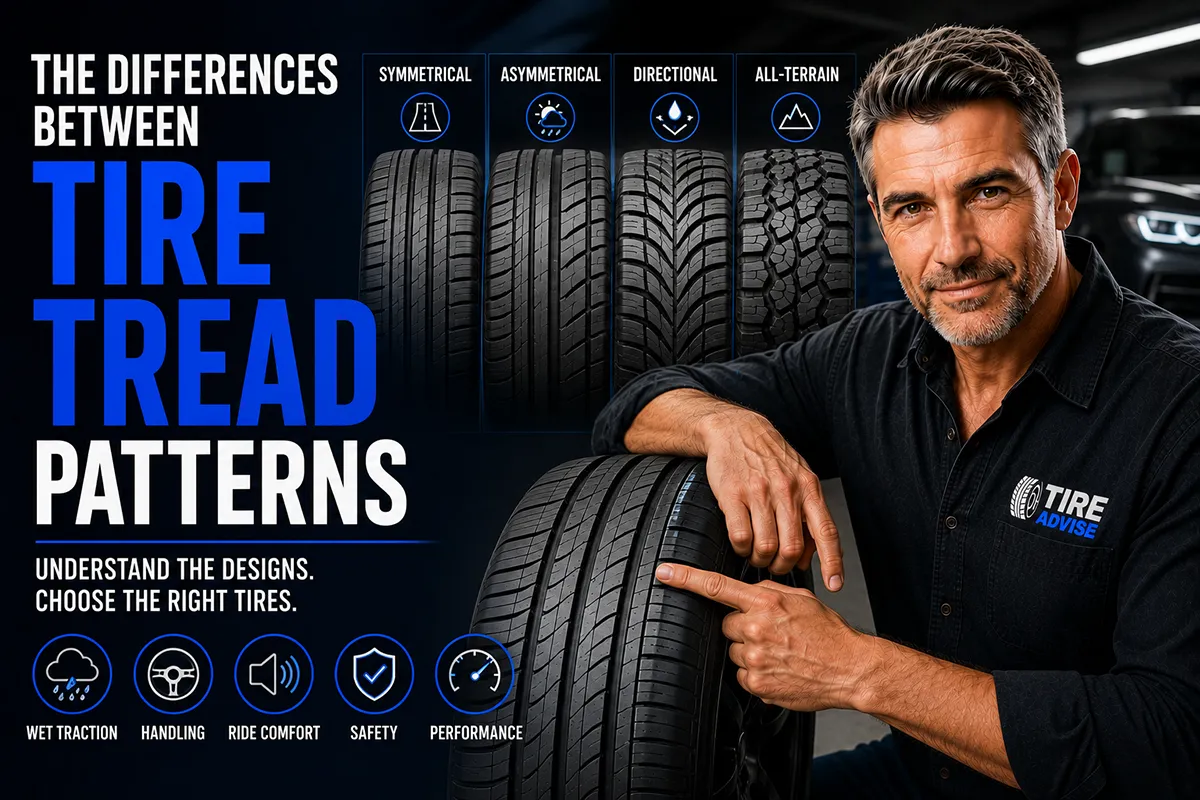
Most drivers never look twice at their tire tread pattern — until they’re standing in a tire shop, staring at three different options, and wondering why one costs $40 more than the other.
Here’s the thing I’ve learned after years of testing and reviewing tires: the tread pattern on your tire isn’t just cosmetic. It directly affects how your car handles in rain, how loud your highway drive is, and how long the tire lasts before you’re back at the shop spending another $600 on a set of four.
I’ve driven on dozens of different tires across every tread pattern category, and the differences are genuinely significant — sometimes even more noticeable than the difference between budget and premium brands.
- There are three main tread patterns: symmetric, asymmetric, and directional (unidirectional).
- Symmetric treads are the most affordable and versatile — great for daily commuters.
- Asymmetric treads offer the best balance of dry grip and wet performance — ideal for sedans and performance cars.
- Directional treads excel at water evacuation and are best for rainy climates or winter conditions.
- Your driving conditions, climate, and vehicle type should determine which pattern you choose.
- Mixing tread patterns on the same axle is never recommended and can compromise safety.
Liked this article?
Add TireAdvise as a preferred source so you see more of our tire reviews and guides on Google.
What Exactly Is a Tire Tread Pattern?
When I talk about a tire’s tread pattern, I’m referring to the arrangement of grooves, channels, sipes, lugs, and ribs molded into the rubber surface that contacts the road. It’s essentially the tire’s fingerprint — and each design serves a specific engineering purpose.
The tread pattern determines how water is channeled away from the contact patch, how much grip the tire generates in corners, how evenly it wears, and even how much road noise enters your cabin. I’ve had tires that were nearly identical in rubber compound but felt worlds apart on the road — purely because of their tread design.
Think of it this way: the tread pattern is the tire’s strategy for dealing with everything the road throws at it. And different strategies work better in different situations.
The Three Main Types of Tire Tread Patterns
Every tire you’ll find at your local Discount Tire, Costco, Tire Rack, or any other US retailer falls into one of three tread pattern categories. Let me break each one down based on what I’ve personally observed and tested.
1. Symmetric Tread Pattern
A symmetric tread pattern is exactly what it sounds like — the tread design on the inner half of the tire mirrors the outer half. If you drew a line down the center of the tire, both sides would look essentially the same. The grooves, blocks, and ribs repeat uniformly across the entire tread face.
This is the most common tread pattern you’ll find on budget and mid-range all-season tires in the US market. Tires like the Continental TrueContact Tour, Hankook Kinergy PT, and Cooper CS5 Ultra Touring use symmetric designs.
What I’ve noticed driving on symmetric tread tires:
- Quiet and comfortable: In my experience, symmetric treads tend to produce less road noise because the uniform pattern doesn’t create the harmonic resonance that more aggressive designs sometimes do. During my test periods on symmetric all-season tires, highway cruising was noticeably quieter compared to directional tires on the same vehicle.
- Even wear: Because the pattern is uniform, symmetric tires tend to wear more evenly over time — especially if you keep up with rotations. And here’s a practical bonus: you can rotate symmetric tires in any direction and to any position on the car. That flexibility is a real advantage for extending tire life.
- Adequate wet performance: Symmetric treads handle light to moderate rain reasonably well, but they don’t evacuate water as aggressively as directional patterns. I’ve felt the difference during heavy downpours on Texas highways — symmetric tires start to feel a bit less planted when water is really standing on the road.
- Affordability: These tires are generally the least expensive option. You can find quality symmetric all-season tires in the $80–$130 per tire range for common passenger car sizes like 215/55R17.
Best for: Daily commuters, budget-conscious drivers, and anyone who primarily drives in mild-to-moderate weather conditions. If you’re putting around town and occasionally hitting the interstate, a good symmetric tire will serve you well.
2. Asymmetric Tread Pattern
An asymmetric tread pattern uses a different design on the inner portion of the tire than on the outer portion. The outboard side typically features larger, more rigid tread blocks for dry cornering grip, while the inboard side has more grooves, channels, and sipes for water evacuation and wet traction.
This is the pattern I see most often on premium touring tires and performance-oriented all-season tires. Think Michelin Pilot Sport All Season 4, Continental ExtremeContact DWS 06 Plus, and Bridgestone Potenza Sport. These are the tires that enthusiast drivers and premium sedan owners gravitate toward — and for good reason.
What I’ve noticed driving on asymmetric tread tires:
- Excellent dry handling: The larger outer tread blocks provide a stiffer contact patch during cornering. I tested a set of asymmetric performance all-season tires on a Mazda3, and the difference in turn-in response compared to the symmetric all-seasons I’d been running was immediately obvious — even during my first drive around town.
- Strong wet performance: The inner tread zone’s channels and sipes do serious work in the rain. During several days of driving through Pacific Northwest rain, I felt confident and planted in a way that symmetric tires on the same vehicle hadn’t provided.
- Lower noise than expected: You might assume the mixed tread design would create more noise, but modern asymmetric tires are engineered with staggered block sequences that actually reduce pattern noise. Many of the premium asymmetric tires I’ve tested were impressively quiet on the highway.
- Mounting matters: Asymmetric tires have a designated “outside” marking on the sidewall. They must be mounted with the correct side facing outward. I’ve heard stories from readers who had tires mounted incorrectly at shops — always double-check before you drive off the lot.
One important note: Like symmetric tires, asymmetric tires can be rotated to any position on the vehicle (front to back, side to side) as long as the “outside” marking remains outboard. This gives you good flexibility for tire rotations, which helps with even wear.
Best for: Drivers who want the best overall balance of dry grip, wet safety, and comfort. If you drive a sedan, crossover, or sports car and you want tires that do everything well, asymmetric is usually the sweet spot. Expect to pay $120–$200+ per tire depending on the brand and size.
3. Directional (Unidirectional) Tread Pattern
A directional tread pattern is designed to rotate in only one direction. You’ll recognize it by the distinctive V-shaped or arrow-shaped grooves that point forward — they look like they’re ready to slice through water, and that’s exactly what they do.
Popular directional tires in the US market include the Nokian Hakkapeliitta R5, Bridgestone Blizzak WS90, General AltiMAX RT45, and BFGoodrich Advantage T/A Sport LT (some sizes). Many winter tires and high-performance summer tires use directional patterns.
What I’ve noticed driving on directional tread tires:
- Superior hydroplaning resistance: This is where directional tires genuinely shine. The V-shaped channels funnel water away from the center of the contact patch toward the outer edges at an incredible rate. I tested a set of directional all-season tires during a week of heavy rain in the Southeast, and the difference in standing-water confidence compared to my previous symmetric tires was dramatic. I could feel the tires actively channeling water rather than riding up on it.
- Good straight-line traction: Directional tires tend to feel very confident under hard acceleration and braking in a straight line. The V-pattern creates natural forward-facing edges that bite into the road surface. I particularly noticed this during winter driving — the forward-oriented sipes gave me more confidence on cold, slick pavement.
- Rotation limitations: Here’s the practical downside: directional tires can only be rotated front to back on the same side of the vehicle. You can’t cross them to the other side without dismounting and remounting the tire on the rim. This means slightly less flexibility in managing wear, and if you need a tire shop to do a remount, it costs extra.
- Can be noisier: In my experience, some directional tires — especially more aggressively patterned ones — generate a bit more road noise at highway speeds compared to similarly priced asymmetric tires. It’s not always the case, but it’s something I’ve noticed across several test periods.
Best for: Drivers in rainy climates (Pacific Northwest, Southeast, Gulf Coast) or anyone shopping for winter tires. Directional tread patterns are the go-to choice when water evacuation and winter traction are your top priorities. Prices range widely from $90–$180+ per tire.
Side-by-Side Comparison: Symmetric vs. Asymmetric vs. Directional
I put together this comparison table to give you a quick reference. These assessments are based on my real-world testing experience across multiple tires in each category.
| Feature | Symmetric | Asymmetric | Directional |
|---|---|---|---|
| Dry Grip | Good | Excellent | Good |
| Wet Traction | Adequate | Very Good | Excellent |
| Hydroplaning Resistance | Moderate | Good | Excellent |
| Road Noise | Low | Low to Moderate | Moderate |
| Tread Life | Very Good | Good to Very Good | Good |
| Rotation Flexibility | All positions | All positions (keep “outside” out) | Front-to-back same side only |
| Cornering Performance | Average | Excellent | Good |
| Winter Performance | Varies | Varies | Often Superior |
| Typical Price Range (per tire) | $80–$130 | $120–$200+ | $90–$180+ |
| Best For | Budget commuters | Balanced performance | Rain/snow climates |
Understanding the Key Tread Components
Before I go further, it helps to understand the individual elements that make up any tread pattern. Once you know what each component does, you’ll be able to look at a tire and make educated guesses about its performance characteristics — which is a genuinely useful skill when you’re comparing options online or in person.
Ribs
Ribs are the continuous raised bands of rubber that run around the circumference of the tire. They provide straight-line stability and are responsible for keeping the tire tracking true on the highway. In my testing, tires with wider, more continuous center ribs tend to feel more planted and stable at high speeds on the interstate.
Grooves
Grooves are the deep channels between the ribs. Their primary job is water evacuation — channeling rain, slush, and standing water away from the contact patch to maintain grip. Wider and deeper grooves move more water. This is why directional tires, with their large V-shaped grooves, are hydroplaning champions.
Sipes
Sipes are the tiny, thin slits cut into the tread blocks and ribs. They create additional biting edges for grip on wet, icy, or slippery surfaces. Winter tires are loaded with sipes — I’ve examined tires like the Bridgestone Blizzak WS90 and the sheer density of sipes is remarkable. In my winter driving tests, heavily siped tires provided noticeably better grip on black ice and packed snow.
Tread Blocks
Tread blocks are the individual raised rubber segments separated by grooves and sipes. Larger, stiffer blocks provide better dry grip and cornering stability (which is why performance tires have big outer blocks). Smaller, more flexible blocks with lots of sipes provide better winter and wet grip but tend to squirm a bit in hard dry cornering.
Shoulders
The shoulder is the outer edge of the tread where it meets the sidewall. Aggressive shoulder designs with deep lugs are common on all-terrain and mud-terrain truck tires. On passenger car tires, the shoulder design affects cornering grip and noise. I’ve noticed that tires with open, aggressive shoulders tend to produce a noticeable hum on smooth highway surfaces.
How Tread Pattern Affects Real-World Driving
Let me get specific about scenarios where I’ve noticed tread pattern making a tangible difference behind the wheel.
Heavy Rain and Standing Water
I’ve driven through torrential summer thunderstorms in Florida and Georgia on multiple tire types. On one occasion, I was driving on a set of symmetric all-season tires and hit a section of I-75 with significant standing water. I felt the steering go noticeably light — that’s hydroplaning beginning. The tires recovered, but it was unsettling.
Several weeks later, I drove the same route in similar conditions on a set of directional all-season tires. The V-shaped grooves made a clear difference. The steering stayed responsive, and I never felt that same lightness. It was one of those moments where the engineering behind a tread pattern went from abstract concept to concrete, life-affecting reality.
Dry Highway Cornering
On a twisty two-lane highway in the Hill Country of Texas, I compared my driving impressions between a symmetric touring tire and a premium asymmetric performance all-season tire on the same vehicle (a Honda Accord). The asymmetric tires felt like they upgraded the car. Turn-in was sharper, the front end felt more connected, and I could carry more speed through sweeping curves without feeling the front tires start to push wide.
The larger outer tread blocks on the asymmetric tire were doing their job — providing a stiffer, more responsive footprint during lateral loading. It’s the kind of difference that makes you understand why tire engineers spend years optimizing these patterns.
Winter and Cold Weather
During a test period in the upper Midwest, I drove on both directional winter tires and standard symmetric all-season tires. The difference on snow-covered roads was night and day. The directional winter tires — packed with sipes and featuring an aggressive V-pattern — bit into packed snow and gave me confidence that the all-seasons simply couldn’t match.
If you live anywhere that sees regular snow (Michigan, Minnesota, Wisconsin, the Northeast), I genuinely believe choosing the right tread pattern for winter — which almost always means directional — is one of the best safety investments you can make.
Noise and Comfort
I’ve tested tires where the tread pattern was the primary driver of cabin noise. One particularly memorable comparison was between two mid-range tires on a Toyota Camry. The symmetric-treaded tire was almost eerily quiet on the highway. The directional-treaded tire on the same car, at the same speeds, on the same roads, produced a noticeable whooshing sound that became tiresome over a long drive.
Tire manufacturers use techniques like variable pitch sequencing (where tread blocks are slightly different sizes) to break up pattern noise, but tread design still plays a significant role in overall noise levels.
What About Asymmetric Directional Tires?
You might occasionally hear about tires that are both asymmetric and directional. These do exist, but they’re rare and almost exclusively found on ultra-high-performance summer tires designed for sports cars and supercars.
The reason they’re uncommon is purely practical: a tire that’s both asymmetric and directional requires four unique tire mountings (left-front, right-front, left-rear, right-rear). You can’t rotate them at all without dismounting and remounting. For most US drivers, this is impractical and expensive.
I’ve only encountered these in very niche applications. Unless you’re driving a Porsche 911 GT3 on track days, you won’t need to worry about this category.
How to Choose the Right Tread Pattern for Your Needs
Here’s my practical decision framework based on everything I’ve tested and observed. I recommend asking yourself these questions:
Where do you live and what’s your climate?
- Sun Belt / dry climates (Arizona, Nevada, Southern California): An asymmetric tread pattern will give you the best dry handling and still handle the occasional rain. Symmetric is fine too if you’re budget-conscious.
- Rainy climates (Pacific Northwest, Southeast, Gulf Coast): A directional tread pattern should be at the top of your list for the superior water evacuation. Asymmetric is a solid second choice.
- Snow Belt / cold climates (upper Midwest, Northeast, mountain states): For your winter tires, go directional. For your all-season set, asymmetric or symmetric both work depending on your performance expectations and budget.
What kind of vehicle do you drive?
- Economy sedan or commuter car: Symmetric tread patterns offer the best value and practicality. You’ll get good tread life, low noise, and easy rotations.
- Mid-size sedan, crossover, or SUV: Asymmetric patterns are the sweet spot. They offer the balanced performance that matches what these vehicles are designed to do.
- Sports car or performance vehicle: Asymmetric is almost always the right call for warm-weather tires. For winter, directional.
- Truck or SUV used off-road: This is a whole separate conversation involving all-terrain and mud-terrain patterns, but many AT tires use symmetric designs while MT tires often use directional-inspired patterns for mud evacuation.
What’s your budget?
If you’re trying to keep costs down, symmetric tires are your friend. You’ll find the most competitive pricing in this category, and the rotation flexibility means you can more easily maximize tread life.
If you can stretch your budget a bit, asymmetric tires from brands like Continental, Michelin, or Pirelli are worth every penny in my experience. The improvement in handling confidence and wet-weather safety is real and measurable.
Common Mistakes I See Drivers Make
Over the years of writing tire reviews and answering reader questions, I’ve seen some recurring mistakes related to tread patterns that I want to help you avoid.
Mixing tread patterns on the same axle
This is the big one. Never put a symmetric tire on one side of an axle and a directional or asymmetric tire on the other. The different tread patterns will evacuate water at different rates and generate different levels of grip, which can cause unpredictable handling — especially in emergency maneuvers. I’ve seen this happen when drivers try to save money by replacing only one tire with whatever’s cheapest.
Installing directional tires backward
Directional tires have an arrow or “rotation” indicator on the sidewall showing which direction they must spin. If mounted backward, the V-pattern works against itself — pushing water inward instead of outward. I always check this before leaving any tire shop, and I recommend you do the same.
Ignoring the “outside” marking on asymmetric tires
Similarly, asymmetric tires have an “OUTSIDE” marking that must face outward when mounted. If a shop mounts them incorrectly, you lose the engineered balance between the inner wet-traction zone and the outer dry-grip zone. After several days of driving on incorrectly mounted asymmetric tires, the wear pattern alone will tell you something is wrong — but by then, you’ve already compromised the tire.
Choosing tread pattern based on looks alone
I get it — some tread patterns look aggressive and cool. But that aggressive directional pattern might make your daily highway commute noisier than it needs to be. Always match the tread pattern to your actual driving conditions, not what looks best in photos.
How Tread Pattern Affects Tire Longevity
One aspect that doesn’t get enough attention is how tread pattern influences wear characteristics over the life of the tire.
In my experience, symmetric tires tend to wear the most evenly because the uniform pattern distributes forces consistently across the tread face. Couple that with the ability to rotate in any direction, and you’ve got a recipe for maximizing tread life.
Asymmetric tires can develop slightly uneven wear between the inner and outer zones because they’re doing different jobs. The outer blocks, which handle more lateral force during cornering, sometimes wear a bit faster — especially if you drive enthusiastically. I’ve noticed this on several sets, though proper alignment and regular rotations minimize the issue significantly.
Directional tires, limited to front-to-back rotations on the same side, sometimes develop more wear on whichever axle does more work (typically the front on FWD cars). Over my test periods, I’ve seen directional tires on front-wheel-drive vehicles develop more aggressive center wear compared to symmetric tires in the same conditions. Regular rotations are especially important here.
A Word About All-Terrain and Specialty Tread Patterns
While this guide focuses on the three main passenger-car tread patterns, I want to briefly address the truck and SUV owners in the audience.
All-terrain (AT) tires typically use modified symmetric patterns with larger, more widely spaced tread blocks and deeper grooves. These are designed to handle both highway driving and unpaved roads. I’ve tested several AT tires, and the tread pattern is always a compromise — more aggressive blocks improve off-road grip but increase highway noise and reduce pavement handling precision.
Mud-terrain (MT) tires feature extremely aggressive, often directional-inspired patterns with massive lugs and very wide voids. They’re designed for serious off-road use and are frankly terrible on the highway. I drove on a set for a few days of mixed driving and the road noise was so intrusive that I found myself avoiding highway speeds whenever possible.
If you’re a truck owner trying to decide between AT and MT, I’d say this: unless you regularly drive on actual mud, deep sand, or technical trails, an AT tire will make your daily driving life much more pleasant.
My Personal Recommendations by Scenario
Based on my testing experience, here’s what I’d recommend for some common US driving scenarios:
- Budget commuter in a mild climate: Go with a quality symmetric all-season like the Hankook Kinergy PT or Cooper CS5 Ultra Touring. You’ll save money upfront and over time through easy rotations and good tread life.
- Everyday driver who wants the best all-around tire: An asymmetric all-season like the Continental ExtremeContact DWS 06 Plus or Michelin Pilot Sport All Season 4 is hard to beat. These tires do everything well.
- Rainy-climate driver prioritizing wet safety: A directional all-season like the General AltiMAX RT45 or a directional-pattern offering from Nokian gives you outstanding hydroplaning resistance.
- Winter tire shoppers: Almost every top winter tire uses a directional pattern — the Bridgestone Blizzak WS90, Michelin X-Ice Snow, and Nokian Hakkapeliitta R5 are all excellent choices I’d recommend.
Final Thoughts: The Tread Pattern Matters More Than You Think
I started this article by saying most drivers don’t think twice about their tread pattern, and that’s honestly a shame. After years of testing tires, I can tell you that choosing the right tread pattern for your driving conditions is one of the most impactful decisions you can make when shopping for replacement tires.
It doesn’t require a PhD in engineering. Just ask yourself three simple questions: What’s my climate? What do I drive? What do I value most — comfort, performance, or safety in bad weather?
The answers will point you toward the right tread pattern, and from there, you can narrow down brands and models within that category. Whether you end up with a symmetric, asymmetric, or directional tire, understanding why you chose it will give you confidence — both at the tire shop and on the road.
I recommend spending an extra five minutes examining the tread pattern the next time you’re shopping. Look at the grooves, the block sizes, the sipes, and the overall design direction. Once you know what you’re looking at, you’ll never see tires the same way again.
Frequently Asked Questions
What are the three main types of tire tread patterns and how do they differ?
The three main tire tread patterns are symmetrical, asymmetrical, and directional (unidirectional). Symmetrical treads feature the same pattern across the entire tire face and are the most affordable, typically found on budget-friendly all-season tires starting around $60-$80 per tire. Asymmetrical treads have different patterns on the inner and outer edges for a balance of wet grip and dry handling, while directional treads use V-shaped grooves designed to channel water in one direction for superior hydroplaning resistance.
Which tire tread pattern is best for driving in rain and wet road conditions?
Directional tire tread patterns are widely considered the best choice for wet-weather driving because their V-shaped grooves are specifically engineered to funnel water away from the contact patch at high speeds. If you frequently drive in heavy rain or live in the Pacific Northwest or Southeast where wet roads are common, I’d recommend looking at directional tires like the Continental ExtremeContact DWS 06 Plus or Michelin Pilot Sport All Season 4. Asymmetrical treads also perform well in wet conditions since their inner tread blocks are designed for water evacuation.
Are symmetrical tread tires good enough for everyday driving in the US?
For most everyday US commuters driving on highways and city streets in moderate climates, symmetrical tread tires are absolutely good enough and offer the best value. They tend to wear evenly, last longer, and cost significantly less—often $60-$120 per tire compared to $150+ for performance asymmetrical options. Popular symmetrical tread options like the Cooper CS5 Grand Touring and Firestone Champion Fuel Fighter deliver solid all-season performance for drivers who don’t need aggressive handling or extreme weather capability.
Can you rotate directional tires the same way as symmetrical tires?
No, directional tires can only be rotated front-to-back on the same side of the vehicle because the tread pattern is designed to spin in one specific direction. Unlike symmetrical tires, which can be cross-rotated in an X-pattern, swapping a directional tire to the opposite side would reverse its rotation and completely defeat the water-channeling design. If you want to move directional tires to the opposite side, a shop would need to dismount and remount them, which typically costs $15-$25 per tire. This is something I always mention because it can add to your long-term maintenance costs.
What tire tread pattern is best for trucks and SUVs used for highway and light off-road driving?
For US truck and SUV owners who split time between highway commuting and light off-road use like gravel roads or camping trails, asymmetrical tread patterns on all-terrain tires offer the best compromise. Tires like the BFGoodrich All-Terrain T/A KO2 and Toyo Open Country A/T III use aggressive outer tread blocks for off-road grip while keeping the inner portion optimized for quiet, stable highway driving. These typically run $180-$280 per tire for popular truck sizes like 265/70R17 and carry 50,000-65,000 mile tread life warranties.
How does tire tread pattern affect road noise and ride comfort?
Tire tread pattern has a major impact on cabin noise levels—symmetrical treads are generally the quietest because their uniform design creates consistent, low-frequency sound, while aggressive directional and deeply grooved patterns tend to produce noticeable hum at highway speeds. Many tire manufacturers now use variable pitch tread block sequencing on asymmetrical tires to break up sound waves and reduce road noise without sacrificing grip. If a quiet ride is a top priority for your daily commute, I’d suggest looking at tires specifically marketed as touring or grand touring, which pair noise-optimized tread designs with softer rubber compounds.
Does tire tread pattern affect gas mileage and fuel efficiency?
Yes, tire tread pattern directly influences rolling resistance, which impacts your fuel economy by as much as 3-5% depending on the design. Symmetrical tread patterns generally produce the lowest rolling resistance and best fuel efficiency, which is why they’re commonly used on economy cars and hybrid vehicles. Directional and heavily siped asymmetrical treads create slightly more friction with the road, which can cost you an extra $100-$200 per year in fuel depending on your mileage. When shopping for replacement tires, look for the UTQG rating and any low rolling resistance certifications to compare fuel efficiency across different tread designs.
