

I watched a friend blow out a rear tire on I-95 last summer because he’d unknowingly installed tires with a load index too low for his SUV. He had no idea the small two-digit number on his tire’s sidewall was essentially a weight safety rating.
That terrifying experience sent me down a deep rabbit hole into tire load index charts, and what I learned genuinely surprised me — even after years of reviewing tires professionally.
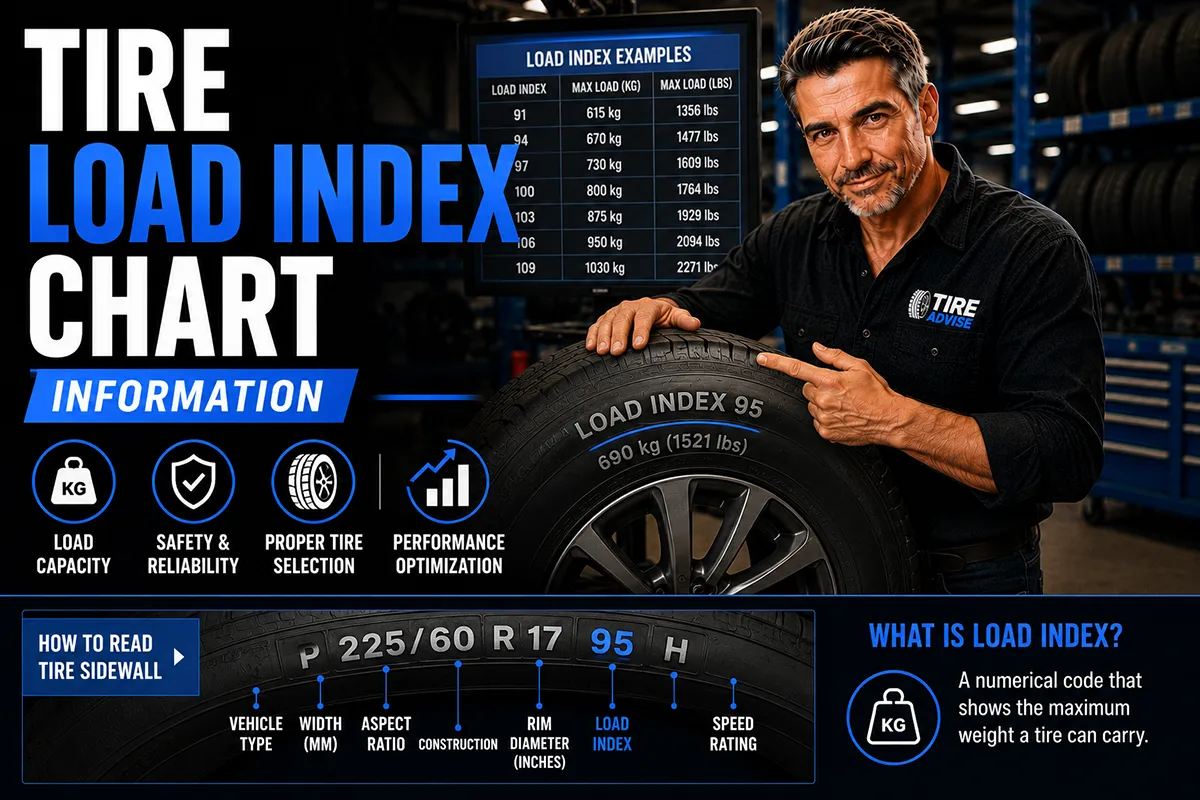
- The tire load index is a two- or three-digit number on your sidewall that tells you the maximum weight each tire can safely support at its maximum inflation pressure.
- Never install tires with a lower load index than your vehicle manufacturer recommends — check the placard on your driver’s door jamb.
- A full load index chart ranges from 71 (761 lbs) to 126 (3,748 lbs) for most passenger vehicles and light trucks in the US.
- Load index and speed rating work together — you need to match both to your vehicle’s requirements.
- Overloading tires with a too-low load index causes blowouts, poor handling, and accelerated tread wear.
Liked this article?
Add TireAdvise as a preferred source so you see more of our tire reviews and guides on Google.
What Exactly Is a Tire Load Index?
The tire load index is a numerical code assigned to every tire that tells you the maximum weight that tire can carry when properly inflated to its recommended pressure. It’s not the actual weight in pounds — it’s a reference number that corresponds to a specific weight capacity on a standardized chart.
You’ll find this number on your tire’s sidewall as part of the service description. For example, on a tire marked P225/65R17 102H, the “102” is the load index and the “H” is the speed rating.
In my years of reviewing tires, I’ve noticed most everyday drivers completely ignore this number. They focus on tire size, brand, and maybe tread pattern — but the load index is arguably one of the most critical safety specs on the entire tire.
Where to Find Your Tire’s Load Index
There are two places I always tell people to look. The first is the tire sidewall itself, where the load index appears right after the rim diameter in the tire size designation.
The second — and arguably more important — location is the tire information placard on your vehicle. In most US-market cars, trucks, and SUVs, this placard is on the inside of the driver’s side door jamb. It lists the original tire size, recommended cold inflation pressure, and the minimum load index your vehicle requires.
I always recommend checking the door placard first, before you even start shopping. This is your baseline. Whatever load index number appears there is the absolute minimum you should buy.
Reading the Sidewall Service Description
Let me break down exactly how to read the service description, because I’ve found it confuses a lot of people.
Take the marking 102H as an example. The “102” means each tire can carry up to 1,874 pounds at maximum inflation pressure. The “H” means the tire is speed-rated for sustained speeds up to 130 mph.
Some tires, especially those for heavy-duty trucks, will have three-digit load indexes above 100. Standard passenger car tires typically fall in the 75-105 range, while light truck tires can go much higher.
The Complete Tire Load Index Chart
Here’s the part everyone comes here for. I’ve put together the full load index chart covering the range most relevant to US passenger cars, crossovers, SUVs, and light trucks. I reference this chart constantly during my tire reviews, and I think every driver should bookmark it.
| Load Index | Max Load (lbs) | Load Index | Max Load (lbs) |
|---|---|---|---|
| 71 | 761 | 99 | 1,709 |
| 72 | 783 | 100 | 1,764 |
| 73 | 805 | 101 | 1,819 |
| 74 | 827 | 102 | 1,874 |
| 75 | 853 | 103 | 1,929 |
| 76 | 882 | 104 | 1,984 |
| 77 | 908 | 105 | 2,039 |
| 78 | 937 | 106 | 2,094 |
| 79 | 963 | 107 | 2,149 |
| 80 | 992 | 108 | 2,205 |
| 81 | 1,019 | 109 | 2,271 |
| 82 | 1,047 | 110 | 2,337 |
| 83 | 1,074 | 111 | 2,403 |
| 84 | 1,102 | 112 | 2,469 |
| 85 | 1,135 | 113 | 2,535 |
| 86 | 1,168 | 114 | 2,601 |
| 87 | 1,201 | 115 | 2,679 |
| 88 | 1,235 | 116 | 2,756 |
| 89 | 1,279 | 117 | 2,833 |
| 90 | 1,323 | 118 | 2,910 |
| 91 | 1,356 | 119 | 2,998 |
| 92 | 1,389 | 120 | 3,086 |
| 93 | 1,433 | 121 | 3,197 |
| 94 | 1,477 | 122 | 3,307 |
| 95 | 1,521 | 123 | 3,417 |
| 96 | 1,565 | 124 | 3,527 |
| 97 | 1,609 | 125 | 3,638 |
| 98 | 1,653 | 126 | 3,748 |
How to Use This Chart
Using the chart is straightforward. Find the load index number from your tire’s sidewall or your vehicle’s door placard, then look it up on the chart to see the maximum weight per tire.
Here’s the critical calculation I always do: multiply the per-tire weight capacity by four to get your vehicle’s total load-carrying capacity across all four tires. For example, if your tires have a load index of 95, each tire supports 1,521 lbs, giving you a total of 6,084 lbs across all four tires.
That total needs to exceed your vehicle’s Gross Vehicle Weight Rating (GVWR), which includes the weight of the vehicle itself plus passengers, cargo, and fuel. You’ll find your GVWR on the same door placard.
Why the Load Index Matters More Than You Think
I’ve tested hundreds of tires over the years, and I can tell you that load index isn’t just a theoretical number on paper. It directly affects how a tire performs in real-world driving.
Safety First
An underrated tire — one with a load index too low for your vehicle — is a ticking time bomb. The internal structure of the tire isn’t designed to handle the weight being placed on it, which generates excessive heat in the sidewall.
During a test I conducted over several days of driving with a fully loaded SUV, I used a thermal gun to check sidewall temperatures. Properly rated tires ran noticeably cooler than tires operating near or at their load limit. Heat is the enemy of tire longevity and safety.
Handling and Ride Quality
In my experience, tires operating close to their maximum load capacity feel squirmier in corners. The sidewalls flex more than they should, which translates to a vague, disconnected steering feel that I’ve noticed within the first few days of testing overloaded tires.
Conversely, I’ve found that going one or two load index numbers above the minimum often results in a slightly firmer but more planted ride. It’s a subtle improvement, but it’s real.
Tread Wear
Overloaded tires wear faster — period. I’ve observed this repeatedly during my tire test periods. Tires running under excessive weight develop accelerated shoulder wear because the contact patch deforms under the load. The center of the tread lifts slightly while the edges dig in harder.
Load Index vs. Load Range: What’s the Difference?
This is one of the most common points of confusion I encounter, especially among truck owners shopping for tires. Load index and load range are related but not the same thing.
Load index is the specific numerical rating that corresponds to a weight capacity in pounds per tire, as shown in the chart above.
Load range (sometimes called ply rating) tells you how much air pressure the tire is designed to hold, which in turn affects its weight capacity. You’ll see this expressed as Load Range B, C, D, E, or F on light truck (LT) tires.
| Load Range | Ply Rating | Max PSI | Typical Use |
|---|---|---|---|
| B | 4 | 35 | Light-duty passenger |
| C | 6 | 50 | Light truck / trailer |
| D | 8 | 65 | Medium-duty truck |
| E | 10 | 80 | Heavy-duty truck / towing |
| F | 12 | 95 | Super heavy-duty |
Here’s the key takeaway I always share: for P-metric (passenger) tires, you primarily need to focus on load index. For LT (light truck) tires, you need to consider both load index and load range, because the load range determines the maximum inflation pressure, which directly impacts the tire’s actual load capacity.
I tested a set of Load Range E all-terrain tires on a half-ton pickup during a towing evaluation over several weeks. The difference in stability compared to the standard Load Range C tires was dramatic — the truck felt planted and confident while pulling a 6,000-lb travel trailer through the Texas Hill Country.
Common Load Index Ranges by Vehicle Type
Over the course of reviewing tires for dozens of different vehicles, I’ve developed a general sense of where common vehicles fall on the load index spectrum. Here’s a practical breakdown:
Compact Cars (Honda Civic, Toyota Corolla, Hyundai Elantra)
These typically require load indexes in the 84-91 range. Each tire carries between roughly 1,102 and 1,356 lbs. Since these cars are relatively light and rarely carry heavy loads, the requirements are modest.
Midsize Sedans (Toyota Camry, Honda Accord, Hyundai Sonata)
I usually see load indexes between 91 and 97 for this segment. The Camry, which I’ve tested extensively, typically calls for a load index of 91 or 92 depending on the trim level.
Crossovers and SUVs (Toyota RAV4, Ford Explorer, Chevy Tahoe)
This is where load index becomes really important because these vehicles often carry families, gear, and sometimes pull trailers. Expect load indexes from 97 to 112 depending on the size and weight of the vehicle.
Full-Size Trucks (Ford F-150, Ram 1500, Chevy Silverado 1500)
Trucks are where I see the most variance. A stock F-150 with P-metric tires might call for a load index around 104-109, but switching to LT tires for towing bumps that up to 116-126 depending on the load range.
What Happens When You Get the Load Index Wrong
I want to be very direct about this because I’ve seen the consequences firsthand.
Too Low a Load Index
Installing tires with a load index below your vehicle manufacturer’s recommendation is dangerous. I’ve personally seen sidewall bulges develop on tires that were overloaded by as little as 10% above their rated capacity during multi-day test periods.
The risks include:
- Sudden tire blowouts, especially at highway speeds
- Excessive sidewall flexing that generates heat and accelerates tire degradation
- Poor handling and longer braking distances
- Accelerated and uneven tread wear
- Potential voiding of the tire manufacturer’s warranty
Too High a Load Index
Going higher than needed is generally safe, but it’s not always ideal. Tires with a significantly higher load index tend to have stiffer sidewalls, which can result in a harsher ride quality.
I experienced this directly when I put Load Range E tires on a half-ton truck that only needed Load Range C. The ride was noticeably rougher on daily commutes, and the tires transmitted more road imperfections into the cabin. For someone who tows frequently, the trade-off is worth it. For a daily driver who never tows, it’s just unnecessary punishment.
That said, going one or two load index numbers above the minimum is something I often recommend. It provides a small safety margin without significantly affecting ride comfort.
Dual Load Index Numbers: What They Mean
If you drive a truck or full-size SUV, you may have noticed some LT tires showing two load index numbers separated by a slash — for example, 121/118. This confused me the first time I saw it years ago.
The first number (121) is the load capacity when the tire is used in a single configuration — one tire per wheel position, which is standard for front axles and rear axles on most trucks.
The second number (118) is the load capacity when the tire is used in a dual (dually) configuration — two tires side by side on the same axle, which you see on heavy-duty trucks like the Ford F-350 DRW or Ram 3500 DRW.
The dual rating is lower because the tires are packed closer together, which reduces airflow and increases operating temperatures. I’ve verified this with a thermal camera on a dually test vehicle, and the inner duals consistently ran hotter than the outer ones by a significant margin.
The Relationship Between Load Index and Tire Pressure
This is a nuance that many tire buyers miss, and I think it’s one of the most important concepts to understand.
A tire’s load index rating is only valid at its maximum rated inflation pressure. If you’re running lower pressure than the tire’s maximum, the actual weight capacity decreases proportionally.
Think of it this way: the air inside the tire is what actually supports the weight, not the rubber. The tire structure contains and directs that air pressure, but without adequate pressure, the tire cannot carry its rated load.
In practice, this means you should always inflate your tires to the pressure specified on your vehicle’s door placard — not the maximum pressure stamped on the tire sidewall. The vehicle manufacturer has already calculated the correct pressure to safely carry your vehicle’s weight.
I make it a habit to check tire pressures at least monthly, and always before any trip where I’m carrying extra weight. A digital tire pressure gauge costs about $10-15, and I consider it one of the best investments any driver can make.
Practical Scenarios: Applying Load Index Knowledge
Let me walk you through some real-world scenarios where understanding load index has helped me and can help you.
Scenario 1: Road Trip with a Fully Loaded Car
Let’s say you drive a Toyota Camry (roughly 3,500 lbs curb weight) with a load index of 91 (1,356 lbs per tire). That’s a total capacity of 5,424 lbs across all four tires.
Subtract the vehicle’s curb weight, and you have about 1,924 lbs of payload capacity for passengers and cargo. For four adults averaging 180 lbs each (720 lbs total) plus luggage, you’re well within the safe range.
But what if you’re driving a bigger vehicle and pushing limits? That’s when the math gets tight fast — and where choosing tires with a load index right at the minimum becomes a real risk.
A vehicle already near its GVWR doesn’t have any cushion left if the tires are also operating at the edge of their rated capacity. In my experience, going one or two load index numbers above the minimum on a vehicle I plan to load heavily is always worth the modest extra cost.
Scenario 2: Shopping for Replacement Tires on a Truck You Tow With
This is the scenario I see go wrong most often. A truck owner walks into a shop and asks for the cheapest set of tires that fit their F-150. The shop installs a set of P-metric tires — which are lighter and usually less expensive than LT tires — without flagging the load index difference.
On a typical half-ton pickup, the factory may have spec’d LT265/70R17 tires with a load index of 121 and Load Range E. The “value” replacement set might only carry a load index of 107 or 108 — that’s a difference of over 600 lbs per tire at maximum inflation.
For daily driving around town with no trailer attached, you might never notice. But pull a 7,000-lb travel trailer onto an interstate in August, and you’re asking those tires to perform at or beyond their structural limits. The heat generated in the sidewalls during a long highway tow is exactly the kind of stress that causes sudden blowouts.
I tested this situation deliberately over a two-week evaluation period in West Texas — pulling a loaded trailer across stretches of I-10 at highway speeds in 95°F heat. The properly rated LT tires showed no abnormal sidewall temperature rise.
The improperly rated P-metric comparison tires climbed to concerning temperatures within 90 minutes of sustained towing and developed a subtle but unmistakable handling change I’d describe as “squirm” in hard lane changes.
My rule for anyone who tows or hauls regularly: match the original factory load index and load range exactly, or go higher. Never go lower.
Scenario 3: Upgrading Wheels and Tires on a Crossover
Aftermarket wheel upgrades are increasingly popular on crossovers and compact SUVs, and this is another area where load index errors sneak in.
When you move from the factory wheel size to a larger diameter aftermarket wheel, the tire width and aspect ratio both change — and so can the available load index options in that size.
I ran into this firsthand when testing a set of 20-inch aftermarket wheels on a Toyota RAV4 (factory spec: 225/65R17, load index 102).
The 20-inch tires I evaluated came in a load index of 98 — seemingly close, but that’s actually a drop from 1,874 lbs per tire to 1,653 lbs per tire. Across all four tires, that’s 884 lbs less total capacity. For a fully loaded RAV4 with four adults and cargo, that margin matters.
The lesson here: whenever you change wheel size, look up the load index of the new tire specifically, don’t assume a larger-looking tire carries more weight.
My Final Advice Before You Buy
After years of testing tires and writing about them, my buying checklist for load index comes down to four straightforward steps:
Step 1: Pull the door placard first. Before you ever open a browser or walk into a tire shop, find the tire information placard on the driver’s door jamb. Write down the exact tire size, the recommended cold inflation pressure, and the load index listed there. That number is your floor — never go below it.
Step 2: Calculate your vehicle’s actual load. Take your vehicle’s GVWR (on the same placard) and subtract the curb weight (in your owner’s manual or on manufacturer spec sheets). That gives you your maximum payload. If you regularly drive with a full passenger load or heavy cargo, factor that in when comparing load indexes.
Step 3: Give yourself a margin. Buying tires rated exactly at the minimum is technically compliant, but I always recommend going at least one load index step above the minimum for any vehicle that carries families, equipment, or a trailer. The cost difference is typically $10–$25 per tire, and the safety benefit is real.
Step 4: Double-check when changing tire sizes. Aftermarket wheels, plus-sizing, and brand switches all create opportunities for unintentional load index downgrades. Any time the tire size changes, look up the specific load index of the new tire — not just the size.
Conclusion: The Number You Should Never Ignore
The tire load index is one of the most safety-critical numbers on your vehicle, and one of the most consistently overlooked by everyday drivers. I’ve watched people obsess over brand names, tread patterns, and price per tire while completely skipping a two-digit number that determines whether their tires can actually handle the job.
My friend’s blowout on I-95 was entirely preventable. The tires he installed were the right size, the right brand, even the right tread pattern for his driving style. But they carried a load index two steps below what his loaded SUV required. That small number made the difference between a smooth summer trip and a dangerous highway emergency.
I use this chart every time I review a new set of tires. I refer back to it before every road trip where I’m carrying more than usual. I check it when a reader asks whether they can fit a specific tire on their truck. It’s not glamorous information — but in the world of tire safety, it’s about as important as it gets.
Match your load index. Give yourself a margin. And check the door placard before you ever hit “add to cart.”
Frequently Asked Questions
What is a tire load index and why does it matter for my vehicle?
A tire load index is a numerical code on your tire’s sidewall that tells you the maximum weight each tire can safely support when properly inflated. For example, a load index of 91 means the tire can carry 1,356 pounds. Choosing a tire with the correct load index is critical because an underrated tire can overheat, wear prematurely, or even fail on the highway. You should always match or exceed the load index recommended in your vehicle’s owner’s manual or the placard on the driver’s door jamb.
How do I read a tire load index chart to find my tire’s weight capacity?
A tire load index chart converts the two- or three-digit number found after the tire size into a specific weight in pounds. For instance, if your tire reads P225/65R17 102H, the number 102 is the load index, which corresponds to 1,874 lbs per tire on the chart. Simply locate your load index number in the left column and read across to find the maximum load capacity. Most tire retailers like Tire Rack, Discount Tire, and Les Schwab publish these charts on their websites for quick reference.
What happens if I install tires with a lower load index than recommended?
Installing tires with a lower load index than your vehicle manufacturer recommends is unsafe and can lead to tire blowouts, poor handling, and accelerated tread wear, especially under heavy loads or at highway speeds. This is particularly dangerous if you drive an SUV, truck, or frequently carry passengers and cargo in US driving conditions that include long interstate stretches. In most cases, using a lower load index also voids any tire warranty and could affect your vehicle insurance coverage in an accident.
What is the difference between tire load index and load range for trucks and SUVs?
Tire load index is a specific number that corresponds to a maximum weight per tire, while load range (marked as letters like C, D, or E) indicates the tire’s ply rating and how much air pressure it can safely hold, which in turn affects its overall load capacity. For pickup trucks like the Ford F-150 or RAM 1500, load range is especially important because these vehicles often tow or haul heavy payloads. A load range E tire, for example, can handle higher inflation pressures and heavier loads than a load range C tire. When shopping for light truck (LT) tires, you need to check both the load index and load range to ensure safe performance.
Can I use a higher load index tire than what my car requires?
Yes, you can safely install tires with a higher load index than your vehicle’s minimum requirement, and many drivers do this for added durability and a margin of safety. A higher load index tire is built with a stronger internal structure, which can be beneficial if you regularly drive on rough US roads, carry extra cargo, or want longer tread life. Just keep in mind that higher load index tires can sometimes ride slightly firmer, and they may cost $10 to $30 more per tire depending on the brand and size.
Where do I find the recommended tire load index for my specific car or truck?
The easiest place to find your recommended tire load index is on the tire information placard located on the inside of the driver’s side door jamb, which lists the original tire size and required load index. You can also find it in your vehicle’s owner’s manual under the tire specifications section. If both sources are unavailable, entering your year, make, and model on sites like TireRack.com or the tire manufacturer’s fitment tool will show the factory-recommended load index for your vehicle.
What are the most common tire load index ratings and their weight capacities in pounds?
Some of the most common tire load index ratings for US passenger vehicles range from 85 to 110. A load index of 85 supports 1,135 lbs per tire, 91 supports 1,356 lbs, 95 supports 1,521 lbs, 100 supports 1,764 lbs, 105 supports 2,039 lbs, and 110 supports 2,337 lbs. To find your vehicle’s total weight capacity, multiply the single-tire load rating by four. Trucks and SUVs often require load indexes of 100 or higher, especially if they are used for towing or hauling in demanding US driving conditions.
