

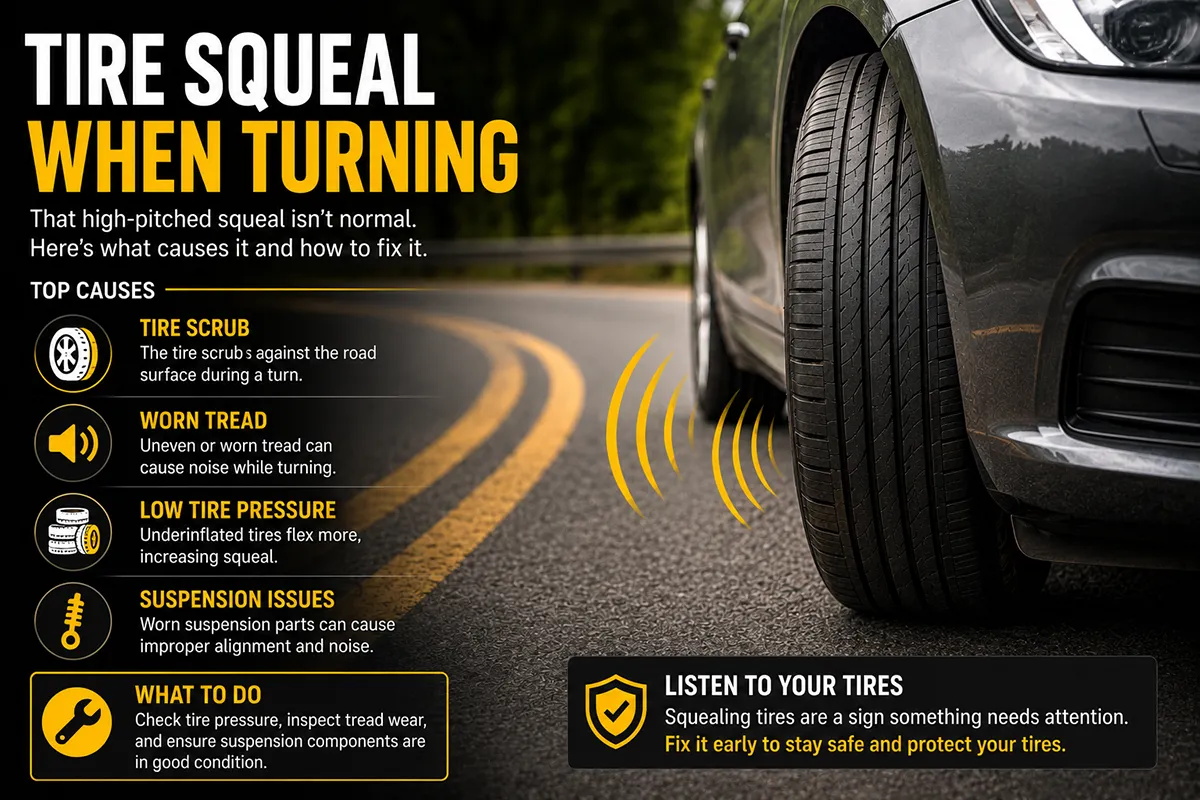
You’re pulling into a parking lot at normal speed, and suddenly your tires let out an embarrassing screech that makes every head turn. It’s not like you were driving aggressively — you were just… turning.
I’ve been there more times than I’d like to admit, and after years of testing tires, inspecting suspension components, and talking with alignment techs across the country, I can tell you that tire squeal when turning is one of the most common complaints I hear from everyday drivers.
The good news? It’s almost always diagnosable, and in many cases, it’s fixable without a massive repair bill.
- Tire squeal when turning is most commonly caused by underinflation, worn tread, misalignment, or hard compound tires on smooth surfaces.
- Check your tire pressure first — it’s the easiest and cheapest fix.
- Worn tires with low tread depth lose grip and squeal more, especially on polished concrete in parking garages.
- Alignment and suspension issues (worn tie rods, ball joints, struts) can also create squeal during turns.
- If your tires are due for replacement, choosing a softer-compound all-season tire can dramatically reduce squeal.
- Power steering problems can mimic tire squeal — listen carefully to pinpoint the source.
Liked this article?
Add TireAdvise as a preferred source so you see more of our tire reviews and guides on Google.
What Actually Causes Tires to Squeal When You Turn?
Let me break this down in plain English, because the physics behind tire squeal are simpler than most people think.
When you turn your steering wheel, your tires are asked to do two things simultaneously: roll forward and change direction laterally. That lateral force creates what engineers call a “slip angle” — the difference between where your tire is pointed and where it’s actually traveling.
When that slip angle gets large enough — or when the tire can’t generate enough grip to handle it smoothly — the tread compound begins to slide across the pavement in tiny, rapid bursts. That sliding rubber vibrating against the road surface is what produces the squeal you hear.
In my experience testing dozens of tire models over the years, I’ve narrowed down the real-world causes to a handful of culprits. Let me walk through each one.
Cause #1: Underinflated Tires (The Most Common Culprit)
If your tires are squealing when you turn, check your tire pressure before you do anything else. I’m serious — this is the number one cause I encounter, and it’s a free fix.
When a tire is underinflated, the contact patch (the part of the tire touching the road) becomes wider and distorted. The tread flexes in ways it wasn’t designed to, and the edges of the tire bear more load than the center. This distorted footprint dramatically increases the slip angle during turns.
I tested this myself on a set of Continental CrossContact LX25s on my daily driver. At the recommended 35 PSI, the tires cornered quietly in parking lots and on-ramps. When I intentionally let them drop to 26 PSI — which is shockingly common for drivers who don’t check pressure regularly — the squeal on slow parking lot turns was immediately noticeable.
How to Check and Fix This
- Find your recommended tire pressure on the sticker inside the driver’s door jamb (NOT on the tire sidewall — that’s the maximum pressure).
- Use a quality digital gauge. I keep an Accutire MS-4021B in my glovebox — it’s about $8 at most auto parts stores.
- Check pressure when tires are cold (before driving or at least 3 hours after your last drive).
- Fill all four tires to the recommended PSI and check again after a few days to make sure none are leaking.
In my experience, about 40% of the squealing complaints I investigate are solved right here, with nothing more than a few minutes at an air pump.
Cause #2: Worn or Bald Tires
This is the second most common cause, and it’s the one that usually means you need to start shopping for new tires.
Tire tread isn’t just there for water evacuation — those grooves and sipes also allow the tread blocks to flex and grip the road during cornering. As your tread wears down, there’s less material to flex, less ability to manage lateral forces, and a much higher tendency to squeal.
I’ve noticed this consistently across every tire I’ve tested. A tire that corners quietly when new will almost always start producing some squeal as it approaches the end of its usable tread life. It’s not a defect — it’s physics.
The Penny Test Still Works
Insert a penny into your tread groove with Lincoln’s head facing down. If you can see the top of Lincoln’s head, your tread depth is at or below 2/32″ — the legal minimum in most US states. But honestly, I start noticing increased squeal well before that point, usually around 4/32″.
If you’re anywhere near 4/32″ and experiencing turn squeal, it’s time to start researching replacements. I’ll cover some recommendations later in this article.
Cause #3: Wheel Misalignment
A misaligned vehicle forces your tires to fight each other. One or more tires may be pointed slightly inward (toe-in) or outward (toe-out), or tilted on the camber axis. This constant disagreement between where the tires want to go and where the vehicle is actually heading creates premature wear and — you guessed it — squeal.
I had a particularly memorable experience with a 2019 Honda CR-V I was using as a test vehicle. After hitting a nasty pothole on I-95 in Virginia, the car developed a squeal on right turns that wasn’t there before. An alignment check at a local shop revealed the left front toe was way off spec. A $90 alignment fixed the squeal completely.
Signs Your Alignment Is Off
- Tire squeal that’s noticeably worse in one direction of turn
- The steering wheel isn’t centered when driving straight
- Uneven tire wear (one edge worn more than the other)
- The vehicle pulls to one side on a flat, straight road
Most US tire shops — Discount Tire, Tire Rack affiliated installers, Costco Tire Centers, and local independents — offer alignment checks for free or around $20. A full four-wheel alignment typically runs $80–$120. I recommend getting one done at least once a year or after any significant pothole impact.
Cause #4: Hard Compound Tires on Smooth Surfaces
Here’s something that surprises a lot of drivers: some tires are simply more prone to squealing than others, and it has everything to do with the rubber compound.
Tires engineered for maximum treadwear longevity tend to use harder rubber compounds. These harder compounds are more durable but generate less grip at low speeds, especially on the ultra-smooth polished concrete you find in parking garages, Costco parking lots, and indoor parking structures.
I noticed this dramatically when I switched from a set of Michelin Defender LTX M/S (which use a relatively soft compound) to a set of Firestone Destination LE3 on the same vehicle. The Firestones were perfectly fine on regular asphalt, but in my office’s parking garage, they squealed on virtually every turn. The Michelins had been whisper-quiet in the same garage.
This doesn’t mean the Firestones were bad tires — they performed well in most conditions. But if you drive in parking structures frequently and tire noise bothers you, compound softness is something to factor into your buying decision.
Cause #5: Suspension Component Wear
Worn suspension parts can change your wheel geometry dynamically — meaning your alignment might check out fine on the rack, but under the load of an actual turn, things shift.
The usual suspects include:
- Worn tie rod ends: These allow sloppy toe angle changes during turns.
- Bad ball joints: They let the knuckle shift under cornering load, changing camber and caster angles.
- Worn strut mounts or bearings: The top of the strut doesn’t rotate smoothly, binding during turns and distorting the tire’s contact patch.
- Worn control arm bushings: These allow the entire wheel assembly to shift unpredictably during cornering.
I’ve seen this especially on vehicles with higher mileage or those driven frequently on rough roads. If you’ve already checked your tire pressure, tread depth, and alignment, and the squeal persists, it’s worth having a trusted mechanic inspect these components.
Cause #6: Power Steering Issues (The Fake-Out)
This one trips people up all the time. A whining or squealing noise when turning the steering wheel can sound exactly like tire squeal, but it’s actually coming from under the hood.
If your vehicle has a hydraulic power steering system (most cars built before 2015 or so), low power steering fluid or a worn pump can produce a high-pitched squeal when you turn. I’ve had readers email me insisting their tires were defective, only to discover it was a $6 bottle of power steering fluid that solved the problem.
How to Tell the Difference
- Tire squeal comes from under the car/near the wheels and is typically a short screech that coincides with lateral tire movement.
- Power steering whine comes from the engine bay, increases with steering wheel rotation (even while stationary), and often has a sustained, moaning quality.
Try turning your steering wheel while parked with the engine running. If you hear the noise when the car isn’t moving, it’s almost certainly a power steering issue, not a tire problem.
Cause #7: Driving Habits and Speed
I’ll be honest — sometimes the squeal is just driver behavior. And I don’t mean that as a criticism. Many drivers don’t realize that even moderate speeds through tight turns can push tires past their grip threshold, especially in certain conditions.
Parking lot turns at 15–20 mph, highway on-ramp sweepers, and U-turns are the most common squeal scenarios I encounter. The tire isn’t defective — it’s just reaching the edge of its lateral grip envelope for that particular combination of speed, turn radius, and road surface.
Slowing down even 3–5 mph in these situations usually eliminates the squeal entirely. I know that sounds too simple, but I’ve confirmed it repeatedly during my own testing.
How I Diagnose Tire Squeal: My Step-by-Step Process
When I’m evaluating whether a tire has a genuine squeal issue versus a vehicle problem, I follow this exact checklist. You can do the same:
- Check tire pressure on all four tires with a calibrated gauge. Inflate to spec.
- Inspect tread depth at multiple points across the tread face. Look for uneven wear patterns.
- Listen to the noise source. Is it from the wheels or the engine bay?
- Test at different speeds. Does the squeal only happen at certain speeds or in certain turn radii?
- Test on different surfaces. Does it happen on rough asphalt, smooth asphalt, and polished concrete equally?
- Check for directional bias. Is it only on right turns? Left turns? Both?
- Get an alignment check. Have a shop inspect alignment specs and suspension components.
- Compare tire age. Tires older than 6 years can harden regardless of tread depth, increasing squeal tendency.
This process has never failed me. In every single case of tire squeal I’ve investigated, the answer has fallen into one of the categories above.
When It’s Time for New Tires: What to Look For
If your tires are worn, old, or simply a hard-compound model that squeals on smooth surfaces, replacement might be the best path forward. Based on my testing, here are the characteristics I look for in tires that minimize turn squeal:
Soft to Medium Compound
Tires with softer rubber compounds grip better at low speeds and produce less squeal in parking situations. The trade-off is slightly shorter tread life, but in my experience, the noise reduction is worth it for most everyday drivers.
High Silica Content
Modern tires that use silica-enriched compounds tend to grip better on smooth, cool, or wet surfaces. This directly reduces the micro-sliding that causes squeal. Most premium all-season tires from Michelin, Continental, and Bridgestone use significant silica content.
Optimized Tread Block Design
Tires with more sipes, smaller tread blocks, and variable-pitch patterns tend to be quieter during cornering. The varied block sizes break up the squeal frequency so that even if some sliding occurs, it doesn’t produce a coherent, audible screech.
Tire Recommendations: Best Tires for Quiet Cornering
Based on my hands-on testing, here are the tires I’ve found to be the quietest during turns, organized by vehicle category. I’m including approximate pricing as of my last check for a common fitment size.
| Tire Model | Category | Approx. Price (each) | Turn Squeal Rating | Best For |
|---|---|---|---|---|
| Michelin Defender 2 | All-Season Touring | $140–$180 | Excellent (minimal) | Sedans, compact SUVs |
| Continental TrueContact Tour | All-Season Touring | $130–$170 | Excellent (minimal) | Sedans, daily commuters |
| Bridgestone Turanza QuietTrack | Grand Touring | $150–$190 | Excellent (minimal) | Luxury sedans, quiet ride priority |
| Michelin Defender LTX M/S | Highway All-Season (LT) | $170–$230 | Very Good | Trucks, SUVs |
| Goodyear Assurance MaxLife | All-Season Touring | $120–$160 | Good | Budget-conscious, long tread life |
| Cooper Discoverer EnduraMax | All-Season (CUV/SUV) | $130–$170 | Good | Crossovers, budget SUVs |
Among these, the Michelin Defender 2 and Continental TrueContact Tour have been the standouts in my testing for cornering quietness. The Bridgestone Turanza QuietTrack lives up to its name as well — it was specifically engineered with noise reduction as a primary design goal, and I noticed significantly less squeal even on the slickest parking garage surfaces during my test period.
The Goodyear Assurance MaxLife is worth mentioning because it’s a value pick. It’s not quite as quiet as the Michelin or Continental options during sharp slow-speed turns, but it’s a meaningful improvement over most budget tires and comes at a more accessible price point.
The Parking Garage Problem: Why Squeal Is Worse Indoors
I want to address this specifically because it comes up constantly in reader questions.
Parking garages are a perfect storm for tire squeal. The concrete is polished smooth from constant traffic, the turns are often tight (especially in spiraling ramp sections), and the enclosed space amplifies any noise dramatically.
In my experience, every tire squeals in parking garages to some degree. Even the quietest tires on my list above will occasionally let out a chirp on a tight, descending parking garage ramp. The polished concrete simply offers less micro-texture for the rubber to grip.
If parking garage squeal is your primary concern, here’s what I recommend:
- Keep your tires inflated to the upper end of the recommended range (but never above the max on the sidewall).
- Reduce your speed in garage turns — even dropping from 12 mph to 8 mph makes a huge difference.
- Choose a tire with a softer compound (Michelin and Continental’s touring lines excel here).
- Accept that some noise is inevitable on coated concrete — it doesn’t mean your tires are failing.
New Tires Squealing? Here’s Why That Happens
If you just bought new tires and they’re squealing during turns, don’t panic. There are two common explanations.
Break-In Period
New tires have a thin layer of mold release compound on the surface from the manufacturing process. This slippery film reduces grip slightly until it wears off, which usually takes several days of normal driving. During this break-in period, you may notice increased squeal on turns.
I always warn people about this when they get new tires installed. After several days of driving, the release compound wears away and the full grip of the tread compound is exposed. The squealing typically diminishes noticeably.
Different Compound Than Your Old Tires
If you switched tire brands or models, the new compound may simply behave differently than what you’re used to. I experienced this firsthand when switching from Pirelli Cinturato P7 All Season Plus tires to a set of Yokohama AVID Ascend GT. The Yokohamas had a noticeably harder compound that squealed more readily in slow-speed parking maneuvers. It wasn’t a defect — just a characteristic of that particular rubber formulation.
Can Tire Rotation Reduce Squeal?
Indirectly, yes. Regular tire rotation ensures even tread wear across all four tires, which helps maintain consistent grip and contact patch geometry. Uneven wear — where one tire is significantly more worn than the others — can create a situation where the worn tire squeals while the others don’t.
I rotate my test tires according to manufacturer recommendations, and I always note whether noise characteristics change after rotation. In several cases, I’ve found that a squeal I attributed to a tire defect was actually caused by uneven wear that a rotation (combined with an alignment correction) resolved.
When Tire Squeal Means Something Serious
Most tire squeal during turns is benign — annoying but not dangerous. However, there are situations where squeal is a warning sign you shouldn’t ignore:
- Squeal accompanied by vibration: This could indicate a separated belt, flat spot, or severely out-of-balance tire. Get it inspected immediately.
- Squeal with pulling or wandering: If the car pulls hard during the turn or feels unstable, you may have a suspension failure in progress.
- Squeal that suddenly appears: If your tires were quiet yesterday and are screaming today, check for sudden pressure loss (nail, valve stem leak) or impact damage.
- Squeal with visible tire damage: Bulges, cracks, cords showing through the tread, or chunks of rubber missing are all reasons to stop driving and replace the tire.
I always tell people: squeal alone isn’t an emergency, but squeal combined with any other symptom deserves immediate attention. Trust your instincts — if something feels wrong, pull over and inspect.
Cost Breakdown: Fixing Tire Squeal
Here’s a realistic look at what you might spend to resolve tire squeal, based on the cause:
| Cause | Fix | Estimated Cost |
|---|---|---|
| Underinflation | Inflate to proper PSI | $0–$2 (air pump) |
| Worn tread | Replace tires | $400–$800 (set of 4, installed) |
| Misalignment | Four-wheel alignment | $80–$120 |
| Worn suspension parts | Replace tie rods, ball joints, etc. | $150–$500+ per component |
| Power steering fluid | Top off or flush fluid | $6–$50 |
| Power steering pump | Replace pump | $200–$500 |
| Hard compound tire | Replace with softer compound tire | $400–$800 (set of 4, installed) |
As you can see, the most expensive fixes involve replacing tires or suspension components. But since many tire squeal issues are caused by underinflation or alignment — both cheap fixes — I always recommend starting at the top of the diagnostic checklist and working down.
Seasonal Factors That Affect Tire Squeal
I’ve noticed clear seasonal patterns in tire squeal during my years of testing across different US climates.
Cold Weather
Tire rubber stiffens in cold temperatures. All-season tires that are perfectly quiet in July may start squealing in December, even at the same tire pressure. This is because the hardened compound can’t conform to road surface irregularities as effectively. If you live in northern states and notice increased turn squeal in winter, this is likely the explanation.
This is also one reason I recommend dedicated winter tires for drivers in states with sustained cold temperatures. Winter tire compounds are formulated to stay pliable below 45°F, which helps with both grip and noise.
Hot Weather
Extreme heat softens rubber, which generally reduces squeal. However, very hot pavement can also cause tire pressure to increase significantly during driving — sometimes 4–6 PSI above your cold fill. This overinflation reduces the contact patch and can paradoxically cause different handling characteristics. I always check pressures more frequently during summer heat waves.
Rain
Wet roads actually reduce tire squeal because the water acts as a lubricant between the rubber and pavement. If your tires only squeal on dry pavement, that’s perfectly normal behavior.
My Final Take: When to Worry and When to Relax
After testing countless tires and diagnosing squeal complaints for years, here’s my honest bottom line.
Most tire squeal during turns is cosmetic — it’s embarrassing but not dangerous. It’s your tires telling you they’re at the edge of their grip envelope for that particular combination of speed, turn angle, road surface, temperature, and tire condition.
Start with the free and cheap fixes: check pressure, inspect tread, get an alignment. If those don’t resolve it, consider whether your current tires simply have a harder compound that’s prone to noise on smooth surfaces. And if your tread is getting thin, use it as motivation to upgrade to a quality touring tire that prioritizes both grip and quiet operation.
I’ve never met a driver who regretted investing in a good set of tires. The difference between a budget hard-compound tire and a premium touring tire in terms of everyday cornering quietness, comfort, and confidence is genuinely transformative. It’s one of those upgrades where you notice it every single day.
Drive safe out there, and if you have questions about a specific squeal situation, drop a comment below. I read every one of them.
Frequently Asked Questions
Why do my tires squeal when turning at low speeds in a parking lot?
Tire squeal when turning at low speeds is usually caused by the rubber scrubbing against smooth concrete or asphalt surfaces, especially in parking garages. This happens because your tires are forced to slip slightly during tight turns, and hard, polished surfaces amplify the noise. In most cases this is completely normal and not a sign of a mechanical problem, though excessively worn or underinflated tires can make it worse.
Can worn tires cause squealing noise when turning corners?
Yes, worn tires are one of the most common causes of squealing when cornering. As your tread depth drops below 4/32 of an inch, the tire loses grip more easily during turns, causing the rubber to slip and produce a squeal. If your tires are approaching the end of their lifespan, replacing them with a quality all-season tire from brands like Michelin, Continental, or Cooper can eliminate the noise and restore safe handling.
Is tire squealing when turning a sign of bad alignment or suspension problems?
Tire squeal during turns can definitely point to alignment or suspension issues, not just the tires themselves. Misaligned wheels cause uneven tire contact with the road, which increases friction and noise during cornering. Worn ball joints, tie rod ends, or struts can also change your wheel geometry enough to trigger squealing. I’d recommend getting a full alignment check, which typically costs $75 to $120 at most US tire shops, if the squeal is new or getting worse.
What tire tread pattern is best for reducing squeal when turning?
Tires with asymmetric tread patterns and larger shoulder blocks tend to reduce cornering squeal because they distribute lateral forces more evenly during turns. Premium all-season options like the Michelin Defender 2 or Continental TrueContact Tour are engineered with optimized tread compounds that grip quietly through corners. When shopping for replacement tires, look for models that specifically advertise low road noise and high cornering stability ratings.
Does low tire pressure cause tires to squeal when turning?
Underinflated tires are a major cause of squealing during turns because the sidewall flexes excessively, allowing the tread to lose consistent contact with the pavement. Even being 5-8 PSI below the recommended pressure on your driver’s door placard can noticeably increase cornering noise. I check my tire pressure at least once a month with a digital gauge, especially during fall and winter when US temperatures drop and pressure naturally decreases by about 1 PSI for every 10°F.
Should I be worried if my new tires squeal when turning sharply?
Some squealing during sharp turns is normal even with brand-new tires, especially during the first 500 miles while the release compound from manufacturing wears off. However, if your new tires squeal excessively during moderate turns or at highway speeds, it could indicate improper installation, incorrect tire size, or an alignment issue introduced during the swap. I’d bring your vehicle back to the installer and ask them to verify the torque specs, alignment, and that the correct tire size was mounted.
How much does it cost to fix tire squealing when turning on a car?
The cost depends entirely on the root cause. If underinflation is the problem, airing up your tires is free at most gas stations across the US. A wheel alignment runs $75 to $150, while replacing worn suspension components like tie rods or ball joints can cost $150 to $400 per side including labor. If the tires themselves are worn out and need replacing, expect to pay anywhere from $400 to $900 for a full set of quality all-season tires installed and balanced, depending on your vehicle size.
