

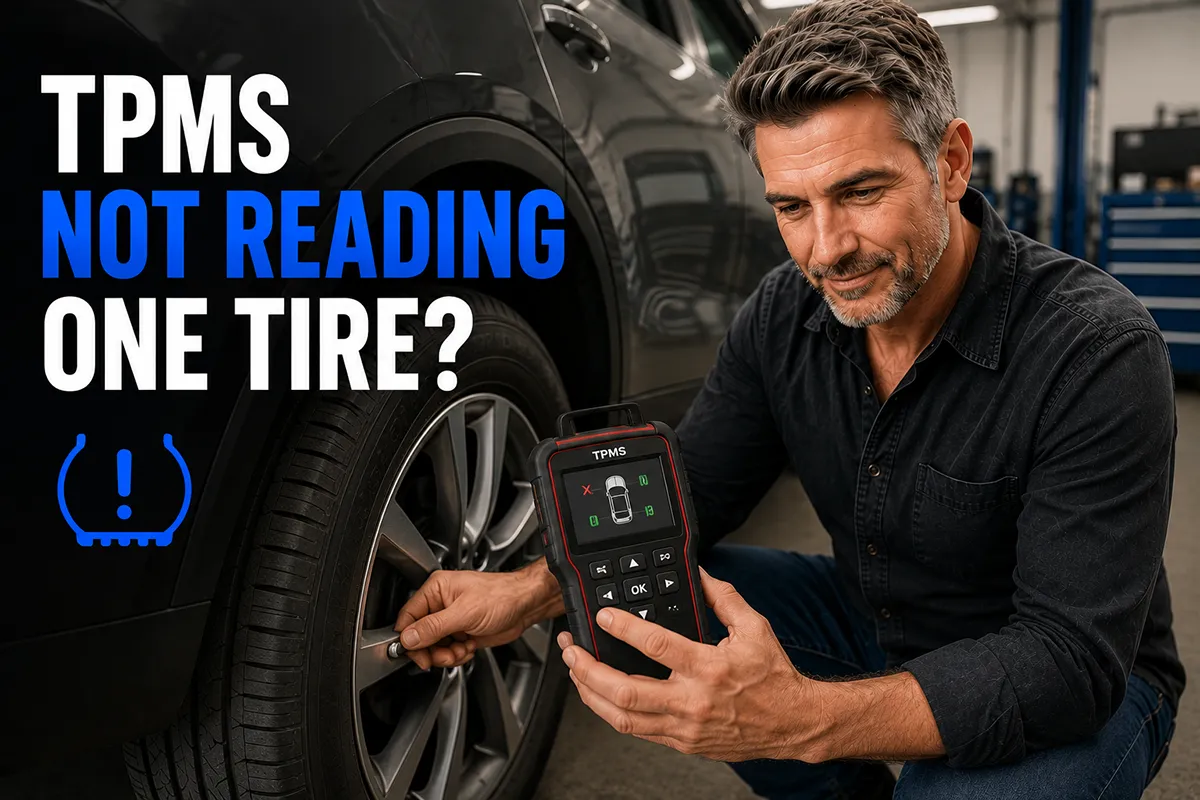
I was driving down I-95 on a Saturday morning when I noticed something annoying on my dashboard — the TPMS warning light was on, but only one tire seemed to be the problem. The other three were reading perfectly fine.
It’s one of those issues that sits in the back of your mind. Is the tire going flat? Is the sensor broken? Am I safe to keep driving?
I’ve dealt with this exact scenario multiple times over the years, both on my own vehicles and while helping friends and family troubleshoot their tire issues. So I decided to put together everything I know — from personal experience, shop visits, and countless hours of research — into this comprehensive guide.
- A TPMS not reading one tire is usually caused by a dead sensor battery, a faulty sensor, or a sensor that lost its pairing with the vehicle’s ECU.
- Before assuming the worst, check the tire pressure manually with a gauge — the tire itself might be fine.
- Replacement TPMS sensors cost between $30 and $80 each, and programming can add $20 to $50 at a shop.
- You can often fix the issue yourself with a TPMS relearn procedure specific to your vehicle.
- If you recently had tires rotated, mounted, or replaced, the sensor may have been damaged or not properly re-paired.
- Don’t ignore the warning — a non-functional TPMS means you lose a critical safety alert for that tire.
Liked this article?
Add TireAdvise as a preferred source so you see more of our tire reviews and guides on Google.
What Does It Mean When TPMS Won’t Read One Tire?
Your Tire Pressure Monitoring System (TPMS) is designed to alert you when any tire drops below a safe pressure threshold — typically around 25% below the manufacturer’s recommended PSI. Each tire has its own sensor, and those sensors communicate wirelessly with your vehicle’s computer.
When one tire stops showing a reading — or the TPMS light stays on even though you’ve checked all four tires and they seem fine — it usually means there’s a communication breakdown between that one sensor and your car. The tire itself may be perfectly healthy.
I want to emphasize that because it’s the single biggest source of unnecessary anxiety I see among drivers. The TPMS light doesn’t always mean you have a flat or a leak. Sometimes it just means the sensor is having a bad day — or has reached the end of its life.
The Two Types of TPMS Warnings (And Why It Matters)
Before we dig into fixes, I need to quickly explain something that trips up a lot of people. There are two different TPMS warning behaviors, and they mean different things.
Solid TPMS Light
A solid, continuously illuminated TPMS light typically means that one or more tires have low pressure. This is the system doing its job. Check your tire pressures with a manual gauge, inflate to spec, and see if the light goes away after a few minutes of driving.
Flashing TPMS Light (Then Stays Solid)
If your TPMS light flashes for about 60 to 90 seconds when you start the car and then stays solid, that’s a system malfunction indicator. This is the one that usually points to a dead or malfunctioning sensor. In my experience, this is the behavior most people see when one specific tire’s sensor has stopped communicating.
Understanding this distinction saved me a trip to the shop once. I saw the flashing light, knew it was a sensor issue rather than a pressure issue, and was able to handle it myself.
Every Reason I’ve Seen for TPMS Not Reading One Tire
Over the years, I’ve encountered this problem enough times to build a pretty reliable mental checklist. Here’s every cause I’ve personally dealt with or confirmed through shop diagnostics.
1. Dead Sensor Battery
This is the number one cause, and it’s the one most people don’t think about. Every direct TPMS sensor has a small lithium battery inside it, and those batteries typically last five to ten years. They’re not rechargeable, and they’re not replaceable — when the battery dies, you replace the whole sensor.
I had this happen on my 2014 Honda Accord. After several years of flawless operation, one sensor just went silent. The other three were still fine. A quick scan at the shop confirmed the left rear sensor battery was dead.
2. Sensor Damage During Tire Service
This is more common than you’d think. Every time a tire is dismounted from a rim — whether for replacement, repair, or rotation — there’s a risk that the technician can bump, crack, or break the TPMS sensor valve stem or the sensor body itself.
I’ve personally had this happen after getting new tires installed at a chain shop. I drove away and within a few minutes noticed the TPMS light. When I went back, they admitted the sensor was damaged during installation and replaced it at no charge. Always check your TPMS before leaving the tire shop.
3. Sensor Corrosion
TPMS sensors sit inside your wheel, exposed to moisture, road salt, and chemical tire sealants. Over time, the valve stem — especially if it’s an aluminum stem on a steel sensor — can corrode badly. In northern US states where roads are heavily salted in winter, I see this issue far more frequently.
The corrosion can cause the sensor to malfunction or make it impossible to remove without breaking.
4. Sensor Not Paired After Tire Rotation or Swap
When you rotate your tires or swap between summer and winter sets, the sensors physically move to different wheel positions. Some vehicles can automatically relearn which sensor is where. Others need a manual relearn procedure, and some require a dedicated TPMS scan tool to reprogram.
If nobody performed the relearn after your last tire rotation, your car might be confused about which sensor belongs to which position. In some cases, it shows one tire as “not reading” because the system doesn’t recognize the sensor in that position.
5. Radio Frequency Interference
This one sounds obscure, but I’ve actually experienced it. TPMS sensors transmit data via radio frequency, typically at 315 MHz or 433 MHz depending on the vehicle. Certain aftermarket electronics, poorly shielded phone chargers, or even proximity to certain structures can cause temporary interference.
I once had a persistent TPMS issue that only occurred in my garage. Once I removed an old aftermarket CB radio that was improperly installed, the problem vanished.
6. Aftermarket Wheels Without Sensor Compatibility
If you’ve upgraded to aftermarket wheels, you need to make sure TPMS sensors are either transferred or new compatible ones are installed. I’ve seen people buy beautiful new rims and skip the sensor installation, then wonder why their TPMS is acting up.
7. Faulty TPMS Module or Antenna
This is less common but worth mentioning. Your vehicle has a TPMS receiver module (sometimes integrated into another module) that picks up signals from the sensors. If the module or its antenna is malfunctioning, it might lose communication with one specific sensor — usually the one farthest from the antenna.
How I Diagnose the Problem Step by Step
When someone comes to me with a TPMS that won’t read one tire, here’s the exact process I walk through. You can do most of this yourself without any special tools.
Step 1: Check Tire Pressure Manually
Grab a quality digital tire pressure gauge — I like the ones from Milton or Accutire, both available at any auto parts store for under $15 — and check all four tires plus the spare. Compare your readings to the placard on the driver’s door jamb.
If one tire is significantly low, inflate it to spec and drive for about 10 to 15 minutes. The TPMS light should reset on its own. If it does, your sensors are fine — you just had a low tire.
Step 2: Attempt a TPMS Relearn
If all pressures are correct and the light is still on (especially if it flashed first), try a relearn procedure. The method varies by manufacturer, but here are the most common approaches I’ve used:
- GM vehicles: Use the key-on, engine-off method, press the trip reset button until TPMS LEARN appears, then go to each tire with a TPMS tool or magnet and trigger each sensor in sequence (LF, RF, RR, LR).
- Ford vehicles: Many Fords use a two-step process involving the ignition cycle and hazard lights. The exact sequence is in your owner’s manual.
- Toyota/Lexus: There’s often a TPMS reset button under the dash or in the glovebox. Press and hold it until the light blinks three times.
- Honda/Acura: Navigate through the infotainment system to the vehicle settings, find TPMS calibration, and initiate it. Then drive for about 20 minutes at highway speed.
Your owner’s manual has the exact procedure for your vehicle. I always recommend starting there.
Step 3: Use a TPMS Scan Tool
If the relearn doesn’t work, the next step is to determine whether the sensor is actually transmitting. A TPMS activation tool — like the ATEQ VT56, Autel MaxiTPMS TS508, or the more budget-friendly JDIAG TPMS Relearn Tool (around $30 to $50 on Amazon) — can wake up each sensor and tell you its status, battery level, and whether it’s transmitting.
I invested in an Autel TS408 a couple of years ago and it’s paid for itself many times over. I hold it near each tire valve, trigger the sensor, and within seconds I can see if that sensor is alive or dead.
If the sensor for the problem tire doesn’t respond at all, the battery is dead or the sensor is damaged. Time for a replacement.
Step 4: Visual Inspection
If possible, visually inspect the valve stem on the problem tire. Look for corrosion, cracking, or any signs that the stem was damaged. If the cap is seized or the stem feels loose or wobbly, the sensor assembly may be compromised.
How to Fix TPMS Not Reading One Tire
Once you’ve identified the cause, here are the fixes ranked from easiest to most involved.
Fix 1: Inflate the Tire and Drive
Cost: Free
Difficulty: Easy
Time: 15-20 minutes
As I mentioned, sometimes it’s just a low tire. Inflate to spec and drive around. The system needs a few minutes of driving at 25+ mph to update readings. I’ve had the light clear after about 10 minutes of highway driving.
Fix 2: Perform a TPMS Relearn
Cost: Free (or $30-$50 if you need a basic TPMS tool)
Difficulty: Moderate
Time: 20-30 minutes
Follow your vehicle’s specific relearn procedure. On some vehicles, this is as simple as pressing a button. On others, you need a TPMS activation tool to trigger each sensor in sequence.
Fix 3: Replace the TPMS Sensor
Cost: $30-$80 for the sensor + $20-$50 for programming/installation
Difficulty: Requires tire dismount (shop visit)
Time: 30-60 minutes at a shop
If the sensor battery is dead or the sensor is damaged, replacement is the only option. You’ll need to have the tire dismounted to access the sensor, which means a trip to a tire shop.
I always recommend OEM sensors if your budget allows. They’re guaranteed to work with your vehicle’s system without any programming headaches. Aftermarket sensors from brands like ATEQ, Schrader, or Continental are also solid choices and often more affordable.
Here’s a comparison of popular replacement sensor options I’ve personally used or recommended:
| Sensor Type | Typical Cost (Each) | Programming Needed? | Pros | Cons |
|---|---|---|---|---|
| OEM Sensor | $50 – $120 | Sometimes (vehicle relearn) | Guaranteed compatibility, longest battery life | Most expensive option |
| Aftermarket (Pre-Programmed) | $30 – $60 | Vehicle relearn only | Affordable, easy to install | Battery life varies by brand |
| Aftermarket (Programmable/Universal) | $25 – $50 | Yes (TPMS tool required) | One sensor covers many vehicle makes | Requires programming tool or shop visit |
| Schrader EZ-Sensor | $35 – $55 | Yes (TPMS tool required) | Broad vehicle coverage, reputable brand | Must be cloned or programmed before install |
Fix 4: Replace the Valve Stem and Service Kit
Cost: $5-$15 per wheel
Difficulty: Requires tire dismount
Time: Included with sensor replacement
Even if the sensor itself is fine, corroded valve stems, cracked grommets, or worn seals can cause issues. Every time I have a tire off the rim, I tell the shop to replace the TPMS service kit — it includes the valve core, cap, nut, grommet, and washer. It’s cheap insurance.
Fix 5: Check or Replace the TPMS Module
Cost: $100-$400 (parts + labor)
Difficulty: Advanced (shop recommended)
Time: 1-2 hours
If you’ve replaced the sensor and performed a relearn but still have issues with one position, the TPMS module or its antenna may be the culprit. This is rare, but I’ve seen it happen on older vehicles with high mileage. A dealer or experienced independent shop can diagnose this with advanced scan tools.
Can You Drive With TPMS Not Reading One Tire?
Technically, yes. Your car will drive just fine. The TPMS is a monitoring system — it doesn’t affect how the vehicle operates mechanically.
But here’s why I strongly recommend against ignoring it for long. The whole point of TPMS is to alert you before a low tire becomes a dangerous blowout. If one sensor is dead, you’ve lost that safety net for that wheel. You won’t get a warning if that tire starts losing pressure due to a nail, a slow leak, or a sidewall issue.
I make it a habit to check my tire pressures manually at least once a week when a TPMS sensor is down. It takes 60 seconds and it’s the best way to bridge the gap until you get the sensor fixed.
Also, depending on your state, a non-functional TPMS can cause your vehicle to fail an annual safety inspection. Many US states now include TPMS functionality in their inspection criteria.
My Experience at Different Types of Shops
I’ve had TPMS sensors replaced at dealerships, national chains (Discount Tire, Tire Rack installs, Firestone, etc.), and independent tire shops. Here’s my honest take on each.
Dealership
Dealers always use OEM sensors, which guarantees compatibility. However, they typically charge the most — I’ve seen bills of $150 to $250 for a single sensor replacement including labor and programming. The upside is they know your car’s TPMS system inside and out.
National Chains (Discount Tire, America’s Tire, Firestone, etc.)
In my experience, Discount Tire has been the most consistent and affordable option. They carry a wide range of aftermarket sensors, they have TPMS programming tools, and their pricing is usually very fair. I’ve had sensors replaced there for $50 to $80 all-in.
Discount Tire also offers free TPMS sensor diagnosis — they’ll scan all four sensors and tell you which one is problematic at no charge. I’ve taken advantage of this multiple times.
Independent Shops
Quality varies widely. Some independent shops have invested in proper TPMS equipment and do great work. Others still treat TPMS as an afterthought. I always call ahead and ask if they have a TPMS scan/programming tool before bringing my car in.
TPMS Myths I Keep Hearing (And Want to Debunk)
After years of talking to everyday drivers about TPMS issues, I’ve heard some persistent myths that I want to address head-on.
Myth: “Cold weather kills TPMS sensors”
Cold weather doesn’t kill the sensor — it lowers tire pressure. For every 10°F drop in temperature, tire pressure drops about 1 PSI. So when temperatures plunge overnight in places like Minnesota or Michigan, the TPMS light may come on because the tires actually are low. This isn’t a sensor problem; it’s a physics problem.
That said, extreme cold can accelerate battery drain in sensors that are already near end-of-life. I’ve seen sensors that were hanging on by a thread finally give up during the first cold snap of the season.
Myth: “You can just put electrical tape over the light”
Please don’t do this. I’ve actually seen this in a friend’s car. The TPMS light is there for a reason. Ignoring it means you won’t know if a different tire develops a problem later.
Myth: “Aftermarket sensors never work right”
This used to be more true a decade ago, but modern aftermarket sensors from reputable brands are excellent. I’ve installed aftermarket sensors that have been working flawlessly for years. The key is proper programming and a quality relearn procedure.
Myth: “Tire sealant fixes everything including TPMS issues”
Actually, tire sealant (like Fix-a-Flat) can damage TPMS sensors by clogging the pressure-sensing port. If you’ve recently used a tire sealant and now your TPMS won’t read that tire, the sealant may have killed the sensor. I always warn people about this.
What About Indirect TPMS Systems?
I should mention that not all vehicles use direct TPMS sensors inside the tire. Some manufacturers — particularly some European brands and certain model years of Mazda, Honda, and others — use indirect TPMS systems that rely on the ABS wheel speed sensors to detect pressure changes.
If your vehicle has indirect TPMS, there’s no physical sensor inside the tire to replace. Instead, the system detects that one tire is rotating at a different speed (because a lower-pressure tire has a slightly smaller effective diameter). If your indirect TPMS is flagging one tire, the issue is likely:
- Genuinely low pressure in that tire
- A mismatched tire size (different brand or model on one wheel)
- A worn tire with significantly different tread depth
- An ABS sensor malfunction for that wheel
- The system needs recalibration after tire service
You can usually recalibrate an indirect TPMS through the infotainment system or a button press. Check your owner’s manual.
Preventing Future TPMS Problems
Based on everything I’ve experienced, here are my top recommendations for keeping your TPMS healthy and avoiding the “one tire not reading” headache.
Always Replace TPMS Service Kits During Tire Changes
Every time you have tires mounted or dismounted, ask the shop to replace the TPMS valve stem service kit. It costs a few dollars per wheel and prevents corrosion-related failures.
Replace All Four Sensors at the Same Time (If Possible)
If one sensor battery has died, the other three are likely close behind — they’re all the same age. If you’re already having tires replaced, it makes financial sense to do all four sensors at once. I’ve done this twice and it saves you from making repeat trips to the shop over the following months.
Keep Valve Caps On
Those little plastic caps aren’t just for looks. They keep dirt, moisture, and road grime out of the valve core area. Metal valve caps are even better, but make sure they have a rubber inner seal to prevent galvanic corrosion between dissimilar metals.
Avoid Tire Sealant When Possible
If you get a flat, a plug or patch repair is always better for your TPMS sensor than pumping in chemical sealant. I keep a portable tire inflator and a plug kit in my trunk instead of relying on sealant products.
Request a TPMS Relearn After Every Tire Rotation
Not every shop does this automatically. When I get my tires rotated, I specifically ask: “Did you relearn the TPMS sensors?” If they give me a blank stare, I know I might need to do it myself when I get home.
When TPMS Issues Signal Something Bigger
In most cases, a TPMS not reading one tire is a straightforward sensor issue. But occasionally, it’s revealed something more important that I would have otherwise missed.
I once had a TPMS sensor drop out on a tire that turned out to have a slow bead leak. The pressure was dropping so gradually that I wouldn’t have caught it for days or weeks without investigating the TPMS warning. The sensor battery was fine — the light came on because the tire was losing air. Fixing the bead leak at the shop was a simple and inexpensive repair, but if I’d ignored the light, I could have been driving on a significantly underinflated tire.
That experience changed my perspective. I no longer view the TPMS light as an annoyance — I view it as a prompt to investigate.
Cost Summary: What You’ll Actually Spend
Here’s a realistic breakdown of costs you might encounter, based on what I’ve personally paid or seen quoted at shops across the US.
| Service | DIY Cost | Shop Cost |
|---|---|---|
| TPMS Diagnosis/Scan | $30-$150 (tool purchase) | $0-$30 (free at Discount Tire) |
| TPMS Relearn (no sensor replacement) | Free | $20-$50 |
| Single Sensor Replacement (aftermarket) | $25-$50 (still need shop for tire dismount) | $50-$100 (parts + labor) |
| Single Sensor Replacement (OEM) | $50-$120 (still need shop for tire dismount) | $100-$250 (dealership) |
| TPMS Service Kit (per wheel) | $2-$5 | $5-$15 |
| All Four Sensors Replaced (aftermarket, at shop) | N/A | $200-$400 total |
My Final Recommendation
If your TPMS is not reading one tire, don’t panic — but don’t ignore it either. Start with the simple stuff: check your tire pressure manually, try a relearn procedure, and inspect the valve stem visually. If none of that works, a TPMS scan tool (or a free scan at a shop like Discount Tire) will quickly tell you whether the sensor is dead.
In my experience, the vast majority of single-tire TPMS failures come down to a dead sensor battery. It’s not expensive to fix, and it’s absolutely worth doing. You’re restoring a safety system that could save you from a blowout, a ruined tire, or worse.
I’ve driven with a dead TPMS sensor for a few days while waiting for a replacement, and I compensated by checking pressures manually every morning. But I wouldn’t recommend letting it go longer than that. It’s the kind of thing that’s easy to forget about — until you wish you hadn’t.
Take care of your TPMS, and it’ll take care of you.
Frequently Asked Questions
Why is my TPMS not reading one tire while the other three work fine?
The most common reason your TPMS is not reading one tire is a dead or failing sensor battery. Each tire has its own individual TPMS sensor, and these batteries typically last 5-10 years before dying out one at a time. A corroded valve stem, sensor damage from a pothole, or a sensor that shifted out of position during a tire change can also cause a single tire to stop communicating with your vehicle’s receiver.
How much does it cost to fix a TPMS sensor that stopped working on one tire?
Replacing a single TPMS sensor in the US typically costs between $50 and $150 for the part, plus $20 to $50 for labor since the tire needs to be dismounted and remounted. If you’re already buying a replacement tire, many shops will bundle the TPMS sensor replacement at a reduced labor rate. OEM sensors from brands like Schrader or Continental tend to cost more than aftermarket universal sensors, but they often pair more reliably with your vehicle’s system.
Can I drive safely with one TPMS sensor not reading?
You can technically drive with one TPMS sensor not working, but you lose the critical safety warning for that specific tire. This means a slow leak or underinflated tire could go undetected, increasing the risk of a blowout—especially on long highway drives or in extreme summer heat common across US states. I’d recommend manually checking that tire’s pressure with a gauge at least once a week until you get the sensor replaced.
Will a new tire fix my TPMS not reading one tire issue?
Installing a new tire alone will not fix a TPMS sensor problem because the sensor is a separate component mounted inside the wheel, not part of the tire itself. However, if you’re shopping for a replacement tire, it’s a smart time to have the sensor inspected or replaced since the tire has to come off the rim anyway. Ask the shop to test the sensor with a TPMS scan tool before remounting so you don’t pay for labor twice.
How do I reset my TPMS after replacing or repairing one sensor?
The reset process varies by vehicle, but most US-market cars let you reset the TPMS through the infotainment settings menu or by holding a reset button located near the steering column. Some vehicles, like many Toyota and Lexus models, require you to drive for 10-20 minutes at speeds above 25 mph to allow the system to automatically relearn the new sensor. If the TPMS light stays on after that, a shop with a TPMS relearn tool can manually sync the new sensor’s ID to your vehicle’s computer for around $20 to $40.
Can a TPMS sensor fail because of tire sealant like Fix-a-Flat?
Yes, tire sealant products like Fix-a-Flat are a well-known cause of TPMS sensor failure because the sealant can coat and clog the sensor’s pressure-reading port inside the tire. If you’ve used an emergency sealant on a flat tire, there’s a good chance the sensor in that wheel is now blocked or corroded. When you bring the tire in for a proper repair or replacement, let the technician know so they can clean or replace the sensor at the same time.
Should I replace all four TPMS sensors if only one stopped working?
You don’t have to replace all four at once, but it’s worth considering if your vehicle is more than 7 years old because the other sensors likely have similar battery life remaining. Replacing them all during a full set of new tires saves on labor costs since each wheel is already off the car. If only one sensor has failed and the others were recently tested as healthy, replacing just the one is perfectly fine and saves you $150 to $400 on parts you may not need yet.
