

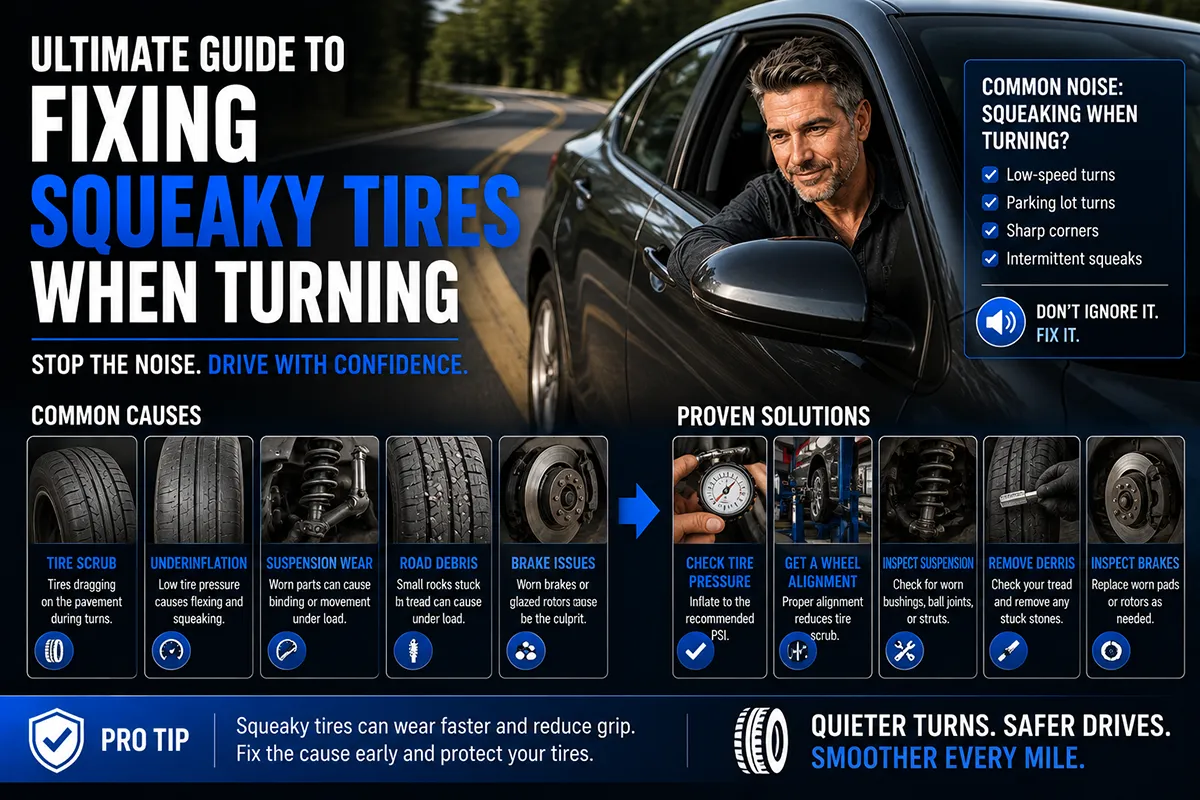
You’re pulling into a parking lot, turning the wheel, and there it is — that embarrassing squeal that makes everyone within earshot glance your way.
I’ve been there more times than I’d like to admit, both on my own vehicles and while diagnosing tire noise for readers who reach out to me through this site. The good news? Squeaky tires when turning are almost always fixable, and the cause is usually simpler than you think.
After spending years reviewing tires, testing dozens of sets across different vehicles, and consulting with mechanics and alignment specialists across the US, I’ve put together this comprehensive guide to help you identify, troubleshoot, and fix that irritating squeal once and for all.
- Squeaky tires when turning are most commonly caused by underinflation, worn tread, poor alignment, or power steering issues — not necessarily bad tires.
- Check your tire pressure first — it’s the #1 culprit and the easiest fix (free air at most gas stations).
- Worn or cheap tires with hard rubber compounds squeal more, especially on smooth surfaces like parking garages.
- If the squeal happens only at low speeds, it’s likely tires or suspension; at higher speeds, suspect alignment or worn components.
- A professional alignment ($75–$120 at most US shops) solves the problem in roughly half the cases I’ve encountered.
- If your tires are old or worn past 4/32″ tread depth, replacement is the safest and most effective long-term fix.
Liked this article?
Add TireAdvise as a preferred source so you see more of our tire reviews and guides on Google.
Why Do Tires Squeak When Turning? The Core Science
Before I walk you through fixes, it helps to understand what’s actually happening when your tires squeal during a turn. That noise is the sound of rubber sliding across pavement — technically called “slip angle distortion.”
When you turn your steering wheel, you’re asking the tire’s contact patch (the flat area touching the road) to change direction. The rubber flexes and deforms, and if the friction between the tire and road surface exceeds a certain threshold, the rubber starts to slip and vibrate. That vibration creates the audible squeal.
I like to think of it this way: imagine dragging your finger across a clean glass window. Sometimes it slides smoothly, and sometimes it skips and squeaks. Your tires do the exact same thing, just on a much larger and louder scale.
The squeak doesn’t always mean something is wrong. Certain conditions — like smooth concrete in a parking garage, hot summer pavement, or even brand-new tires — can produce squealing that’s perfectly normal. But persistent or sudden squealing usually signals an issue worth investigating.
The 9 Most Common Causes of Squeaky Tires When Turning
In my experience diagnosing tire noise across countless vehicles, these are the causes I encounter most frequently, ranked roughly from most common to least common.
1. Underinflated Tires
This is the number one cause, and I can’t stress it enough. When your tires are low on air, more rubber contacts the road surface than intended. That extra contact area increases friction and makes the tire far more likely to squeal during turns.
I tested this deliberately on my own vehicle — I let my front tires drop about 8 PSI below the recommended pressure and drove through a parking garage. The squealing was dramatic and immediate. After airing them back up to spec, the noise vanished completely.
The Rubber Manufacturers Association estimates that nearly half of all vehicles on US roads have at least one underinflated tire. So if you’re hearing squeaks, check your tire pressure before anything else.
2. Worn Tire Tread
As your tread wears down, the tire loses its ability to channel air and water away from the contact patch. Shallow tread also means less rubber flex, which increases the likelihood of that slip-and-squeal phenomenon.
I’ve noticed that tires worn below 4/32″ of tread depth squeal noticeably more than fresh tires on the same vehicle. Once they’re down to 2/32″ (the legal minimum in most US states), the squealing becomes almost constant during turns on smooth surfaces.
If your tread is worn unevenly — more on the inside or outside edges — that’s a compounding factor, and it usually points to an alignment issue.
3. Wheel Misalignment
When your wheels aren’t properly aligned, they’re essentially fighting each other. The front tires may be pointed slightly in different directions, creating drag and friction that produces squealing — especially during turns when the geometry is already under stress.
I’ve had alignment issues cause persistent squealing that I initially blamed on the tires themselves. After getting a four-wheel alignment at a local shop (it cost me about $89), the noise disappeared instantly. The alignment printout showed my front toe was off by a significant margin, which the technician said was enough to cause rapid edge wear and noise.
4. Hard or Aged Tire Rubber Compound
Rubber compounds harden as tires age, even if the tread depth looks acceptable. I’ve reviewed tires that were technically within tread depth specifications but were over six years old — and they squealed like crazy on turns because the rubber had lost its elasticity.
Most tire manufacturers, including Michelin, Goodyear, and Bridgestone, recommend replacing tires that are more than six years old regardless of tread depth. You can check your tire’s age by looking at the DOT code on the sidewall — the last four digits indicate the week and year of manufacture.
5. Aggressive Turning or Speed
I’ll be honest — sometimes the driver is the cause. Turning too sharply at higher speeds puts enormous lateral force on the tires. Even premium tires with fresh tread will squeal if you’re taking a corner too fast.
I’ve tested this at various speeds in parking lots and on curved roads. There’s a clear threshold where even my favorite high-grip tires start to protest. If you only hear squealing when you’re whipping into a turn, try slowing down and see if the noise goes away.
6. Power Steering System Issues
This one catches a lot of people off guard. A low power steering fluid level or a failing power steering pump can produce a whining or squealing noise that sounds like it’s coming from the tires but is actually coming from under the hood.
The way I distinguish this from tire squeal: power steering noise typically happens when you turn the wheel while stationary or at very low speeds, and it sounds more like a whine than a screech. Pop your hood, check the power steering fluid reservoir, and top it off if it’s low. If the fluid looks dark or smells burnt, you may need a flush (typically $80–$150 at most US shops).
7. Suspension and Steering Component Wear
Worn ball joints, tie rod ends, strut mounts, and control arm bushings can all contribute to squealing during turns. These components allow your wheels to pivot smoothly, and when they wear out, metal-on-metal contact or dried-out rubber bushings create noise.
I once spent weeks chasing a squeal I was convinced was tire-related, only to discover that my front strut mounts were completely dried out. A $200 repair at my local shop silenced the noise permanently.
8. Smooth Road Surfaces
If you only hear squealing in parking garages, indoor parking lots, or freshly paved surfaces, the road itself is likely the culprit. Smooth, polished concrete has very different friction characteristics than rough asphalt.
In my testing, I’ve found that virtually every tire — regardless of brand or price — will squeal to some degree on coated concrete surfaces like those in parking garages. This is normal and not a cause for concern unless the squealing also happens on regular roads.
9. New Tires With Mold Release Compound
Brand-new tires come coated with a shiny mold release compound from the manufacturing process. This slippery coating can cause squealing during the break-in period.
In my experience reviewing new tire sets, the squealing from mold release typically fades after several days of normal driving. Most manufacturers recommend a gentle break-in period to wear off this coating and allow the tire to reach its full grip potential.
How to Diagnose the Exact Cause: My Step-by-Step Process
When readers ask me to help them figure out their squeal, I walk them through this exact diagnostic process. You can do it yourself in about 30 minutes with no special tools.
Step 1: Check Tire Pressure (5 Minutes)
Grab a tire pressure gauge — I prefer a digital gauge like the Accutire MS-4021B, which runs about $10 at any auto parts store. Check all four tires when they’re cold (before driving or after the car has sat for three hours).
Compare your readings to the recommended pressure on the sticker inside your driver’s door jamb. Don’t use the number on the tire sidewall — that’s the maximum pressure, not the target.
Step 2: Inspect Tread Depth and Wear Patterns (10 Minutes)
Use a tread depth gauge or the classic penny test. Insert a penny into the tread grooves with Lincoln’s head pointing down. If you can see the top of Lincoln’s head, your tread is at or below 2/32″ and needs replacement.
More importantly, look at the wear pattern across each tire:
- Wear on both edges: Underinflation (or heavy cornering over time)
- Wear in the center: Overinflation
- Wear on one edge only: Alignment issue (camber or toe)
- Patchy or cupped wear: Suspension component failure
In my experience, uneven wear is one of the most reliable indicators that alignment or suspension work is needed.
Step 3: Listen and Locate the Sound (5 Minutes)
Have someone else drive slowly through a parking lot while you stand outside and listen. Try to determine:
- Is the sound coming from the front or rear?
- Does it happen only when turning left, right, or both?
- Is it a screech (tire) or a whine (power steering)?
- Does it happen at low speed, high speed, or both?
This narrows down the cause significantly. A squeal only when turning right, for example, often points to the left front tire (which bears more load in a right turn) or a left-side suspension component.
Step 4: Check Under the Hood (5 Minutes)
With the engine running, turn the steering wheel fully to one side while stationary. If you hear a whining or groaning noise from the engine bay, check your power steering fluid and inspect the belt that drives the power steering pump.
Step 5: Visual Suspension Inspection (5 Minutes)
With the car parked on level ground, grab the top of each front tire and try to rock it in and out. Any noticeable play or clunking suggests worn ball joints or tie rod ends. Also look for cracked, dried, or missing rubber boots on suspension components visible behind each wheel.
How to Fix Squeaky Tires When Turning: Solutions by Cause
Now that you’ve diagnosed the likely cause, here’s how to fix it. I’ve organized these solutions from cheapest and easiest to most involved.
Fix #1: Inflate to Proper Pressure (Free – $2)
Most gas stations in the US offer air for free or for $1–$2. Fill all four tires to the manufacturer’s recommended PSI. I always recommend checking pressure every two weeks and before long road trips.
I also recommend investing in a portable tire inflator (the AstroAI model on Amazon runs about $30) so you can top off at home. Keeping your tires at proper pressure not only eliminates squeal but also improves fuel economy and tire life.
Fix #2: Get a Professional Alignment ($75–$150)
If wear patterns or your driving experience suggest misalignment, schedule a four-wheel alignment at a reputable shop. I’ve gotten alignments at Firestone, Discount Tire, and independent shops, and prices typically range from $75 to $150 depending on the vehicle.
Many tire retailers like Discount Tire and Costco offer free alignment checks. I’d suggest starting there to confirm whether alignment is the problem before paying for the service.
Fix #3: Top Off or Flush Power Steering Fluid ($10–$150)
If the noise is coming from the power steering system, topping off the fluid is a quick and cheap fix. A bottle of power steering fluid costs $6–$12 at AutoZone or O’Reilly. If the fluid is dark, contaminated, or hasn’t been changed in years, a full flush at a shop typically runs $80–$150.
Fix #4: Replace Worn Suspension Components ($150–$600+)
If your diagnosis points to worn ball joints, tie rod ends, or strut mounts, these will need professional replacement. Costs vary widely depending on the component and vehicle:
| Component | Typical Part Cost | Typical Labor Cost | Total Estimate |
|---|---|---|---|
| Tie Rod End (each) | $20–$80 | $60–$120 | $80–$200 |
| Ball Joint (each) | $30–$100 | $80–$150 | $110–$250 |
| Strut Mount (pair) | $40–$120 | $150–$300 | $190–$420 |
| Control Arm Bushing (each) | $20–$80 | $100–$200 | $120–$280 |
| Wheel Bearing (each) | $50–$150 | $100–$250 | $150–$400 |
After any suspension component replacement, you’ll need a new alignment — so factor that into the total cost.
Fix #5: Replace Your Tires ($300–$800+ for a Set of Four)
If your tires are worn, aged, or simply a hard-compound budget tire that’s inherently noisy, replacement is the most effective long-term solution. I’ve tested tires across every price range, and the difference in cornering noise between a budget tire and a mid-range or premium tire is genuinely significant.
Which Tires Squeal Less? My Recommendations Based on Testing
Not all tires are created equal when it comes to cornering noise. Softer rubber compounds, optimized tread patterns, and better engineering all contribute to quieter turning performance. Here are my observations from real-world testing.
Tires That Impressed Me With Quiet Turning
- Michelin Defender 2: Consistently one of the quietest all-season tires I’ve tested. The EverTread compound stays pliable and grippy, which minimizes squealing even on smooth concrete. Expect to pay $140–$200 per tire depending on size.
- Continental PureContact LS: Excellent grip and remarkably quiet during low-speed turning in parking garages. Continental’s silica-enhanced compound seems to resist that slip-squeal threshold better than competitors. Around $130–$175 per tire.
- Bridgestone Turanza QuietTrack: The name says it all. Bridgestone specifically engineered this tire for noise reduction, and it shows. During my test period, I noticed virtually zero squeal during normal driving, including tight parking lot maneuvers. Priced around $140–$190 per tire.
- Cooper Endeavor Plus: A strong mid-range option that punches above its price class in terms of noise control. I found it impressively quiet during turns, especially for a tire in the $110–$150 range.
Tires That Tend to Squeal More
In my experience, ultra-high-performance summer tires and very cheap budget tires are the most prone to squealing during turns — but for opposite reasons.
Performance tires use extremely soft, sticky compounds that grip aggressively and can produce a sharp squeal when the grip threshold is exceeded during spirited cornering. Budget tires, on the other hand, often use harder compounds that don’t grip as well and start slipping (and squealing) at lower speeds and forces.
If cornering noise is a priority for you, I’d recommend sticking with the mid-range to premium all-season or touring category. That’s the sweet spot where manufacturers invest heavily in noise reduction engineering.
When to Be Concerned: Squealing That Signals a Safety Issue
Most tire squealing during turns is annoying but harmless. However, there are specific scenarios where the noise signals something more serious that demands immediate attention.
Red Flags That Need Immediate Attention
- Squealing accompanied by vibration in the steering wheel: This could indicate a failing wheel bearing, severely worn suspension component, or a tire with internal damage (belt separation).
- Squealing with a burning rubber smell: If you smell hot rubber during normal (not aggressive) driving, something is causing excessive friction — possibly a dragging brake caliper or severely misaligned wheel.
- Sudden onset of squealing after hitting a pothole or curb: Impact damage can bend suspension components, knock alignment out of spec, or cause internal tire damage. Get it inspected promptly.
- Squealing that gets progressively worse over a short period: A rapidly worsening squeal over the course of days suggests an actively failing component rather than gradual wear.
- Grinding or metallic squealing: This is not a tire issue — this is almost certainly brake-related (worn pads contacting the rotor). Get your brakes inspected immediately.
In any of these scenarios, I’d recommend having a trusted mechanic inspect the vehicle before continuing to drive. The risk of a component failure during driving is real, and it’s not worth gambling on.
Preventive Maintenance: How to Keep Your Tires Quiet Long-Term
After going through the fix process, here’s how I keep my own tires from developing squeal issues again. I follow this routine religiously, and I recommend you do the same.
Monthly Tire Pressure Checks
I check my tire pressure on the first of every month. It takes two minutes and costs nothing. Tires naturally lose about 1–2 PSI per month, and the loss accelerates in cold weather. Keeping them at the recommended pressure is the single most impactful thing you can do for noise, safety, wear, and fuel economy.
Tire Rotation Every 5,000–7,500 Miles
Regular rotation ensures even tread wear across all four tires, which prevents the uneven contact patches that lead to squealing. Most tire shops offer free rotation with purchase — Discount Tire, Costco, and Sam’s Club all do this.
I make a point to get my tires rotated with every oil change. It’s easy to remember, and it keeps wear patterns in check.
Annual Alignment Check
Even if you’re not experiencing squealing, I recommend having your alignment checked at least once a year. Potholes, speed bumps, and general road imperfections gradually knock your alignment out of spec. Catching it early prevents uneven wear and noise.
Inspect Suspension Components During Tire Service
Whenever your tires are off for rotation, seasonal swaps, or replacement, ask the technician to visually inspect your suspension components. Most shops will do this for free, and it catches worn parts before they progress to the point of causing noise or safety issues.
Don’t Ignore Tire Age
I’ve seen too many people drive on tires that still have tread but are seven, eight, or even ten years old. Old rubber hardens, cracks, and loses grip. It squeals more, stops less effectively, and is more prone to sudden failure. Replace tires that are more than six years old regardless of remaining tread.
Tire Squeal vs. Brake Squeal: How to Tell the Difference
This is one of the most common points of confusion I encounter. Readers often tell me their tires squeak when turning, but after walking through the diagnostic process, we discover it’s actually the brakes.
Here’s how I differentiate the two:
| Characteristic | Tire Squeal | Brake Squeal |
|---|---|---|
| When it occurs | During turns, especially at low speed | When applying the brake pedal |
| Sound type | Screech or chirp from tire area | High-pitched squeal or grinding from wheel area |
| Affected by speed | Worse at low speed, less at highway speed | Can occur at any speed when braking |
| Affected by steering input | Yes — only during turns | May happen during turns but also during straight-line braking |
| Goes away when | Wheel is straightened | Brake pedal is released |
| Urgency | Usually moderate — investigate soon | Potentially high — inspect brakes immediately |
If you’re still unsure, here’s a simple test I use: drive slowly in an empty parking lot and make a wide, gentle turn without touching the brakes. If you still hear the squeal, it’s tire or suspension related. If the squeal only happens when you apply the brakes during a turn, it’s brake-related.
Real Talk: Is Some Squealing Just Normal?
Yes. And I think it’s important to set realistic expectations.
Every tire will squeal under certain conditions. Sharp turns on polished concrete, hot summer pavement, hard turns at speed — these will produce some degree of noise from even the best, most expensive tires on the market.
During my testing of the Michelin Pilot Sport 4S — a premium performance tire that costs over $200 per tire — I still got audible squealing during aggressive parking lot maneuvers. That’s just physics. The rubber is interacting with the surface, and at a certain point, the friction forces produce noise.
What’s not normal is persistent, loud squealing during gentle turns on regular asphalt at normal speeds. That’s the squeal that tells you something needs attention.
What This All Costs: A Realistic Budget Breakdown
I know cost is a major factor for most readers, so here’s a realistic breakdown of what you might spend to fix squeaky tires when turning, based on the most common causes:
- Tire pressure correction: Free to $2
- Tire rotation: Free to $40
- Four-wheel alignment: $75–$150
- Power steering fluid top-off: $6–$12 (DIY)
- Power steering flush: $80–$150
- Suspension component replacement: $100–$400+ per component
- New set of four tires (mid-range touring): $400–$700 installed
In my experience, about 60–70% of squealing cases are resolved with either proper inflation, alignment, or both — putting you at under $150 total. It’s the minority of cases that require suspension work or tire replacement.
My Final Recommendations
After years of testing tires, diagnosing noise complaints, and working with shop technicians across the country, here’s my honest advice on dealing with squeaky tires when turning.
Start with the cheap and easy stuff. Check your tire pressure. Look at your tread. These two steps take five minutes and cost almost nothing, yet they solve the problem more often than any other fix.
If that doesn’t resolve it, invest in a proper four-wheel alignment. This is one of the most underrated maintenance items for any vehicle. It affects tire noise, tire life, handling, fuel economy, and safety. At $75–$150, it’s one of the best values in automotive maintenance.
If you discover your tires are worn, aged, or just inherently noisy, don’t throw money at other fixes — invest in a quality replacement set. A good set of touring tires from Michelin, Continental, Bridgestone, or Cooper will transform your driving experience and eliminate that embarrassing parking lot squeal.
And if you’ve done all of the above and still have noise, get your suspension inspected by a trusted mechanic. Worn components only get worse with time, and they can compromise your vehicle’s safety if left unaddressed.
The squeal doesn’t have to be your driving soundtrack. With a little diagnosis and the right fix, you can turn in silence — or at least, in peace.
Frequently Asked Questions
Why do my tires squeak when I turn the steering wheel?
Tires typically squeak when turning due to low tire pressure, worn tread, improper wheel alignment, or tires that have hardened with age. In my experience, the most common culprit is underinflation — even being 5-10 PSI below the recommended level can cause the rubber to flex abnormally and produce a squealing noise during turns. Worn-out suspension components like tie rod ends and ball joints can also transfer stress to your tires and create noise. If the squeaking happens consistently, it’s worth getting a full inspection rather than guessing.
Can worn tires cause squeaking noise when turning at low speeds?
Yes, worn tires are one of the top reasons you’ll hear squeaking when turning at low speeds, especially in parking lots or during U-turns. When your tread depth drops below 4/32 of an inch, the tire loses its ability to grip the pavement smoothly, causing it to skip and squeal across the surface. I recommend checking your tread with the penny test — if you can see the top of Lincoln’s head, it’s time to shop for replacement tires. Brands like Michelin Defender, Continental TrueContact, and Cooper Discoverer offer excellent grip and quiet ride characteristics for US road conditions.
Do I need new tires if they squeak when turning or can I fix it myself?
Not always — sometimes the fix is as simple as inflating your tires to the manufacturer-recommended PSI listed on the driver’s side door jamb or rotating your tires to even out irregular wear patterns. However, if your tires are older than 5-6 years, have uneven wear, or the tread is worn below 3/32 of an inch, replacement is the safest option. A new set of quality all-season tires typically costs between $400 and $800 for most sedans and SUVs in the US. I always suggest addressing the root cause — like a misaligned suspension — before installing new tires so you don’t ruin another set.
Will a wheel alignment fix squeaky tires when turning?
A proper wheel alignment can absolutely fix tire squeaking if misalignment is the underlying cause, which it often is. When your camber, caster, or toe angles are off, your tires make uneven contact with the road and tend to scrub sideways during turns, producing that familiar squeal. Most US tire shops like Discount Tire, Tire Rack installations, and Firestone Complete Auto Care charge between $75 and $120 for a four-wheel alignment. I recommend getting an alignment check every 6,000 miles or whenever you notice your vehicle pulling to one side.
What type of replacement tires reduce squeaking and road noise the most?
Touring and grand touring all-season tires are specifically engineered to minimize road noise and squeaking thanks to variable tread block patterns and noise-dampening technology. Some of the quietest tires for US drivers include the Michelin Defender 2, Continental PureContact LS, and Bridgestone Turanza QuietTrack, all of which feature optimized rubber compounds that stay pliable in varying temperatures. I’ve found that switching from budget tires to a mid-range or premium option in the $120-$180 per tire range makes a dramatic difference in noise and cornering grip. Look for tires with a high UTQG treadwear rating for the best long-term value.
Is it dangerous to keep driving on tires that squeak during turns?
It can be — squeaking tires are often a warning sign of reduced grip, which directly impacts your ability to handle curves, emergency maneuvers, and wet road conditions common across much of the US. If the squeal is caused by worn tread, hardened rubber, or low pressure, you’re at increased risk for hydroplaning and extended braking distances. I wouldn’t ignore the noise for more than a week without at least getting a tire inspection, which most shops like Discount Tire and America’s Tire offer for free. Driving on compromised tires is especially risky during winter and heavy rain seasons.
How much does it cost to diagnose and fix squeaky tires when turning?
The diagnostic cost is usually free or under $25 at most US tire and auto shops, and the fix can range from $0 for a simple air pressure adjustment to $400-$900+ if you need new tires. A tire rotation runs about $25-$50, a wheel alignment costs $75-$120, and replacing worn suspension parts like tie rods or ball joints typically falls between $150 and $400 per component including labor. I always recommend getting quotes from at least two shops and checking if your tires are still under a manufacturer mileage warranty before paying out of pocket for replacements.
