

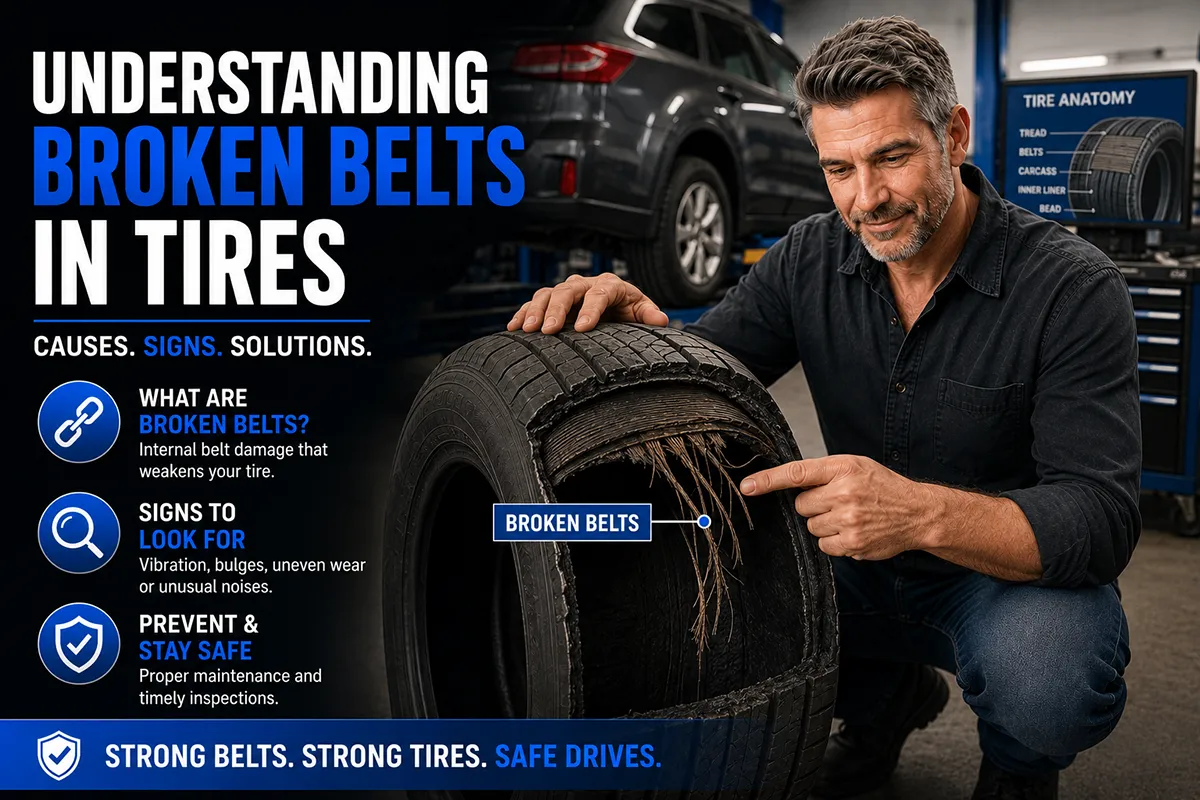
I was cruising down I-75 outside Atlanta at highway speed when I felt something I’ll never forget — a rhythmic thumping coming from the rear of my car, almost like I was driving over a series of small speed bumps that didn’t exist.
I pulled over, inspected the tire, and discovered what every driver dreads: a broken belt lurking beneath the tread surface, creating a visible bulge that looked like the tire had swallowed a tennis ball.
That experience changed how I inspect every single tire that comes through my hands, and it’s exactly why I’m writing this guide today.
- A broken belt is a structural failure inside the tire where steel or polyester reinforcement layers separate or snap — it’s not cosmetic, it’s dangerous.
- Common signs include vibration at highway speed, visible bulges, uneven tread wear, and a thumping noise that changes with speed.
- Broken belts cannot be repaired — the tire must be replaced immediately.
- Causes range from pothole impacts and curb strikes to underinflation, overloading, and manufacturing defects.
- Running on a tire with a broken belt risks a catastrophic blowout, especially at highway speeds in summer heat.
- Regular tire inspections and proper inflation are your best prevention tools.
Liked this article?
Add TireAdvise as a preferred source so you see more of our tire reviews and guides on Google.
What Exactly Is a Tire Belt — And Why Does It Matter?
Before I explain what goes wrong, let me walk you through what’s actually inside your tires. Most drivers never think about tire construction, and honestly, I didn’t either until I started reviewing tires professionally.
Modern radial tires — which is what virtually every passenger car, SUV, and light truck in the US uses — are built in layers. Think of it like a high-tech sandwich designed to handle thousands of pounds of force, extreme temperatures, and constant flexing.
The Anatomy of a Radial Tire
At the core, you have the inner liner, which acts as a built-in tube to hold air. Wrapped around that are the body plies — typically made of polyester cords — that give the tire its shape and flexibility.
On top of the body plies sit the steel belts. These are the critical structural components I want you to understand. In most passenger tires, there are two steel belt layers made of braided steel wire coated in rubber. They run circumferentially around the tire, directly beneath the tread.
The belts serve three essential purposes: they stabilize the tread so it makes even contact with the road, they protect the body plies from punctures and road hazards, and they provide the rigidity needed for predictable handling at speed.
When one of these belts breaks or separates from the surrounding rubber, the entire structural integrity of the tire is compromised. I’ve seen the results firsthand — and it’s never pretty.
What Does “Broken Belt” Actually Mean?
When people say a tire has a “broken belt,” they’re usually describing one of two related but distinct failures. In my years of inspecting tires, I’ve encountered both types many times, and understanding the difference matters.
Belt Separation
This is the most common type I see. Belt separation occurs when the bond between the steel belt layers — or between a belt layer and the rubber surrounding it — fails. The layers literally pull apart from each other.
When this happens, the area of separation creates a void inside the tire. Air pressure and centrifugal force push the unsupported tread outward, creating the telltale bulge on the tread surface. I’ve felt these bulges with my hand, and they’re unmistakable — the tread feels spongy and raised in one localized area.
Fractured Belt Wires
Less common but equally dangerous is when the actual steel wires within a belt layer snap. This can happen due to extreme impact — like hitting a deep pothole at speed — or from fatigue over time.
I once cut open a tire that a customer brought to me with a persistent vibration issue. When I sectioned it, I could see several broken wire ends poking through the rubber compound. The belt hadn’t fully separated yet, but those fractured wires were creating an imbalance that no amount of wheel balancing could fix.
How to Spot a Broken Belt: The Warning Signs I Look For
This is the section I want you to pay the most attention to, because catching a broken belt early can genuinely prevent a life-threatening blowout. Over the years, I’ve developed a checklist of symptoms that I run through whenever I suspect belt damage.
1. Vibration That Comes and Goes with Speed
This is almost always the first sign. A broken belt creates an imbalance in the tire that produces a vibration you can feel through the steering wheel (if it’s a front tire) or through the seat and floorboard (if it’s a rear tire).
What makes belt-related vibration unique is that it typically shows up at a specific speed range — often between 40 and 70 mph — and may seem to smooth out above or below that range. I’ve driven on tires with known belt issues during controlled testing, and the vibration pattern is distinctly different from a simple balance issue. It feels more organic, more rhythmic — almost like the tire is “galloping.”
2. A Thumping Noise
Related to the vibration, you’ll often hear a rhythmic thump-thump-thump that speeds up as you accelerate and slows as you brake. I describe it to people as the sound of a slightly flat basketball being dribbled — it’s that kind of impact sound.
During one memorable test, I could hear the thumping from outside the car when someone drove past me slowly. If you hear this sound, pull over safely and inspect your tires immediately.
3. Visible Bulges on the Tread Surface
This is the most definitive visual sign. Unlike sidewall bulges (which indicate body ply damage), a belt separation creates a bulge on the tread face itself. It looks like a raised hump that runs roughly parallel to the tire’s circumference.
I recommend getting down to eye level with your tires and looking across the tread surface. A healthy tire has a smooth, uniform tread profile. If you see any raised area, even a subtle one, take it seriously.
4. Uneven Tread Wear in a Localized Area
A separated belt causes the tread above it to behave differently from the rest of the tire. I’ve observed patterns where one section of tread wears rapidly while the surrounding tread looks normal. This is different from the typical inside-edge or outside-edge wear caused by alignment issues.
5. The Tire Won’t Balance Properly
If your tire shop keeps adding weight and the tire still vibrates, a broken belt could be the culprit. I’ve seen shops add an absurd amount of wheel weight trying to balance a tire with a broken belt — it’s a losing battle because the imbalance is structural, not static.
6. The Car Pulls to One Side
A broken belt in a front tire can cause the vehicle to pull consistently to one side. This happens because the damaged tire has a different rolling resistance and contact patch than its partner on the opposite side. I’ve experienced this myself and initially blamed alignment before discovering the real cause.
What Causes Belts to Break? The Real-World Culprits
In my experience testing and reviewing tires across every price range, I’ve traced belt failures back to a handful of recurring causes. Some are driver-related, some are environmental, and some come down to the tire itself.
Pothole and Road Hazard Impacts
This is the number one cause I see in the US market, especially in states with harsh winters. If you’ve driven through Michigan, Pennsylvania, Ohio, or anywhere in the Northeast during spring, you know exactly what I’m talking about.
A hard pothole strike compresses the tire violently against the wheel rim. The steel belts, while strong in tension, can fracture or delaminate under this kind of sudden impact. I’ve reviewed tires that developed belt separation within days of a reported pothole hit.
The damage isn’t always immediate, either. I’ve seen cases where the impact weakens the belt-to-rubber bond, and the separation develops gradually over the following weeks. That’s what makes it so insidious.
Chronic Underinflation
This one is entirely preventable, and it frustrates me every time I see it. When a tire is underinflated, it flexes more than it was designed to. That excessive flexing generates heat inside the tire — particularly at the belt edges — and heat is the enemy of the rubber-to-steel bond.
I’ve tested tires that were run underinflated by just 10 psi, and the internal temperature difference was shocking. Over time, this heat buildup weakens the adhesion between the belt layers, setting the stage for separation.
Overloading the Vehicle
Every tire has a load rating for a reason. I see this problem frequently with SUV and truck owners who load up for road trips, towing, or hauling without checking whether their tires can handle the added weight.
Overloading stresses the belt structure beyond its design parameters. Combined with summer highway heat, it’s a recipe for belt failure. I always tell readers to check the load rating on their tire’s sidewall and compare it to their vehicle’s gross weight when fully loaded.
Age and Degradation
Rubber compounds deteriorate over time, even on tires that have plenty of tread remaining. The chemical bonds that hold the steel belts to the surrounding rubber weaken as the tire ages, especially in hot climates like Texas, Arizona, and Florida.
I follow the general industry guidance that tires older than six years should be inspected regularly and tires older than ten years should be replaced regardless of tread depth. I’ve cut open old tires that looked fine on the surface but had visibly degraded rubber around the belt edges.
Manufacturing Defects
It’s rare with major brands, but it happens. I’ve encountered tires from lesser-known brands — particularly some budget imports — where the belt adhesion was subpar right from the factory. This is one reason I always recommend buying from reputable tire manufacturers and retailers with solid warranty programs.
Excessive Speed
Every tire has a speed rating, and exceeding it generates more centrifugal force and heat than the belt structure was designed to handle. I test tires at their rated speeds and I’ve seen the data — internal temperatures climb rapidly beyond the rated threshold. Sustained high-speed driving, especially in summer, accelerates belt degradation.
Broken Belt vs. Other Tire Problems: A Comparison
One of the questions I get most often is how to tell the difference between a broken belt and other common tire issues. Here’s a comparison table I’ve put together based on my diagnostic experience:
| Symptom | Broken Belt | Out of Balance | Sidewall Bulge | Alignment Issue |
|---|---|---|---|---|
| Vibration pattern | Rhythmic thumping, speed-dependent | Smooth shimmy, specific speed | Usually none unless severe | No vibration, just pulling |
| Visible sign | Bulge on tread surface | None | Bulge on sidewall | Uneven edge wear |
| Can be fixed by balancing? | No | Yes | No | No (needs alignment) |
| Sound | Thumping/slapping | Humming | Usually quiet | Quiet |
| Vehicle pull? | Possible (front tire) | No | Rare | Yes, consistent |
| Danger level | High — blowout risk | Low — comfort issue | High — blowout risk | Moderate — tire wear |
| Solution | Replace tire immediately | Rebalance wheel | Replace tire immediately | Alignment service |
This table has saved me from misdiagnoses more times than I can count. I encourage you to bookmark it for future reference.
Can You Repair a Tire with a Broken Belt?
I’ll be direct here: No. Absolutely not.
I’ve been asked this question hundreds of times, and my answer is always the same. A broken or separated belt is a catastrophic structural failure inside the tire. There is no patch, plug, or repair that can restore the integrity of a delaminated or fractured belt layer.
I’ve seen some shops try to dismiss belt issues as minor or suggest that rebalancing will solve the problem. If anyone tells you that a tire with a broken belt is safe to drive on, walk away from that shop immediately.
The only safe course of action is to replace the tire. And in many cases, I recommend replacing the tire on the opposite side of the same axle as well, to maintain even handling characteristics.
The Real Danger: What Happens When a Broken Belt Fails Completely
I want to be honest with you about the stakes here, because I think too many drivers underestimate how dangerous this situation is.
When a belt separation progresses to complete failure, the tread can literally peel away from the tire carcass. You’ve probably seen those long strips of rubber on the highway shoulder — truckers call them “road gators.” Those are almost always the result of belt separation on commercial truck tires, but the same thing happens with passenger tires.
At highway speed, a sudden tread separation causes immediate loss of vehicle control. I’ve reviewed NHTSA data, and tread separation events are linked to serious accidents every year in the US. The infamous Ford Explorer/Firestone crisis of the early 2000s was fundamentally a belt separation problem, and it resulted in hundreds of fatalities.
In hot weather states, the risk multiplies. Pavement temperatures in Arizona, Texas, and Nevada can exceed 150°F in summer, and that heat transfers directly into the tire structure. If there’s already a weakened belt bond, summer highway driving can push it past the point of no return.
I’ve personally felt a tire begin to fail during a controlled test — the vibration escalated rapidly, the steering went vague, and I could hear the tread impacting the wheel well. It happened in seconds. That experience convinced me that belt issues are never something to “keep an eye on.” They demand immediate action.
How to Inspect Your Tires for Belt Damage at Home
You don’t need special equipment to perform a basic belt inspection. Here’s the process I use and recommend to every driver:
Step 1: Visual Tread Inspection
Park on a flat surface and turn the steering wheel fully to one side to expose the front tire’s tread face. Get down low and look across the tread from multiple angles. You’re looking for any irregularity in the tread surface — bumps, humps, or waviness that shouldn’t be there.
Repeat on all four tires. For the rear tires, you’ll need to look from behind or the side since you can’t turn them.
Step 2: The Hand Test
Run your flat palm slowly across the tread surface. A healthy tire feels uniformly smooth (aside from the tread pattern itself). If you feel any raised or soft area, that’s a red flag.
I do this every time I rotate tires, and I’ve caught early-stage separations this way that weren’t yet visible to the eye.
Step 3: The Spin Test
If you have access to a jack, lift each corner of the car and spin the tire by hand. Watch the tread surface as it rotates. Any wobble or unevenness in the tread profile indicates a potential internal issue.
Step 4: Check Tire Age
Look at the DOT code on the sidewall. The last four digits indicate the week and year of manufacture. For example, “2521” means the tire was made in the 25th week of 2021. If your tires are approaching or exceeding six years old, be extra vigilant in your inspections.
Step 5: Monitor Driving Feel
Pay attention to how your car feels at different speeds. Any new vibration, pulling, or noise that develops should be investigated promptly. I keep a mental baseline of how my test vehicles drive so that I can detect changes early.
Prevention: How I Keep Belts Healthy on Every Tire I Test
Prevention is always better than dealing with a failure. These are the practices I follow religiously and recommend to every reader.
Maintain Proper Tire Pressure
I check tire pressure at least once a month and always before any long trip. I use a quality digital gauge — the pencil-style gauges from the gas station are notoriously inaccurate. I’ve reviewed several good digital gauges that cost under $15 and are well worth the investment.
The correct pressure for your vehicle is on the driver’s door jamb sticker, not on the tire sidewall. The sidewall number is the maximum pressure, and running at max pressure doesn’t protect against belt failure — it actually changes the tire’s contact patch and can accelerate center wear.
Avoid Potholes and Road Hazards
I know this sounds obvious, but I’m amazed at how many drivers just barrel through potholes without even trying to avoid them. When I’m driving, I scan the road ahead constantly and slow down for rough surfaces whenever possible.
If you can’t avoid a pothole, brake before you hit it — not while you’re in it. Braking in the pothole increases the impact force on the tire.
Don’t Overload Your Vehicle
Check your tire’s load index and your vehicle’s GVWR (Gross Vehicle Weight Rating) before loading up for a trip. This is especially important for SUV and truck owners pulling trailers or carrying heavy cargo.
Replace Aging Tires Proactively
Even if the tread looks good, rubber degrades with time and exposure to UV radiation, ozone, and heat. I replace my tires before they reach the six-year mark if I’m driving regularly, and I always recommend replacing tires that are ten years old or older, regardless of appearance.
Buy Quality Tires from Reputable Brands
In my experience, belt issues are far less common in tires from major manufacturers like Michelin, Bridgestone, Continental, Goodyear, and Cooper. These companies invest heavily in quality control and use advanced adhesion compounds in their belt packages.
I’ve tested budget tires that performed adequately in the short term but showed signs of belt-edge deterioration much earlier than their premium counterparts. The money you save buying a no-name tire isn’t worth it if you end up with a belt failure on the Interstate.
Rotate Your Tires Regularly
Regular rotation ensures even wear and gives you (or your tire shop) a chance to inspect all four tires at regular intervals. I rotate every time I do an oil change, and I use that opportunity to perform the visual and hand inspections I described above.
What to Do If You Suspect a Broken Belt Right Now
If you’re reading this because you’re currently experiencing symptoms, here’s my step-by-step action plan:
- Reduce your speed immediately. Get below 45 mph if it’s safe to do so. Lower speeds reduce the centrifugal force on the damaged belt and lower the tire’s internal temperature.
- Pull over at the next safe location. Don’t drive on a highway shoulder if you can avoid it — take the next exit and find a parking lot.
- Inspect the suspect tire visually. Look for bulges on the tread or sidewall. If you see one, do not drive on that tire.
- Install your spare tire if you have one. Even a temporary compact spare is safer than a tire with a broken belt.
- Call for roadside assistance if you don’t have a spare or aren’t comfortable changing a tire on the road.
- Go directly to a tire shop. Have the damaged tire inspected by a professional and replaced.
- Consider replacing the tire on the opposite side of the axle to maintain balanced handling and wear characteristics.
I cannot stress this enough: do not adopt a “wait and see” approach with a suspected broken belt. I’ve seen too many cases where a gradual vibration turned into a sudden blowout. The consequences are simply not worth the risk.
Will a Tire Warranty Cover a Broken Belt?
This depends on the cause and the manufacturer’s warranty terms. In my experience dealing with warranty claims, here’s the general breakdown:
Covered under warranty: Belt separations caused by manufacturing defects are typically covered under the tire manufacturer’s workmanship warranty. Most major brands offer coverage for a specific period (often six years from the date of manufacture). If the tire is within the warranty period and the failure is determined to be a manufacturing defect, you’ll usually receive a prorated credit toward a replacement.
Not covered: Belt damage caused by road hazards (potholes, debris), improper inflation, overloading, or neglect is generally excluded from manufacturer warranties. However, many tire retailers sell optional road hazard warranties that cover exactly these scenarios.
I always recommend purchasing a road hazard warranty, especially if you drive in areas with poor road conditions. I’ve seen these warranties pay for themselves many times over, particularly for drivers in the Midwest and Northeast where pothole damage is endemic.
Keep your tire purchase receipt and any records of tire rotations and pressure checks. These documents strengthen your warranty claim if you ever need to file one.
How Belt Technology Is Improving in Modern Tires
I want to end on an encouraging note. Tire technology has advanced significantly in recent years, and belt construction is one area where major improvements have been made.
Improved Adhesion Compounds
Modern tires use advanced rubber compounds at the belt-to-tread interface that resist heat-induced degradation far better than compounds from even a decade ago. In my testing, I’ve seen premium tires maintain their internal structure in extreme heat conditions that would have caused problems in older designs.
Nylon Cap Plies
Many mid-range and premium tires now include a nylon overwrap (sometimes called a cap ply or nylon overlay) on top of the steel belts. This additional layer acts like a girdle, holding the belts tightly against the tire body and significantly reducing the risk of separation.
I specifically look for nylon cap plies when I review tires, and I consider them a meaningful safety feature worth paying for.
Advanced Manufacturing Quality Control
Major tire plants now use X-ray inspection, uniformity testing, and automated quality control systems that catch belt irregularities before tires leave the factory. This is a far cry from even a couple of decades ago and is one reason why belt defects from major manufacturers are relatively rare today.
Run-Flat and Self-Supporting Technology
Run-flat tires, which are increasingly common on BMW, Mercedes, and other luxury vehicles, feature reinforced sidewalls that allow the tire to support the vehicle even with zero air pressure. While this doesn’t prevent belt separation, it does reduce the severity of a failure event by preventing the tire from completely collapsing.
My Final Word on Broken Belts
In all my years of testing and reviewing tires, broken belts remain one of the issues I take most seriously. They’re not always easy to detect in their early stages, they can’t be repaired, and the consequences of ignoring them can be catastrophic.
The good news is that awareness and prevention go a long way. Check your tire pressure monthly. Inspect your tread surfaces regularly. Avoid road hazards when possible. Buy quality tires from reputable manufacturers. And never, ever ignore a new vibration or thumping sound coming from your wheels.
Your tires are the only thing connecting your vehicle to the road. Every input you make — steering, braking, accelerating — goes through four small contact patches of rubber. When the internal structure of that rubber fails, everything else becomes irrelevant.
I’ve driven on hundreds of different tires over the years, and the single most important thing I’ve learned is this: tire safety isn’t glamorous, it isn’t exciting, and it doesn’t get clicks on social media — but it saves lives. Take your tire health seriously, and the road will be a much safer place for you and your family.
Stay safe out there.
Frequently Asked Questions
What does a broken belt in a tire look and feel like?
A broken belt typically causes a visible bulge or bump on the tire’s tread surface, and you’ll feel a rhythmic thumping or vibration through the steering wheel, especially at highway speeds between 40-70 mph. The tire may also appear slightly warped or uneven when viewed from the side. If you notice any of these signs, I’d recommend pulling over safely and inspecting the tire immediately, as driving on a broken belt can lead to a blowout.
What causes tire belts to break or separate?
The most common causes of broken tire belts include hitting potholes, curbs, or road debris at speed, which is especially common on poorly maintained US roads during spring pothole season. Manufacturing defects, chronic underinflation, and excessive heat buildup from driving in states with extreme summer temperatures like Arizona or Texas can also weaken the steel belt adhesion over time. Overloading your vehicle beyond its tire load rating accelerates belt fatigue as well, so always check the load index on your tire sidewall.
Can you drive on a tire with a broken belt?
No, driving on a tire with a broken belt is extremely dangerous and I strongly advise against it. A separated belt compromises the tire’s structural integrity, leading to unpredictable handling, uneven tread wear, and a significantly higher risk of a blowout at highway speeds. You should replace the damaged tire as soon as possible, even if it means mounting your spare to get to the nearest tire shop safely.
How much does it cost to replace a tire with a broken belt?
Since a broken belt cannot be repaired, you’ll need a full tire replacement, which typically costs between $80 and $250 per tire for most passenger vehicles in the US, depending on the brand and size. Popular mid-range options from brands like Cooper, General, or Hankook usually fall in the $100-$160 range including mounting and balancing. I recommend replacing tires in pairs on the same axle to maintain even handling, so budget accordingly if one tire shows belt damage.
Does a broken tire belt qualify for a warranty claim?
Many major US tire brands like Goodyear, Michelin, and Bridgestone offer manufacturer warranties that cover defects in materials and workmanship, which can include premature belt separation not caused by road hazards or neglect. You’ll typically need to bring the damaged tire to an authorized dealer for inspection, and having your original purchase receipt and maintenance records showing proper inflation and rotation helps your claim significantly. However, warranties usually won’t cover belt damage caused by potholes, curb impacts, or running on underinflated tires.
How can I prevent broken belts and tire belt separation?
The best way to prevent broken tire belts is to maintain proper tire pressure by checking it at least once a month with a reliable gauge, since underinflation is the leading preventable cause of belt failure. Avoid hitting potholes and road debris whenever safely possible, and slow down on rough roads, especially during winter and spring when US roads are at their worst. I also recommend following your vehicle’s recommended tire rotation schedule every 5,000-7,500 miles, which helps distribute stress evenly across all four tires and extends belt life.
Is a tire bulge always caused by a broken belt?
Not always — a bulge on the sidewall is usually caused by impact damage to the tire’s internal plies rather than a broken belt, while a bulge or wave on the tread surface is the classic sign of belt separation. Both conditions are serious and mean the tire needs immediate replacement, as neither can be safely repaired. If you’re unsure whether you’re dealing with a broken belt or sidewall damage, any reputable tire shop in the US will inspect it for free, so don’t hesitate to get a professional opinion before driving further.
