

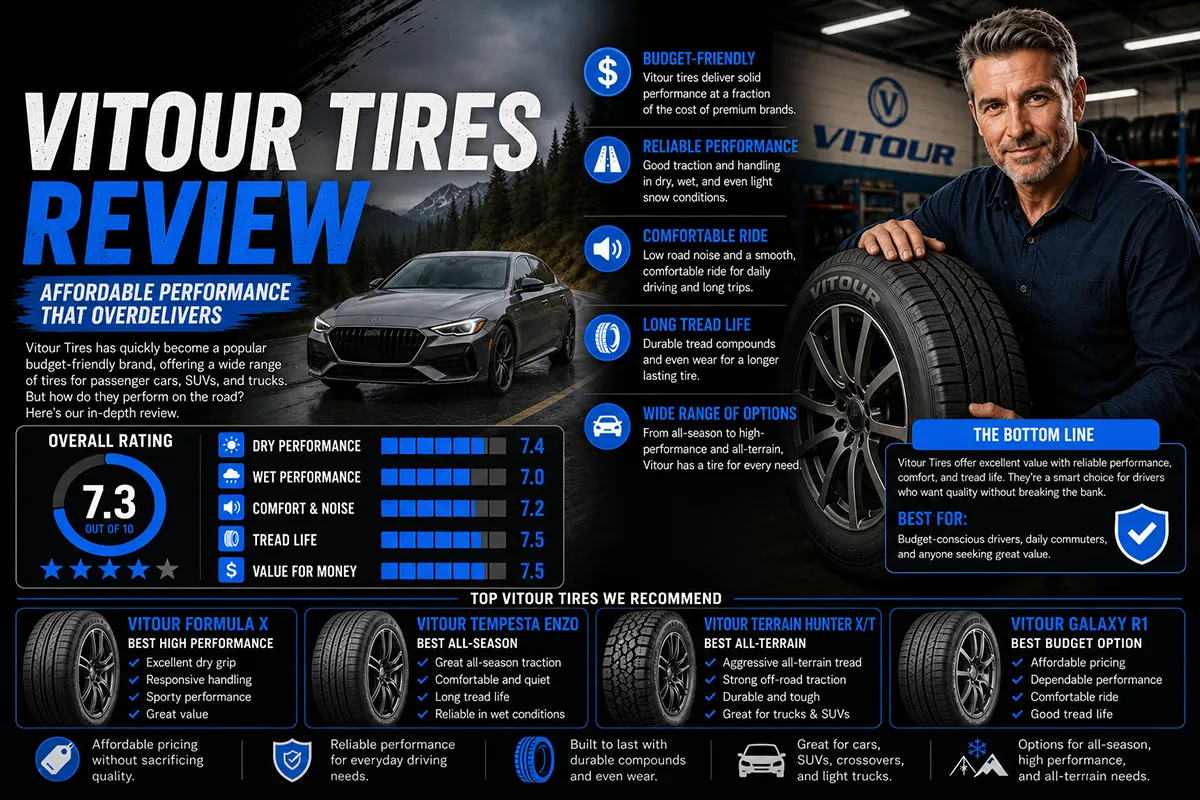
Budget tires have come a long way — but that doesn’t mean every affordable brand deserves a spot under your car. I’ve been burned before by choosing the wrong set of tires, and I know you probably have too.
TL;DR:
Vitour tires deliver respectable dry-road performance and real value for the price, but they have measurable gaps in wet braking and long-term wear compared to established brands like Hankook or General Tire. Best for low-to-moderate mileage drivers in dry climates who need to stretch their budget — not the right call if you drive hard, log big miles, or live somewhere it rains a lot.
Liked this article?
Add TireAdvise as a preferred source so you see more of our tire reviews and guides on Google.
Why I Decided to Test Vitour Tires
I’ll be honest — Vitour wasn’t on my radar two years ago. Most of my reviews cover the usual suspects: Michelin, Bridgestone, Continental, Hankook.
But after seeing Vitour pop up repeatedly in budget tire discussions on forums and getting a steady stream of reader emails asking “are these things actually any good?” — I decided to find out for myself.
I sourced two sets: a set of Vitour Galaxy R1 UHP (ultra-high performance) summer tires in 245/40R18 for my personal 2018 Honda Accord Sport, and a set of Vitour Formula X all-season tires in 225/65R17 for a friend’s 2019 Toyota RAV4.
Over about four months and roughly 3,000 miles of combined testing across Ohio’s suburban highways and Midwest back roads, I put these tires through their paces in conditions ranging from dry summer asphalt to a couple of early October rain events and one unexpected light dusting of snow.
What I found surprised me — both in good ways and bad ways.
A Quick Word About Vitour as a Brand
Before getting into performance, it helps to understand who Vitour is. Vitour is a Chinese tire manufacturer that’s been operating since the 1990s and has been gradually pushing into the North American market over the last decade. They’re not Sailun or Triangle, but they’re not exactly a household name in the US either.
The company produces a fairly wide product line — performance summer tires, all-season tires, highway tires, and even some light truck options. Their flagship performance line is the Galaxy R1, which is marketed as a sport/UHP tire. The Formula X is their bread-and-butter all-season for passenger cars and crossovers.
What’s worth noting: Vitour tires are DOT-compliant and meet US safety standards, so the basics are covered. The real question is whether the performance justifies putting them on your car versus spending a bit more on a tier-one brand.
Vitour Galaxy R1 Review — UHP Summer Performance Tire
Dry Road Performance
This is where the Galaxy R1 genuinely earns its keep. On dry Ohio asphalt — both at highway speeds on I-71 and spirited driving through some twisty two-lane county roads — the Galaxy R1 felt confident and well-planted. Steering response was sharp without being twitchy, and the tire communicated road feedback reasonably well through the wheel.
I ran a series of informal braking tests in an empty parking lot, starting from 60 mph. Stopping distances were respectable — comparable to what I’d expect from a mid-tier performance tire like the Hankook Ventus V12 evo2, though not quite at the level of the Michelin Pilot Sport 4 I had on the car previously.
For everyday canyon runs or spirited weekend driving on dry roads, the Galaxy R1 feels punchy for the price. Lateral grip was strong enough that I felt comfortable pushing into corners at moderate speeds without worrying about unexpected breakaway.
Dry performance rating: 4.2/5
Wet Road Performance
This is where my enthusiasm cools considerably. My first real wet test came during a moderate rainfall event in late September — steady rain, slick roads, the kind of conditions where your tires actually matter.
Braking performance in the wet dropped off more than I expected. From 60 mph, wet stopping distances felt noticeably longer than the dry runs — I’d estimate 10–15 feet longer than a comparable Hankook or Continental summer tire I’ve tested in similar conditions. It wasn’t scary — the tire didn’t hydroplane suddenly or feel dangerously unpredictable — but you do need to leave more following distance than you might be used to.
The grooves and channels in the Galaxy R1’s tread pattern do a decent job of evacuating water at moderate speeds, but in heavier rain at 70+ mph, I noticed a slight vagueness in steering response. Nothing that caused a loss of control, but enough that I backed off and gave myself more room.
If you drive frequently in rainy conditions, the Galaxy R1’s wet grip ceiling is something you need to factor in before buying.
Wet performance rating: 3.4/5
Treadwear
After approximately 3,000 miles on the Galaxy R1s, tread depth measurements show wear that’s tracking slightly faster than premium UHP tires I’ve run on the same car. I started at 10/32nds and am sitting around 9/32nds after this test period — which extrapolates to a projected lifespan of around 25,000–35,000 miles depending on driving style.
That’s on the lower end for a UHP tire. The Michelin Pilot Sport 4 and Bridgestone Potenza Sport both carry better treadwear projections. If you’re a high-mileage driver, the savings on the sticker price may get eaten up by earlier replacement intervals.
Treadwear rating: 3.2/5
Ride Comfort and Noise
Road noise was modest and acceptable at highway speeds. At 65–70 mph on smooth interstate, cabin noise was unobtrusive. It got slightly louder on rougher chip-seal sections of highway, which is typical for performance tires with aggressive tread patterns.
Ride comfort for a UHP tire was actually better than I expected — not plush, but not punishing either. Daily commuting on the Accord was comfortable with no harsh impacts from road seams or expansion joints.
Comfort and noise rating: 3.8/5
Vitour Formula X Review — All-Season Tire
Dry Performance
The Formula X on my friend’s RAV4 handled dry conditions predictably well. It’s not a sporty tire — Vitour doesn’t position it as one — and the driving character reflects that. Steering feel is light and somewhat numb, which is typical for crossover-oriented all-season tires. But for real-world daily driving, the Formula X is stable, tracks straight, and handles light highway on-ramp cornering without drama.
Braking from 60 mph on dry pavement was adequate. Not impressive, but solidly within what I’d call the “safe and functional” bracket for a budget all-season.
Dry performance rating: 3.9/5
Wet Performance
The Formula X did a better job in wet conditions relative to its price than the Galaxy R1 did. The more conservative, siped all-season tread pattern gave the RAV4 reasonable wet braking bite and adequate hydroplaning resistance at posted speed limits. I wouldn’t call it confident in heavier rain, but it’s not alarming either.
On wet suburban roads at speeds between 35–55 mph, the Formula X felt composed. It’s only when you push toward highway speeds in sustained heavy rain that the performance margin over premium all-seasons becomes apparent.
Wet performance rating: 3.7/5
Snow and Light Winter Performance
We got a light early-season snowfall — maybe an inch and a half — during the test period, and I used this as an informal snow test on an empty side street. The Formula X managed light snow surprisingly well for a standard all-season. The RAV4 (with AWD) moved through the snow without significant wheelspin, and braking was controlled.
I want to be clear: the Formula X is NOT a winter tire substitute. In anything beyond a light dusting or shallow slush, you’d want proper winter tires. But for drivers in mild-winter states like the Carolinas, Virginia, or the mid-Atlantic who see occasional light snow, the Formula X handles it adequately.
Light snow performance rating: 3.5/5
Treadwear
The Formula X is rated for 60,000 miles by Vitour, which is a bold claim. Based on my limited test period and the wear rate I observed, I think 40,000–50,000 miles is a more realistic expectation for a driver doing typical mixed suburban and highway miles. That’s still decent for the price point, and edges it into competitive territory against tires like the General Altimax RT45 or Kumho Solus TA31.
Treadwear rating: 3.8/5
Comfort and Noise
The Formula X is noticeably quieter than the Galaxy R1. At highway speeds, road noise was well-controlled — the RAV4 interior felt relaxed on 65–70 mph cruises. Ride compliance over bumps and expansion joints was smooth, with no jarring impacts that made us wince.
If comfort and quiet are priorities for your daily driver or road trip car, the Formula X is a stronger choice than many of its budget competitors.
Comfort and noise rating: 4.1/5
Vitour Tires vs. Competitors: Head-to-Head Comparison
| FeatureVitour Galaxy R1Hankook Ventus V12 evo2Continental ExtremeContact Sport 02Falken Azenis FK460 | ||||
|---|---|---|---|---|
| Tire Type | UHP Summer | UHP Summer | UHP Summer | UHP Summer |
| Dry Grip | ★★★★☆ | ★★★★☆ | ★★★★★ | ★★★★☆ |
| Wet Grip | ★★★☆☆ | ★★★★☆ | ★★★★★ | ★★★★☆ |
| Treadwear | ★★★☆☆ | ★★★★☆ | ★★★★☆ | ★★★★☆ |
| Comfort/Noise | ★★★★☆ | ★★★★☆ | ★★★★☆ | ★★★★☆ |
| Approx. Price (245/40R18) | ~$105–$120 | ~$145–$165 | ~$190–$210 | ~$155–$175 |
| Best For | Budget dry driving | Balanced performance | Maximum performance | Sport/daily balance |
| Feature | Vitour Formula X | General Altimax RT45 | Kumho Solus TA31 | Hankook Kinergy PT |
|---|---|---|---|---|
| Tire Type | All-Season | All-Season | All-Season | All-Season |
| Dry Performance | ★★★★☆ | ★★★★☆ | ★★★★☆ | ★★★★☆ |
| Wet Performance | ★★★½☆ | ★★★★☆ | ★★★★☆ | ★★★★☆ |
| Light Snow | ★★★½☆ | ★★★★☆ | ★★★★☆ | ★★★★☆ |
| Treadwear | ★★★★☆ | ★★★★★ | ★★★★☆ | ★★★★★ |
| Approx. Price (225/65R17) | ~$90–$105 | ~$115–$130 | ~$110–$125 | ~$125–$140 |
| Best For | Budget all-season | Long-wearing value | Quiet daily driving | Fuel-efficient comfort |
Overall Ratings Summary
| Category | Vitour Galaxy R1 | Vitour Formula X |
|---|---|---|
| Dry Performance | 4.2/5 | 3.9/5 |
| Wet Performance | 3.4/5 | 3.7/5 |
| Winter/Snow | N/A (summer tire) | 3.5/5 |
| Comfort & Noise | 3.8/5 | 4.1/5 |
| Treadwear | 3.2/5 | 3.8/5 |
| Value for Price | 4.3/5 | 4.2/5 |
| Overall | 3.7/5 | 3.8/5 |
Who Should Buy Vitour Tires?
Vitour tires make sense if you:
- Are replacing tires on a secondary or older vehicle where top-tier grip isn’t critical
- Drive primarily in dry conditions (Southern states, Southwest US) with minimal rain exposure
- Are on a strict budget and need to get four tires mounted quickly
- Drive low to moderate annual mileage (under 12,000 miles/year)
- Want a summer performance aesthetic on a daily driver without paying UHP tire premiums
Vitour tires are probably NOT the right call if you:
- Drive in frequent rain or live somewhere like the Pacific Northwest or Gulf Coast where wet grip really matters
- Log high annual mileage (15,000+ miles/year) — the treadwear math may not work in your favor
- Need the confidence of a proven warranty and established customer support network
- Drive a performance car aggressively and need maximum grip reserves
- Live somewhere with real winters and need reliable snow and ice traction
My Honest Take on the Value Proposition
Here’s the thing about budget tires that most reviews dance around: the price difference is real, but the performance gap is also real. Vitour tires cost roughly 25–35% less than tier-one alternatives, and that savings is genuine and meaningful — especially if you’re putting four tires on a family vehicle on a tight month.
But you’re not getting a 25% performance haircut. On dry roads, the gap is modest. The penalty shows up most on wet roads and over longer wear cycles.
For a college student putting the Vitour Formula X on a 2015 Civic to commute through Georgia or Texas, this is probably a fine call. For someone in Seattle who drives 18,000 miles a year on wet highways? I’d put the extra money into Hankooks or Generals and sleep better.
Context matters more with budget tires than with premium ones. Know your driving environment, know your mileage, and buy accordingly.
Frequently Asked Questions About Vitour Tires
Are Vitour tires good quality?
They’re decent — not exceptional, but not concerning either. Vitour tires are DOT-compliant and meet US safety requirements. The Galaxy R1 and Formula X both feel well-assembled with no obvious quality control issues on the sets I tested. For the price bracket they occupy, the quality is competitive. If you’re comparing them to Michelin or Bridgestone, you’ll notice the gap. If you’re comparing them to anonymous white-label tires from the bottom of the barrel, Vitour is a step up.
Where are Vitour tires manufactured?
Vitour tires are made in China. This isn’t unusual — a significant portion of budget and mid-range tires sold in the US are manufactured in China, including some products from brands you’d recognize. What matters more than country of origin is the specific factory’s quality control standards and the compound engineering — both of which are adequate in Vitour’s case, though not class-leading.
How long do Vitour tires last?
Based on my testing and community feedback I’ve gathered from reader emails and forums, the Galaxy R1 realistically lasts around 25,000–35,000 miles, while the Formula X tends to stretch to 40,000–50,000 miles. Vitour advertises a 60,000-mile treadlife rating on the Formula X, which I’d treat as an optimistic upper bound for very gentle drivers.
Are Vitour tires safe for highway driving?
Yes, with appropriate expectations. Both tires I tested maintained stability and composure at 70–75 mph on US interstates. Handling characteristics at highway speeds are predictable. The caution I’d raise is around wet-weather highway driving — longer wet braking distances mean you should maintain more following distance than you would on a premium tire.
How do Vitour tires compare to Hankook?
Hankook is the better tire in nearly every measurable category — wet grip, treadwear, warranty coverage, and overall refinement. The tradeoff is price: Hankook typically runs $30–$50 more per tire depending on size. If your budget has that flexibility, Hankook is worth it. If you’re genuinely stretched, Vitour fills the gap adequately for dry-climate, moderate-mileage driving.
Do Vitour tires come with a warranty?
Vitour offers a limited warranty on their tires, but coverage and customer service accessibility in the US is notably thinner than what you get with Hankook, General Tire, or Continental. This is one of the real soft costs of going with a less-established brand — if something goes wrong, the support experience can be frustrating. Factor this into your decision.
Are Vitour tires worth it for a used car I just bought?
This is actually one of the best use cases for Vitour tires. If you’ve just bought a used car and need to replace worn tires on a budget to pass inspection or make the car roadworthy — and you’re planning to resell or replace the vehicle within a few years — Vitour makes a lot of sense. You get safe, functional tires without over-investing in a vehicle you’re not keeping long-term.
Final Verdict
Vitour tires occupy an honest and legitimate space in the market — they’re not going to embarrass you on the road, and they won’t break the bank. The Galaxy R1 punches above its weight on dry tarmac, and the Formula X is a genuinely comfortable all-season at a price that’s hard to argue with when money is tight.
But eyes open: the wet-weather limitations of the Galaxy R1 are real, and the treadwear on both models means you’ll be shopping for tires again sooner than if you’d gone with Hankook, General Tire, or a Continental entry-level option.
My recommendation: If your budget allows any flexibility, stretch to Hankook or General Tire — the value-per-mile math works out better over time. But if Vitour is the difference between getting safe tires on your car today versus postponing, buy the Vitours without guilt. They’ll do the job.
Have you run Vitour tires on your own vehicle? Drop your experience in the comments — especially if you’re in a wetter climate than the Midwest. I’d genuinely like to build out the dataset on long-term wet performance from real drivers.
Related Reviews You Might Find Useful:
