

I was standing in a tire shop a few years ago, watching a technician adjust my tire pressure while my car was still up on the lift. Something felt off, so I asked him about it. He shrugged and said, “It’s close enough.”
It wasn’t close enough. That moment taught me one of the most underappreciated concepts in tire care — and it’s something called “weight on wheels.”
If you’ve ever wondered why your tire pressure readings seem inconsistent, why your alignment feels off after a shop visit, or why your tires are wearing unevenly despite doing everything “right,” the answer might come down to whether your vehicle had its weight on its wheels when those measurements were taken.
- “Weight on wheels” (WOW) means the vehicle’s full weight is resting on its tires while they’re on the ground — not suspended on a lift or jack.
- Tire pressure, alignment, and suspension measurements should ideally be taken with weight on the wheels for accurate results.
- Getting this wrong can lead to uneven tire wear, poor handling, and wasted money on tires that wear out prematurely.
- Always ask your tire shop whether they perform final checks with the vehicle on the ground.
- Understanding WOW helps you communicate better with mechanics and protect your tire investment.
Liked this article?
Add TireAdvise as a preferred source so you see more of our tire reviews and guides on Google.
What Does “Weight on Wheels” Actually Mean?
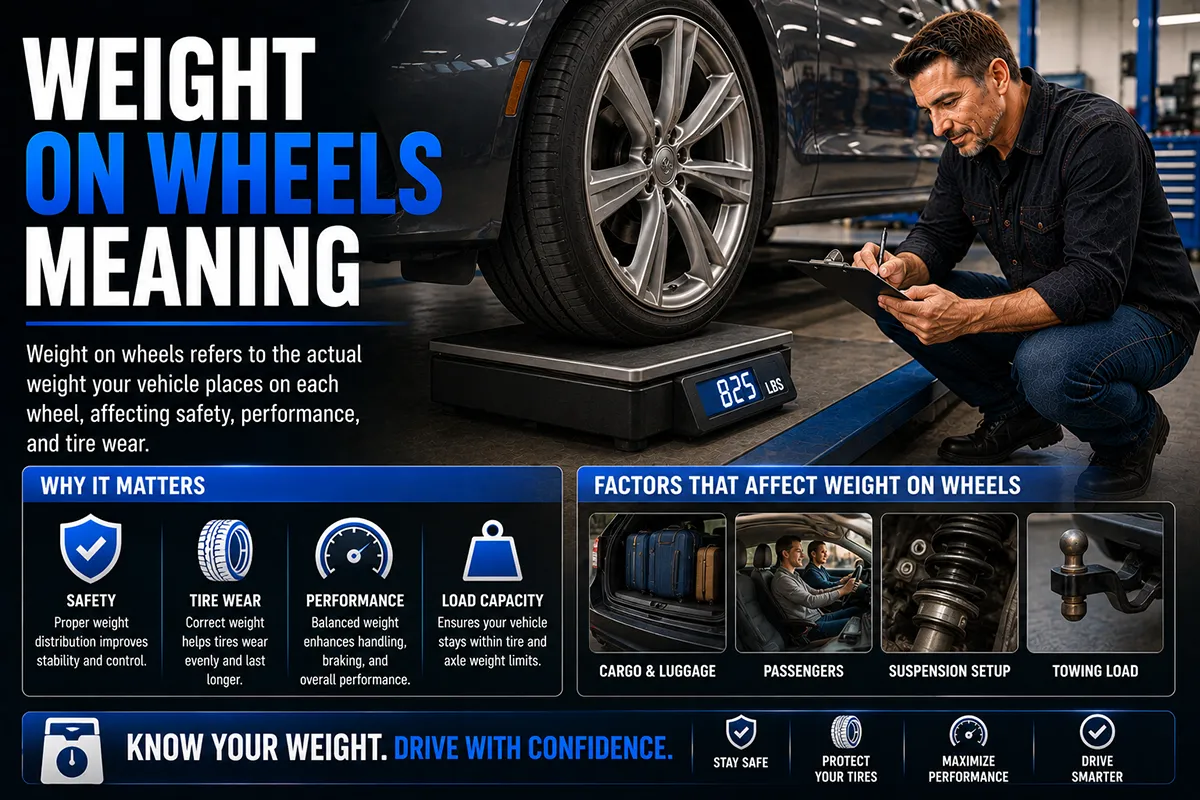
“Weight on wheels” — sometimes abbreviated as WOW — is a straightforward concept that carries enormous practical weight (pun intended). It simply means that a vehicle’s full mass is being supported by its tires as they sit on a flat surface, rather than being held up by a hydraulic lift, jack stands, or any other support device.
In my experience, most everyday drivers have never heard this term. It’s more commonly used in aviation, where “weight on wheels” sensors tell aircraft systems whether a plane is on the ground or in the air. But the automotive world borrowed the concept because it matters just as much for cars, trucks, and SUVs.
When your car is sitting naturally on the ground, the full weight of the vehicle compresses the suspension, flexes the tires slightly, and loads the chassis in a way that reflects how the car actually behaves while driving. This is the “true” state of your vehicle. When it’s up on a lift, the suspension hangs freely, the geometry changes, and the tires aren’t compressed at all.
Why Does This Distinction Matter?
It matters because nearly every critical measurement related to your tires — pressure, alignment angles, ride height — changes depending on whether the car’s weight is on the wheels or not. I’ve seen alignment specs that were perfect on the rack but completely off once the car was lowered. That’s not the shop’s fault necessarily; it’s physics.
Think of it this way: if you measure the shape of a balloon while squeezing it versus while it’s just sitting on a table, you’ll get two very different measurements. The same logic applies to your suspension and tires.
How Weight on Wheels Affects Tire Pressure
Let’s start with the one thing every driver checks (or should check) regularly: tire pressure. I’ve been testing tires professionally for years, and I can tell you that where and how you measure tire pressure makes a real difference.
When your vehicle is on a lift, the tires aren’t supporting any load. The air inside the tire is still at whatever pressure it was set to, but the tire’s contact patch — the part that touches the road — doesn’t exist. The tire is hanging freely, and its shape is different than when it’s loaded.
The Practical Difference
Now, the actual PSI reading on a gauge won’t change dramatically just because the car is on a lift versus on the ground. Air pressure is air pressure. But here’s where I’ve seen problems in real life: technicians who inflate tires on the lift don’t always account for how the tire will behave once loaded.
Temperature changes, the way the bead seats, and even the slight deformation of the tire under load can all influence what you see on the gauge when you check it later on the ground. I always recommend checking tire pressure when the car is sitting on a flat surface, tires are cold (haven’t been driven for at least three hours), and the full weight of the vehicle is on the wheels. That’s the reading you should trust.
Your vehicle’s recommended tire pressure — the one on the placard inside the driver’s door jamb — was determined by the manufacturer with the vehicle’s weight on the wheels. So that’s the condition under which you should verify it.
Weight on Wheels and Wheel Alignment
This is where the weight-on-wheels concept becomes absolutely critical. Wheel alignment is, in my opinion, the single most important maintenance procedure for extending tire life. And it’s also the one most affected by whether the vehicle’s weight is on its wheels.
What Happens During an Alignment
During a wheel alignment, a technician adjusts three primary angles: camber, caster, and toe. Each of these angles is measured in degrees or fractions of degrees. Even small deviations — we’re talking fractions of a degree — can cause significant uneven tire wear over time.
Here’s the problem I’ve seen repeatedly: many alignment machines require the car to be on a rack, and some racks lift the vehicle so the suspension hangs free. If the alignment is set in that unloaded state, the angles won’t be accurate once the car is back on the ground with weight on the wheels. The suspension compresses, the geometry shifts, and suddenly your “perfect” alignment is off.
The Right Way to Do It
The best alignment shops use what are called “runway-style” or “drive-on” alignment racks. These allow the car to sit on flat platforms with its full weight on the wheels while the sensors read the alignment angles. I’ve had alignments done both ways, and I can tell you the difference in tire wear is noticeable over time.
If your shop uses a lift-style rack, they should at minimum “jounce” the suspension (push down on each corner firmly) after lowering the car and before finalizing measurements. This settles the suspension into its natural loaded position. I always ask about this before approving an alignment.
How This Affects Suspension Components
Your suspension system is designed to work under load. Springs, struts, control arms, bushings — all of these components are engineered to perform with the vehicle’s weight pressing down on them. When the car is lifted, these parts are in an unloaded, relaxed state that doesn’t represent real-world conditions.
I’ve inspected suspension components on a lift and thought everything looked fine, only to hear noises or feel looseness once the car was back on the ground. That’s because the weight on the wheels compresses bushings, loads ball joints, and tensions tie rods in ways that reveal wear that’s invisible when unloaded.
A Real-World Example
During one of my test periods with a set of all-season tires on a mid-size sedan, I noticed a slight pull to the right that developed after several days of driving. The shop checked the alignment on a lift and said everything was within spec. I pushed back and asked them to re-check with the car on the ground. Sure enough, the camber on the right front was off — a worn control arm bushing was allowing the wheel to tilt under load but looked fine when unloaded.
That experience reinforced something I now tell every driver: if something feels wrong, make sure they’re checking with weight on the wheels.
Weight on Wheels and Tire Mounting
When you buy new tires and have them mounted, the process happens with the wheel and tire off the vehicle. That’s normal and unavoidable — you can’t mount a tire on a wheel while it’s bolted to the car. But the final torquing of lug nuts is a different story.
Lug Nut Torquing: On the Ground Matters
I’ve written about this before, and I’ll keep saying it: lug nuts should receive their final torque with the vehicle’s weight on the wheels. Here’s why. When the car is on a lift and you torque the lug nuts, the rotor and hub assembly can shift slightly because there’s no load holding everything in place. Once the car is lowered and loaded, the components settle, and the lug nut torque can change.
The best practice — and what I’ve seen the most reputable shops do — is to snug the lug nuts on the lift, lower the vehicle so the weight is on the wheels, and then do the final torque to the manufacturer’s specification with a calibrated torque wrench. This ensures even clamping force and reduces the risk of warped brake rotors or loose wheels.
Why Tire Shops Sometimes Get This Wrong
I want to be fair here. Most tire shops are staffed with hardworking people who want to do right by their customers. But the reality is that checking everything with weight on the wheels takes more time. And time is money, especially in a high-volume shop.
Lifting a car, doing the work, and lowering it again for final checks adds minutes to every job. Multiply that by dozens of cars per day, and you can see why some shops cut corners. It’s not malicious — it’s just business pressure.
What You Can Do
As a consumer, the best thing you can do is ask questions. Before you approve an alignment, ask: “Will you check the angles with the car on the ground?” Before they hand you the keys after a tire mount, ask: “Were the lug nuts final-torqued with the weight on the wheels?” These aren’t unreasonable questions, and any reputable shop will be happy to confirm.
In my experience, the shops that take the extra time to get this right are the ones worth returning to. I’ve built relationships with specific technicians at Discount Tire, Tire Rack’s installer network, and independent shops specifically because they follow these best practices.
Weight on Wheels in Different Driving Conditions
Understanding weight on wheels also helps you think about how your tires behave in different real-world scenarios. The weight distribution of your vehicle changes constantly while driving — and those changes affect your tires.
Acceleration and Braking
When you accelerate, weight transfers to the rear wheels. When you brake, it shifts forward. This is why front tires on front-wheel-drive cars tend to wear faster — they handle both the driving force and the majority of the braking force, and they bear the most weight during deceleration.
I’ve noticed this pattern on virtually every FWD vehicle I’ve tested. The front tires consistently show more wear than the rears after the same period of driving. Regular tire rotation helps equalize this, but understanding the weight transfer dynamics explains why it happens.
Cornering
In a turn, weight shifts to the outside wheels. The outside front tire in a corner is doing the most work — it’s carrying the most weight, generating the most lateral grip, and wearing the fastest. This is one reason I always pay close attention to the outside edges of front tires when inspecting wear patterns.
Loaded vs. Unloaded Vehicle
If you’re loading up your SUV for a family road trip, the total weight on the wheels increases significantly. Passengers, luggage, and cargo can add hundreds of pounds. This is why your owner’s manual lists different recommended tire pressures for full-load conditions versus normal driving. I always bump up my tire pressure to the full-load spec when I’m packing the car for a long trip — it’s right there on the door placard, and ignoring it puts extra stress on your tires.
Weight on Wheels vs. Curb Weight vs. GVWR: Understanding the Numbers
While we’re on the topic, let’s clear up some related terms that often confuse drivers. These numbers all relate to how much weight your tires are carrying, and understanding them helps you make smarter tire-buying decisions.
| Term | Definition | Typical Example (Mid-Size Sedan) |
|---|---|---|
| Curb Weight | Weight of the vehicle with all fluids, full tank of gas, but no passengers or cargo | ~3,300 lbs |
| Gross Vehicle Weight Rating (GVWR) | Maximum allowable total weight of the vehicle including passengers, cargo, and fluids | ~4,500 lbs |
| Weight on Wheels (WOW) | The actual weight being supported by the tires at any given moment | Varies based on load, passengers, and conditions |
| Tire Load Rating | The maximum weight each individual tire is designed to support at its rated pressure | ~1,477 lbs per tire (Load Index 95) |
The key takeaway from this table is that your tire’s load rating must be sufficient to handle your vehicle’s GVWR divided by four (approximately — weight distribution isn’t always perfectly even). When I’m recommending replacement tires, I always verify that the load index matches or exceeds the original equipment specification. Going lower is a safety risk I’d never take.
How to Use This Knowledge When Buying Tires
So how does all of this translate into practical advice when you’re shopping for replacement tires? Here’s what I’ve learned from years of testing and reviewing tires.
1. Match or Exceed the OE Load Index
Your original equipment tires were selected by the vehicle manufacturer to handle the GVWR with a safety margin. When you shop for replacements, check the load index on the tire sidewall and make sure it’s equal to or greater than what came from the factory. I’ve seen drivers buy cheaper tires with lower load ratings to save a few bucks, and it’s simply not worth the risk.
2. Consider Your Real-World Load
If you regularly carry heavy loads — construction materials, tools, multiple passengers, towing equipment — you might need tires with a higher load rating than the base OE spec. I’ve recommended this to several friends who use their trucks for work, and the difference in tire longevity and stability is significant.
3. Factor in Weight Distribution
Front-engine vehicles typically have about 60% of their weight on the front axle. This means the front tires carry more static load than the rears. When I’m evaluating tire wear, I always consider this front-heavy bias. It’s also why I’m a strong advocate for regular tire rotation — usually every six months or at the interval your manufacturer recommends.
4. Ask About Installation Practices
When you buy tires from a retailer — whether it’s Costco, Discount Tire, Tire Rack’s install partners, or a local shop — ask about their installation procedures. Specifically, ask if they final-torque lug nuts with the car on the ground. Ask if alignments are checked with weight on the wheels. These questions mark you as an informed consumer, and they ensure your new tires get the best possible start.
The Connection Between Weight on Wheels and Tire Wear
I’ve tested dozens of tire sets over the years, and I can confidently say that improper setup during installation is one of the top reasons tires wear unevenly. And a lot of that comes down to whether the vehicle had its weight on the wheels when critical measurements were taken.
Uneven Wear Patterns to Watch For
- Inner or outer edge wear: This usually indicates a camber problem. If the alignment was set without weight on the wheels, the camber angle might be wrong once the suspension is loaded.
- Feathering (saw-tooth pattern): This points to a toe misalignment. Even a tiny toe error that went undetected because the car was on a lift can cause this over time.
- Center wear: Over-inflation. If tire pressure was set high on the lift and never rechecked on the ground, the tires might be running at too high a pressure under load.
- Edge wear on both sides: Under-inflation. The opposite scenario — pressure was set too low, or the loaded tire is flexing too much because the pressure wasn’t verified under real conditions.
I check my tire wear patterns regularly. It takes about two minutes to run your hand across the tread and feel for uneven wear. If you catch it early, you can often correct the underlying issue before the tire is ruined.
Weight on Wheels for Trucks, SUVs, and Heavier Vehicles
Everything I’ve discussed applies even more to trucks and SUVs. These vehicles are heavier, their suspension systems have more travel, and the difference between loaded and unloaded geometry is more dramatic.
I tested a set of all-terrain tires on a full-size truck recently, and during the alignment, I specifically requested a drive-on rack. The shop initially wanted to use their standard two-post lift. I explained that the truck’s suspension — with its leaf springs and heavy-duty shocks — would settle significantly under load, and an unloaded alignment wouldn’t be accurate. They accommodated me, and the alignment was spot-on.
Pickup Trucks Are Especially Sensitive
Pickup trucks have a unique challenge: the rear axle is designed to carry payload. When the bed is empty, the rear end is relatively light. When it’s loaded with a thousand pounds of gravel, the rear suspension compresses significantly. This changes the ride height, the alignment angles, and the tire contact patches.
If you use your truck for work and regularly haul heavy loads, I’d recommend getting the alignment checked in a condition that reflects your typical use. Some shops can even simulate a loaded condition during alignment. It’s worth asking about.
How I Verify Weight-on-Wheels Practices at Tire Shops
Over the years, I’ve developed a simple checklist that I use whenever I bring a vehicle to a tire shop. I’m not trying to be difficult — I just want to make sure the work is done right so my tires last as long as they should.
- Alignment: “Do you use a drive-on alignment rack, or will the car be on a lift?” If it’s on a lift, I ask if they jounce the suspension before final measurements.
- Tire pressure: “Will you set and verify tire pressure with the car on the ground?” I also ask them to use the manufacturer’s recommended pressure from the door placard, not the max pressure on the tire sidewall.
- Lug nut torque: “Will the final torque be applied with the car on the ground using a torque wrench?” I specifically ask about a torque wrench — not an impact gun. Impact guns can over-torque lug nuts and warp brake rotors.
- Suspension inspection: “Can you check for play in the suspension components with the car loaded on the ground?” Ball joints, tie rod ends, and bushings should be checked under load for the most accurate assessment.
Not every shop gets every question right. But the ones that do earn my repeat business — and my recommendation to readers.
Common Misconceptions About Weight on Wheels
Let me clear up a few things I hear regularly from other drivers and even from some shop technicians.
“Tire Pressure Is the Same on the Lift or on the Ground”
Technically, the air pressure inside the tire doesn’t change dramatically just because the car is on a lift. But the way the tire responds to that pressure changes. The contact patch, sidewall deflection, and bead seating are all influenced by load. I always verify pressure on the ground because that’s the condition the manufacturer specified.
“Alignment Machines Compensate for the Lift”
Modern alignment machines are sophisticated, but they measure what they see. If the suspension geometry is different because the car is unloaded, the machine reads that incorrect geometry. Some high-end alignment systems include load compensation, but in my experience, a simple drive-on rack eliminates the issue entirely.
“It Doesn’t Matter for New Cars”
New cars still have suspension that moves. Even a brand-new vehicle will have different alignment angles when loaded versus unloaded. In fact, I’d argue it’s even more important to get the alignment right on a new car because you’re setting the baseline for the life of the first set of tires.
Putting It All Together: My Recommendations
After years of testing tires, visiting shops, and analyzing wear patterns, here’s my bottom-line advice on weight on wheels for everyday drivers.
Always check your own tire pressure with the car on the ground and tires cold. Buy a quality digital tire pressure gauge (I like the ones from Accutire or Milton — they’re under $15 on Amazon) and check monthly. Don’t rely solely on TPMS sensors; they’re warning systems, not precision instruments.
When getting an alignment, insist on a loaded check. Whether that means a drive-on rack or a post-lowering jounce-and-verify procedure, make sure the angles are confirmed with the vehicle’s weight on the wheels. This is the single most impactful thing you can do for even tire wear.
Verify lug nut torque after any tire service. I actually carry a small torque wrench in my trunk for this purpose. After driving for a few days following a tire mount, I’ll re-check the torque. It takes five minutes and gives me peace of mind.
Understand your vehicle’s weight characteristics. Know your curb weight, GVWR, and typical load. This helps you choose the right tires and maintain the right pressure for your actual driving conditions.
Weight on wheels isn’t a complicated concept, but it’s one that separates a good tire service from a great one. The more you understand it, the better equipped you are to protect your tire investment — and keep your family safe on the road.
Frequently Asked Questions
What does weight on wheels mean for my vehicle?
Weight on wheels (WOW) refers to the total load your vehicle places on its tires when it’s sitting on the ground with passengers, cargo, and a full tank of fuel. Understanding your actual weight on wheels helps you choose replacement tires with the correct load rating, which directly affects safety, handling, and tire longevity. You can find your vehicle’s gross weight and per-axle weight ratings on the placard inside the driver’s door jamb.
How does weight on wheels affect which replacement tires I should buy?
Every tire has a load index number that tells you the maximum weight it can safely support at its rated inflation pressure. If your actual weight on wheels exceeds the combined load capacity of your tires, you risk blowouts, uneven wear, and poor braking performance. When shopping for replacements, I always recommend matching or exceeding your vehicle manufacturer’s specified load index, especially if you frequently carry heavy cargo or tow a trailer.
What happens if my tires can’t handle the weight on my wheels?
Overloading tires beyond their rated capacity causes excessive heat buildup, sidewall flex, and accelerated tread wear, which can lead to a dangerous blowout at highway speeds. You may also notice sluggish steering response, longer braking distances, and reduced fuel economy. In the US, tire-related failures contribute to roughly 11,000 crashes annually according to NHTSA, and improper load management is a leading factor.
How do I calculate the weight on each wheel of my car or truck?
The most accurate way is to drive to a public truck scale or weigh station and measure each axle’s weight individually, which typically costs $10 to $15 per weighing. Divide each axle weight by two to get an approximate per-wheel load. For everyday drivers, you can also reference your vehicle’s GVWR on the door placard and factor in your typical passenger and cargo load to estimate whether your current tires have adequate load capacity.
Does tire pressure change how much weight my tires can support?
Yes, tire pressure and load capacity are directly linked. A tire’s published load rating assumes it is inflated to the maximum pressure listed on its sidewall, and running lower pressure significantly reduces the weight each tire can safely carry. I recommend checking your tire pressure at least once a month using a quality gauge and following the inflation specs on your vehicle’s door placard rather than the max PSI on the tire itself, especially during hot US summers when pressure fluctuates.
What is the difference between weight on wheels and gross vehicle weight rating (GVWR)?
Weight on wheels is the actual measured weight pressing down on your tires at any given moment, while GVWR is the maximum total weight your vehicle is designed to handle as set by the manufacturer. Your weight on wheels changes depending on passengers, cargo, and fuel level, but it should never exceed your GVWR. When choosing replacement tires, use the GVWR as your upper limit to ensure the tires you select can handle your vehicle’s worst-case loading scenario.
Do I need higher load-rated tires if I drive a heavy truck or SUV in the US?
If you drive a full-size pickup like an F-150 or RAM 1500 and regularly haul payloads, tow trailers, or load up for road trips, upgrading to a higher load range tire such as Load Range E can provide a meaningful safety margin. Standard passenger-rated tires on trucks often max out under heavy use, leading to premature wear and increased blowout risk. Brands like BFGoodrich, Goodyear, and Cooper offer light truck tires specifically engineered for the heavier weight on wheels that American truck owners deal with daily, typically ranging from $150 to $350 per tire depending on size and rating.
