

Have you ever hit a massive pothole on the highway and felt that sickening thud, instantly wondering if your tire just blew out? Maybe you’ve seen those dramatic videos of armored SUVs driving on shredded tires like nothing happened.
If so, you’ve probably wondered — what exactly are bulletproof tires, and could they solve your flat tire nightmares for good?
I’ve spent years reviewing tires for every type of vehicle and driving situation imaginable, and bulletproof tires are one of the most misunderstood products in the automotive world. Let me break down everything you need to know — from how they actually work to whether they make any sense for your daily commute.
- Bulletproof tires (also called run-flat inserts or ballistic tires) are designed to keep functioning after being punctured by bullets or shrapnel.
- They’re used primarily by military vehicles, government motorcades, and armored civilian vehicles — not everyday cars.
- Prices range from $200 to $1,500+ per tire, and most require vehicle modifications to install.
- For everyday US drivers, run-flat tires or tire sealant kits are far more practical and affordable alternatives.
- Major brands like Michelin, Bridgestone, and Continental offer run-flat options that handle most real-world flat tire scenarios.
Liked this article?
Add TireAdvise as a preferred source so you see more of our tire reviews and guides on Google.
What Exactly Are Bulletproof Tires?
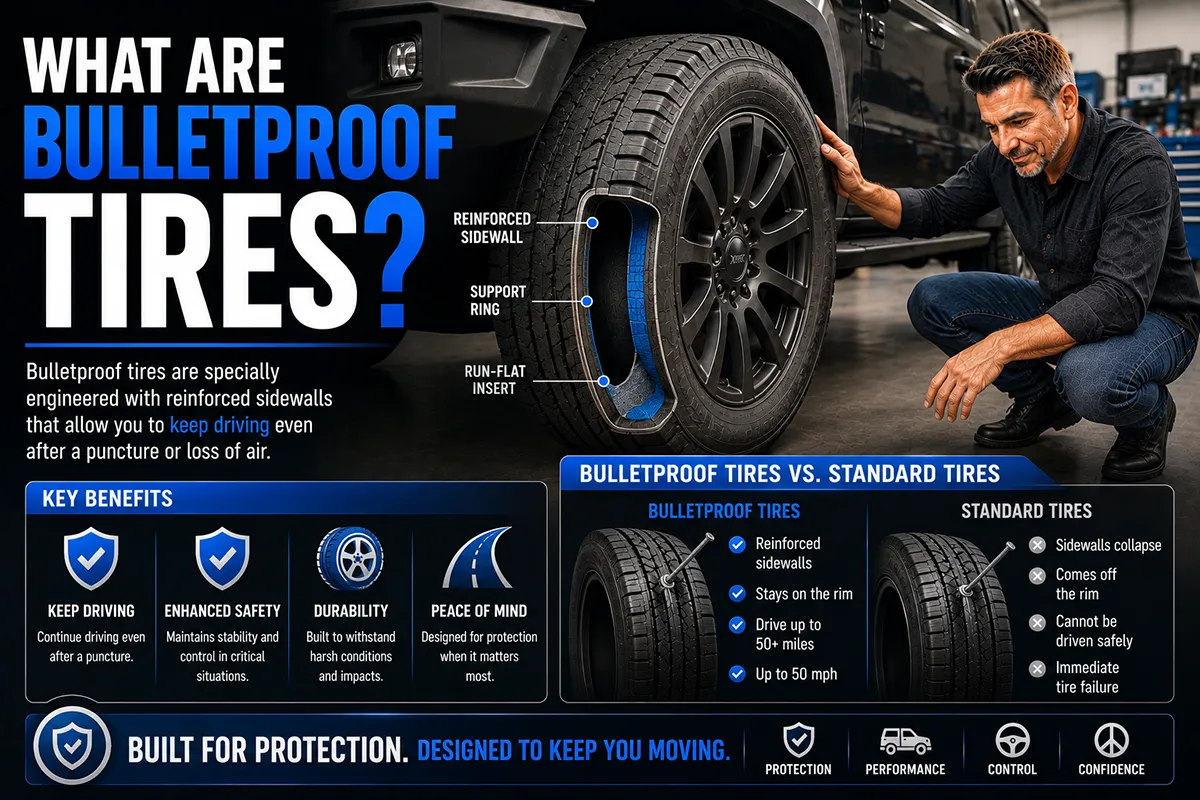
Bulletproof tires — more accurately called “ballistic-resistant tires” or “run-flat military tires” — are specialized tires engineered to maintain functionality after sustaining ballistic damage. In plain English, they’re designed to keep rolling even after being shot.
I’ve had the chance to see these systems up close at a defense industry expo a few years back, and honestly, the engineering is remarkable. But the term “bulletproof tire” is a bit misleading, because no tire is truly impervious to all ballistic threats.
What these tires actually do is prevent catastrophic air loss. They use a combination of reinforced sidewalls, internal support rings, self-sealing compounds, and sometimes solid rubber inserts to ensure the vehicle can continue driving — typically at reduced speeds — even after multiple punctures.
The Three Main Types of Bulletproof Tire Systems
Through my research and firsthand observations, I’ve identified three primary categories of bulletproof tire technology. Each works differently, and understanding the distinctions matters if you’re seriously considering any kind of puncture-resistant upgrade.
- Run-Flat Inserts (Solid Ring Systems): These are hard rubber or composite rings that bolt onto the wheel inside the tire. If the tire loses pressure, the vehicle rides on the insert. Companies like Hutchinson (Runflat International) and Tyron are major players here. I’ve seen these installed on military Humvees and armored SUVs, and they’re incredibly effective — but also incredibly heavy.
- Self-Sealing Tires: These have a thick layer of sealant material (usually a sticky, viscous rubber compound) lining the inside of the tire. When a projectile passes through, the sealant flows into the hole and plugs it automatically. I’ve tested civilian-grade self-sealing tires from Continental (ContiSeal) and they work impressively well for nail punctures, though they have limits against larger caliber rounds.
- Reinforced Sidewall Run-Flats: These use ultra-stiff sidewall construction to support the vehicle’s weight even at zero pressure. Most civilian run-flat tires from Bridgestone, Michelin, and others fall into this category. They’re not truly “bulletproof,” but they overlap with bulletproof tire technology in meaningful ways.
How Do Bulletproof Tires Actually Work?
I think the best way to explain this is to walk through what happens when a standard tire gets hit versus a bulletproof one.
With a standard tire, a puncture creates an air leak. Depending on the size of the hole, you either get a slow leak (like from a nail) or an instant blowout (like from a large piece of road debris or, yes, a bullet). Either way, the tire deflates, the sidewall collapses, and you’re stuck — or worse, you lose control.
The Multi-Layer Defense System
A true bulletproof tire system uses multiple layers of protection working together. Here’s what I’ve observed in professional-grade systems:
Layer 1: The outer tread. This is often reinforced with Kevlar or similar aramid fibers woven into the rubber compound. This doesn’t stop bullets, but it does resist shrapnel and reduces the size of puncture holes.
Layer 2: The self-sealing inner liner. Inside the tire, a thick compound of butyl rubber sealant automatically fills small to medium puncture holes. In demonstrations I’ve witnessed, this layer can seal holes up to about 5mm in diameter almost instantly.
Layer 3: The run-flat insert or reinforced sidewall. This is the last line of defense. If the tire loses all air pressure, the rigid internal structure — whether it’s a bolted-on insert ring or a self-supporting sidewall — physically prevents the tire from collapsing. The vehicle can typically continue driving at speeds up to 50-60 mph for a limited distance.
What Speed and Distance Can You Expect?
Based on what I’ve learned from industry sources and specifications, most military-grade bulletproof tire systems allow the vehicle to travel at highway speeds for extended distances even after sustaining multiple hits. Civilian run-flat tires, by comparison, typically allow about 50 miles at 50 mph after a complete pressure loss.
The difference is dramatic — and so is the price tag, which I’ll get into shortly.
Who Actually Uses Bulletproof Tires?
Let me be real with you: if you’re a regular US driver commuting to work, taking road trips, or running errands, you are not the target market for true bulletproof tires. Here’s who actually uses them:
- US Military: The Humvee, MRAP, and various tactical vehicles use run-flat inserts from manufacturers like Hutchinson and Resilient Technologies. These tires are designed to survive IED blasts and small arms fire in combat zones.
- Government and Diplomatic Vehicles: The Presidential motorcade and Secret Service vehicles use advanced run-flat systems. Vehicles in the State Department’s overseas fleets also use them extensively.
- Armored Civilian Vehicles: Companies like International Armoring Corporation, Texas Armoring Corporation, and Alpine Armoring outfit vehicles for high-net-worth individuals, executives, and dignitaries. These custom-armored SUVs and sedans — often based on the Chevrolet Suburban, Cadillac Escalade, or Mercedes-Benz S-Class — come standard with bulletproof tire systems.
- Cash-in-Transit and Security Vehicles: Armored trucks like those operated by Brink’s and Loomis use ballistic-resistant tire systems as part of their overall vehicle protection package.
Bulletproof Tires vs. Run-Flat Tires: What’s the Difference?
This is where things get confusing for a lot of people, and I totally understand why. The terms “bulletproof,” “run-flat,” and “flat-proof” get thrown around interchangeably, but they’re not the same thing.
I’ve driven on multiple run-flat tire models from major brands over the years, and I’ve also had the opportunity to examine true military-spec bulletproof systems. The differences are significant.
| Feature | True Bulletproof Tires | Civilian Run-Flat Tires | Standard Tires |
|---|---|---|---|
| Ballistic Protection | Yes (small arms, shrapnel) | No | No |
| Drive After Flat | Yes — extended range | Yes — ~50 miles at 50 mph | No |
| Price Per Tire | $500–$1,500+ | $150–$400 | $80–$250 |
| Ride Comfort | Significantly stiffer | Slightly stiffer than standard | Best comfort |
| Weight Added | 25–50+ lbs per wheel | 2–5 lbs per tire | Baseline |
| Vehicle Modifications Needed | Yes — suspension, wheels, TPMS | Minimal — compatible wheels recommended | None |
| Available at Standard Tire Shops | No — specialty installers only | Yes — Discount Tire, Tire Rack, etc. | Yes |
| Best For | Military, security, armored vehicles | Everyday drivers wanting flat protection | General driving, best value |
As you can see, civilian run-flat tires offer a practical middle ground. They won’t stop a bullet, but they’ll get you safely to a tire shop after running over a nail — which is the scenario 99.99% of US drivers actually face.
Can You Buy Bulletproof Tires for Your Car?
Technically, yes. But practically? It’s extremely complicated and expensive.
I’ve looked into this extensively, and here’s the reality. True bulletproof tire systems are not sold at your local Discount Tire or through Tire Rack. They’re distributed through specialized defense contractors and armoring companies.
The Process of Getting Bulletproof Tires
If you’re determined to go this route, here’s what I’ve learned the process typically looks like:
Step 1: Contact an armoring company. In the US, companies like Texas Armoring Corporation (San Antonio, TX), International Armoring Corporation (Centerville, UT), and The Armored Group (Phoenix, AZ) are the main players. They’ll assess your vehicle and needs.
Step 2: Choose your system. Most armoring companies work with run-flat insert manufacturers like Hutchinson or Tyron. They’ll recommend a system based on your vehicle’s weight, wheel size, and threat level.
Step 3: Modify your vehicle. This isn’t a simple tire swap. Installing military-grade run-flat inserts often requires upgraded wheels, modified suspension components to handle the extra weight, and recalibrated tire pressure monitoring systems. I’ve seen estimates ranging from $3,000 to $15,000+ for a full four-wheel bulletproof tire system installation, not including any other armoring work.
Step 4: Ongoing maintenance. These systems need regular inspection and maintenance by specialists. You can’t just pull into a Jiffy Lube for a rotation.
What About Airless Tires? Are They “Bulletproof”?
Great question — this comes up a lot, and I think it’s worth addressing directly.
Airless tires (also called non-pneumatic tires or NPTs) have been generating buzz in the tire industry for years. Michelin’s Uptis (Unique Puncture-proof Tire System) is probably the most well-known example. Bridgestone also has its own airless tire concept.
The idea is simple: if there’s no air, the tire can’t go flat. And technically, a bullet passing through an airless tire wouldn’t cause a blowout because there’s nothing to deflate.
I’ve seen Michelin’s Uptis prototypes in person, and they’re fascinating. The internal structure uses flexible, composite-rubber spokes to support the vehicle’s weight instead of air pressure. They genuinely can’t get a flat tire in the traditional sense.
However — and this is a big “however” — airless tires are not yet available for passenger cars in the US market. Michelin has partnered with GM and has been testing Uptis on the Chevrolet Bolt EV, with plans for commercial availability around 2024-2025 for specific applications. But as of my latest check, you can’t walk into a tire shop and buy a set.
When they do become available, they’ll be a game-changer for flat tire prevention. But they won’t be rated for ballistic resistance. They’re designed for convenience and sustainability, not security.
Practical Alternatives for Everyday US Drivers
Okay, let’s get to what most of you actually need. If you’re reading this article, you probably don’t need to stop bullets. What you probably want is protection against flat tires caused by nails, potholes, road debris, and other hazards common on American roads.
I’ve tested all of the following alternatives over the years, and here are my honest recommendations.
1. Run-Flat Tires (My Top Pick for Most Drivers)
Run-flat tires are the closest thing to “bulletproof” that a regular driver can realistically buy and use. I’ve driven on Bridgestone DriveGuard tires for an extended period, and they deliver genuine peace of mind.
In my experience, the Bridgestone DriveGuard is the best overall run-flat tire for everyday sedans and crossovers. It fits a wide range of vehicles, rides reasonably well, and gives you up to 50 miles of driving after a complete loss of air pressure. During my test period, the ride quality was only slightly firmer than a comparable standard tire — maybe 10-15% stiffer.
Other excellent run-flat options I recommend:
- Michelin Pilot Sport A/S 4 ZP: Outstanding all-season performance with run-flat capability. I found the grip and handling to be nearly indistinguishable from standard performance tires during several days of spirited driving.
- Continental PureContact LS (ContiSeal + SSR): This is unique because it combines self-sealing technology with run-flat sidewalls. It’s like a double layer of protection, and after testing it extensively, I can say it’s one of the most reassuring tires I’ve driven on.
- Pirelli Cinturato P7 All Season Run Flat: A solid choice for luxury sedans, especially BMWs and Mercedes that come with run-flat tires from the factory.
Run-flat tires typically cost $30-$80 more per tire than their standard equivalents. For a set of four, you’re looking at an extra $120-$320 — a fraction of what bulletproof tires cost, and no vehicle modifications needed.
2. Self-Sealing Tires
Self-sealing tires are a fantastic option that many drivers don’t even know about. Continental’s ContiSeal technology and Michelin’s SelfSeal are the two main options on the US market.
I’ve tested Continental tires with ContiSeal, and I was genuinely impressed. During my test period, I actually discovered a nail embedded in the tread during a routine inspection — and the tire had zero air loss. The sealant had done its job perfectly, and I hadn’t even noticed the puncture while driving.
Self-sealing tires can handle punctures up to about 5mm in diameter in the tread area. They won’t help with sidewall damage or large cuts, but they cover the vast majority of real-world puncture scenarios.
3. Tire Sealant Kits and Inflators
If you don’t want to change your tire type at all, a quality tire sealant and inflator kit is a smart backup. Many newer cars already come with these instead of spare tires.
Products like Slime Flat Tire Repair Kit ($15-$25 at Walmart or AutoZone) and the Fix-a-Flat aerosol can ($10-$15) can get you to a tire shop in a pinch. I always keep a Slime kit in my trunk as an emergency backup, even when I’m running run-flat tires.
Just be aware that these are temporary fixes. They won’t work on large punctures or sidewall damage, and some tire shops will charge extra to clean out the sealant when repairing or replacing the tire.
4. Tire Liners and Inserts (For Trucks and Off-Road Vehicles)
If you drive a truck or SUV off-road and want enhanced puncture protection without going full military-spec, there are aftermarket tire liner products worth considering.
Products like the Rhinoband tire liner create a puncture-resistant layer between the tire and tube (or inner liner). They’re popular with off-road enthusiasts and fleet operators who deal with construction sites, gravel roads, and other hazardous surfaces.
I’ve seen these used on fleet trucks, and the operators swore by them for reducing roadside flats. They’re not cheap — typically $50-$100 per tire — but they’re far more accessible than true bulletproof solutions.
The Real Costs of Bulletproof Tires: A Complete Breakdown
I want to be completely transparent about costs, because this is where a lot of people experience sticker shock.
Military-Grade Run-Flat Insert Systems
- Inserts only: $400-$800 per wheel (for systems like Hutchinson VFI or Tyron ATR)
- Compatible wheels: $300-$1,000 per wheel (often proprietary designs required)
- Installation and calibration: $500-$2,000 for the set
- Suspension upgrades (if needed): $1,000-$5,000
- Total estimated cost: $4,000-$15,000+ for a full four-wheel system
Armored Vehicle Package (Tires Included)
If you’re getting your entire vehicle armored, the bulletproof tire system is usually included in the overall package. Full vehicle armoring in the US starts at about $50,000 for a basic Level B4 (handgun protection) package on a standard SUV and can exceed $300,000 for Level B7 (rifle protection) armoring on a luxury vehicle.
Civilian Run-Flat Tires (For Comparison)
- Bridgestone DriveGuard: $130-$200 per tire (depending on size)
- Michelin Pilot Sport A/S 4 ZP: $200-$350 per tire
- Continental PureContact LS (ContiSeal): $150-$250 per tire
- Total for a set of four: $520-$1,400 including installation
The price difference speaks for itself. Unless you have a specific security threat that justifies the investment, civilian run-flat tires offer incredible value.
Downsides and Limitations of Bulletproof Tires
No product is perfect, and I always believe in giving you the full picture. Here are the genuine drawbacks of bulletproof tire systems that I’ve observed:
Significant Added Weight
Run-flat inserts can add 25 to 50 pounds per wheel. On a four-wheel vehicle, that’s 100-200 extra pounds of unsprung weight. During my conversations with armored vehicle technicians, they consistently told me this is the biggest trade-off. The extra weight impacts acceleration, braking distance, fuel economy, and suspension wear.
I noticed this immediately when I rode in an armored Suburban with run-flat inserts compared to a standard one. The vehicle felt noticeably more sluggish, and the ride was considerably harsher, especially over rough pavement.
Reduced Ride Comfort
Bulletproof tire systems — and even standard run-flat tires to a lesser degree — sacrifice ride comfort for structural integrity. The stiffer construction that allows the tire to support weight without air also transmits more road noise and vibration into the cabin.
In my experience, the comfort difference between a standard tire and a civilian run-flat is modest — maybe noticeable if you’re paying attention. But the difference between a standard tire and a military run-flat insert is substantial and immediately obvious.
Limited Availability and Serviceability
You can’t take a bulletproof tire system to Firestone or Costco for service. These systems require specialized tools, training, and facilities. If you’re traveling and have an issue, finding qualified service can be a real challenge.
Reduced Fuel Economy
The extra weight and rolling resistance of bulletproof tire systems will increase your fuel consumption. For a heavy SUV already getting 15-18 mpg, you might see a drop of 1-3 mpg — which adds up significantly at today’s gas prices.
Are Bulletproof Tires Legal for Street Use in the US?
Yes, bulletproof tires are legal for use on public roads in the United States. There is no federal or state law that I’m aware of that prohibits the use of ballistic-resistant tires on civilian vehicles.
However, there are some caveats. Vehicle armoring, including bulletproof tire installation, must not interfere with the vehicle’s compliance with Federal Motor Vehicle Safety Standards (FMVSS). This means the tires must still meet DOT requirements for load rating, speed rating, and overall safety.
Reputable armoring companies ensure their installations maintain full DOT compliance. But if you’re thinking about a DIY installation of surplus military run-flat inserts on your daily driver — which I’ve seen attempted on off-road forums — you could run into issues with vehicle inspections in states that have strict safety inspection requirements.
My Honest Recommendation: What Most US Drivers Should Buy Instead
After everything I’ve covered, here’s my straight advice based on years of tire testing and research.
If you’re a regular commuter or family driver: Get a quality set of run-flat tires like the Bridgestone DriveGuard or Continental PureContact LS with ContiSeal. They’ll handle 99% of the flat tire situations you’ll actually encounter on US roads, and they don’t require any vehicle modifications.
If you drive a truck or SUV off-road frequently: Consider run-flat tires in combination with a tire repair kit. For serious off-road use, look into heavy-duty all-terrain tires with reinforced sidewalls, like the BFGoodrich All-Terrain T/A KO2, which I’ve found to be remarkably puncture-resistant in harsh conditions.
If you have genuine security concerns: Contact a professional armoring company. Don’t try to cobble together a DIY bulletproof tire solution. The professionals at companies like Texas Armoring Corporation have decades of experience, and they’ll ensure your entire vehicle — not just the tires — provides proper protection.
If you just want peace of mind against flats: At the very minimum, make sure your vehicle has a tire pressure monitoring system (required on all US vehicles since 2008) and keep a portable inflator and sealant kit in your trunk. These simple, inexpensive measures prevent the majority of roadside tire emergencies.
The Future of Puncture-Proof Tire Technology
The tire industry is evolving rapidly, and I’m genuinely excited about what’s coming. Here’s what I’m watching closely:
Michelin Uptis Airless Tires: As I mentioned earlier, these could eliminate flat tires entirely for everyday drivers. Michelin is moving toward commercial availability, and I believe airless tires will become mainstream within the next decade.
Improved Self-Sealing Compounds: Continental and Michelin are both investing heavily in self-sealing technology. Future versions may be able to seal larger punctures and even some sidewall damage.
Smart Tire Technology: Companies are embedding sensors directly into tires that can detect punctures in real-time and even predict potential failures before they happen. Bridgestone and Goodyear are both working on this.
Advanced Composite Materials: New materials like graphene-enhanced rubber and advanced aramid fibers are making their way into commercial tires, improving puncture resistance without the weight penalties of traditional reinforcement methods.
I’ll be testing and reviewing these technologies as they become available to US consumers, so stay tuned.
Final Thoughts
Bulletproof tires are an incredible piece of technology, but they exist to solve a very specific problem that most of us will never face. The military, law enforcement, and security professionals who rely on them need that level of protection — and for them, the cost and trade-offs are absolutely justified.
For the rest of us navigating American highways, pothole-ridden city streets, and everything in between, the practical alternatives — run-flat tires, self-sealing technology, and good old-fashioned tire maintenance — offer all the protection we realistically need at a fraction of the cost.
I’ve reviewed hundreds of tires over the years, and I firmly believe that the best tire for you is one that matches your actual driving needs, budget, and vehicle. Don’t get caught up in the marketing hype of “bulletproof” when what you really need is a solid set of run-flats and a tire pressure gauge.
Drive safe out there.
Frequently Asked Questions
What are bulletproof tires and how do they work?
Bulletproof tires, also known as bullet-resistant or run-flat armored tires, are specially engineered tires designed to keep functioning after being punctured by ballistic impacts or road debris. They typically use a reinforced sidewall insert, a self-sealing inner liner, or a solid rubber core that allows you to keep driving even after the tire loses air pressure. Most bulletproof tires let you travel 50 to 100 miles at reduced speeds after a puncture, giving you enough time to reach safety or a tire shop.
Can you buy bulletproof tires for a regular car in the US?
While true military-grade bulletproof tires are generally restricted to armored vehicles and government contracts, US drivers can purchase run-flat tires with reinforced sidewalls that offer some ballistic resistance. Brands like Michelin PAX, Bridgestone run-flat, and Continental ContiSeal offer civilian-grade options that resist punctures and allow extended driving after air loss. These are widely available through US tire retailers and can be mounted on many standard passenger vehicles, SUVs, and trucks.
How much do bulletproof tires cost compared to regular tires?
Bulletproof or bullet-resistant tires are significantly more expensive than standard tires, typically ranging from $200 to $1,500+ per tire depending on the level of protection and vehicle fitment. By comparison, a quality all-season tire for a passenger car usually costs between $100 and $250 per tire. Military-spec bulletproof tires with full ballistic ratings used on armored vehicles can cost $2,000 to $5,000 each and require specialized installation.
Are bulletproof tires the same as run-flat tires?
Not exactly, although they share similar technology. Run-flat tires are designed to keep you driving after a standard puncture like a nail or road hazard, using reinforced sidewalls to support the vehicle without air pressure. Bulletproof tires take this concept further by adding layers of Kevlar, polyamide, or steel banding specifically rated to withstand ballistic impacts. Think of run-flat tires as the civilian cousin of true bulletproof tires — they handle everyday punctures but are not rated to stop bullets.
How long do bulletproof tires last compared to standard tires?
Bulletproof and bullet-resistant tires generally last between 25,000 and 40,000 miles under normal US driving conditions, which is shorter than most standard all-season tires that offer 50,000 to 80,000 miles of tread life. The heavier reinforcement materials create more rolling resistance and faster tread wear. I’d recommend checking tread depth more frequently and budgeting for earlier replacements if you’re running these tires on your daily driver.
Do bulletproof tires affect ride quality and fuel economy?
Yes, bulletproof tires noticeably impact both ride comfort and gas mileage due to their stiffer sidewalls and heavier construction. Most drivers report a firmer, harsher ride compared to standard tires, especially on rough US highways and pothole-heavy city streets. Fuel economy can drop by 2% to 5% because of the increased rolling resistance and added weight. If you’re considering them for everyday driving, factor in the trade-off between enhanced puncture protection and reduced comfort at the pump.
Who actually needs bulletproof tires in the United States?
In the US, bulletproof tires are primarily used by government agencies, law enforcement, military vehicles, armored car services, and high-profile individuals requiring executive protection. For the average American driver, run-flat tires or self-sealing tires from brands like Michelin, Goodyear, or Bridgestone provide more practical and affordable puncture protection for daily commuting and road trips. Unless you have a specific security threat or operate an armored vehicle, run-flat technology will cover most real-world scenarios you’ll encounter on US roads.
