

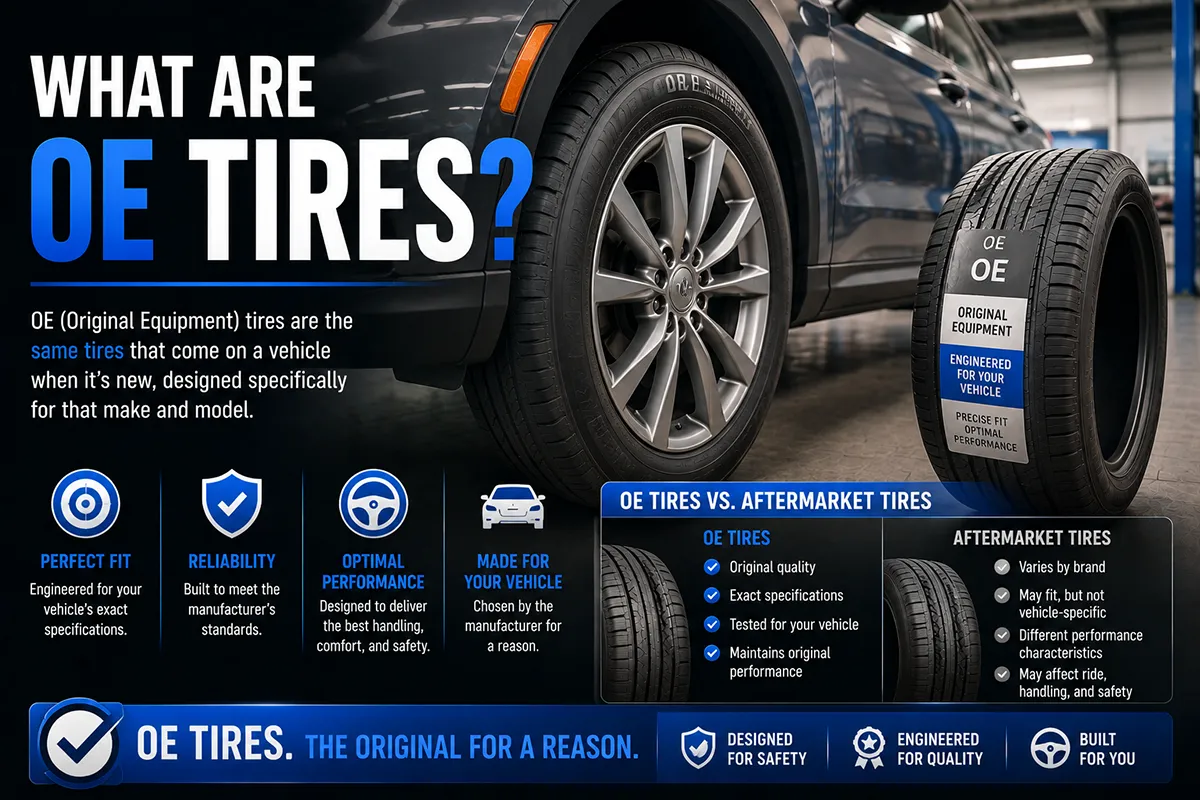
Ever pulled into a tire shop, asked for replacements, and heard the advisor say “Do you want to stick with the OE tire or try something different?” — only to realize you had no idea what “OE” even meant?
You’re not alone. I’ve talked to hundreds of drivers over the years who didn’t realize that the tires sitting on their brand-new car were specifically chosen by the manufacturer — and that this choice has real consequences for ride quality, handling, fuel economy, and even how long those tires last.
Understanding what OE tires are, how they differ from aftermarket options, and whether you should buy them again is one of the most important decisions you’ll make as a car owner. Let me break it all down based on my years of reviewing and testing tires across dozens of vehicles.
- OE (Original Equipment) tires are the specific tires chosen by your vehicle’s manufacturer to come installed on your car from the factory.
- They’re engineered to match your car’s weight, suspension, handling, and fuel economy targets — not necessarily to last the longest or perform the best in every condition.
- Replacing with the same OE tire guarantees a familiar driving experience, but aftermarket alternatives can offer better treadlife, wet grip, or winter performance.
- OE tires sometimes cost more than comparable aftermarket options, so shopping around is smart.
- Check your owner’s manual for the correct tire size and speed rating before buying anything.
Liked this article?
Add TireAdvise as a preferred source so you see more of our tire reviews and guides on Google.
What Does OE Mean When It Comes to Tires?
OE stands for “Original Equipment.” In the tire world, it refers to the specific tire model and specification that a vehicle manufacturer selects to be installed on a new car before it rolls off the assembly line and into the dealership.
When you buy a brand-new 2024 Toyota Camry, Honda CR-V, or Ford F-150, the tires already mounted on it are the OE tires. Toyota, Honda, or Ford specifically chose those tires — working directly with tire manufacturers like Michelin, Bridgestone, Continental, Goodyear, or others — to complement the vehicle’s engineering.
This isn’t a random selection. In my experience covering the tire industry, I’ve learned that automakers spend years collaborating with tire companies during vehicle development. The OE tire is purpose-built to meet that specific car’s performance targets.
OE Tires vs. Aftermarket Tires — What’s the Difference?
Here’s where things get interesting, and where I see the most confusion among everyday drivers.
An OE tire is the exact model and spec that came on your car from the factory. An aftermarket tire (sometimes called a “replacement tire”) is any tire you can buy to replace your OE tires — including the same model, a different model from the same brand, or a completely different brand altogether.
Here’s the kicker: the same tire model can exist in both OE and aftermarket versions. For example, Michelin might produce a Primacy MXM4 specifically tuned for BMW (with a star marking on the sidewall) and a standard retail version of the same tire. They look almost identical, but the rubber compound, tread pattern, or internal construction may differ slightly.
I’ve driven on both OE-specific and standard retail versions of the same tire model, and the differences are subtle but real — especially in road noise and ride comfort.
How Do Car Manufacturers Choose OE Tires?
This is a process I find fascinating, and it directly impacts your driving experience. Let me walk you through how it works based on what I’ve learned from industry sources and tire engineers.
Step 1: Define the Vehicle’s Performance Goals
Every vehicle has a personality that the automaker wants to achieve. A Lexus ES needs to be whisper-quiet and comfortable. A Chevy Corvette needs razor-sharp handling. A Ford F-150 needs to haul heavy loads reliably. The OE tire must support that personality.
Step 2: Collaborate with Tire Manufacturers
Automakers send their requirements to multiple tire companies and essentially hold a competition. I’ve been told by engineers that this process can involve dozens of prototypes and rounds of testing over two to three years before a final selection is made.
Step 3: Fine-Tune the Compound and Construction
The winning tire manufacturer often creates a unique version of one of their existing tire models specifically for that vehicle. This might mean a softer rubber compound for better ride quality, a stiffer sidewall for sportier handling, or a lower rolling resistance formulation for improved fuel economy.
Step 4: Test and Validate
The automaker then tests the tire-vehicle combination extensively — on test tracks, in extreme weather, at high speeds, and during emergency maneuvers. I’ve visited a few of these testing facilities, and the rigor is genuinely impressive.
Step 5: Approve for Production
Once approved, that tire goes into mass production and gets mounted on every vehicle of that model (for that trim level) coming off the assembly line.
Common OE Tire Markings You Should Know
One way to identify an OE tire is by special markings on the sidewall. These brand-specific codes tell you the tire was developed specifically for that automaker. Here are the most common ones I encounter:
| Marking | Automaker | Notes |
|---|---|---|
| ★ (Star) | BMW | Indicates BMW-approved specification |
| MO | Mercedes-Benz | Mercedes Original; MO1 for AMG performance models |
| AO | Audi | Audi Original specification |
| N0, N1, N2, etc. | Porsche | Porsche-approved; higher number = newer spec |
| VOL | Volvo | Volvo-specific noise-reduction technology |
| T0, T1 | Tesla | Tesla-specific, often low rolling resistance |
| J, JLR | Jaguar Land Rover | Jaguar Land Rover approved specification |
Most mainstream brands like Toyota, Honda, Ford, Chevy, and Hyundai don’t use special sidewall markings on their OE tires. For those vehicles, you’ll need to check your owner’s manual or the tire placard on the driver’s door jamb to confirm the exact OE tire spec.
In my experience, the markings matter most for European luxury and performance vehicles, where the OE-specific tire can behave noticeably differently from the standard retail version.
Are OE Tires Good? The Honest Truth
This is the question I get asked the most, and my honest answer is: it depends on what “good” means to you.
What OE Tires Do Well
OE tires are specifically optimized for your vehicle. That means the ride quality, noise level, handling balance, and fuel economy have all been tested and approved by the automaker to work together as a system. In my testing, I’ve consistently found that OE tires deliver the most predictable, well-balanced driving experience for the specific car they were designed for.
If you value a driving experience that feels exactly like the day you bought your car, the OE tire is the safest bet.
Where OE Tires Often Fall Short
Here’s the uncomfortable truth I’ve observed over years of testing: OE tires frequently wear out faster than their aftermarket counterparts.
Why? Because automakers prioritize different things than tire buyers do. When you test-drive a new car at the dealership, you want it to feel smooth, quiet, and responsive. The automaker knows this. So they often select OE tires with softer rubber compounds that grip better and ride quieter — but wear down faster.
I’ve seen this pattern across dozens of vehicles. The factory-installed tires on many popular sedans and SUVs tend to show noticeable wear sooner than I’d expect compared to a similar aftermarket replacement tire.
Additionally, OE tires on economy cars and family vehicles often prioritize low rolling resistance for better EPA fuel economy ratings. That’s great at the pump, but I’ve found these tires sometimes sacrifice wet-weather grip or snow traction as a tradeoff.
Should You Replace OE Tires with the Same Tire?
This is where I give what I think is genuinely useful, real-world advice — not just the safe corporate answer.
When I Recommend Sticking with OE Tires
- You love how your car drives. If you’ve been happy with the ride quality, noise level, and handling, going back to the OE tire is the easiest way to maintain that experience.
- You drive a performance or luxury vehicle. Cars like BMW 3 Series, Porsche 911, Mercedes C-Class, or Tesla Model 3 have carefully tuned suspensions that are calibrated to work with specific OE tires. I’ve tested aftermarket alternatives on these vehicles and sometimes noticed changes in steering feel, road noise, or even how the stability control system responds.
- You lease your car. If you’re turning in a lease, putting the same OE tire back on keeps things simple and avoids any potential issues at lease return.
- Your vehicle has TPMS or advanced driver-assist systems. While any correctly-sized tire will work with TPMS, some newer ADAS features are calibrated with the OE tire’s specific rolling diameter. Sticking with OE avoids any edge cases.
When I Recommend Trying an Aftermarket Alternative
- Your OE tires wore out too quickly. This is the number-one complaint I hear. If you felt the OE tires didn’t last, an aftermarket tire with a better treadwear warranty might be a smarter investment.
- You need better winter or wet-weather performance. Many OE all-season tires are mediocre in snow. If you live in the northern US and face real winters, I almost always recommend upgrading to a higher-performing all-season or adding a dedicated winter tire set.
- You want a quieter ride. Some OE tires — particularly on trucks and SUVs — can be noisier than aftermarket touring tires designed specifically for low road noise.
- The OE tire is significantly more expensive. I’ve seen cases where the OE-specific version of a tire costs $30-$50 more per tire than the standard retail version of the same model, just because of that little OE marking on the sidewall.
OE Tires vs. Aftermarket Tires: A Real-World Comparison
To make this more concrete, let me share my general observations from testing OE tires against popular aftermarket replacements across several vehicle categories.
| Category | OE Tires (General) | Aftermarket Alternatives (General) |
|---|---|---|
| Ride Comfort | Excellent — tuned to the vehicle | Good to Excellent — varies by model |
| Handling | Optimized for the specific car | Can be better or worse depending on choice |
| Tread Life | Often shorter than aftermarket | Often longer; many come with mileage warranties |
| Wet Traction | Adequate to Good | Good to Excellent (top-tier options) |
| Snow/Ice Performance | Usually mediocre for all-seasons | Many aftermarket options are 3PMSF rated |
| Road Noise | Well-managed for the vehicle | Varies — some quieter, some louder |
| Fuel Economy | Often optimized for low rolling resistance | Varies; some match, others sacrifice for grip |
| Price | Sometimes premium-priced | Wide range — budget to premium |
The takeaway from my experience: OE tires are rarely the best tire you can buy for any single performance category. But they’re usually the most balanced tire for your specific vehicle. It’s always a tradeoff.
Popular OE Tires on Common US Vehicles
To give you a sense of what’s out there, here are some OE tire pairings I’ve personally encountered on popular US-market vehicles:
- Toyota Camry: Often comes with Bridgestone Turanza QuietTrack or Hankook Kinergy GT — both solid all-season tires that prioritize comfort and low noise.
- Honda CR-V: Frequently fitted with Hankook Kinergy GT or Continental CrossContact — decent all-around tires with a comfort bias.
- Ford F-150: Commonly equipped with Goodyear Wrangler Territory or Hankook Dynapro — designed for a mix of highway comfort and light off-road capability.
- Tesla Model 3: Often runs Michelin Primacy MXM4 with the T0 marking — optimized for low rolling resistance and range.
- Chevrolet Equinox: Frequently comes with Michelin Defender or Continental ProContact — fuel-efficient all-season touring tires.
- BMW 3 Series: Typically equipped with Bridgestone Potenza or Pirelli Cinturato with the star marking — performance-oriented with a sport-touring balance.
I’ve driven on all of these in their OE configurations, and they generally do a great job of matching the character of the vehicle. But in every case, I could also identify aftermarket options that outperformed the OE tire in at least one important area.
How to Find Out What OE Tires Came on Your Car
If you’re not sure what tires your car came with from the factory, here are the methods I use:
Method 1: Check the Driver’s Door Jamb
Open your driver’s door and look for a tire information placard. This sticker lists the recommended tire size, inflation pressures, and sometimes the specific tire model. Every car sold in the US is required to have this placard.
Method 2: Check Your Owner’s Manual
The tire specifications section of your owner’s manual will list the approved tire size (like 225/45R17) and sometimes the specific OE tire model. You can usually find a digital version of your manual on the automaker’s website if you’ve lost the paper copy.
Method 3: Look at the Tires Themselves
If you still have the factory tires, the brand, model name, and size are all printed on the sidewall. Look for any OE-specific markings (like the star, MO, or AO codes I mentioned earlier).
Method 4: Use an Online Tire Finder
Websites like TireRack.com, Discount Tire, or even the tire manufacturer’s own site let you enter your year, make, model, and trim to see what OE tire was originally specified. I use this method all the time when testing vehicles where the original tires have already been replaced.
OE Tires and Warranties: What You Need to Know
One thing that catches a lot of US drivers off guard is how OE tire warranties work differently from aftermarket tire warranties.
Manufacturer Warranty vs. Tire Brand Warranty
Your new car warranty from the automaker typically does not cover tire wear. Tires are considered a consumable item, similar to brake pads. However, the tire manufacturer usually provides a separate warranty for defects in workmanship and materials.
Many OE tires also come with a limited treadwear warranty (sometimes called a mileage warranty), but it’s often shorter than the warranty on the aftermarket version of the same tire. I’ve seen this with Michelin and Continental tires — the OE version might have a shorter warranty than the one you’d buy off the shelf at a tire shop.
Road Hazard Coverage
OE tires generally don’t come with road hazard coverage. If you hit a pothole or pick up a nail during the first few weeks of owning your new car, you’re likely on the hook for the repair or replacement. Many aftermarket tire purchases, on the other hand, include optional or even complimentary road hazard protection from the retailer.
This is one area where buying aftermarket replacements has a real financial advantage, and it’s something I always mention to readers.
My Personal Approach to Replacing OE Tires
After testing tires across all types of vehicles for years, here’s the personal framework I follow — and recommend to friends and family:
1. Start with Your Priorities
Before you even look at tires, ask yourself: what do I want to improve? Longer tread life? Better rain performance? Quieter cabin? More confidence in snow? Knowing your priorities makes the decision much easier.
2. Use Your OE Tire as a Baseline
I always recommend driving on the OE tires long enough to understand their strengths and weaknesses. After several months of daily driving, you’ll have a good sense of what you like and what you’d want to change.
3. Research Aftermarket Options in the Same Size
Once you know what you want, look at aftermarket options that match your OE size. Read reviews from real drivers, check warranty terms, and compare prices. Sites like TireRack and Discount Tire make this incredibly easy.
4. Don’t Automatically Dismiss the OE Tire
Sometimes, after researching, I’ve concluded that the OE tire actually is the best choice — especially on luxury and performance vehicles where the tire-vehicle integration is critical. Don’t assume aftermarket is always better.
5. Buy from a Reputable Source
Whether you buy online from TireRack, Discount Tire, or Amazon, or walk into a local shop like Costco, Walmart, or a Goodyear dealer, make sure you’re getting fresh tires (check the DOT date code) and proper installation with a road hazard warranty.
Common Myths About OE Tires — Debunked
I’ve heard a lot of misinformation over the years, so let me clear up the most common myths.
Myth 1: “OE Tires Are Cheap Junk That Automakers Buy to Save Money”
This is probably the most persistent myth, and it’s mostly wrong. While it’s true that automakers negotiate massive volume discounts (which is why the tire might seem “cheap”), the tires themselves are typically high-quality products from major manufacturers. They’re not cheap junk — they’re just optimized differently than what you might buy at retail.
In my testing, I’ve never encountered an OE tire that was genuinely dangerous or poorly made. They may wear faster or lack grip in extreme conditions, but they meet all federal safety standards and are specifically validated for the vehicle.
Myth 2: “You Must Replace OE Tires with the Same Exact Tire”
Absolutely not true. You can replace your OE tires with any tire that matches the correct size, load rating, and speed rating specified by your vehicle’s manufacturer. You are not locked into the OE brand or model.
The only exception I’d note is for some performance vehicles where the automaker specifies a very particular tire size or rating — but even then, you have choices within that specification.
Myth 3: “Aftermarket Tires Will Void Your Car’s Warranty”
This is completely false under US law. The Magnuson-Moss Warranty Act prevents automakers from voiding your warranty simply because you installed a different brand of tire. As long as the tire meets the correct specifications and isn’t the cause of a mechanical failure, your vehicle warranty remains intact.
I’ve personally installed aftermarket tires on brand-new vehicles and never had a warranty issue.
Myth 4: “OE Tires Are Always More Expensive”
Not necessarily. In some cases, the OE tire is actually the same price or even cheaper than popular aftermarket alternatives, especially if you’re comparing it against premium replacement tires like the Michelin Defender 2 or Continental TrueContact Tour.
The pricing varies widely by tire size and vehicle, so I always recommend getting quotes for several options before making a decision.
What About OE Tires on Electric Vehicles?
This is a topic I’ve been diving deep into recently, because EV tires have some unique considerations.
Electric vehicles like the Tesla Model Y, Ford Mustang Mach-E, Chevy Bolt, and Rivian R1S are heavier than comparable gas-powered vehicles due to their battery packs. They also deliver instant torque, which puts extra stress on tires. And because EVs are marketed partly on range, automakers tend to select OE tires with very low rolling resistance.
In my experience testing EV-specific OE tires, I’ve noticed they tend to wear faster than OE tires on gas vehicles in the same class. The combination of extra weight and instant torque really takes a toll.
When it comes time to replace EV tires, I recommend looking specifically at tires designed for or compatible with EVs. Several manufacturers — including Michelin (e.Primacy), Continental (EcoContact 6), and Hankook (iON) — now make tires specifically engineered for the demands of electric vehicles.
These EV-specific aftermarket tires often outperform the original OE tires in tread life while maintaining the low rolling resistance needed for good range. It’s one of the cases where I almost always recommend going aftermarket.
How Much Do OE Tires Cost vs. Aftermarket?
Pricing varies enormously by vehicle and tire size, but here’s what I typically see in the US market:
- Economy sedans (Civic, Corolla, etc.): OE tires usually run $120-$180 per tire. Aftermarket options range from $80-$200+.
- Mid-size SUVs (RAV4, CR-V, Equinox): OE tires typically cost $150-$220 per tire. Aftermarket options run $110-$250+.
- Full-size trucks (F-150, Silverado, RAM 1500): OE tires are usually $180-$280 per tire. Aftermarket LT and all-terrain options range from $150-$350+.
- Luxury/Performance vehicles (BMW, Mercedes, Porsche): OE-marked tires can run $250-$500+ per tire. Standard retail versions of the same tire (without the OE marking) are often $20-$60 less.
The biggest savings I’ve found come from buying the non-OE-marked version of the same tire (when available) or switching to a well-reviewed competitor at a lower price point. A set of four tires is a significant purchase — often $600 to $1,200+ installed — so even small per-tire savings add up.
My Final Take: OE Tires Are a Starting Point, Not a Mandate
After years of testing tires across every type of vehicle, here’s my bottom line on OE tires.
They’re good. They’re safe. They’re specifically engineered for your car. But they’re not always the best choice when it’s time to replace them.
Think of OE tires as the “default setting” on your vehicle. They deliver a well-balanced experience, but your driving needs might have evolved since you bought the car. Maybe you’ve moved to a snowier climate. Maybe you’re doing more highway miles and want a quieter ride. Maybe you just want tires that last longer.
The most empowering thing you can do as a tire buyer is understand what OE tires are, recognize what they were designed to do, and then make an informed decision about whether to stick with them or explore the huge world of aftermarket options. Either way, you’ll be making a smarter choice — and that’s what great tire buying is all about.
I encourage you to use the OE tire as your reference point. Read reviews of aftermarket alternatives. Compare prices. And don’t be afraid to try something new. Your car, your driving conditions, and your budget are unique to you — and your tires should reflect that.
Frequently Asked Questions
What are OE tires and what does OE stand for?
OE stands for Original Equipment, meaning these are the exact tires that came factory-installed on your vehicle when it was brand new. Automakers like Ford, Toyota, and GM work directly with tire manufacturers to design OE tires that match each vehicle’s specific performance, handling, noise, and fuel efficiency requirements. If you look at your driver’s side door jamb sticker, you’ll find the OE tire size and specifications your vehicle was built around.
Are OE tires better than aftermarket replacement tires?
OE tires are specifically engineered and tested to complement your vehicle’s suspension, braking system, and driving dynamics, so they offer a predictable, well-balanced driving experience. However, aftermarket tires can actually outperform OE tires in specific areas like wet traction, tread life, or winter grip depending on the brand and model you choose. For most US drivers, OE tires are a safe and reliable choice, but exploring premium aftermarket options from brands like Michelin, Continental, or Bridgestone can sometimes deliver better value and performance for your driving needs.
How do I find the OE tires for my specific vehicle?
The easiest way to find your OE tire size is to check the tire information placard on the inside of your driver’s side door jamb or in your owner’s manual. This placard lists the exact tire size, load rating, and recommended tire pressure your vehicle was designed for. You can also enter your year, make, and model on major tire retailer websites like Tire Rack, Discount Tire, or your dealership’s parts department to see which exact OE tire models were originally fitted.
Do OE tires cost more than aftermarket tires?
OE tires typically cost about the same as their retail counterparts, generally ranging from $120 to $250 per tire for most passenger vehicles and SUVs in the US market. However, some OE-specific versions with unique markings — like BMW’s star symbol or Porsche’s N-rated tires — can cost 10-20% more than the standard retail version of the same tire. I recommend comparing prices across Discount Tire, Costco, and Tire Rack, since OE-equivalent tires are widely available and often go on seasonal promotions.
Can I replace OE tires with a different brand or tire type?
Yes, you absolutely can replace OE tires with a different brand or model as long as you match the correct tire size, load index, and speed rating specified for your vehicle. Many US drivers switch from OE tires to aftermarket options for better tread life, improved snow performance, or a more comfortable ride. Just make sure you don’t downgrade your speed rating or load capacity, and consider sticking with a reputable brand like Goodyear, Michelin, or Cooper to maintain safe handling and braking performance.
Do OE tires wear out faster than aftermarket tires?
Many drivers notice that OE tires seem to wear out faster, often lasting 30,000 to 50,000 miles, and there’s a real reason for this. Automakers frequently prioritize ride comfort, low road noise, and fuel efficiency in their OE tire specs, which can mean softer rubber compounds that sacrifice tread longevity. If longer tread life is important to you, aftermarket touring tires with 60,000 to 80,000-mile treadwear warranties are widely available and can be a smarter long-term investment for daily commuting and highway driving.
What do OE tire markings like MO, AO, and N0 mean on the sidewall?
These special sidewall markings indicate that the tire was developed and approved as original equipment for a specific automaker — MO is for Mercedes-Benz, AO is for Audi, N0 through N4 are for Porsche, and you may also see a star for BMW or J for Jaguar. These OE-marked tires are tuned slightly differently from the standard retail version in areas like sidewall stiffness, tread compound, or noise reduction to meet that automaker’s exact specifications. While it’s recommended to use the OE-marked version for the best match, the standard retail version of the same tire model will work safely for most everyday driving situations in the US.
