

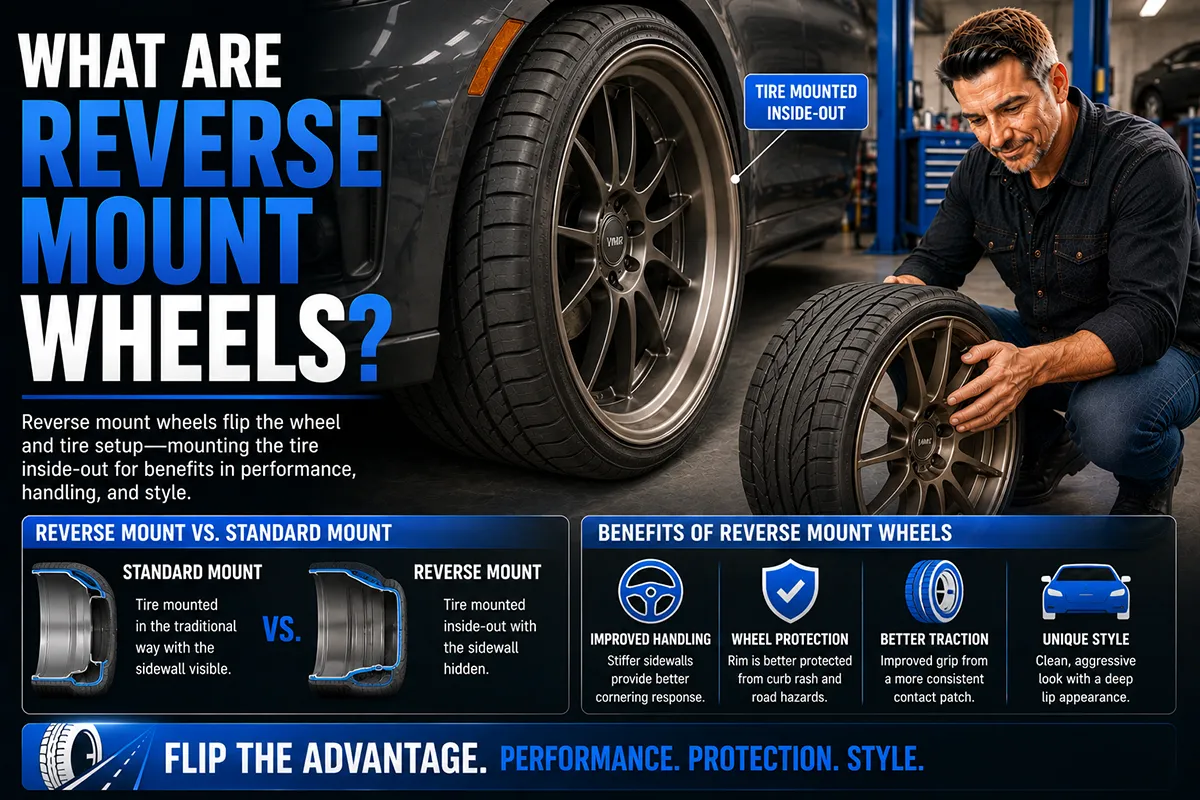
Have you ever stared at a truck or a show car and wondered why the wheels looked like they were sitting deeper inside the fender — almost recessed — giving the vehicle a totally unique, aggressive stance?
That’s likely a reverse mount wheel setup, and it’s one of those automotive modifications that looks deceptively simple but carries real implications for your tires, handling, and even safety.
I’ve been working with wheels and tires for over a decade, and I still get questions about reverse mounting almost every week. So let me break it all down for you.
- Reverse mount wheels are flipped so the mounting surface faces outward instead of inward, creating a deep-lip or concave look.
- They change your wheel’s offset significantly, pushing the tire further inward toward the suspension or outward from the hub face.
- This setup is popular in the show car and truck scene but comes with real trade-offs in ride quality, tire wear, and handling.
- Not all wheels are designed for reverse mounting — doing it wrong can compromise safety.
- I recommend consulting a professional wheel and tire shop before committing to a reverse mount setup.
Liked this article?
Add TireAdvise as a preferred source so you see more of our tire reviews and guides on Google.
What Exactly Is a Reverse Mount Wheel?
A reverse mount wheel is a wheel that has been flipped or manufactured so that the mounting face — the flat surface that bolts against your hub — faces the opposite direction compared to a standard wheel. In a conventional setup, the mounting surface sits behind the spokes, toward the vehicle. In a reverse mount configuration, that surface is pushed forward, toward the outside of the car.
The result is a dramatically different visual profile. You get a deep lip on the outer edge of the wheel, creating that concave, dish-like appearance that’s become a hallmark of custom trucks, classic cars, and show vehicles.
I first encountered reverse mount wheels years ago when a friend brought in his Chevy C10 with a set of polished aluminum wheels that looked absolutely stunning. The deep lip was eye-catching, but when I got underneath the truck, I realized the geometry of everything had changed. That experience taught me that reverse mounting is far more than a cosmetic swap.
How Reverse Mount Wheels Work: The Technical Breakdown
To understand reverse mount wheels, you first need to understand a concept called wheel offset. Offset is the distance (measured in millimeters) between the wheel’s mounting surface and the centerline of the wheel.
Quick Offset Primer
- Positive offset: The mounting surface is closer to the outside (street side) of the wheel. Most modern passenger cars use positive offset.
- Zero offset: The mounting surface is perfectly aligned with the wheel’s centerline.
- Negative offset: The mounting surface is closer to the inside (suspension side) of the wheel. This pushes the wheel outward from the vehicle.
When you reverse mount a wheel, you’re essentially taking what was a positive offset wheel and making it behave like a deeply negative offset wheel — or vice versa. The mounting pad flips, so the wheel sits in a completely different position relative to the hub.
In my experience, many people confuse reverse mount wheels with simply buying a wheel that has a different offset. They’re related concepts, but reverse mounting specifically involves flipping the wheel’s orientation, which changes far more than just where the tire sits in the wheel well.
The Math Behind It
Let’s say you have a wheel with a +45mm offset. In standard mounting, the hub face sits 45mm toward the outside of the wheel from its centerline. If you reverse mount that same wheel, the hub face now sits roughly 45mm toward the inside, but measured from the opposite reference point. The effective offset swings dramatically — potentially by 80-100mm or more depending on the wheel’s width and original design.
That’s a massive change, and it has real consequences for how your vehicle drives, steers, and wears its tires.
Why Do People Use Reverse Mount Wheels?
I’ve talked to hundreds of car and truck enthusiasts about their wheel choices, and reverse mounting comes up for a few key reasons.
1. The Deep-Lip Aesthetic
This is the number one reason, hands down. A deep-lip wheel looks incredible, especially on classic trucks, lowriders, and show cars. The polished or chrome lip catches light beautifully, and the concave face of the spokes adds three-dimensionality to the wheel’s appearance.
I’ve seen reverse mount setups at SEMA, local car shows across the Midwest, and even at Cars and Coffee events in Texas. Every single time, they draw a crowd.
2. Achieving a Specific Stance
Some truck and car owners want their wheels to poke out past the fenders, or conversely, they want them tucked deep inside the wheel well. Reverse mounting gives them a way to achieve extreme positions that aren’t possible with off-the-shelf offset options.
3. Budget-Friendly Custom Look
Buying a purpose-built deep-lip wheel from brands like Intro, US Mags, or American Racing can run $400-$800+ per wheel. Some people reverse mount a more affordable wheel to get a similar visual effect for less money. I’ve seen guys flip $150 wheels and get a look that rivals setups costing three times as much.
4. Running Wider Tires
In some cases, reverse mounting allows owners to fit wider tires without rubbing on suspension components. By changing where the wheel sits relative to the hub, you create more clearance on one side — though you may lose it on the other.
Types of Vehicles That Use Reverse Mount Wheels
Not every vehicle is a good candidate for reverse mounting. In my years of experience, I’ve seen it work best — and worst — on specific platforms.
Best Candidates
- Classic trucks (Chevy C10, Ford F-100): These have wide wheel wells and simple suspension geometry, making them forgiving of offset changes.
- Full-size trucks and SUVs: Silverados, Rams, and F-150s often have enough fender clearance to accommodate the changed wheel position.
- Show cars and lowriders: These vehicles are built for looks, not daily driving, so the handling trade-offs matter less.
- Drag racing vehicles: Some drag setups use reverse mount front wheels (often called “skinnies”) for specific weight distribution and clearance goals.
Poor Candidates
- Modern sedans and crossovers: Tight wheel wells, complex suspension, and electronic stability systems don’t play well with drastic offset changes.
- Performance cars: Any vehicle where precise handling matters should avoid reverse mounting unless professionally engineered.
- Daily drivers in general: I’ll be honest — if you rely on your vehicle to commute every day, reverse mount wheels add risk and maintenance concerns that most people don’t want to deal with.
The Pros and Cons of Reverse Mount Wheels
I believe in giving you the full picture, so here’s an honest breakdown based on what I’ve seen firsthand.
| Pros | Cons |
|---|---|
| Stunning deep-lip visual appearance | Altered steering geometry and handling |
| Allows unique stance customization | Increased stress on wheel bearings and hubs |
| Can be more affordable than buying purpose-built deep-lip wheels | Potential for tire rubbing on fenders or suspension |
| Wider tire fitment options in some cases | Uneven and accelerated tire wear |
| Head-turning show car appeal | May void vehicle warranty |
| Popular in the truck and lowrider community | Not all wheels are safe to reverse mount |
How Reverse Mount Wheels Affect Your Tires
This is where I really want you to pay attention, because this is a tire-focused site and your rubber is directly impacted by this modification.
Tire Wear Changes
When you dramatically alter your wheel’s offset, you change the scrub radius — the distance between where your steering axis hits the ground and where the center of your tire contacts the road. A larger scrub radius puts uneven forces on the tire, and in my experience, I’ve seen reverse mount setups chew through inner or outer tire edges significantly faster than a stock configuration.
After several days of driving on a buddy’s reverse-mounted truck, I noticed the tires were already showing signs of uneven shoulder wear that shouldn’t have appeared that quickly. That told me the alignment was fighting the offset change.
Tire Clearance Issues
Reverse mounting can push your tire closer to the fender on one side and closer to the suspension and inner fender liner on the other. I’ve personally witnessed tires rubbing on control arms, coil springs, and even brake lines after a reverse mount swap. This isn’t just annoying — it’s dangerous. A tire rubbing against a brake line can cause catastrophic brake failure.
Always do a full-lock steering test and a suspension compression test (bouncing the vehicle firmly) after installing reverse mount wheels. I do this every single time, without exception.
Tire Size Compatibility
Because the wheel sits differently, you may need to change your tire size to avoid rubbing. Some owners go narrower on the tire, while others need to adjust the sidewall height. In my experience, this often means the tire that originally came with the wheel isn’t the right choice anymore.
I always recommend bringing your wheel and tire combination to a professional shop for a test fit before committing. Many shops in the US — like Discount Tire, America’s Tire, or independent custom wheel shops — will help you mock up the fitment.
Are Reverse Mount Wheels Safe?
This is the question I get asked most, and my answer is: it depends entirely on how it’s done.
When It’s Safe
- The wheel was specifically designed by the manufacturer for reverse mounting (some wheels are marketed as “reversible” or “dual-mount”).
- A professional shop installs them with proper torque specs and verifies clearance.
- The lug nuts or bolts still fully engage the mounting holes with correct thread depth.
- An alignment is performed after installation.
- The vehicle is used primarily for shows or light driving, not heavy highway use.
When It’s Dangerous
- The wheel was not designed for reverse mounting, and the mounting pad doesn’t sit flush against the hub.
- Lug nuts don’t fully seat into the lug holes because the cone angle is now reversed.
- No clearance check is performed, and the tire rubs critical components.
- The vehicle is driven at highway speeds regularly, where the added stress on bearings and steering components is magnified.
I’ve seen a wheel literally walk off its studs because someone reverse-mounted a wheel without checking that the lug nuts properly engaged. That’s a wheel coming off at speed, and I don’t need to explain how terrifying that scenario is.
Reverse Mount vs. Deep-Lip Wheels: What’s the Difference?
People often use these terms interchangeably, but they’re not the same thing.
A deep-lip wheel is a wheel specifically manufactured with a deep outer lip as part of its design. The offset, spoke angle, and barrel are all engineered to create that look while maintaining proper hub fitment and structural integrity.
A reverse mount wheel is a standard wheel that has been flipped to create a deep-lip effect. It wasn’t necessarily designed for this, and the engineering may not support it.
In my opinion, if you want the deep-lip look, buying a purpose-built deep-lip wheel is almost always the better choice. Yes, it costs more. But you get a wheel that was engineered, stress-tested, and certified for that configuration. Brands like US Mags, Intro Wheels, American Racing, Fuel Off-Road, and Hostile Wheels all offer deep-lip options designed for the US truck and car market.
How to Tell If a Wheel Can Be Reverse Mounted
Not every wheel can be safely flipped. Here’s what I look for when evaluating a wheel for reverse mounting.
Check the Mounting Pad
The mounting pad (the flat area where the wheel contacts the hub) needs to be flat, machined, and wide enough to sit flush against your vehicle’s hub surface. If the back side of the wheel has spokes, ribs, or uneven surfaces where the hub would contact it, reverse mounting is a no-go.
Inspect the Lug Holes
Most lug holes are tapered (conical) or have a flat washer seat. When you flip the wheel, the taper faces the wrong direction. This means standard lug nuts won’t seat properly. You may need shank-style lug nuts or special flat-seat hardware to make it work.
Look at the Valve Stem Hole
When reversed, the valve stem hole will be on the inside of the wheel, making it harder to access for inflation and pressure checks. Some people drill a new valve stem hole, but this compromises the wheel’s structural integrity and is something I strongly advise against.
Consider the Wheel’s Load Rating
Wheels are load-rated based on their standard mounting orientation. Reverse mounting changes the stress distribution, and the wheel may not be rated for the loads it will experience in the flipped position. I always check the manufacturer’s specs before proceeding.
The Installation Process: What to Expect
If you’ve decided to go ahead with reverse mount wheels, here’s what the installation process typically looks like. I’ve done this several times, and I always follow the same steps.
Step 1: Verify Fitment Off the Vehicle
Before mounting tires, I hold the wheel against the hub in the reverse position to check that the mounting pad sits flush, the bolt pattern aligns, and there’s no obvious interference with brake calipers or rotors.
Step 2: Select the Right Hardware
Standard conical lug nuts usually won’t work in the reversed position. I source shank-style or flat-seat lug nuts that properly engage the reversed lug holes. This step is non-negotiable for safety.
Step 3: Mount and Balance the Tires
Tires are mounted on the wheel in the reverse position. Balancing is critical — the weight distribution is different when the wheel is flipped, and I’ve found that reverse-mounted wheels sometimes need more balancing weight than usual.
Step 4: Install on the Vehicle and Check Clearance
After torquing the wheels to spec, I turn the steering wheel lock-to-lock and check for rubbing at full compression. I also bounce each corner of the vehicle aggressively to simulate road dips and potholes.
Step 5: Get an Alignment
This is absolutely essential. The changed offset affects camber, caster, and toe. Without a proper alignment, your tires will wear unevenly and your vehicle won’t track straight. I always get a four-wheel alignment immediately after installing reverse mount wheels.
Step 6: Re-Torque After Initial Driving
After a few days of driving, I re-torque every lug nut. This is standard practice for any new wheel installation, but it’s especially important with reverse mount setups because the different seating angle of the hardware means there’s a higher risk of the nuts loosening during the break-in period.
Cost of a Reverse Mount Wheel Setup
Here’s a rough breakdown of what you can expect to pay in the US market:
- Wheels (set of 4): $400-$2,000+ depending on brand and size (if buying wheels specifically for reverse mounting)
- Specialty lug nuts/hardware: $30-$80
- Tire mounting and balancing: $60-$120 for all four
- Four-wheel alignment: $80-$150
- Spacers (if needed): $60-$200 per pair
If you’re flipping wheels you already own, the total cost can be as low as $170-$350 for hardware, mounting, and alignment. That’s significantly cheaper than buying a set of purpose-built deep-lip wheels, which can easily run $2,000-$4,000 for a quality set of four.
Common Mistakes I’ve Seen with Reverse Mount Wheels
Over the years, I’ve seen just about every mistake in the book. Here are the most common ones — and how to avoid them.
Using the Wrong Lug Nuts
This is the most dangerous mistake. If your lug nuts don’t properly seat in the reversed lug holes, the wheel can come loose. Always use the correct hardware for the reversed orientation.
Skipping the Alignment
I’ve had people tell me, “It’s just a wheel swap, I don’t need an alignment.” Wrong. Changing the offset by 50-100mm absolutely requires a new alignment. Skipping this step will destroy your tires in a matter of weeks.
Ignoring Clearance Issues
“It looked like it cleared” isn’t good enough. I use a flashlight and a thin piece of cardboard to check clearance at every potential contact point. If there’s less than half an inch of clearance at full lock or full compression, it’s too tight.
Reverse Mounting Wheels That Aren’t Designed for It
Some wheels have structural reinforcements on one side that are specifically designed for the standard mounting direction. Flipping these wheels puts stress on areas that aren’t reinforced, which can lead to cracking or catastrophic failure. I always research the specific wheel model before reverse mounting.
My Honest Recommendation
After years of working with wheel and tire setups of every kind, here’s my honest take on reverse mount wheels.
If you’re building a show truck, a weekend cruiser, or a vehicle that doesn’t see heavy daily use, reverse mount wheels can look absolutely incredible. The deep-lip aesthetic is hard to beat, and when done correctly, it’s a safe and cost-effective way to get a custom look.
But if you’re an everyday driver who depends on their vehicle for commuting, road trips, and hauling the family around, I’d steer you toward a purpose-built deep-lip wheel instead. The engineering is sound, the fitment is predictable, and you won’t be gambling with safety margins.
And regardless of which route you choose, please invest in a proper alignment, the correct hardware, and a thorough clearance check. These aren’t optional — they’re the difference between a head-turning build and a dangerous liability.
Where to Buy Reverse Mount and Deep-Lip Wheels in the US
If you’re looking to explore your options, here are some reputable US-based sources I’ve personally used or verified:
- Discount Tire / America’s Tire: Great for consultations and test-fitting. Their staff can advise on offset and clearance.
- Custom Offsets (customoffsets.com): Excellent gallery showing real-world fitments on specific vehicles. Their database is a goldmine for checking if your desired setup will work.
- Tire Rack (tirerack.com): Huge selection of wheels with detailed offset specs. They ship nationwide.
- Intro Wheels: Specializes in billet and deep-lip wheels built in the US. Premium pricing, but outstanding quality.
- American Racing: A legacy brand with classic deep-lip designs that are popular in the truck and muscle car community.
- Local custom wheel shops: These are often your best resource for reverse mount projects. A good local shop can mock up the fitment, source the right hardware, and handle the alignment all in one visit.
Final Thoughts: Is a Reverse Mount Setup Right for You?
Reverse mount wheels occupy a unique space in the automotive world. They’re not for everyone, and they’re definitely not a plug-and-play modification. But when executed properly — with the right wheel, the right hardware, the right tires, and professional oversight — they create a look that’s genuinely hard to replicate any other way.
I’ve admired some truly jaw-dropping reverse mount builds over the years, and I’ve also seen setups that were downright scary. The difference always comes down to preparation, knowledge, and a willingness to do things the right way.
If you’re considering reverse mount wheels, take the time to research your specific vehicle and wheel combination. Talk to a professional. Check your clearances obsessively. And never, ever compromise on lug nut fitment.
Your tires are the only thing connecting your vehicle to the road. Whatever wheel setup you choose, make sure it keeps that connection safe and reliable.
Frequently Asked Questions
What are reverse mount wheels and how do they differ from standard wheels?
Reverse mount wheels, also called reverse offset or deep-lip wheels, are designed so the mounting surface sits closer to the back of the wheel rather than the front. This pushes the wheel face outward, creating a deeper lip or concave appearance on the front side. Compared to standard mount wheels, they give your vehicle a more aggressive, wider stance that many truck and car enthusiasts prefer for both aesthetics and performance.
Are reverse mount wheels safe for daily driving on US roads?
Yes, reverse mount wheels are safe for daily driving as long as they are properly sized for your vehicle and don’t cause the tires to extend beyond the fender line, which is illegal in many US states. You’ll want to confirm that the offset and backspacing are compatible with your suspension and brake components. I always recommend having a professional installer verify fitment to avoid rubbing issues, uneven tire wear, or steering problems on highways and city streets.
What is the difference between wheel offset and backspacing on reverse mount wheels?
Wheel offset measures the distance in millimeters between the wheel’s mounting surface and its centerline, while backspacing measures the distance in inches from the mounting surface to the inner edge of the wheel. On reverse mount wheels, you’ll typically see a lower or negative offset and reduced backspacing, which is what pushes the wheel and tire assembly outward. Understanding both measurements is critical when shopping for reverse mount wheels to ensure proper clearance with your fenders, suspension, and brake calipers.
Do reverse mount wheels affect tire wear or alignment?
Reverse mount wheels can affect tire wear if the offset dramatically changes your vehicle’s scrub radius or suspension geometry. A significantly different offset from the factory spec may cause inner or outer edge tire wear and put extra stress on wheel bearings and ball joints. To minimize these issues, I recommend staying within 10-15mm of your vehicle’s original offset and getting a professional four-wheel alignment after installation.
How much do reverse mount wheels cost compared to regular wheels in the US?
Reverse mount wheels generally cost between $150 and $500 per wheel for most passenger cars and trucks, though premium forged options from US brands like American Force, Fuel Off-Road, or Weld Racing can run $600 to $1,500+ each. The price premium over standard wheels is usually modest since the main difference is the offset design rather than materials. Factor in an additional $80-$150 for a professional alignment after installation to protect your new tire investment.
What vehicles benefit most from reverse mount wheels?
Reverse mount wheels are most popular on full-size trucks like the Ford F-150, Chevy Silverado, and Ram 1500, as well as Jeep Wranglers and SUVs where a wider, more aggressive stance is desired. They’re also common in the sport compact and muscle car scenes for achieving a flush or slightly poked fitment. If you’re lifting your truck or leveling it, reverse mount wheels paired with wider off-road tires can dramatically improve both the look and off-road stability of your setup.
Can I use my existing tires on reverse mount wheels?
In many cases, yes, you can reuse your existing tires on reverse mount wheels as long as the new wheel diameter, width, and bolt pattern match your current tire specifications. However, since reverse mount wheels often come in wider widths to complement the pushed-out stance, you may need a slightly wider tire for proper bead seating and safe performance. I’d suggest checking the tire manufacturer’s approved rim width range printed on your tire sidewall or listed online before making the switch.
