

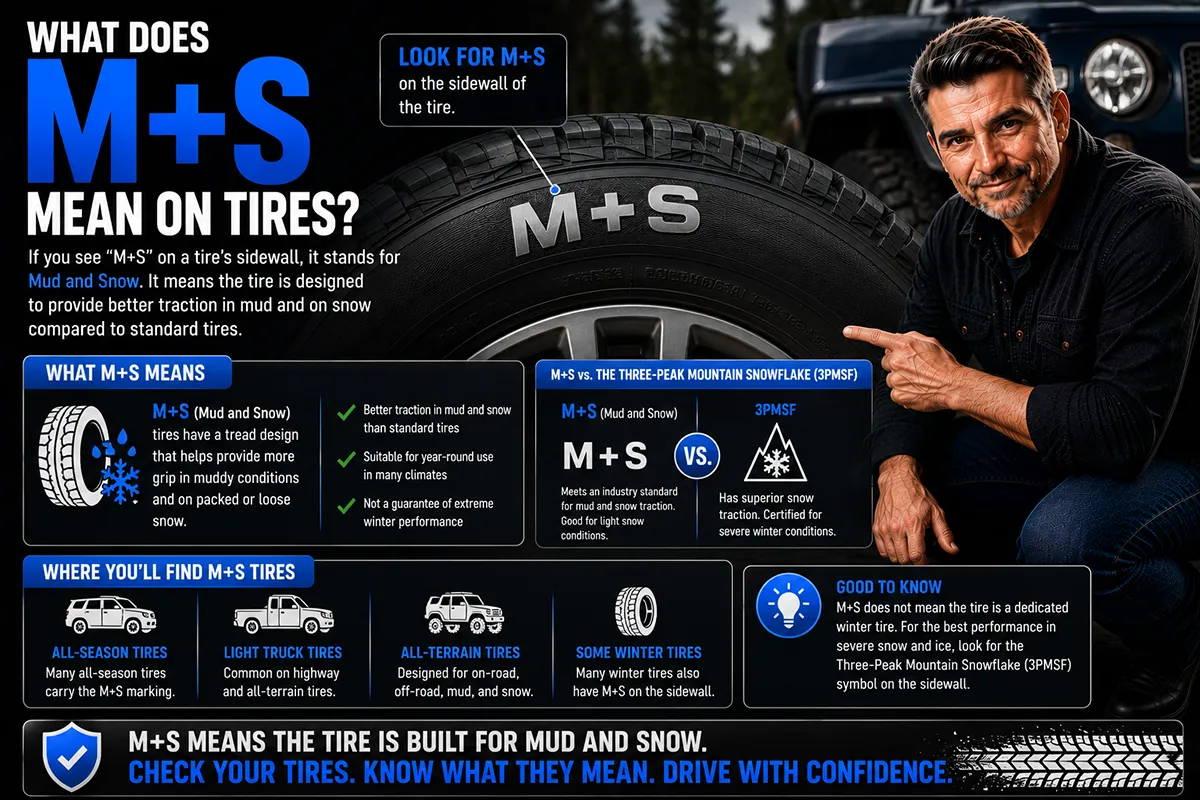
If you’ve ever crouched down next to your tire and squinted at the sidewall, you’ve probably noticed a jungle of letters, numbers, and symbols that seem like they were designed to confuse you.
One marking that catches almost everyone’s eye is “M+S” — and most people assume it means their tires are ready for winter. I used to think the same thing, and that misconception nearly cost me during an unexpected ice storm in Colorado a few years back.
The truth about M+S is more nuanced than you’d expect, and understanding it could save you money, improve your safety, and help you pick the right tires the next time you’re shopping for replacements.
- M+S stands for “Mud and Snow” and indicates a tire’s tread pattern is designed for light off-road and mild winter conditions.
- M+S is NOT the same as a true winter tire — it’s a self-certified designation by the manufacturer, not a tested performance standard.
- For real winter driving, look for the Three-Peak Mountain Snowflake (3PMSF) symbol instead.
- Most all-season tires sold in the US carry the M+S marking, so it’s extremely common.
- If you live in a state with mild winters, M+S tires are usually sufficient. For heavy snow and ice, you need dedicated winter tires with the 3PMSF symbol.
Liked this article?
Add TireAdvise as a preferred source so you see more of our tire reviews and guides on Google.
What Does M+S Actually Stand For?
M+S stands for Mud and Snow. You’ll sometimes see it written as M/S, M&S, or MS on the tire sidewall. All of these variations mean the same thing.
This designation tells you that the tire’s tread pattern has been designed with wider grooves and more aggressive void areas compared to a standard summer tire. The idea is that these tread features help channel mud, slush, and light snow away from the contact patch so the tire can maintain grip.
I’ve inspected hundreds of tires over the years, and I can tell you that M+S shows up on the vast majority of all-season tires sold in the United States. If you walk out to your garage right now and look at your tires, there’s a very good chance you’ll find it.
How a Tire Earns the M+S Designation
Here’s where things get interesting — and a little controversial. The M+S marking is self-certified by the tire manufacturer. There is no independent testing requirement, no government oversight, and no standardized performance benchmark that a tire must meet to carry this label.
The Rubber Manufacturers Association (now the U.S. Tire Manufacturers Association) established the M+S criteria decades ago. To qualify, a tire simply needs to have a tread pattern with sufficient void area — specifically, the tread design must meet certain geometric criteria related to groove width and depth.
In my experience, this means that the M+S label tells you something about how the tire looks but not necessarily how it performs. I’ve driven on M+S-rated all-season tires that felt completely inadequate on packed snow, and I’ve driven on others that handled light winter conditions with surprising confidence.
The key takeaway is that M+S is a design standard, not a performance standard. No one is putting these tires on a snowy test track and measuring braking distances before they get the M+S stamp.
M+S vs. the Three-Peak Mountain Snowflake Symbol
This is the single most important distinction I want you to understand, because it could genuinely affect your safety.
The Three-Peak Mountain Snowflake (3PMSF) symbol is a small icon on the tire sidewall that looks like a snowflake inside a mountain outline. Unlike the M+S marking, this symbol requires the tire to pass an actual standardized performance test.
To earn the 3PMSF symbol, a tire must demonstrate a minimum level of traction on packed snow in a controlled test, compared against a reference tire. This is defined by ASTM International standard F1805, and it gives the 3PMSF designation real teeth.
Here’s how the two markings compare:
| Feature | M+S (Mud and Snow) | 3PMSF (Three-Peak Mountain Snowflake) |
|---|---|---|
| What it measures | Tread design geometry | Actual snow traction performance |
| Testing required | No — self-certified | Yes — ASTM F1805 test |
| Winter performance | Mild — light snow, mud, slush | Moderate to strong — packed snow |
| Found on | Most all-season tires | Winter tires and some premium all-season/all-weather tires |
| Legal winter tire (Canada) | No (phasing out) | Yes |
| Suitable for heavy snow/ice | No | Yes (dedicated winter tires preferred) |
I’ve tested tires with both markings back to back on snowy roads in the Midwest, and the difference is not subtle. During one particularly memorable test period, I swapped between an M+S-only all-season tire and a 3PMSF-rated all-weather tire on the same vehicle within the span of a week. The 3PMSF tire stopped noticeably shorter on snow and felt far more planted through corners. It was the kind of difference that would matter in an emergency.
Why M+S Tires Are So Common in the US
If you look at the best-selling tires in America — think the Michelin Defender series, the Continental TrueContact, the Bridgestone Turanza, or the Goodyear Assurance — virtually all of them carry the M+S marking.
That’s because the all-season tire category dominates the US market. According to industry data, roughly 60-70% of replacement tires sold in the United States are all-season tires. And nearly every all-season tire qualifies for the M+S designation because of its tread design.
This makes perfect sense when you consider America’s geography. The majority of US drivers live in areas with relatively mild winters. If you’re in Texas, Florida, Georgia, Arizona, or Southern California, you probably don’t need anything beyond a good M+S all-season tire.
I’ve lived and driven in several US states, and I can tell you from firsthand experience that the right tire depends entirely on your local conditions. M+S tires have served me well in places like North Carolina and Tennessee, where snowfall is occasional and light. But when I spent time driving in Minnesota and Colorado, I learned quickly that M+S alone wasn’t enough.
When M+S Tires Are a Good Choice
Let me be clear: M+S tires are not bad tires. In the right conditions, they’re exactly what you need. Here’s when I’d recommend sticking with M+S all-season tires:
- You live in a region with mild winters — If your area sees light snow that melts within a day or two, M+S all-season tires will handle it fine.
- You mostly drive on paved, maintained roads — City and highway drivers who benefit from plowed and salted roads don’t typically need dedicated winter tires.
- You want year-round convenience — M+S all-season tires let you run one set of tires for all four seasons, which saves money on buying, storing, and swapping a second set.
- Your budget is tight — A quality M+S all-season tire from a reputable brand can run anywhere from $80 to $160 per tire depending on size, which is often less expensive than maintaining two separate sets.
- You drive a sedan, crossover, or minivan — These vehicles paired with M+S tires handle typical American road conditions with no issues for most of the year.
During my time testing the Michelin Defender 2, for example, I found it to be excellent for everyday driving in moderate climates. It carries the M+S marking and provides solid grip in light rain and occasional slush. For the average driver in, say, Virginia or Kansas, it’s more than adequate.
When M+S Tires Are NOT Enough
Now let me tell you when M+S tires will let you down — because I’ve experienced it personally.
If you regularly deal with any of the following conditions, you should seriously consider tires with the 3PMSF symbol, or ideally a dedicated set of winter tires:
- Packed or compacted snow on roads — M+S tires lose traction quickly on snow that’s been driven over and compressed.
- Black ice or freezing rain — The rubber compound in standard all-season tires hardens in extreme cold, reducing grip dramatically.
- Temperatures consistently below 45°F (7°C) — Even without snow, cold temperatures cause all-season rubber to stiffen. Winter tires use softer compounds that stay pliable.
- Mountain driving in winter — If you drive through mountain passes in states like Colorado, Montana, or Washington, you may even be legally required to carry chains or winter tires.
- Steep hills in snowy areas — I’ve seen M+S tires spin helplessly on moderate inclines that a winter tire would climb without drama.
One experience that really drove this home for me was driving through a late-season storm in the Rocky Mountains. I was on a well-known all-season tire with the M+S marking, and while it handled the highway fine, the moment I hit an unplowed secondary road with a few inches of packed snow, the rear end got squirrelly in a way that made my palms sweat. After several tense minutes of careful driving, I pulled over and made a mental note: M+S doesn’t mean winter-ready.
Understanding the Rubber Compound Difference
One thing the M+S marking doesn’t tell you anything about is the tire’s rubber compound. And honestly, the compound matters just as much as — if not more than — the tread pattern when it comes to winter performance.
Summer tires use a harder rubber compound optimized for warm pavement. It provides excellent grip when the road is hot but becomes rigid and slippery in cold weather.
All-season tires (most of which are M+S rated) use a compromise compound that works across a wider temperature range, typically from about 40°F to over 100°F. They’re the jack-of-all-trades.
Winter tires use a much softer compound infused with silica that stays flexible even when temperatures plummet below freezing. This is why winter tires grip better on cold, dry pavement — not just on snow.
I’ve done back-to-back cold-weather braking tests where an all-season M+S tire took significantly longer to stop on a cold, dry road compared to a dedicated winter tire. The tread patterns were both aggressive, but the rubber compound made the real difference. You could feel it through the brake pedal — the all-season tire just didn’t bite into the pavement the same way.
What About All-Weather Tires?
This is a category that’s been gaining a lot of traction (pun intended) in the US market over the past few years, and I think it deserves serious attention if you’re trying to figure out the M+S puzzle.
All-weather tires carry BOTH the M+S marking AND the 3PMSF snowflake symbol. They’re designed to be year-round tires — like all-season tires — but with enough winter performance to pass the snow traction test.
Some excellent all-weather options I’ve personally tested include:
- Michelin CrossClimate2 — This was a game-changer when it hit the market. I’ve driven it in everything from summer heat to moderate snowfall, and it performs admirably in all conditions. It typically runs $150-$200 per tire depending on size.
- Nokian WR G4 — A fantastic all-weather tire from a Finnish company that knows cold weather. It’s a bit pricier but delivers genuine confidence in snow.
- Toyo Celsius II — A great value all-weather option that I’ve found to be surprisingly capable in winter conditions for its price point of around $120-$170 per tire.
- General AltiMAX 365 AW — A budget-friendly all-weather tire that gives you the 3PMSF symbol without breaking the bank, often priced between $90-$140.
For drivers who want year-round convenience but face more challenging winters than a typical M+S all-season can handle, all-weather tires are the sweet spot. I recommend them constantly to readers who live in the upper Midwest, the Pacific Northwest, or the Northeast.
How to Find the M+S Marking on Your Tires
If you want to check your own tires, here’s exactly what to do. I’ve walked countless friends and family members through this process, so I’ll make it simple.
Walk up to your car and look at the sidewall of any tire — the flat vertical surface facing outward. You’ll see a lot of text, including the tire brand, model name, size (like P225/65R17), speed rating, and load index.
The M+S marking is usually located near the tire size information, often close to the bead area (the part of the tire closest to the wheel). Look for the letters M+S, M/S, or M&S. Sometimes it’s molded in small text and can be hard to spot if the tire is dirty.
While you’re there, also look for the 3PMSF symbol — a small snowflake icon inside a mountain silhouette. If your tire has both M+S and the snowflake, you’ve got an all-weather or winter tire with tested snow performance.
I always recommend cleaning the sidewall with a damp cloth first. Years of road grime can make these markings nearly invisible.
Do Any US States Require M+S or Winter Tires?
This is a question I get asked frequently, and the answer varies by state. The US doesn’t have a federal winter tire mandate, but several states and mountain passes have their own rules.
Colorado has the Traction Law, which applies to Interstate 70 and other mountain corridors during winter storms. When activated, it requires tires with at least 3/16″ tread depth and either the M+S marking or chains. The more restrictive Chain Law requires chains or tires with the 3PMSF symbol.
California requires chains on certain mountain roads (like routes to Lake Tahoe and through the Sierras), though M+S tires with adequate tread may be permitted as an alternative in some chain-control levels.
Washington, Oregon, Idaho, and Montana have varying traction device requirements during winter months, and M+S tires sometimes satisfy the minimum requirement.
In my experience, even if M+S technically meets the legal minimum in your state, it’s worth going beyond the bare minimum when your safety is at stake. Laws define the floor, not the ceiling.
Common Misconceptions About M+S Tires
Over the years, I’ve heard a lot of myths and misunderstandings about the M+S marking. Let me clear up the biggest ones.
Myth 1: “M+S means my tires are winter tires”
This is the most dangerous misconception. M+S tires are NOT winter tires. They have a tread pattern that can handle light mud and snow, but they lack the rubber compound and the tested performance level of a true winter tire. If someone at a tire shop tells you that your M+S tires are “fine for winter,” push back and ask about the 3PMSF symbol.
Myth 2: “All M+S tires perform the same in snow”
Absolutely not. I’ve tested M+S tires that were clearly designed for highway comfort and fuel efficiency alongside M+S tires built for light truck applications with much more aggressive tread. Their snow performance was worlds apart, even though both carried the same M+S marking. The label tells you almost nothing about relative performance between tires.
Myth 3: “If my tire doesn’t have M+S, it’s unsafe”
Not true either. Summer performance tires and ultra-high-performance tires often don’t carry the M+S marking because they’re designed for warm, dry, and wet conditions — not mud or snow. If you live in the Sun Belt and drive a sports car, a summer tire without M+S might actually be the best and safest choice for your specific conditions.
Myth 4: “M+S tires are good for off-road mud”
The “mud” in M+S is a bit misleading. It really refers to light, muddy conditions — think a sloppy dirt road after rain, not a muddy off-road trail. If you need serious mud performance, you should be looking at dedicated mud-terrain (M/T) tires with much more aggressive tread patterns.
How I Evaluate M+S Tires During Testing
When I test any tire that carries the M+S marking, I put it through a consistent set of real-world evaluations. I don’t rely on just the sidewall markings — I want to know how the tire actually behaves.
My testing includes driving on dry pavement at various speeds to evaluate handling, stability, and comfort. I test wet performance by driving through standing water and evaluating hydroplaning resistance. When the conditions allow, I drive on light snow and slush to see how the tread channels clear debris and maintain traction.
I also pay attention to road noise, ride comfort, and how the tire responds to temperature changes. I’ve noticed that some M+S tires get noticeably louder or stiffer when temperatures drop below 40°F, which is a sign that the rubber compound is hardening.
After several days of driving on each tire, I develop a clear picture of its strengths and weaknesses. And I can tell you with confidence that the M+S marking alone has almost zero correlation with how good a tire feels on the road. I’ve tested budget M+S tires that were terrible and premium M+S tires that were excellent. The marking is just one small data point.
My Recommendations Based on Where You Live
Let me break this down by region, because that’s really how you should approach the M+S question.
Southern and Southwestern States (TX, FL, AZ, GA, SC, etc.)
You probably don’t need to worry about the M+S marking at all. A good all-season or even a summer tire will serve you well. Snow is so rare in these areas that it doesn’t make sense to optimize for it. Focus on wet traction and heat resistance instead.
Mid-Atlantic and Border States (VA, NC, TN, KY, MO, etc.)
M+S all-season tires are typically sufficient. You’ll get occasional snow, but it rarely lasts more than a few days. A quality M+S all-season tire from brands like Michelin, Continental, or Bridgestone will handle these conditions without any issues.
Upper Midwest and Northeast (MN, WI, MI, NY, VT, ME, etc.)
I strongly recommend either a set of dedicated winter tires for the cold months or a year-round all-weather tire with the 3PMSF symbol. M+S alone is not enough for the sustained cold, frequent snowfall, and icy conditions you’ll face. If you can afford two sets of tires, the winter/summer swap is ideal. If you want one tire year-round, go all-weather.
Mountain and Pacific Northwest States (CO, MT, WA, OR, ID, etc.)
Dedicated winter tires are the way to go if you live in the mountains or regularly drive through mountain passes. If you’re in lower elevations like Portland or Seattle, an all-weather tire with 3PMSF is a strong choice. M+S alone may not meet traction law requirements during storms.
The Bottom Line on M+S
After years of testing tires, writing about them, and helping everyday drivers make better choices, here’s what I want you to take away from this article.
The M+S marking on your tires means that the tread pattern is designed for mud and snow — but it’s a self-certified, design-based standard that doesn’t guarantee any specific level of winter performance. Most all-season tires in the US carry this marking, so having it on your tires doesn’t make them special or particularly winter-capable.
If you live somewhere with real winters, look beyond M+S and seek out the Three-Peak Mountain Snowflake (3PMSF) symbol. That’s the marking that actually tells you a tire has been tested and proven to perform in snow.
And if you’re shopping for new tires, don’t let the M+S label be the deciding factor. Focus on the tire’s overall performance ratings, user reviews, tread compound technology, and how well it matches your specific driving conditions. The sidewall markings are just the starting point — the real story is in how the tire performs when it matters most.
I’ve been writing for TireAdvise.com for years because I believe that informed drivers are safer drivers. The M+S marking is one of those things that sounds simple on the surface but has layers of nuance underneath. Now that you understand what it really means — and more importantly, what it doesn’t mean — you’re in a much better position to choose the right tires for your car, your climate, and your driving style.
Stay safe out there, and as always, check your tread depth and tire pressure regularly. The best tire in the world can’t help you if it’s worn out or underinflated.
Frequently Asked Questions
What does M+S mean on a tire sidewall?
M+S stands for Mud and Snow, indicating that the tire’s tread pattern is designed to provide better traction in muddy and light snowy conditions compared to a standard summer tire. You’ll find this marking on most all-season tires sold in the US, and it means the tire meets the Rubber Manufacturers Association’s geometry-based tread design standards. However, it’s important to know that the M+S designation does not mean the tire has been performance-tested in severe winter conditions.
Is an M+S tire the same as a winter tire?
No, an M+S tire is not the same as a dedicated winter tire. A true winter tire carries the Three-Peak Mountain Snowflake (3PMSF) symbol, which means it has been tested and proven to meet specific snow traction performance standards. M+S tires are typically all-season tires that handle light snow and mud but can lose grip in severe winter conditions like heavy snow, ice, and temperatures consistently below 20°F. If you live in states like Minnesota, Michigan, or Colorado and face harsh winters, a dedicated winter tire with the 3PMSF symbol is the safer choice.
Are M+S rated tires good enough for winter driving in the US?
M+S rated tires can handle mild winter conditions like occasional light snow and wet roads, making them a practical choice for drivers in states like Virginia, Tennessee, or the Pacific Northwest. However, if you regularly drive in heavy snow, ice, or sustained below-freezing temperatures — common in the northern US and mountain regions — you’ll want tires with the Three-Peak Mountain Snowflake rating for reliable traction. I always recommend checking your state’s winter tire laws too, since some mountain passes in states like Colorado and California require chains or tires with specific traction ratings.
Do all all-season tires have the M+S designation?
Most all-season tires sold in the US from brands like Michelin, Goodyear, Cooper, and Bridgestone carry the M+S designation, but not every single one does. The M+S marking depends on the tire’s tread design meeting specific void-to-rubber ratio criteria set by the Rubber Manufacturers Association. When shopping for replacement all-season tires, always check the sidewall markings to confirm the M+S rating if mud and light snow traction matter for your driving conditions.
Can I use M+S tires year-round in the US?
Yes, M+S tires — especially all-season models — are designed to be used year-round and are the most popular tire choice among US drivers for exactly that reason. They provide a solid balance of dry grip, wet traction, and light winter capability for most moderate US climates. That said, they do compromise on peak summer performance compared to dedicated summer tires and on deep winter traction compared to dedicated snow tires, so drivers in extreme climates may benefit from seasonal tire swaps.
What is the difference between M+S and M+S with the snowflake symbol on tires?
A tire marked only with M+S meets a tread design standard for mud and snow but has not been independently tested for severe snow performance. A tire that carries both the M+S marking and the Three-Peak Mountain Snowflake (3PMSF) symbol has passed an actual traction test proving it performs at least 10% better than a reference tire in packed snow conditions. If you’re comparing tires for winter driving, the snowflake symbol is the more meaningful indicator of real-world snow safety, and many newer all-weather tires from brands like Nokian, Toyo, and Michelin now carry both markings.
How much do M+S rated all-season tires cost compared to winter tires?
M+S rated all-season tires for a typical US passenger car or SUV generally range from $80 to $180 per tire depending on brand and size, while dedicated winter tires usually cost between $100 and $250 per tire. The total cost difference adds up when you factor in that winter tires also require a second set of wheels or seasonal mounting and balancing fees, which can run $25 to $50 per tire. For many US drivers in moderate climates, a quality set of M+S all-season tires is the more budget-friendly option since they eliminate the need for seasonal swaps.
