

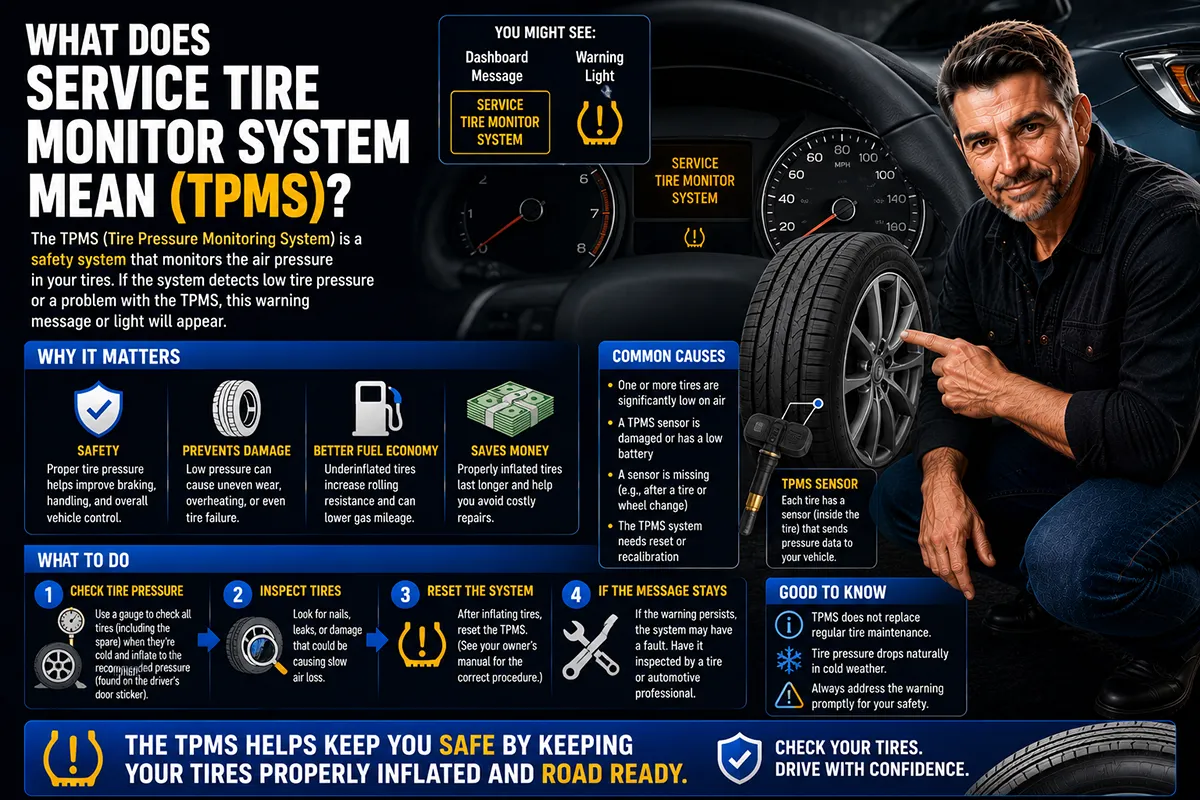
You’re cruising down the highway when a small amber light flickers on your dashboard — sometimes it says “Service Tire Monitor System,” other times it’s just a horseshoe-shaped icon with an exclamation mark. Your stomach drops a little because you have no idea what it means or whether you should pull over immediately.
I’ve been there myself, and I’ve fielded this exact question from dozens of friends, family members, and readers over the years. After spending over a decade reviewing tires and helping everyday drivers make smart tire decisions, I can tell you this: the message is important, but it’s rarely a reason to panic.
- “Service Tire Monitor System” means your TPMS (Tire Pressure Monitoring System) itself needs attention — it’s not always a flat tire.
- The warning can be triggered by a dead sensor battery, a faulty sensor, a recent tire change, or even extreme temperature swings.
- A steady TPMS light usually means low tire pressure; a flashing light means the system has a malfunction.
- Replacement TPMS sensors typically cost $50–$150 per wheel installed at most US tire shops.
- You should never ignore this warning — driving on underinflated tires is dangerous and costly.
Liked this article?
Add TireAdvise as a preferred source so you see more of our tire reviews and guides on Google.
What Is TPMS and Why Does Your Car Have It?
TPMS stands for Tire Pressure Monitoring System. It’s a federally mandated safety feature that has been required on every new passenger vehicle sold in the United States since September 2007, thanks to the TREAD Act passed by Congress in 2000.
The system’s job is simple: monitor the air pressure inside your tires and alert you when one or more tires drop significantly below the recommended pressure. In my experience working with hundreds of vehicles over the years, TPMS has prevented more blowouts and tire-related accidents than most drivers will ever realize.
Before TPMS existed, the only way to know your tires were low was to physically check them with a gauge or notice that your car was pulling to one side. Now, the system does the monitoring for you — but it’s not perfect, and that’s exactly why you sometimes see the “Service Tire Monitor System” message.
The Difference Between “Low Tire Pressure” and “Service Tire Monitor System”
This is the most important distinction I can help you understand, and it’s one that confuses almost everyone I talk to.
A steady TPMS warning light (the light stays on continuously) almost always means that one or more of your tires is underinflated. This is the system doing its job correctly — it detected low pressure and is telling you to add air.
A flashing TPMS light (the light blinks for about 60–90 seconds when you start the car, then stays on) means the TPMS system itself has a problem. The sensors, the receiver module, or the communication between them has malfunctioned.
The “Service Tire Monitor System” text message, which appears on vehicles from GM, Chevrolet, GMC, Buick, and Cadillac most commonly, is essentially the same as that flashing light. It’s telling you: “Hey, I can’t do my job right now — something in my monitoring system is broken.”
How TPMS Actually Works Inside Your Tires
To understand why the service warning appears, it helps to know what’s actually going on inside your wheels. There are two types of TPMS, and I’ve worked with both extensively.
Direct TPMS (Most Common)
Direct TPMS uses small electronic sensors mounted inside each tire, typically attached to the valve stem or banded to the inside of the wheel. Each sensor contains a pressure transducer, a small battery, a temperature sensor, and a radio transmitter.
These sensors measure the actual air pressure inside the tire and wirelessly transmit that data to a receiver module in your vehicle. In my experience, direct TPMS is far more accurate and reliable — it can tell you the exact pressure in each tire, often displayed right on your dashboard or infotainment screen.
The downside? Those sensors have batteries that eventually die. They can also be damaged during tire changes, corrode over time, or simply fail electronically. This is the single most common reason I see for “Service Tire Monitor System” warnings.
Indirect TPMS
Indirect TPMS doesn’t use pressure sensors at all. Instead, it relies on your vehicle’s ABS (anti-lock braking system) wheel speed sensors to detect differences in how fast each wheel is rotating.
When a tire loses air, its diameter shrinks slightly, causing it to rotate faster than the other tires. The system detects this speed difference and triggers a warning.
I find indirect systems to be less precise and more prone to false alerts, but they’re cheaper and there are no sensor batteries to worry about. You’ll typically find indirect TPMS on some older or budget vehicles. The “Service Tire Monitor System” message is far less common with indirect systems since there are fewer components that can fail.
The 7 Most Common Reasons for a “Service Tire Monitor System” Warning
Over the years, I’ve diagnosed this warning on my own vehicles and helped countless readers troubleshoot theirs. Here are the causes I see most frequently, ranked from most to least common.
1. Dead TPMS Sensor Battery
This is the number one culprit, and it’s completely unavoidable. The lithium batteries inside TPMS sensors typically last 5 to 10 years, depending on the sensor and driving conditions. You can’t replace just the battery — when it dies, you need a new sensor.
I had this happen on my own truck after several years of ownership. One morning the “Service Tire Monitor System” message appeared out of nowhere. A quick trip to my local tire shop confirmed that the rear passenger sensor battery had given up the ghost.
2. Damaged or Faulty Sensor
TPMS sensors live in a harsh environment — they’re constantly exposed to road salt, moisture, heat, and impacts from potholes. I’ve seen sensors with corroded valve stems, cracked housings, and water damage.
If you recently hit a nasty pothole or curb, that impact can physically damage the sensor or knock it out of alignment. In my experience, this is especially common in northern states where road conditions deteriorate during winter.
3. Recent Tire Change or Rotation
If you just had new tires installed, had your tires rotated, or even had a flat repaired, the TPMS sensors may need to be reprogrammed or relearned by the vehicle’s computer. Some shops forget this step — or don’t have the proper TPMS tool to do it.
I always ask the tire technician specifically, “Did you reprogram the TPMS sensors?” before I leave the shop. It’s a simple step, but it gets overlooked more than you’d think.
4. Extreme Temperature Changes
Temperature has a direct effect on tire pressure — for every 10°F drop in ambient temperature, your tires lose about 1 PSI. But extreme temperature swings can also cause TPMS sensors to behave erratically.
I notice this most often during the fall-to-winter transition in the Midwest and Northeast. One morning it’s 55°F, the next it’s 25°F, and suddenly the TPMS system can’t get a consistent reading. Usually this resolves itself once temperatures stabilize, but sometimes the sensor needs a reset.
5. Aftermarket Wheels Without TPMS Sensors
If you’ve installed aftermarket wheels or a separate set of winter tires without TPMS sensors, your vehicle’s system will throw a warning because it’s not receiving signals from the expected sensors.
I’ve seen this happen with drivers who buy a set of winter wheels from an online retailer and don’t realize they need to purchase and program TPMS sensors separately. It’s an extra cost, but it’s non-negotiable if you want the warning to go away.
6. Interference or Signal Issues
TPMS sensors communicate via radio frequency, and occasionally other electronic devices or signals can interfere. I’ve also seen cases where aftermarket accessories — like certain dash cams, radar detectors, or even phone chargers — caused intermittent TPMS warnings.
This is rarer, but it’s worth considering if you recently added any electronic accessories to your vehicle.
7. TPMS Module Failure
The receiver module that collects signals from your sensors can also fail, though this is the least common cause. When it does happen, none of your sensors will communicate with the vehicle, and you’ll get the service warning.
This is the most expensive fix on the list, as the module itself can cost $200–$500 for the part alone, depending on the vehicle.
What Should You Do When the Warning Appears?
Here’s the step-by-step process I follow every time I see this warning, and it’s what I recommend to every reader.
Step 1: Don’t Panic, But Don’t Ignore It
The “Service Tire Monitor System” message means the monitoring system isn’t working properly. It does NOT necessarily mean your tires are flat. However, it also means the system can’t warn you if they DO go flat — so you’re essentially flying blind.
I treat this as an urgent-but-not-emergency situation. You don’t need to pull over on the highway shoulder, but you should address it within the next day or two.
Step 2: Manually Check All Four Tires (Plus the Spare)
Since your TPMS can’t be trusted at this point, grab a manual tire pressure gauge and check all four tires yourself. I keep a high-quality digital gauge in my glovebox at all times — you can get a reliable one for about $10–$15 at any auto parts store.
Check the pressure when tires are cold (before driving or after the car has been sitting for at least three hours). Compare the readings to the recommended pressure listed on the sticker inside your driver’s door jamb — not the number on the tire sidewall.
Step 3: Inflate to Proper Pressure
If any tires are low, inflate them to the recommended PSI. Sometimes, simply correcting the pressure and driving for a few minutes will allow the TPMS to reset itself. I’ve had this work for me on more than one occasion.
Step 4: Try a Manual TPMS Reset
Many vehicles have a TPMS reset button, usually located under the steering column or in the glovebox. The process varies by manufacturer, but generally you turn the ignition to the “on” position (without starting the engine), press and hold the reset button until the TPMS light blinks three times, then release.
I recommend checking your owner’s manual for the exact procedure for your vehicle. On some newer cars, you can reset the TPMS through the infotainment system settings menu.
Step 5: Visit a Tire Shop or Dealer
If the warning persists after checking pressures and attempting a reset, it’s time to have the system professionally diagnosed. Most major tire retailers — Discount Tire, Tire Rack (with installation partners), Les Schwab, Firestone, and Goodyear — have TPMS diagnostic tools that can identify which sensor is malfunctioning.
In my experience, independent tire shops often charge less for TPMS service than dealerships. I typically see diagnostic fees of $20–$50, with some shops waiving the fee if you purchase the replacement sensor from them.
How Much Does It Cost to Fix TPMS Issues?
Cost is always a top concern for the readers I work with, so let me break down the typical expenses you’ll encounter at US tire shops.
| Service | Typical US Cost | Notes |
|---|---|---|
| TPMS Diagnostic Scan | $0–$50 | Often free at Discount Tire and similar shops |
| Single TPMS Sensor Replacement (OEM) | $50–$150 | Includes sensor, programming, and installation |
| Single TPMS Sensor Replacement (Aftermarket) | $30–$80 | Brands like Schrader, Dorman, and ATEQ work well |
| All Four TPMS Sensors Replaced | $150–$500 | Recommended if one fails — others are likely aging too |
| TPMS Relearn/Reprogram Only | $20–$60 | Needed after tire rotation or new wheel installation |
| TPMS Module Replacement | $200–$550 | Rare — usually a dealership repair |
| Valve Stem Service Kit | $5–$15 per sensor | Should be replaced with every new tire installation |
Here’s a tip I always share: if you’re already getting new tires, ask the shop to replace all four TPMS sensors at the same time. Since the tires are already being dismounted, you save on labor costs. Most shops bundle this service, and in my experience, it’s the smartest move if your sensors are more than five or six years old.
Can You Drive With the TPMS Warning On?
Technically, yes — the car will still operate normally. But I strongly advise against ignoring it for any extended period.
When the “Service Tire Monitor System” message is on, your vehicle cannot alert you to dangerously low tire pressure. This means you could be driving on a slowly leaking tire without any dashboard warning. Underinflated tires increase stopping distances, reduce fuel economy, cause uneven tread wear, and dramatically increase the risk of a blowout — especially at highway speeds.
I’ve personally witnessed the aftermath of blowouts caused by underinflated tires, and it’s not something I’d wish on anyone. In one case during a tire review event, a colleague’s test vehicle had a catastrophic rear tire failure at highway speed because the TPMS wasn’t functioning and the tire had been slowly losing air for days. The car was recoverable, but it was a scary moment.
The bottom line: treat a TPMS warning like a broken smoke detector in your house. The house isn’t on fire right now, but you need that detector working before something goes wrong.
TPMS and New Tire Purchases: What You Need to Know
If you’re reading this article, there’s a good chance you’re also shopping for replacement tires. Here’s what I always tell readers about TPMS considerations during a tire purchase.
Always Factor TPMS Service Into Your Tire Budget
When I review tires and talk about total cost of ownership, I always include TPMS valve stem service kits. Every time a tire is dismounted from a wheel, the TPMS valve stem components (the nut, seal, cap, and core) should be replaced. This is a $5–$15 per-wheel expense that prevents air leaks and corrosion.
If your sensors are aging, this is also the perfect time to replace them entirely. I’ve seen too many people spend $800 on a great set of tires, only to have the “Service Tire Monitor System” warning pop up a few weeks later because the shop didn’t address the aging sensors.
Buying Tires Online? Don’t Forget Sensors
If you’re ordering tires from Tire Rack, Amazon, or SimpleTire, remember that TPMS sensors aren’t included. You’ll need to either purchase sensors separately and ship them to your installer or have your installer source them.
I personally prefer buying tires from Tire Rack and having them shipped to a local installer because Tire Rack’s website makes it easy to add the correct TPMS sensors for your vehicle right in the checkout process. It’s a small detail that saves a lot of hassle later.
Winter Tires on a Second Set of Wheels
If you live in a state where winter tires are a good idea — and in my experience, they’re absolutely worth it anywhere that regularly sees snow and ice — you’ll want TPMS sensors on your winter wheels too.
A second set of sensors programmed to your vehicle typically costs $120–$300 for all four. Some drivers skip this and just deal with the warning light all winter, but I don’t recommend that approach. You want TPMS protection year-round, especially in winter when tire pressure drops are more common due to cold temperatures.
Can You Replace TPMS Sensors Yourself?
I get this question a lot, and my honest answer is: it depends on your skill level and tools.
The Physical Installation
Replacing a TPMS sensor requires dismounting the tire from the wheel, swapping the sensor, and remounting and balancing the tire. Unless you have a tire machine and balancer in your garage (most DIYers don’t), this part needs to be done at a shop.
The Programming
After installation, the new sensor needs to be programmed with your vehicle’s unique sensor IDs and then “relearned” by the car’s computer. This requires a TPMS programming tool.
There are consumer-grade TPMS tools available — the Autel MaxiTPMS TS408 and the ATEQ VT56 are popular options that I’ve used — but they range from $100 to $400. For someone who only needs to do this once, it doesn’t make financial sense.
My recommendation for most people: buy the sensors yourself (you can find OEM and quality aftermarket options on Amazon, RockAuto, or Tire Rack for $25–$75 each), then bring them to a tire shop and pay only the labor for installation and programming. This hybrid approach has saved me meaningful money over the years.
OEM vs. Aftermarket TPMS Sensors: Which Should You Choose?
This is a debate I’ve gone back and forth on through years of experience. Here’s where I’ve landed.
OEM Sensors
OEM (original equipment manufacturer) sensors are the same ones that came with your car from the factory. They’re guaranteed to be compatible, they don’t require programming (only relearning), and they tend to be very reliable.
The downside is cost. OEM sensors from a dealership can run $80–$180 each, depending on the vehicle. For a luxury vehicle like a BMW or Mercedes, I’ve seen them priced even higher.
Aftermarket Sensors
Quality aftermarket sensors from brands like Dorman, Schrader, and Continental are designed to be universal or multi-application — one sensor that can be programmed to work with many different vehicles.
In my testing and real-world use, I’ve found aftermarket sensors from reputable brands to work just as well as OEM units at half the price or less. I’ve installed Dorman sensors on my own daily driver and have had zero issues over several years of use.
The only caveat: avoid the cheapest no-name sensors on Amazon. I purchased a set of bargain sensors once for a test, and two of the four failed within the first few months. You get what you pay for.
TPMS Warning on Specific Vehicle Brands
The “Service Tire Monitor System” message appears most frequently on GM-platform vehicles — Chevrolet, GMC, Buick, and Cadillac. Other manufacturers display the same information differently.
- Chevrolet / GMC / Buick / Cadillac: Displays “Service Tire Monitor System” or “Service Tire Pressure System” as a text message in the driver information center.
- Ford / Lincoln: Typically shows “Tire Pressure Monitor Fault” or a flashing TPMS icon.
- Toyota / Lexus: Flashing TPMS light for system malfunction; steady light for low pressure. May also display “Tire Pressure Warning System Malfunction.”
- Honda / Acura: Flashing TPMS icon on startup, then stays solid. Often accompanied by a message on the multi-information display.
- Hyundai / Kia: “Check TPMS” message on the instrument cluster or a flashing TPMS icon.
- Nissan / Infiniti: “TPMS Malfunction” warning light with a solid or flashing indicator depending on the issue.
Regardless of the specific wording, the meaning is the same across all brands: the tire pressure monitoring system needs service.
Preventing TPMS Problems Before They Start
After dealing with TPMS issues on my own vehicles and hearing from hundreds of readers, I’ve developed a simple maintenance routine that minimizes problems.
Check Tire Pressures Monthly
I check all four tires (and the spare, if applicable) with a manual gauge once a month, even though I have a functioning TPMS. The system is a backup, not a replacement for proactive maintenance. I usually do this on the first Saturday of every month — it takes less than five minutes.
Replace Valve Stem Components With Every Tire Change
As I mentioned earlier, the rubber seals and metal components on TPMS valve stems degrade over time. A $5 service kit per wheel during a tire change is cheap insurance against air leaks and sensor damage.
Replace All Sensors When They Start Aging Out
If one sensor fails due to a dead battery, the other three are likely on borrowed time. I always recommend replacing all four at once, ideally during your next tire purchase. It’s the most cost-effective timing.
Be Gentle During Tire Changes
If you’re at a tire shop, don’t be afraid to mention that you want the technician to be careful with the TPMS sensors during mounting and dismounting. I’ve seen careless tire techs damage sensors with mounting machines. A polite heads-up goes a long way.
Keep Your TPMS Tool Updated
If you own a TPMS programming tool, make sure its firmware and vehicle database are up to date. Manufacturers release new sensor protocols regularly, and an outdated tool may not properly program newer sensors.
Is It Legal to Disable or Ignore TPMS?
This comes up more than you’d think. Under federal law (49 CFR Part 571, Standard No. 138), it is not legal for a repair shop or tire dealer to disable or render your TPMS inoperative. A shop that installs tires without functioning TPMS sensors or refuses to address a TPMS issue is technically in violation of federal regulations.
However, there is no law that requires you, as the vehicle owner, to maintain or repair your TPMS after the point of sale. In most states, a car with a non-functioning TPMS will still pass inspection — though this varies by state, and regulations are tightening.
From a purely practical standpoint, I’d never recommend disabling or ignoring your TPMS. The system exists because underinflated tires kill people. The NHTSA estimates that approximately 11,000 tire-related crashes per year in the US could be prevented with proper tire pressure maintenance. TPMS is your first line of defense.
My Final Thoughts on the “Service Tire Monitor System” Warning
After years of working with tires, testing every major brand on the market, and helping everyday drivers navigate confusing dashboard warnings, here’s my bottom line.
The “Service Tire Monitor System” message is your car telling you that its tire pressure safety net has a hole in it. The fix is almost always straightforward — usually a sensor replacement or reprogramming — and the cost is modest compared to the potential consequences of driving on dangerously underinflated tires.
If this warning appeared on my dashboard today, here’s exactly what I’d do: manually check all my tire pressures immediately, attempt a TPMS reset, and if the warning persisted, schedule a visit to my local tire shop within the next day or two. I’d budget $50–$150 for a single sensor replacement or $200–$400 if all four need to go.
Don’t let this warning become background noise on your dashboard. Take care of it, keep your tires properly inflated, and get back to driving with confidence. Your safety — and the safety of everyone sharing the road with you — is absolutely worth the small investment.
Frequently Asked Questions
What does ‘Service Tire Monitor System’ mean on my dashboard?
The ‘Service Tire Monitor System’ message means your vehicle’s TPMS (Tire Pressure Monitoring System) has detected a malfunction in the monitoring system itself, not necessarily a problem with your tire pressure. This is different from a simple low-tire-pressure warning — it indicates that one or more TPMS sensors may be faulty, the system battery is dying, or there’s a communication error between the sensors and your vehicle’s computer. I recommend having a mechanic or tire shop diagnose the issue promptly, as a malfunctioning TPMS means you won’t receive accurate tire pressure alerts while driving.
Is it safe to drive with the Service Tire Monitor System warning on?
You can technically drive with the Service Tire Monitor System warning on, but I wouldn’t recommend ignoring it for long. The warning means your TPMS can’t reliably alert you to dangerously low tire pressure, which increases the risk of a blowout — especially at highway speeds or in extreme US summer heat. Manually check all four tires (plus the spare) with a gauge to make sure they’re at the pressure listed on your driver’s side door jamb, and schedule a TPMS service as soon as possible.
How much does it cost to fix or replace a TPMS sensor in the US?
Replacing a single TPMS sensor typically costs between $50 and $150 per wheel at most US tire shops, including the sensor and labor. If you’re already buying replacement tires, many shops like Discount Tire, Tire Rack, or Les Schwab will offer bundled TPMS sensor replacement at a reduced rate. OEM sensors from brands like Schrader or Continental tend to cost more than aftermarket universal sensors, but both work reliably when properly programmed to your vehicle.
What causes the TPMS sensor to fail and trigger the service warning?
The most common cause is a dead sensor battery, since TPMS sensor batteries typically last 5 to 10 years and are not replaceable — the entire sensor must be swapped out. Other causes include sensor damage during a tire change, corrosion on the valve stem (especially in states that use road salt in winter), or installing new wheels or tires without reprogramming the TPMS. Driving on a spare tire that doesn’t have a TPMS sensor can also trigger the warning.
Do I need to reset the TPMS after replacing tires or inflating to the correct pressure?
Yes, in many cases you’ll need to reset or relearn the TPMS after installing new tires, rotating tires, or correcting tire pressure. Some vehicles reset automatically after driving a few miles at 20+ mph, while others require a manual reset via a dashboard button or a TPMS relearn tool. Check your owner’s manual for your specific reset procedure — GM, Ford, and Toyota vehicles each handle this differently. If the ‘Service Tire Monitor System’ light stays on after a reset, the sensor itself likely needs replacement.
What’s the difference between a low tire pressure warning and a Service Tire Monitor System alert?
A low tire pressure warning (steady TPMS light) means at least one tire is underinflated, usually 25% or more below the recommended PSI. The ‘Service Tire Monitor System’ alert (often a flashing TPMS light that then stays solid) means the monitoring hardware itself is malfunctioning and can’t accurately read pressure. Think of it this way: one tells you your tires need air, while the other tells you the system watching your tires is broken and needs repair.
Can I replace TPMS sensors myself, or should I go to a tire shop?
While it’s technically possible to buy aftermarket TPMS sensors online for $15 to $40 each and install them yourself, I’d recommend having a tire shop handle it unless you have tire mounting equipment and a TPMS programming tool. The sensors sit inside the tire on the valve stem, so the tire must be dismounted from the rim to access them. You’ll also need a TPMS relearn tool or scan tool (like the ATEQ or Autel models) to program the new sensors to your vehicle’s ECU, which adds $30 to $200 if you’re buying one for DIY use.
