

If you’ve been shopping for replacement tires recently, you’ve probably stumbled across the term “UHP” plastered on sidewalls, product listings, and marketing materials — and wondered what it actually means for your daily driving.
Maybe you drive a sporty sedan, a modern crossover, or even a muscle car, and the tire shop recommended UHP tires without really explaining why. You’re not alone — it’s one of the most common questions I get from readers.
I’ve spent years testing tires across every category imaginable, and I can tell you that the UHP label carries real meaning — but it’s not for everyone. Let me break it all down so you can make a confident, informed decision.
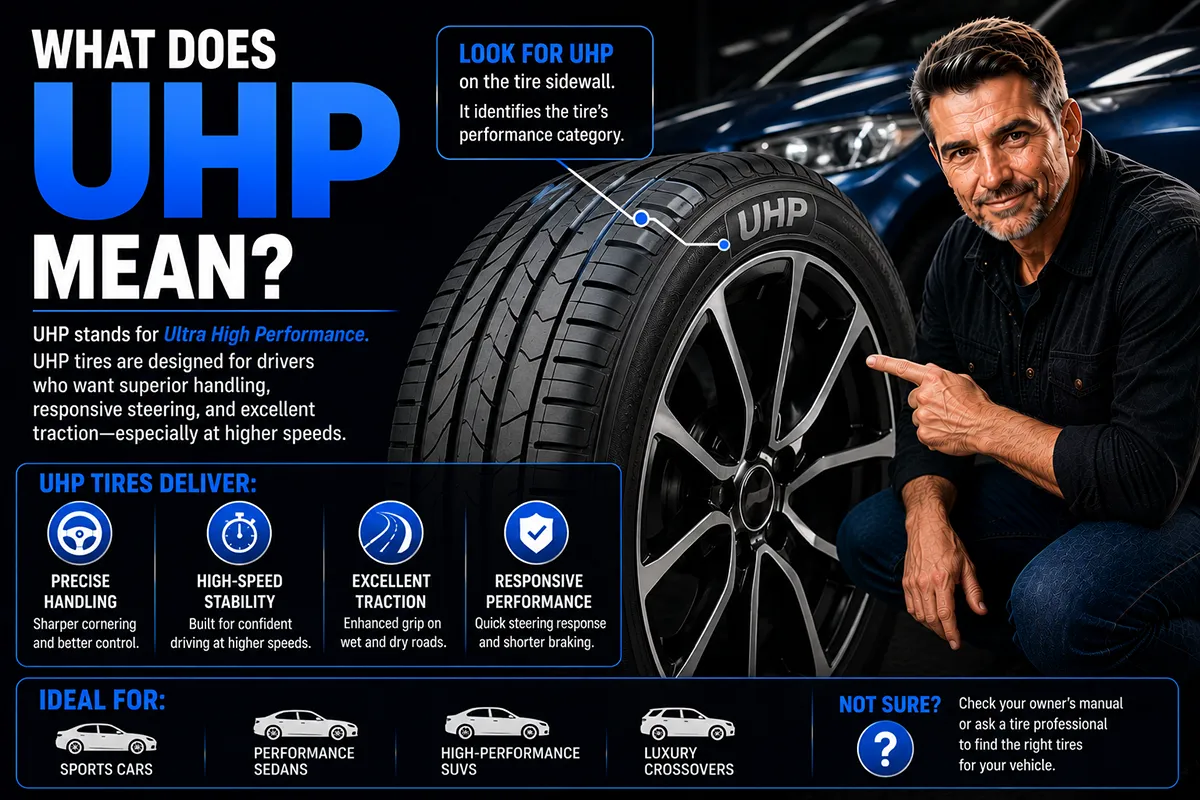
- UHP stands for Ultra High Performance — a tire category designed for superior grip, handling, and cornering at higher speeds.
- UHP tires use softer rubber compounds and aggressive tread patterns that prioritize traction over tread life.
- They’re ideal for sports cars, performance sedans, and drivers who value handling over longevity.
- UHP tires typically cost 20–40% more than standard touring tires and wear faster.
- If you mostly commute on highways and want long-lasting tires, a grand touring or all-season tire may be a better fit.
- UHP tires come in summer, all-season, and even winter variants.
Liked this article?
Add TireAdvise as a preferred source so you see more of our tire reviews and guides on Google.
What Does UHP Actually Stand For?
UHP stands for Ultra High Performance. It’s a tire category — not a specific brand or model — that describes tires engineered for maximum grip, razor-sharp handling, and stability at higher speeds.
In my experience, UHP tires are the tires you’d choose when you want your car to feel planted, responsive, and almost glued to the road. They’re the opposite of a cushy, quiet touring tire that prioritizes comfort above all else.
The Tire and Rim Association and tire manufacturers generally classify tires into categories like passenger, touring, grand touring, high performance (HP), and ultra high performance (UHP). UHP sits at the top of the performance spectrum for street-legal tires, just below full competition or track-day tires.
How UHP Tires Differ from Regular Tires
I think the easiest way to understand UHP tires is to compare them directly to the standard all-season touring tires that come on most sedans and SUVs. The differences are significant, and they affect everything from how your car feels to how often you’ll need to replace your tires.
Rubber Compound
UHP tires use a softer, stickier rubber compound. This is the single biggest difference, and it’s what gives them their superior grip. During my testing, I’ve always noticed that UHP tires feel noticeably more confident on dry pavement — you can push harder into corners and the car just holds.
The trade-off? Softer rubber wears faster. That’s just physics, and there’s no getting around it.
Tread Pattern
Look at the tread on a UHP tire versus a standard all-season, and you’ll see the difference immediately. UHP tires typically have larger, more continuous tread blocks with fewer sipes (those tiny slits in the tread). This maximizes the contact patch — the amount of rubber touching the road at any given moment.
Standard all-season tires, by contrast, have more complex tread patterns with lots of sipes and grooves designed to channel water, slush, and light snow. They sacrifice some dry grip for versatility.
Speed Rating
UHP tires carry higher speed ratings, typically W (168 mph), Y (186 mph), or even Z (149+ mph). Standard touring tires usually carry H (130 mph) or T (118 mph) ratings.
Now, I know what you’re thinking — “I’m never going 186 mph on I-95.” And you’re absolutely right. But the speed rating isn’t just about top speed. Tires rated for higher speeds are built with stiffer internal structures and better heat management, which translates to more precise handling and better stability even at normal highway speeds.
Sidewall Construction
UHP tires tend to have shorter, stiffer sidewalls (lower aspect ratios like 35, 40, or 45). This reduces sidewall flex during cornering, giving you more direct steering feel. When I’ve switched between touring tires and UHP tires on the same car, the difference in steering precision is immediately obvious — it’s like going from a loose handshake to a firm one.
The downside is that stiffer, shorter sidewalls transmit more road imperfections into the cabin. Expect a firmer ride.
Noise and Comfort
If ride comfort and a whisper-quiet cabin are your top priorities, UHP tires will likely disappoint you. They’re louder on coarse pavement and less forgiving over potholes and expansion joints. In my testing, this is consistently the most common complaint from drivers who switch to UHP tires without understanding the trade-offs.
UHP Tires at a Glance: Comparison Table
Here’s a quick comparison table I put together based on my experience testing tires across these categories:
| Feature | Standard All-Season Touring | Grand Touring | UHP All-Season | UHP Summer |
|---|---|---|---|---|
| Dry Grip | Good | Good–Very Good | Very Good | Excellent |
| Wet Grip | Good | Very Good | Very Good | Excellent |
| Snow/Ice Traction | Fair–Good | Fair–Good | Poor–Fair | Very Poor |
| Tread Life | Excellent | Very Good | Fair–Good | Fair |
| Ride Comfort | Excellent | Very Good | Good | Fair |
| Road Noise | Very Quiet | Quiet | Moderate | Moderate–Loud |
| Speed Rating | T or H | H or V | W or Y | W, Y, or Z |
| Price Range (per tire) | $80–$150 | $100–$180 | $130–$250 | $150–$350+ |
The Different Types of UHP Tires
This is where things get interesting — and where a lot of confusion lives. “UHP” isn’t one monolithic category. There are several sub-types, and choosing the right one matters a lot depending on where you live and how you drive.
UHP Summer Tires
These are the purebreds of the UHP world. UHP summer tires deliver the absolute best grip and handling you can get on a street tire. They use the softest compounds and the most aggressive tread designs.
I’ve tested several UHP summer tires on both sports cars and performance sedans, and the grip is genuinely stunning — you feel like you have twice the traction you had on touring tires.
But here’s the critical caveat: UHP summer tires should never be driven in temperatures below about 40°F. The rubber compound hardens dramatically in cold weather, and grip falls off a cliff. If you live anywhere that gets winter weather — even mild winters — you’ll need a second set of tires for the cold months.
Popular examples include the Michelin Pilot Sport 4S, Continental ExtremeContact Sport 02, and Bridgestone Potenza Sport.
UHP All-Season Tires
UHP all-season tires try to split the difference between the blistering grip of a summer UHP tire and the year-round versatility of an all-season. In my experience, the best ones in this category do a remarkably good job — maybe 85–90% of the dry grip of a pure summer tire, with decent cold-weather capability.
This is the sweet spot for a lot of US drivers. If you have a sporty car but don’t want to swap tires twice a year, a UHP all-season is probably what you want.
Top picks I’ve been impressed with include the Michelin Pilot Sport All Season 4, Continental ExtremeContact DWS 06 Plus, and Goodyear Eagle Exhilarate.
UHP Winter Tires
Yes, these exist, and they’re a game-changer for performance car owners in the northern US. A UHP winter tire maintains the low-profile sizing and speed ratings needed for your sporty car while delivering genuine winter traction with cold-weather-optimized rubber compounds.
I’ve tested UHP winter tires during cold-weather driving in the Northeast, and the difference compared to trying to limp through winter on UHP summer tires is night and day. If you own a performance vehicle and deal with snow and ice, investing in a set of UHP winters is one of the smartest safety moves you can make.
Look at options like the Michelin Pilot Alpin PA4, Pirelli P Zero Winter, and Bridgestone Blizzak LM-32.
Who Actually Needs UHP Tires?
This is the question I really want to answer honestly, because the tire industry has a tendency to upsell. Not everyone needs UHP tires, and for some drivers, they’re actively the wrong choice.
You Probably Need UHP Tires If…
- Your car came with UHP tires from the factory. Many sports cars, performance sedans, and even some sporty crossovers ship with UHP tires as original equipment. I always recommend matching or exceeding the OE tire category. Downgrading to touring tires on a car engineered for UHP rubber can actually change the handling dynamics in ways that feel unsafe.
- You enjoy spirited driving. If you take on-ramps at speed, hit the occasional canyon road, or simply love the feeling of a responsive, communicative car, UHP tires will make your driving experience dramatically better.
- You track your car or participate in autocross. For any competitive or track use, UHP summer tires are essentially mandatory. Standard all-seasons will overheat and lose grip in a track environment.
- You drive a high-horsepower vehicle. Cars with over 300 horsepower — especially rear-wheel-drive models — genuinely need the extra grip that UHP tires provide to safely put that power down.
You Probably Don’t Need UHP Tires If…
- You drive a regular commuter car. If your car is a Camry, Civic, Altima, or similar, and you’re just getting to work and back, standard all-season touring tires will serve you better. They’ll last longer, ride more comfortably, and cost less.
- You prioritize tread life and value. UHP tires wear out significantly faster than touring tires. If you’re budget-conscious and want maximum life out of every dollar, UHP isn’t the right move.
- You live somewhere with harsh winters and don’t want two sets of tires. A good all-season touring tire will handle light winter conditions better than a UHP all-season. And running UHP summer tires in winter is genuinely dangerous.
How UHP Tires Feel on the Road: My Real-World Experience
I want to move beyond the specs and tell you what it’s actually like to drive on UHP tires versus standard tires, because this is where the rubber literally meets the road.
The First Thing You Notice: Steering Response
When I first switched from touring all-seasons to UHP tires on a test vehicle, the very first thing I noticed — within the first few hundred yards — was the steering. It felt tighter, more alive, more connected. Every tiny input translated immediately into the car changing direction. On touring tires, there had always been a slight vagueness, a softness in the steering. With UHP tires, that was completely gone.
Cornering Confidence
After several days of driving on UHP tires, I started trusting the car more in corners. I could carry more speed through sweeping highway on-ramps, and the car felt utterly stable doing it. There was no tire squeal, no sense that I was approaching the limit. The grip level was just on a different plane.
On wet roads, the difference was equally pronounced. During a rainy commute, the UHP tires evacuated water more effectively and inspired more confidence during lane changes and highway merging.
The Trade-Offs Are Real
But I also noticed the downsides quickly. Road noise went up — not dramatically, but enough that I could tell the difference on certain highway surfaces. The ride was firmer. I felt potholes and expansion joints more directly. My back didn’t love it on longer highway drives.
And during my test period, the tread wear indicators showed that these tires were wearing noticeably faster than the touring tires I’d had on before. That’s the price you pay for that extra grip.
UHP Tire Pricing: What to Expect in 2024–2025
Let me give you a realistic picture of what UHP tires cost in the US market right now. Prices vary based on size, brand, and model, but here’s what I’ve consistently seen:
- Budget UHP tires: $100–$150 per tire. Brands like Federal, Falken, and Sumitomo offer solid options at this price point. I’ve tested some of these, and while they don’t match the premium brands, they’re a massive upgrade over standard all-seasons for grip and handling.
- Mid-range UHP tires: $150–$220 per tire. This is where you’ll find excellent all-around performers like the Continental ExtremeContact DWS 06 Plus and the General G-Max RS. In my experience, this is the sweet spot for most enthusiast drivers.
- Premium UHP tires: $220–$350+ per tire. The Michelin Pilot Sport 4S, Bridgestone Potenza Sport, and Pirelli P Zero live here. These are the best of the best, and I can tell you from testing that the premium is justified if you’re a serious enthusiast or have a high-end vehicle.
For a full set of four tires, you’re looking at anywhere from $400 on the budget end to $1,400+ for premium UHP rubber. Factor in mounting, balancing, and disposal fees (usually $60–$100 total at most US tire shops), and that’s your all-in cost.
How to Read UHP Tire Markings on the Sidewall
The sidewall of a UHP tire is packed with information, and knowing how to read it will help you make smarter choices. Here’s what to look for:
Speed Rating
The speed rating is a single letter in the tire size code. For UHP tires, you’ll typically see:
- V — 149 mph (entry-level performance)
- W — 168 mph (common UHP rating)
- Y — 186 mph (high-end UHP)
- Z — 149+ mph (often used as a blanket designation for high-performance tires; usually paired with W or Y in parentheses)
For example, a tire marked 245/40ZR18 (97Y) is a UHP tire with a Y speed rating.
UTQG Ratings
The Uniform Tire Quality Grading (UTQG) system gives you three numbers/letters:
- Treadwear: A relative number where higher means longer-lasting. UHP summer tires often score 200–340, while touring tires might score 600–800. This tells you a lot about how quickly the tire will wear.
- Traction: Rated AA, A, B, or C. Most UHP tires score AA, the highest rating.
- Temperature: Rated A, B, or C. UHP tires almost always score A, meaning they can handle heat at high speeds.
I always check the UTQG treadwear rating when comparing UHP tires. It’s one of the most practical indicators of how long a tire will actually last.
Load Index
This number tells you how much weight each tire can safely support. For most passenger cars, this isn’t a concern when shopping for UHP tires in the correct size. But if you’re fitting UHP tires to a heavier vehicle like a sport SUV, make sure the load index meets or exceeds your vehicle manufacturer’s specification.
Common Mistakes People Make with UHP Tires
Over the years, I’ve seen — and helped correct — a lot of UHP tire mistakes. Here are the most common ones:
Mistake #1: Running UHP Summer Tires in Winter
I can’t stress this enough. UHP summer tires become hard and slippery below 40°F. I’ve personally experienced the loss of grip on a cold morning with summer UHP tires, and it’s alarming. Even without snow or ice on the road, the tires simply don’t work in cold temperatures.
If you live in the northern half of the US, either choose UHP all-seasons or plan to swap to winter tires when temperatures drop.
Mistake #2: Expecting Touring-Tire Tread Life
Some drivers buy UHP tires, then get frustrated when they need replacement sooner than expected. The softer compound that gives you all that grip also wears faster — that’s an inherent trade-off, not a defect.
Set your expectations accordingly. You’re buying performance, not longevity.
Mistake #3: Mixing UHP Tires with Non-UHP Tires
I’ve seen drivers put UHP tires on the front axle and leave standard all-seasons on the rear (or vice versa). This creates unpredictable handling because the two axles have vastly different grip levels. Always replace tires in pairs at minimum, and ideally run the same tire on all four corners.
Mistake #4: Ignoring Tire Pressure
UHP tires are more sensitive to inflation pressure than standard tires. Even being 3–4 PSI off can noticeably affect handling and wear patterns. I check my tire pressures every two weeks and always before any spirited driving. Get a quality digital tire gauge — it’s a $10 tool that protects a $1,000+ tire investment.
Top UHP Tires I Recommend for US Drivers in 2025
Based on my testing and experience, here are the UHP tires I most often recommend to readers:
Best Overall UHP Summer Tire: Michelin Pilot Sport 4S
This tire is the benchmark. I’ve tested it on multiple vehicles, and it delivers extraordinary dry and wet grip, predictable handling at the limit, and surprisingly decent tread life for a summer UHP tire. It’s not cheap — expect $200–$300+ per tire depending on size — but it’s worth every penny if performance is your priority.
Best UHP All-Season: Continental ExtremeContact DWS 06 Plus
For drivers who want year-round UHP capability, this Continental is my top pick. During my testing, it delivered genuinely impressive dry grip while still performing respectably in wet and light snow conditions. It’s also one of the quieter UHP tires I’ve tested. Pricing typically runs $150–$230 per tire.
Best Value UHP Tire: Falken Azenis FK510
If you want UHP performance without the premium brand price tag, the Falken Azenis FK510 is the tire I recommend most. After several days of testing it against pricier competitors, I was genuinely surprised by how close it came in dry grip and steering feel. At $120–$180 per tire, it’s a smart buy.
Best UHP Tire for Muscle Cars: Goodyear Eagle F1 Asymmetric 6
I’ve found that this tire pairs exceptionally well with high-horsepower American muscle cars. Its wide contact patch and advanced compound handle the torque of a Mustang GT or Camaro SS with confidence. Pricing runs $170–$260 per tire.
UHP vs. HP: Is There a Difference?
Yes, and it’s worth clarifying. HP (High Performance) tires sit one rung below UHP on the performance ladder. They offer better grip and handling than touring tires but don’t reach the extremes that UHP tires do.
HP tires typically carry V speed ratings (149 mph), while UHP tires carry W, Y, or Z ratings. HP tires also tend to last a bit longer and ride a bit more comfortably than UHP tires.
In my experience, HP tires are a great middle ground for drivers who want some performance improvement without fully committing to the UHP trade-offs. Think of them as “performance-lite.”
Do UHP Tires Affect Fuel Economy?
This is a question I get a lot, and the honest answer is: slightly, yes. UHP tires generally have higher rolling resistance than eco-focused touring tires because of their softer compounds and wider contact patches.
In my real-world driving, the difference has typically been around 1–2 MPG. It’s noticeable if you track your fuel economy closely, but it’s not dramatic enough to be a dealbreaker for most drivers. If fuel economy is your absolute top priority, UHP tires are the wrong category — but for most enthusiasts, the handling improvement is worth a couple of MPG.
How to Decide: A Simple Framework
After years of testing and recommending tires, I’ve developed a simple decision framework that I share with every reader who asks me whether UHP tires are right for them:
- Step 1: Check what your car came with from the factory. If it had UHP tires as original equipment, I strongly recommend staying in the UHP category.
- Step 2: Ask yourself what you value most — handling performance, ride comfort, or tread life. If handling is first, go UHP. If comfort or longevity leads, consider grand touring instead.
- Step 3: Consider your climate. Summer UHP tires are a no-go for year-round use in cold-weather states. Choose UHP all-season or plan for a seasonal tire swap.
- Step 4: Set a realistic budget. You can get excellent UHP tires for $140–$200 per tire in most sizes. Don’t assume you have to buy the most expensive option.
Final Thoughts: UHP Tires Are About Driving Joy
At the end of the day, UHP tires exist because some of us genuinely love driving. We want to feel the road, trust our tires in corners, and know that when we push the accelerator, the grip is there to match.
If that sounds like you, UHP tires will transform your driving experience. After testing countless sets over the years, I can say without hesitation that the right set of UHP tires is one of the most impactful modifications — or replacements — you can make on a performance-oriented vehicle.
But if you’re the kind of driver who just wants to get from A to B safely, quietly, and affordably, there’s absolutely no shame in sticking with a quality touring tire. Know what matters to you, match the tire to your priorities, and you’ll be happy with whatever you choose.
If you have specific questions about UHP tires for your vehicle, drop a comment below — I read and respond to every one. Happy driving.
Frequently Asked Questions
What does UHP mean on tires?
UHP stands for Ultra High Performance, a category of tires engineered for superior grip, responsive handling, and higher speed ratings compared to standard all-season or touring tires. UHP tires typically carry speed ratings of H, V, W, Y, or Z, meaning they’re built to safely handle sustained speeds above 130 mph. If you drive a sports car, performance sedan, or any vehicle where cornering precision and braking response matter to you, UHP tires are designed with your driving style in mind.
Are UHP tires worth it for daily driving in the US?
UHP tires can absolutely be worth it for daily driving if you value a connected, responsive feel behind the wheel, especially on highways and well-maintained US roads. However, they do tend to wear faster and cost more than standard touring tires, with prices typically ranging from $150 to $350 per tire depending on the brand and size. I’d recommend them if you drive a performance-oriented vehicle and are willing to replace tires a bit more frequently in exchange for noticeably better handling and braking.
What is the difference between UHP tires and regular all-season tires?
The main differences come down to grip, handling responsiveness, and tread life. UHP tires use softer rubber compounds and more aggressive tread patterns to maximize traction during cornering and braking, while regular all-season tires prioritize longer tread life and ride comfort. As a tradeoff, UHP tires generally last 25,000 to 45,000 miles compared to 50,000 to 80,000 miles for a typical all-season tire, and they can produce slightly more road noise.
Can you use UHP tires in winter or snow?
Standard UHP summer tires perform very poorly in cold weather, snow, and ice because their rubber compounds harden below roughly 45°F, drastically reducing traction. If you live in northern US states and want UHP-level performance year-round, look specifically for UHP all-season tires from brands like Continental, Michelin, or Bridgestone, which offer better cold-weather capability. For serious winter conditions, I’d strongly recommend swapping to a dedicated winter tire set rather than relying on any UHP tire.
What are the best UHP tire brands available in the US?
Some of the top-rated UHP tire brands for US drivers include Michelin (Pilot Sport 4S and Pilot Sport 5), Continental (ExtremeContact Sport 02), Bridgestone (Potenza Sport), and Goodyear (Eagle F1 Asymmetric 6). For a more budget-friendly option, General Tire’s G-MAX RS and Firestone’s Firehawk Indy 500 consistently earn strong reviews from US consumers. I always recommend checking Tire Rack ratings and UTQG scores to compare treadwear, traction, and temperature grades before buying.
How long do UHP tires typically last?
Most UHP tires last between 25,000 and 45,000 miles depending on your driving habits, vehicle weight, and whether you rotate them regularly every 5,000 to 7,500 miles. UHP summer tires tend to wear faster than UHP all-season variants because they use softer compounds optimized for maximum grip. If you drive aggressively or live in a hot climate like Texas or Arizona, expect to be on the shorter end of that range, so budget for more frequent replacements when calculating your overall tire costs.
What speed rating should I look for when buying UHP tires?
UHP tires typically carry a speed rating of H (130 mph) at the entry level, with V (149 mph), W (168 mph), Y (186 mph), and Z (149+ mph) ratings for higher-performance applications. I always recommend matching or exceeding your vehicle manufacturer’s original speed rating, which you can find on the tire placard inside your driver’s door jamb or in your owner’s manual. Going with a lower speed rating than specified can compromise handling stability and may even affect your vehicle’s warranty coverage.
