

I got a call from my cousin last winter after she drove on a visibly soft front tire for nearly two weeks straight. She thought it would “be fine” until her next oil change.
It wasn’t fine. She ended up with a shredded sidewall on the shoulder of I-95 in New Jersey, in freezing rain, with her two kids in the backseat.
That experience stuck with me — and it’s one of the main reasons I check tire pressure religiously before every long drive and at least once a week during my regular routine. Low tire pressure is one of those silent problems that most drivers ignore until it becomes a loud, expensive, and sometimes dangerous emergency.
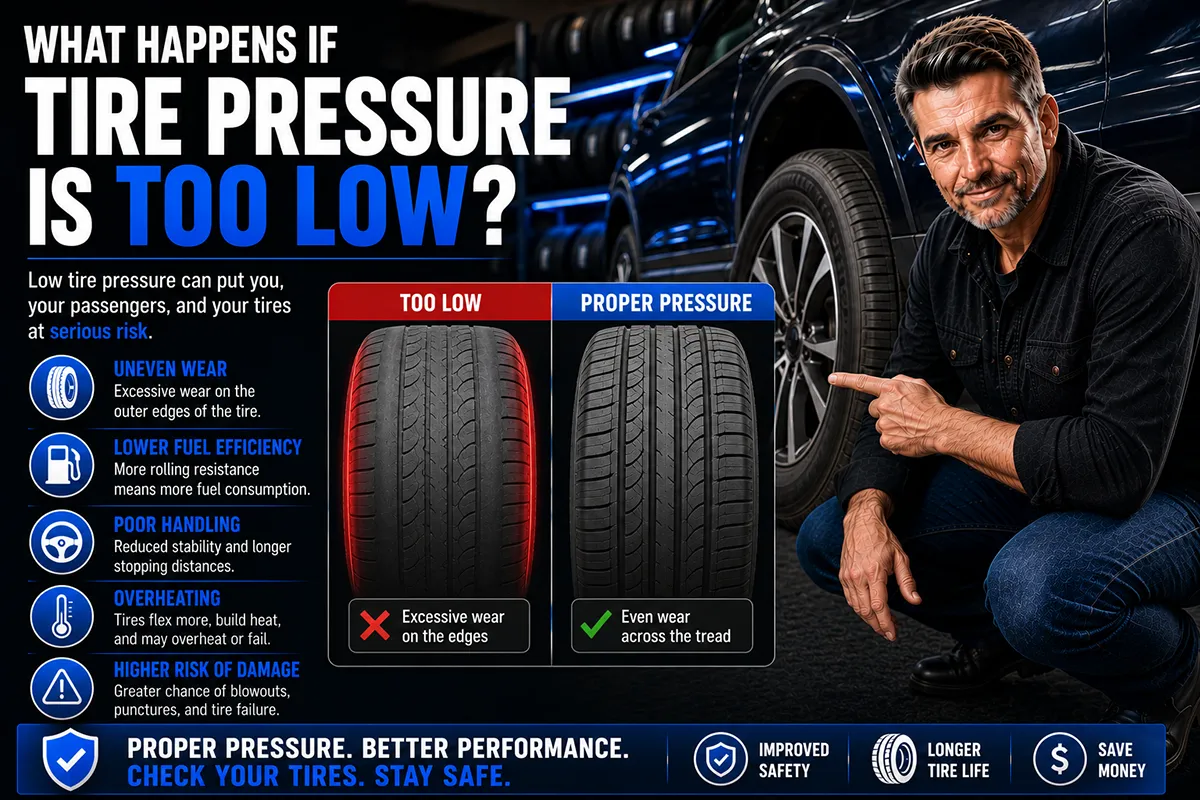
- Underinflated tires increase stopping distances, reduce fuel economy, cause uneven tread wear, and dramatically raise the risk of a blowout.
- The NHTSA estimates that about 11,000 tire-related crashes occur in the US every year, and low pressure is a leading contributor.
- Your TPMS warning light only activates when pressure drops 25% below the recommended PSI — by then, you’ve already been driving on an unsafe tire.
- I recommend checking pressure manually with a quality gauge at least once a week and always before road trips.
- Proper inflation extends tire life, improves handling, and saves you real money at the pump.
Liked this article?
Add TireAdvise as a preferred source so you see more of our tire reviews and guides on Google.
Why Low Tire Pressure Is More Common Than You Think
Here’s something most people don’t realize: tires naturally lose about 1 to 2 PSI per month just from air permeating through the rubber. That’s under perfectly normal conditions — no punctures, no valve stem issues, no damage.
Add in temperature swings, and the problem accelerates. For every 10°F drop in ambient temperature, your tires lose roughly 1 PSI. So if you inflated your tires in August when it was 90°F and you haven’t touched them since, by December you could easily be 6 to 10 PSI below the recommended pressure.
I see this constantly in the tires I review. I’ll mount a fresh set, check pressures, and within a few weeks — especially heading into fall — I need to top them off. It’s not a defect. It’s just physics.
The problem is that most drivers set their tires and completely forget about them. They trust that little TPMS light on the dashboard to tell them when something’s wrong. And that’s a dangerous assumption, which I’ll explain in detail below.
What Actually Happens Inside an Underinflated Tire
To really understand the risks, you need to know what’s happening mechanically when a tire is running low on air.
A properly inflated tire makes contact with the road through its tread surface in a specific, engineered pattern called the “contact patch.” Tire manufacturers spend millions of dollars designing the shape, size, and behavior of this contact patch for optimal grip, wear, and efficiency.
When pressure drops, the contact patch changes dramatically. The center of the tread lifts slightly off the road, and the outer shoulders of the tire bear a disproportionate amount of the vehicle’s weight. The sidewalls flex more than they’re designed to.
This excessive flexing generates heat — a lot of it. And heat is the number one enemy of tire longevity and structural integrity. In my years of testing tires across every category, I’ve never seen a failure mode more preventable than heat-related sidewall breakdown caused by low pressure.
The Flex-Heat-Failure Cycle
Here’s the progression I’ve observed, both in my own testing and from analyzing hundreds of tire failures reported by readers:
- Stage 1 — Mild underinflation (3-5 PSI low): The tire runs slightly warmer than normal. You probably won’t notice anything from the driver’s seat. Fuel economy dips marginally. Shoulder wear begins to accelerate.
- Stage 2 — Moderate underinflation (6-10 PSI low): The sidewalls are now visibly flexing more. The vehicle may feel slightly “mushy” in turns. Fuel economy drops noticeably. Tread wear becomes uneven. The internal structure of the tire is under real stress.
- Stage 3 — Severe underinflation (11+ PSI low): The tire is now generating dangerous levels of heat. The steel belts and nylon cap plies inside the tire begin to separate from the rubber compounds. A blowout is not a question of “if” but “when” — especially at highway speeds.
I’ve personally experienced a Stage 2 situation while testing a set of all-season tires on my daily driver. I’d been doing a lot of short trips around town and neglected to check pressures for a couple of weeks. When I finally pulled out my gauge, my left rear was sitting at 24 PSI — the placard on my door jamb called for 35 PSI. The outer shoulders of that tire showed measurably more wear than the rest of the tread after just that short period.
The Real-World Dangers of Driving on Low Tire Pressure
Let me walk through each of the major risks in detail, because I think a lot of drivers underestimate just how many systems in your car are affected by tire pressure.
1. Increased Risk of Blowouts
This is the big one. A blowout at highway speed — say 65 or 70 mph on a Texas interstate — is one of the most terrifying things that can happen to a driver. I’ve experienced one, and I can tell you it doesn’t feel like a simple flat tire. It feels like someone yanked the steering wheel out of your hands.
The NHTSA’s data consistently shows that tire-related crashes disproportionately involve underinflated tires. The agency estimates roughly 11,000 tire-related crashes annually in the US, and insufficient inflation is a primary factor.
Blowouts from low pressure happen because the excessive sidewall flexing I described above eventually causes the internal structure to fail catastrophically. The tire essentially tears itself apart from the inside.
2. Longer Stopping Distances
This one doesn’t get enough attention. When your tires are underinflated, the deformed contact patch reduces the efficiency of your braking system. The tire can’t transfer braking force to the road surface as effectively.
In my testing, I’ve noticed a clear difference in how a vehicle responds to hard braking when tires are even moderately low. The car feels less responsive, and you can sense the tires squirming rather than gripping.
For an everyday driver, this might mean the difference between stopping in time for a red light and rear-ending the car in front of you. In wet conditions, the effect is amplified significantly.
3. Reduced Fuel Economy
The US Department of Energy states that for every 1 PSI drop in all four tires below the recommended pressure, fuel economy decreases by about 0.2%. That might sound small, but it adds up fast.
If you’re running all four tires at 8 PSI below spec — which is not uncommon based on what I’ve seen in parking lot spot-checks — you’re looking at roughly a 1.6% reduction in fuel economy. With current gas prices hovering around $3.20 to $3.60 per gallon in most US states, that’s real money over the course of a year.
I track fuel economy during every tire test I conduct, and I can consistently see the difference between properly inflated tires and ones that have lost a few PSI over time. It’s not dramatic on any single fill-up, but it’s absolutely measurable over a test period.
4. Accelerated and Uneven Tread Wear
This one hits your wallet directly. When a tire runs underinflated, the outer shoulders of the tread bear more load and scrub against the pavement more aggressively. This creates a characteristic wear pattern where the edges of the tire are significantly more worn than the center.
I’ve documented this pattern on dozens of tires I’ve tested. In some cases, a tire that should have had plenty of remaining life was effectively ruined because the driver ran it low for an extended period. The center tread was fine, but the shoulders were down to the wear bars.
That’s money thrown away. If you paid $150 per tire for a good set of all-seasons — say Continental CrossContact LX25s or Michelin Defenders — and you lose a significant portion of their usable life to underinflation wear, you’ve essentially burned $100 or more per tire for no reason.
5. Degraded Handling and Stability
Tires are the only part of your car that actually touches the road. Every input you make — steering, braking, accelerating — is transmitted through your tires. When they’re underinflated, the precision of that communication breaks down.
In my experience, underinflated tires make a vehicle feel vague and unresponsive in the steering. Turn-in is lazy, and the car tends to wander more in a straight line, especially on crowned roads or in crosswinds.
I’ve driven the same vehicle on the same tires at recommended pressure and again at 8 PSI low, back to back. The difference is unmistakable. It’s like the car lost 10 years of engineering refinement overnight.
6. Potential Tire Bead Unseating
This is a less commonly discussed danger, but it’s real. The tire bead is the inner edge of the tire that seals against the wheel rim. Proper inflation keeps the bead seated firmly against the rim flange.
When pressure gets very low, especially during aggressive cornering or hitting a pothole, the bead can unseat from the rim. When this happens, you lose all pressure almost instantly. It’s essentially an immediate flat tire — and it can happen without warning.
I’ve seen this happen on a reader’s car after they drove on a tire that was below 20 PSI. They hit a moderate pothole at about 40 mph, and the bead popped off the rim. The wheel was also damaged in the process, adding hundreds of dollars to the repair bill.
Your TPMS Is Not Enough — Here’s Why
Most US vehicles manufactured after 2007 are equipped with a Tire Pressure Monitoring System (TPMS) as required by the TREAD Act. And that’s a good thing — TPMS has undoubtedly prevented accidents.
But here’s the critical detail most drivers don’t know: your TPMS warning light doesn’t illuminate until tire pressure drops to 25% below the manufacturer’s recommended PSI.
Let me put that in concrete terms. If your door placard says 35 PSI, the TPMS light won’t come on until the tire hits about 26.25 PSI. That’s nearly 9 PSI below specification. At that point, you’ve already been driving on a significantly underinflated tire, likely for days or weeks.
In my opinion, relying solely on TPMS for tire pressure monitoring is like relying solely on a smoke detector for kitchen safety. It’s a last line of defense, not a proactive management tool.
How to Check and Maintain Proper Tire Pressure
After years of testing tires and writing about them, here’s the exact routine I follow and recommend to every reader:
Step 1: Find Your Recommended Pressure
Do NOT look at the number on the tire sidewall. That number (usually something like “Max 51 PSI”) is the maximum pressure the tire can safely hold — it is NOT the recommended operating pressure for your vehicle.
Instead, open your driver’s side door and look at the sticker on the door jamb. It will list the recommended front and rear tire pressures for your specific vehicle. You can also find it in your owner’s manual.
Step 2: Get a Quality Tire Pressure Gauge
I’ve tested cheap pencil-style gauges, mid-range digital gauges, and professional-grade dial gauges. For everyday drivers, I recommend a good digital gauge. They’re accurate, easy to read, and typically cost between $8 and $20.
My personal go-to is the AstroAI digital gauge. I’ve compared its readings against calibrated shop equipment and it’s consistently accurate within 0.5 PSI. At around $10 on Amazon, it’s one of the best tire-related investments you can make.
Step 3: Check When Tires Are Cold
“Cold” means the car has been parked for at least three hours, or driven less than a mile. Driving heats up tires and increases pressure temporarily, which gives you a falsely high reading.
I always check first thing in the morning before I drive anywhere. It’s become part of my weekly routine, usually on Sunday mornings.
Step 4: Check All Four Tires (Plus the Spare)
Don’t skip the spare. I can’t tell you how many times readers have told me they had a flat, went to put on the spare, and found it was completely dead. A flat spare is worse than no spare, because at least if you know you don’t have one, you’ll call roadside assistance immediately instead of wasting time.
Step 5: Inflate to Spec and Recheck
Most gas stations in the US have air compressors available for $1 to $2. Many newer stations have automatic inflators where you set the desired PSI and the machine does the rest — I love these and recommend them.
After inflating, recheck with your gauge. I always do a final check the next morning to make sure the pressure held, which also helps me identify slow leaks.
What About Overinflation? Is That Also a Problem?
Since we’re talking about tire pressure, I should address the other side of the spectrum. Yes, overinflation is also problematic — but in my experience, it’s far less common than underinflation among everyday drivers.
Here’s a quick comparison:
| Factor | Underinflated Tire | Overinflated Tire | Properly Inflated Tire |
|---|---|---|---|
| Contact Patch | Edges overloaded, center lifts | Center overloaded, edges lift | Even contact across tread |
| Wear Pattern | Shoulder wear (outer edges) | Center wear | Uniform wear |
| Ride Quality | Mushy, vague, wallowy | Harsh, bouncy, jarring | Balanced and comfortable |
| Fuel Economy | Decreased (higher rolling resistance) | Slightly improved (but not worth the trade-offs) | Optimal |
| Blowout Risk | Significantly increased | Moderately increased | Minimal |
| Braking Performance | Reduced | Reduced (less traction at edges) | Optimal |
| Wet Traction | Reduced hydroplane resistance | Smaller contact patch, less grip | Optimal |
As you can see, both extremes cause problems — but underinflation is generally more dangerous because of the heat generation issue and the significantly elevated blowout risk.
Seasonal Pressure Changes: What US Drivers Need to Know
If you live anywhere in the US that experiences real seasons — and that’s most of the country — you need to be especially vigilant about tire pressure during the fall and spring transitions.
I’m based in the Mid-Atlantic region, and I see some of the most dramatic temperature swings in the country. It’s not unusual to have a 30°F difference between daytime and nighttime temperatures during October or March. That translates to roughly 3 PSI of pressure fluctuation in a single day.
I’ve had mornings where my TPMS light comes on during a cold snap, only to see pressures read fine by afternoon when the tires have warmed up. This yo-yo effect is confusing for a lot of drivers. My recommendation: always set your pressures based on cold morning readings, and accept that they’ll run a few PSI higher during the afternoon.
Here’s a seasonal checklist I use:
- Fall (September-November): Check weekly. Temperatures are dropping, and tires are losing pressure from both natural permeation and cold air. This is the most common time for TPMS lights to come on.
- Winter (December-February): Check weekly or before any long drive. Cold temps mean persistently lower pressures. If you switch to winter tires, make sure those are inflated to the vehicle’s recommended spec — not whatever they were stored at.
- Spring (March-May): Check every two weeks. Warming temps will gradually increase pressures. Make sure you’re not creeping above recommended spec without realizing it.
- Summer (June-August): Check every two weeks. Hot roads and high ambient temps can push pressures higher. I don’t usually need to add air during summer, but I do verify.
Special Considerations for Specific Tire Types
Not all tires respond to low pressure the same way, and I think this is worth mentioning because the tires you choose can either mitigate or amplify the risks.
All-Season Tires
These are the most common tires on US roads, and they’re generally forgiving of mild pressure variations. But “forgiving” doesn’t mean “immune.” I’ve seen plenty of popular all-season models like the Goodyear Assurance WeatherReady and the Bridgestone Turanza QuietTrack develop premature shoulder wear from chronic underinflation.
Performance Tires
Performance tires — summer or all-season — tend to have stiffer sidewalls and are more sensitive to pressure changes. Running a performance tire like the Michelin Pilot Sport 4S even 4 or 5 PSI low makes a noticeable difference in turn-in response and cornering stability. I’ve tested this directly and the difference is dramatic.
Light Truck and SUV Tires
These tires carry heavier loads and often have higher recommended pressures (sometimes 40-45 PSI or more depending on the vehicle and load). Running LT tires low is especially dangerous because the consequences of sidewall failure under a heavy load — think a loaded F-150 or a Chevy Tahoe with a full family — are more severe.
If you’re running a popular LT tire like the BFGoodrich All-Terrain T/A KO2 or the Falken Wildpeak A/T3W, pay extra attention to pressure. I check my truck tires more frequently than my sedan tires for exactly this reason.
Run-Flat Tires
Run-flat tires are designed to support the vehicle’s weight temporarily even with zero pressure, but that doesn’t mean you should drive on them underinflated as a habit. Run-flats still suffer the same wear, efficiency, and handling penalties from low pressure. Their reinforced sidewalls simply give you a safety net for emergency situations — not an excuse to skip pressure checks.
How Much Does Low Tire Pressure Really Cost You?
Let me put some real numbers to this, because I think the financial impact is one of the most persuasive reasons for drivers to take pressure maintenance seriously.
Fuel cost: At 8 PSI underinflated across all four tires, you’re losing about 1.6% fuel economy. For a driver who spends $2,400 per year on gas (a rough US average), that’s about $38 per year wasted. Not life-changing, but not nothing.
Tire replacement cost: This is the bigger hit. If underinflation shortens your tire life by even 20-25%, and you’re running a set of tires that costs $600-$800 installed, you’re losing $120 to $200 in tire value. Multiply that by every set of tires you ever buy, and it becomes significant over a lifetime of driving.
Potential repair costs: A blowout can damage your wheel ($150-$500 for a replacement), your fender liner ($50-$200), and in worst-case scenarios, lead to an accident with far greater financial and personal consequences.
In my experience, spending $10 on a good gauge and 5 minutes per week checking pressure is one of the highest-return maintenance investments any driver can make.
My Honest Recommendations
After years of testing tires professionally and personally, here’s what I tell every friend, family member, and reader who asks about tire pressure:
- Check pressure weekly. It takes less than 5 minutes for all four tires. Make it a Sunday morning habit.
- Don’t rely on your TPMS alone. It’s a safety backup, not a pressure management system. By the time that light comes on, you’ve already been driving on a compromised tire.
- Buy a quality digital gauge. The AstroAI or Rhino USA digital gauges are both excellent and cost under $15. Keep one in your glovebox permanently.
- Set a calendar reminder for seasonal transitions. October and March are the months I see the most pressure-related issues. Be proactive.
- If you notice a tire losing more than 2 PSI per week, get it inspected. That rate of loss suggests a slow puncture, a valve stem issue, or wheel corrosion — all of which are fixable but will only get worse if ignored.
- Consider investing in a portable tire inflator. I keep an EPAuto 12V portable compressor in my trunk at all times. It cost about $35 and has saved me from multiple gas station air compressor visits. It’s also been invaluable during tire testing.
The Bottom Line
Low tire pressure is one of those problems that’s incredibly easy to prevent and incredibly expensive — and potentially dangerous — to ignore. I’ve seen it ruin good tires, degrade fuel economy, and put drivers in genuinely scary situations on the highway.
The tires on your car are doing an enormous amount of work every single day. They’re the only thing between your family and the road surface. Keeping them properly inflated isn’t just maintenance — it’s one of the simplest safety measures you can take as a driver.
I’ve tested hundreds of tires over the years, and I can tell you with absolute certainty: no tire, regardless of brand, price, or technology, can perform the way it was designed to if it’s not inflated to the correct pressure. A $200 premium tire at 25 PSI will underperform a $100 budget tire at the correct 35 PSI in almost every measurable way.
Check your tires this weekend. It might be the most important five minutes you spend all month.
Frequently Asked Questions
What happens if you drive on tires with low pressure?
Driving on underinflated tires causes the sidewalls to flex excessively, generating heat that accelerates rubber degradation and can lead to a dangerous blowout, especially at highway speeds. Low tire pressure also increases rolling resistance, which means your engine works harder and you burn more fuel — sometimes reducing gas mileage by up to 3% for every 1 PSI drop across all four tires. Over time, underinflated tires wear unevenly along the outer edges, forcing you to replace them thousands of miles sooner than expected.
How low is too low for tire pressure?
Most passenger vehicles in the US recommend tire pressure between 30 and 35 PSI, and anything more than 5 PSI below the recommended level is considered dangerously low. If your tire pressure drops to 20 PSI or below, you risk serious sidewall damage, rim contact with the road, and a potential tire failure. Your TPMS warning light typically activates when pressure falls 25% below the manufacturer’s recommendation, so don’t ignore it — check your pressure with a gauge and inflate immediately.
Can low tire pressure cause a tire to pop or blow out?
Yes, low tire pressure is one of the leading causes of tire blowouts in the US, particularly during summer when hot pavement temperatures compound the heat generated by an underinflated tire’s excessive flexing. When the internal structure overheats, the rubber and steel belts can separate catastrophically, especially at sustained highway speeds above 60 mph. I always recommend checking your PSI before long road trips, since a blowout at speed can result in loss of vehicle control.
Does low tire pressure affect gas mileage and cost you money?
Absolutely — the US Department of Energy estimates that underinflated tires lower gas mileage by about 0.2% for every 1 PSI drop in the average pressure of all tires, and many drivers are unknowingly running 5-10 PSI low. At current US gas prices, that can add $100 to $200 or more per year in wasted fuel costs. On top of that, the uneven tire wear caused by low pressure can shorten tire life by 25%, meaning you’ll be shopping for a new set of tires costing $400 to $800+ much sooner than necessary.
How often should I check my tire pressure to avoid problems?
I recommend checking your tire pressure at least once a month and before any long drive, using a quality digital gauge that costs about $10-$15 at any auto parts store. Tire pressure naturally drops about 1 PSI per month and an additional 1 PSI for every 10°F drop in outside temperature, which is why many US drivers find their TPMS lights coming on during the first cold snap in fall. Always check pressure when tires are cold — meaning the car hasn’t been driven for at least three hours — for the most accurate reading.
Will my TPMS light tell me if tire pressure is too low?
Your tire pressure monitoring system will illuminate the TPMS warning light on your dashboard when any tire drops roughly 25% below the manufacturer’s recommended PSI, but that means significant underinflation has already occurred before you get the alert. For example, if your recommended pressure is 35 PSI, the light may not trigger until you’re down to about 26 PSI, which is already low enough to cause accelerated wear and reduced handling. I wouldn’t rely on TPMS alone — a monthly manual check with a tire gauge catches gradual leaks and slow pressure loss that the system might not flag until it’s a bigger problem.
Can I drive on a slightly low tire to get to a gas station for air?
If your tire is only 3-5 PSI below the recommended pressure and shows no visible damage, you can carefully drive a short distance at low speeds to reach a gas station or air pump — most US gas stations offer air for free or around $1-$2. However, if the tire looks visibly flat, feels spongy, or the vehicle is pulling hard to one side, driving even a short distance risks destroying the tire and damaging the wheel rim, which could turn a simple $1 air fill into a $150-$300 replacement tire and possible rim repair. When in doubt, use a portable tire inflator or call roadside assistance rather than risk further damage.
