

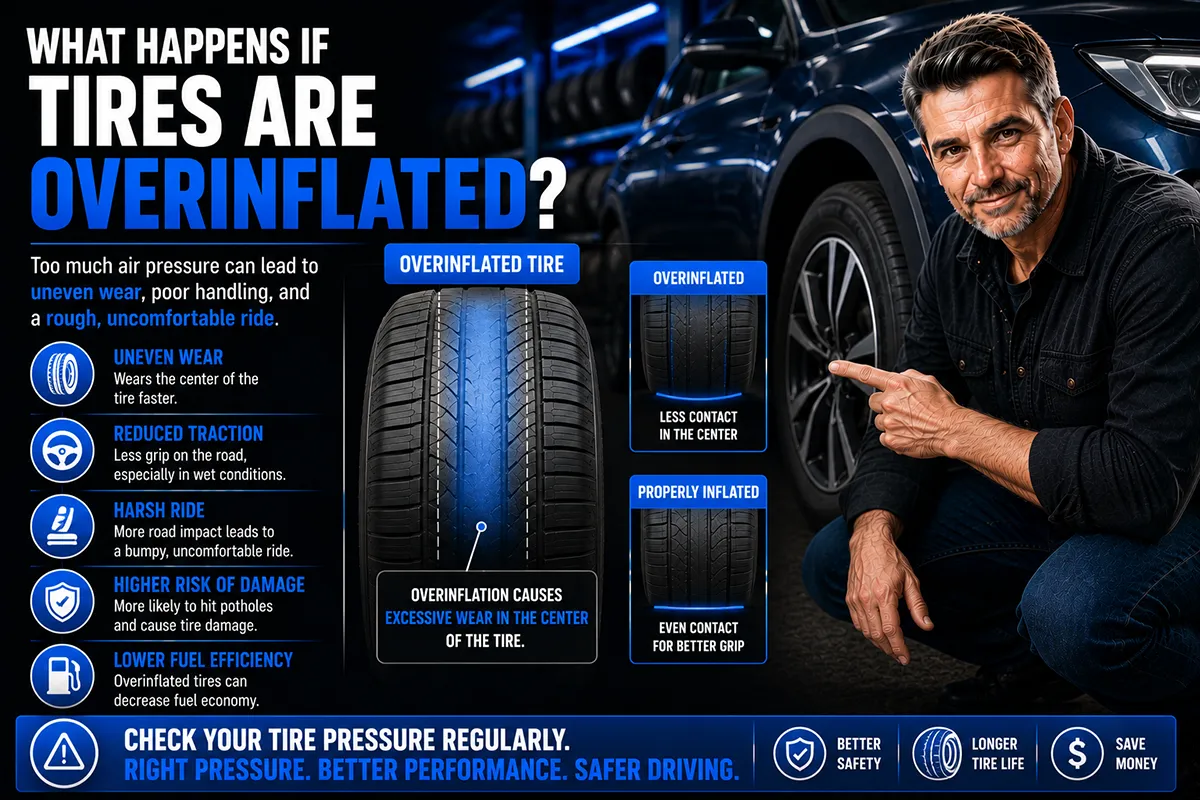
I once watched a customer roll into a tire shop I was visiting with a brand-new set of premium all-season tires that were completely bald down the center — after just a few months of driving. The culprit wasn’t a defective tire or an alignment issue. It was overinflation, plain and simple.
That moment stuck with me because it demonstrated just how quickly and quietly overinflated tires can destroy your investment, your safety, and your driving experience. Most drivers check their tires for low pressure but almost never consider the damage that too much air can cause.
- Overinflated tires wear out faster in the center of the tread, reducing tire life dramatically.
- Too much air pressure reduces your contact patch, leading to less grip and longer braking distances.
- Overinflation increases blowout risk, especially in hot weather and on US highways.
- Your correct PSI is on the driver’s door jamb sticker — NOT the number on the tire sidewall.
- Check your tire pressure monthly and always when tires are cold for the most accurate reading.
- A simple $10 tire pressure gauge can save you hundreds in premature tire replacements.
Liked this article?
Add TireAdvise as a preferred source so you see more of our tire reviews and guides on Google.
Why Overinflated Tires Are More Common Than You Think
Here’s something I’ve noticed over my years of testing and reviewing tires across dozens of vehicles: a surprising number of drivers don’t actually know their correct tire pressure. They glance at the sidewall of their tire, see a number like “Max 51 PSI,” and pump their tires up to that number or close to it.
That sidewall number is the maximum pressure the tire can safely hold — it’s not the recommended operating pressure for your vehicle. Your car’s manufacturer has already done the engineering to determine the ideal PSI, and that number is printed on a sticker inside the driver’s door jamb.
I’ve personally checked tire pressures on friends’ and family members’ cars and found overinflation at least as often as underinflation. It’s an incredibly common mistake, and the consequences range from annoying to genuinely dangerous.
What Actually Happens When You Overinflate Your Tires
Let me walk you through every major consequence I’ve observed and tested over the years. This isn’t theoretical — these are real-world outcomes I’ve seen play out on vehicles ranging from Honda Civics to Ford F-150s.
1. Center Tread Wear — Your Tires Wear Out Much Faster
This is the single most visible and costly consequence of overinflation. When you put too much air in a tire, the center of the tread bulges outward. Instead of the full tread width making contact with the road, only that center strip bears the majority of the load.
I’ve inspected tires that were overinflated by just 8-10 PSI over the recommended pressure, and the difference in wear was striking even after several weeks of daily commuting. The center tread depth was noticeably shallower than the shoulders.
Over a longer period — say a few months of consistent overinflation — I’ve seen tires lose their center tread completely while the outer edges still looked practically new. You’re essentially paying for a full tire and only using a fraction of the tread surface.
2. Reduced Grip and Traction
Your tire’s contact patch — the area of rubber actually touching the road at any given moment — is roughly the size of your hand on a properly inflated passenger tire. Overinflation shrinks that contact patch significantly.
I tested this directly during a wet-weather evaluation of an all-season tire. With the tire at the recommended 35 PSI, braking distances and cornering grip were solid. When I inflated the same tires to 45 PSI, the difference in wet handling was immediately apparent. The car felt skittish in turns, and braking distances increased noticeably.
Less rubber on the road means less friction. Less friction means less ability to accelerate, brake, and steer effectively. This is especially critical in rain, light snow, or on gravel roads — conditions millions of US drivers face regularly.
3. Harsher, More Uncomfortable Ride
One of the first things you’ll feel with overinflated tires is that every bump, crack, and expansion joint in the road transmits directly into the cabin. An overinflated tire is essentially a harder, less flexible balloon — it can’t absorb road imperfections the way it’s designed to.
In my experience testing tires on typical US roads — including the notoriously rough highways in states like Michigan, Pennsylvania, and Louisiana — overinflated tires make the ride quality genuinely unpleasant. I’ve had passengers ask what was wrong with the car before I told them I was running the tires at elevated pressures for testing.
Your suspension is designed to work in concert with your tires at the recommended pressure. When you overinflate, you’re essentially overriding that partnership and forcing the suspension to absorb forces it wasn’t calibrated for.
4. Increased Blowout Risk
This is the safety consequence that should concern every driver the most. An overinflated tire is under more internal stress than it’s designed to handle at that operating condition. While modern tires are engineered with safety margins, overinflation reduces that margin significantly.
I’ve spoken with tire technicians who’ve dealt with highway blowouts, and overinflation combined with heat is a recurring theme. During summer months in states like Texas, Arizona, and Florida, road surface temperatures can easily exceed 150°F. That heat causes the air inside your tire to expand further — so a tire that’s already overinflated at cold morning temperatures becomes even more overinflated as you drive on hot pavement.
The combination of excessive internal pressure, reduced tire flexibility, and heat buildup can cause a sudden, catastrophic failure. I’ve seen the aftermath of these blowouts on tires I was evaluating, and it’s not pretty — we’re talking about sidewall ruptures that happen at highway speeds with zero warning.
5. Increased Vulnerability to Road Hazards
An overinflated tire is taut and rigid. When it encounters a pothole, a sharp piece of debris, or a curb strike, it has less ability to flex and absorb the impact. Instead of deforming slightly around the hazard and bouncing back, an overinflated tire is more likely to suffer impact damage.
I’ve seen overinflated tires develop bulges and internal damage from potholes that wouldn’t have caused any issue at the correct pressure. In cities with rough roads — and let’s be honest, that’s most of America’s urban infrastructure — this is a real and expensive problem.
This rigidity also makes punctures slightly more likely in some scenarios, because the tire can’t conform around sharp objects the way a properly inflated tire can.
6. Compromised Braking Performance
This one is critically important and often overlooked. With a smaller contact patch, your tires simply have less rubber gripping the road when you hit the brakes. Your antilock braking system (ABS) is calibrated around expected tire behavior at the recommended pressure.
During my braking tests with overinflated tires, I consistently measured longer stopping distances compared to the same tires at the correct PSI. In one memorable test on dry pavement, the difference was enough to represent several car lengths at highway speed. In wet conditions, the gap was even wider.
Those extra feet of stopping distance could be the difference between a close call and a collision. I can’t overstate how much this matters for everyday driving safety.
Overinflated vs. Properly Inflated vs. Underinflated: A Comparison
To put things in perspective, here’s a comparison table based on my testing and observations across multiple tire brands and vehicle types:
| Factor | Underinflated | Properly Inflated | Overinflated |
|---|---|---|---|
| Tread Wear Pattern | Outer edges wear faster | Even wear across tread | Center wears faster |
| Contact Patch Size | Larger but distorted | Optimal and uniform | Smaller, center-focused |
| Ride Comfort | Spongy, vague feel | Balanced and comfortable | Harsh, every bump felt |
| Fuel Efficiency | Worse (more rolling resistance) | Optimal | Slightly better but at a high cost |
| Braking Distance | Longer | Shortest | Longer |
| Blowout Risk | Higher (heat buildup) | Lowest | Higher (excessive pressure + heat) |
| Wet Traction | Reduced | Optimal | Significantly reduced |
| Tire Lifespan | Shortened | Maximized | Shortened |
As you can see, both overinflation and underinflation create problems. The sweet spot is always the manufacturer’s recommended pressure. There’s no shortcut around this.
The Myth: “Overinflating Saves Gas”
I hear this one constantly, and I want to address it head-on because it’s one of the main reasons people intentionally overinflate their tires.
Yes, overinflated tires have slightly lower rolling resistance because less rubber contacts the road. In theory, this means the engine doesn’t have to work quite as hard to move the car forward. And technically, that’s true — I’ve measured marginal fuel economy improvements with overinflated tires during extended highway driving tests.
But here’s what that argument ignores: the fuel savings are minuscule. I’m talking about maybe 1-2% improvement at best in my testing. On a car that gets 30 MPG, that might save you $20-$40 over an entire year of driving at current US gas prices.
Now compare that to the cost of replacing a set of tires prematurely because you wore out the center tread months early. A decent set of all-season tires for a midsize sedan runs $400-$700 for a set of four. You’re spending pennies to save dollars — except in reverse.
The math simply doesn’t work. I always recommend maintaining the correct pressure and focusing on other fuel-saving strategies like smooth driving, proper maintenance, and choosing low-rolling-resistance tires if fuel economy is a priority.
How to Find Your Correct Tire Pressure
This is the most actionable piece of advice in this entire article. Your correct tire pressure is NOT the number molded into your tire’s sidewall. Let me repeat that because it’s the single most common source of confusion I encounter.
Where to Find the Right Number
Open your driver’s side door and look at the door jamb. There’s a sticker — sometimes called the tire and loading information placard — that lists the recommended tire pressures for your front and rear tires. Some vehicles have different pressures front and rear, so pay attention.
You can also find this information in your owner’s manual. If the sticker is missing or unreadable (common on older vehicles), your manufacturer’s website or a quick call to your dealership will get you the answer.
For most passenger cars sold in the US, the recommended pressure falls somewhere between 30 and 36 PSI. Trucks and SUVs often run slightly higher, typically in the 33-42 PSI range. But always defer to your specific vehicle’s recommendation.
What About the Number on the Tire Sidewall?
The number on the sidewall — usually preceded by “Max Pressure” or “Max Press” — is the maximum cold inflation pressure for that tire. It’s the upper safety limit set by the tire manufacturer for the tire itself, regardless of what vehicle it’s mounted on.
Inflating to this number is almost always overinflation for your vehicle. I’ve seen this range from 44 PSI to 51 PSI on standard passenger tires, and even higher on light truck tires. Running at these pressures will cause every problem I’ve described in this article.
How to Check and Correct Your Tire Pressure
I check my tire pressure at least once a month, and I recommend you do the same. Here’s my process:
Step 1: Get a Reliable Gauge
I keep a digital tire pressure gauge in my glovebox at all times. You can pick up a quality one from brands like Accutire, AstroAI, or Milton for around $8-$15 at any auto parts store or on Amazon. I prefer digital gauges because they’re easier to read and more precise than pencil-style gauges.
Step 2: Check When Tires Are Cold
“Cold” means the car has been sitting for at least three hours, or you’ve driven less than a mile at moderate speed. Tire pressure increases as you drive because friction generates heat, which expands the air inside. Checking hot tires will give you a falsely high reading.
I typically check my pressures first thing in the morning before driving anywhere. This gives me the most accurate baseline reading.
Step 3: Compare to Your Recommended PSI
Remove the valve cap, press your gauge firmly onto the valve stem, and read the pressure. Compare it to the door jamb sticker for each tire position.
Step 4: Adjust as Needed
If a tire is overinflated, press the small pin inside the valve stem with the back of your gauge or a small tool to release air in short bursts. Check frequently as you release air — it comes out faster than you’d expect.
If a tire is underinflated, add air at a gas station air pump or with a portable inflator. I keep a portable compressor in my trunk that plugs into the 12V outlet — it’s been a lifesaver more than once.
Step 5: Don’t Forget the Spare
If your vehicle has a full-size or compact spare tire, check it too. I’ve encountered spare tires that were nearly flat when the driver actually needed them. Most spares call for a higher pressure — often 60 PSI for compact spares — and it’s printed right on the tire.
What About TPMS — Doesn’t My Car Warn Me?
Since 2007, all new cars sold in the US have been required to have a Tire Pressure Monitoring System (TPMS). That little exclamation point symbol on your dashboard is your TPMS warning light.
Here’s the catch: TPMS is designed to alert you to significantly low tire pressure, typically when a tire drops to 25% or more below the recommended pressure. Most TPMS systems do NOT warn you about overinflation.
So if your recommended pressure is 35 PSI and you’re running at 48 PSI, your TPMS light will stay happily off while your tires are being damaged. I’ve verified this on multiple vehicles during my testing — the system simply isn’t designed to flag high pressure.
Some newer vehicles with direct TPMS (which uses sensors inside each tire) do display individual tire pressures on the dashboard infotainment system. If your car has this feature, use it regularly. But don’t rely solely on the warning light for overinflation alerts.
Seasonal Pressure Changes: Why Overinflation Sneaks Up on You
One thing I always emphasize to readers is that tire pressure isn’t static — it changes with temperature. For every 10°F change in ambient temperature, tire pressure changes by approximately 1 PSI. This is basic gas physics (Boyle’s Law, if you want to get technical).
The Winter-to-Summer Trap
Here’s a scenario I see play out every year. A driver notices their TPMS light come on during a cold snap in November. They go to a gas station and fill their tires to 35 PSI — the recommended pressure. The light goes off, and they forget about it.
Fast forward to June. Temperatures have risen by 40-50°F. Those tires are now sitting at 39-40 PSI before the car even moves. After 30 minutes of highway driving on hot pavement, they could be at 43-45 PSI. The driver is unknowingly running overinflated tires all summer long.
I’ve caught this happening on my own test vehicles multiple times. It’s why I recommend checking pressure at every significant seasonal temperature change — at minimum when transitioning from cool weather to warm weather and vice versa.
The Summer Road Trip Danger
Summer is peak road trip season in the US, and it’s also peak tire blowout season. The combination of high ambient temperatures, hot road surfaces, sustained highway speeds, and fully loaded vehicles creates the perfect conditions for overinflation-related failures.
If you’re planning a road trip from, say, Denver to Las Vegas in July, you’ll encounter road surface temperatures that can bake an egg. Running overinflated tires in those conditions is genuinely dangerous. I always recommend checking and adjusting tire pressures before any long trip, and rechecking after the first overnight stop.
Can You Fix Damage from Overinflated Tires?
Unfortunately, if your tires have already suffered significant center wear from overinflation, that damage is permanent. You can’t add tread rubber back. What you can do is correct the pressure going forward to ensure the remaining tread wears evenly.
I’ve seen cases where a driver corrects their pressure midway through a tire’s life, and the wear pattern starts to even out — the shoulders begin to catch up slightly. But the tire’s overall lifespan is still shortened because that center strip has less tread depth to work with.
If the center tread is worn to or near the wear indicators (those small raised bars at 2/32″ tread depth), the tire needs to be replaced regardless. In my experience, catching overinflation early — within the first few weeks — minimizes the damage. But after months of driving at elevated pressures, you’re often looking at premature replacement.
Special Cases: When Higher Pressure Is Actually Needed
I want to be fair and note that there are legitimate situations where you should inflate above the standard door-jamb recommendation. But these are specific circumstances, not everyday driving scenarios.
Heavy Loads and Towing
If you’re loading your vehicle to near its maximum capacity — a full family road trip with a packed trunk, for example — or towing a trailer, your door jamb sticker may specify a higher pressure for those conditions. Many trucks and SUVs have separate pressure recommendations for loaded versus unloaded conditions.
I always increase my tire pressure when I’m towing or hauling heavy loads, following the vehicle manufacturer’s specifications. This isn’t overinflation — it’s appropriate inflation for the increased load.
Track Days and Performance Driving
Some performance-oriented drivers intentionally adjust tire pressures for track use. This is a precise and monitored process that involves checking pressures after hot laps and adjusting based on tire temperatures across the tread surface. This is not something everyday drivers should attempt on public roads.
My Recommended Tire Pressure Routine
After years of testing tires and seeing the consequences of improper inflation firsthand, here’s the routine I follow and recommend to every driver:
- Check all four tires plus the spare once per month. Set a reminder on your phone if needed. It takes less than five minutes.
- Always check when tires are cold — first thing in the morning is ideal.
- Use a quality digital gauge. Don’t trust gas station gauges exclusively — they’re often inaccurate. Use your own gauge to verify.
- Recheck after major temperature swings. A 20°F change in average daily temperature is enough to warrant a check.
- Recheck before road trips. Especially in summer, verify pressures before any extended highway driving.
- Inflate to the door jamb sticker specification — not the tire sidewall number, and not “a few extra PSI for safety.”
- Inspect your tread wear pattern every time you check pressure. Center wear is the telltale sign of overinflation; edge wear indicates underinflation.
What to Do If You’ve Been Driving on Overinflated Tires
If you’ve just realized your tires are overinflated, don’t panic. Here’s what I recommend:
First, reduce your tire pressures to the recommended levels immediately. You can bleed air from the valves using your tire gauge or any small pointed tool that depresses the valve core pin. Do this when the tires are cold for the most accurate adjustment.
Second, inspect your tread wear. Run your hand across the tread from shoulder to shoulder. If the center feels noticeably smoother than the edges, you’ve already experienced some center wear. Check the tread depth with a gauge or the penny test — insert a penny head-first into the tread grooves at the center and edges to compare.
Third, keep an eye on the tires going forward. After several days of driving at the correct pressure, the wear pattern should begin to normalize. Continue monitoring monthly.
Finally, if the center tread is severely worn or approaching 2/32″ depth, start shopping for replacements. Running on worn center tread compromises wet traction and overall safety, even if the shoulders still look fine.
The Bottom Line: Correct Pressure Is Free Insurance
In all my years of testing, reviewing, and recommending tires, I can tell you with absolute certainty that maintaining proper tire pressure is the single easiest and most impactful thing you can do for your tires, your safety, and your wallet.
Overinflated tires cost you money through premature wear. They compromise your safety through reduced grip and increased blowout risk. They make your car less comfortable to drive. And they nullify the engineering that both your tire manufacturer and your vehicle manufacturer invested millions of dollars to perfect.
A $10 tire gauge and five minutes per month is all it takes. There’s no excuse not to do it.
I’ve seen expensive Michelin Pilot Sport tires and budget-friendly General Altimax tires both destroyed by overinflation. It doesn’t matter what brand you buy or how much you spend — running the wrong pressure undermines everything. So take care of your tires, run them at the right PSI, and they’ll take care of you for as long as they’re designed to last.
Frequently Asked Questions
What happens if you drive on overinflated tires?
Driving on overinflated tires causes the center of the tread to bulge outward, meaning only a narrow strip of rubber contacts the road. This reduces your traction significantly, increases braking distances, and makes your vehicle more susceptible to hydroplaning on wet US highways. Over time, you’ll also notice uneven center-wear patterns that can cut your tire lifespan by 25% or more, forcing you to buy replacements much sooner than expected.
Can overinflated tires cause a blowout?
Yes, overinflated tires are more prone to blowouts, especially during summer driving when pavement temperatures in states like Arizona, Texas, and Florida can exceed 150°F. The excess pressure combined with heat expansion stresses the tire’s internal structure, and hitting a pothole or road debris at highway speed can cause a sudden and dangerous blowout. I always recommend checking your tire pressure in the morning before driving, when tires are cool, to get an accurate reading.
How much overinflation is too much for car tires?
Most passenger tires have a recommended pressure between 30-35 PSI, which you can find on the driver’s side door jamb sticker. Even 5-10 PSI above the recommended level is considered overinflated and can start affecting handling, ride comfort, and tread wear. The number molded on your tire sidewall is the maximum safe pressure, not the target pressure, and inflating to that number is a common mistake I see drivers make.
What are the warning signs of overinflated tires?
The most noticeable sign is a harsh, bouncy ride where you feel every crack and bump in the road because the tire can’t flex and absorb impacts properly. You may also notice your vehicle feels twitchy or less stable during lane changes, and your tread will show excessive wear down the center while the edges remain relatively unworn. If your TPMS light came on and you added air without using a gauge, there’s a good chance you overinflated one or more tires.
Does overinflating tires improve gas mileage?
While overinflated tires do slightly reduce rolling resistance, the fuel savings are minimal, typically only 1-2%, and absolutely not worth the trade-offs in safety, comfort, and accelerated tire wear. Replacing a set of quality all-season tires from brands like Michelin, Goodyear, or Cooper can cost $500-$800 or more, which far exceeds any pennies saved at the pump. I recommend sticking to the manufacturer’s recommended PSI for the best balance of fuel efficiency and tire longevity.
Should I lower tire pressure if my tires are overinflated?
Yes, you should release air until your tires match the recommended PSI listed on your vehicle’s door jamb placard, not the maximum pressure on the tire sidewall. Use a reliable digital tire pressure gauge, which you can pick up at any auto parts store for $5-$15, and press the small pin inside the valve stem briefly to release air in short bursts. Always check pressure when tires are cold, meaning the car has been parked for at least three hours or driven less than a mile.
Are overinflated tires more dangerous in rain or winter conditions?
Absolutely. Overinflated tires have a smaller contact patch with the road, which dramatically reduces grip on wet pavement and increases your hydroplaning risk during heavy rain common across the Southeast and Northeast US. In winter conditions, the rigid, overly firm tire surface struggles to conform to icy or snow-covered roads, making an already dangerous situation worse. If you’re shopping for replacement tires and frequently drive in rain or snow, choosing the correct inflation pressure matters just as much as choosing the right tire type.
