

Most people don’t think about tire pressure until a warning light pops up on their dashboard — and by then, you’ve already been driving on improperly inflated tires for who knows how long.
Here’s something that surprised me early in my career: the “perfect” tire pressure isn’t actually printed on your tire sidewall. That number is the *maximum* pressure the tire can handle, and inflating to it is one of the most common mistakes I see drivers make.
I’ve spent years testing tires across every category — all-season, winter, performance, and touring — and I can tell you without hesitation that proper tire pressure is the single easiest thing you can do to improve your safety, fuel economy, and tire lifespan. Yet it’s also the most neglected.
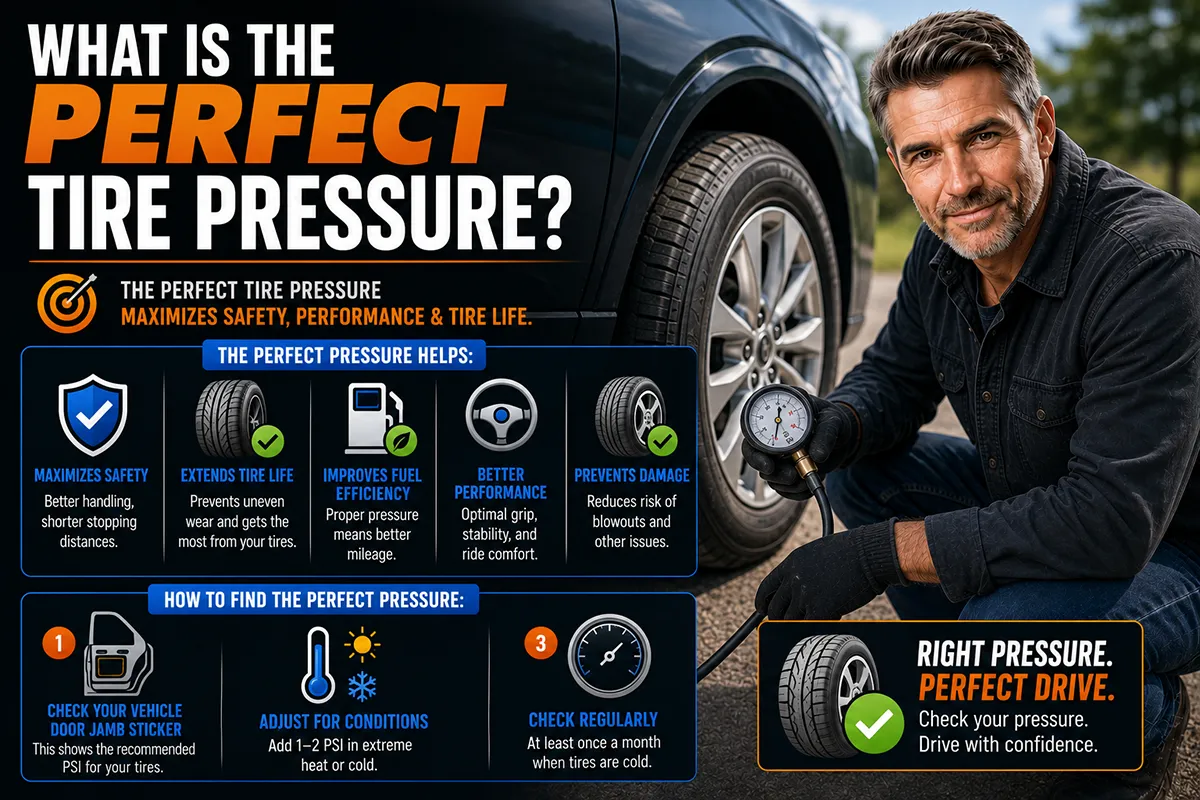
- Your perfect tire pressure is found on the driver’s door jamb sticker — NOT on the tire sidewall.
- Most passenger cars call for 30–35 PSI, but always check your specific vehicle’s recommendation.
- Check pressure when tires are cold (before driving or after sitting 3+ hours).
- Underinflation wastes fuel and causes uneven wear; overinflation reduces grip and comfort.
- Check your tire pressure at least once a month and before long road trips.
- Temperature changes of 10°F can shift pressure by about 1 PSI — so seasonal checks are critical.
Liked this article?
Add TireAdvise as a preferred source so you see more of our tire reviews and guides on Google.
What “Perfect Tire Pressure” Actually Means
Let me clear up the biggest misconception right away. There is no single universal “perfect” tire pressure that applies to every car. The ideal pressure depends on your specific vehicle, its weight distribution, and what the manufacturer engineered the suspension and handling around.
When I say “perfect tire pressure,” I’m referring to the pressure recommended by your vehicle’s manufacturer — the number that was determined after extensive testing to deliver the best balance of ride comfort, handling, tread wear, and fuel efficiency for your specific car. This is the number you should trust above all else.
I’ve personally tested what happens when you deviate from this number in both directions, and the results are always the same: you compromise something. Too low, and you’re burning extra fuel and chewing up the edges of your tread. Too high, and you lose grip, get a harsher ride, and wear the center of the tread prematurely.
Where to Find Your Recommended Tire Pressure
This is where so many drivers go wrong, and I want to be extremely clear about this.
The Door Jamb Sticker (Your Best Friend)
Open your driver’s side door and look at the door jamb — the area where the door latches. You’ll see a sticker, usually white or yellow, that lists the recommended tire pressure for your front tires, rear tires, and spare tire. This is the number you want.
In my experience working with dozens of different vehicles during tire testing, I’ve seen this number range anywhere from 28 PSI on some smaller sedans to 40+ PSI on certain trucks and SUVs. Most standard passenger cars fall somewhere in the 30–35 PSI range.
If the sticker is missing or unreadable (which I’ve encountered on older used cars), you can also find this information in your owner’s manual or by searching your vehicle’s year, make, and model on the manufacturer’s website.
The Tire Sidewall Number (NOT Your Target)
The number molded into the sidewall of your tire — usually something like “Max Press 51 PSI” or “Max Press 44 PSI” — is the maximum cold inflation pressure the tire is designed to safely hold. It is NOT a recommendation. It’s a limit.
I’ve had readers tell me they’ve been inflating their tires to the sidewall max for years. When I explain the difference, they’re genuinely shocked. Think of it this way: your oven can reach 500°F, but you wouldn’t cook everything at that temperature.
Why the Right Tire Pressure Matters More Than You Think
I realize “check your tire pressure” sounds about as exciting as “eat your vegetables.” But after years of testing tires in real-world conditions, I can tell you that incorrect tire pressure affects your driving experience in ways that are immediately noticeable — once you know what to look for.
Safety and Handling
This is the big one, and I don’t say that lightly. Underinflated tires flex more than they should during cornering, which makes the steering feel vague and unresponsive. I’ve tested the same tire at both the recommended 32 PSI and at 25 PSI on wet pavement, and the difference in stopping distance was genuinely alarming.
The National Highway Traffic Safety Administration (NHTSA) estimates that underinflated tires contribute to roughly 11,000 tire-related crashes in the US every year. That’s not a scare tactic — that’s reality.
Overinflated tires have their own safety issues. They reduce the contact patch (the area of tire actually touching the road), which means less grip. I’ve felt this firsthand during hard braking tests — overinflated tires break traction noticeably sooner.
Fuel Economy
The US Department of Energy states that for every 1 PSI drop in pressure across all four tires, your fuel economy decreases by approximately 0.2%. That might sound tiny, but let me put it in perspective.
If your tires are 8 PSI underinflated (which is more common than you’d think), you’re looking at roughly a 1.6% drop in fuel economy. With gas prices hovering between $3.00 and $4.00 per gallon across much of the US, that adds up over a year of driving. In my experience, properly inflated tires are the cheapest fuel economy upgrade you’ll ever make.
Tire Lifespan
This is where I see the most dramatic real-world impact. I’ve inspected tires that were chronically underinflated, and the wear pattern tells the whole story — the outer edges of the tread are worn down while the center still looks almost new. That’s because underinflation causes the tire to sag, putting excessive load on the shoulders.
Overinflation creates the opposite pattern: the center of the tread wears faster because the tire bulges outward, concentrating all the vehicle’s weight on a narrower strip of rubber.
Either way, you’re replacing tires sooner than you should be. And with the average set of all-season tires running $400–$800 for most passenger cars in the US market, that’s real money wasted.
The Difference Between Cold and Hot Tire Pressure
This is a detail that trips up a lot of people, and I want to explain it thoroughly because it directly affects the accuracy of your readings.
Why Cold Pressure Is the Standard
Tire pressure increases as the tire heats up during driving. Friction with the road surface generates heat, and as the air inside the tire warms, it expands. In my testing, I’ve consistently measured a pressure increase of 3–5 PSI after just 20–30 minutes of highway driving. On hot summer days, that increase can be even higher.
This is why every vehicle manufacturer specifies tire pressure as a “cold” measurement. “Cold” means the tires haven’t been driven on for at least three hours, or you’ve driven less than a mile at low speed.
I always check my tire pressure first thing in the morning before I drive anywhere. It’s become part of my routine, and I encourage you to do the same.
What If You Can Only Check While Tires Are Warm?
If you’re at a gas station and your tires are warm, here’s what I do: add approximately 3–4 PSI above the recommended cold pressure to account for the heat. Then, check again in the morning when they’ve cooled down and adjust if necessary.
It’s not a perfect solution, but it’s better than ignoring the issue entirely. In my experience, this rough adjustment gets you close enough to drive safely until you can do a proper cold check.
How Temperature and Seasons Affect Tire Pressure
If you live anywhere in the US that experiences seasonal temperature swings — and that’s most of us — this is critical information.
As a general rule, tire pressure changes by approximately 1 PSI for every 10°F change in ambient temperature. This means if you set your tires to a perfect 32 PSI in September when it’s 70°F, and then November rolls in with 30°F mornings, your tires could be sitting at 28 PSI without you ever letting any air out.
I’ve seen this play out every single fall. My TPMS light comes on like clockwork during the first cold snap of the season. It’s not because anything is wrong with my tires — it’s pure physics.
The reverse happens in summer. Tires that were properly inflated during the cool spring months can become overinflated during a heat wave. I recommend checking your pressure at the start of each season, at minimum.
How to Check Your Tire Pressure: My Step-by-Step Process
I’ve been doing this for years, and I’ve refined my process down to something quick and repeatable. Here’s exactly what I do:
What You Need
- A quality tire pressure gauge. I strongly recommend a digital gauge over the old pencil-style ones. The Accutire MS-4021B (around $8–$12 at most auto parts stores) is what I’ve used for years. It’s accurate, backlit, and cheap enough to keep one in every car.
- Access to an air compressor or portable inflator. Many gas stations have air pumps, though they’re not always free (usually $1–$2). If you prefer doing it at home, a portable 12V tire inflator like the EPAuto AT-010-1Z (around $30–$35 on Amazon) is an excellent investment. I keep one in my trunk.
The Steps
- Step 1: Check your door jamb sticker and note the recommended PSI for front and rear tires. Some vehicles have different front and rear pressures.
- Step 2: Remove the valve cap from one tire. Press the gauge firmly onto the valve stem. You’ll hear a brief hiss — that’s normal. Hold steady until the gauge gives you a reading.
- Step 3: Compare the reading to the recommended pressure. If it’s low, add air in short bursts, rechecking after each burst. If it’s high, press the small pin inside the valve stem briefly to release air, then recheck.
- Step 4: Repeat for all four tires, including the spare if it’s a full-size spare.
- Step 5: Replace all valve caps securely. They keep out dirt and moisture that can damage the valve core over time.
The whole process takes me less than 10 minutes. That’s a small investment for the safety and savings it provides.
Common Tire Pressure Mistakes I See All the Time
After years of writing about tires and talking to everyday drivers, I’ve cataloged the most common pressure-related mistakes. Here’s what to avoid:
Mistake #1: Relying Solely on TPMS
Your Tire Pressure Monitoring System (TPMS) — that little warning light on your dashboard — is a safety backup, not a maintenance tool. Federal regulations only require TPMS to alert you when pressure drops 25% below the recommended level. For a tire rated at 32 PSI, that means the light doesn’t come on until you hit about 24 PSI.
That’s already severely underinflated. In my experience, a tire at 24 PSI handles noticeably worse and is already suffering accelerated wear. Don’t wait for the light. Check manually.
Mistake #2: Setting All Four Tires to the Same Pressure
Some vehicles specify different pressures for front and rear tires, especially front-wheel-drive cars and trucks. I’ve tested vehicles where the recommendation was 35 PSI front and 33 PSI rear, or 36 PSI front and 38 PSI rear on certain trucks. The door jamb sticker will specify this clearly.
Mistake #3: Inflating to the Sidewall Max
I’ve already covered this above, but it bears repeating because it’s the single most common mistake I encounter. The sidewall number is a maximum, not a target.
Mistake #4: Never Checking the Spare
When was the last time you checked your spare tire’s pressure? If you have a full-size or compact spare, it can lose pressure over time just sitting in your trunk. I’ve pulled out spare tires that were completely flat when the driver needed them most. Check it every time you check your other four.
Mistake #5: Filling Tires Right After Highway Driving
If you just got off the highway and pull into a gas station to add air, your tires are hot and reading artificially high. You might think they’re fine when they’re actually low. Always try to check cold.
Recommended Tire Pressures: A Quick Reference Table
While I always recommend checking your specific vehicle’s door jamb sticker, here’s a general reference table based on common vehicle types I’ve tested. These are typical ranges — your vehicle may differ.
| Vehicle Type | Typical Front PSI | Typical Rear PSI | Notes |
|---|---|---|---|
| Compact Sedan (e.g., Honda Civic, Toyota Corolla) | 32–35 PSI | 30–33 PSI | Lower pressures for comfort-focused models |
| Midsize Sedan (e.g., Toyota Camry, Honda Accord) | 32–36 PSI | 32–36 PSI | Often same front and rear |
| Compact SUV (e.g., Toyota RAV4, Ford Escape) | 33–35 PSI | 33–35 PSI | Slightly higher when loaded |
| Full-Size SUV (e.g., Chevy Tahoe, Ford Expedition) | 35–38 PSI | 35–38 PSI | Check for towing pressure specs |
| Half-Ton Pickup (e.g., Ford F-150, Ram 1500) | 35–40 PSI | 35–40 PSI | Rear may need increase for heavy loads |
| Sports/Performance Car (e.g., Ford Mustang, Chevy Camaro) | 32–36 PSI | 32–38 PSI | Rear-drive models often run higher rear pressure |
| Minivan (e.g., Honda Odyssey, Chrysler Pacifica) | 33–36 PSI | 33–36 PSI | Increase when fully loaded with passengers |
Important: These are general ranges based on my experience with common vehicles. Always defer to your specific vehicle’s placard for the exact recommended pressure.
Should You Adjust Tire Pressure for Different Conditions?
This is a question I get asked frequently, and the short answer is: sometimes, yes.
Heavy Loads and Towing
If you’re loading up for a family road trip, hauling furniture, or towing a trailer, your vehicle is heavier than normal. Many vehicles have a secondary pressure recommendation on the door jamb sticker specifically for “full load” conditions. For trucks like the Ford F-150 or Ram 1500, this can mean increasing rear tire pressure by 5–10 PSI when the bed is loaded.
I always bump up my tire pressure before a long trip with a fully loaded car. I’ve noticed that handling feels more stable and the tires run cooler with the added pressure compensating for the extra weight.
Highway Driving vs. City Driving
In general, I stick with the manufacturer’s recommended pressure for both highway and city driving. The engineers designed the recommendation to work across both scenarios. I don’t recommend reducing pressure for city driving or increasing it for highway driving — the manufacturer has already accounted for this.
Off-Road Driving
If you’re taking an SUV or truck onto trails, sand, or mud, some experienced off-roaders “air down” to 15–20 PSI to increase the contact patch and improve traction on loose surfaces. I’ve done this myself on sand and can confirm it makes a significant difference.
However — and this is critical — you must air back up to the recommended pressure before driving on paved roads. Driving on the highway at 15 PSI is extremely dangerous and can cause tire failure. I always carry a portable compressor when I air down off-road.
Nitrogen vs. Regular Air: Is It Worth It?
You’ve probably seen tire shops offering nitrogen fills for $5–$10 per tire. The pitch is that nitrogen molecules are larger than oxygen molecules, so they leak out more slowly and are less affected by temperature changes.
In my experience, the benefits of nitrogen are real but marginal for everyday driving. I’ve monitored nitrogen-filled tires and standard air-filled tires side by side over several months, and the nitrogen tires did hold pressure slightly more consistently — maybe 1 PSI better over a month.
Is that worth $20–$40 per fill-up? For most drivers, I’d say no. If you’re checking your pressure monthly like you should be, regular compressed air from any gas station or home compressor works perfectly fine. Save your money for a quality tire pressure gauge instead.
That said, if a tire shop offers nitrogen for free with a tire purchase (as Costco does with all their tire installations), there’s no reason not to take it.
How Often Should You Check Tire Pressure?
Here’s my recommendation based on years of experience:
- Once a month minimum. Tires naturally lose 1–2 PSI per month through the rubber itself (it’s called permeation). A monthly check catches this slow loss before it becomes a problem.
- Before any road trip. I never hit the highway for a long drive without checking all four tires plus the spare. It takes 10 minutes and gives me total peace of mind.
- After any significant temperature change. When the seasons shift or a cold front rolls in, check your pressure. That 1 PSI per 10°F rule means a sudden 20-degree temperature drop could leave you 2 PSI low on all four tires.
- If a tire looks low. Trust your eyes. If a tire looks even slightly flatter than the others, check it immediately. By the time a tire looks visibly low, it could be 10+ PSI underinflated.
What About TPMS Sensors and Replacement Tires?
If you’re shopping for replacement tires — which many of our readers are — here’s something worth knowing. Your TPMS sensors are mounted inside the tire, either on the valve stem or banded to the wheel. When you have new tires mounted, the sensors can sometimes be damaged if the technician isn’t careful.
I always ask the tire shop to inspect my TPMS sensors during installation and replace any that look worn or corroded. Replacement sensors typically run $40–$80 per sensor installed, and it’s much cheaper to do it during a tire change than as a separate service later.
Also, if you’re switching to a different tire size (with the same overall diameter), your recommended pressure may change. When I’ve tested plus-sized tires on vehicles, I’ve consulted both the tire manufacturer’s load/inflation tables and the vehicle manufacturer’s guidance to find the right pressure for the new size.
Signs Your Tire Pressure Is Wrong
Even without a gauge in hand, your car will tell you when something’s off. Here’s what I’ve learned to watch for:
- Vehicle pulling to one side: If one tire is significantly lower than the others, the car will drift toward that side. I’ve experienced this during testing and it’s subtle but noticeable.
- Uneven tread wear: Check your tread periodically. Edge wear means underinflation. Center wear means overinflation. I run my hand across the tread to feel for unevenness.
- Spongy or floaty steering feel: Underinflated tires make the steering feel imprecise and the car feel less planted. When I inflate back to the correct pressure, the transformation in steering response is immediate.
- Increased road noise: Overinflated tires can amplify road noise because the stiffer tire transmits more vibration. If your tires suddenly seem louder, check your pressure.
- Decreased fuel economy: If you’re tracking your MPG and notice a drop with no other explanation, underinflated tires are a likely culprit.
My Personal Tire Pressure Routine
I want to wrap up by sharing exactly what I do, because I think having a consistent routine is the key to never dealing with pressure-related problems.
Every Sunday morning, before I drive anywhere, I walk out to my car with my digital gauge. I check all four tires and the spare. The whole thing takes about five minutes. If any tire is more than 1 PSI off from the recommendation, I adjust it with my portable inflator right there in the driveway.
During the transitional seasons — fall and spring — I check more frequently, sometimes twice a week, because temperatures can swing 30–40 degrees in a matter of days where I live. I’ve found this eliminates those annoying TPMS warnings entirely.
Before any trip longer than an hour, I check again. It’s become second nature, like checking my mirrors before backing out of a parking space.
I also keep a written log in my phone’s notes app. It might sound obsessive, but it’s helped me catch a slow leak once — I noticed one tire was consistently losing 2 PSI per week while the others held steady. Turned out to be a small nail I couldn’t even see with a visual inspection.
The Bottom Line: Your Perfect Tire Pressure
Let me leave you with the simplest possible summary. Your perfect tire pressure is the number on your driver’s door jamb sticker. Not the tire sidewall. Not what your neighbor told you. Not some universal number from the internet.
Check it cold. Check it monthly. Adjust for seasons and loads.
I’ve tested hundreds of tires over the years, and the one constant across every brand, every category, and every vehicle is this: properly inflated tires perform better, last longer, and keep you safer. It costs nothing but a few minutes of your time.
If you take just one thing from this entire article, let it be this: go check your tire pressure right now. I’ll bet at least one of your tires is off. And once you correct it, you’ll feel the difference the moment you pull out of your driveway.
Frequently Asked Questions
What is the perfect tire pressure for most cars and SUVs?
For most passenger cars and SUVs sold in the US, the recommended tire pressure falls between 30 and 35 PSI, though some trucks and larger SUVs may call for 40 PSI or higher. The perfect tire pressure for your specific vehicle is printed on the driver’s side door jamb sticker, not on the tire sidewall. I always recommend checking that sticker first because it reflects the pressure your vehicle’s manufacturer engineered for optimal handling, fuel economy, and tire life.
Is 40 PSI too high for regular car tires?
For many sedans and compact cars, 40 PSI is above the manufacturer’s recommended pressure and can cause the center of the tread to wear prematurely, reducing tire life and grip. However, some full-size trucks, SUVs, and crossovers like the Ford F-150 or Chevy Tahoe actually specify 35–44 PSI as their ideal range. Always follow the pressure listed on your door jamb placard rather than inflating to the maximum number stamped on the tire sidewall, which represents the tire’s max capacity, not its ideal operating pressure.
How often should I check my tire pressure for safe driving?
I recommend checking your tire pressure at least once a month and before any long road trip, especially if you’re driving through varying US climates where temperature swings are common. Tires typically lose about 1 PSI per month naturally and about 1 PSI for every 10°F drop in temperature. Investing in a quality digital tire pressure gauge, which costs around $10–$15 at most auto parts stores, is one of the cheapest safety upgrades you can make.
Does tire pressure change in cold weather and how should I adjust it?
Yes, tire pressure drops roughly 1 PSI for every 10-degree Fahrenheit decrease in outside temperature, which is why your TPMS light often comes on during the first cold snap of fall or winter. If you live in states like Minnesota, Michigan, or anywhere with harsh winters, you may need to add 3–5 PSI when temperatures plunge. I always check pressure when tires are cold, meaning the car has been parked for at least three hours or driven less than a mile, to get an accurate reading.
What happens if I drive on underinflated or overinflated tires?
Driving on underinflated tires increases rolling resistance, which can reduce fuel economy by up to 3% and cause excessive wear on the outer edges of the tread, potentially costing you hundreds of dollars in premature tire replacement. Overinflated tires ride on a smaller contact patch, reducing traction on wet or icy US roads and wearing out the center tread faster. In extreme cases, underinflation generates dangerous heat buildup that can lead to a blowout, especially during summer highway driving at sustained speeds.
Should I use the tire pressure on the sidewall or the door sticker?
Always use the pressure listed on the door jamb sticker or in your owner’s manual, not the number on the tire sidewall. The sidewall number is the maximum pressure the tire can safely hold, not the optimal pressure for your vehicle’s weight, suspension, and handling characteristics. This is one of the most common mistakes I see drivers make, and it can lead to a harsh ride, uneven tread wear, and reduced braking performance on your new replacement tires.
Do different tire brands or sizes require different PSI levels?
When you replace your tires with the same OEM size, you should stick with the tire pressure recommended on your vehicle’s door placard regardless of whether you switch from Goodyear to Michelin or Continental. However, if you upgrade to a different tire size, such as moving to a plus-size fitment or installing load range E tires on a truck, the ideal pressure may change and should be recalculated based on the new tire’s load capacity. I recommend consulting your tire installer or using a load-inflation table from the tire manufacturer to find the correct PSI for non-stock sizes.
