

I was cruising down I-95 outside of Jacksonville a couple of years ago when the SUV ahead of me suddenly shed a massive strip of rubber across three lanes. Traffic scattered. I swerved. My heart rate didn’t come back down for a solid twenty minutes.
That strip of rubber wasn’t a blowout in the traditional sense — it was tire delamination. And it’s far more common on American highways than most drivers realize.
If you’ve ever seen those shredded tire carcasses littering the shoulder of an interstate, there’s a very good chance delamination is what put them there. I’ve spent years reviewing tires, inspecting failures, and talking to tire technicians across the country, and I want to walk you through everything you need to know about this dangerous — and largely preventable — problem.
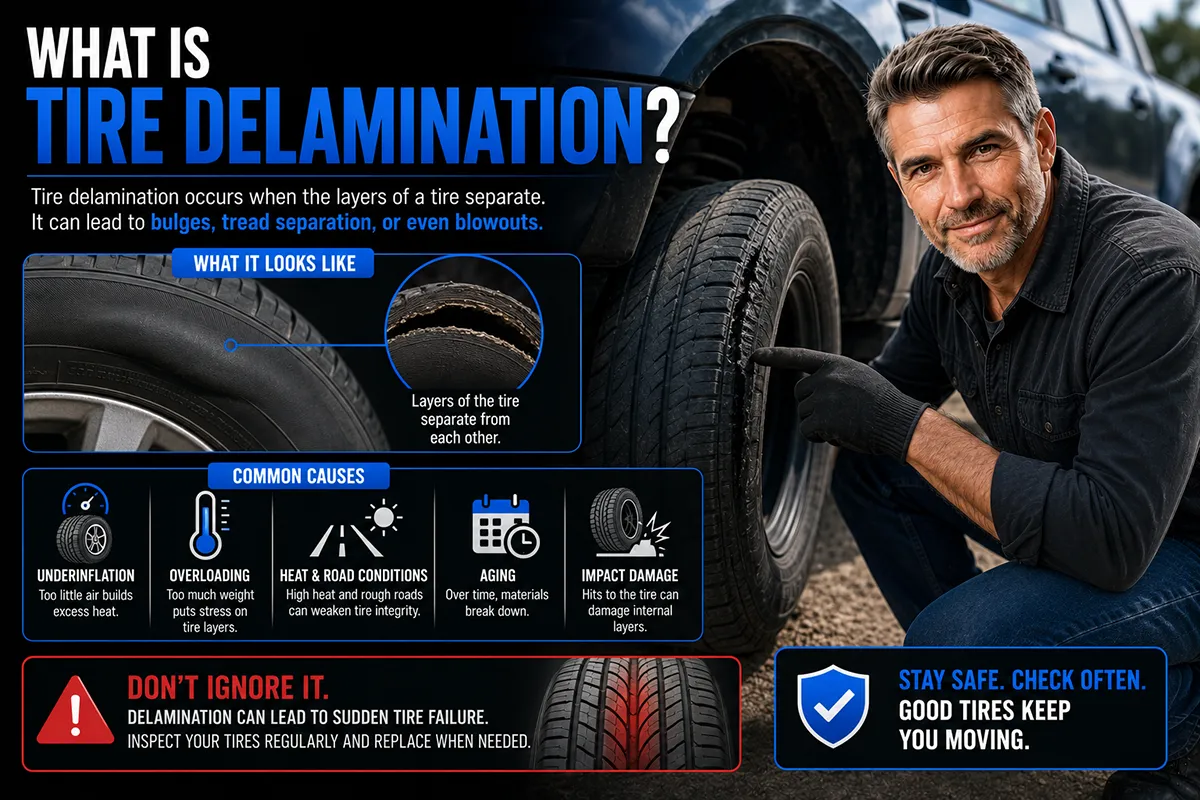
- Tire delamination is the separation of internal tire layers, especially the tread from the steel belts beneath it.
- Common causes include heat, underinflation, manufacturing defects, age, and impact damage.
- Warning signs include bubbles, vibrations, uneven tread wear, and visible bulges on the sidewall or tread face.
- Delamination can lead to sudden tread separation at highway speed — a life-threatening event.
- Regular inspections, proper inflation, and replacing tires before they age out (6–10 years) are your best defenses.
- If you suspect delamination, do NOT keep driving — replace the tire immediately.
Liked this article?
Add TireAdvise as a preferred source so you see more of our tire reviews and guides on Google.
What Exactly Is Tire Delamination?
To understand delamination, you need to understand how a tire is built. A modern radial tire isn’t just a solid ring of rubber. It’s a carefully engineered sandwich of layers — rubber compounds, textile plies, steel belts, bead wire, and more — all bonded together under heat and pressure during manufacturing.
Delamination occurs when those internal layers separate from each other. Most commonly, it’s the tread rubber separating from the steel belt package directly beneath it. But it can also happen between belt layers, between the body ply and the inner liner, or in the sidewall area.
I think of it like plywood that’s been exposed to water — eventually, the layers start peeling apart. Except with a tire, that peeling can happen at 70 mph on a Texas highway in July, and the consequences can be catastrophic.
Why It’s Different from a Blowout
A blowout is a sudden, rapid loss of air pressure — essentially, the tire structure fails and the air escapes violently. Delamination is the process that often *leads to* a blowout, but it’s a distinct phenomenon.
In my experience inspecting failed tires, delamination usually starts slowly. The bond between layers weakens over time, creating a pocket where air, heat, or moisture can infiltrate. That pocket grows. The tread may start to shift or wobble. And then, at the worst possible moment, the tread peels right off the tire.
I’ve seen tires where the delamination was caught early — a slight bulge, a subtle vibration — and the driver avoided disaster. I’ve also seen the aftermath when it wasn’t caught. The difference between those two outcomes is knowledge, and that’s exactly why I’m writing this.
What Causes Tire Delamination?
Over the years, I’ve narrowed down the most common causes of delamination to a handful of key factors. Some of these are within your control. Others aren’t. But understanding all of them helps you make smarter tire-buying decisions.
1. Underinflation (The #1 Culprit I See)
If I had to pick the single most common cause of delamination in tires I’ve inspected, it’s chronic underinflation. When a tire runs low on air, the sidewalls flex excessively. That excessive flexing generates heat — a lot of it.
Heat is the enemy of the adhesive bonds holding tire layers together. Over time, the repeated thermal cycling from running underinflated weakens those bonds until separation begins. I’ve personally seen tires that were only slightly underinflated — maybe 5-8 psi below spec — develop early-stage delamination after a relatively short period of driving.
The frustrating part? Most drivers don’t check their tire pressure regularly. According to the NHTSA, roughly one in four cars on US roads has at least one significantly underinflated tire at any given time. That’s a staggering number when you consider what’s at stake.
2. Heat and Hot Climate Driving
Living and driving in hot climates accelerates tire aging and delamination risk dramatically. I’ve reviewed tires in Arizona, Texas, Florida, and Southern California, and I can tell you firsthand that heat is relentless on rubber compounds.
Pavement temperatures in Phoenix can exceed 150°F in summer. Your tires are already generating internal heat from flexing and friction — add scorching asphalt to the equation, and you’ve got a recipe for accelerated bond failure. This is one of the reasons I always tell drivers in the Sun Belt to be more aggressive about tire inspections and replacement timelines.
3. Manufacturing Defects
Not all delamination is the driver’s fault. Manufacturing defects — contamination during the bonding process, insufficient curing, improper rubber compounding, or foreign material trapped between layers — can cause delamination even on relatively new tires.
I’ve personally encountered brand-new tires from reputable manufacturers that showed signs of tread separation within the first few weeks of use. It’s rare, but it happens. This is why I always recommend buying from established, reputable brands and purchasing from authorized dealers who will honor warranty claims.
The infamous Ford Explorer/Firestone tire recall of 2000 — which involved approximately 6.5 million tires — was fundamentally a delamination issue caused by manufacturing and design problems. That recall resulted in hundreds of deaths and remains one of the most significant automotive safety events in US history.
4. Tire Age
Rubber degrades over time, even if a tire is sitting in a warehouse or mounted on a car that’s rarely driven. The chemical bonds that hold a tire together weaken through a process called oxidation.
Most tire manufacturers and safety organizations, including the NHTSA, recommend replacing tires that are 6 to 10 years old regardless of remaining tread depth. I personally lean toward the conservative end of that range — I start getting uncomfortable with any tire over 6 years old, especially if it’s been exposed to heat and UV light.
You can check your tire’s age by reading the DOT code on the sidewall. The last four digits tell you the week and year of manufacture. For example, “2319” means the tire was made in the 23rd week of 2019.
5. Impact Damage and Road Hazards
Hitting a pothole, curb, or road debris at speed can damage the internal structure of a tire without leaving any visible external evidence. I’ve reviewed tires that looked perfectly fine on the outside but had internal belt separation caused by a single hard impact.
This type of damage is insidious because you might not notice anything immediately. The delamination can develop gradually over days or weeks after the impact, eventually revealing itself as a vibration, bulge, or — in the worst case — a sudden tread separation.
If you hit something hard enough to jar the car, I always recommend having that tire inspected by a professional as soon as possible.
6. Overloading
Every tire has a maximum load rating, and exceeding it puts enormous stress on the internal structure. I see this frequently with pickup truck and SUV owners who load up for camping trips, towing, or hauling without considering whether their tires are rated for the additional weight.
Overloading causes the same excessive flex and heat buildup as underinflation. In fact, the two problems often compound each other — an overloaded vehicle with slightly low tire pressure is a delamination time bomb.
Warning Signs of Tire Delamination
One of the things that scares me most about delamination is that it often develops internally before any external signs appear. But there *are* warning signs if you know what to look for, and I want to make sure every reader of this article can spot them.
Vibration or Shaking
If you feel a new vibration through the steering wheel or seat — especially one that wasn’t there before and gets worse at highway speeds — delamination should be on your list of suspects. I’ve driven on tires with early-stage delamination during controlled testing, and the vibration is distinct. It’s often rhythmic, corresponding to the rotation of the affected tire, and it tends to worsen as speed increases.
Don’t just assume a vibration is a balance issue. If a balance and alignment check comes back clean and the vibration persists, have a technician physically inspect the tire.
Bulges and Bubbles
A bulge on the sidewall or tread face is a screaming red flag. It means the internal structure has already separated, and air pressure is pushing outward against the weakened area. I’ve seen bulges ranging from marble-sized to fist-sized, and every single one of them represents an imminent failure risk.
If you see a bulge, do not drive on that tire. Period. I don’t care if it’s a brand-new tire. Mount your spare and get to a tire shop.
Uneven or Wavy Tread Wear
Delamination can cause the tread surface to distort slightly, leading to unusual wear patterns. If you run your hand across the tread and feel high and low spots — almost like a wave pattern — the tread may be separating from the belt beneath it.
During my tire reviews, I always check for this by running my palm flat across the tread surface. It’s a quick, easy check that any driver can do at home.
Cracking in the Sidewall or Tread Grooves
While cracking alone doesn’t always mean delamination is occurring, it’s a sign of rubber degradation that makes delamination more likely. Deep cracks in the tread grooves or sidewall tell me the rubber is losing its elasticity and its ability to maintain bonds with the layers beneath it.
I see this most often on older tires and tires that spend a lot of time parked in direct sunlight.
Thumping Noise
A rhythmic thumping sound — almost like you’re driving over a series of small bumps — can indicate that a section of tread has begun to lift. The separated section “slaps” the pavement with each revolution. If you hear this, pull over safely and inspect your tires immediately.
How Dangerous Is Tire Delamination?
I’m not going to sugarcoat this: tire delamination is one of the most dangerous tire failures you can experience. When the tread separates from a tire at highway speed, the driver often loses control of the vehicle. The sudden asymmetry in the tire can pull the car violently to one side, and the flailing tread can damage brake lines, fender liners, and other components.
The NHTSA estimates that tire-related crashes cause approximately 11,000 accidents per year in the United States. While not all of those are delamination-specific, tread separation is a significant contributor, especially in hot-weather states and among vehicles running on aged or underinflated tires.
I’ve spoken with emergency responders who’ve told me that tread separation accidents on highways are among the most violent single-vehicle crashes they see. The combination of high speed and sudden loss of vehicle control is a deadly one.
Vehicles Most at Risk
In my experience, certain types of vehicles are more susceptible to delamination-related incidents:
- SUVs and trucks with a high center of gravity: Tread separation at speed can trigger a rollover event more easily in tall vehicles.
- Vehicles running on aged tires: Spare tires, trailer tires, and tires on cars that are driven infrequently are often well past their safe service life.
- Heavily loaded vehicles: Pickup trucks used for hauling, RVs, and vehicles towing trailers place extra stress on tires.
- Cars with mismatched or budget tires: Some ultra-budget tire brands cut corners on manufacturing quality control, increasing delamination risk.
Tire Delamination vs. Other Tire Failures: A Comparison
I find it helpful to compare delamination to other common tire failures so you can understand what makes it unique — and uniquely dangerous.
| Failure Type | What Happens | Warning Signs | Typical Cause | Danger Level |
|---|---|---|---|---|
| Delamination | Internal layers separate; tread may peel off | Vibration, bulges, uneven wear, thumping | Heat, underinflation, age, defects | Very High |
| Blowout | Sudden, explosive loss of air pressure | Loud bang, rapid deflation, pulling | Puncture, overload, delamination, road hazard | Very High |
| Slow Leak / Puncture | Gradual air loss from a small hole | TPMS warning, visible nail/screw, low tire | Road debris, valve stem failure | Moderate |
| Sidewall Damage | Cut, gouge, or crack in the sidewall | Visible damage, bulge, air loss | Curb contact, road hazard, age | High |
| Bead Failure | Tire unseats from the rim | Air loss, visible gap at rim edge | Improper mounting, corrosion, impact | High |
As you can see, delamination is at the top of the danger scale — partly because it can happen with little warning and partly because the resulting tread separation is so difficult to control at speed.
Can a Delaminated Tire Be Repaired?
No. Absolutely not. I want to be crystal clear about this.
A tire experiencing delamination cannot be repaired, retreaded, or made safe again. The structural integrity of the tire has been compromised at a fundamental level. No patch, plug, or sealant can re-bond internal layers that have separated.
I’ve had readers ask me whether a “minor” bulge can be monitored and driven on carefully. My answer is always the same: replace it. The cost of a new tire — even a good one — is a fraction of what a tread separation accident can cost you in vehicle damage, medical bills, or worse.
How to Prevent Tire Delamination
The good news is that most delamination is preventable. Here’s what I do personally, and what I recommend to every driver I talk to:
Check Your Tire Pressure Monthly
I keep a quality digital tire pressure gauge in my glove box and check all four tires (plus the spare) at least once a month. I do it in the morning before driving, when the tires are cold, because that gives me the most accurate reading.
Your vehicle’s recommended tire pressure is on a sticker inside the driver’s door jamb — not the number on the tire sidewall (that’s the maximum, not the recommended pressure). Maintaining proper inflation is the single most effective thing you can do to prevent delamination.
Inspect Your Tires Regularly
Every couple of weeks, I do a visual walk-around. I’m looking for bulges, cracks, uneven wear, objects lodged in the tread, and anything that just doesn’t look right. It takes less than five minutes and could save your life.
I also recommend getting your tires professionally inspected during every oil change or routine service visit. A trained technician can catch things you might miss, especially on the inner sidewall that’s harder to see.
Replace Tires Before They Age Out
Regardless of tread depth, I replace my tires when they reach 6 years of age. If the tires have been exposed to extreme heat or stored improperly, I might replace them even sooner. Rubber doesn’t last forever, and the risk of delamination increases significantly with age.
Don’t forget about your spare tire. I’ve seen countless spare tires — especially the full-size spares mounted under trucks and SUVs — that were well over a decade old. That spare is supposed to save you in an emergency; it can’t do that if it’s delaminating.
Buy Quality Tires from Reputable Brands
I’ve reviewed tires across every price point, and I’ll be honest with you: not all tires are created equal. Premium and mid-range brands like Michelin, Bridgestone, Continental, Goodyear, Cooper, and General invest heavily in quality control, materials science, and manufacturing processes that minimize the risk of delamination.
That doesn’t mean you need to buy the most expensive tire on the shelf. But I’d steer you away from unknown brands with no track record, especially those sold through gray-market channels where you can’t verify manufacturing date or storage conditions.
Avoid Overloading Your Vehicle
Check your vehicle’s load capacity on the same door jamb sticker where you find tire pressure information. If you regularly haul heavy loads or tow trailers, consider upgrading to tires with a higher load rating — and make sure your inflation pressure is adjusted upward per the manufacturer’s recommendations for loaded driving.
Drive Responsibly
Aggressive driving — hard braking, fast cornering, high-speed driving on hot pavement — generates extra heat in your tires. I’m not saying you need to drive like a grandparent, but being mindful of how driving style affects tire temperature and wear can extend the safe life of your tires.
What to Do If You Suspect Delamination While Driving
If you suddenly feel a strong vibration, hear a thumping sound, or notice your vehicle pulling to one side, here’s what I recommend:
- Do NOT brake hard. A sudden deceleration can cause the weakened tire to fail completely and may trigger a loss of control, especially at highway speed.
- Gradually reduce speed. Ease off the accelerator slowly and let the vehicle decelerate naturally.
- Keep a firm grip on the steering wheel. The car may pull in the direction of the affected tire. Resist the urge to overcorrect.
- Signal and move to the shoulder safely. Get off the road as soon as you can do so without putting yourself or others at risk.
- Turn on your hazard lights. Alert other drivers to your situation.
- Do not attempt to drive on the tire. Even if it hasn’t fully failed, driving further will only make the situation worse. Mount your spare or call for roadside assistance.
I’ve practiced this response scenario myself, and I encourage every driver to mentally rehearse it. When a tire lets go at highway speed, you won’t have time to Google what to do — your response needs to be instinctive.
Delamination and Tire Warranties: What You Need to Know
If delamination occurs on a tire that’s relatively new and hasn’t been abused, you may be covered under the manufacturer’s warranty. Most major tire brands offer workmanship and materials warranties that cover defects like internal layer separation.
Here’s what I’ve learned from helping readers navigate warranty claims:
- Keep your receipt. Proof of purchase is almost always required.
- Buy from authorized dealers. Tires purchased from unauthorized sellers or online gray-market sources may not be eligible for warranty coverage.
- Don’t destroy the tire. If you suspect a manufacturing defect, keep the failed tire. The manufacturer may want to inspect it.
- Act quickly. Most warranties have time limits (typically 4-6 years from the date of purchase or the DOT date).
- Document everything. Take photos of the failure, note the DOT code, and record any vehicle data (mileage, service history) that supports your claim.
In my experience, major brands like Michelin, Goodyear, and Continental have solid warranty processes. I’ve seen legitimate defect claims resolved with full replacement at no cost to the driver. Budget brands, on the other hand, can be much harder to deal with — another reason I recommend sticking with established names.
Special Considerations for Truck, SUV, and Trailer Tires
I want to call out a few vehicle types that I believe face elevated delamination risk based on my testing and research.
Light Truck and SUV Tires
Trucks and SUVs are workhorses in America, and their tires take a beating. The combination of heavy loads, higher center of gravity, and the fact that many truck owners run their tires longer than they should makes delamination a real concern.
If you drive a half-ton pickup or full-size SUV, I recommend paying extra attention to load ratings, inflation pressure, and tire age. I’ve reviewed LT (Light Truck) tires specifically designed for heavier-duty use, and they’re worth the investment if you haul or tow regularly.
Trailer Tires
Trailer tires are arguably the most neglected tires on American roads. They sit in driveways baking in the sun, they’re rarely checked for pressure, and they’re often run well past their safe service life. I’ve inspected trailer tires with DOT codes indicating they were manufactured over 12 years ago — that’s a delamination failure waiting to happen.
If you own a boat trailer, utility trailer, or travel trailer, please check your tire dates and pressure before every trip. It’s a five-minute task that could prevent a catastrophic failure on the highway.
RV Tires
RV tires carry enormous loads and often sit parked for months at a time, which accelerates UV degradation and flat-spotting. I’ve spoken with RV tire specialists who tell me that delamination is one of the most common failure modes they see.
If you own an RV, I strongly recommend investing in tire covers for long-term storage, checking pressure before every trip, and replacing tires on a calendar basis rather than waiting for tread wear.
How Tire Delamination Relates to Your Tire Buying Decision
Everything I’ve discussed in this article should inform how you shop for your next set of tires. Here’s my bottom-line advice as someone who reviews tires for a living:
Don’t Buy the Cheapest Option Just Because It’s Cheap
I understand budget constraints — trust me, I do. But I’ve seen firsthand how certain ultra-budget tires cut corners in ways that directly affect structural integrity. Manufacturing quality control, rubber compounding, and belt adhesion technology all cost money, and those costs are reflected in the price.
A mid-range tire from a brand like Cooper, General, Falken, or Hankook gives you strong delamination resistance without breaking the bank. I’ve tested all of these extensively and feel confident recommending them.
Check the DOT Date Before You Buy
Even at reputable tire shops, it’s possible to receive a tire that’s been sitting in a warehouse for a few years. Before installation, I always check the DOT code to verify the manufacturing date. I prefer tires that are less than a year old at the time of purchase, and I won’t accept anything older than two years.
Choose the Right Tire for Your Driving Conditions
A tire designed for your specific driving conditions — climate, vehicle type, load requirements — will perform more safely and last longer than a generic option. If you live in the southern US, look for tires with compounds specifically engineered for heat resistance. If you tow regularly, invest in a proper LT-rated tire.
Prioritize Brands with Strong Warranties
A manufacturer that stands behind its product with a comprehensive warranty is a manufacturer that’s confident in its quality control. I always factor warranty coverage into my tire recommendations, and I think you should too.
My Final Thoughts on Tire Delamination
Tire delamination isn’t an exotic or rare failure mode — it’s something that happens every day on US roads, and it’s responsible for accidents, injuries, and deaths that could be prevented. In my years of reviewing and testing tires, I’ve come to believe that awareness and basic maintenance are the two most powerful tools a driver has against this threat.
Check your tire pressure. Inspect your tires visually. Know the age of every tire on your vehicle, including the spare. Buy quality products from reputable sources. And if something doesn’t look or feel right, don’t gamble — get it checked.
Your tires are the only thing connecting your vehicle to the road. They deserve your attention, and understanding delamination is a critical part of being a safe, informed driver. I hope this guide has given you the knowledge and confidence to protect yourself and your family on the road.
Frequently Asked Questions
What is tire delamination and how does it happen?
Tire delamination occurs when the internal layers of a tire, specifically the tread or belt layers, separate from each other due to a breakdown in the bonding between rubber and steel belts. This is often caused by manufacturing defects, prolonged exposure to extreme heat on US highways, underinflation, or age-related degradation. When the layers separate, the tire loses structural integrity and can fail catastrophically at highway speeds.
What are the early warning signs of tire delamination?
The most common early signs of tire delamination include bulges, bubbles, or blisters on the tire sidewall or tread surface, as well as unusual vibrations or wobbling while driving. You may also notice uneven tread wear patterns or a thumping sound at higher speeds. If I spot any of these symptoms, I immediately reduce speed and have the tire inspected by a professional before driving further.
Can tire delamination cause a blowout while driving?
Yes, tire delamination is one of the leading causes of sudden blowouts, especially during highway driving in hot climates like the southern US states where pavement temperatures can exceed 150°F. When the tread separates from the tire body at high speed, you can lose vehicle control almost instantly. This is why checking for signs of delamination during routine tire inspections is critical for safe driving.
How much does it cost to replace a delaminated tire in the US?
Replacing a single delaminated tire typically costs between $100 and $300 for most passenger vehicles, depending on the tire brand and size, with popular US-market brands like Goodyear, Cooper, and Michelin falling in that range. If the delamination is caused by a verified manufacturing defect, many tire manufacturers will honor their warranty and provide a prorated replacement. I always recommend replacing at least both tires on the same axle to maintain balanced handling and traction.
Are certain tire brands or types more prone to delamination?
While delamination can happen to any tire, budget or off-brand tires that cut corners on manufacturing quality tend to be more susceptible than reputable brands like Bridgestone, Michelin, or Goodyear. Tires that have been recalled by NHTSA in the past often had delamination-related defects, so I always check the NHTSA recall database before purchasing replacement tires. High-performance and trailer tires also face higher delamination risk due to the extreme loads and heat they endure.
Can underinflation or overloading cause tire delamination?
Absolutely — chronic underinflation is one of the most common driver-caused reasons for tire delamination because it generates excessive heat buildup inside the tire, weakening the bond between internal layers. Overloading your vehicle beyond its tire load rating has the same effect, and this is especially common with SUVs and pickup trucks hauling heavy cargo across US interstates. I check my tire pressure at least once a month and always before long road trips to minimize this risk.
How can I prevent tire delamination on my vehicle?
The best ways to prevent tire delamination include maintaining proper tire pressure according to your vehicle’s door placard, avoiding overloading your vehicle, and replacing tires that are older than six years regardless of remaining tread depth. I also recommend storing vehicles out of direct sunlight when possible, since UV exposure and heat accelerate rubber degradation in states with intense summers. Purchasing tires from reputable US-market brands and inspecting them regularly for bulges or irregular wear will significantly reduce your delamination risk.
