

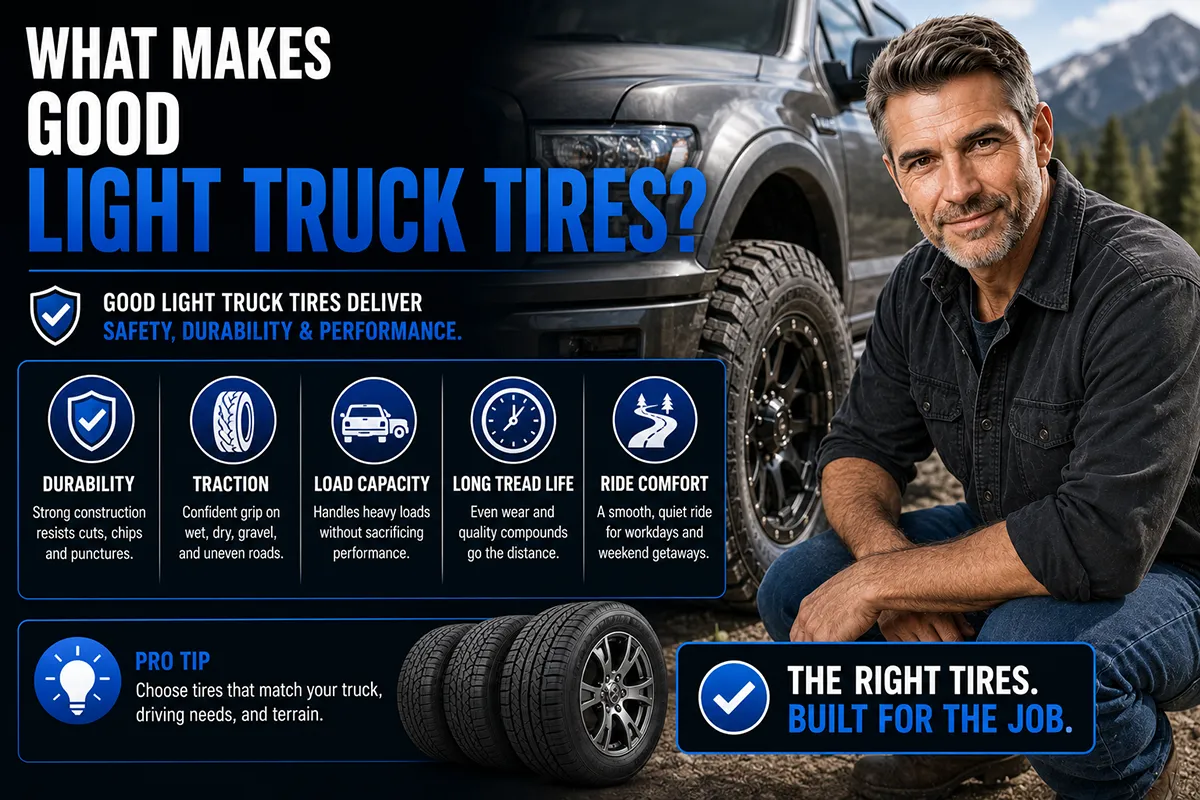
If you’ve ever stood in a tire shop staring at a wall of light truck tires, each one promising to be the best, you know how overwhelming the decision can be.
I’ve been there more times than I can count — both as a consumer and as someone who tests and reviews tires for a living. The truth is, not all light truck tires are created equal, and the wrong choice can cost you hundreds of dollars, compromise your safety, and leave you frustrated every time you get behind the wheel.
After years of testing dozens of light truck tires across every terrain and condition the US has to offer, I’ve learned exactly what separates the great ones from the forgettable ones. Let me walk you through everything I know.
- Good light truck tires balance load capacity, tread life, traction, and ride comfort for your specific use case.
- The LT designation matters — it means the tire is built to handle heavier loads and tougher conditions than a standard passenger tire.
- Tread pattern, rubber compound, sidewall construction, and speed rating all play critical roles in real-world performance.
- Highway all-season LT tires suit most daily drivers, but all-terrain and mud-terrain options exist for those who need them.
- Don’t just chase the lowest price — a well-chosen tire pays for itself in longevity, fuel economy, and safety.
- I recommend matching your tire choice to your actual driving habits, not the most aggressive-looking option on the shelf.
Liked this article?
Add TireAdvise as a preferred source so you see more of our tire reviews and guides on Google.
Why Light Truck Tires Are Different From Passenger Tires
Before I dive into what makes a good light truck tire, I need to clear up a common misconception. A lot of truck and SUV owners don’t realize that their vehicle may actually be running on passenger-rated (P-metric) tires from the factory, even though light truck (LT) tires exist for their vehicle size.
The difference is significant. LT tires are engineered with reinforced sidewalls, stiffer construction, and higher load-carrying capacity. They’re designed for vehicles that tow, haul, or regularly carry heavy loads. If you drive a half-ton pickup like a Ford F-150, Ram 1500, or Chevy Silverado 1500, you might be perfectly fine with P-metric tires for daily commuting. But the moment you start towing a boat, hauling lumber, or loading up for a cross-country move, LT-rated tires become essential.
In my experience, switching from a P-metric tire to a proper LT tire on a truck that regularly carries loads transforms the driving experience. The truck feels more planted, the steering is more predictable under load, and you gain a meaningful margin of safety.
The Core Qualities I Look For in Every Light Truck Tire
After testing more light truck tires than I can keep track of, I’ve boiled down the essential qualities into a handful of categories. These are the factors I evaluate every single time, and they’re the same ones you should be thinking about when shopping.
1. Load Capacity and Ply Rating
This is the foundation of any light truck tire. The load range — typically indicated by a letter like C, D, or E — tells you how much weight that tire can safely support at its maximum inflation pressure.
A Load Range E tire, for example, can typically handle significantly more weight per tire than a Load Range C. But here’s the tradeoff I’ve noticed in my testing: higher load ranges mean stiffer sidewalls, which often translates to a firmer, less comfortable ride when the truck is unloaded.
I always tell people to match the load range to their actual needs. If you’re towing a 7,000-pound travel trailer on weekends, you need that Load Range E. If your truck is primarily a daily commuter that occasionally picks up mulch from the garden center, a Load Range C or D might serve you better and ride more comfortably.
2. Tread Life and Durability
Nobody wants to replace tires more often than necessary. Good light truck tires should deliver long, even tread wear across their lifespan.
In my testing, the tires that wear the longest tend to share a few traits: harder rubber compounds, symmetrical or optimized tread designs, and good resistance to irregular wear like cupping or feathering. I’ve also found that keeping up with rotations and alignment makes an enormous difference — even the best tire will wear poorly on a misaligned truck.
The UTQG treadwear rating on the sidewall gives you a comparative baseline, but I’d caution against relying on it as gospel. I’ve tested tires with identical UTQG ratings that performed very differently in real-world conditions. Treat it as a starting point, not a guarantee.
3. Traction in Wet and Dry Conditions
This one is non-negotiable for me. A good light truck tire needs to grip confidently on both dry pavement and wet roads.
Dry traction on light truck tires is generally not the problem — most LT tires grip well on clean, dry asphalt. Where they separate themselves is in wet performance. I pay close attention to how a tire handles hard braking on wet roads, how it behaves during highway driving in rain, and whether it begins to hydroplane at speed.
The tires that perform best in wet conditions typically have wide circumferential grooves, numerous lateral sipes, and tread compounds that remain pliable enough to conform to the road surface. During my testing over the past several years, I’ve found that some all-terrain tires actually match or exceed highway tires in wet braking, which surprised me.
4. Ride Comfort and Road Noise
This is where many truck owners get caught off guard. You can buy the toughest, most aggressive-looking tire on the market, but if it drones like a prop plane at highway speed and jolts you over every expansion joint, you’re going to hate your daily commute.
In my experience, ride comfort in LT tires comes down to sidewall construction and tread design. Tires with more flexible sidewalls absorb bumps better. Tires with variable-pitch tread patterns — where the tread blocks are slightly different sizes — do a much better job of canceling out road noise.
I’ve driven trucks where swapping from one tire to another turned the cabin from uncomfortably loud to genuinely pleasant. If you spend a lot of time on the highway, don’t underestimate how much tire choice affects your daily quality of life.
5. Off-Road and All-Terrain Capability
Not every light truck tire needs to conquer Moab. But if you live on a dirt road, deal with muddy job sites, or enjoy the occasional trail, you need a tire that won’t leave you stranded.
I categorize light truck tires into three broad buckets: highway all-season (HT), all-terrain (AT), and mud-terrain (MT). Highway tires are optimized for pavement. All-terrains split the difference between road manners and off-road grip. Mud-terrains are built for the rough stuff but sacrifice road comfort and noise.
For most truck owners I talk to, an all-terrain tire is the sweet spot. Modern all-terrains have gotten remarkably good at doing both jobs. During my tests, some of the latest all-terrain offerings delivered highway comfort that was nearly indistinguishable from a dedicated highway tire while still performing admirably on gravel, packed dirt, and light mud.
6. Winter and Cold-Weather Performance
If you live anywhere in the northern half of the US, winter performance matters — even if you’re not driving through blizzards. Cold temperatures alone cause standard rubber compounds to stiffen, which reduces grip.
I always check whether a light truck tire carries the Three-Peak Mountain Snowflake (3PMSF) symbol. This designation means the tire has been tested and proven to meet a minimum threshold of snow traction. Many of the best all-terrain tires now carry this rating, which makes them a compelling year-round option for drivers in states like Michigan, Minnesota, Colorado, or upstate New York.
That said, I’ve found that a dedicated winter tire still outperforms even the best 3PMSF-rated all-terrain in serious snow and ice. If you live where winters are brutal and prolonged, I recommend a dedicated set of winter tires on a second set of wheels.
Understanding Light Truck Tire Sizing and Markings
I know tire sidewall markings look like hieroglyphics, but understanding them is one of the most empowering things you can do as a tire buyer. Let me break down what you’re actually reading.
A typical light truck tire size looks like this: LT265/70R17 121/118S E
- LT — Light Truck designation, meaning this tire is built for truck-level loads.
- 265 — Tread width in millimeters.
- 70 — Aspect ratio (the sidewall height is 70% of the tread width).
- R — Radial construction.
- 17 — Fits a 17-inch wheel.
- 121/118 — Load index for single and dual rear wheel configurations.
- S — Speed rating (112 mph in this case).
- E — Load Range E (10-ply rated).
The load index is particularly important for light truck tires. It directly tells you the maximum weight each tire can carry when properly inflated. I always recommend checking your vehicle’s door placard for the recommended tire size and load rating — deviating from it without understanding the implications can create safety issues.
Highway vs. All-Terrain vs. Mud-Terrain: Which Type Do You Actually Need?
This is the single most important decision you’ll make, and I see people get it wrong all the time. Let me lay it out clearly.
| Feature | Highway (HT) | All-Terrain (AT) | Mud-Terrain (MT) |
|---|---|---|---|
| Road Comfort | Excellent | Good to Very Good | Fair to Poor |
| Road Noise | Very Quiet | Moderate | Loud |
| Wet Traction | Very Good | Good to Very Good | Fair |
| Off-Road Grip | Poor | Good to Very Good | Excellent |
| Mud Performance | Very Poor | Fair to Good | Excellent |
| Snow Traction | Fair (unless 3PMSF) | Good (many are 3PMSF) | Fair to Good |
| Tread Life | Excellent | Good to Very Good | Fair to Good |
| Fuel Economy Impact | Minimal | Slight decrease | Noticeable decrease |
| Typical Price Range (per tire) | $150 – $280 | $180 – $350 | $250 – $400+ |
My Recommendation for Most Drivers
If 80% or more of your driving is on paved roads, a highway all-season LT tire is the smartest buy. You’ll get the longest tread life, the best fuel economy, the quietest ride, and perfectly adequate traction for rain and light snow.
If you regularly encounter gravel roads, unpaved job sites, hunting trails, or moderate off-road conditions, an all-terrain tire is where I’d steer you. The best modern ATs barely compromise on-road comfort while giving you genuine off-road confidence.
Mud-terrain tires should be reserved for people who actually drive in mud, rock, and extreme off-road conditions on a regular basis. I’ve tested plenty of MTs, and while they’re extraordinary in their element, they are genuinely unpleasant for daily highway driving. The noise, the reduced fuel economy, and the faster tread wear on pavement make them a poor choice for a truck that mostly sees asphalt.
The Role of Rubber Compound and Construction
This is something most tire buyers never think about, but it’s one of the biggest differentiators I’ve noticed across the tires I’ve tested.
Rubber Compound
The rubber compound is the material the tread is made from, and it dramatically affects grip, wear rate, noise, and rolling resistance. Harder compounds last longer but tend to offer less wet grip. Softer compounds grip better but wear faster.
The best light truck tire manufacturers use multi-compound tread designs — harder rubber in the center for longevity and softer rubber on the shoulders for grip during cornering and wet braking. In my testing, I’ve noticed this approach delivers the best real-world balance, and it’s a hallmark of premium tires.
Some brands also incorporate silica-enriched compounds, which maintain flexibility in cold temperatures. This is why certain all-season tires perform noticeably better in winter conditions — the rubber literally stays softer and grippier when temperatures drop below 45°F.
Internal Construction
What’s inside the tire matters just as much as what’s on the outside. Light truck tires typically use steel belts under the tread for puncture resistance and stability, along with polyester body plies for flexibility.
Higher-end LT tires often add extra reinforcements — things like a nylon cap ply over the steel belts to help the tire maintain its shape at high speeds and under heavy loads. I’ve found that tires with this extra layer tend to feel more stable on the highway, especially when loaded or towing.
What Good Light Truck Tires Look Like in Real-World Driving
I can talk about specs all day, but what really matters is what happens when rubber meets road. Here’s what I’ve consistently experienced with the best light truck tires I’ve tested.
Confident Towing and Hauling
When I’m towing a loaded trailer, the last thing I want is a tire that feels squirmy or vague. The best LT tires I’ve tested provide rock-solid stability under load. The truck tracks straight, lane changes feel controlled, and braking distances remain predictable even at highway speeds with a trailer attached.
I’ve noticed that cheaper, lower-quality LT tires tend to develop a noticeable sway or wandering sensation when heavily loaded. This isn’t just uncomfortable — it’s dangerous.
Predictable Wet Weather Behavior
I do a lot of my testing in rainy conditions because that’s where tires reveal their true character. A good light truck tire should inspire confidence in the rain — not make you white-knuckle the steering wheel.
The best performers evacuate water efficiently and maintain grip during braking and cornering. I’ve tested tires that felt fine in the dry but became genuinely sketchy in a moderate downpour. That’s not a tire I’d recommend to anyone.
Even, Predictable Wear
Over extended test periods, I monitor tread wear carefully. The best light truck tires wear evenly across the entire tread face, assuming the truck’s alignment and inflation are correct.
I’ve seen tires that looked great initially but developed center wear, shoulder wear, or cupping patterns surprisingly quickly. Often, this is a sign of suboptimal tread design or poor compound choices. Sometimes it’s a manufacturing quality issue. Either way, it’s a dealbreaker for me.
Common Mistakes I See Truck Owners Make When Buying LT Tires
I’ve talked to hundreds of truck owners over the years, and certain mistakes come up again and again.
Buying the Wrong Load Range
This is the most dangerous mistake. If your truck requires a Load Range E tire for towing and you install Load Range C tires because they ride better, you’re operating outside the tire’s safe capacity. I’ve seen the consequences of this, and they’re not pretty.
Always check your vehicle’s requirements. Your owner’s manual and the tire information placard on the driver’s door jamb will tell you exactly what you need.
Choosing Looks Over Function
I get it — those aggressive mud-terrain tires look incredible on a lifted truck. But if your truck never leaves pavement, you’re paying more for a tire that performs worse in every category that actually matters to you: road noise, ride comfort, fuel economy, and tread life.
I always encourage people to be honest with themselves about how they actually use their truck. There’s no shame in a highway tire — it’s actually the smarter choice for most drivers.
Ignoring Inflation Pressure
Light truck tires are especially sensitive to inflation pressure because their load capacity is directly tied to it. An underinflated LT tire doesn’t just wear faster — it may not be able to safely carry the weight it’s rated for.
I check my tire pressures at least once a month and always before any towing trip. If you’re not doing this, you’re undermining whatever tire you buy.
Skipping the Alignment After Installation
A fresh alignment when you install new tires is one of the best investments you can make. I’ve seen perfect tires develop irregular wear patterns within a few weeks because the truck’s alignment was off. It’s typically $80 to $120 at most shops — a small price to pay to protect a $1,000+ tire investment.
Brands That Consistently Impress Me in the LT Tire Space
I’m not going to recommend a single specific tire here because the “best” tire depends entirely on your truck, your driving conditions, and your priorities. But I can share which brands have consistently delivered quality across the LT tires I’ve tested.
Michelin consistently impresses me with ride comfort, tread life, and wet performance. Their LT offerings tend to command a premium price, but in my experience, you get what you pay for.
BFGoodrich (owned by Michelin) has a long and well-deserved reputation in the all-terrain and off-road space. The toughness and off-road capability I’ve experienced with their products is hard to beat.
Toyo is a brand I think deserves more attention. Their light truck tires have impressed me with strong build quality, competitive pricing, and genuinely good all-around performance.
Falken has been a pleasant surprise in recent years. Their AT and highway LT tires have shown significant improvement, and I’ve found them to be excellent values.
Cooper is another strong contender, especially for value-conscious buyers. I’ve tested several Cooper LT tires that punch well above their price point.
Goodyear and Continental round out the premium tier with consistently solid performers, particularly on the highway side.
I’d caution against ultra-budget, no-name LT tires from brands you’ve never heard of. In my testing, there’s a noticeable quality gap in construction, rubber quality, and performance consistency. Your tires are the only thing connecting your truck to the road — this isn’t where I’d cut corners.
How Much Should You Expect to Spend?
Light truck tires are more expensive than passenger tires. This is simply a reality of the heavier construction and materials involved.
For a typical set of four LT tires in a common size like LT265/70R17, here’s roughly what I see in the current US market:
- Budget tier: $140 – $180 per tire ($560 – $720 for a set of four)
- Mid-range tier: $180 – $260 per tire ($720 – $1,040 for a set of four)
- Premium tier: $260 – $370 per tire ($1,040 – $1,480 for a set of four)
Add in mounting, balancing, disposal fees, and alignment, and you’re typically looking at another $100 to $200 on top of the tire cost.
In my experience, the mid-range tier offers the best value for most truck owners. You get meaningfully better performance, comfort, and longevity compared to budget tires without paying the full premium tax. That said, if you tow frequently or put serious demands on your tires, the premium tier is often justified by its superior durability and performance margins.
Maintenance Tips to Get the Most Out of Your Light Truck Tires
Even the best tire in the world will underperform if you neglect basic maintenance. Here’s what I do with every set of LT tires I run.
Check Pressure Regularly
I check my tire pressure every two to four weeks, always when the tires are cold (before driving). LT tires should be inflated to the pressure specified on your vehicle’s door placard — not necessarily the maximum pressure listed on the tire sidewall. These are two different numbers, and confusing them is a common mistake.
Rotate on Schedule
I rotate my light truck tires every oil change, or roughly every 5,000 to 7,500 miles. This helps ensure even wear across all four (or six, if you’re running dualies) tires. Front tires on a 4×4 truck tend to wear faster on the shoulders due to steering forces, and regular rotation helps balance this out.
Inspect for Damage
I make it a habit to visually inspect my tires every couple of weeks. I look for cuts, bulges, embedded nails or screws, and uneven wear patterns. Catching a problem early can be the difference between a simple repair and a roadside blowout.
Don’t Forget the Spare
If your truck has a full-size spare — and many do — check its pressure periodically. There’s nothing worse than needing your spare and discovering it’s flat. I’ve been there, and I learned that lesson the hard way.
The Bottom Line: What Actually Makes a Good Light Truck Tire
After all my years of testing, reviewing, and driving on light truck tires, I can tell you that the “best” tire is the one that matches your specific needs. It sounds like a non-answer, but it’s the truth.
A good light truck tire has appropriate load capacity for your vehicle and usage. It provides confident traction in the conditions you actually drive in. It wears evenly and lasts a long time. It rides comfortably enough for your daily driving. And it comes from a manufacturer with a proven track record of quality and consistency.
Don’t buy a mud-terrain because it looks cool if you never leave pavement. Don’t cheap out on load range if you tow regularly. Don’t ignore ride comfort if you commute an hour each way on the highway.
Be honest about how you use your truck, do your research, and invest in a tire that serves your real-world needs. That’s the formula I follow, and it’s steered me right every single time.
If you have specific questions about a particular light truck tire you’re considering, feel free to explore our detailed reviews here on TireAdvise.com. I test these tires so you don’t have to gamble with your hard-earned money.
Frequently Asked Questions
What makes a good light truck tire different from a regular passenger tire?
A good light truck tire is built with a stronger internal structure, typically using higher ply ratings and reinforced sidewalls, to handle heavier loads and the demands of towing or hauling. Unlike passenger tires, light truck (LT) tires are designed to maintain stability under load and resist punctures on rough terrain. If you drive a full-size pickup like an F-150 or Silverado and regularly carry heavy cargo, choosing a purpose-built LT tire over a passenger metric tire makes a significant difference in safety and durability.
How do I choose the best light truck tires for highway driving and towing?
When shopping for light truck tires for highway use and towing, I recommend prioritizing a high load rating (Load Range E is common for heavy towing), low rolling resistance for fuel efficiency, and a tread pattern designed for stable, quiet highway performance. Brands like Michelin Defender LTX M/S, BFGoodrich Commercial T/A, and Goodyear Wrangler Endurance consistently rank well for this use case. Make sure the tire’s load index matches or exceeds your truck’s Gross Vehicle Weight Rating, which you can find on the driver-side door jamb sticker.
Are all-terrain light truck tires worth the extra cost over highway tires?
All-terrain light truck tires are absolutely worth it if you split your driving between paved roads and unpaved surfaces like gravel, dirt, or muddy job sites. They typically cost $30 to $80 more per tire than comparable highway options, but you get a more aggressive tread pattern that provides significantly better off-road grip without sacrificing too much on-road comfort. Popular choices like the Falken Wildpeak AT3W and Toyo Open Country AT III offer excellent all-season traction, including the three-peak mountain snowflake rating for winter driving.
How long should a good set of light truck tires last?
A quality set of light truck tires should last between 50,000 and 70,000 miles under normal driving conditions, though premium options like the Michelin Defender LTX M/S can push past 80,000 miles with proper maintenance. Factors like towing frequency, tire pressure habits, and alignment will heavily influence actual tread life. I always recommend rotating your LT tires every 5,000 to 7,500 miles and checking inflation at least monthly, since underinflated light truck tires wear dramatically faster and reduce fuel economy.
What load range do I need for my light truck tires?
The load range you need depends on your truck’s weight, what you haul, and whether you tow regularly. Load Range C handles lighter-duty half-ton trucks, Load Range D suits moderate hauling, and Load Range E is the standard for three-quarter-ton and one-ton trucks or anyone who tows heavy trailers. Going with a higher load range than necessary can make your ride stiffer and less comfortable, so I suggest checking your owner’s manual or door placard for the manufacturer’s recommended tire specification before upgrading.
Do light truck tires perform well in snow and winter conditions?
Not all light truck tires are created equal for winter driving. Highway LT tires can struggle in snow, but many all-terrain LT tires now carry the three-peak mountain snowflake (3PMSF) symbol, meaning they meet established traction standards for severe snow conditions. If you live in states like Michigan, Colorado, or the upper Midwest where heavy snow is common, I’d look at options like the BFGoodrich KO2 or General Grabber ATX, which handle winter roads well without requiring a separate set of dedicated winter tires.
How much should I expect to pay for a good set of light truck tires in 2025?
For a solid set of four light truck tires in the US market, expect to spend between $600 and $1,200 depending on size, brand, and load rating. Budget-friendly but reliable options from Cooper or Hankook start around $150 per tire, while premium picks from Michelin or BFGoodrich can run $250 to $350 each in popular sizes like LT275/70R18. I recommend factoring in an additional $80 to $120 for mounting, balancing, valve stems, and disposal fees, and always check for manufacturer rebates which can save you $50 to $100 per set.
