

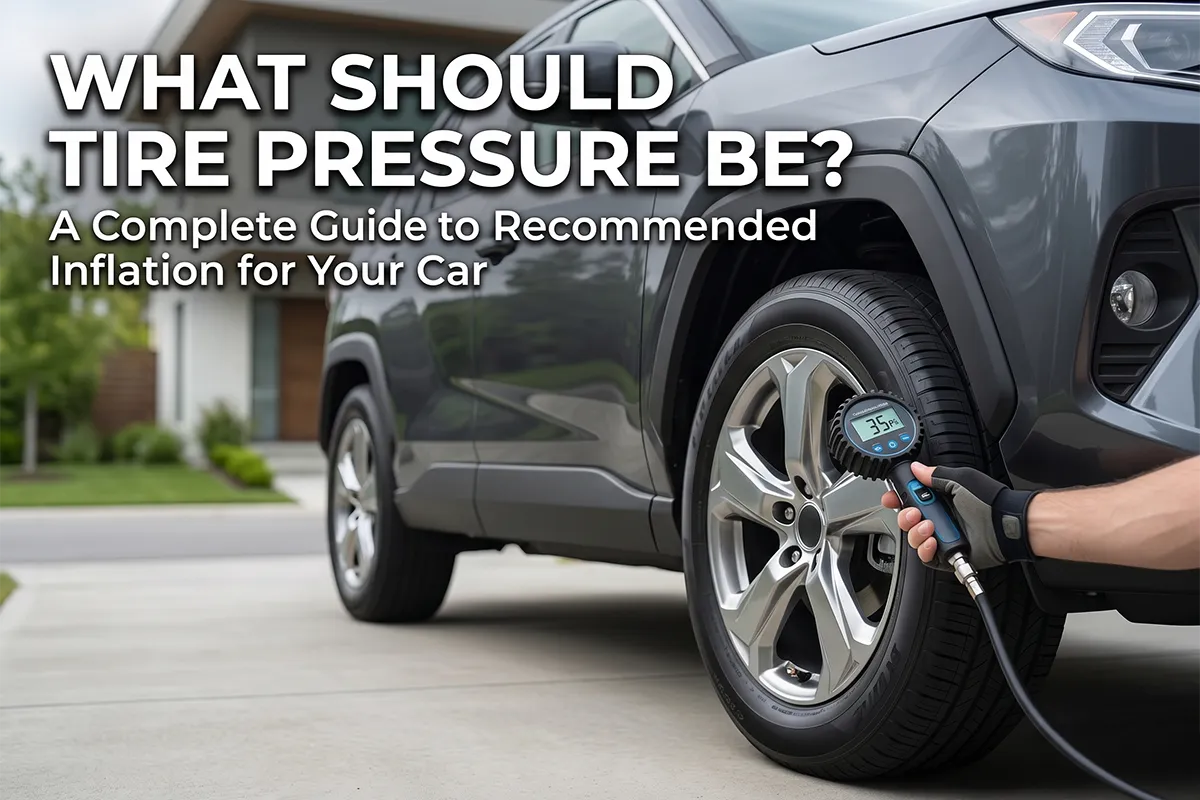
Your TPMS light just came on — or it’s been on for weeks and you keep ignoring it. Either way, that little horseshoe icon is trying to tell you something. Before assuming a part is broken, your first step should always be to verify what your tire pressure should be and check the air levels.
If your tires are properly inflated and the light remains on, you likely have a sensor issue. Fortunately, the answer might be simpler and cheaper than you think.
To ensure your dashboard isn’t lying to you, never rely solely on the electronic sensors. Always keep one of the best tire pressure gauges in your center console so you can manually verify a failing sensor against the actual mechanical PSI of the tire.
- Tire pressure sensors (TPMS) are battery-powered sensors mounted inside each wheel that wirelessly report tire pressure to your car’s computer.
- A single sensor costs $20–$100 depending on your vehicle; professional replacement runs $50–$150 per sensor installed.
- Sensors typically last 5–12 years before the internal battery dies.
- After replacing one, you need to perform a TPMS relearn procedure to sync it with your car.
- DIY is very doable with basic tools.
For a broader look at tire maintenance, our complete tire buying and maintenance guide walks through everything from choosing the right tire to knowing when your wheels need service.
Liked this article?
Add TireAdvise as a preferred source so you see more of our tire reviews and guides on Google.
What Is a Tire Pressure Sensor, Exactly?
A tire pressure sensor is a small electronic device — usually about the size of a thick matchbook — that lives inside your tire, attached to the wheel rim at the valve stem. Every tire on your car has one, and on most vehicles, there’s a fifth sensor in the spare.
Each sensor constantly monitors the air pressure inside its tire and transmits that data wirelessly to a receiver module in your car, typically every 60 seconds or so. The receiver compares that data against your vehicle’s programmed thresholds and triggers the TPMS warning light on your dashboard when a tire drops 25% or more below the recommended pressure.
The system as a whole is called the Tire Pressure Monitoring System, or TPMS. In the United States, federal law (FMVSS 138) has required TPMS on all new passenger vehicles since September 2007. If your car was built after that date, it has them.
How Does a Tire Pressure Sensor Work?
There are two fundamentally different types of TPMS, and knowing which one your car has matters when it comes to service and replacement.
Direct TPMS
Direct TPMS is what most people picture when they think about tire pressure monitoring. Each wheel has a physical sensor that contains:
- A pressure transducer (measures actual PSI inside the tire)
- A temperature sensor (temperature affects readings and also reports independently on some vehicles)
- An accelerometer (detects wheel rotation — the sensor only transmits when the wheel is spinning, to conserve battery)
- A small lithium battery (sealed inside the sensor body, not replaceable)
- A low-frequency radio transmitter (typically 315 MHz or 433 MHz depending on the manufacturer)
The sensor wakes up when it detects wheel rotation and begins transmitting pressure data. Each sensor has a unique ID code, which is how your car’s receiver knows which tire is which. That ID matching is what the “relearn” procedure re-establishes whenever you replace a sensor or rotate tires.
Direct TPMS is accurate to within 1–2 PSI and gives you real-time per-tire data. Many vehicles display the individual pressure for each tire on the instrument cluster or infotainment screen, not just a generic warning light.
Indirect TPMS
Indirect TPMS doesn’t use pressure sensors at all — it uses your car’s existing ABS wheel speed sensors to infer pressure indirectly.
Here’s the logic: an underinflated tire has a slightly smaller effective rolling diameter than a properly inflated one. The ABS system detects that this smaller tire is completing slightly more rotations per mile than the others, flags the discrepancy, and illuminates the TPMS light.
Indirect TPMS is cheaper to manufacture (no sensors to buy or replace) but less precise. It can’t give you an actual PSI reading, only a general warning. It also needs to be recalibrated every time you inflate your tires, rotate them, or change to different size tires — otherwise the baseline is off and warnings become unreliable.
Many vehicles from the late 1990s and early 2000s used indirect TPMS. Most vehicles made after 2012 use direct TPMS. If your car shows individual tire PSI readings anywhere on the dashboard, you have direct TPMS.
Where Is the Tire Pressure Sensor Located?
On direct TPMS systems, each sensor is physically located inside the tire, mounted to the wheel rim at the valve stem position. When you look at the outside of the wheel, the TPMS valve stem looks different from a standard rubber valve stem — it’s typically metal (silver or black) and slightly larger, often with a hexagonal nut at the base.
From the inside of the tire (which you can only see when the tire is dismounted from the rim), the sensor body sits against the inner rim surface, held in place by the valve stem hardware and sometimes a band clamp or strap depending on the manufacturer.
A few vehicles — particularly some older GM models — used a band-mounted TPMS sensor that attaches separately from the valve stem via a metal strap around the rim. These are less common today.
If you’re not sure whether your car has direct or indirect TPMS, the quickest way to check is to look at your valve stems the next time you’re at a tire shop or doing your own pressure check. Metal valve stems on all four wheels? Almost certainly direct TPMS.
Can Tire Pressure Sensors Go Bad? (Yes — Here’s Why)
The short answer is yes, and it’s almost inevitable if you keep a vehicle long enough. Here’s what causes TPMS sensors to fail:
Battery Death (Most Common)
The internal battery in a direct TPMS sensor is lithium-based, sealed inside the sensor body, and cannot be replaced without replacing the entire sensor.
Under normal driving conditions, these batteries last approximately 5–10 years or 100,000–150,000 miles — though that varies significantly based on how often you drive (more driving = more transmissions = faster drain) and climate (cold temperatures reduce battery performance).
Extreme temperatures not only drain the lithium battery faster, but understanding how tire pressure in winter vs summer fluctuates can save you from misdiagnosing a weather-related PSI drop as a dead sensor.
I’ve seen sensors fail as early as 4 years on high-mileage fleet vehicles, and I’ve also seen them last 12 years on a low-mileage weekend car. There’s no way to check the battery level — the sensor either works or it doesn’t.
Corrosion and Physical Damage
The valve stem hardware that holds the sensor to the rim is typically aluminum or steel. Over time, particularly in regions that use road salt, these components can corrode significantly. I’ve personally seen sensors that were so corroded they crumbled when a technician tried to remove them, requiring careful rim cleanup before the new sensor could seal properly.
The rubber grommet that seals the valve stem to the rim also degrades over time, sometimes leading to slow air leaks that mimic a tire puncture.
Impact Damage
Hitting a curb or pothole hard enough can physically damage a sensor. This is more common than you’d think, especially in city driving. A cracked sensor housing will leak water into the electronics and fail quickly.
Corrosion at the Valve Core
Even when the sensor body is fine, the valve core inside the stem can corrode and cause slow air loss. Replacing just the valve core (a $2 part) sometimes resolves what looks like a sensor problem.
Signs Your Tire Pressure Sensor Is Failing
These are the warning signs I’ve come across most often:
The TPMS light is solid even after you’ve properly inflated all tires. This is the classic symptom. You check every tire, they’re all at the correct pressure, you drive a few miles, and the light stays on. That’s almost certainly a dead or malfunctioning sensor — not a tire pressure problem.
The TPMS light flashes for 60–90 seconds after startup, then stays on. This is the industry-standard behavior for a TPMS system fault (as opposed to a low-pressure warning, which illuminates and stays solid from startup). Flashing = system malfunction. Solid = pressure issue.
Your car shows “—” or “- -” instead of a PSI reading for one tire. On vehicles with per-tire pressure display, this indicates the receiver can’t communicate with that sensor.
The light comes on and off at random. A sensor with a dying battery sometimes transmits intermittently before failing completely.
A slow leak that can’t be found. If a tire loses 2–3 PSI per week and no puncture, bead leak, or rim damage can be found, the valve stem grommet on the TPMS sensor may be the source.
How Much Does a Tire Pressure Sensor Cost?
TPMS sensor cost varies significantly based on vehicle make, model, and whether you go OEM or aftermarket. Here’s what I typically see:
| Sensor Type | Typical Part Cost | Notes |
|---|---|---|
| Aftermarket universal (programmable) | $15–$30 each | Must be programmed to your car’s frequency; works on most vehicles |
| Aftermarket vehicle-specific | $25–$55 each | Pre-configured for specific make/model; easier install |
| OEM (dealership) | $50–$150 each | Exact factory spec; pricier but guaranteed compatible |
| Schrader / Continental brand | $30–$60 each | Reputable aftermarket; used by many independent shops |
| Valve stem replacement only | $2–$8 each | Only if sensor body is good but stem hardware is corroded |
Labor costs vary by shop but generally run:
| Service | Typical Labor Cost |
|---|---|
| Sensor replacement (tire already off) | $15–$30 per sensor |
| Sensor replacement (includes dismount/remount) | $30–$60 per sensor |
| TPMS relearn procedure (standalone) | $20–$50 per visit |
| Full set of 4 sensors replaced + relearn | $150–$350 total (parts + labor) |
Dealerships typically charge the most for both parts and labor. Independent shops usually charge significantly less and often use quality aftermarket sensors like Schrader or Continental that perform identically to OEM in real-world use.
I’ve had good results with aftermarket sensors on multiple vehicles and have no strong reason to go OEM unless the dealer includes it in a service package.
How to Replace a Tire Pressure Sensor: DIY or Shop?
Replacing a TPMS sensor is genuinely a hybrid job — part of it is accessible to a DIYer, part of it requires shop equipment.
What requires shop equipment:
- Dismounting the tire from the rim (requires a tire machine)
- Remounting and balancing the tire after sensor installation (requires a balancing machine)
What a DIYer can do:
- Purchase the correct sensor and any programming tool needed
- Remove and reinstall the wheel (standard jack and lug wrench)
- Handle the relearn procedure with an inexpensive TPMS tool
My recommendation: Unless you have access to a tire machine and balancer, take the wheel to a shop for the dismount/remount portion. Many independent tire shops will charge $15–$25 per wheel to swap a sensor you bring in — especially if you’re getting a rebalance at the same time. That’s the most cost-effective DIY approach.
Step-by-Step: Replacing a Direct TPMS Sensor
Here’s what the process looks like from start to finish:
Step 1: Identify the failing sensor. If your car displays per-tire PSI, the dead sensor position is obvious. If not, a TPMS scan tool (about $30–$80 for a basic unit like the Autel TS408) will read sensor IDs and tell you which sensor isn’t transmitting.
Step 2: Purchase the correct replacement sensor. For aftermarket programmable sensors, you’ll need to know your vehicle year/make/model and whether it uses 315 MHz or 433 MHz frequency. The packaging or product listing will specify. For vehicle-specific sensors, just match the year/make/model.
Step 3: Remove the wheel from the vehicle. Standard wheel removal — loosen lug nuts with the vehicle on the ground, jack up the corner, remove the wheel.
Step 4: Have the tire dismounted at a shop. Bring the bare wheel to an independent tire shop and ask them to dismount the tire, swap the sensor, and remount and balance it. Most shops will do this while you wait for a small fee.
Step 5: Program the new sensor (if aftermarket programmable). Using a TPMS tool, copy your vehicle’s sensor protocol to the new sensor, or program it with the correct vehicle-specific settings. Vehicle-specific sensors usually don’t need this step.
Step 6: Reinstall the wheel and perform the relearn procedure. See the next section.
How to Relearn (Reset) Your TPMS After Replacement
This is the step most DIYers miss, and it’s why the TPMS light stays on even after a new sensor is installed. The car’s receiver needs to “learn” the unique ID of the new sensor and associate it with the correct wheel position.
Before initiating this sequence, confirm your tires are filled to the exact recommended tire pressure by vehicle, as the system will use this exact PSI as its new baseline for monitoring.
There are three types of relearn procedures:
1. Stationary Relearn (Most Common)
Enter TPMS learn mode through the vehicle’s menu (usually Settings > Vehicle > TPMS or a dedicated button sequence), then hold a TPMS activation tool near each sensor in sequence. The car beeps or chirps to confirm each sensor is recognized. This is the most common method on GM, Chrysler, and many other domestic vehicles.
2. Auto Relearn (Drive-Based)
Some vehicles — particularly Toyota, Honda, and many European makes — automatically relearn sensor positions after you drive at speeds above 15–20 mph for a set distance (typically 5–15 minutes of normal driving). No tool required. Check your owner’s manual for the exact procedure.
3. OBD-II Relearn (Tool Required)
Some vehicles require a TPMS tool connected to the OBD-II port to initiate the relearn sequence. The tool communicates directly with the TPMS module. This is common on Ford vehicles and some Hyundai/Kia models.
How to find your vehicle’s procedure: Your owner’s manual will have a TPMS section with specific instructions. Alternatively, the Autel TS508 and similar tools include a vehicle database with step-by-step relearn instructions for thousands of vehicles.
How to Fix a “Tire Pressure Sensor Fault” Message
If your dashboard says “Tire Pressure Sensor Fault” (or similar language), it means the TPMS system itself has a problem—not just low pressure. This is a distinct warning from the standard low tire pressure light, which simply indicates a drop in PSI.
Here’s the diagnostic ladder I work through:
Step 1: Check that all tires are properly inflated. Sometimes a severely underinflated tire causes a “fault” message rather than just a regular warning light. If you haven’t done this manually before, take a quick look at how to check tire pressure using a physical gauge. Inflate all four tires to spec and drive 10+ minutes to see if the message clears.
Step 2: Check if any sensor recently lost communication. A sensor with a dying battery will often trigger a fault code before failing completely. A TPMS scan tool will reveal which sensor (if any) has stopped transmitting.
Step 3: Check for recent wheel/tire service. If you just had tires rotated, a new set installed, or any wheel work done, the sensors may need a relearn procedure. The car’s receiver has sensor IDs mapped to specific positions — if those positions changed, it generates a fault.
Step 4: Inspect valve stems for physical damage. A bent, broken, or corroded valve stem can cause an air leak and simultaneously damage the sensor. Look at all four stems for visible damage.
Step 5: Check the TPMS receiver/module. In rare cases, the fault is in the vehicle’s TPMS receiver rather than an individual sensor. This is more common on older vehicles and typically requires a dealer-level scan tool to diagnose. If all four sensors check out fine and the fault persists, this is your next stop.
Do You Need a Tire Pressure Sensor? Is It Illegal to Remove One?
This is a question I get more often than I expected, usually from people who had a sensor fail right before a trip and wonder if they can just pull it out and drive.
Legally: In the United States, it is illegal under federal law to deactivate, disable, or remove a required TPMS system on a vehicle where one was required by law (i.e., any vehicle manufactured after September 1, 2007). This applies to shops as well — a tire shop cannot legally disable or remove your TPMS sensors at your request.
Practically: A missing sensor doesn’t make the car unsafe to drive in the short term — people drove without TPMS for decades. But you lose the early warning system that catches slow leaks and pressure loss from temperature changes, which is a genuine safety trade-off.
What happens if you remove one: Your TPMS light will be illuminated permanently, which will cause an emissions/safety inspection failure in most states. Beyond the inspection issue, you’ll just need to check your pressure manually more often.
The right answer is always to replace the failed sensor, not remove it.
TPMS Sensor Lifespan: What to Expect
As a rough planning guide:
| Mileage / Age | Expected TPMS Status |
|---|---|
| 0–50,000 miles / under 5 years | Sensors should be fully functional |
| 50,000–100,000 miles / 5–8 years | Monitor for first sensor failures; battery life varies |
| 100,000–150,000 miles / 8–12 years | Proactive replacement recommended, especially on sets |
| 150,000+ miles / 12+ years | Expect most or all sensors to be at end of battery life |
A practical tip: if one sensor fails and your vehicle has over 100,000 miles on the clock, strongly consider replacing all four at the same time.
The remaining sensors are on similar battery timelines, and replacing them one at a time over the following years will cost you significantly more in labor (dismount, remount, relearn) than doing the set at once.
On a vehicle with 120,000 miles, replacing all four sensors at a tire rotation costs me roughly $180–$220 in parts and about $60–$80 in total labor — versus $50–$60 per sensor visit if I replace them one at a time.
FAQ: Tire Pressure Sensor Questions
How do tire pressure sensors work?
Direct TPMS sensors contain a pressure transducer, temperature sensor, accelerometer, battery, and radio transmitter. They wake up when the wheel spins, measure pressure, and transmit a signal to your car’s TPMS receiver module. The receiver compares readings to programmed thresholds and illuminates the warning light when pressure drops 25% or more below spec.
Where is the tire pressure sensor located?
Inside the tire, mounted to the wheel rim at the valve stem position. On direct TPMS systems, the valve stem is metal rather than rubber. You cannot see the sensor body without dismounting the tire.
How much is a tire pressure sensor?
Individual sensors range from $15–$30 for programmable aftermarket sensors to $50–$150 for OEM sensors from a dealership. Labor for replacement adds $15–$60 per sensor depending on whether the tire needs to be dismounted.
How long do tire pressure sensors last?
Typically 5–10 years or 100,000–150,000 miles, depending on driving frequency and climate. The internal battery is the limiting factor — it cannot be replaced, so when the battery dies, the entire sensor needs replacement.
Can I replace a tire pressure sensor myself?
Partially. You can purchase the sensor, remove the wheel, and perform the relearn procedure yourself. However, you need a tire machine to safely dismount and remount the tire — which means involving a shop for that portion unless you have shop equipment at home.
What happens if I don’t replace a bad TPMS sensor?
Your TPMS light will stay on, you’ll fail safety/emissions inspections in most states, and you lose the early warning system for tire pressure loss. The car is technically drivable but you should monitor pressure manually more frequently.
How do I reset a tire pressure sensor after replacing it?
Through a relearn procedure specific to your vehicle — either a stationary procedure using a TPMS tool, an automatic drive-cycle relearn, or an OBD-II relearn. Check your owner’s manual for the exact method. Many TPMS tools ($30–$80) include vehicle-specific relearn instructions.
How to fix a tire pressure sensor fault?
Start by confirming all tires are properly inflated and driving 10 minutes to see if the fault clears. If not, scan the system with a TPMS tool to identify the failing sensor. Most faults are caused by a dead sensor battery, a needed relearn after tire service, or a corroded/damaged valve stem.
Do all cars have tire pressure sensors?
All new U.S. passenger vehicles manufactured after September 1, 2007 are legally required to have TPMS. Vehicles made before that date may or may not have them depending on make and model.
Final Thoughts
TPMS sensors are one of those components that most drivers never think about until the warning light appears — and then suddenly they’re the most important thing on the car. The good news is that they’re not complicated, not especially expensive, and in most cases very straightforward to address.
If your TPMS light came on and you’ve confirmed your tires are properly inflated, the sensor is almost certainly the culprit. Get it scanned at a shop or with your own tool, buy the right replacement sensor, have the tire swapped at a local shop, and do the relearn. Total out-of-pocket on a single sensor replacement, doing as much as possible yourself, is typically $50–$80.
For everything else you need to know about keeping your tires and wheels in top shape, our complete tire buying and maintenance guide covers the full picture — from choosing tires to long-term maintenance.
Have a specific TPMS situation you can’t figure out? Leave it in the comments — I’ve dealt with most of the weird ones and I’m happy to help diagnose.
