

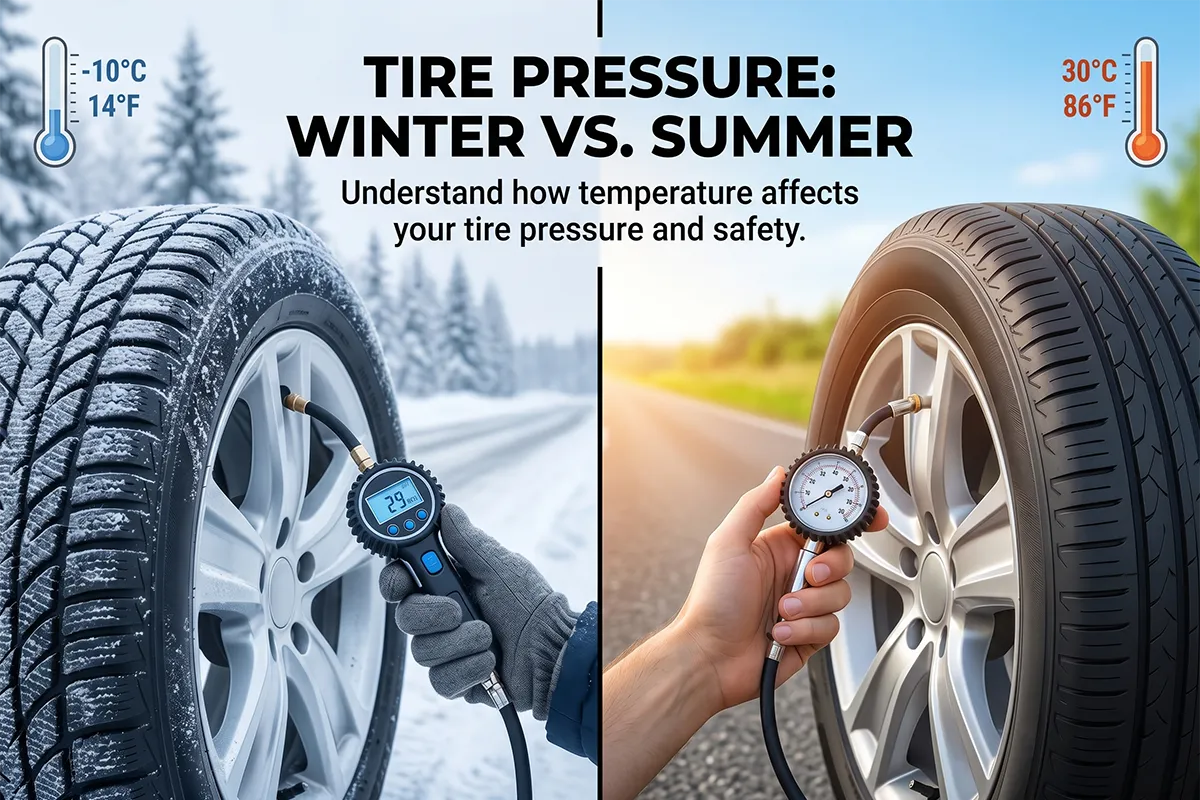
You already know what tire pressure your car is supposed to run — but here’s what most drivers don’t realize: that target number stays the same year-round, while the actual pressure in your tires quietly shifts with every weather change, sometimes by as much as 6–8 PSI between a warm fall day and a hard winter freeze.
- Tire pressure drops roughly 1 PSI for every 10°F decrease in temperature and rises 1 PSI for every 10°F increase.
- Your recommended PSI doesn’t change between seasons — what changes is how often you need to add air.
- In winter, check monthly and expect to top off regularly.
- In summer, watch for overinflation on extremely hot days.
- The door jamb sticker is your target in every season.
- In summer, watch for overinflation on extremely hot days.
Our tire buying and maintenance guide has the full picture on keeping tires in top shape through every season and mile.
Liked this article?
Add TireAdvise as a preferred source so you see more of our tire reviews and guides on Google.
Why Tire Pressure and Temperature Are Linked
To understand why your tire pressure changes with the seasons, you need a quick look at what’s actually happening inside the tire — and it comes down to basic gas physics.
Air behaves predictably under pressure and temperature changes according to what’s known as Gay-Lussac’s Law: at a constant volume, the pressure of a gas is directly proportional to its absolute temperature.
In plain English, when the air inside your tire gets colder, its molecules slow down, collide less forcefully with the tire walls, and exert less pressure. When the air gets hotter, the opposite happens — molecules speed up, hit harder, and pressure rises.
Your tires are essentially a fixed-volume container. The rubber flexes slightly under load, but for the purposes of pressure measurement, the volume is effectively constant. So all the temperature-driven changes show up as pressure changes.
This relationship is predictable, consistent, and happens to every tire on every vehicle every time the temperature swings. It’s not a sign of a leak or a failing tire — it’s just physics doing what physics does.
How Much Does Tire Pressure Change With Temperature?
The practical rule of thumb used by tire engineers, mechanics, and anyone who’s spent serious time around tires is this:
Tire pressure changes approximately 1 PSI for every 10°F change in ambient temperature.
It’s a simplification of the underlying ideal gas law math, but it holds up remarkably well in the real-world pressure ranges passenger car tires operate in. Here’s what that looks like across a range of realistic temperature swings:
| Temperature Drop (°F) | Approximate PSI Loss | Example Scenario |
|---|---|---|
| 10°F | ~1 PSI | Mild autumn night vs afternoon |
| 20°F | ~2 PSI | Cool fall morning vs warm afternoon |
| 30°F | ~3 PSI | October morning vs summer baseline |
| 40°F | ~4 PSI | Cold November morning vs September |
| 50°F | ~5 PSI | Hard winter (20°F) vs mild fall (70°F) |
| 60°F | ~6 PSI | Deep winter freeze vs late-summer inflation |
| 70°F | ~7 PSI | Extreme cold snap vs summer benchmark |
And for temperature increases:
| Temperature Rise (°F) | Approximate PSI Gain | Example Scenario |
|---|---|---|
| 10°F | ~1 PSI | Mild spring warming |
| 20°F | ~2 PSI | Spring thaw period |
| 30°F | ~3 PSI | Late spring to early summer |
| 40°F | ~4 PSI | Cold winter inflation in summer heat |
| 50°F | ~5 PSI | Extreme heat vs winter baseline |
A real-world example: I live in an area that sees summer highs around 90°F and winter lows around 10°F. That’s an 80°F swing. If I inflate my tires perfectly to 35 PSI on a 70°F fall day and don’t touch them again, by January at 10°F they could read around 29 PSI — 6 PSI below spec — without a single molecule of air escaping the tire.
The sensor on a 35 PSI tire usually triggers at 26 PSI, so I’m getting dangerously close to that threshold on cold mornings without any leak or damage involved.
This dramatic seasonal drop is exactly why your low tire pressure light seems to illuminate on your dash every single fall… and why drivers who check pressure in September and then wait until March often find their tires noticeably low.
Tire Pressure in Winter: What You Need to Know
What Should Tire Pressure Be in Winter?
This is the question I get every October and November without fail, and the answer often surprises people: your recommended tire pressure doesn’t change in winter. The number on your door sticker is correct in January just as much as it is in July.
What changes is how hard you have to work to maintain that number. In winter, you’re fighting against natural pressure loss from cold air plus the ongoing 1–3 PSI per month of normal permeation. The target is the same; the maintenance cadence needs to increase.
If your door sticker says 35 PSI, you should be running 35 PSI cold in winter—not less, not more as a blanket rule.
If you aren’t sure what your factory spec is, look up the recommended tire pressure by vehicle to verify the baseline for your exact make and model.
Should Tire Pressure Be Lower in Winter?
This is a persistent myth worth addressing directly. The idea seems logical — lower pressure means more tire contact patch, better grip in snow, right? In practice, it doesn’t work that way, and here’s why.
Modern winter and all-season tires are engineered to perform at their rated pressures. The tread compound, siping pattern, and block geometry are all designed to work together at the manufacturer’s recommended PSI.
Running significantly lower pressure in winter doesn’t give you more grip — it gives you increased rolling resistance, poor handling response, accelerated edge wear, and the same heat-buildup risks that exist in any underinflation scenario.
The one partial exception is purpose-built off-road driving in deep snow or mud, where experienced drivers sometimes deliberately lower pressure to increase the contact patch on very soft surfaces. That’s a specific technique for specific conditions — not a general winter driving recommendation for street use.
For everyday winter driving on cleared roads, stick to your recommended PSI.
Additionally, intentionally underinflating your tires in the snow will continuously trigger your car’s tire pressure sensor (TPMS), creating an annoying, persistent dashboard warning while also masking a real emergency if you actually do run over a nail.
Why Does Tire Pressure Drop in Cold Weather?
I covered the physics above, but here’s the practical picture: it’s not that air escapes the tire in cold weather. The air is still there. It’s just that cold air molecules move more slowly, strike the inner tire surface with less force, and therefore generate less pressure than warm air molecules would.
Think of it this way: the same number of air molecules packed into the same space exerts less pressure when cold. When the temperature rises again, those same molecules generate more pressure. Nothing entered or left the tire — only temperature changed.
This is also why tires that appear slightly low on a cold morning often read correctly after driving for 20 minutes. The friction of driving warms the air inside and the pressure rises back up.
That doesn’t mean you shouldn’t inflate them — you should always inflate to spec cold and let the normal pressure rise happen from there.
Winter Tire Pressure Management: My Approach
After dealing with this seasonal ritual for years, here’s the routine I’ve settled into:
Late September / early October: As daily lows start dropping toward 40–45°F consistently, I do a full four-tire check and inflate all tires to 2–3 PSI above the recommended spec. Not overinflation territory — just a buffer. By the time the hard cold hits in December and January, the buffer has absorbed the pressure loss and I’m at or just above spec rather than below it.
Monthly checks through winter: I check pressure on the first weekend of every month through the cold season. In regions where temperatures fluctuate significantly week-to-week, I sometimes check more often. Cold snaps of 20°F or more are worth a quick check.
After significant warm spells: A mid-January thaw that brings temps back to 50°F for a few days can raise tire pressure 3–4 PSI above my buffered starting point. I check and release a little air if I’m running more than 4 PSI above spec, to keep the handling response where it belongs.
Spring transition: When daily temperatures stabilize above 50°F consistently, I do a final check and set pressures precisely to spec without the cold buffer. To make sure you are getting the most accurate reading during this seasonal shift, I highly recommend using one of the best tire pressure gauges rather than relying on a cheap gas station air hose.
Tire Pressure in Summer: What Changes and What to Watch For
Does Tire Pressure Rise in Hot Weather?
Yes, significantly — and while most winter pressure problems involve tires being too low, summer pressure problems often involve tires being too high.
On a hot summer day with pavement temperatures that can reach 150–170°F, the combination of ambient heat and road-generated heat warms the air inside your tires substantially.
If you inflated your tires to the correct 35 PSI cold on a 40°F February morning and temperatures climb to 95°F in July, that same air now registers 4–6 PSI higher — putting you at 39–41 PSI — without a single additional molecule of air being added.
For most passenger cars, this isn’t immediately dangerous territory, because tires are designed with a margin above the recommended operating pressure.
But consistently running 5–6 PSI above spec in summer heat does cause center tread wear and slightly firmer ride quality — the same issues as overinflation from any cause.
What to Do About Summer Pressure Rise
The key here is doing nothing reactive and something proactive.
Don’t release air from hot tires after a long summer drive to bring the reading down to 35 PSI. You’d be setting cold pressure to 28–30 PSI, which is significantly underinflated and genuinely dangerous. The elevated reading on a hot tire is expected and correct.
Do check cold pressure in summer — first thing in the morning before driving. If you haven’t checked since spring, grab a gauge and follow our quick guide on how to check tire pressure. A proper cold morning check in June or July will tell you the true, accurate state of your tires.
Watch for overinflation if tires were set in winter. If you added the 2–3 PSI cold buffer I described in the winter section and then summer arrives without a recheck, you might find yourself running 37–38 PSI cold — 2–3 PSI over spec — which is noticeable in ride quality and center wear over time. A spring recheck and reset to spec prevents this.
Summer Blowout Risk: The Real Story
You’ll sometimes read that summer is when blowouts happen most often, which is true — but the mechanism is usually misunderstood. The danger isn’t overinflation by itself. The danger is underinflated tires operating in extreme heat.
Underinflated tires flex more with each rotation, generating heat in the sidewall and internal structure. In summer heat, with already-elevated ambient and road temperatures, that additional heat buildup can push the internal tire temperature to the point where the structural integrity of the rubber and cord fails — a sudden blowout.
The lesson: summer heat doesn’t protect you from underinflation problems. If anything, it makes underinflation more dangerous. Keep your tires properly inflated year-round.
Seasonal Transition Periods: Fall and Spring
Fall and spring are the two seasons where tire pressure requires the most active attention, because temperatures swing the most erratically.
Fall (September–November in most of the US)
Fall is when the TPMS light makes its annual appearance for millions of drivers. Temperatures that dropped 30–40°F from summer highs can push tires 3–4 PSI low before most drivers think to check. The first hard frost often coincides with the first TPMS warning of the year.
Fall action plan:
- Do a complete four-tire pressure check and reset as daily lows drop below 50°F consistently
- Add the 2–3 PSI cold buffer if you’re heading into a region with harsh winters
- If you’re switching to dedicated winter tires, inflate to the correct PSI before mounting — don’t assume shop air pressure after a tire change is exactly right
Spring (March–May in most of the US)
Spring is the mirror image of fall. Temperatures rise, pressure rises with them, and drivers who set correct winter pressures may find themselves overinflated as the season warms.
Spring action plan:
- Do a four-tire check after temperatures stabilize above 50°F
- Release any excess pressure built up from winter buffering
- Inspect tires for winter damage — pothole impacts, sidewall scuffs, uneven wear from months of driving in challenging conditions
- If switching back from dedicated winter tires, check all-season pressure before mounting
Winter Tires vs All-Season Tires: Does Pressure Differ?
If you run dedicated winter tires on a separate wheel set from October through April, the pressure question comes up twice a year at each seasonal swap. Here’s what to know:
Winter tires use the same recommended PSI as your all-season or summer tires — whatever your door sticker specifies. There’s no separate winter tire pressure recommendation. The same 33 or 35 PSI that works on your all-seasons applies to your winter rubber.
One practical nuance: winter tire compounds are softer and more pliable than all-season compounds. They may feel slightly different at the same pressure — sometimes a touch “squishier” in steering response at correct PSI. This is normal and expected, not a sign that they need more air.
After mounting winter tires:
- Always check pressure before driving — tire shop mounting doesn’t guarantee exact pressure
- The seasonal temperature drop that prompted the switch is probably already pulling pressure down from whatever the shop set
- Set to your door sticker spec cold, add the 2–3 PSI buffer if entering deep winter
Altitude and Tire Pressure: An Underrated Factor
If you live at high altitude or regularly drive over mountain passes, there’s one more variable worth understanding: altitude affects relative (gauge) pressure readings very slightly, but the more practical issue is temperature.
Mountain passes and high-elevation destinations often come with significant temperature swings over short distances — you might ascend from a 75°F valley to a 40°F summit in under an hour.
The pressure drop from that temperature change is the same 1 PSI per 10°F relationship, just happening faster than it would from seasonal change.
For most drives, this isn’t a serious concern. But on extended mountain trips or if you live at high elevation and regularly commute to lower altitudes (or vice versa), it’s worth factoring temperature-driven pressure variation into your check schedule.
Common Seasonal Tire Pressure Mistakes
After years of fielding questions about tire pressure, these are the mistakes I see most consistently:
Setting pressure in summer and not rechecking in fall. By January, tires inflated correctly in August can be 5–6 PSI low purely from temperature drop. Monthly winter checks are non-negotiable if you live in a cold climate.
Releasing air from hot tires after a summer drive. The pressure reading on a hot tire is 4–8 PSI higher than cold pressure. Release that air and you’ve set your cold pressure dangerously low.
Inflating tires indoors in winter, then driving outside. If you inflate in a 65°F heated garage and the outside temperature is 5°F, your pressure will drop 6 PSI the moment the tire equilibrates to ambient temperature. Inflate to 3–4 PSI above target in heated settings during extreme cold, or inflate outdoors where the reading reflects actual operating conditions.
Ignoring the spare during seasonal checks. The spare sits unused for months or years and is subject to the same permeation and temperature-driven pressure loss as the other four tires. A spare that was correctly inflated two winters ago may be dangerously low today.
Trusting the TPMS to catch all seasonal pressure problems. The TPMS light triggers at 25% below recommended pressure. A 35 PSI tire can drop to 27 PSI from temperature loss before the light comes on — that’s almost 10 PSI low, a meaningful performance and safety compromise. The light is a last resort, not a maintenance schedule.
Quick Reference: Seasonal Tire Pressure Summary
| Season | Key Risk | Action |
|---|---|---|
| Summer | Pressure rise from heat; underinflation + heat = blowout risk | Check cold in the morning; don’t release air from hot tires |
| Fall | Rapid pressure drop as temps fall; first TPMS warning of year | Check and reset PSI as temperatures drop below 50°F consistently |
| Winter | Sustained pressure loss; 5–8 PSI below spec common in deep cold | Check monthly; add 2–3 PSI cold buffer; don’t lower pressure for “snow grip” |
| Spring | Overinflation if winter buffer not reset; winter damage inspection | Check after temps stabilize; reset to exact spec; inspect for winter damage |
FAQ: Tire Pressure and Temperature Questions
Does tire pressure change with temperature?
Yes, reliably and predictably. Tire pressure changes approximately 1 PSI for every 10°F change in ambient temperature — dropping as temperatures fall, rising as temperatures rise. This happens to every tire on every vehicle as a matter of basic gas physics.
How much does tire pressure change with temperature?
The practical rule is 1 PSI per 10°F. A 60°F temperature swing — common between summer and winter in much of the US — produces about 6 PSI of pressure change. A 30°F overnight drop produces about 3 PSI of pressure loss.
Should tire pressure be lower in winter?
No. Your recommended PSI stays the same year-round. Running lower pressure in winter doesn’t improve snow traction on street tires and introduces the same underinflation risks that exist in any season. Maintain the pressure specified on your door jamb sticker.
Why does tire pressure drop in cold weather?
Cold air molecules move more slowly and exert less pressure on the tire walls than warm molecules do. The air isn’t escaping — the same air is simply generating less pressure at lower temperature. Inflate to your recommended PSI cold and the pressure returns to normal.
What should tire pressure be in winter?
The same number as any other season — whatever your driver’s door jamb sticker specifies. For most passenger cars that’s 32–35 PSI; for crossovers and SUVs, typically 33–36 PSI. There is no separate winter tire pressure target.
Can I inflate tires in a warm garage in winter?
Yes, but account for the pressure drop once the tires are exposed to outdoor temperatures. If you inflate to exactly 35 PSI in a 68°F garage and it’s 8°F outside, the tires will read roughly 29 PSI after equilibrating. Either inflate to 5–6 PSI above spec in the warm garage, or do the final check and top-off outside.
Why is my tire pressure light on every winter morning?
Your tires are losing pressure overnight as temperatures drop. This is normal and doesn’t indicate a leak or sensor fault. Inflate all four tires to your recommended PSI cold, and the light will go off after a few minutes of driving. Recurring winter-morning TPMS warnings are a sign you need to check and top off tires more frequently through the cold season.
Does temperature affect tire pressure in summer too?
Yes — pressure rises in hot weather. After a long summer drive or on an extremely hot day, tires may read 4–8 PSI above their cold pressure. Don’t release air based on a hot reading; check cold in the morning instead.
Final Thoughts
Temperature-driven tire pressure changes are one of those things that, once you understand the mechanism, stop being mysterious or frustrating. Your tires aren’t leaking every fall. They’re not malfunctioning.
The laws of thermodynamics are just doing their job, and a few minutes of attention each month is all it takes to stay ahead of them.
The seasonal discipline that’s served me well: check and buffer up in fall, check monthly through winter, reset in spring, check cold in summer heat.
Keep the door sticker number as your constant target across every season and every temperature. Everything else is just managing the gap between that target and what physics keeps doing to your air molecules.
For a complete grounding in tire pressure fundamentals — what PSI to target, how to check correctly, and what the TPMS light is actually telling you — our tire buying and maintenance guide covers it all in one place.
Do you run a different seasonal strategy — or live somewhere with extreme temperature swings that’s made you develop your own approach? I’d genuinely like to hear it in the comments.
