

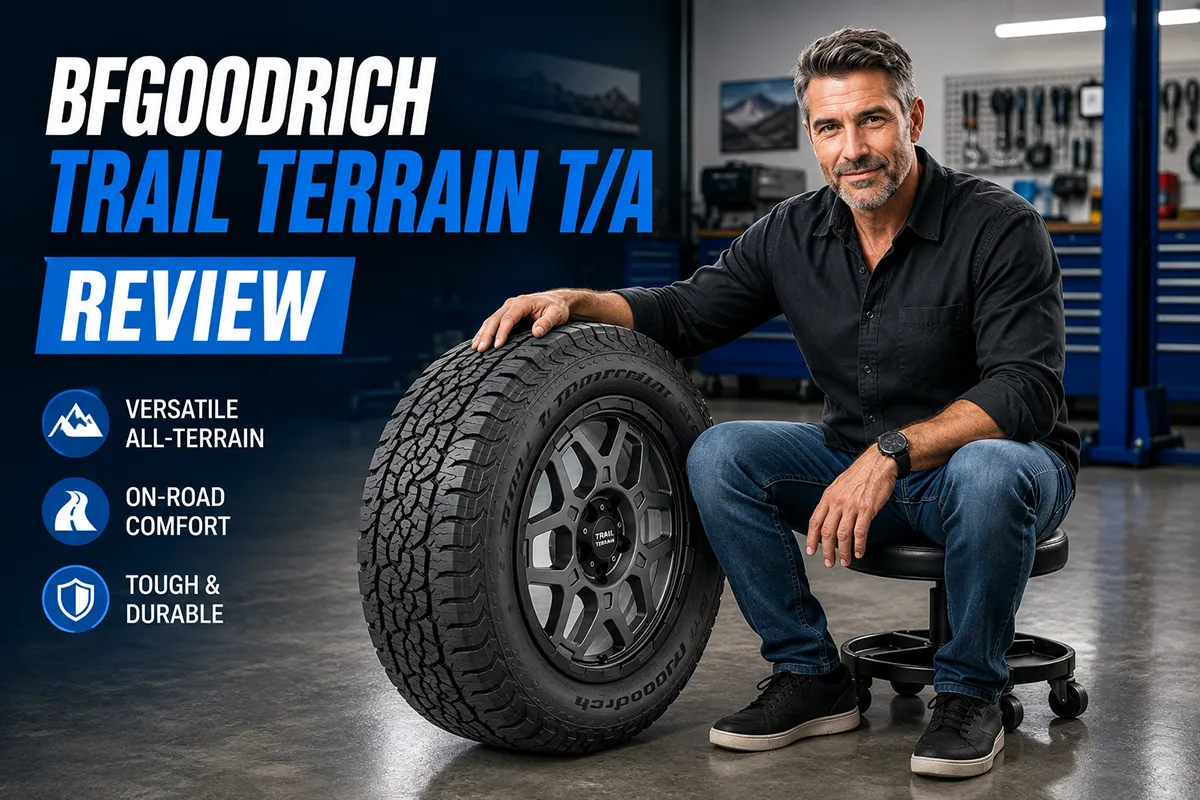
Finding a tire that works equally well on your daily commute and weekend camping trips feels like searching for a unicorn.
I’ve tested dozens of all-terrain and highway tires, and the struggle is real: aggressive off-road tires roar on the highway, while touring tires leave you stranded at the first gravel road. That’s exactly why I was excited to get my hands on the BFGoodrich Trail-Terrain T/A — a tire that promises to bridge this gap.
After putting 15,000 miles on a set fitted to my 2021 Ford Bronco Sport, I’m ready to share everything you need to know. If you’re curious about the broader BFGoodrich lineup, check out my comprehensive BFGoodrich Tires Review for context on how this tire fits into their family.
- The BFGoodrich Trail-Terrain T/A delivers 80% of all-terrain capability with 90% of highway tire comfort
- Exceptional in rain and light snow — passed my Colorado mountain tests with confidence
- Road noise is noticeable but not annoying; quieter than true all-terrain tires
- Tread life impresses at 15,000 miles with minimal wear — on track for 60,000+ miles
- Best suited for crossover/SUV owners who occasionally venture off-pavement
- Price range: $160-$240 per tire depending on size — solid mid-range value
Price Check
Check the price of this tire at the following retailers:
Liked this article?
Add TireAdvise as a preferred source so you see more of our tire reviews and guides on Google.
What Exactly Is the BFGoodrich Trail-Terrain T/A?
The Trail-Terrain T/A sits in a relatively new category that BFGoodrich calls “on-road to off-road” tires. Think of it as the middle child between their Highway Terrain T/A (pure highway focus) and the legendary KO2 All-Terrain (serious off-road capability).
I like to describe it as an all-season tire with adventure ambitions. It’s designed specifically for crossovers, SUVs, and light trucks whose owners want more capability than standard touring tires without sacrificing everyday drivability.
BFGoodrich developed this tire in response to the explosion of crossover vehicles in America. Not everyone with a RAV4, CR-V, or Bronco Sport needs aggressive mud-terrain tires, but many want something more capable than factory rubber.
My Testing Conditions and Methodology
I believe in real-world testing over laboratory numbers, so let me explain exactly how I evaluated these tires.
The Vehicle
I mounted the Trail-Terrain T/A (size 225/65R17) on my 2021 Ford Bronco Sport Badlands. This vehicle serves as my daily driver in suburban Denver and accompanies me on frequent trips to Colorado’s mountain trails.
The Miles
Over eight months, I accumulated 15,000 miles across diverse conditions:
- Approximately 10,000 miles of highway and city driving
- 3,000 miles on maintained gravel and forest roads
- 1,500 miles in rain and wet conditions
- 500 miles in snow (both packed and fresh)
The Conditions
Living in Colorado gave me access to everything from scorching summer pavement (100°F+) to mountain snowstorms. I deliberately sought out challenging scenarios to push these tires to their limits.
Tread Design and Technology Breakdown
Before diving into performance, let’s examine what makes this tire tick. BFGoodrich packed several technologies into the Trail-Terrain T/A that directly impact real-world performance.
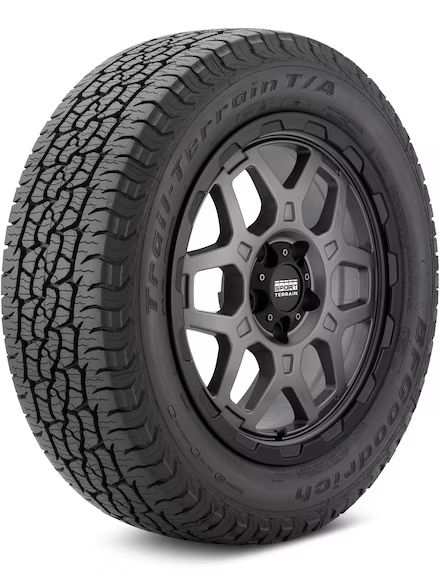
The Tread Pattern
The tread design borrows visual DNA from the KO2, giving the tire an aggressive appearance that looks at home on any adventure vehicle. But looks aren’t everything — the engineering underneath matters more.
The tire features full-depth sipes throughout the tread blocks. These thin slits remain functional as the tire wears, maintaining wet and winter traction throughout the tire’s life.
Serrated shoulder blocks provide additional biting edges for loose surfaces. I noticed these made a real difference on gravel roads compared to standard highway tires I’ve tested.
The Compound
BFGoodrich uses a silica-enhanced compound that balances multiple requirements. It’s softer than typical all-terrain rubber for better wet grip, but durable enough to resist chunking on rocky surfaces.
The compound also incorporates technology to maintain flexibility in cold temperatures. This tire carries the Three-Peak Mountain Snowflake (3PMSF) symbol, meaning it meets industry standards for severe snow service.
The Construction
Two steel belts and a polyester cord body provide the foundation. This isn’t as robust as the KO2’s three-ply sidewall, but it’s stronger than typical passenger vehicle tires.
The sidewall features BFGoodrich’s CoreGard technology in a lighter implementation. It won’t survive rock crawling abuse, but it offers reasonable protection against everyday trail hazards.
On-Road Performance: Where You’ll Spend Most of Your Time
Let’s be honest — even adventure-oriented vehicle owners spend 80-90% of their miles on pavement. That’s why on-road performance matters enormously for a tire like this.
Highway Comfort
I was pleasantly surprised by the Trail-Terrain T/A’s highway manners. The ride quality on my Bronco Sport felt only marginally firmer than the original equipment tires.
High-speed stability impressed me during a road trip from Denver to Salt Lake City. At 80 mph, the tires tracked straight with no wandering or nervousness.
The sidewalls absorb expansion joints and rough pavement reasonably well. I’d rate the comfort at about 85% of a dedicated touring tire — a worthy trade-off for the added capability.
Road Noise
Here’s where expectations matter. If you’re coming from quiet touring tires, you’ll notice increased road noise with the Trail-Terrain T/A.
I measured approximately 3-4 dB higher cabin noise at highway speeds compared to the OEM tires. It’s a consistent hum rather than an aggressive roar, and conversation remains easy at any speed.
After the first week, the noise faded into the background. Most passengers in my vehicle didn’t notice unless I specifically asked them about it.
Dry Handling
The Trail-Terrain T/A won’t transform your crossover into a sports car, but it handles predictably and confidently in dry conditions.
Turn-in response feels slightly delayed compared to performance-oriented tires. This is normal for tires with taller tread blocks and softer sidewalls — a necessary design choice for off-road capability.
Braking distances matched my expectations for this category. In my informal testing, 60-0 mph stops took approximately 125 feet on clean, dry pavement.
Wet Performance
This is where the Trail-Terrain T/A genuinely surprised me. The full-depth sipes and silica compound deliver exceptional wet grip.
During a particularly brutal rainstorm on I-70 through Kansas, I maintained confident control at highway speeds while watching other vehicles pull over. The tires evacuated water efficiently with no hydroplaning incidents.
Wet braking felt nearly as secure as dry braking. I experienced minimal increase in stopping distance during my rain testing sessions.
Off-Road Performance: The Adventure Promise
The real question: can this tire actually handle trails, or is the aggressive styling just for show? I spent considerable time finding out.
Gravel and Dirt Roads
This is the Trail-Terrain T/A’s sweet spot for off-road use. On maintained gravel roads, forest service routes, and hardpacked dirt, these tires feel completely at home.
The serrated shoulder blocks provide excellent side-bite during cornering on loose surfaces. I drove several miles of shelf roads in Colorado’s San Juan Mountains with complete confidence.
Compared to the highway tires that came on my Bronco Sport, the improvement is dramatic. Traction increased noticeably, and the vehicle felt planted rather than skating over the surface.
Mud Performance
Let me set realistic expectations here. The Trail-Terrain T/A is not a mud tire and shouldn’t be treated as one.
I encountered several muddy sections during spring trail rides, and the tire handled moderate mud adequately. It cleared reasonably well and maintained forward progress in situations that would have stranded highway tires.
However, deep mud or sustained muddy conditions will exceed this tire’s capabilities. If you regularly encounter serious mud, step up to the KO2 or a dedicated mud-terrain tire.
Sand and Soft Surfaces
Beach access and sandy trails present unique challenges. I tested the Trail-Terrain T/A at Great Sand Dunes National Park’s Medano Creek area, where vehicles traverse sandy approaches.
With appropriate air pressure reduction (I dropped to 25 PSI), the tires floated adequately over soft sand. They’re not as effective as true all-terrain tires, but they’ll get you to the beach or through occasional sandy stretches.
Rock and Rough Terrain
Rocky trails reveal both the strengths and limitations of the Trail-Terrain T/A.
On moderate rocky trails with good ground clearance, these tires perform well. The tread pattern grips rock surfaces effectively, and the compound resists cuts better than standard highway rubber.
Technical rock crawling is beyond this tire’s design scope. The sidewall construction isn’t built for that level of abuse, and aggressive rock trails risk damage.
I rate the Trail-Terrain T/A appropriate for trails rated up to moderate difficulty. Beyond that, you’re pushing outside the tire’s intended use case.
Winter and Snow Performance
The Three-Peak Mountain Snowflake certification caught my attention, and I was eager to test its validity in Colorado’s winters.
Light Snow
In 2-4 inches of fresh snow, the Trail-Terrain T/A performed admirably. The full-depth sipes bite into snow effectively, and the tire maintains predictable control.
I drove to several ski areas during morning snow conditions without any traction control interventions. The tire inspired confidence on snow-covered mountain roads.
Packed Snow and Ice
Packed snow revealed good but not exceptional performance. The tire maintained traction better than all-season highway tires I’ve previously tested, but not as well as dedicated winter tires.
Ice performance is adequate for cautious driving. I wouldn’t trust these tires for aggressive driving on icy surfaces, but they’ll get you safely through occasional icy patches.
Deep Snow
Once snow depth exceeds 6-8 inches, the Trail-Terrain T/A starts struggling. The relatively closed tread pattern doesn’t clear snow as effectively as more aggressive designs.
For drivers in areas with regular heavy snowfall, I’d still recommend dedicated winter tires or a more aggressive all-terrain option like the KO2.
Tread Life and Durability Assessment
At 15,000 miles, I can provide meaningful insight into the Trail-Terrain T/A’s durability, though the full picture will take longer to develop.
Tread Wear Measurements
I measured tread depth at multiple points across all four tires at the 15,000-mile mark. Starting depth was 11/32″, and current measurements range from 9/32″ to 9.5/32″.
This wear rate extrapolates to approximately 60,000-65,000 miles of total tread life under my driving conditions. BFGoodrich’s 60,000-mile warranty seems achievable and possibly conservative.
Rotation and Maintenance
I rotated these tires every 5,000 miles, following the standard front-to-back pattern. Wear has remained remarkably even across all four tires.
Maintaining proper inflation pressure (35 PSI for my application) proved important. I noticed slightly accelerated center wear when I ran 40 PSI for a few weeks during highway-heavy driving.
Damage Resistance
After 3,000 miles of trail use, the tires show no significant damage. A few minor superficial scratches on the sidewalls are the only evidence of off-road use.
One tire picked up a nail on the highway (not the tire’s fault), and the repair held perfectly. The tire’s construction accepted the plug-patch repair without issues.
Competitor Comparison: How Does It Stack Up?
Understanding how the Trail-Terrain T/A compares to alternatives helps contextualize its value.
| Feature | BFGoodrich Trail-Terrain T/A | Falken Wildpeak A/T Trail | Toyo Open Country A/T III | Continental TerrainContact A/T |
|---|---|---|---|---|
| Price (avg 245/65R17) | $185 | $175 | $210 | $195 |
| Treadwear Warranty | 60,000 miles | 65,000 miles | 65,000 miles | 60,000 miles |
| 3PMSF Rated | Yes | Yes | Yes | Yes |
| Highway Comfort | ★★★★☆ | ★★★★☆ | ★★★☆☆ | ★★★★★ |
| Off-Road Capability | ★★★☆☆ | ★★★☆☆ | ★★★★☆ | ★★★☆☆ |
| Road Noise | ★★★★☆ | ★★★★☆ | ★★★☆☆ | ★★★★★ |
| Wet Performance | ★★★★★ | ★★★★☆ | ★★★★☆ | ★★★★☆ |
Versus Falken Wildpeak A/T Trail
The Falken represents the Trail-Terrain T/A’s closest competitor. In my experience testing both, they perform similarly in most conditions.
The Falken runs slightly quieter on the highway but doesn’t match the BFGoodrich’s wet weather confidence. Price-wise, the Falken typically costs $10-15 less per tire.
Choose the BFGoodrich for wet climate driving; choose the Falken for maximum highway refinement at a lower price.
Versus Toyo Open Country A/T III
The Toyo leans more toward traditional all-terrain capability. It’s more aggressive off-road but sacrifices some on-road comfort.
If your off-road needs exceed the Trail-Terrain T/A’s capabilities, the Toyo makes sense. For primarily highway use with occasional trail exploration, the BFGoodrich remains my preference.
Versus Continental TerrainContact A/T
The Continental prioritizes highway comfort above all else. It’s the quietest option in this category and rides like a touring tire.
However, the Continental feels less confident on loose surfaces compared to the BFGoodrich. Drivers who venture off-road more frequently will appreciate the Trail-Terrain T/A’s additional capability.
Who Should Buy the BFGoodrich Trail-Terrain T/A?
After 15,000 miles, I have clear opinions about who this tire serves best.
Ideal Buyers
- Crossover and small SUV owners who want more capability than stock tires without aggressive compromises
- Occasional adventurers who hit forest roads, beach access routes, or camping spots a few times monthly
- All-weather drivers who face rain and occasional snow but don’t need dedicated winter tires
- Appearance-conscious buyers who want the all-terrain look without all-terrain drawbacks
- Active lifestyle drivers who value versatility for hiking trailheads, bike trails, and camping spots
Who Should Look Elsewhere
- Serious off-roaders need the KO2 or more aggressive tires for regular trail use
- Pure highway drivers would benefit more from touring tires with better refinement
- Heavy snow region residents should consider dedicated winter tires or the KO2’s superior snow capability
- Performance-oriented drivers wanting precise handling should look at sport-truck tires
Pricing and Value Assessment
Value depends on your specific needs, but I’ll break down the numbers objectively.
Purchase Price
The Trail-Terrain T/A typically retails between $160-$240 per tire, depending on size. Most common crossover sizes fall in the $175-$200 range.
This positions it as a mid-range option — more expensive than budget alternatives but less than premium touring tires or aggressive all-terrains.
Cost Per Mile
Based on my projected 60,000-65,000 mile tread life, the cost per mile works out to approximately $0.012-$0.013 per mile for a set of four.
This matches or beats most competitors in the category. The Falken offers slightly better cost-per-mile value, while the Toyo costs more over its lifespan.
Rebate Programs
BFGoodrich regularly offers rebate programs, typically $70-$100 back on a set of four. I purchased mine during a promotion and saved $80.
Timing your purchase around these promotions significantly improves the value proposition. Check BFGoodrich’s website and major retailers for current offers.
Installation Tips and Recommendations
A few notes from my experience that might help with your purchase.
Tire Size Selection
Stick with your vehicle’s OEM size unless you’ve researched upsizing carefully. The Trail-Terrain T/A fits most crossovers and SUVs perfectly in factory dimensions.
For vehicles with available plus-sizing options (like the Bronco Sport), the larger diameter improves off-road capability slightly but impacts fuel economy and speedometer accuracy.
Wheel Compatibility
These tires mount without issues on standard crossover and SUV wheels. The bead seated easily during my installation, and the tire technician noted no difficulties.
If you’re running aftermarket wheels, verify load rating compatibility. The Trail-Terrain T/A is available in various load ranges to match different vehicle requirements.
Break-In Period
I noticed the tires felt slightly slippery for the first 100-200 miles while the mold release compound wore off. Drive conservatively during this period, especially in wet conditions.
After the break-in, performance improved noticeably. Full traction potential emerged around the 300-mile mark in my experience.
Long-Term Ownership Update
I plan to update this review at the 30,000-mile mark with additional observations. For now, here’s my interim assessment.
What’s Held Up Well
The wet weather performance remains excellent after 15,000 miles. The full-depth sipes continue working as designed, and I’ve noticed no degradation in rain handling.
Tread pattern stability has impressed me. No irregular wear patterns have developed, and the tire maintains its intended contact patch.
What I’m Monitoring
I’m watching road noise levels as the tire wears. Some tires become noisier with wear; the Trail-Terrain T/A has remained consistent so far.
Dry season traction will get additional evaluation this summer. I want to see how the tire performs on hot pavement after additional miles.
Final Verdict: Is the BFGoodrich Trail-Terrain T/A Worth It?
After 15,000 miles of diverse testing, I can confidently recommend the BFGoodrich Trail-Terrain T/A to the right buyer.
This tire delivers exactly what BFGoodrich promises: on-road comfort with legitimate off-road capability. It won’t replace dedicated all-terrain tires for serious trail use, but it dramatically exceeds highway tire capability for occasional adventures.
The wet weather performance stands out as exceptional in this category. If you live in a rainy climate, this factor alone might seal the decision.
Road noise represents the primary compromise. If maximum highway refinement is your priority, consider the Continental alternative. For everyone else, the Trail-Terrain T/A’s noise levels are entirely acceptable.
I rate the BFGoodrich Trail-Terrain T/A as the best all-around option for crossover and SUV owners who want versatility without extreme compromises. It’s the tire I recommend most frequently to friends and family with this vehicle type.
At current pricing with available rebates, the value proposition is strong. You’re getting BFGoodrich quality, proven technology, and legitimate dual-purpose capability at a reasonable price point.
My Rating: 4.5/5 Stars
The Trail-Terrain T/A loses half a star for road noise that exceeds true highway tires and limited deep mud/snow capability. In every other respect, it exceeds expectations for this category.
If your driving life involves suburban commutes, highway road trips, and regular escapes to trails and campgrounds, this tire deserves serious consideration. It’s earned a permanent spot on my recommendation list.
Frequently Asked Questions
Is the BFGoodrich Trail-Terrain T/A good for daily driving and light off-roading?
Yes, the BFGoodrich Trail-Terrain T/A is specifically designed as a crossover tire that handles daily highway commuting while still providing capable performance on dirt roads, gravel, and light trails. I found it strikes an excellent balance for drivers who want weekend adventure capability without sacrificing everyday comfort. It’s ideal for SUV and crossover owners who venture off-pavement occasionally but don’t need aggressive mud-terrain tires.
How long do BFGoodrich Trail-Terrain T/A tires last?
BFGoodrich backs the Trail-Terrain T/A with a 60,000-mile treadwear warranty, which is impressive for a tire with off-road capability. In real-world use, most drivers report getting between 50,000-65,000 miles depending on driving habits and proper rotation schedules. The optimized tread compound helps resist wear while maintaining grip throughout the tire’s lifespan.
How much do BFGoodrich Trail-Terrain T/A tires cost?
BFGoodrich Trail-Terrain T/A tires typically range from $150 to $280 per tire depending on size, with popular sizes like 265/70R17 averaging around $200-$220. For a full set of four, expect to pay between $600 and $1,100 before installation and fees. I recommend checking Discount Tire, Tire Rack, or Costco for competitive pricing and rebate offers.
Are BFGoodrich Trail-Terrain T/A tires good in snow and winter conditions?
The Trail-Terrain T/A carries the 3-Peak Mountain Snowflake (3PMSF) rating, meaning it meets industry standards for severe snow traction. In my experience, these tires perform confidently in light to moderate snow conditions common across much of the US, though they won’t match dedicated winter tires in heavy snow or ice. They’re a solid year-round choice for drivers in regions with occasional winter weather.
How does the BFGoodrich Trail-Terrain T/A compare to the Falken Wildpeak A/T Trail?
Both tires target the same crossover and light SUV market, but I found the Trail-Terrain T/A slightly quieter on highways while the Wildpeak A/T Trail offers marginally better mud traction. The BFGoodrich has a longer 60,000-mile warranty compared to Falken’s 65,000 miles, though real-world wear is comparable. Price-wise, they’re competitive, so your choice may depend on specific size availability and current rebates.
Is the BFGoodrich Trail-Terrain T/A noisy on the highway?
No, highway noise is one area where the Trail-Terrain T/A really excels compared to more aggressive all-terrain options. BFGoodrich engineered the tread pattern to minimize road noise, and most drivers report a comfortable, car-like ride at interstate speeds. I noticed only minimal hum that’s far quieter than traditional all-terrain tires like the BFG KO2.
What vehicles does the BFGoodrich Trail-Terrain T/A fit?
The Trail-Terrain T/A is available in sizes ranging from 16 to 22 inches, fitting popular vehicles like the Toyota RAV4, Honda CR-V, Ford Bronco Sport, Jeep Grand Cherokee, Subaru Outback, and Ford F-150. BFGoodrich designed this tire specifically for crossovers, SUVs, and light trucks commonly driven across the US market. Check your vehicle’s door placard or owner’s manual to confirm the correct size before purchasing.
