

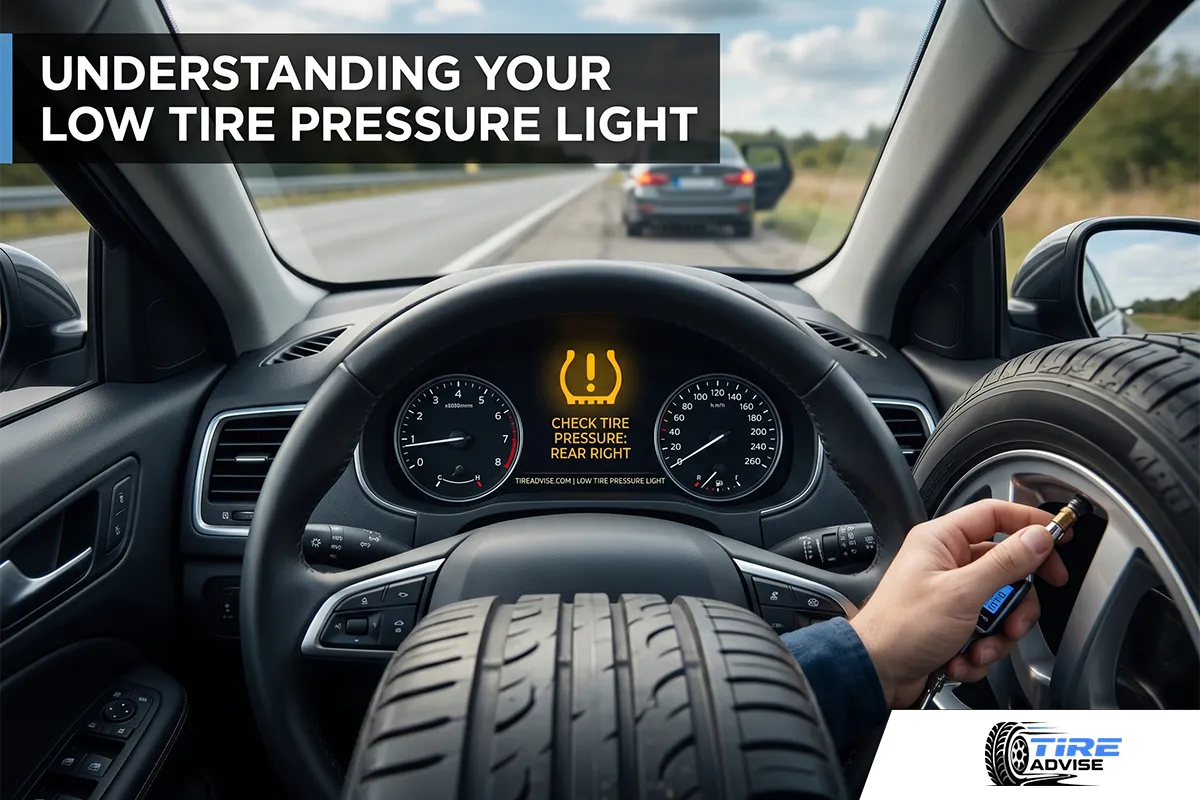
That little glowing horseshoe on your dashboard is one of the most ignored warning lights in the average car — and one of the most important ones to actually act on. Turning it off is easy, but it starts with knowing exactly what your tire pressure should be before you add a single PSI of air.
- When your low tire pressure light comes on, pull over safely, check all four tires with a gauge, and inflate any low tires to the recommended PSI found on your driver’s door jamb sticker.
- A solid light means low pressure; a flashing light means a sensor fault.
- Driving on significantly underinflated tires is genuinely dangerous and causes rapid, irreversible tire damage. Don’t ignore this one.
Understanding tire pressure is part of the bigger picture of tire ownership — our complete tire buying and maintenance guide walks through everything from reading your tire specs to knowing when it’s time for a full replacement.
Liked this article?
Add TireAdvise as a preferred source so you see more of our tire reviews and guides on Google.
What Does the Low Tire Pressure Light Look Like?
The tire pressure warning light is the icon that looks like a cross-section of a tire — a U-shape or horseshoe — with an exclamation point inside it. On most vehicles it glows amber or orange. Some older vehicles display it in red.
You’ll find it in the instrument cluster, usually grouped with other warning indicators near the speedometer. If you’ve never paid attention to it before, now is a good time to get familiar with it — because when it turns on, what you do in the next few minutes actually matters.
Solid Light vs. Flashing Light: These Mean Two Different Things
This is the first thing to check, and a lot of drivers miss the distinction entirely.
A solid, steady light means one or more of your tires has dropped to 25% or more below the recommended pressure. On a tire that should be at 35 PSI, that means you’re at roughly 26 PSI or lower. This is a pressure problem, and the fix is straightforward: find the low tire and inflate it.
A flashing light that blinks for 60–90 seconds after you start the car, then stays on solid means something is wrong with the TPMS system itself — typically a dead or malfunctioning sensor rather than a pressure issue. This is a different problem that requires diagnosing which sensor has failed. I covered TPMS sensor diagnosis and replacement in detail in the tire pressure sensor guide.
The way I remember it: flashing means the system can’t do its job; solid means the system is working and telling you something is wrong.
Why Is My Tire Pressure Light On? The Most Common Causes
Over the years I’ve tracked down a lot of low tire pressure warnings, and the cause almost always falls into one of five categories.
1. Temperature Drop (Most Common in Fall and Winter)
This is the number one cause of low tire pressure lights that catch drivers off guard, and it catches people every single year.
This is the number one cause of low tire pressure lights that catch drivers off guard, and it catches people every single year.
Tire pressure drops approximately 1 PSI for every 10°F decrease in ambient temperature. Because of this extreme fluctuation in air density, understanding the difference in tire pressure in winter vs summer is critical to avoid constantly fighting with your TPMS light on cold mornings.
A tire that was correctly inflated to 35 PSI on a 65°F October afternoon will read closer to 29–30 PSI on a 5°F January morning. That’s a 5–6 PSI drop from temperature alone — enough to trigger the warning light.
There’s no leak. There’s no damage. The laws of physics just reduced the pressure in your tires overnight. Inflate them to spec and the light will go off.
This also explains why the light often comes on during the first cold snap of the season and then keeps coming back until you make a habit of checking pressure in cold weather. I add about 2 PSI above the recommended spec when I’m heading into fall specifically to buffer against temperature swings.
2. Slow Puncture or Nail
A screw, nail, or piece of road debris embedded in the tread will often cause a slow leak rather than an immediate flat. The tire might lose 3–5 PSI per day rather than going flat overnight. The warning light comes on when the cumulative loss hits the threshold.
If you find one tire significantly lower than the others and there’s no obvious temperature explanation, walk around the car and look at the tread on all four tires. Nails and screws are often visible if you know to look. Run your hand carefully around the tread — you’ll sometimes feel the head of a fastener before you see it.
3. Normal Air Permeation
Even a perfectly healthy tire with no damage loses air naturally. Air molecules permeate through the rubber over time. Under normal conditions, a tire loses about 1–3 PSI per month through this process alone.
If you haven’t checked your tire pressure in three or four months — which is most drivers — you could easily be sitting 6–8 PSI below spec without any leak or damage involved. This is the most mundane cause and also the most preventable: monthly pressure checks catch it before the warning light does.
4. Valve Stem Leak
The valve stem is the small rubber or metal protrusion on your wheel where you add air. The rubber valve stems on older wheels deteriorate over time and can develop slow leaks. Metal TPMS valve stems can corrode at the base seal. Even the small valve core inside the stem can get damaged or loosen.
A quick way to check: put a small amount of soapy water on the tip of the valve stem while the cap is off. If it bubbles, the stem is leaking. Valve core replacement is a $2–$5 fix; a full rubber stem replacement is $5–$15 at most shops.
5. Bead Leak
The tire bead is the edge of the tire that seals against the wheel rim. On corroded or damaged rims — particularly common on older alloy wheels in regions with heavy road salt use — the bead seal can deteriorate and allow slow air loss.
Bead leaks are harder to diagnose without dismounting the tire, but a shop can identify them by submerging the inflated tire in water and watching for bubbles at the rim edge.
Why Does Tire Pressure Go Down Over Time?
Even without any of the above causes, tire pressure naturally decreases because of two physical processes working together.
Gas permeation through rubber: Rubber is not perfectly airtight at a molecular level. Over weeks and months, air molecules — particularly nitrogen — migrate through the rubber compound and escape. This is unavoidable and affects even brand-new tires. It’s why tire pressure recommendations include a monthly check interval, not an annual one.
Temperature cycling: Every time your tires heat up from driving and cool down when parked, the rubber expands and contracts slightly. Over hundreds of cycles, this gradually allows small amounts of air to escape around the valve and bead. The effect is small per cycle but meaningful over months.
The practical takeaway: even if you’ve never had a flat tire or a puncture in your life, your tires are still losing air. Monthly checks aren’t paranoia — they’re just physics.
What Tire Pressure Is Too Low?
The TPMS warning light is calibrated to activate at 25% below the vehicle’s recommended pressure — but I’d argue that’s too conservative a threshold to use as your personal benchmark. Here’s a more practical framework:
| PSI vs. Recommended | Classification | What to Do |
|---|---|---|
| 1–3 PSI below | Slightly low — normal variation | Inflate when convenient |
| 4–6 PSI below | Noticeably low | Inflate before any significant drive |
| 7–10 PSI below | TPMS light will likely be on | Inflate now; inspect for leak |
| 11–25% below recommended | Significantly underinflated | Inflate immediately; do not take highway speeds |
| More than 25% below | Severely underinflated | Do not drive; risk of tire failure |
To put numbers on it: on a vehicle with a 35 PSI recommendation, the TPMS light triggers at roughly 26 PSI. I’d want to know about it at 30 PSI — which is why I check manually rather than relying on the light as my first warning.
At 20 PSI or below on a standard passenger car tire, you are in dangerous territory. The sidewall is flexing far beyond its design limits, the tire is generating excessive heat, and the risk of sudden failure rises substantially.
Is It Safe to Drive With the Low Tire Pressure Light On?
This is the question I get asked most often, and the honest answer is: it depends on how low the tire is and how far you need to go.
The conservative, technically correct answer: No. When the light is on, one or more tires is at least 25% below spec — a level that increases wear rate, reduces handling performance, and in extreme cases increases blowout risk. You should pull over and address it.
The practical real-world answer: A short, low-speed drive to a gas station or tire shop a mile or two away is not going to destroy your tires or put you in immediate danger. But driving 30+ miles on the highway with a significantly underinflated tire is a different calculation entirely.
My personal rule: if the light just came on and I know it’s probably temperature-related (first cold day of fall), I drive carefully to the nearest place I can add air and handle it. If the light has been on for a week and I’ve been putting it off — that’s a different situation, and I’m running a real risk.
What I wouldn’t do: Drive at highway speeds for any significant distance with the light on. The combination of heat buildup, sidewall stress, and reduced handling margin is where the real danger lives.
How Low Is Too Low to Drive?
| Scenario | Can You Drive? | My Recommendation |
|---|---|---|
| 3–5 PSI below spec, light just came on | Yes, carefully | Get to a gas station or pump within a few miles |
| 6–10 PSI below spec | Short distances only | Don’t take the highway; inflate before any real driving |
| 11–15 PSI below spec | Only in an emergency | Drive slowly to the nearest shop or pump; risk of damage |
| 15+ PSI below spec / visually flat | No | Stop driving; inflate or call for assistance |
| Visibly flat (under 20 PSI) | No | You are at serious risk; do not drive on this tire |
The Real Dangers of Low Tire Pressure
I want to spend a moment here being direct about what underinflation actually does, because I think a lot of drivers assume it’s mostly just a fuel economy issue. It’s not.
Tire failure risk. An underinflated tire flexes much more aggressively with each rotation. This flexing generates internal heat — and heat degrades rubber at the molecular level. Run a tire significantly underinflated at highway speeds for long enough, and the internal structure can fail catastrophically. A blowout at 70 mph is not a minor inconvenience.
Handling and braking degradation. An underinflated tire deforms under cornering loads and braking forces in ways a properly inflated tire doesn’t. Stopping distances increase, particularly on wet pavement. The car doesn’t respond as quickly or predictably to steering inputs.
Irreversible internal damage. Here’s something most drivers don’t know: if you drive on a significantly underinflated tire, particularly at highway speeds, you can cause internal structural damage — broken cords, delamination — that isn’t visible from the outside. The tire might look fine and hold air afterward, but the internal damage is there. This is why tire shops sometimes refuse to reinstall a tire that’s been run severely underinflated: they can’t certify its integrity.
Accelerated tread wear. Underinflation causes the outer edges of the tread to wear faster than the center. Depending on how long and how severely a tire was underinflated, this edge wear can be significant enough to shorten the tire’s useful life by thousands of miles.
What to Do When the Tire Pressure Light Comes On: Step by Step
Here’s exactly what I do when the light comes on:
Step 1: Don’t panic, but don’t ignore it. The light doesn’t mean you’re about to have a blowout right now. It means you need to address pressure in the next few minutes to hours, not days.
Step 2: Glance at the light — is it solid or flashing? Solid = pressure issue. Flashing at startup then staying solid = sensor fault. If it’s flashing, you need sensor diagnosis, not just air.
Step 3: Find a safe place to pull over or drive to in the next mile or two. A gas station is ideal — most have an air hose. A parking lot is fine if you have your own gauge and pump.
Step 4: Check all four tires with a gauge. Don’t just eyeball them. A tire at 26 PSI often looks identical to one at 35 PSI. You need to use a high-quality physical tool (like one of the best tire pressure gauges) to check all four tires, write down the readings, and compare them against the target PSI.
Step 5: Identify which tire(s) are low. Often it’s one tire with a slow leak; sometimes it’s all four from temperature drop. If one is dramatically lower than the others, inspect that tire carefully for embedded objects.
Step 6: Inflate to the recommended PSI. Use the gas station air hose or your own compressor. If you’ve never done this manually, take a minute to read our step-by-step guide on how to check tire pressure. Add air in short bursts, checking the pressure between bursts, as it’s easy to overshoot with a fast-flowing air hose.
Step 7: Drive a few miles to let the system update. Most TPMS systems need a few minutes of driving above 15–20 mph to register the new pressure and turn the light off. After 5–10 minutes, the light should go out on its own.
Step 8: If the light stays on, diagnose further. See the next section.
How to Reset the Low Tire Pressure Light
In most cases, the TPMS light turns itself off automatically once you’ve properly inflated the tires and driven for a few minutes. You don’t need to do anything special. Here’s the breakdown by scenario:
Light goes off on its own after inflating and driving: Normal operation. You’re done.
Light stays on after inflating all four tires to correct pressure:
- Confirm your pressures are actually correct. Don’t just guess; look up the exact recommended tire pressure by vehicle to ensure you are hitting the specific manufacturer baseline required to turn the sensor off
- Drive at speeds above 25 mph for at least 10 minutes — the system needs wheel rotation to update
- If it still doesn’t go off, try turning the car off and back on after driving
- If the light remains solid after all this, one sensor may have failed or needs a relearn — see below
Manual reset procedure (for vehicles with a TPMS reset button): Some Honda, Acura, and other vehicles have a physical TPMS reset button, usually located under the steering wheel. With the vehicle on (not engine running on some models, engine running on others — check your owner’s manual):
- Inflate all tires to correct pressure
- Press and hold the TPMS reset button until the light blinks three times
- Drive at 50 mph for 10+ minutes for the system to recalibrate
For indirect TPMS systems: After inflating your tires, you need to reset the system’s baseline or it won’t know what “normal” looks like. Most indirect TPMS vehicles have a calibration reset option in the vehicle settings menu — something like Vehicle Settings > TPMS Calibration > Calibrate. Some require a specific drive cycle.
Why Is My Tire Pressure Light Still On After I Added Air?
This is one of the most common frustrations I hear, and there are several reasons it happens:
You haven’t driven far enough yet. The TPMS system typically needs 5–15 minutes of driving above 15–20 mph to register the updated pressure. Inflating the tires in the driveway and then checking the light on a 2-minute drive to the store isn’t long enough.
The pressure you added isn’t quite right. Gas station air gauges are notoriously inaccurate — I’ve seen them off by 4–6 PSI. If you used the gas station gauge to set pressure and it was reading high, you may have inflated the tires to less than you think. Double-check with your own quality digital gauge.
One tire is still low. It’s easy to miss the actually-low tire when one is dramatically lower than the others. Check all four again carefully.
A sensor has failed. If all four tires are genuinely at the correct pressure and the light is still on, the most likely explanation is a dead or malfunctioning TPMS sensor. The light will remain on regardless of actual pressure if the receiver can’t communicate with a sensor. At this point you need a TPMS scan — most auto parts stores (AutoZone, O’Reilly, Advance) will do this for free.
The system needs a relearn after recent tire service. If you recently had tires rotated, replaced, or remounted, the TPMS module may have lost the sensor ID-to-position mapping and needs a relearn procedure.
You have a persistent slow leak. If you inflate the tire, the light goes off, and then it comes back on within a day or two, you have a leak. Check for embedded objects, valve stem issues, and bead leaks.
Seasonal Tire Pressure Light Pattern: What’s Normal
If your TPMS light follows a predictable seasonal pattern, you’re not alone. Here’s what’s normal versus what needs attention:
| Pattern | Likely Cause | Action Needed |
|---|---|---|
| Light comes on every fall when temps drop | Normal temperature-related pressure loss | Inflate to spec; monitor monthly in winter |
| Light comes on every morning when very cold, goes off after driving 10 min | Normal — cold tires read lower; pressure rises as tires warm | Inflate to cold spec; light should eventually stay off |
| Light comes on after heavy rain | Rain cools tires briefly; if chronic, check for bead leak | Monitor; if persistent, have bead checked |
| Light comes on randomly regardless of temperature | Sensor fault or persistent slow leak | Get TPMS scan; inspect all tires for leak |
| Light comes on within 24 hours after inflating | Active slow leak | Inspect thoroughly for puncture or valve issue |
FAQ: Low Tire Pressure Light Questions
Why is my tire pressure light on when my tires look fine?
Tires can lose significant pressure before they look visibly flat — a tire at 26 PSI often looks normal to the naked eye. Always use a gauge. The other possibility is a TPMS sensor fault, which triggers the light regardless of actual pressure.
Why is my tire pressure light blinking or flashing?
A TPMS light that flashes for 60–90 seconds at startup (then stays solid) indicates a system fault — usually a dead or malfunctioning sensor. This is different from a low-pressure warning. The sensor needs to be diagnosed and likely replaced.
Is it OK to drive with the low tire pressure light on?
For a short, low-speed drive to a place where you can add air — yes, carefully. For extended highway driving — no. Sustained driving on an underinflated tire generates heat that can damage the tire internally or cause a blowout.
What is too low of a tire pressure to drive on?
Anything below about 20 PSI on a standard passenger car tire is in dangerous territory and you should not drive on it. Even 26 PSI (which triggers the TPMS light on a 35 PSI tire) is a “handle it today” situation, not a “maybe this weekend” situation.
How do I get the tire pressure light to turn off?
Inflate all tires to the correct PSI (from your door jamb sticker), then drive at normal speeds for 5–10 minutes. The light should turn off on its own. If it doesn’t, check all pressures again with a quality gauge, and if they’re correct, suspect a sensor fault.
Why does my tire pressure keep going low?
If one tire repeatedly loses pressure, you have a slow leak — most likely a small puncture, faulty valve stem, or bead leak. If all four tires keep going low, it’s usually normal air permeation combined with seasonal temperature drops. Check all four monthly.
Can I drive 2 miles with low tire pressure?
Two miles at low speeds to a gas station or pump is generally safe if the tire isn’t visibly flat. Avoid highway speeds even for short distances on a noticeably underinflated tire.
Why does tire pressure go down in the cold?
Cold air is denser and takes up less space, so the pressure inside the tire drops as temperatures fall. The rule of thumb is roughly 1 PSI lost per 10°F temperature drop. This is normal physics — inflate to spec and check monthly through winter.
What should I do if my tire pressure light comes on while driving on the highway?
Reduce speed gradually and safely — don’t brake hard or make sudden lane changes. Move to the right lane, take the next exit, and find a safe place to stop and check your tires. Do not continue at highway speeds with the light on.
Final Thoughts
The low tire pressure light is genuinely one of the few warning lights that deserves immediate attention rather than a mental note to deal with it later. It’s easy to handle — usually a 5-minute stop at a gas station — and the cost of ignoring it can range from shortened tire life to a dangerous high-speed blowout.
My advice: take it seriously, handle it the same day, and then set a monthly pressure check reminder so you’re catching pressure loss before your car has to tell you about it. The light should be your backup, not your primary reminder.
For the complete picture of tire care — including how to choose the right tires, read wear patterns, and know when replacement is due — our tire buying and maintenance guide has everything in one place.
If your light is on right now and you’re not sure what you’re dealing with, drop your situation in the comments — year, make, model, and what the light is doing — and I’ll help you figure out the next step.

How do I turn off the TPMS permanently?
I check.tire pressure regularly (I have an air compressor in my garage) and I garage both my vehicles. Yet the tire pressure warning light won’t go off! I am frustrated and whish to get rid of the system.