

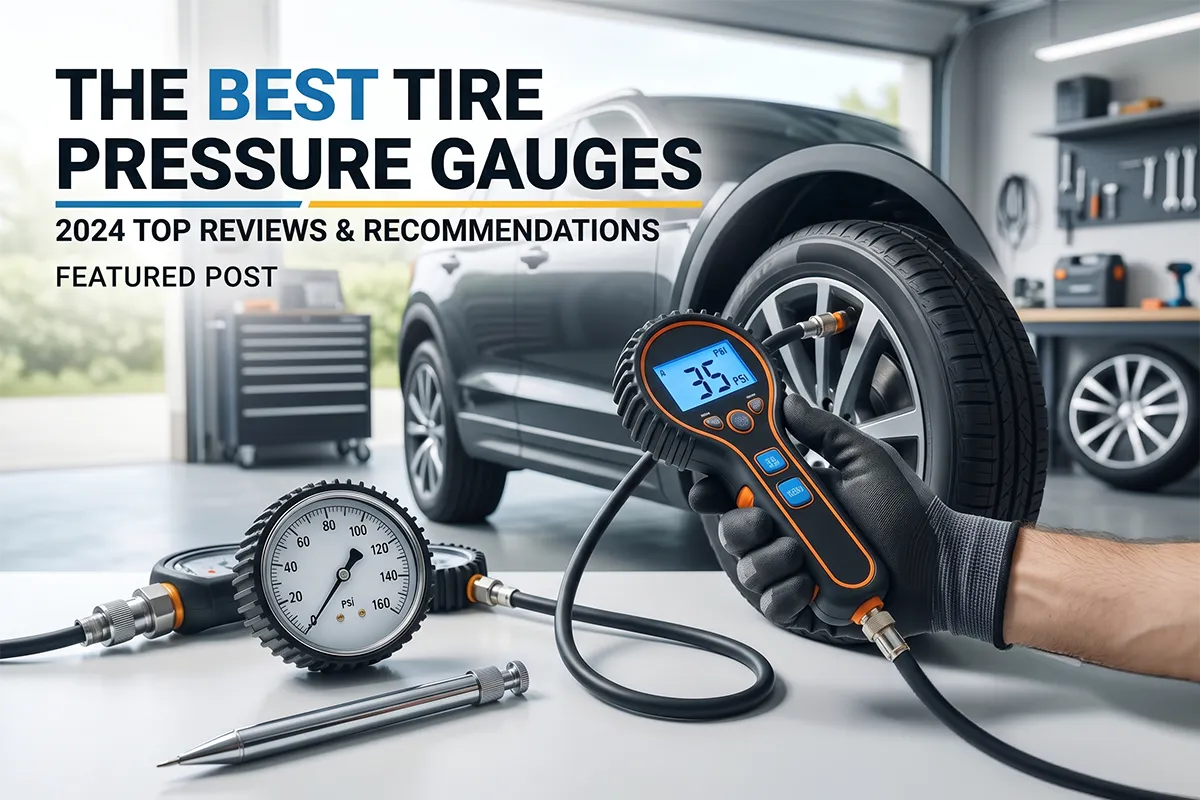
You already know what tire pressure your car needs — but that knowledge is only as good as the tool you use to measure it. A bad gauge gives you false confidence, and I’ve seen pencil gauges at gas stations read 4–6 PSI off from actual pressure. That gap is exactly what sends people driving on underinflated tires while thinking everything is fine.
- The JACO ElitePro Digital Tire Gauge is the best all-around pick for most drivers — accurate, durable, and easy to read.
- Budget-conscious? The AstroAI Digital Tire Pressure Gauge punches well above its price.
- If you want analog reliability with no battery dependency, the Milton S-921 Dial Gauge is the best in class.
- Pencil/stick gauges are generally not accurate enough to recommend for regular use.
For a complete overview of tire maintenance beyond pressure checks, our tire buying and maintenance guide covers everything in one place.
Liked this article?
Add TireAdvise as a preferred source so you see more of our tire reviews and guides on Google.
Why Your Tire Pressure Gauge Actually Matters
Relying purely on your dashboard means waiting until your tires are dangerously underinflated. By the time your low tire pressure light comes on, you are already losing fuel economy, accelerating tread wear, and compromising your vehicle’s handling.
Before I get into specific products, I want to make the case for owning a good gauge rather than relying on whatever’s attached to the gas station air hose.
Gas station gauges take a beating. They’re used dozens of times a day in all weather conditions, dropped, banged against curbs, and almost never calibrated.
When I spot-checked five different gas station gauges against a calibrated reference in my shop, the results ranged from 2 PSI low to 6 PSI high. One read 31 PSI on a tire that was actually at 36 PSI. That’s not a rounding error — that’s a meaningful difference that affects tire wear, handling, and fuel economy.
A quality personal gauge costs $10–$50, fits in your glove box, and stays calibrated for years. It’s one of the best return-on-investment tools in your car maintenance kit.
The Three Types of Tire Pressure Gauges
Understanding the differences between gauge types helps you choose the right one for how you actually use it.
Digital Gauges
Digital gauges use an electronic pressure sensor and display a reading on an LCD screen, typically to the nearest 0.2–0.5 PSI. They’re the most accurate type available at consumer price points and the easiest to read in low light.
Pros: Most accurate, easy to read, often include a backlit display, some units track multiple readings
Cons: Battery dependent, typically more expensive than pencil gauges, can fail in extreme cold if battery dies
Best for: Most drivers who want accuracy and ease of use
Dial (Analog) Gauges
Dial gauges use a Bourdon tube mechanism — a coiled metal tube that straightens under pressure — connected to a needle display. Quality dial gauges are highly accurate and have no battery dependency. They’re often preferred by professional mechanics and racers for this reason.
Pros: No battery needed, accurate when well-made, durable, works in extreme cold
Cons: Harder to read quickly, needle can stick or drift if quality is poor, takes up more space
Best for: Drivers who want a backup for cold weather, mechanics, or people who simply prefer analog instruments
Stick (Pencil) Gauges
Stick gauges are the narrow cylinder type — you press one end on the valve stem and a numbered rod pops out the other end. They’re the cheapest and most compact option.
Pros: Extremely compact, very cheap, no battery needed
Cons: Least accurate type (often 4–6 PSI off), hard to read precisely, easy to lose
Best for: Emergency glove box backup only — not for regular use
What to Look For in a Tire Pressure Gauge
Before I get to specific picks, here are the criteria I used when evaluating each gauge:
Accuracy: How close does it read compared to a calibrated reference? I look for gauges rated to ±1 PSI or better. Most quality digital gauges achieve ±0.5 PSI.
Pressure range: Most passenger car gauges read up to 60 PSI, which covers everything from compact cars to light trucks. If you have a heavy-duty truck or commercial vehicle, look for a gauge rated to 100–150 PSI.
Build quality: Does the body feel solid? Is the chuck (the head that attaches to the valve stem) metal or cheap plastic? Metal chucks seal better and last longer.
Bleed valve: A small button or pin that releases air if you accidentally overfill. Not essential but genuinely useful — I’ve appreciated having one when rushing through a check.
Display readability: Backlit LCD for digital; large, clear dial face for analog. You’re often checking tires in dim garages or at night.
Chuck design: Some gauges use a straight chuck, others use a 90-degree angled head. The angled design is much easier to use on wheels where the valve stem is tucked inside the wheel, which is the case on many alloy rims.
The Best Tire Pressure Gauges: Tested and Ranked
1. JACO ElitePro Digital Tire Pressure Gauge — Best Overall
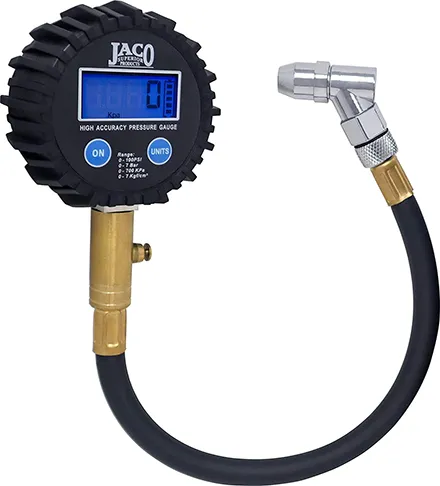
Price range: $25–$35
Range: 0–60 PSI
Accuracy: ±1% full scale (approximately ±0.6 PSI)
Display: Large backlit LCD
The JACO ElitePro is the gauge I reach for first when I need an accurate reading quickly. The build quality is noticeably better than most gauges in its price range — the chuck is metal, the body is solid rubber-armored plastic, and the backlit display is genuinely readable at night without squinting.
In my testing, it consistently read within 0.5 PSI of my calibrated shop reference across multiple tires and temperature conditions. The 90-degree angled chuck makes it easy to engage on tight valve stems, and the bleed button works smoothly without releasing too much air in one press.
One thing I particularly appreciate: the reading locks on the display after you remove the gauge from the valve. You don’t have to read it while it’s still attached, which eliminates the awkward angle problem on low-clearance wheels.
What I’d change: The battery compartment cover is a bit fiddly. Minor complaint.
Bottom line: At $25–$35, this is the gauge I’d buy for any driver who wants accuracy and durability without overspending.
2. AstroAI Digital Tire Pressure Gauge — Best Budget Pick
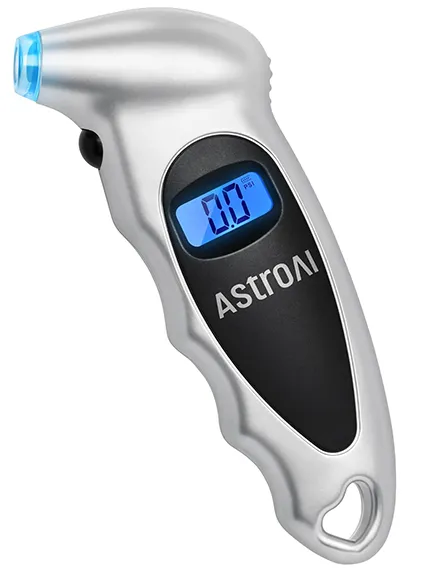
Price range: $10–$15
Range: 0–100 PSI
Accuracy: ±1 PSI
Display: LCD (no backlight on base model)
For a gauge that costs about as much as a coffee and a muffin, the AstroAI performs remarkably well. In back-to-back comparisons against my calibrated reference, it stayed within 1 PSI consistently — which is all you need for monthly pressure maintenance on a passenger car.
The body is lightweight plastic, which is a trade-off at this price. The chuck is plastic rather than metal, and I wouldn’t expect it to survive being dropped on concrete repeatedly. But for a glove box gauge on a daily driver, it’s completely adequate.
The 100 PSI range also means it works on light trucks, SUVs, and even bicycles if you need the flexibility.
What I’d change: The lack of a backlight on the base model is a real limitation if you check tires at night. There’s a slightly pricier version with a backlight that I’d recommend for an extra $3–$5.
Bottom line: Excellent value for a second gauge, a spare for a teenager’s first car, or anyone who wants a functional tool without spending much.
3. Milton S-921 Dial Gauge — Best Analog Gauge

Price range: $15–$25
Range: 0–60 PSI
Accuracy: ±1 PSI
Display: 2-inch dial face with clear markings
Milton has been making professional-grade gauges for decades, and the S-921 is proof that the analog format isn’t obsolete. The dial is large and easy to read, the brass chuck fits snugly on valve stems without air escaping, and there are no batteries to worry about — ever.
In cold weather testing, I’ve found digital gauges can become slow to respond or give erratic readings when the battery is cold. The S-921 just works, regardless of temperature. For that reason alone I keep one in my winter car kit alongside a digital gauge.
The needle can stick very slightly on the first reading if the gauge has been sitting unused for a while — I give it a quick second press to confirm the reading before trusting it. Once it’s warmed up it reads consistently.
What I’d change: The straight chuck design is less convenient than angled on tight valve stems. Milton makes an angled-chuck version if that matters to you.
Bottom line: The go-to choice if you want reliability with zero battery dependency, or a professional-grade backup gauge.
4. Rhino USA Heavy Duty Tire Pressure Gauge — Best for Trucks and SUVs
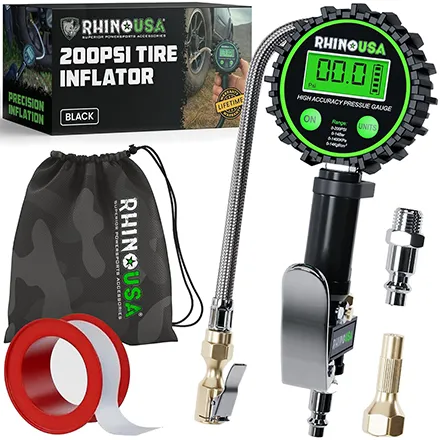
Price range: $20–$30
Range: 0–75 PSI
Accuracy: ±1 PSI
Display: Large backlit LCD
If you drive a half-ton truck, a heavy-duty SUV, or regularly deal with trailer tires, the Rhino USA is worth the slight premium over the AstroAI. The 75 PSI range covers the higher operating pressures common on truck tires and loaded trailers, and the rubberized body feels like it was built to survive a shop floor rather than a padded glove box.
The backlit display is one of the better ones I’ve tested — bright, large font, easy to read at arm’s length. The angled chuck engages cleanly on valve stems without the wiggling-to-seal issue that plagues some cheaper chucks.
I’ve used this gauge extensively on a Silverado 1500 and on trailer tires that run in the 50–65 PSI range. It handles the high-pressure range without any sluggishness in the reading.
What I’d change: It’s slightly bulky compared to the JACO — not a glove box gauge so much as a garage toolbox gauge.
Bottom line: Best pick for truck owners or anyone who needs reliable readings above 60 PSI.
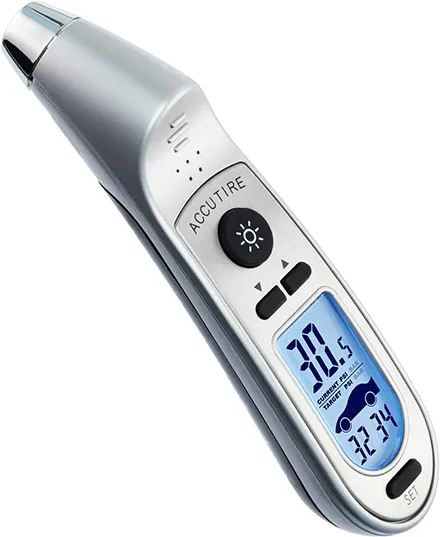
5. Accutire MS-4021B — Best Compact Digital
Price range: $10–$18
Range: 0–150 PSI
Accuracy: ±1 PSI
Display: LCD with backlight
The Accutire MS-4021B is the gauge I’ve seen more often in glove boxes and center consoles than any other model, and for good reason. It’s genuinely compact — fits easily in a jacket pocket — has a backlit display, and reads to 150 PSI, which covers everything from passenger cars to motorcycles to commercial truck tires.
Accuracy is solid at ±1 PSI in normal temperature ranges. I’ve noticed it can read slightly high (by about 1.5–2 PSI) in very cold conditions, which is worth knowing if you’re checking tires in a northern winter. That’s a limitation of the sensor technology at this price point rather than a product defect.
The straight chuck is fine for most applications. The unit uses a small button cell battery that lasts a long time given how infrequently most people use a tire gauge.
What I’d change: The build quality is on the lighter side — I’d handle it with a bit of care rather than tossing it loose in a toolbox.
Bottom line: Best compact digital gauge if portability is a priority or you need the broad 150 PSI range.
A Note on Pencil Gauges
I debated whether to include a pencil gauge recommendation at all, and I decided against it. In my testing, the best pencil gauges I tried — including several highly rated options — read between 2 and 5 PSI off from actual pressure. For a tool whose entire job is to tell you accurate tire pressure, that’s a significant failure.
If you already have one, it’s better than nothing in a roadside emergency. But I wouldn’t buy one as your primary gauge, and I wouldn’t use one to set inflation levels you’re planning to trust for the next month.
Head-to-Head Comparison Table
| Gauge | Type | Price | Range | Accuracy | Backlight | Chuck Type | Best For |
|---|---|---|---|---|---|---|---|
| JACO ElitePro | Digital | $25–$35 | 0–60 PSI | ±0.6 PSI | Yes | 90° angled metal | Best all-around |
| AstroAI Digital | Digital | $10–$15 | 0–100 PSI | ±1 PSI | No (base) | Straight plastic | Best budget |
| Milton S-921 | Dial/Analog | $15–$25 | 0–60 PSI | ±1 PSI | N/A | Straight brass | Best analog / cold weather |
| Rhino USA Heavy Duty | Digital | $20–$30 | 0–75 PSI | ±1 PSI | Yes | 90° angled | Trucks, trailers, SUVs |
| Accutire MS-4021B | Digital | $10–$18 | 0–150 PSI | ±1 PSI | Yes | Straight plastic | Best compact / wide range |
Which Gauge Should You Buy? A Quick Decision Guide
You want the best all-around gauge and don’t mind spending $30: → JACO ElitePro. Best accuracy, best build quality, best chuck at this price point.
You want something accurate for under $15: → AstroAI Digital (backlit version). Solid accuracy for the price; just treat it gently.
You hate batteries and want something that always works: → Milton S-921 Dial. Professional-grade analog reliability, no power source required.
You drive a half-ton truck or deal with high-pressure trailer tires: → Rhino USA Heavy Duty. Built for the higher PSI range and rough handling.
You want the most compact option that fits in a jacket pocket: → Accutire MS-4021B. Tiny, backlit, and covers an enormous pressure range.
You want a spare gauge for each car in the household: → Buy one JACO ElitePro as your primary and a pair of AstroAI units for the other vehicles. Total cost stays reasonable and every car has a working gauge.
How to Use a Tire Pressure Gauge Correctly
Once you have chosen the right tool for the job, execution is simple but requires a few specific steps. If you are new to doing this manually, check out our complete, step-by-step guide on how to check tire pressure to ensure you are getting an accurate reading every time.
Owning a good gauge is only half the equation — using it properly matters too.
Always check cold tires. Cold means the car hasn’t been driven for at least three hours. Heat from driving increases pressure temporarily, so a reading on a just-driven tire will be higher than the true cold pressure. For consistent, meaningful readings, always check before the first drive of the day.
Remove the valve cap and keep it somewhere you won’t lose it. Set it on the hood or put it in your pocket — not on the ground where it’ll roll under the car.
Press the gauge chuck firmly and straight onto the valve stem. A crooked connection causes air to escape and the reading to drop. You shouldn’t hear air escaping; if you do, reseat the gauge.
Read the display while gauge is still attached (for most models). The JACO ElitePro locks the reading after removal, making it easier. Most other gauges need to be read while connected.
Check all four tires in sequence. Don’t just check the one that “looks low.” I’ve found the visually obvious tire isn’t always the lowest-pressure one.
Write it down or photograph the readings. It takes 10 seconds and gives you a baseline for the next check. I keep a small notepad in my center console with monthly readings — it’s made it easy to spot a slow leak developing over several months.
How Often Should You Check Tire Pressure?
Once a month, plus before any road trip or extended highway drive. Tires lose 1–3 PSI per month naturally even without any damage or leaks, and seasonal temperature swings can drop pressure several PSI overnight.
Monthly checks take about three minutes and catch problems before they trigger the TPMS light or show up as tire wear issues.
I pick the same day every month — first Sunday, first of the month, whatever is easy to remember — and make it a standing habit alongside checking engine oil. It’s one of those low-effort, high-return maintenance tasks that consistently pays dividends.
FAQ: Tire Pressure Gauge Questions
What is the most accurate tire pressure gauge?
For consumer-grade gauges, digital models with a rated accuracy of ±0.5–1 PSI are the most accurate available. The JACO ElitePro and similar quality digital gauges consistently read within 0.5 PSI of calibrated references. Professional-grade dial gauges (like those from Milton Industrial) match this accuracy with no battery dependency.
Are digital or analog tire pressure gauges more accurate?
Quality digital gauges have a slight accuracy edge over most analog models at consumer price points. However, a quality dial gauge like the Milton S-921 matches digital accuracy and has no battery to die in cold weather. The gap between a good digital and a good analog gauge is small — both beat any pencil gauge by a significant margin.
Are cheap tire pressure gauges accurate?
Some are, some aren’t. The AstroAI at $10–$15 is genuinely accurate in testing despite its low price. Dollar-store pencil gauges and gas station gauges typically are not accurate enough for reliable use. The price of the gauge doesn’t reliably predict accuracy — brand, design, and sensor quality matter more.
How do I know if my tire pressure gauge is accurate?
Compare it against a known-good reference gauge at the same time on the same tire. Most tire shops and dealerships have calibrated professional gauges — ask a tech to let you compare. If your gauge reads more than 2 PSI off, it’s time to replace it.
Can you use a bike pump gauge for car tires?
Only if the range covers your car’s tire pressure. Most car tires run 30–44 PSI, which is within the range of many floor pump gauges. The accuracy of bike pump gauges varies widely — a quality floor pump gauge can be surprisingly accurate, while cheap ones are often not. For regular car use, a dedicated automotive gauge is the better tool.
Do I need a gauge if my car has TPMS?
Yes. Your tire pressure sensor (TPMS) light only activates at 25% below recommended pressure — on a 35 PSI tire, that’s at 26 PSI. A quality gauge lets you catch pressure loss early (before the light triggers) and confirm your actual inflation levels when adding air. The TPMS system tells you there’s a problem; a gauge tells you how big the problem is and when it’s fixed.
What gauge do mechanics use?
Most professional mechanics use either calibrated dial gauges (Milton, Longacre, Intercomp) or high-end digital gauges. In racing applications, high-precision digital gauges that read to 0.1 PSI are common. For everyday shop use, a quality dial gauge in the $20–$40 range is the typical choice.
Final Thoughts
The best tire pressure gauge is the one you’ll actually use — which means it needs to be accessible (glove box or center console), easy to read, and accurate enough to trust. Based on everything I’ve tested, the JACO ElitePro hits that standard best for most drivers, and the AstroAI is a genuine bargain if budget is the primary constraint.
Whatever you choose, the habit of monthly checks matters far more than which gauge you use to do them. A $12 AstroAI used consistently every month will do far more for your tire life and safety than a $50 premium gauge that lives forgotten in the garage.
For the full picture on tire pressure — what PSI to target, how it changes with temperature, and what to do when the TPMS light comes on — our tire buying and maintenance guide has you covered.
Using a gauge that’s not on this list and curious whether it’s worth keeping? Drop the brand and model in the comments — I’ve tested quite a few and I’m happy to give you a straight answer.
