

I’ll never forget the morning I walked out to my car in a Minnesota January and found a puddle of bright green fluid underneath it. My coolant had failed, my engine was at risk, and I realized I’d been neglecting one of the most basic — yet critical — fluids in my vehicle.
If you’re reading this on a tire blog and wondering why we’re talking about antifreeze, trust me — it’s all connected. The health of your cooling system directly affects your engine, your drivetrain, and ultimately the performance you get out of those tires you just invested in.
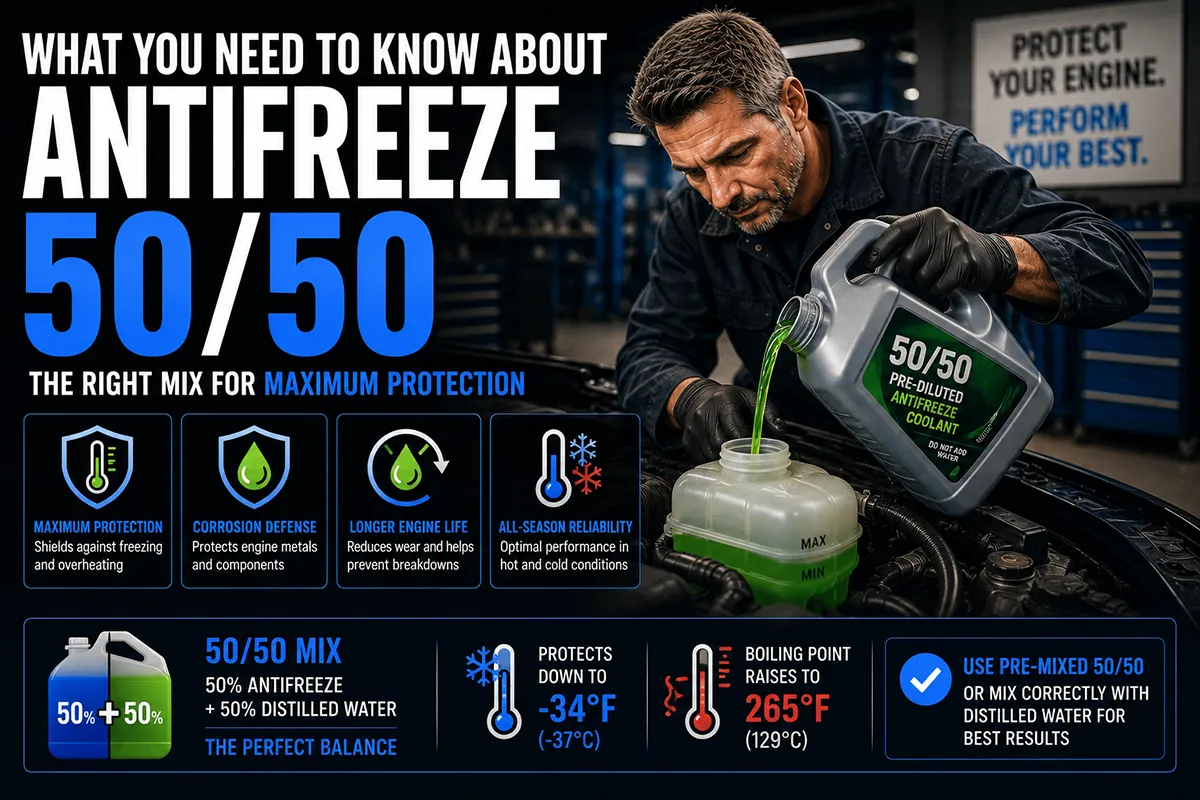
- 50/50 antifreeze is a pre-mixed blend of antifreeze concentrate and distilled water, ready to pour directly into your cooling system.
- It protects your engine from freezing down to about -34°F and from boiling up to around 265°F.
- Using the wrong type or neglecting your coolant can lead to overheating, which damages engines, transmissions, and shortens the life of your tires.
- Always match the antifreeze color/type to your vehicle manufacturer’s recommendation.
- Pre-mixed 50/50 costs a bit more per gallon than concentrate, but it eliminates the risk of mixing errors.
- Plan to flush and replace your coolant every 30,000 to 50,000 miles or per your owner’s manual schedule.
Liked this article?
Add TireAdvise as a preferred source so you see more of our tire reviews and guides on Google.
Why a Tire Reviewer Is Talking About Antifreeze
I know what you’re thinking. “I came here for tire advice, not a chemistry lesson.” But hear me out, because after years of reviewing tires and working on cars, I’ve seen firsthand how interconnected every system on your vehicle really is.
When your cooling system fails, your engine overheats. When your engine overheats, you’re stranded on the side of the road. And when you’re stranded on the side of the road in extreme heat, your tires are sitting on scorching asphalt, baking under a car that’s radiating abnormal levels of heat — none of which is good for tire longevity.
I’ve also seen plenty of cases where people invest hundreds of dollars in premium tires but skip basic maintenance like coolant checks. It’s like buying top-shelf running shoes and then never tying the laces. You have to take care of the whole vehicle to get the most out of every component, tires included.
What Exactly Is 50/50 Antifreeze?
50/50 antifreeze — also called pre-mixed coolant — is a blend of antifreeze concentrate and distilled water in equal parts. It’s designed to be poured directly into your vehicle’s cooling system without any additional mixing or measuring.
The “antifreeze” part is typically ethylene glycol or propylene glycol. These chemicals lower the freezing point and raise the boiling point of water, protecting your engine in both brutal winters and scorching summers.
The “50/50” ratio is the sweet spot that most vehicle manufacturers recommend. It provides optimal freeze protection down to approximately -34°F and boilover protection up to about 265°F (with a standard 15 psi radiator cap). In my experience, this covers the vast majority of driving conditions across the United States, from the frigid upper Midwest to the blazing deserts of Arizona.
50/50 Pre-Mixed vs. Concentrate: Which Should You Buy?
This is one of the most common questions I get, and I’ve used both over the years. Here’s the honest breakdown.
Pre-Mixed 50/50 Antifreeze
This is the grab-and-go option. You open the jug, pour it in, and you’re done. I recommend this for most everyday drivers because it eliminates the single biggest source of error: using the wrong water or the wrong ratio.
Tap water contains minerals, chlorine, and other impurities that can cause scale buildup and corrosion inside your cooling system over time. With pre-mixed, the manufacturer has already blended in distilled or deionized water, so you don’t have to worry about it.
The downside? You’re paying for water. A gallon of pre-mixed 50/50 typically runs between $10 and $18 at most auto parts stores like AutoZone, O’Reilly, or Walmart. You’re getting half a gallon of actual antifreeze concentrate per gallon of product.
Antifreeze Concentrate (Full Strength)
Concentrate is pure antifreeze that you need to dilute yourself — typically with distilled water at a 50/50 ratio. A gallon of concentrate usually costs between $12 and $22, but since you’re mixing it yourself, you effectively get two gallons of usable coolant.
I use concentrate when I’m doing a full system flush, because I need more volume and the cost savings add up. But I always — and I mean always — use distilled water for the mix. Never tap water. Never hose water. Distilled only.
If you’re in an extreme cold climate and need extra freeze protection, you can adjust the ratio to 60% antifreeze and 40% water (which protects down to about -62°F). But never go above 70% antifreeze — counterintuitively, too much antifreeze actually reduces the mixture’s ability to transfer heat effectively.
Comparison Table: 50/50 Pre-Mixed vs. Concentrate
| Feature | 50/50 Pre-Mixed | Concentrate (Full Strength) |
|---|---|---|
| Convenience | Ready to pour — no mixing needed | Requires measuring and distilled water |
| Cost per gallon of usable coolant | $10 – $18 | $6 – $11 (after dilution) |
| Risk of mixing error | None | Moderate (wrong water or ratio) |
| Best for | Top-offs, quick refills, most drivers | Full flushes, budget-conscious DIYers |
| Freeze protection | Down to ~-34°F | Adjustable based on ratio |
| Shelf availability | Widely available everywhere | Widely available everywhere |
The Different Colors and Types of Antifreeze — and Why They Matter
If you’ve ever walked down the coolant aisle at your local auto parts store, you’ve probably noticed antifreeze comes in a rainbow of colors: green, orange, pink, blue, yellow, and even purple. This isn’t just marketing — the colors indicate different chemical formulations.
Conventional Green (IAT — Inorganic Acid Technology)
This is the classic bright green coolant that’s been around for decades. It uses silicates and phosphates as corrosion inhibitors. I grew up using this stuff in older American vehicles, and it works well — but it has a shorter service life than newer formulas.
Typical replacement interval: every 2 years or 30,000 miles.
Orange (OAT — Organic Acid Technology)
General Motors popularized this with Dex-Cool starting in the mid-1990s. OAT coolants use organic acids for corrosion protection and last significantly longer than conventional green. If your vehicle calls for Dex-Cool, use Dex-Cool. I’ve seen what happens when people mix green and orange — it’s not pretty. The additives can gel up and clog your cooling system.
Typical replacement interval: every 5 years or 150,000 miles.
Pink/Blue/Purple (HOAT — Hybrid Organic Acid Technology)
HOAT coolants combine elements of both IAT and OAT formulas. Many European and Asian manufacturers specify these. For example, many Toyota and Lexus vehicles use a pink HOAT coolant, while many VW and Audi models require a specific purple/pink formulation.
Typical replacement interval: every 5 years or 150,000 miles (varies by manufacturer).
The Golden Rule
Always check your owner’s manual. I can’t stress this enough. Using the wrong type of antifreeze can cause internal corrosion, gasket deterioration, and cooling system failure. The color of your current coolant isn’t always a reliable indicator — some universal coolants are dyed to match. When in doubt, go with the exact specification your manufacturer recommends.
How Antifreeze Affects Your Overall Vehicle Health (Including Your Tires)
Here’s where I bring this back to tires, because I know that’s why most of you are here.
Overheating and Roadside Breakdowns
I’ve been on more roadside assistance calls than I can count where someone’s car overheated because they had old, degraded coolant — or no coolant at all. When your car overheats and you’re forced to pull over on hot pavement, you’re subjecting your tires to extreme surface temperatures while they bear the full static load of your vehicle.
In my experience, tires that sit on superheated asphalt (120°F+) while the car is stationary for extended periods can develop flat spots and accelerated rubber degradation. It’s a scenario that’s entirely preventable with basic coolant maintenance.
Engine Temperature and Performance
Your engine’s operating temperature affects everything downstream. A properly cooled engine runs efficiently, which means consistent power delivery to the wheels. When the engine runs hot, the ECU may reduce power output to protect itself (a process called thermal derating). That means less responsive acceleration, which can affect how evenly your tires wear — especially if you’re compensating by driving harder once the power returns.
Transmission Cooling
Many vehicles route transmission fluid through the radiator for cooling. If your coolant is compromised, your transmission can overheat too. Overheated transmission fluid loses its lubricating properties, which can cause erratic shifting and inconsistent power delivery to your drive wheels — yet another factor that indirectly affects tire wear patterns.
How to Check Your Antifreeze: A Step-by-Step Guide
I check my coolant at every oil change, and I recommend you do the same. Here’s exactly how I do it.
Step 1: Wait Until the Engine Is Cool
Never open a radiator cap or coolant reservoir on a hot engine. The system is pressurized, and you risk severe burns. I always do my checks first thing in the morning before I’ve driven anywhere.
Step 2: Locate Your Coolant Reservoir
Most modern vehicles have a translucent plastic overflow reservoir with “MIN” and “MAX” markings. It’s usually near the radiator on one side of the engine bay. Your owner’s manual will show you exactly where it is.
Step 3: Check the Level
The coolant should be between the MIN and MAX lines. If it’s below MIN, you need to add coolant. If it’s consistently low, you may have a leak — which is a problem that needs professional attention.
Step 4: Check the Condition
Good coolant is clear and vibrant in color (whatever color your vehicle uses). If it looks rusty, muddy, has floating particles, or has an oily film on top, it’s time for a flush and replacement.
Step 5: Test the Freeze Protection (Optional but Recommended)
I use a simple antifreeze hydrometer or refractometer — you can pick one up for $5 to $15 at any auto parts store. Just draw a small sample from the reservoir and the tool will tell you the freeze protection level. For most US drivers, you want protection down to at least -34°F.
When to Replace Your 50/50 Antifreeze
This depends on the type of coolant your vehicle uses, but here are the general guidelines I follow.
- Conventional green (IAT): Every 2 years or 30,000 miles
- Extended-life orange (OAT/Dex-Cool): Every 5 years or 150,000 miles
- Hybrid (HOAT): Every 5 years or 150,000 miles (check manufacturer specs)
That said, I always defer to the maintenance schedule in the owner’s manual. Some newer vehicles have coolant that’s rated for even longer intervals. And if your coolant looks dirty or tests poorly before the scheduled interval, replace it early. Prevention is always cheaper than repair.
In my experience, a coolant flush at a shop typically costs between $100 and $200. Doing it yourself with a 50/50 pre-mixed antifreeze costs about $20 to $40 in materials. Either way, it’s a fraction of what an overheated engine repair would cost you.
Popular 50/50 Antifreeze Brands I’ve Used
Over the years, I’ve used a number of brands. Here are the ones I’ve had the best experience with and that are readily available across the US.
Prestone 50/50 Prediluted Antifreeze/Coolant
Prestone is probably the most recognizable name in antifreeze, and for good reason. Their 50/50 formula is marketed as compatible with all makes and models, which makes it a convenient option. I’ve used it in several of my test vehicles without any issues. A gallon typically runs about $13 to $17 at Walmart or AutoZone.
That said, if your vehicle has a very specific coolant requirement (like Dex-Cool for GM vehicles or a specific HOAT for a European car), I still recommend going with the manufacturer-specified formula rather than a universal product.
Zerex by Valvoline
Zerex is my go-to when I need a vehicle-specific formula. They make coolants tailored to specific OEM requirements — Zerex G-05 for Ford and Chrysler, Zerex Asian Vehicle for Toyota and Honda, Zerex Dex-Cool for GM, and so on. All are available in 50/50 pre-mixed versions. Prices range from $12 to $20 per gallon.
I’ve used Zerex G-05 in my personal truck for years, and the cooling system has stayed clean and efficient throughout multiple harsh winters and hot summers.
Peak Original Equipment Technology (OET)
Peak’s OET line is another solid option that’s formulated to match specific manufacturer requirements. I’ve found it at O’Reilly Auto Parts and Advance Auto Parts for around $11 to $16 per gallon. Good quality, widely available, and competitively priced.
Motorcraft (Ford OEM)
If you drive a Ford, Lincoln, or Mercury, Motorcraft coolant is the factory specification. I always use OEM coolant when it’s readily available and reasonably priced — and Motorcraft fits both criteria. You can find it at Ford dealerships, Amazon, and most major auto parts retailers for about $15 to $22 per gallon in 50/50 form.
ACDelco Dex-Cool (GM OEM)
For GM vehicles that require Dex-Cool, I always go with ACDelco. It’s the factory spec, it’s widely available, and it avoids any compatibility concerns that might come with using a universal product. Expect to pay $14 to $20 per gallon for the 50/50 pre-mixed version.
Common Antifreeze Mistakes I’ve Seen (and Made)
I’ll be the first to admit I haven’t always gotten this right. Here are the most common mistakes I’ve encountered — some from personal experience, others from helping friends and family with their vehicles.
Mistake #1: Mixing Different Types of Antifreeze
This is the big one. Mixing IAT (green) with OAT (orange) can cause the additives to react, forming a gel-like sludge that clogs your radiator, heater core, and water passages. I once helped a friend flush a system that had been “topped off” with the wrong coolant repeatedly over several years. The inside of the radiator looked like it was filled with brown oatmeal. The entire cooling system had to be replaced — a $1,200 repair that could have been avoided with a $15 jug of the right coolant.
Mistake #2: Using Tap Water Instead of Distilled
If you’re mixing concentrate yourself, tap water is tempting — it’s free and right there at the kitchen sink. But the minerals in tap water (calcium, magnesium, iron) will deposit scale inside your cooling system over time. This scale acts as an insulator, reducing the system’s ability to transfer heat. I’ve seen water jackets in cylinder heads so scaled up that the engine was running 20-30 degrees hotter than normal.
Always use distilled water. A gallon costs less than a dollar at any grocery store.
Mistake #3: Ignoring Low Coolant Levels
If your coolant level keeps dropping, you have a leak somewhere. It might be a slow seep from a hose clamp, a weeping water pump, or — worst case — a head gasket issue. I’ve seen people just keep topping off without investigating the cause, and eventually the leak gets worse and causes catastrophic overheating.
If you’re adding coolant more than once in a short period, get the system pressure-tested. Most shops will do it for $30 to $50.
Mistake #4: Never Changing the Coolant
“It’s still green, so it’s still good” — I’ve heard this more times than I can count. The color of the coolant doesn’t tell you whether the corrosion inhibitors are still active. Over time, these additives deplete, and the coolant becomes acidic. Acidic coolant eats away at gaskets, seals, aluminum components, and the inside of your radiator.
Follow the replacement schedule. Test your coolant regularly with pH strips or a refractometer if you want extra peace of mind.
Mistake #5: Running Straight Water in the Summer
Some people drain their antifreeze in spring and run plain water during the summer months. This is a bad idea for two reasons. First, water boils at 212°F — well below the temperatures your engine can reach under load on a hot day. Antifreeze raises that boiling point significantly. Second, water provides zero corrosion protection for the metal surfaces inside your engine.
Even in the hottest US climates, I always run a 50/50 mix year-round.
Antifreeze Safety: What Every Car Owner Should Know
Ethylene glycol — the primary ingredient in most antifreeze — is toxic. It has a sweet taste and smell that can attract children and pets. I take this very seriously, and you should too.
- Store antifreeze in its original, sealed container and keep it out of reach of children and animals.
- Clean up spills immediately. If you spill coolant on your driveway or garage floor, soak it up with cat litter or absorbent pads and dispose of it properly.
- Never pour antifreeze down a storm drain or onto the ground. Most auto parts stores and service centers will accept used antifreeze for recycling — many do it for free.
- Consider propylene glycol-based antifreeze if you have pets or children around your garage. It’s significantly less toxic, though still not something you want anyone ingesting. Brands like Sierra offer propylene glycol formulas.
- Wear gloves when handling antifreeze. I always keep a box of nitrile gloves in my garage for coolant work, oil changes, and tire-related tasks.
How Seasonal Changes Affect Your Antifreeze and Your Tires
This is where my two worlds — tires and vehicle maintenance — really collide. As a tire reviewer, I’m constantly thinking about seasonal driving conditions. And those same conditions affect your coolant.
Winter
In cold climates, your antifreeze’s freeze protection is critical. If the coolant freezes, it expands and can crack your engine block — one of the most expensive repairs possible. At the same time, this is when many drivers switch to winter tires, which are designed for cold-weather flexibility and traction. It makes no sense to invest in premium winter tires while neglecting the fluid that keeps your engine from literally cracking apart.
I always test my coolant’s freeze point before the first hard freeze of the season. It takes 30 seconds with a hydrometer and could save you thousands.
Summer
In hot climates or during summer driving, boilover protection becomes the priority. An engine that overheats on a highway in 110°F Arizona heat is a dangerous situation — for you, your engine, and your tires. The combination of extreme ambient heat, hot pavement, and potential extended idling while stranded creates the worst possible conditions for tire rubber.
This is also the season when I see the most blowouts during my tire testing. While those blowouts are typically caused by underinflation or worn tread, being stranded with an overheated vehicle and a blown tire is a nightmare scenario that’s avoidable with basic maintenance.
The Seasonal Maintenance Checklist I Follow
Every time I swap my seasonal tires (or at least twice a year), I also:
- Check coolant level and condition
- Test coolant freeze point
- Inspect hoses and clamps for wear or leaks
- Check tire pressure and tread depth
- Inspect brake components (since the wheels are already off)
- Top off or replace windshield washer fluid
Bundling these tasks together saves time and ensures nothing gets overlooked. I’ve made this a habit over the years, and it’s one of the best pieces of advice I can give to any car owner.
Frequently Asked Questions I Get About 50/50 Antifreeze
While I won’t do a formal FAQ section here, I want to address a few things that come up constantly when I talk about this topic with readers and fellow enthusiasts.
Can I mix brands of antifreeze? Generally yes, as long as they’re the same type (IAT with IAT, OAT with OAT, HOAT with HOAT). I still prefer to stick with one brand for consistency, but mixing brands of the same formulation type is typically fine.
Is the more expensive coolant worth it? In my experience, the OEM-specified coolant is almost always the best choice. It’s formulated specifically for your vehicle’s metallurgy and gasket materials. The price difference between a cheap universal and the right OEM coolant is usually just a few dollars — not worth the risk.
How do I know if my coolant is bad? Look for rust-colored discoloration, floating debris, an oily film, or a sour smell. You can also buy coolant test strips for about $8 that test pH and reserve alkalinity. If either reading is out of spec, it’s time for a change.
Can I just add water in an emergency? Yes — in a true emergency, adding plain water is better than running with a dangerously low coolant level. But get to a shop and have the system properly serviced as soon as possible. Diluted coolant won’t protect your engine adequately in extreme temperatures.
My Bottom Line on 50/50 Antifreeze
After years of testing tires, maintaining vehicles, and learning from my own mistakes, I can tell you this: antifreeze is one of the cheapest and most impactful maintenance items on your entire vehicle. A $15 jug of the right 50/50 coolant can prevent thousands of dollars in engine damage and keep you safely on the road.
Don’t overlook it just because it’s not as exciting as a new set of tires. In fact, I’d argue that maintaining your cooling system is one of the best things you can do to protect your tire investment. An overheated, broken-down vehicle sitting on hot pavement is bad for everything — your engine, your wallet, and yes, your tires.
Use the right type for your vehicle. Check it regularly. Replace it on schedule. And if you’re ever unsure, grab a 50/50 pre-mixed jug of the manufacturer-specified formula and save yourself the guesswork.
Your tires — and your engine — will thank you.
Frequently Asked Questions
What does 50/50 antifreeze mean and how is it different from full-strength coolant?
A 50/50 antifreeze is a pre-mixed blend of half concentrated antifreeze (ethylene glycol or propylene glycol) and half distilled water, ready to pour directly into your cooling system. Full-strength antifreeze is pure concentrate that you need to dilute yourself before use. I recommend 50/50 pre-mixed for most US drivers because it eliminates the guesswork and ensures the correct ratio for freeze protection down to about -34°F and boil-over protection up to around 265°F.
Can using the wrong antifreeze damage my tires or affect tire pressure?
While antifreeze doesn’t directly contact your tires, a failing cooling system can overheat your engine and leave you stranded, which means sitting on hot pavement that accelerates tire degradation. More importantly, extreme temperature swings caused by coolant problems affect tire pressure — for every 10°F change in ambient temperature, your tires gain or lose about 1 PSI. Keeping your cooling system healthy with the right 50/50 antifreeze helps you maintain consistent driving conditions that protect both your engine and your tires.
How often should I change 50/50 antifreeze in my car?
Most vehicle manufacturers recommend flushing and replacing 50/50 antifreeze every 30,000 to 50,000 miles, or roughly every 2 to 5 years, depending on the coolant type. Extended-life antifreeze formulas like Dex-Cool can last up to 150,000 miles in some GM vehicles. I always check my owner’s manual for the exact interval and inspect the coolant during seasonal tire rotations — it’s an easy habit that keeps both your cooling system and your tires on a regular maintenance schedule.
What is the best 50/50 antifreeze brand for US drivers?
Popular and widely trusted 50/50 antifreeze brands in the US include Prestone, Zerex by Valvoline, Peak, and Motorcraft for Ford vehicles. Prestone’s all-vehicle 50/50 coolant typically runs $12 to $18 per gallon at auto parts stores and is compatible with most cars and trucks on American roads. I suggest matching the coolant color and specification listed in your owner’s manual rather than just grabbing the cheapest option, since mixing incompatible types can cause corrosion and cooling system failures.
Is it safe to mix different colors of 50/50 antifreeze?
Mixing different colors of antifreeze — such as green, orange, or pink — is generally not recommended because each color indicates a different additive chemistry designed for specific engine materials. Combining incompatible types can cause the additives to react and form a gel-like sludge that clogs your radiator and heater core. If you’re unsure what’s currently in your system, the safest move is to do a full coolant flush before adding fresh 50/50 antifreeze that matches your vehicle’s specifications.
Can I use 50/50 antifreeze in extreme cold or hot US climates?
A properly mixed 50/50 antifreeze solution protects against freezing down to approximately -34°F, which covers the vast majority of US winter conditions including states like Minnesota, Wisconsin, and Montana. In extreme heat states like Arizona and Texas, the same 50/50 mix raises the boiling point to around 265°F with a pressurized cooling system, preventing boil-overs during summer highway driving. If you regularly face temperatures below -34°F, you can shift to a 60/40 antifreeze-to-water ratio, but never exceed 70% concentrate since too much actually reduces heat transfer efficiency.
How much does a 50/50 antifreeze flush and replacement cost?
A professional coolant flush using 50/50 antifreeze typically costs between $100 and $200 at most US service shops, including labor and materials. If you’re comfortable doing it yourself, a gallon of pre-mixed 50/50 coolant runs $12 to $20 and most vehicles need 1 to 2 gallons for a complete fill. I like to schedule my coolant flush at the same time as a tire rotation or seasonal tire swap — many shops offer bundled maintenance deals that save you money and keep your vehicle road-ready year-round.
