

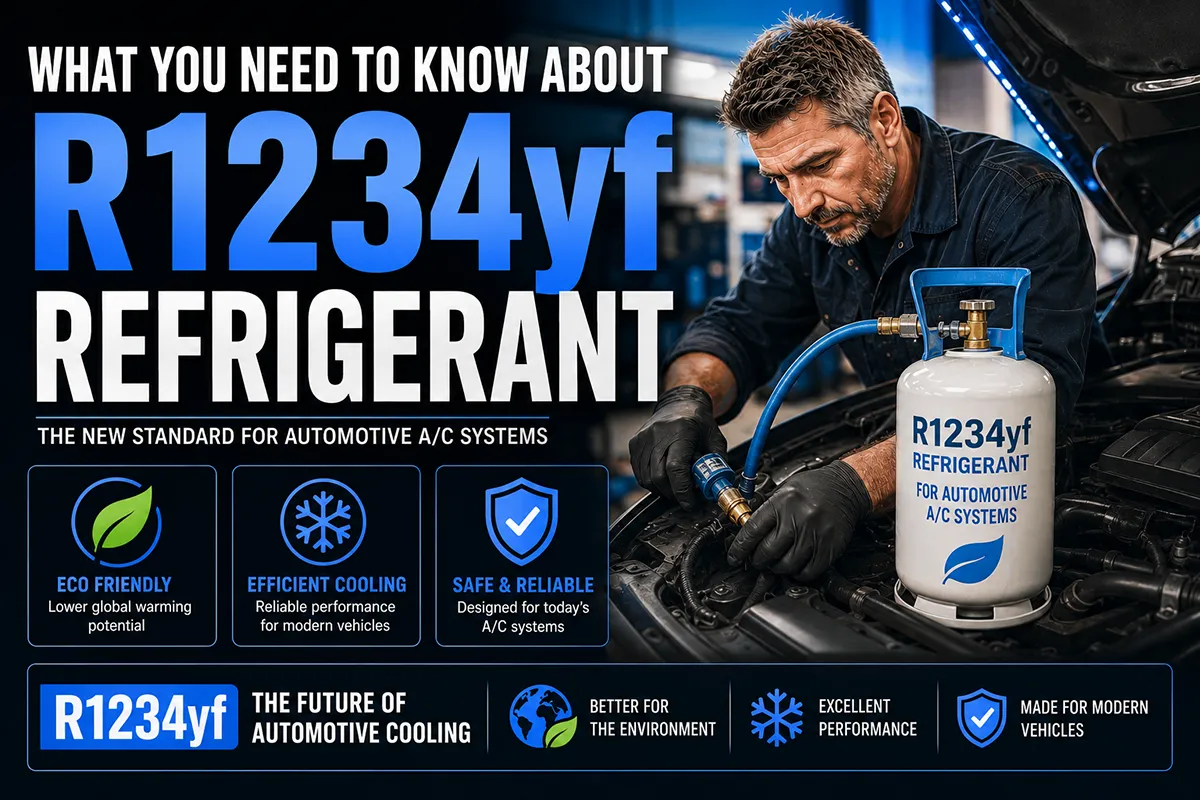
If you’ve ever climbed into your car on a sweltering July afternoon in Texas or Arizona, cranked the AC, and felt nothing but warm air — you know that sinking feeling in your gut.
You’re already dreading the repair bill. And if your car was made after 2015, there’s a very good chance the culprit involves a refrigerant called R1234yf — one that can cost five to ten times more than the old stuff to recharge.
Now, I know what you’re thinking: “This is a tire blog — why are you talking about refrigerant?” Stay with me.
As someone who has spent years reviewing tires, testing vehicles across every climate in the US, and advising everyday drivers on how to get the most out of their cars, I’ve learned that AC performance, cabin comfort, and even tire behavior are more connected than most people realize.
I’m going to break down everything you need to know about R1234yf so you can make smarter decisions at the shop — and on the road.
- R1234yf is the refrigerant used in nearly all new cars sold in the US since 2021, replacing the older R134a.
- It’s significantly more expensive — expect $150–$300+ for a recharge vs. $50–$100 for R134a.
- R1234yf was mandated because it has a much lower global warming potential (GWP of 4 vs. 1,430 for R134a).
- You cannot mix R1234yf and R134a — they require different equipment and fittings.
- AC system health affects engine load, fuel economy, and indirectly, tire wear and performance.
- DIY recharge kits exist but come with risks — professional service is usually the smarter call.
- Prices are slowly dropping as supply increases, but it’s still a premium service in 2024–2025.
Liked this article?
Add TireAdvise as a preferred source so you see more of our tire reviews and guides on Google.
What Exactly Is R1234yf Refrigerant?
R1234yf (chemical name: 2,3,3,3-Tetrafluoropropene) is a hydrofluoroolefin (HFO) refrigerant designed to replace R134a in automotive air conditioning systems. If that sounds like a mouthful, don’t worry — you don’t need a chemistry degree to understand why it matters.
The short version: it does the same job as the old refrigerant (cools your car’s cabin), but it breaks down in the atmosphere much faster. R134a lingers for about 13 years. R1234yf breaks down in roughly 11 days. That difference is massive when it comes to environmental impact.
The US Environmental Protection Agency (EPA) and the automotive industry began the transition to R1234yf starting around 2014–2015. General Motors was one of the first to adopt it in certain Chevrolet and Cadillac models. By the 2021 model year, virtually every new car sold in the United States uses R1234yf exclusively.
Why Did the Industry Switch From R134a?
The switch comes down to one metric: Global Warming Potential (GWP). R134a has a GWP of 1,430, meaning it traps 1,430 times more heat than carbon dioxide over a 100-year period. R1234yf has a GWP of just 4. That’s a 99.7% reduction.
The European Union’s MAC Directive actually mandated the switch first, banning R134a in new vehicles starting in 2017. The US followed through EPA regulations under the Significant New Alternatives Policy (SNAP) program, and automakers, wanting global platform consistency, made the transition across their entire lineups.
In my experience testing vehicles over the past several years, I’ve noticed the transition was seamless from a performance standpoint. Modern R1234yf systems cool just as effectively as the old R134a setups. You won’t feel a difference in the cabin. You will, however, feel the difference in your wallet when something goes wrong.
R1234yf vs. R134a: A Direct Comparison
I put together this comparison table to make the key differences crystal clear:
| Feature | R134a | R1234yf |
|---|---|---|
| Global Warming Potential | 1,430 | 4 |
| Atmospheric Lifespan | ~13 years | ~11 days |
| Cost Per Pound (retail) | $5–$10 | $40–$80 |
| Typical AC Recharge Cost | $50–$100 | $150–$300+ |
| Flammability | Non-flammable | Mildly flammable (A2L classification) |
| Used in New US Cars Since | 1994–2015 (phasing out) | 2014–present (standard by 2021) |
| DIY Recharge Available? | Yes, widely available | Yes, but limited and more complex |
| Interchangeable? | No | No |
The takeaway? R1234yf is better for the environment but harder on your budget. And you absolutely cannot swap one for the other — the fittings are physically different to prevent cross-contamination.
How Do I Know If My Car Uses R1234yf?
This is one of the most common questions I get from readers, and the answer is usually straightforward.
Check Your Model Year
If your car, truck, or SUV was manufactured in 2021 or later, it almost certainly uses R1234yf. Many vehicles made between 2014 and 2020 also use it, depending on the manufacturer and model. GM and Chrysler were early adopters. Toyota, Honda, and Ford phased it in across their lineups between 2017 and 2020.
Look Under the Hood
There’s typically a label on or near the AC compressor or on the underside of the hood that specifies the refrigerant type. It will clearly say “R1234yf” or “HFO-1234yf.” The service ports also have a different size and shape compared to R134a ports — this is a deliberate design choice to prevent accidental cross-filling.
Check Your Owner’s Manual
Your owner’s manual will specify the exact refrigerant type and the system capacity. I always recommend keeping a digital copy of your manual on your phone — it comes in handy more often than you’d think.
Why R1234yf Costs So Much More
I remember the first time I took a newer test vehicle in for an AC recharge and saw the bill. Coming from years of cheap R134a top-offs, the price was genuinely shocking.
There are a few reasons R1234yf is more expensive:
- Patent and manufacturing costs: Honeywell and Chemours (a DuPont spinoff) hold the primary patents on R1234yf production. This limited competition has kept prices elevated, though some patents are beginning to expire, and Chinese manufacturers are entering the market.
- Specialized equipment: Shops need dedicated R1234yf recovery and recycling machines. These machines cost $5,000–$10,000+, and shops pass that investment on to customers.
- Higher material cost: The raw refrigerant simply costs more per pound to produce than R134a due to the more complex chemical synthesis process.
- Lower supply volume (historically): Although supply has improved significantly since 2020, the market is still catching up to demand, especially during peak summer months in the southern US.
The good news? Prices have been trending downward. When I first encountered R1234yf recharges back in 2016–2017, shops were quoting $400–$500. Today, in 2024–2025, I’m seeing $150–$250 at most independent shops, and sometimes under $200 at national chains like Firestone, Pep Boys, or Midas.
Can You Recharge R1234yf Yourself?
Technically, yes. DIY R1234yf recharge kits are now available at stores like AutoZone, O’Reilly Auto Parts, and Walmart. Brands like A/C Pro have introduced consumer-friendly canisters designed specifically for R1234yf systems.
However, I want to be transparent about the risks and limitations based on my own experience:
Pros of DIY R1234yf Recharge
- Potentially saves $100–$200 compared to a shop visit
- Convenient for a simple low-refrigerant top-off
- Modern kits include gauges and stop-leak additives
Cons of DIY R1234yf Recharge
- Mild flammability: R1234yf is classified as A2L (mildly flammable). While the risk of ignition in an automotive context is very low, it’s not zero, and it requires more careful handling than R134a.
- Overcharging risk: Without professional gauges and recovery equipment, it’s easy to overcharge the system, which can damage the compressor — a $600–$1,200 repair.
- Masking leaks: If your system is low, there’s a reason. Simply topping off without diagnosing the leak means you’ll be back in the same situation within weeks or months.
- Cost of the kit: A single R1234yf DIY recharge kit typically runs $50–$80 for a small canister. That’s a fraction of what a shop charges, but you’re getting less refrigerant and no professional diagnosis.
- Environmental and legal considerations: Venting refrigerant is illegal under Section 608 of the Clean Air Act. Improper DIY handling can result in accidental venting.
My honest recommendation? If you’re comfortable working on cars and your system just needs a minor top-off, a DIY kit can work. But if your AC has completely stopped blowing cold, take it to a certified shop. The potential for costly mistakes outweighs the savings.
The Connection Between AC Performance and Tire Wear
Alright, here’s where my tire expertise comes into play, and where most other articles on R1234yf completely miss the mark.
Your air conditioning system puts load on the engine. When the AC compressor engages, it draws power from the engine via the serpentine belt. This additional load — typically 3 to 7 horsepower depending on the system and conditions — affects your vehicle’s behavior in subtle but measurable ways.
Fuel Economy and Driving Behavior
When your AC is working efficiently with the proper refrigerant charge, the compressor cycles on and off as needed. When it’s low on refrigerant or the system is struggling, the compressor runs continuously, drawing more power and reducing fuel economy by as much as 10–20% in extreme heat.
In my tire testing, I’ve noticed that drivers who are getting worse fuel economy tend to drive differently. They accelerate harder to compensate for the sluggishness. They brake later. These aggressive driving patterns directly accelerate tire wear — especially on the front tires of front-wheel-drive vehicles.
Heat Management and Tire Pressure
Here’s another connection most people don’t think about. If your AC isn’t working and you’re driving with the windows down at highway speeds, your fuel economy drops further, and you’re more likely to be fatigued and distracted in extreme heat. Fatigue leads to less attentive driving, including ignoring tire pressure warnings.
I’ve tested tires across the desert Southwest during summer, and I can tell you firsthand: hot pavement and underinflated tires are a dangerous combination. Proper AC keeps you comfortable, alert, and more likely to maintain safe driving habits — including checking your tire pressure regularly.
Undercarriage Heat and Tire Temperature
Your AC condenser, mounted at the front of the vehicle, radiates heat. When the system is struggling or overcharged, it generates more heat than necessary. While this alone won’t cook your tires, combined with 140°F+ pavement temperatures in places like Phoenix, Las Vegas, or Houston, every degree matters.
In my experience, properly maintained vehicles — including properly charged AC systems — run cooler overall, which contributes to a healthier environment for your tires.
How Much Does an R1234yf AC Recharge Cost in 2024–2025?
I’ve collected pricing from a variety of sources — personal shop visits, reader reports, and published pricing from major chains — to give you a realistic picture of what to expect across the US.
| Service Provider | Estimated Cost (R1234yf Recharge) | Notes |
|---|---|---|
| Dealership | $200–$400 | Most expensive; includes diagnostics |
| Independent Shop | $150–$250 | Best value with full service |
| National Chain (Firestone, Midas, etc.) | $180–$300 | Frequently run coupons |
| DIY Kit (AutoZone, Walmart) | $50–$80 per canister | No leak diagnosis; limited quantity |
My advice: call at least three shops in your area and ask specifically for R1234yf pricing. Some shops haven’t invested in the equipment and will either turn you away or quote inflated prices. Others specialize in AC work and can offer competitive rates.
Is R1234yf Dangerous? Addressing the Flammability Concern
This is a topic I’ve researched extensively because it comes up in reader emails all the time. Let me set the record straight.
Yes, R1234yf is classified as “mildly flammable” (ASHRAE safety classification A2L). This was a significant concern during the early adoption phase, particularly after a 2012 incident where Daimler (Mercedes-Benz) engineers demonstrated that R1234yf could ignite and produce hydrogen fluoride (a toxic gas) in a simulated under-hood leak scenario near a hot exhaust manifold.
However, there’s important context:
- SAE International studies concluded that the risk of ignition in real-world conditions is extremely low when the system is properly designed and maintained.
- Every major automaker in the world — including Mercedes-Benz, which initially resisted — now uses R1234yf. They would not do so if the risk were unacceptable.
- The concentration required for ignition (6.2% by volume in air) is very difficult to achieve in the well-ventilated engine bay of a moving vehicle.
- Modern AC systems include safety features such as improved hose designs, leak detection, and compressor shutoff to mitigate any risk.
In my years of working with and around vehicles using R1234yf, I have never encountered a safety incident related to the refrigerant. That doesn’t mean the risk is zero, but it does mean it’s been engineered to an acceptably low level — much like the gasoline in your tank, which is far more flammable.
What Happens If You Put R134a in an R1234yf System (or Vice Versa)?
Don’t do it. Seriously. I’ve heard stories from shop owners about customers who tried this, and the results are always expensive.
The two refrigerants operate at slightly different pressures and have different oil compatibility requirements. R1234yf systems use PAG oils that are specifically formulated for the new refrigerant. Mixing the two can cause:
- Compressor failure: The wrong oil and refrigerant combination can damage internal compressor components. Replacing an AC compressor can cost $600–$1,500 depending on the vehicle.
- Reduced cooling performance: The system won’t operate at peak efficiency, and you’ll still end up at a shop — now with a contaminated system that’s more expensive to service.
- System contamination: Once mixed, the entire system may need to be flushed, evacuated, and recharged from scratch. Some components may need to be replaced entirely.
- Warranty voiding: If your vehicle is still under warranty, using the wrong refrigerant will void your AC system coverage immediately.
The service port fittings are physically different between R134a and R1234yf systems specifically to prevent this. If someone has to use an adapter to connect to your ports, something is very wrong.
The Future of R1234yf: What’s Coming Next?
As someone who follows the automotive industry closely, I think it’s worth sharing what’s on the horizon for vehicle refrigerants.
Falling Prices
Key patents held by Honeywell and Chemours have been expiring, and additional manufacturers — including several in China — are ramping up production. I expect R1234yf prices to continue declining over the next two to three years, potentially approaching R134a-like affordability by 2027–2028.
CO2 (R744) as an Alternative
Some European manufacturers, particularly in luxury and EV segments, are experimenting with CO2-based (R744) AC systems. These have an even lower GWP (literally 1), but they operate at much higher pressures and require entirely redesigned components. I don’t expect widespread US adoption in the near term, but it’s worth watching.
EV-Specific Considerations
Electric vehicles add another layer of complexity. In EVs, the AC system is powered by the battery rather than a belt-driven compressor. This means AC usage directly impacts range. R1234yf systems in EVs have been optimized for efficiency, but a poorly maintained AC system can reduce your driving range noticeably — something I’ve observed firsthand during EV tire testing in hot climates.
If you drive an EV, maintaining your AC system isn’t just about comfort — it’s about range, which affects how often you stop and how you drive, which in turn affects your tire wear patterns.
My Practical Advice for Everyday Drivers
After years of testing vehicles, reviewing tires, and maintaining everything from economy cars to performance trucks, here’s my straightforward advice on dealing with R1234yf:
1. Know What Your Car Uses Before You Need Service
Check your owner’s manual or under-hood label now, while you’re thinking about it. Knowing whether you have R134a or R1234yf will save you time and prevent sticker shock when your AC starts blowing warm.
2. Budget for Higher AC Service Costs
If you drive a 2017+ vehicle, set aside a little extra in your car maintenance budget for potential AC work. It’s not a question of if you’ll need a recharge — it’s when.
3. Get AC Issues Diagnosed Promptly
A slow leak will only get worse and more expensive. If your AC performance declines gradually over several weeks, get it checked before the refrigerant is completely gone. Running a compressor with no refrigerant can destroy it.
4. Use a Certified Shop
Make sure the shop has R1234yf-specific equipment and trained technicians. ASE certification is a good baseline. Don’t be afraid to ask if they have an R1234yf-compatible recovery machine — a legitimate shop will be happy to confirm.
5. Don’t Forget Your Tires When You’re at the Shop
This is something I always tell readers: anytime you’re at a shop for any service, ask them to check your tire pressure and do a visual inspection. Hot weather that’s hardest on your AC system is also hardest on your tires. Underinflation in extreme heat is the number one cause of blowouts. Consider it a free safety check.
6. Pair AC Maintenance With Tire Rotation
I like to schedule my AC system check during tire rotation appointments. It’s efficient, and it ensures both systems — the one keeping you cool and the ones keeping you safe on the road — are in top shape.
Common R1234yf Myths I Keep Hearing
Let me debunk a few persistent myths that I encounter in reader emails and forum posts:
- “R1234yf will explode in a crash.” No. Extensive crash testing by automakers and SAE International has shown the risk of ignition in a collision is negligible. Modern system designs include safety measures to prevent refrigerant release near ignition sources.
- “You can convert your R1234yf system back to R134a to save money.” Technically possible but practically disastrous. It voids warranties, may violate EPA regulations, requires system modifications, and can damage components. Don’t do this.
- “R1234yf doesn’t cool as well as R134a.” In my experience, I’ve noticed zero perceptible difference in cooling performance between the two refrigerants when systems are properly charged and maintained. The engineering has been dialed in.
- “DIY is just as good as professional service.” For a simple top-off on a system with no leaks, maybe. But a professional service includes leak detection, system pressure testing, oil level verification, and proper recovery of old refrigerant. The value is in the diagnosis, not just the gas.
Final Thoughts: Stay Cool, Stay Safe, Stay Informed
R1234yf refrigerant isn’t something most drivers think about until their AC fails on the hottest day of the year. But understanding what’s in your system — and what it costs to maintain — puts you in a much better position as a car owner.
In my experience, the drivers who maintain their vehicles holistically — tires, brakes, fluids, AND AC — are the ones who avoid expensive surprises and stay safer on the road. Your AC system and your tires are both critical components that perform under extreme stress, especially during US summers.
The transition to R1234yf is permanent. Prices are coming down, availability is improving, and the environmental benefits are undeniable. Embrace it, budget for it, and keep your system in good shape. Your wallet — and your tires — will thank you.
Frequently Asked Questions
What is R1234yf refrigerant and why does it matter for my car?
R1234yf (also called HFO-1234yf) is a newer automotive air conditioning refrigerant that replaced the older R134a in most vehicles manufactured after 2015. It was mandated because it has a significantly lower global warming potential, making it more environmentally friendly. If you’re shopping for a car or need an AC recharge, knowing which refrigerant your vehicle uses directly affects service costs and where you can get it serviced.
Which vehicles use R1234yf refrigerant in the US?
Most new cars, trucks, and SUVs sold in the US since 2015-2016 use R1234yf, and nearly all vehicles manufactured from 2021 onward are equipped with it. Popular models from GM, Ford, Toyota, Honda, Chrysler, and BMW made the switch early. You can check your owner’s manual or the label under the hood near the AC service ports to confirm which refrigerant your vehicle requires.
How much does an R1234yf AC recharge cost compared to R134a?
An R1234yf recharge typically costs between $150 and $350 at a shop, compared to $100 to $200 for an R134a recharge. The higher price is largely because R1234yf refrigerant itself costs significantly more per pound, sometimes three to five times the price of R134a. Prices have been coming down gradually, but it’s still one of the more expensive routine maintenance items for newer vehicles.
Can I replace R1234yf with R134a to save money on AC service?
No, you should never substitute R134a for R1234yf in a system designed for R1234yf. The two refrigerants operate at different pressures and require different oils, so mixing or swapping them can damage your compressor, void your warranty, and violate EPA regulations. Always use the refrigerant specified by your vehicle manufacturer to keep your AC system running safely and efficiently.
Can I recharge R1234yf refrigerant myself at home?
Yes, DIY R1234yf recharge kits are now available at auto parts stores like AutoZone and O’Reilly, typically costing $50 to $80 per can. However, R1234yf is classified as mildly flammable (A2L), so you need to follow safety precautions carefully and work in a well-ventilated area. I’d recommend having a professional handle it if you’re not comfortable working with automotive AC systems, since overcharging can damage your compressor.
How does R1234yf affect my car’s AC performance in hot US summers?
R1234yf performs very similarly to R134a in terms of cooling capacity, so you shouldn’t notice a significant difference in cabin comfort even during extreme summer heat in states like Texas, Arizona, or Florida. Automakers have optimized newer AC systems specifically for R1234yf, so cooling performance is comparable to older systems. If your AC feels weak, it’s more likely a leak or low charge issue rather than a limitation of the refrigerant itself.
Is R1234yf refrigerant safe, and is it really flammable?
R1234yf is classified as mildly flammable (A2L rating), but the risk in a normal driving scenario is extremely low. Automakers have added safety features like improved hose fittings, leak detection systems, and strategic placement of AC components to minimize any fire risk in a collision. The EPA and SAE International have both approved R1234yf for automotive use in the US after extensive safety testing, so it’s considered safe for everyday drivers.
