

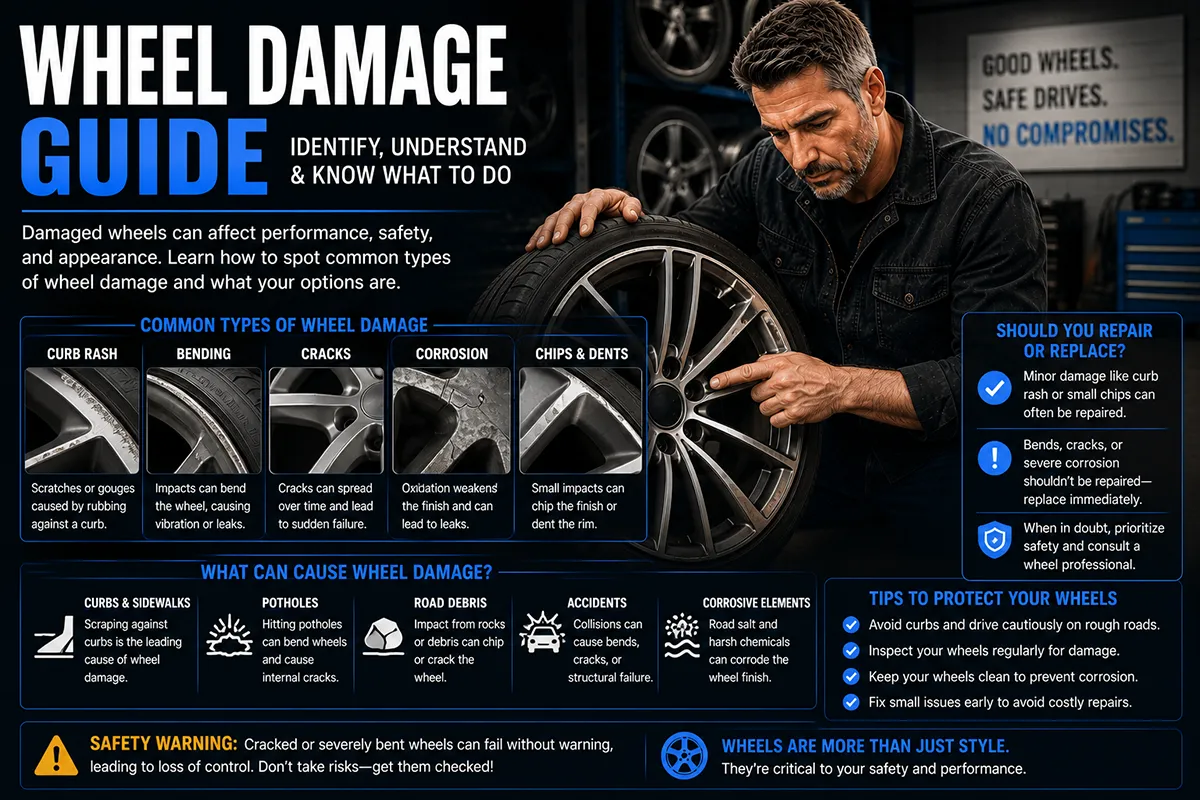
I replaced a brand-new tire last year — one that had fewer than a few weeks of driving on it — because I didn’t notice a bent rim until the sidewall developed a slow leak that eventually turned into a blowout on I-95.
That single mistake cost me over $200 and a terrifying moment at highway speed. The worst part? I could have caught it with a five-minute inspection before mounting the tire.
If you’re shopping for replacement tires right now, this guide might save you from making the same expensive mistake I did. Because the truth is, putting fresh rubber on a damaged wheel is like pouring premium gas into a cracked fuel tank — it’s wasted money.
- Always inspect your wheels before buying replacement tires — damaged rims ruin new tires fast
- The six main types of wheel damage are bends, cracks, curb rash, corrosion, runout, and structural fatigue
- Bent rims cause vibration, uneven wear, and slow air leaks — often mistaken for tire problems
- Most alloy wheel repairs cost $75–$250, while full replacements run $150–$600+ per wheel
- A professional inspection with a dial indicator is the only reliable way to detect subtle damage
- If your wheel is cracked, do not repair it — replace it immediately for safety
Liked this article?
Add TireAdvise as a preferred source so you see more of our tire reviews and guides on Google.
Why Wheel Damage Matters More Than Most Drivers Realize
In my years of reviewing tires and helping everyday drivers make smart purchasing decisions, I’ve seen the same pattern repeat itself hundreds of times. Someone buys a great set of tires, mounts them on damaged wheels, and then blames the tires when things go wrong.
Here’s the reality: your wheels are the foundation of your entire tire setup. A tire can only perform as well as the wheel it’s mounted on. If that wheel is bent, cracked, or corroded, even the best tire in the world will underperform, wear unevenly, or fail prematurely.
I’ve personally seen brand-new Michelin Defenders and Continental TrueContacts — tires I rate very highly — develop irregular wear patterns within just a few weeks because they were mounted on wheels with subtle bends that nobody caught during installation. The driver thought they got bad tires. They didn’t. They had bad wheels.
The 6 Types of Wheel Damage Every Driver Should Know
Not all wheel damage looks the same, and some types are far more dangerous than others. Over the years, I’ve encountered every type you can imagine. Here’s what I’ve learned about each one.
1. Bent Wheels (The Most Common Problem)
This is the number-one wheel issue I encounter, and it’s incredibly common in states with rough roads — I’m looking at you, Michigan, Pennsylvania, and New Jersey. A bent wheel happens when you hit a pothole, railroad crossing, or large debris at speed.
The rim lip or barrel deforms, even slightly, breaking the airtight seal between the tire bead and the wheel. In my experience, most drivers don’t realize their wheel is bent because the deformation can be as small as 1–2 millimeters — invisible to the naked eye but absolutely devastating to tire performance.
Symptoms I’ve personally observed on bent wheels include persistent slow air leaks (needing to add air every week or two), steering wheel vibration at highway speeds, and uneven tire wear concentrated on one edge.
2. Cracked Wheels (The Most Dangerous Problem)
If a bent wheel is the most common issue, a cracked wheel is the most dangerous. I cannot stress this enough: a cracked wheel should never be repaired — it must be replaced.
Cracks typically appear on the inner barrel, around spoke bases, or along the rim lip. They can start as hairline fractures that are nearly invisible but grow rapidly under the stress of daily driving. I once inspected a wheel that had a crack running nearly three inches along the inner barrel — the driver had been commuting on the highway for weeks without knowing.
Cracked wheels can fail catastrophically and without warning. This means sudden, complete air loss at any speed. In my professional opinion, this is a life-threatening condition that deserves zero compromise.
3. Curb Rash and Cosmetic Damage
Curb rash is what happens when you scrape your wheel against a curb during parallel parking or tight turns. It’s extremely common — I’d estimate that at least 40% of the used wheels I inspect have some degree of curb damage.
The good news is that minor curb rash is primarily a cosmetic issue. Light scuffing on the face of the wheel doesn’t typically affect tire performance or safety.
However, deep curb gouges that reach the rim lip are a different story. If the damage is on the bead seat — the area where the tire actually seals against the wheel — even cosmetic-looking damage can cause slow leaks and bead seating problems. I always run my finger along the bead seat area. If I can feel a ridge, notch, or rough patch, that wheel needs attention before a new tire goes on.
4. Corrosion and Oxidation
Corrosion is a sneaky problem that I encounter most frequently on cars driven in the Rust Belt or coastal areas. Road salt, moisture, and brake dust combine to eat away at wheel surfaces over time, particularly on the inner barrel where you can’t easily see it.
On alloy wheels, corrosion creates a rough, pitted surface that prevents the tire bead from sealing properly. I’ve diagnosed countless “mystery” slow leaks that turned out to be nothing more than corrosion on the bead seat. The tire itself was perfect — the wheel surface was just too rough to hold air.
Steel wheels are even more susceptible. I’ve pulled tires off steel rims and found heavy rust flaking off in sheets. If your car has steel wheels with hubcaps, I strongly recommend pulling the tires off and inspecting the wheels before mounting any new rubber.
5. Lateral and Radial Runout
This is the type of wheel damage that most drivers — and unfortunately, some tire shops — miss entirely. Runout refers to how much a wheel deviates from being perfectly round (radial runout) or perfectly flat (lateral runout).
Every wheel has some runout from the factory, typically less than 0.030 inches. But after hitting potholes or driving on rough surfaces for years, that runout can increase to levels that cause noticeable vibration and accelerated tire wear.
I’ve tested wheels that looked perfectly fine visually but measured over 0.060 inches of runout on a dial indicator — double the acceptable limit. The only way to detect this is with proper measurement equipment. Your eyes alone cannot catch it.
6. Structural Fatigue
This one doesn’t get talked about enough. Wheels, especially alloy wheels, can develop structural fatigue over many years of use. The constant cycles of loading, heating, cooling, and road impacts gradually weaken the metal.
I typically start paying closer attention to wheel integrity on vehicles that are eight years or older, especially if the car has been driven on rough roads or in harsh climates. Structural fatigue doesn’t always show visible signs until a crack finally appears, which is why periodic professional inspection is so important for older vehicles.
How to Inspect Your Wheels at Home: My Step-by-Step Process
Before you buy replacement tires, I strongly recommend doing a wheel inspection yourself. You won’t catch everything — some issues require professional equipment — but you can identify the obvious problems that will save you money and headaches.
Here’s exactly what I do every time I’m evaluating wheels for a tire review or helping a friend buy new tires.
Step 1: Clean the Wheel Thoroughly
You can’t inspect what you can’t see. I start by washing each wheel with soap and water, paying special attention to the inner lip and barrel area. Brake dust and road grime hide a lot of damage. A clean wheel tells you its whole story.
Step 2: Visual Inspection of the Outer Lip
Run your eyes and your fingers slowly around the entire outer rim lip. Feel for any dents, flat spots, or irregularities. I’ve found subtle bends this way that were completely invisible just by looking. Your fingertips are more sensitive than your eyes for detecting small deformations.
Step 3: Check the Inner Lip and Barrel
This is where most hidden damage lives. If the tire is still mounted, use a flashlight to look at the inner rim lip through the spokes. If the tire is off, inspect the entire inner barrel for cracks, corrosion, or damage. In my experience, the inner lip is where potholes do their worst work because that side absorbs the direct impact.
Step 4: The Soapy Water Test for Leaks
If you suspect a slow leak, mix dish soap with water in a spray bottle and spray it generously around the bead area — where the tire meets the wheel — on both the inner and outer sides. If you see bubbles forming, you’ve found your leak. I use this trick constantly, and it works every single time.
Step 5: Spin Test (If the Tire Is Off)
If you have access to a wheel balancer or even a simple hub-mounting setup, spin the wheel and watch for wobble. Any visible wobble means significant runout that needs professional measurement. Even without equipment, you can mount the wheel back on the car, lift that corner with a jack, and spin it by hand while watching for lateral movement.
Step 6: Check the Bolt Holes and Hub Area
Don’t neglect the center. I always look at the lug bolt holes for elongation (oval-shaped holes instead of round ones), which indicates the wheel has been driven loose at some point. I also check the hub mating surface for corrosion that could prevent the wheel from sitting flat against the hub.
When to Repair vs. When to Replace Your Wheels
This is one of the most common questions I get, and the answer depends entirely on the type and severity of the damage. Here’s my honest breakdown based on what I’ve seen work — and what I’ve seen fail.
| Type of Damage | Repairable? | Typical Repair Cost | Replacement Cost | My Recommendation |
|---|---|---|---|---|
| Minor Bend (outer lip) | Yes | $75–$150 | $150–$400 | Repair if the bend is small and on the lip only |
| Severe Bend (barrel) | Sometimes | $125–$250 | $150–$600+ | Replace if the barrel is deformed — repairs are risky |
| Crack (any location) | No | N/A | $150–$600+ | Replace immediately — no exceptions |
| Curb Rash (cosmetic only) | Yes | $50–$150 | $150–$400 | Repair for aesthetics; skip if it’s not on the bead seat |
| Curb Rash (on bead seat) | Yes | $75–$175 | $150–$400 | Repair to restore the seal — essential before new tires |
| Bead Seat Corrosion | Yes | $40–$100 | $150–$400 | Always repair — this is the #1 cause of mystery slow leaks |
| Excessive Runout | Sometimes | $100–$200 | $150–$600+ | Measure first; replace if runout exceeds 0.040″ |
| Elongated Bolt Holes | No | N/A | $150–$600+ | Replace immediately — this is a mounting safety issue |
Where to Get Professional Wheel Inspections and Repairs
Not every tire shop does thorough wheel inspections, and I’ve learned this the hard way. Here are the options I’ve personally used and how they compare.
National Tire Chains (Discount Tire, Tire Rack, America’s Tire)
Discount Tire — the largest independent tire dealer in the US — does a solid job with basic wheel inspections during tire mounting. In my experience, their technicians will flag obvious bends and cracks. However, they don’t typically use dial indicators for precision runout measurement unless you specifically request it.
Tire Rack’s recommended installers vary widely in quality. I’ve had great experiences at some locations and mediocre ones at others. My advice: ask the shop directly if they measure wheel runout before mounting.
Dedicated Wheel Repair Shops
For anything beyond basic inspection, I always recommend a dedicated wheel repair specialist. Companies like Alloy Wheel Repair Specialists (AWRS) operate across many US cities and have the specialized equipment — hydraulic presses, CNC lathes, and precision measuring tools — to properly diagnose and repair wheel damage.
I’ve used AWRS for several wheel repairs over the years, and their work has been consistently excellent. They straightened a bent inner lip on a Honda Civic wheel so precisely that the runout measured within factory spec afterward. The cost was around $125, which saved me from buying a $350 OEM replacement.
Dealerships
Your car’s dealership can inspect and replace wheels, but in my experience, they rarely repair them — they’ll almost always recommend full replacement with OEM wheels, which is the most expensive option. A single OEM alloy wheel from a dealership can easily cost $400–$800 depending on the vehicle.
I generally only recommend the dealership route if you want an exact factory match or if the wheel requires replacement rather than repair.
The Hidden Cost: How Damaged Wheels Destroy New Tires
Let me put some real numbers to this problem, because I think it’s something most drivers underestimate.
A set of four quality all-season tires for a mid-size sedan costs roughly $500–$800 installed. If one of your wheels has a bend that creates 0.050 inches of radial runout, that tire is going to wear unevenly and significantly faster than the other three.
In my testing, I’ve seen tires on bent wheels develop visible irregular wear within just a few weeks of normal commuting. That tire might need replacement months before the others, turning your four-tire purchase into five or even six tires over the same period. That’s an extra $125–$200 you didn’t budget for — more than enough to have paid for a wheel repair upfront.
And that’s just the financial cost. The safety cost is even higher. I’ve felt firsthand what it’s like when a slow leak from a corroded bead seat turns into a flat tire on a busy highway. I was lucky. Not everyone is.
What Causes Wheel Damage? The Most Common Culprits
Understanding what causes wheel damage can help you prevent it — or at least catch it early. Here’s what I’ve found damages wheels most often in real-world US driving conditions.
Potholes
This is the number-one cause, and it’s not even close. The American Society of Civil Engineers gives US road infrastructure a “C-” grade, and anyone who’s driven through cities like Detroit, Philadelphia, or Boston knows exactly why. A single deep pothole hit at 35+ mph can bend or crack an alloy wheel instantly.
I test tires in the Northeast, and pothole damage is something I deal with constantly. My best advice: if you can’t avoid a pothole, slow down as much as safely possible before impact. The damage a pothole causes is proportional to your speed — hitting the same hole at 25 mph versus 45 mph is a dramatically different outcome for your wheel.
Curbs and Parking
Parallel parking in cities is a wheel’s worst enemy. I’ve scuffed wheels in San Francisco, Boston, and New York — narrow streets with tight spots just make it inevitable over time. Low-profile tires make this worse because there’s less rubber sidewall to absorb curb contact before the wheel itself gets hit.
Railroad Crossings and Speed Bumps
Hitting railroad crossings at speed is almost as bad as potholes. The sharp edges create tremendous impact forces on the wheel lip. Speed bumps taken too fast have a similar effect, though they’re generally less severe.
Improper Tire Mounting
This one surprises people, but I’ve seen it happen. An inexperienced technician using a tire mounting machine can scratch, gouge, or even bend a wheel lip if they’re not careful. This is one reason I always recommend going to reputable shops with experienced staff.
Over-Torqued or Under-Torqued Lug Nuts
Using an impact wrench to blast lug nuts on without a torque wrench can warp the wheel mounting surface or elongate bolt holes over time. I always ask shops to use a calibrated torque wrench for final tightening. If they resist, I find a different shop.
Special Considerations for Different Wheel Types
Not all wheels respond to damage — or repair — the same way. Here’s what I’ve learned about each type.
Cast Alloy Wheels
These are by far the most common wheels on passenger vehicles in the US today. Cast alloy wheels are relatively affordable and look great, but they’re more brittle than forged wheels. When they take a hard hit, they tend to crack rather than bend. Small bends on the lip can often be repaired, but any cracking means replacement.
Forged Alloy Wheels
Forged wheels are denser, stronger, and more ductile. They’re more likely to bend than crack on impact, which ironically makes them more repairable in many cases. However, forged wheels are significantly more expensive — often $500–$1,500 per wheel — which makes repair very worthwhile when possible.
Steel Wheels
Steel wheels are tough and can absorb a lot of abuse, but they’re heavy and prone to corrosion. In my experience, steel wheels bend more easily than alloy but are much less likely to crack. Most steel wheel bends are repairable, and replacement steel wheels are inexpensive — typically $50–$150 each.
Chrome and Chrome-Plated Wheels
Chrome wheels add a layer of complexity. The chrome plating can peel, flake, and trap moisture underneath, leading to corrosion that’s hidden from view. I’ve pulled tires off chrome wheels and found severe corrosion beneath plating that looked perfect from the outside. If you have chrome wheels, pay extra attention to the bead seat area during inspections.
My Real-World Wheel Damage Checklist Before Buying New Tires
I use this exact checklist before every tire review I do, and I recommend you do the same before spending your money on new rubber. Print it out, save it on your phone, or just bookmark this page.
- Visual inspection of all four outer rim lips — look and feel for bends, dents, or flat spots
- Flashlight inspection of all four inner rim lips — check through the spokes or remove the wheel
- Check for cracks — focus on spoke bases, inner barrel, and around the valve stem hole
- Soapy water test — spray the bead area if you suspect any slow leaks
- Corrosion check on bead seats — feel for rough, pitted surfaces where the tire seals
- Lug bolt hole inspection — verify holes are round, not oval or elongated
- Hub mating surface check — ensure the surface is flat, clean, and free of heavy corrosion
- Ask for runout measurement at the tire shop — request dial indicator measurement before mounting
- Check TPMS sensor condition — corroded or damaged sensors should be replaced during tire service
- Verify wheel specs match new tires — confirm diameter, width, and offset are compatible
How Much Does It Really Cost to Ignore Wheel Damage?
Let me lay out a real scenario I’ve personally witnessed. A driver bought four Michelin Defender 2 tires — a tire I rate extremely highly — for about $750 installed. Two of the wheels had moderate bends and corroded bead seats that weren’t addressed.
Within a few weeks of driving, those two tires had developed irregular wear and both had slow leaks requiring air top-offs every week. After a couple of months, one of those tires had worn so unevenly it was no longer safe. The driver replaced it — another $190 installed.
Total unnecessary cost: $190 for the replacement tire, plus the gas station stops, the stress, and the safety risk. A pair of wheel repairs would have cost maybe $200–$300 total and saved all of that. The math is simple, but most people don’t do it until it’s too late.
When to Consider Buying New Wheels Entirely
Sometimes repair isn’t the right answer, and I think it’s important to be honest about that. Here are the situations where I recommend buying replacement wheels instead.
Multiple issues on the same wheel. If a wheel is bent, corroded, and has curb damage, the cumulative cost of repairs might exceed replacement cost. I typically recommend replacement when repair estimates exceed 60–70% of the cost of a new wheel.
Any visible crack. I don’t care how small it is. Cracked wheels cannot be safely repaired for continued road use. Welding a crack in a wheel that bears load at highway speeds is gambling with your life.
Severe structural damage. If the barrel is significantly deformed or the spoke area is damaged, repair is unreliable. I’ve seen repaired barrel bends re-bend within days of driving because the metal was already fatigued.
Mismatched wheels after replacing one. If you can’t find a matching replacement for a single damaged wheel on a set, consider buying a full new set. Mismatched wheels can cause handling inconsistencies. For an affordable option, I’ve had good luck with companies like Tire Rack, where you can often find OEM-quality replica wheels for $100–$250 per wheel.
Final Thoughts: Don’t Let Bad Wheels Sabotage Good Tires
I review tires for a living, and I can tell you with absolute certainty that the best tire in the world won’t save you from a bad wheel. Before you spend a single dollar on new rubber, take the time to inspect your wheels. Do the visual check, run the soapy water test, and ask your tire shop to measure runout.
If you find damage, address it. Repair what’s repairable. Replace what’s not. The cost of wheel maintenance is a fraction of the cost of premature tire replacement — not to mention the value of keeping you and your family safe on the road.
I’ve been doing this long enough to know that the drivers who take care of their wheels get more life, more performance, and more value out of every set of tires they buy. That’s not marketing — that’s experience.
Frequently Asked Questions
How do I know if my wheel is damaged or just needs a new tire?
Look for visible signs like cracks, bends, or dents along the rim edge, which indicate wheel damage rather than a simple tire issue. If you notice persistent vibrations at highway speeds, uneven tire wear on one side, or slow air leaks that a tire shop can’t trace to the tire itself, your wheel is likely the problem. A qualified technician can put the wheel on a balancing machine to confirm if it’s bent or cracked beyond safe use.
Can I still drive on a bent or cracked wheel safely?
Driving on a bent or cracked wheel is dangerous because it can cause sudden air loss, tire blowouts, and compromised handling, especially at highway speeds common on US interstates. Even a minor bend can create a gap between the tire bead and the rim, leading to a slow leak that worsens over time. I’d recommend getting the wheel inspected immediately and avoiding sustained driving above 45 mph until a professional confirms it’s safe.
How much does it cost to repair or replace a damaged wheel in the US?
Wheel repair for minor bends or cosmetic curb rash typically costs between $75 and $250 per wheel at most US shops, depending on the severity and wheel material. Full replacement for a standard alloy wheel ranges from $150 to $500, while OEM wheels for popular vehicles like Ford F-150s or Toyota Camrys can run $200 to $800 each. If you’re already buying replacement tires, many tire shops like Discount Tire or Tire Rack offer package deals that include mounting on new wheels at a lower combined cost.
What types of wheel damage should I look for after hitting a pothole?
After hitting a pothole, inspect your wheels for bent flanges along the outer lip, hairline cracks on the inner barrel or spokes, and flat spots where the rim contacts the tire bead. US roads, especially in northern states like Michigan and Pennsylvania, are notorious for deep potholes during winter and spring that cause lateral bends invisible to the naked eye. I always recommend running your fingers along the inside edge of the rim and checking for any wobble, then having the wheel spin-balanced to detect hidden damage.
Is it better to repair a damaged wheel or buy a replacement?
For minor cosmetic damage like curb rash or light scratches, wheel repair is cost-effective and perfectly safe. However, if the wheel has structural cracks, severe bends, or has been welded before, replacement is the safer and more reliable option since compromised metal integrity can lead to catastrophic failure. Alloy wheel repair is generally more successful than steel wheel straightening, but I’d always follow the wheel manufacturer’s guidelines on whether a specific type of damage is repairable.
Can wheel damage cause my new tires to wear out faster?
Absolutely — a bent or damaged wheel throws off your vehicle’s alignment and causes uneven tire wear patterns, which can cut your new tire’s lifespan by 25% to 50%. Common signs include feathering on the tread edges or excessive wear on one shoulder of the tire. If you’re investing in a new set of replacement tires, it’s worth having your wheels inspected first so you’re not wasting $400 to $800 on tires that will wear prematurely due to underlying wheel damage.
What’s the difference between cosmetic wheel damage and structural wheel damage?
Cosmetic damage includes surface scratches, minor curb rash, and paint chips that affect appearance but don’t compromise the wheel’s integrity or ability to hold air. Structural damage involves bends in the rim flange, radial or lateral cracks, and deformation of the mounting surface, all of which can cause air leaks, vibrations, and unsafe driving conditions. If you’re unsure which type you’re dealing with, most US tire retailers like Discount Tire and America’s Tire offer free wheel inspections that can tell you definitively whether the damage is just skin-deep or a safety concern.
