

I’ve lost count of how many emails I get from readers who stare at the side of their tire and feel like they’re reading hieroglyphics.
You know that moment — you’re standing in the tire shop or scrolling online, and you see something like “225/65R17” and have absolutely no idea what it means or whether it’s the right fit for your car.
Here’s the thing: choosing the wrong wheel or tire size isn’t just an inconvenience. It can wreck your speedometer accuracy, destroy your fuel economy, rub against your fenders, and even compromise your safety. I’ve personally seen the consequences of mismatched sizing, and trust me, it’s a mistake you want to avoid.
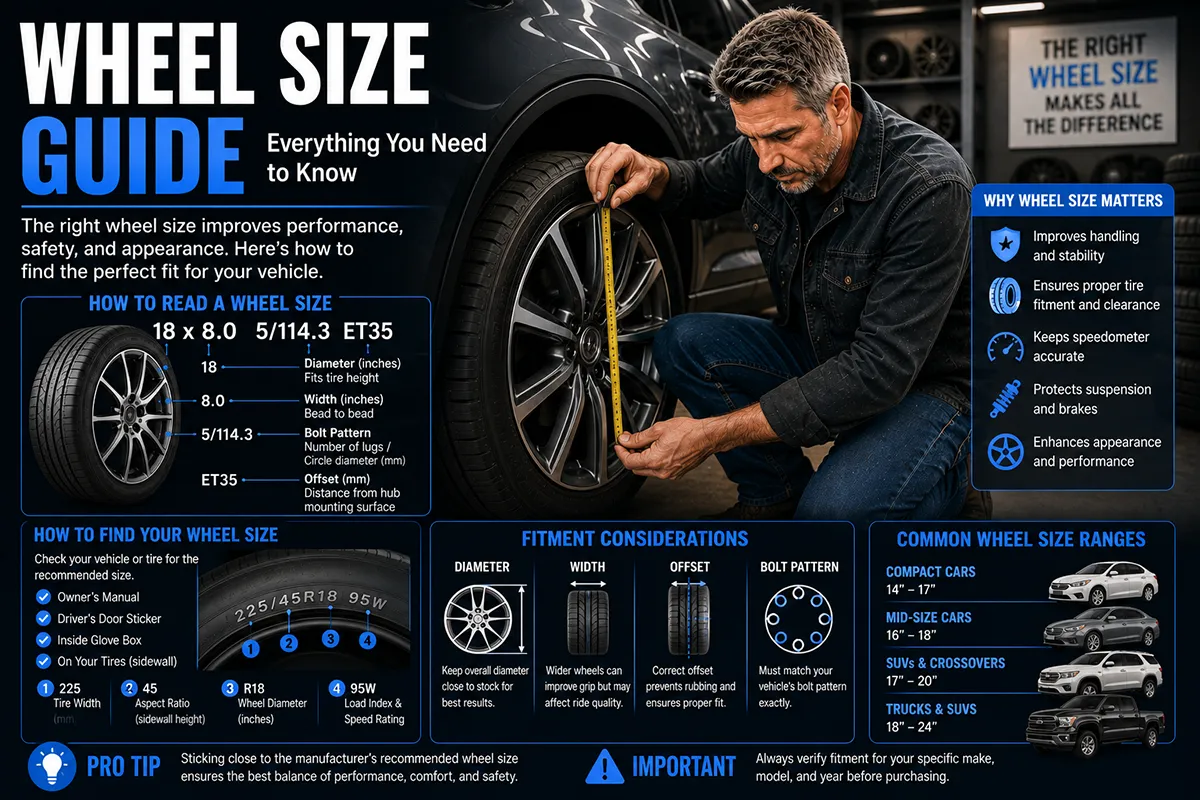
- Your tire size is printed on the sidewall (e.g., 225/65R17) — each number tells you width, aspect ratio, and wheel diameter.
- Your wheel (rim) size includes diameter, width, bolt pattern, and offset — all four must match your vehicle.
- Upsizing or downsizing wheels is possible but requires careful recalculation of tire dimensions.
- Always check your owner’s manual or driver’s door jamb sticker for your vehicle’s OEM recommended size.
- Wrong sizing affects speedometer readings, ride comfort, handling, fuel economy, and safety.
- I include a comparison table and real-world tips from years of tire testing to help you choose correctly.
Liked this article?
Add TireAdvise as a preferred source so you see more of our tire reviews and guides on Google.
Why Wheel and Tire Size Actually Matters
Before I dive into the numbers, I want to explain why this even matters. In my years of testing and reviewing tires across every category — from all-season touring to winter and all-terrain — I’ve seen firsthand how dramatically the right (or wrong) size affects real-world performance.
Your wheel and tire size determines your contact patch with the road. That’s the small rectangle of rubber that’s actually touching pavement at any given moment. Change the size, and you change everything: grip, braking distance, hydroplaning resistance, road noise, and ride comfort.
I once helped a friend who’d bought a set of “good deal” tires online that were technically the wrong width for his Honda CR-V. After several days of driving, he noticed his fuel economy had dropped, the steering felt vague, and there was a faint rubbing noise during sharp turns. All because the tires were 15mm too wide for his stock wheels.
How to Read Your Tire Size: Breaking Down Every Number
Let’s use a real example that’s extremely common on US roads: 225/65R17 102H. This is a size you’ll find on vehicles like the Toyota RAV4, Honda CR-V, and Subaru Outback. I’ll decode each piece.
225 — Tire Width (in Millimeters)
The first number is your tire’s section width — the measurement from sidewall to sidewall when the tire is properly mounted and inflated. In this case, it’s 225 millimeters, which is roughly 8.86 inches.
A wider tire generally means more grip because there’s more rubber contacting the road. But wider isn’t always better. In my experience testing winter tires, narrower widths (like 205 or 215) can actually perform better in deep snow because they cut through to the pavement rather than floating on top.
65 — Aspect Ratio (Sidewall Height as a Percentage)
This is the one that confuses most people. The “65” means the sidewall height is 65% of the tire’s width. So in this case, the sidewall is 65% of 225mm, which equals 146.25mm (about 5.76 inches).
A lower aspect ratio (like 40 or 45) means a shorter, stiffer sidewall — which gives you sharper handling but a harsher ride. A higher aspect ratio (like 70 or 75) means a taller, more flexible sidewall that absorbs bumps better. I personally prefer something in the 55-65 range for daily driving because it strikes a nice balance between comfort and responsiveness.
R — Construction Type
The “R” stands for radial construction, which is the standard for virtually every passenger tire sold in the US today. Radial tires have internal plies that run perpendicular to the direction of travel, giving them better flexibility and heat dissipation.
You might occasionally see “D” for diagonal (bias-ply) on trailer tires or some specialty applications, but for your car, SUV, or truck, it’s going to be “R” every time.
17 — Wheel Diameter (in Inches)
This is the diameter of the wheel (rim) that the tire fits onto, measured in inches. A 225/65R17 tire needs to be mounted on a 17-inch wheel. Period. You cannot mount a 17-inch tire on a 16-inch wheel — it physically won’t work and attempting it is dangerous.
This is the number that changes when people “upsize” or “downsize” their wheels, which I’ll cover in detail later.
102 — Load Index
The load index tells you the maximum weight each tire can support when properly inflated. A load index of 102 means each tire can carry up to 1,874 pounds. Multiply by four, and your set can support 7,496 pounds total.
I always tell readers: never go below your vehicle manufacturer’s recommended load index. Going higher is fine (and sometimes preferred for heavy SUVs and trucks), but going lower is a safety risk.
H — Speed Rating
The speed rating indicates the maximum sustained speed the tire is engineered to handle. “H” means 130 mph. You’ll also commonly see “T” (118 mph), “V” (149 mph), and “W” (168 mph) on US passenger vehicles.
In my testing, I’ve found that tires with higher speed ratings tend to have stiffer construction and better high-speed stability, but they can sometimes sacrifice ride comfort and treadlife. For most US drivers who aren’t tracking their cars, an H or V rating is more than sufficient.
How to Read Your Wheel (Rim) Size
Now let’s talk about the wheel itself. Tire size and wheel size are related but different measurements, and you need to understand both. A typical wheel size designation looks like this: 17×7.5 ET45 5×114.3.
17 — Wheel Diameter
Just like the tire size, this is the diameter in inches. It must match the last number in your tire size. If you’re running 225/65R17 tires, you need 17-inch wheels.
7.5 — Wheel Width
This is the internal width of the wheel, measured in inches from bead seat to bead seat. This is critical because every tire has an approved range of wheel widths it can be mounted on.
For a 225mm wide tire, the recommended wheel width is typically between 6.0 and 8.0 inches, with 7.0-7.5 being the sweet spot. I’ve seen people try to stretch a 245-width tire onto a 7-inch wide wheel, and it looks awful, wears unevenly, and handles terribly.
ET45 — Offset
Offset (measured in millimeters) tells you how far the wheel’s mounting surface is from the centerline of the wheel. A positive offset (like ET45) means the mounting surface is toward the outside face of the wheel. A negative offset means it’s toward the inside.
This measurement is crucial for proper fitment. Too much positive offset and the tire can rub on the inner fender or suspension components. Too much negative offset and the tire sticks out past the fender, which is both illegal in some states and a real-world problem — I’ve seen rocks, mud, and road debris flung onto the vehicle body by wheels with excessive negative offset.
5×114.3 — Bolt Pattern
This specifies the number of lug nuts (5) and the diameter of the circle they form (114.3mm). This must match your vehicle exactly. A 5×114.3 wheel will not fit a vehicle with a 5×120 bolt pattern, even though both have 5 lugs.
Common US bolt patterns include:
- 5×114.3 (5×4.5″) — Honda, Toyota, Nissan, Hyundai, Ford (many models)
- 5×120 — BMW, older Honda (Odyssey, Pilot), Chevy Camaro
- 5×112 — Volkswagen, Audi, Mercedes-Benz
- 6×139.7 (6×5.5″) — Toyota Tacoma, Chevy Silverado, GMC Sierra, Nissan Frontier
- 5×127 (5×5″) — Jeep Wrangler, Chevy Impala
Where to Find Your Vehicle’s Correct Size
This is probably the most practical section of this entire guide. You have three reliable sources for your OEM tire and wheel size:
1. Driver’s Door Jamb Sticker
Open your driver’s side door and look at the jamb where the door latches. There’s a sticker (sometimes called the tire placard) that lists the recommended tire size and inflation pressure for your vehicle. This is the gold standard. I check this sticker on every vehicle I test.
2. Owner’s Manual
Your owner’s manual will list the OEM tire size, approved alternative sizes, and recommended inflation pressures. If you’ve lost your physical manual, most manufacturers have PDF versions available on their websites for free.
3. The Tires Currently on Your Car
If your car still has its original wheels and hasn’t been modified, the size printed on your current tires is what you need. Just look at the sidewall and write down that full size string.
One important caveat: if you bought the car used, the previous owner might have changed the wheels or tires. I always recommend cross-referencing whatever’s on the car with the door jamb sticker to make sure they match.
The Plus-Sizing and Minus-Sizing Guide
This is where things get really interesting — and where I see the most mistakes. Plus-sizing means going to a larger diameter wheel (and a lower-profile tire to compensate). Minus-sizing is the reverse.
How Plus-Sizing Works
Let’s say your vehicle came with 225/65R17 tires and you want larger 18-inch wheels for a sportier look. You can’t just throw on 18-inch wheels and use the same tire — the overall diameter would be way off, and everything from your speedometer to your ABS system would be affected.
Instead, you need to adjust the tire dimensions so the overall diameter stays approximately the same. Here’s how that looks:
| Setup | Tire Size | Wheel Diameter | Overall Diameter | Sidewall Height | Speedometer Effect |
|---|---|---|---|---|---|
| OEM (Stock) | 225/65R17 | 17″ | 28.52″ | 5.76″ | Baseline (0%) |
| Plus One (+1) | 235/55R18 | 18″ | 28.17″ | 5.09″ | -1.2% |
| Plus Two (+2) | 245/45R19 | 19″ | 27.68″ | 4.34″ | -2.9% |
| Minus One (-1) | 225/70R16 | 16″ | 28.44″ | 6.20″ | -0.3% |
As you can see, the key is keeping the overall diameter as close to stock as possible. I generally recommend staying within 3% of the original overall diameter. Beyond that, you’ll start noticing meaningful speedometer errors and potential issues with traction control and ABS calibration.
Pros and Cons of Plus-Sizing
In my experience, plus-sizing gives you:
- Sharper, more responsive handling due to shorter sidewalls
- A more aggressive, modern look
- Often better high-speed stability
But the trade-offs are real:
- Harsher ride — those shorter sidewalls don’t absorb bumps as well
- Greater susceptibility to pothole damage (bent rims, pinch flats)
- Typically more expensive tires and wheels
- Potentially worse winter performance
I tested a set of 19-inch wheels with low-profile tires on a Mazda CX-5 that originally came with 17s. The handling improvement was noticeable, especially on highway on-ramps and through twisty back roads. But during my test period driving over some rough Pennsylvania roads, I felt every single crack and expansion joint in a way I never did on the stock setup. It genuinely made the car less pleasant to commute in.
Why Minus-Sizing Is Underrated
Going down a wheel size is something I recommend more often than most people expect. If you’re buying a dedicated winter tire setup, for example, dropping from 18-inch to 17-inch wheels (with appropriately taller tires) gives you more sidewall to absorb impacts from hidden potholes under snow, and narrower options that cut through slush more effectively.
I’ve personally run minus-one winter setups on multiple test vehicles, and the improvement in winter ride quality alone makes it worthwhile. Plus, smaller wheels and tires are almost always cheaper — sometimes saving $200-$400 for a full set.
Common Wheel Sizes by Vehicle Type in the US
To give you a real-world reference point, here are the most common OEM wheel sizes I see across major vehicle categories in the US market:
Compact Cars (Civic, Corolla, Mazda3, Jetta)
- Typical OEM size: 16″ or 17″
- Common tire sizes: 205/55R16, 215/45R17, 225/45R17
- Recommended wheel width: 6.5″ to 7.5″
Midsize Sedans (Camry, Accord, Sonata, K5)
- Typical OEM size: 17″ or 18″
- Common tire sizes: 215/55R17, 235/45R18, 225/50R17
- Recommended wheel width: 7.0″ to 8.0″
Compact SUVs/Crossovers (RAV4, CR-V, Tucson, Forester)
- Typical OEM size: 17″ or 18″
- Common tire sizes: 225/65R17, 225/60R18, 235/55R19
- Recommended wheel width: 7.0″ to 8.0″
Full-Size Trucks (F-150, Silverado 1500, RAM 1500, Tundra)
- Typical OEM size: 17″, 18″, or 20″
- Common tire sizes: 265/70R17, 275/65R18, 275/55R20
- Recommended wheel width: 7.5″ to 9.0″
Full-Size SUVs (Tahoe, Expedition, Suburban, Yukon)
- Typical OEM size: 18″ or 20″
- Common tire sizes: 275/65R18, 275/55R20, 285/45R22
- Recommended wheel width: 8.0″ to 9.5″
The Relationship Between Wheel Width and Tire Width
This is a detail that many guides gloss over, but in my experience, it’s one of the most important fitment considerations. Every tire has a range of approved wheel widths, and mounting a tire on a wheel that’s too narrow or too wide creates problems.
When a tire is mounted on a wheel that’s too narrow, the tread face doesn’t sit flat — it crowns in the middle, causing accelerated center wear. When mounted on a wheel that’s too wide, the tread pulls apart and the edges wear prematurely.
Here’s a general guideline I use:
| Tire Width (mm) | Minimum Wheel Width | Ideal Wheel Width | Maximum Wheel Width |
|---|---|---|---|
| 195 | 5.5″ | 6.0″ – 6.5″ | 7.0″ |
| 205 | 5.5″ | 6.5″ – 7.0″ | 7.5″ |
| 215 | 6.0″ | 7.0″ | 7.5″ |
| 225 | 6.0″ | 7.0″ – 7.5″ | 8.0″ |
| 235 | 6.5″ | 7.5″ – 8.0″ | 8.5″ |
| 245 | 7.0″ | 7.5″ – 8.5″ | 8.5″ |
| 265 | 7.5″ | 8.0″ – 9.0″ | 9.5″ |
| 275 | 7.5″ | 8.5″ – 9.5″ | 9.5″ |
I always check the tire manufacturer’s specific recommendations for wheel width, which are available on their websites or in the tire’s technical data sheet. Don’t guess on this one.
How Wheel Size Affects Your Driving Experience
I want to share what I’ve actually felt behind the wheel when testing identical vehicles with different wheel and tire setups. These aren’t theoretical differences — they’re tangible, real-world impacts.
Ride Comfort
Larger wheels with lower-profile tires transmit more road imperfections into the cabin. After several days of driving a test vehicle on 20-inch wheels, I switched back to the 17-inch option on the same car, and the difference was immediately obvious. The 17s soaked up road irregularities that the 20s transmitted directly through the steering wheel and seat.
If you live in an area with rough roads — and let’s be honest, that’s most of the US — this is a serious consideration. Pothole-ridden cities like Detroit, Philadelphia, and Chicago are brutal on low-profile tires.
Handling and Responsiveness
On the flip side, larger wheels with shorter sidewalls reduce sidewall flex during cornering. I felt noticeably less body roll and more precise turn-in with the 19-inch and 20-inch setups. If you enjoy spirited driving on smooth roads, bigger wheels can genuinely improve the experience.
Noise
In my experience, larger wheels tend to produce more road noise, especially on coarse-textured highway surfaces. The shorter sidewall has less material to dampen vibrations. It’s not a dramatic difference, but over a long highway drive, it adds up.
Fuel Economy
Larger, heavier wheels increase unsprung weight and rolling resistance. During my test periods comparing different wheel sizes, I’ve consistently seen a small but measurable drop in fuel economy — typically in the range of 1-2 mpg — when going from the smallest to the largest available wheel option on the same vehicle.
Braking Distance
Here’s a nuance most people don’t consider. Larger wheels can accommodate larger brake rotors and calipers (which is why performance cars have big wheels). But if you’re just swapping to bigger wheels without upgrading the brakes, you’re adding rotational mass without any braking benefit. In my testing, braking distances have been slightly longer with heavier aftermarket wheels compared to lighter OEM setups.
Steel vs. Alloy vs. Forged Wheels: Does It Matter for Sizing?
The material your wheel is made from doesn’t change the sizing numbers, but it absolutely affects weight, and weight matters more than most people realize.
Steel Wheels
These are the heaviest option, but they’re incredibly durable and cheap. A 17-inch steel wheel might weigh 22-25 pounds. I recommend steel wheels for dedicated winter setups — they handle curb rash and road salt without the cosmetic heartbreak of scratching a nice alloy.
Prices typically range from $50-$100 per wheel for passenger cars and light trucks.
Alloy (Cast Aluminum) Wheels
These are what come standard on most new vehicles. A comparable 17-inch alloy wheel typically weighs 18-22 pounds. They look better, weigh less, and dissipate brake heat more effectively than steel. Most aftermarket alloy wheels range from $100-$300 per wheel.
Forged Aluminum Wheels
Forged wheels are manufactured from a single block of aluminum under extreme pressure, making them the lightest and strongest option. A forged 17-inch wheel can weigh as little as 14-17 pounds. The downside? They’re expensive — often $400-$1,000+ per wheel.
I’ve tested forged wheels on a few performance vehicles, and the reduction in unsprung weight is immediately noticeable. Steering feels lighter, the car changes direction more quickly, and the ride actually feels smoother because there’s less mass slamming into bumps.
Staggered Setups: When Front and Rear Sizes Differ
Some vehicles — particularly rear-wheel-drive sports cars and performance sedans — come with a staggered setup from the factory. This means wider tires (and sometimes wider wheels) on the rear axle than the front.
For example, a BMW 3 Series might run 225/45R18 on the front and 255/40R18 on the rear. The wider rear tires provide more traction for acceleration, while the narrower fronts allow for crisper steering response.
If your vehicle came with a staggered setup, I strongly recommend maintaining it when you buy replacements. Switching to a square (same-size-all-around) setup changes the handling balance the engineers designed, and not always for the better.
One important note: staggered setups usually mean you can’t rotate tires front-to-rear, only side-to-side. This can lead to uneven wear between front and rear tires. I’ve dealt with this on several test cars and usually end up replacing the rears more frequently.
Tools I Use to Verify Fitment
Over the years, I’ve developed a process for confirming wheel and tire fitment before recommending any setup. Here are the tools I rely on:
- Tire Rack’s Tire Size Calculator — Free online tool that lets you compare overall diameters, speedometer differences, and more between tire sizes. I use this constantly.
- Will They Fit (willtheyfit.com) — Another excellent free calculator that visually shows how different tire and wheel combinations compare.
- Owner’s Manual / Door Jamb Sticker — Always my starting reference point.
- Manufacturer Fitment Guides — Brands
Frequently Asked Questions
How do I read the wheel size on my current rims?
Your wheel size is typically stamped on the back of the rim or listed on a sticker inside your driver’s side door jamb. The format reads as diameter x width (e.g., 17×7.5), where 17 is the diameter in inches and 7.5 is the width in inches. You’ll also need to know the bolt pattern, offset, and center bore to ensure a proper fit when shopping for replacements.
What happens if I put the wrong size wheels on my car?
Installing the wrong wheel size can cause serious issues including rubbing against fenders or suspension components, inaccurate speedometer readings, and premature tire wear. Incorrect offset or bolt pattern can also compromise handling stability, especially during highway driving or in wet conditions common across many US regions. I always recommend sticking within your vehicle manufacturer’s approved wheel size range to avoid voiding warranties or creating safety hazards.
Can I put bigger wheels on my car without a lift or modification?
Most vehicles can safely go up one inch in wheel diameter (called plus-sizing) without any modifications, as long as you pair the larger wheel with a lower-profile tire to maintain the overall diameter. For example, moving from a 16-inch to a 17-inch wheel is usually straightforward and costs between $150–$300 per wheel for quality options from US brands like American Racing or Fuel. Going beyond plus-one sizing typically requires fender modifications or suspension changes to prevent rubbing.
What is wheel offset and why does it matter when buying new rims?
Wheel offset measures the distance in millimeters between the wheel’s mounting surface and its centerline, and it determines how far your wheels sit inward or outward in the wheel well. A positive offset pushes the wheel inward while a negative offset pushes it outward, which directly affects handling, tire clearance, and even bearing wear. Getting the wrong offset by even 10–15mm can cause your tires to rub or put excessive stress on suspension components, so I always check my vehicle’s factory offset specs before purchasing.
Does wheel size affect gas mileage and ride comfort?
Yes, larger and heavier wheels increase rotational mass, which can reduce fuel economy by 1–3 mpg depending on driving conditions and the size difference. Bigger wheels paired with lower-profile tires also transmit more road imperfections into the cabin, which is especially noticeable on rougher US roads and highways. If fuel savings and a comfortable ride are priorities, sticking with your vehicle’s stock wheel size or a lightweight aftermarket option in the same dimensions is your best bet.
How do I find the correct bolt pattern for my wheel size?
The bolt pattern (also called lug pattern) is expressed as two numbers, such as 5×114.3, where 5 is the number of lug holes and 114.3 is the diameter of the circle they form in millimeters. You can find your bolt pattern in your owner’s manual, on the manufacturer’s website, or by using an online bolt pattern guide filtered by your vehicle’s year, make, and model. I recommend physically measuring your existing wheels as a double-check, since some vehicles like certain Ford and Chevy trucks share similar but not identical patterns that can lead to costly mistakes.
What is the difference between wheel size and tire size, and how do they work together?
Wheel size refers to the diameter and width of the metal rim itself, while tire size describes the rubber tire’s width, aspect ratio, and the diameter of wheel it fits. These two measurements must be compatible—for example, a 225/55R17 tire is designed specifically for a 17-inch wheel with a recommended rim width between 6 and 8 inches. When upgrading wheel sizes, you need to adjust the tire size accordingly so the overall rolling diameter stays within 3% of the factory spec to keep your speedometer accurate and your vehicle’s safety systems functioning properly.
