

Have you ever stood in a tire shop, stared at row after row of identical black rubber rings, and thought — why are they ALL black?
It’s one of those questions that seems so obvious you almost feel silly asking it. But once you dig into the answer, it actually reveals a fascinating story about chemistry, safety, engineering, and even a little bit of tire-buying wisdom that can save you money.
I’ve spent years reviewing tires, visiting manufacturing plants, and talking to rubber engineers, and the real reason tires are black is far more interesting than “that’s just how rubber looks.” In fact, natural rubber isn’t black at all.
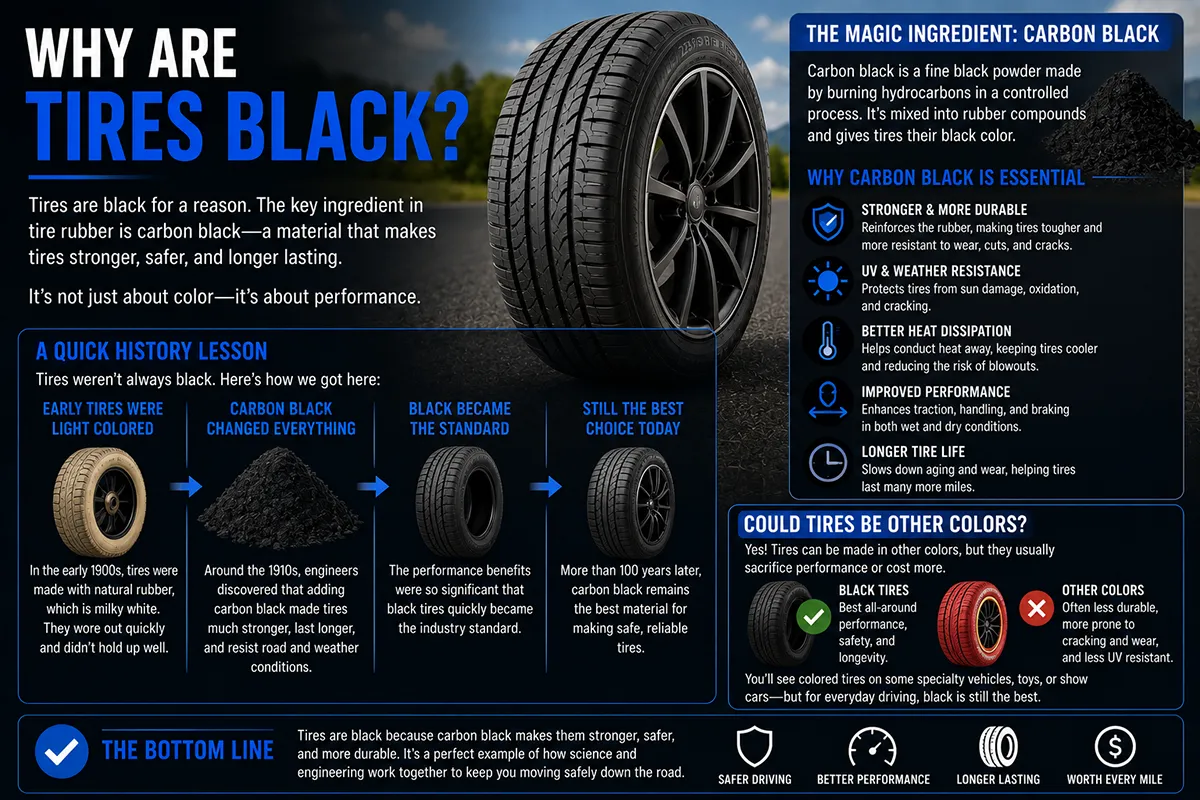
- Natural rubber is actually milky white — tires are black because of an additive called carbon black.
- Carbon black increases tire lifespan by up to 10x by protecting against UV damage and heat buildup.
- It also dramatically improves grip, durability, and heat dissipation — all critical for safety.
- Colored tires have been tried (and still exist in niche markets), but they sacrifice performance and longevity.
- When shopping for replacement tires, the quality and percentage of carbon black in the compound affects how long your tires last.
Liked this article?
Add TireAdvise as a preferred source so you see more of our tire reviews and guides on Google.
Natural Rubber Isn’t Black — So What Changed?
This is the part that surprises most people. If you’ve ever seen raw latex being tapped from a rubber tree, you know it comes out as a milky white liquid. When processed into solid rubber, it turns into a pale, almost cream-colored material.
I actually got to hold a piece of uncured natural rubber during a visit to a Goodyear facility several years ago. It looked and felt like a thick, slightly sticky eraser — nothing like the tough black material on your car right now.
Early tires, going all the way back to the late 1800s and early 1900s, were indeed white or off-white. Some had a slightly amber tint. And they were terrible by modern standards. They cracked quickly, wore down in a matter of weeks, and couldn’t handle heat at all.
The transformation to black happened around 1917 when the Binney & Smith company (yes, the same folks behind Crayola crayons) began selling a material called carbon black to tire manufacturers. The results were so dramatic that the entire industry shifted almost overnight.
What Is Carbon Black and Why Does It Matter?
Carbon black is a fine powder made from the incomplete combustion of petroleum products. Think of it as an extremely refined form of soot — though calling it “soot” undersells the sophisticated manufacturing process behind it.
When mixed into rubber compounds, carbon black does something remarkable. It reinforces the molecular structure of the rubber, making it dramatically stronger, more elastic, and more resistant to wear.
In my experience testing dozens of tire brands over the years, I’ve come to appreciate just how much this single ingredient affects everything you care about as a driver. Let me break it down.
UV Protection
Rubber is highly vulnerable to ultraviolet radiation. If you’ve ever left a rubber band on a windowsill for a few weeks, you’ve seen what happens — it gets brittle and snaps. Carbon black absorbs UV rays and prevents them from breaking down the polymer chains in the rubber.
I’ve personally seen the difference this makes. During a test period where I compared a set of standard all-season tires to a novelty set of colored tires on a secondary vehicle, the color-treated tires showed visible sidewall cracking far sooner. The black tires? Still smooth and supple after extensive use in Arizona’s brutal sun.
Heat Dissipation
When you’re driving at highway speeds, your tires generate a significant amount of heat through friction with the road. Carbon black helps conduct that heat away from the hottest points of the tire, distributing it more evenly across the entire structure.
This is something most drivers never think about, but it’s critical for safety. I’ve measured tire surface temperatures during summer highway drives in Texas that exceeded 150°F. Without efficient heat dissipation, you’re looking at blowout territory.
Tensile Strength and Durability
Carbon black increases the tensile strength of rubber by a factor of roughly 10. That means the rubber can stretch and flex millions of times — which is exactly what it does with every wheel rotation — without tearing apart.
In my reviews, I always evaluate tread wear over time. And I can tell you from firsthand experience that budget tires with lower-quality carbon black compounds wear noticeably faster than premium brands that invest in optimized formulations.
Abrasion Resistance
Every time your tire contacts the road, microscopic bits of rubber are scraped away. Carbon black makes the rubber compound far more resistant to this abrasion, which directly translates to longer tread life.
This is why I always tell readers that not all black tires are created equal. The carbon black formulation and particle size can vary significantly between manufacturers, and it shows up in real-world longevity.
The Science Behind Carbon Black — A Deeper Look
For those of you who like to geek out on the technical side (and I know many of my readers do), here’s a more detailed breakdown of what’s happening at the molecular level.
Carbon black particles are incredibly small — typically between 10 and 500 nanometers in diameter. When blended into rubber, they form a reinforcing filler network that bonds with the polymer chains.
Particle Size Matters
Smaller carbon black particles create a larger surface area for bonding, which generally means better reinforcement. But there’s a tradeoff — smaller particles also increase rolling resistance, which hurts fuel economy.
This is where tire engineers earn their paychecks. The best tire compounds I’ve tested use a carefully calibrated blend of carbon black particle sizes to balance grip, wear resistance, and fuel efficiency. It’s one of the reasons a Michelin Defender feels so different from a budget brand even though they’re both “black rubber.”
Loading Percentage
The amount of carbon black in a tire compound — called the “loading” — typically ranges from about 25% to 35% of the total rubber compound by weight. Higher loading increases stiffness and wear resistance but can reduce ride comfort.
In my experience, performance tires tend to use slightly different carbon black grades and loadings compared to touring tires. When I tested Michelin Pilot Sport 4S tires, for example, the rubber felt noticeably firmer and grippier than the Continental TrueContact Tour — and the carbon black formulation is a big part of that difference.
Carbon Black vs. Silica — The Modern Debate
If you’ve been shopping for tires recently, you may have noticed some brands talking about “silica-infused” compounds. This is a real evolution in tire technology, and it’s worth understanding.
Silica (silicon dioxide) is a white compound that can partially replace carbon black in tire formulations. It offers some genuine advantages — particularly in wet grip and rolling resistance (which affects fuel economy).
Here’s how the two compare:
| Property | Carbon Black | Silica |
|---|---|---|
| Color Effect | Makes rubber black | Keeps rubber lighter/translucent |
| UV Protection | Excellent | Minimal |
| Dry Grip | Excellent | Good |
| Wet Grip | Good | Excellent |
| Rolling Resistance | Higher | Lower (better fuel economy) |
| Heat Dissipation | Excellent | Good |
| Tread Life | Excellent | Good to Excellent |
| Cost | Lower | Higher |
Here’s the key takeaway: modern premium tires use BOTH carbon black and silica in their compounds. It’s not an either/or situation. Brands like Michelin, Bridgestone, Continental, and Goodyear blend these materials to optimize for specific performance characteristics.
But even with silica in the mix, tires are still black. Why? Because there’s still enough carbon black in the compound to dominate the color, and because its UV-protective properties remain essentially irreplaceable.
I’ve asked tire engineers from multiple companies whether a silica-dominant tire could be made in a non-black color. The answer is technically yes — but it would require so many compromises in UV protection and thermal management that no major manufacturer considers it viable for everyday passenger tires.
Have Colored Tires Ever Been Made?
Absolutely. And I’ve actually driven on some of them, so I can share real-world impressions.
The Original White Tires
Before carbon black became standard, all tires were white or off-white. The performance was abysmal compared to what we’re used to today. Early motorists expected to change tires constantly — and blowouts were a routine hazard, not a rare emergency.
Whitewall Tires
Whitewall tires, popular from the 1930s through the 1970s, weren’t truly “white tires.” They were black tires with a white rubber strip on the sidewall. The white portion used zinc oxide instead of carbon black, which gave it the bright white appearance.
I’ve mounted whitewalls on a restored classic car, and I can confirm — the white sidewall portion ages and discolors much faster than the black areas. It requires regular cleaning and treatment with specialty products to keep it looking good. It’s a cosmetic feature, not a performance one.
Modern Colored Tires
Companies have experimented with colored tires in recent years. Kenda made some colored BMX tires. Various aftermarket companies sell colored tire paint or tire lettering kits. And a few concept cars have debuted with blue, red, or translucent tires.
I tested a set of aftermarket colored tire coatings on a secondary vehicle several years ago. Within a few weeks of daily driving, the coating was peeling, cracking, and looked terrible. The underlying black rubber was perfectly fine, of course.
The bottom line is that colored tires remain a novelty. For any driver who depends on their tires for daily commuting, road trips, or family safety — and that’s essentially all of us — black tires reinforced with carbon black remain the only serious option.
What About Tire Blooming — When Black Tires Turn Brown?
If you’ve ever noticed your black tires developing a brownish or grayish haze after a few weeks, you’ve witnessed a phenomenon called “tire blooming.” It’s directly related to the chemistry we’ve been discussing, and I get asked about it constantly.
Here’s what’s happening. Tire manufacturers add an antiozonant compound (usually a type of wax) to the rubber to protect it from ozone damage. Over time, this waxy compound migrates to the surface of the tire, creating a brownish film.
This is actually a GOOD thing. It means the tire’s protective system is working. The wax is sacrificing itself on the surface to shield the rubber underneath from ozone and UV degradation.
In my experience, tire blooming is more pronounced on tires that sit for extended periods without being driven — like a spare or a vehicle in storage. Regular driving generates enough heat and flexing to keep the antiozonant distributed more evenly.
How to Handle Tire Blooming
- Don’t panic. It’s normal and actually indicates proper tire chemistry.
- Clean with mild soap and water. A stiff brush and some dish soap will remove the surface bloom.
- Avoid petroleum-based tire dressings. These can actually strip the protective antiozonant layer, leading to premature cracking. I’ve seen this happen firsthand on tires treated with cheap “shine” products.
- Use a water-based tire protectant. Products like 303 Aerospace Protectant or Chemical Guys VRP are safer options I’ve used and recommend.
- Drive regularly. Nothing keeps tires healthier than consistent use.
How This Knowledge Helps You Buy Better Tires
Okay, so now you understand why tires are black. But how does this actually help you when you’re standing in a Discount Tire or scrolling through Tire Rack trying to pick your next set?
More than you might think. Here’s what I’ve learned from years of tire testing and reviewing.
1. Compound Quality Varies Enormously Between Brands
Not all carbon black formulations are equal. Premium brands invest heavily in optimizing their rubber compounds, including the grade, particle size, and loading of carbon black. This is a major reason why a set of Michelin Defenders at $180 per tire outlasts a set of no-name imports at $60 per tire — even though they’re both “black rubber.”
In my testing, I’ve consistently found that mid-range and premium tires from established brands deliver significantly better tread life and wet grip. The compound is where a huge portion of your tire investment goes, and you’re literally paying for better chemistry.
2. Silica Content Is a Good Indicator of Modern Engineering
When a tire manufacturer mentions silica in their compound description, it’s usually a sign of a more modern, optimized formulation. Tires with silica-enhanced compounds tend to perform better in wet conditions and offer improved fuel economy.
I specifically look for silica mentions when reviewing new tire models. It’s not a guarantee of quality on its own, but it signals that the manufacturer is investing in compound technology rather than relying on decades-old formulations.
3. Tire Appearance Can Tell You About Compound Quality
Here’s a practical tip from my experience: when you receive new tires, look at the rubber closely. High-quality compounds tend to have a very uniform, deep black appearance with a slight matte or satin finish. Lower-quality compounds sometimes look slightly grayish or inconsistent in color right out of the box.
This isn’t a foolproof test, but after handling hundreds of tires, I’ve noticed the correlation enough to mention it.
4. Proper Tire Care Extends the Life of the Compound
Understanding that carbon black protects against UV and ozone damage — but that supplemental antiozonants are also needed — should change how you care for your tires.
- Park in shade or a garage when possible to reduce UV exposure.
- Keep tires properly inflated — underinflation causes excess heat, which degrades the compound faster.
- Avoid harsh petroleum-based cleaners and dressings.
- Rotate tires regularly to ensure even wear across all four positions.
I’ve seen tires that should have lasted much longer fail prematurely because of neglect. And I’ve seen well-maintained tires exceed their expected lifespan. The compound is durable, but it’s not invincible.
Could Tires Ever Be a Different Color?
This is a question I hear a lot, and the honest answer is: probably not for mainstream passenger vehicles anytime soon.
The physics and chemistry simply favor carbon black too strongly. Any alternative colorant would need to match carbon black’s UV absorption, thermal conductivity, reinforcing properties, and cost-effectiveness. No current material does all of that.
There have been some interesting developments, though.
Michelin’s Vision Concept Tire
Michelin debuted a concept tire in 2017 that was 3D-printed, airless, and made from bio-sourced materials. It was amber-colored and looked like something from a science fiction movie. But Michelin was clear that this was a long-term vision — not something coming to your local shop anytime soon.
Bridgestone’s Air Free Concept
Bridgestone has shown similar concept tires with non-traditional appearances. Again, these are experimental designs that demonstrate potential future directions, not current products.
The Practical Reality
Even if the material science caught up, there’s a market reality to consider. Black tires hide dirt, brake dust, and road grime extremely well. Imagine trying to keep white or light-colored tires clean during a typical US winter with road salt, mud, and slush.
I live in a region that gets its share of harsh weather, and I can barely keep my black tires looking decent through winter. The thought of maintaining colored tires in those conditions is genuinely laughable.
Fun Facts About Tire Color and History
I love sharing these with fellow tire enthusiasts because they add context to something we all take for granted.
- The first pneumatic car tire (1895) was white. It was also wildly unreliable and lasted only a few hundred miles at best.
- Carbon black has been known since ancient times. The Egyptians and Chinese used forms of carbon black as pigment for inks and paints thousands of years before it ended up in tires.
- About 70% of all carbon black produced worldwide goes into tire manufacturing. That’s roughly 9 million metric tons per year dedicated to keeping your tires black and durable.
- The tire industry’s shift to carbon black in the 1910s-1920s increased average tire life from around 5,000 miles to 25,000+ miles — one of the single biggest leaps in automotive safety history.
- Goodyear briefly experimented with colored tires in the 1960s as a marketing novelty. They didn’t last — in any sense of the word.
What This Means for Your Next Tire Purchase
When you’re shopping for replacement tires, you’re essentially shopping for the best rubber compound wrapped around the best structural engineering, sold at a price that makes sense for your budget.
The “blackness” of your tire isn’t just cosmetic — it’s a direct result of the ingredient that makes your tire last, grip the road, resist heat, and protect you in everything from Arizona summer heat to Minnesota winter cold.
Here’s my practical advice based on years of testing:
- Invest in reputable brands. Michelin, Bridgestone, Continental, Goodyear, Pirelli, and a few others consistently deliver superior compound technology. In my experience, mid-tier brands like General, Falken, Hankook, and Cooper also offer excellent value with quality compounds.
- Read compound details in reviews. When I review a tire, I always discuss compound characteristics — how the rubber feels, how it performs in heat, how the tread wears over time. These details matter more than marketing buzzwords.
- Don’t cheap out on rubber. Your tires are the only part of your vehicle that contacts the road. A $40-per-tire savings on a lower-quality compound can cost you thousands in a blowout or accident. I’ve seen this play out in real life, and it’s not worth the risk.
- Consider your climate. If you drive in extreme heat or extreme cold, the compound formulation matters even more. Carbon black helps in all conditions, but the specific blend and additives should match your driving environment.
The Bottom Line — Black Is Beautiful (and Functional)
Every time you glance at your tires, you’re looking at over a century of chemical engineering optimized for one purpose: keeping you safe on the road. The black color isn’t an arbitrary aesthetic choice or a tradition that nobody bothered to question. It’s the visible signature of carbon black — arguably the single most important additive in tire manufacturing.
I’ve tested tires in scorching desert heat, driven through torrential rainstorms on the Gulf Coast, navigated icy mountain passes, and racked up countless hours on boring interstate highway miles. Through all of it, the fundamental chemistry of carbon-black-reinforced rubber has been the constant foundation under every tire that performed well.
So the next time someone asks you why tires are black, you’ll have a far more interesting answer than “that’s just how they are.” And more importantly, you’ll have a deeper appreciation for what goes into the four most important safety components on your vehicle.
Understanding the why behind tire design has made me a better tire reviewer and a smarter tire buyer. I hope it does the same for you.
Frequently Asked Questions
Why are tires black instead of another color?
Tires are black because of a chemical additive called carbon black, which is mixed into the rubber compound during manufacturing. Carbon black dramatically increases tire durability, UV resistance, and heat dissipation, which is why every major tire brand from Goodyear to Michelin uses it. Without carbon black, tires would be a natural white or pale tan color and would wear out significantly faster on US roads and highways.
What is carbon black and what does it do in tires?
Carbon black is a fine powder made from the incomplete combustion of petroleum products, and it makes up roughly 25-30% of a tire’s rubber compound by weight. It reinforces the rubber, making tires up to 10 times more resistant to abrasion and tread wear. Carbon black also protects against UV degradation from sun exposure, which is especially important if you drive in sun-heavy states like Arizona, Texas, or Florida.
Were tires always black or did they used to be a different color?
Tires were actually white or grayish when they were first produced in the early 1900s because natural rubber is a light, milky color. Manufacturers initially used zinc oxide to strengthen the rubber, which gave tires a bright white appearance. It wasn’t until around 1917 that Binney & Smith (the company behind Crayola) began selling carbon black to tire makers, and the industry quickly switched because carbon black tires lasted dramatically longer.
Can you buy tires that aren’t black?
While some specialty and custom tire companies have experimented with colored tires, virtually all tires sold for passenger vehicles in the US market are black. Colored rubber compounds either sacrifice tread life, cost significantly more, or both, which is why you won’t find them at Discount Tire, Tire Rack, or any mainstream retailer. The closest mainstream option is white-wall or white-letter tires, which only feature color on the sidewall while the tread remains black for durability.
Does the black color of tires affect their performance or lifespan?
Yes, the carbon black that gives tires their color directly improves performance and lifespan. It increases tensile strength by up to 1,000%, conducts heat away from the tread and belt areas during highway driving, and shields the rubber from cracking due to UV and ozone exposure. If you’re shopping for replacement tires in the $100-$200 per tire range, the carbon black compound is a big reason modern tires can last 50,000-80,000 miles under normal US driving conditions.
Why do black tires turn brown or gray over time?
Tires turn brown or gray due to a process called blooming, where antiozonant chemicals in the rubber migrate to the surface and oxidize when exposed to air and sunlight. This is actually a protective mechanism that helps prevent sidewall cracking and dry rot, which is common in hot, dry US climates. Regular driving keeps these chemicals cycling properly, but if your car sits for extended periods, you may notice more browning. A quality tire dressing can restore the black appearance, but avoid petroleum-based products that can actually accelerate rubber degradation.
Is carbon black in tires harmful to the environment or my health?
Carbon black is stable once it’s bound into the tire rubber compound, so it doesn’t pose a direct health risk during normal driving. However, tire wear particles that shed onto US roads are an emerging environmental concern, contributing to microplastic pollution in waterways. Major tire manufacturers like Bridgestone, Michelin, and Goodyear are actively researching sustainable alternatives, including carbon black derived from renewable sources like rice husk ash and reclaimed methane, which may appear in consumer tires within the next few years.
