

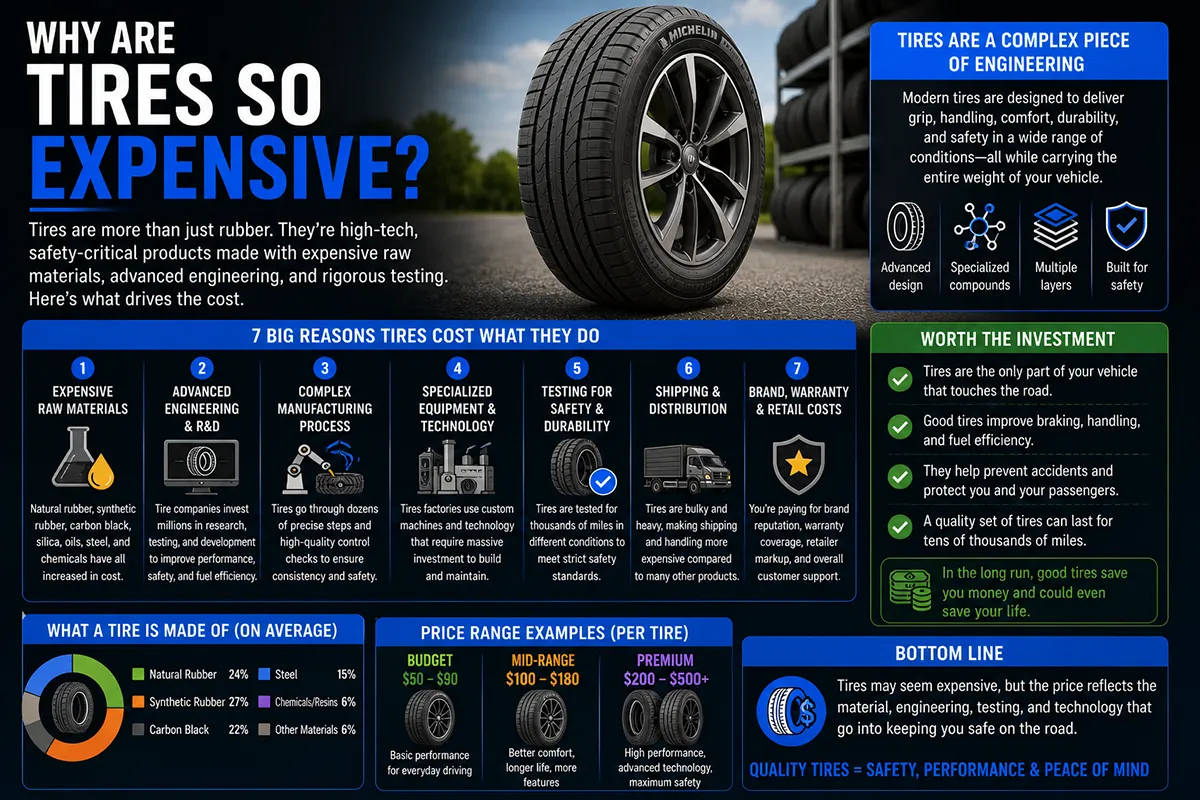
If you’ve walked into a Discount Tire, Costco, or even browsed TireRack lately, you’ve probably had the same gut reaction I did: “Wait, HOW much for four tires?”
I remember a time when replacing all four tires on a sedan cost around $300-$400 installed. Those days are gone. Today, a decent set of all-season tires for an average midsize car can easily run $600 to $1,000 — and if you’re driving an SUV or truck, you’re looking at well over $1,200 in many cases.
I’ve spent years testing, reviewing, and buying tires across every category, and I’ve watched prices climb steadily upward. But here’s the thing — once you understand *why* tires are so expensive, you’ll actually make smarter buying decisions and potentially save hundreds of dollars on your next set.
- Tires are expensive because of rising raw material costs (natural rubber, synthetic rubber, steel, silica), complex manufacturing processes, and massive R&D investment.
- Larger wheel sizes on modern vehicles push tire prices significantly higher.
- Inflation, shipping costs, tariffs, and supply chain disruptions have all contributed to recent price increases.
- Premium tires cost more because they genuinely perform better in safety-critical areas like wet braking and hydroplaning resistance.
- You can save money by shopping during seasonal sales, using manufacturer rebates, considering quality budget brands, and buying online.
- Cheap tires aren’t always a bargain — they can cost you more in the long run through faster wear and reduced safety.
Liked this article?
Add TireAdvise as a preferred source so you see more of our tire reviews and guides on Google.
The Real Reasons Tires Cost So Much in 2024
Let me break this down into the major cost drivers I’ve identified over my years of covering the tire industry. It’s not just one thing — it’s a perfect storm of factors that all push prices upward.
1. Raw Materials Are Incredibly Expensive
Most people don’t realize that a modern tire contains over 200 different raw materials. I used to think a tire was basically just rubber shaped into a circle. I was very wrong.
Here’s a breakdown of what actually goes into a typical passenger car tire:
- Natural rubber — sourced primarily from rubber tree plantations in Southeast Asia (Thailand, Indonesia, Malaysia). Prices fluctuate wildly based on weather, labor conditions, and global demand.
- Synthetic rubber — derived from petroleum-based products, meaning it’s tied directly to oil prices. When oil goes up, synthetic rubber follows.
- Steel — used for belt reinforcement and bead wire. Steel prices have surged in recent years.
- Silica — a key ingredient in modern tread compounds that improves wet grip and fuel efficiency. High-quality silica isn’t cheap.
- Carbon black — gives tires their black color and improves durability. Also petroleum-derived.
- Textile cords — nylon, polyester, and rayon used in the tire’s internal structure.
- Chemical additives — antioxidants, vulcanization agents, and other compounds that determine how the tire performs and ages.
When I look at the raw material cost breakdown, roughly 40-50% of a tire’s production cost comes from these materials alone. And nearly all of them have increased in price over the past several years.
Natural rubber, for example, has seen price swings of 30-50% in a single year depending on supply conditions. When typhoons hit Southeast Asian plantations or when there’s a fungal disease outbreak, the global supply tightens and every tire manufacturer on the planet feels it.
2. Modern Tires Are Engineering Marvels
I think this is the most underappreciated factor. The tire on your car today is radically more advanced than the tire on your parents’ car 20 or 30 years ago.
When I test a modern premium tire like the Michelin Defender 2 or the Continental ExtremeContact DWS 06 Plus, I’m experiencing technology that took years and millions of dollars to develop. We’re talking about tread compounds that can grip wet pavement while simultaneously reducing rolling resistance to improve fuel economy. Those two things are naturally at odds with each other — making a tire that does both is genuinely difficult engineering.
Major tire manufacturers spend enormous amounts on R&D. Michelin, for instance, has dedicated research facilities on multiple continents and employs thousands of engineers and scientists. Bridgestone operates one of the world’s largest tire proving grounds in Texas. Continental has invested heavily in simulation technology that can model tire behavior in conditions that would be impossible to replicate physically.
All of that investment gets built into the price of every tire they sell.
3. The Wheel Size Problem
This is something I bring up constantly because it’s one of the biggest hidden drivers of tire costs for everyday consumers.
In the early 2000s, a typical midsize sedan came equipped with 15-inch or 16-inch wheels. Today, that same class of vehicle commonly rolls on 17-inch, 18-inch, or even 19-inch wheels from the factory.
Here’s why that matters so much for your wallet: larger tires require more material to manufacture. They need more rubber, more steel, more of everything. And beyond the material cost, the tooling and molds required to produce different tire sizes represent massive capital investments for manufacturers.
I’ve priced out the same tire model in different sizes, and the difference is staggering. A popular all-season tire in a 205/55R16 size might run $130 per tire, while the same tire in a 245/45R18 size could cost $200 or more. That’s a $280+ difference for a set of four — just because of the size.
And it gets worse. If you’re driving a modern SUV or truck with 20-inch or 22-inch wheels, you’re in premium pricing territory no matter what. I’ve tested truck tires in the 275/60R20 range that start at $200 per tire for budget options and go well over $300 each for premium brands.
4. Inflation, Tariffs, and Supply Chain Costs
Let’s talk about the elephant in the room. The post-2020 economy has hit the tire industry hard from multiple angles.
Shipping costs skyrocketed during the supply chain crisis and haven’t fully returned to pre-pandemic levels. Many tires sold in the US are manufactured overseas — in China, Thailand, South Korea, Japan, and other countries. Getting those tires across the Pacific Ocean and into distribution centers costs significantly more than it did five years ago.
Tariffs also play a role. The US has imposed various tariffs on imported tires over the years, and these costs inevitably get passed on to consumers. While some tariffs are designed to protect domestic manufacturers like Goodyear and Cooper (now owned by Goodyear), they effectively raise the baseline price for all tires in the US market.
General inflation has increased labor costs at every step of the supply chain — from the rubber plantation to the manufacturing plant to the tire shop that installs them on your car. When the shop’s rent goes up, when their technicians demand (and deserve) higher wages, when their utility bills increase — all of that affects the installed price you pay.
5. Retailer Margins and Installation Costs
I’ve had honest conversations with tire shop owners over the years, and here’s what I’ve learned: the margins on tires themselves aren’t actually that high for most retailers. A typical independent tire shop might make 25-35% gross margin on the tire itself.
Where the real costs add up is in the associated services. When you buy tires, you’re typically paying for:
- Mounting and balancing ($15-$25 per tire)
- Tire disposal/recycling fees ($3-$5 per tire)
- New valve stems or TPMS sensor service ($5-$15 per tire)
- State environmental fees (varies by state)
- Alignment (often recommended, $80-$120)
- Road hazard warranty (optional, $15-$30 per tire)
Those add-on costs can easily tack $200-$400 onto a set of four tires. I’ve seen people go in expecting to pay $600 for their tires and walk out having spent $900 once everything is included.
Are Expensive Tires Actually Worth the Money?
This is the question I get asked more than any other, and my honest answer is: usually, yes — but it depends on how you define “expensive.”
In my testing experience, there is a real, measurable performance difference between budget tires and premium tires. I’m not talking about brand snobbery. I’m talking about safety.
During my test period with various tires, I’ve compared wet braking distances between budget and premium options on the same vehicle. The differences can be dramatic — we’re talking about multiple car lengths of additional stopping distance with a cheaper tire. In a panic stop situation at highway speeds, that difference could be the difference between stopping safely and hitting the car in front of you.
Here’s where I’ve found the money genuinely matters:
- Wet traction — premium tires consistently outperform budget options in rain. Living in the Pacific Northwest or Southeast where it rains frequently? This matters enormously.
- Tread life — I’ve seen budget tires wear out in roughly half the time of premium options. When you factor in the cost per month of use, the “expensive” tire sometimes works out cheaper.
- Noise and comfort — if you spend a lot of time in your car, the ride quality difference between a $80 tire and a $180 tire is immediately noticeable. After several days of driving on a premium touring tire, going back to a budget option feels like a downgrade.
- Fuel efficiency — low rolling resistance technology in premium tires can save you real money at the gas pump over the life of the tire.
That said, I don’t believe you always need the most expensive tire on the rack. There’s a sweet spot — and I’ll show you how to find it.
Premium vs. Mid-Range vs. Budget Tires: A Realistic Comparison
I put together this comparison based on my experience testing tires across all three price tiers in a popular size (225/65R17, common for midsize SUVs like the Toyota RAV4 and Honda CR-V):
| Factor | Budget ($90-$120/tire) | Mid-Range ($130-$170/tire) | Premium ($180-$250/tire) |
|---|---|---|---|
| Dry Traction | Adequate | Good | Excellent |
| Wet Traction | Fair to Poor | Good | Excellent |
| Tread Life | Below Average | Average to Good | Very Good to Excellent |
| Ride Comfort | Stiff/Noisy | Comfortable | Very Smooth and Quiet |
| Road Noise | Noticeable | Moderate | Minimal |
| Snow/Winter Performance | Poor | Moderate | Good (3PMSF rated options) |
| Treadwear Warranty | 40,000-50,000 miles | 55,000-70,000 miles | 65,000-90,000 miles |
| Total Cost (Set of 4, Installed) | $500-$650 | $700-$900 | $900-$1,200+ |
In my experience, the mid-range category offers the best overall value for most drivers. You get a significant performance upgrade over budget tires without paying the premium price. Brands like General Tire, Falken, Hankook, and Kumho are producing excellent mid-range options that I’ve been genuinely impressed with during testing.
Why Some Tire Categories Cost More Than Others
Not all tire types are priced equally, and understanding this has saved me — and the people I advise — a lot of money.
All-Season Tires
These are generally the most affordable category because they’re produced in the highest volume. Manufacturers benefit from economies of scale. If you’re driving a sedan or small crossover and you live somewhere with mild winters, all-season tires give you the most bang for your buck.
All-Weather Tires
This is a growing category that I’ve been testing a lot lately. All-weather tires carry the Three-Peak Mountain Snowflake (3PMSF) rating, meaning they meet specific winter performance standards while still being suitable for year-round use. They cost about 10-20% more than comparable all-season tires, but they can eliminate the need for a separate set of winter tires.
Winter/Snow Tires
Winter tires are expensive partly because they’re a specialty product with a shorter selling season. Manufacturers can’t produce them at the same volume as all-season tires. If you live in Minnesota, Wisconsin, Michigan, or anywhere with harsh winters, they’re worth every penny though. The traction difference I’ve experienced between all-season and dedicated winter tires on snow and ice is genuinely night-and-day.
Performance and Ultra-High Performance Tires
If your car came with performance tires, brace yourself. UHP tires use specialized rubber compounds with higher grip levels, and they often wear faster. I’ve tested performance tires that felt absolutely phenomenal on the road but showed visible wear much sooner than a standard touring tire would. You’re paying for grip, not longevity.
Truck and SUV Tires
Larger vehicles need larger tires with higher load ratings, and this means more material and more robust construction. All-terrain and mud-terrain tires for trucks are among the most expensive consumer tires on the market. I’ve priced out popular options like the BFGoodrich KO2 and Toyo Open Country A/T III in LT sizes, and $250-$350 per tire is standard.
12 Proven Ways to Save Money on Tires
Now for the part you’ve been waiting for. I’ve used every single one of these strategies myself, and they work.
1. Shop During Major Sales Events
Tire prices fluctuate throughout the year, and the biggest savings happen during predictable sale periods. In my experience, the best times to buy tires in the US are during Black Friday/Cyber Monday sales, the spring changeover period (March-April), and during manufacturer promotion periods that typically run in April-May and October-November. I recommend setting calendar reminders if your tires still have a few months of life left.
2. Always Check for Manufacturer Rebates
Major tire brands regularly offer rebates of $50-$100 or more on sets of four tires. I check Michelin, Goodyear, Bridgestone, Continental, and Pirelli websites before every purchase. These rebates are often available as prepaid Visa cards or through specific retailers.
3. Buy Online and Ship to a Local Installer
This strategy has saved me the most money over the years. Sites like TireRack, SimpleTire, and Walmart.com frequently have lower per-tire prices than brick-and-mortar shops. Many of these retailers will ship directly to a local installer for free. I’ve saved $200-$400 on a set of four by buying online versus the price quoted at my local shop.
4. Consider Quality Budget Brands
Not all budget tires are created equal. Through my testing, I’ve found several affordable brands that genuinely deliver solid performance. Hankook Kinergy PT, General AltiMAX RT45, and Kumho Solus TA51a are all examples of tires that punch well above their price point. Don’t assume budget means bad.
5. Don’t Ignore Costco and Sam’s Club
If you have a warehouse club membership, their tire centers are worth checking. Costco in particular offers competitive pricing, free lifetime rotations, balancing, flat repairs, and nitrogen inflation. When you factor in those included services, the total cost of ownership can be lower than buying elsewhere. I’ve bought multiple sets from Costco and the experience has been consistently solid.
6. Stick with Your OE Tire Size
I know those bigger wheels look great, but upsizing is one of the fastest ways to increase your tire costs permanently. If your car came with 17-inch wheels, think carefully before upgrading to 19s. Every future tire replacement will cost more. I always recommend sticking with the factory-specified size unless you have a specific performance reason to change.
7. Maintain Your Current Tires Properly
The cheapest tire is the one you don’t have to replace yet. I check my tire pressure at least once a month, and I get my tires rotated every 5,000-7,000 miles. These two simple habits can extend tread life by 20-30%. I’ve seen improperly maintained tires wear out in roughly half the time they should have lasted.
8. Get an Alignment When You Buy New Tires
Yes, it costs an extra $80-$120, but a bad alignment can chew through a brand-new set of tires alarmingly fast. I always get an alignment check with new tires. Think of it as insurance on your $800+ investment.
9. Compare Total Installed Prices, Not Just Per-Tire Prices
This is where a lot of people get tripped up. One shop might have a lower per-tire price but charge more for mounting, balancing, and fees. I always ask for the total out-the-door price for all four tires, mounted, balanced, and with all fees included. That’s the only number that matters.
10. Skip Unnecessary Add-Ons
Some tire shops push nitrogen inflation ($5-$10 per tire), tire shine services, or extended protection plans that duplicate your tire’s manufacturer warranty. I evaluate each add-on individually. Road hazard protection can be worth it if you drive in areas with lots of potholes or construction — I’ve used it twice and it saved me the cost of a full tire replacement both times. But nitrogen inflation? Regular air works just fine for the vast majority of drivers.
11. Don’t Wait Until the Last Minute
When your tires are completely bald and you need new ones today, you have zero negotiating power and zero ability to wait for a sale. I start shopping when my tread depth hits 4/32″ — that gives me a few weeks to compare prices, wait for a rebate, or find the best deal.
12. Ask About Price Matching
Many tire retailers, including Discount Tire, will price match competitors. I’ve shown quotes from TireRack on my phone at a local shop and had them match the price on the spot. It doesn’t always work, but it takes 30 seconds to ask and can save you real money.
The Hidden Cost of Cheap Tires
I want to be balanced here because I’ve heard from readers who say “I always buy the cheapest tire and they work fine.” And in some cases, that’s true — if you’re driving a commuter car in a dry climate at moderate speeds, a budget tire will get you from A to B.
But I’ve also experienced the other side. I once tested an ultra-budget tire — I won’t name the brand — and within the first few days of driving, I noticed the car felt skittish on wet highway on-ramps. The tread pattern simply couldn’t evacuate water fast enough, and I could feel the front tires losing grip in situations where my previous tires had no issues.
That experience stuck with me. Tires are the only part of your car that actually touches the road. They affect braking, steering, cornering, hydroplaning resistance, and even how well your ABS and stability control systems work. Cheap tires can literally undermine the safety technology built into your vehicle.
There’s also the wear issue. I’ve tracked the longevity of budget tires versus mid-range options on the same vehicle, and the mid-range tires consistently lasted significantly longer. When I calculated the cost per month of use, the budget tires weren’t actually cheaper — they just had a lower upfront price.
Why Tire Prices Will Likely Keep Rising
I wish I had better news, but based on everything I’m seeing in the industry, tire prices are unlikely to come down anytime soon. Here’s why:
Electric vehicles are changing the market. EVs are heavier than comparable gas-powered cars due to their battery packs, and they produce instant torque that accelerates tire wear. Tire manufacturers are developing EV-specific tires with reinforced construction and specialized compounds — and these tires carry a price premium. As EVs become more common, this will affect the broader tire market.
Regulatory requirements are increasing. The EU has already implemented tire labeling regulations, and the US may follow. Meeting stricter standards for wet grip, rolling resistance, and noise often requires more expensive materials and more complex tread designs.
Sustainability demands add cost. Tire manufacturers are investing in sustainable materials — recycled rubber, bio-based compounds, and more environmentally friendly manufacturing processes. These are good things, but they add cost during the transition period.
Wheel sizes continue to grow. The automotive industry’s trend toward larger wheels shows no sign of stopping. Even economy cars are now frequently equipped with 17-inch or 18-inch wheels.
My Bottom Line on Tire Pricing
After years of testing, buying, and writing about tires, here’s what I genuinely believe: tires are expensive because they deserve to be. They’re complex, safety-critical components that are more technologically advanced than most people realize.
That said, you absolutely don’t need to overpay. The tire market has enough competition and enough buying options that a savvy shopper can save hundreds of dollars without sacrificing quality or safety.
Here’s my personal buying framework that I recommend to everyone:
- Know your size before you start shopping. It’s on the sidewall of your current tires or in your owner’s manual.
- Read real user reviews and professional tests — not just star ratings. Look for patterns in feedback about noise, wear, and wet performance.
- Target the mid-range unless you have specific reasons to go premium (luxury car, performance driving, severe winter conditions).
- Shop online first to establish a baseline price, then check local options.
- Time your purchase around sales and manufacturer rebates when possible.
- Compare total installed costs, not just the per-tire price.
- Maintain your new tires with proper inflation and regular rotations to maximize the investment.
Tires will never be cheap. But with the right approach, you can get excellent tires at a fair price — and keep your family safe on the road without breaking the bank. That’s always been my goal with every tire recommendation I make, and I hope this guide helps you feel more confident the next time you’re staring at a wall of tires wondering why they cost so much.
Frequently Asked Questions
Why are tires so expensive right now in 2024?
Tire prices have climbed significantly due to rising costs of raw materials like natural rubber, synthetic rubber derived from petroleum, and steel for belts and beads. Supply chain disruptions, higher shipping costs from overseas manufacturing, and inflation across the US economy have all contributed to price increases of 10-20% over the past few years. Even budget-friendly brands have raised prices, making it harder for everyday drivers to find affordable replacement tires.
How much should I realistically expect to pay for a full set of tires?
For most passenger cars and sedans in the US, a full set of four tires typically costs between $400 and $800 for mid-range brands like Cooper, General, or Hankook. If you drive an SUV or truck and need larger all-terrain or all-season tires, expect to pay $600 to $1,200 or more. Premium brands like Michelin, Bridgestone, or Goodyear will push costs higher, but they often deliver longer tread life and better warranties that offset the upfront price.
Are expensive tires actually worth the extra money?
In most cases, yes — premium tires offer measurably shorter braking distances, better wet and snow traction, and longer tread life compared to cheap alternatives. I’ve found that a tire rated for 70,000 miles at $150 each can actually cost less per mile than a $80 tire rated for only 30,000 miles. For US drivers dealing with harsh winters, summer heat, or frequent highway commuting, investing in quality tires is a safety and financial decision that pays off over time.
Why do truck and SUV tires cost so much more than car tires?
Truck and SUV tires require significantly more raw material due to their larger diameter, wider tread, and reinforced sidewalls designed to handle heavier vehicle weights and towing loads. Many light truck tires also feature extra steel belts and specialized rubber compounds to resist punctures off-road or on rough US highways. A single all-terrain tire for a full-size pickup like a Ford F-150 can easily run $200-$300, partly because the engineering demands and material costs are substantially higher than a standard sedan tire.
What hidden costs make replacement tires more expensive than expected?
Beyond the sticker price, most tire shops charge $15-$25 per tire for mounting, balancing, valve stems, and tire disposal fees, which can add $60-$100 to your total bill. You may also need a wheel alignment ($75-$150) to prevent uneven wear on your new tires, and some shops charge extra for TPMS sensor resets. I always recommend asking for an out-the-door quote before committing so there are no surprises at checkout.
How can I save money on tires without sacrificing safety or quality?
The best way to save is to watch for seasonal tire rebates from brands like Michelin, Goodyear, and Continental, which often offer $50-$100 back on a set of four during spring and fall promotions. Warehouse clubs like Costco and Sam’s Club consistently offer competitive per-tire pricing with free lifetime balancing and rotation included. You can also consider well-reviewed mid-tier brands like Falken, Kumho, or Cooper that deliver strong performance in US driving conditions at 20-30% less than premium competitors.
Do tire prices vary by region or state in the US?
Yes, tire prices and installation costs can vary depending on where you live due to differences in local labor rates, state taxes, and regional demand for specific tire types. Drivers in northern states often pay more for winter or all-weather tires because of higher seasonal demand, while states with no sales tax like Oregon or Montana offer small savings on the purchase price. Shopping online and comparing quotes from local installers through platforms like TireRack or SimpleTire can help you find the best deal regardless of your location.
