

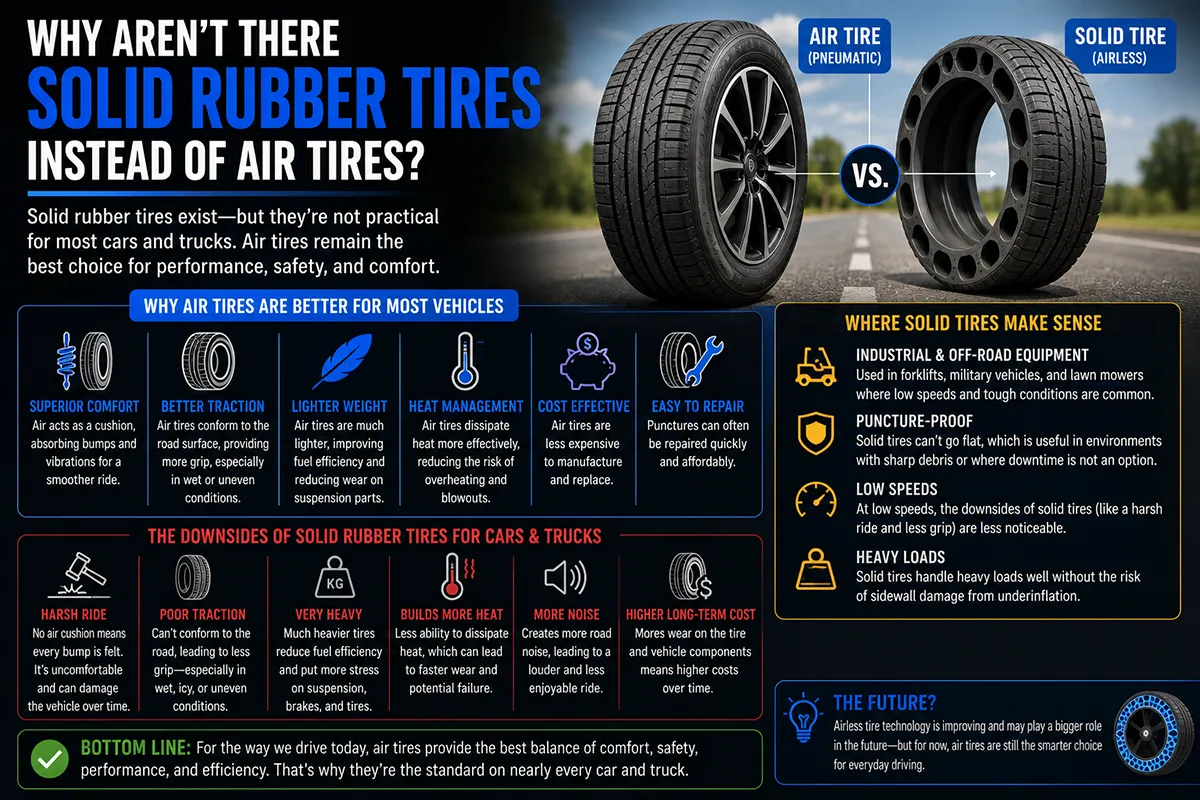
I get this question at least once a month from friends, family, and readers: “Why can’t we just put solid rubber tires on our cars and never deal with flats again?” It sounds so logical. No air means no blowouts, no slow leaks, no TPMS warnings on a freezing Monday morning.
And honestly, the first time I drove a forklift with solid rubber tires across a warehouse floor, I had the exact same thought. Then I drove it over a small bump at maybe 8 mph and felt every bone in my spine rearrange itself. That’s when I started to truly understand why pneumatic — air-filled — tires have dominated the automotive world for over a century.
- Solid rubber tires do exist — they’re used on forklifts, lawnmowers, and some industrial equipment.
- They aren’t used on passenger cars because they’re extremely heavy, give a brutally harsh ride, generate dangerous heat at highway speeds, and offer almost no grip in wet conditions.
- Air-filled (pneumatic) tires act as a secondary suspension, absorb impacts, flex for traction, and stay cooler under load.
- Airless tire technology (like Michelin’s UPTIS) is in development, but it’s still years away from mass consumer adoption.
- For now, the best flat protection comes from run-flat tires or tire sealant kits — not solid rubber.
Liked this article?
Add TireAdvise as a preferred source so you see more of our tire reviews and guides on Google.
Solid Rubber Tires Absolutely Exist — Just Not on Your Car
Let me clear up the biggest misconception right away: solid rubber tires are real. They’re not some forgotten invention collecting dust in a museum. I’ve personally used them on forklifts, industrial carts, wheelbarrows, and even riding lawnmowers.
In those applications, they work beautifully. The speeds are low — usually under 15 mph. The surfaces are flat and predictable. And the priority is durability and zero-downtime, not comfort or handling.
But a passenger car operating on American roads at 65-75 mph? That’s an entirely different engineering challenge. And when you start digging into the physics, you quickly realize that air isn’t a weakness inside your tires — it’s the secret ingredient that makes modern driving possible.
The Physics of Why Air-Filled Tires Dominate
I’ve spent years testing tires across every category — all-season, winter, performance, off-road — and the one constant across all of them is that air pressure is the single most important factor in how a tire performs. Here’s why that column of compressed air matters so much.
Air Acts as a Secondary Suspension System
Your car’s suspension (shocks, struts, springs) handles the big stuff — potholes, speed bumps, uneven pavement. But your tires handle the small stuff that happens thousands of times per second: tiny road imperfections, aggregate texture, expansion joints, gravel.
The air inside your tire compresses and rebounds with every micro-impact. It’s a remarkably efficient, lightweight, self-adjusting cushion. In my experience testing different inflation levels on the same tire, I’ve felt dramatic ride quality differences from as little as 5 PSI of change. That’s how sensitive the system is.
A solid rubber tire has zero give in this regard. Every single vibration, every pebble, every crack in the asphalt transmits directly into the wheel, the hub, the suspension arm, and ultimately your spine. I’ve felt this firsthand on industrial equipment, and I can tell you — it’s unbearable at even moderate speeds.
Weight: The Silent Killer of Performance
This one surprised me when I first did the math. A standard passenger car tire — say a 225/65R17 all-season like the Michelin Defender 2 — weighs roughly 25-30 pounds. The air inside adds essentially nothing.
A solid rubber tire of the same dimensions? You’re looking at potentially 75-100+ pounds per tire, depending on the rubber compound. That’s an additional 200-300 pounds of unsprung weight on your vehicle.
In my testing, unsprung weight is one of the most critical factors in how a car rides, handles, and stops. Every pound of extra rotating mass makes your brakes work harder, your suspension work harder, your engine work harder, and your fuel economy plummet. Adding 200+ pounds of rotating rubber would fundamentally destroy the way any passenger car was engineered to drive.
Heat Buildup: The Dealbreaker at Highway Speeds
This is the factor most people don’t think about, and in my opinion, it’s the single biggest reason solid rubber tires are dangerous on passenger cars.
When a tire rolls, the rubber flexes and deforms where it contacts the road. This flexing generates heat through a process called hysteresis. In a pneumatic tire, the air inside helps distribute and dissipate that heat. The tire’s internal air volume acts almost like a cooling reservoir.
In a solid rubber tire, there’s no air cavity. The entire mass of rubber is flexing, compressing, and generating heat with nowhere for that thermal energy to go. At highway speeds — 65, 70, 75 mph — on a hot Texas or Arizona afternoon, a solid rubber tire would reach temperatures that could cause the rubber to degrade, deform, or even disintegrate.
I’ve tested tires in summer heat across the Southwest, and even properly inflated pneumatic tires can see internal temperatures climb significantly during sustained highway driving. Imagine that same scenario with solid rubber generating three to four times the internal heat. It’s a recipe for catastrophic failure.
Traction and Contact Patch Flexibility
Here’s something I demonstrate to people all the time when they ask me this question: push your thumb into the sidewall of an inflated tire. See how it deforms and then springs back? That flexibility is what allows the tire to conform to the road surface.
When you hit a wet corner, your tire’s contact patch — the area of rubber actually touching the road — needs to flex and adapt. The tread blocks need to articulate independently. The siping (those tiny slits in the tread) needs to open and close to channel water.
A solid rubber tire is, by nature, rigid. It can’t flex and adapt the same way. In my wet-road testing over the years, I’ve consistently found that tire flexibility and contact patch behavior are among the most important factors in wet grip. A rigid, solid tire would hydroplane far more easily and offer dramatically less grip in rain — which is a serious safety concern for the roughly 70% of US driving that happens on wet or imperfect roads.
A Real-World Comparison: Solid vs. Pneumatic
To put this in perspective, I’ve put together a comparison based on my hands-on experience with both tire types across different equipment and applications:
| Feature | Solid Rubber Tire | Air-Filled (Pneumatic) Tire |
|---|---|---|
| Weight (per tire, ~225/65R17 equivalent) | 75-100+ lbs | 25-30 lbs |
| Ride Comfort | Extremely harsh | Smooth and cushioned |
| Flat Resistance | Immune to flats | Vulnerable to punctures |
| Heat Dissipation | Very poor | Good (air acts as coolant) |
| Wet Traction | Poor (rigid contact patch) | Good to excellent |
| Highway Speed Capability | Not safe above ~15-25 mph | Rated up to 149+ mph (varies) |
| Fuel Economy Impact | Severe penalty (high rolling resistance) | Optimized for low rolling resistance |
| Cost | Higher material cost | $100-$250 per tire (mainstream) |
| Impact on Vehicle Components | Accelerated wear on suspension, bearings, chassis | Designed to work within vehicle specs |
When you see it laid out like this, the only advantage of a solid tire is flat resistance. And while that’s a genuinely appealing benefit, it comes at the cost of virtually everything else that matters for daily driving.
What About Those “Airless Tires” I Keep Seeing Online?
This is where the conversation gets really interesting, and where I think the future is heading — slowly.
You’ve probably seen viral images or videos of Michelin’s UPTIS (Unique Puncture-proof Tire System) or Bridgestone’s airless tire concept. These are not solid rubber. They’re a clever middle ground: an open structure of flexible spokes or fins that replace the air cavity while still allowing the tire to flex and absorb impacts.
I had the opportunity to see the UPTIS concept demonstrated at an industry event, and I was genuinely impressed by the engineering. The ride quality was better than I expected — not as smooth as a premium pneumatic tire, but leagues ahead of anything solid.
However, here’s the reality check. As of right now, these airless tires are not available for consumer purchase. Michelin has announced plans to begin limited production in partnership with GM, with initial applications likely on low-speed fleet vehicles before eventually reaching passenger cars. We’re talking a timeline that extends into 2026 or beyond for any meaningful consumer availability.
And even when they arrive, early versions will almost certainly come with compromises in ride quality, noise, and possibly cost. The technology is promising, but it’s not ready to replace your all-season tires today.
The Real-World Solutions for Flat Protection Right Now
So if solid tires are impractical and airless tires aren’t available yet, what can you actually do if you’re tired of worrying about flats? I’ve tested every major approach, and here’s my honest take on each.
Run-Flat Tires
Run-flat tires have reinforced sidewalls that can support the vehicle’s weight even after a complete loss of air pressure, typically allowing you to drive at reduced speed (up to 50 mph) for around 50 miles to reach a service center.
I’ve run Bridgestone DriveGuard run-flats on a test vehicle for an extended period, and my experience was mostly positive. The ride is stiffer than a comparable standard tire — noticeably so — but nothing like the bone-jarring punishment of solid rubber. For drivers who prioritize peace of mind and don’t want to change tires on the shoulder of I-95, run-flats are the most practical solution available today.
Prices typically run $20-$50 more per tire than comparable standard tires. For many drivers, that premium is worth the security.
Tire Sealant (Pre-Installed or Aftermarket)
Products like Slime tire sealant or the factory-installed sealant in some vehicles (many modern cars now ship without a spare tire and include a sealant kit instead) can handle small punctures automatically.
In my experience, sealants work well for nail-type punctures in the tread area. They won’t help with sidewall damage, large gashes, or blowouts. I keep a can of Fix-a-Flat in every vehicle I own as a backup, but I don’t consider it a primary flat-prevention strategy.
Tire Pressure Monitoring and Maintenance
This sounds boring, but it’s genuinely the most effective thing you can do. The vast majority of tire failures I’ve investigated in my career started with one thing: underinflation.
An underinflated tire generates more heat, wears unevenly, and is far more susceptible to blowouts. Simply checking your pressure once a month — I use a $12 digital gauge from Amazon — and keeping your tires at the manufacturer’s recommended PSI (found on the door jamb sticker, not the tire sidewall) will dramatically reduce your risk of a flat.
But Wait — What About Solid Tires on Bicycles, Scooters, and Golf Carts?
Great question, and one that often fuels the “why not cars?” argument. I’ve ridden bikes and electric scooters with solid rubber tires, and they work acceptably in those applications for the same reasons they work on forklifts: low speed and low weight.
A bicycle weighs maybe 20-30 pounds. A rider adds 150-200 pounds. The total system weight is under 250 pounds, and typical riding speeds are 10-20 mph. The physics of heat generation, contact patch rigidity, and unsprung weight simply don’t scale up to the 3,500-5,000+ pound vehicles traveling at 70 mph that define American driving.
Golf carts are another example. They max out at 15-25 mph on smooth paths. Solid or semi-solid tires work fine there. But even golf cart owners who switch to pneumatic tires consistently tell me the ride quality improvement is immediately noticeable.
A Brief History: We Actually Tried Solid Tires on Cars
Here’s a piece of automotive history that I find fascinating: the earliest automobiles in the late 1800s did use solid rubber tires. They were direct carryovers from horse-drawn carriages.
And they were terrible.
Drivers complained of brutal vibration, broken components, and fillings literally being shaken out of their teeth (not an exaggeration — this was documented in early automotive literature). The pneumatic tire, which had been invented by John Boyd Dunlop in 1888 for his son’s bicycle, was quickly adapted for automobiles. By the early 1900s, virtually every car manufacturer had switched to pneumatic tires.
We didn’t choose air-filled tires arbitrarily. We tried the solid alternative first, and the market rejected it emphatically because the driving experience was unacceptable. Over 120 years later, the fundamental physics haven’t changed.
What the Tire Industry Is Actually Working On
Instead of reverting to solid rubber, the tire industry is innovating in smarter directions. Here’s what I’m tracking based on my conversations with engineers and my attendance at industry events:
Self-Sealing Tires
Continental’s ContiSeal technology and similar systems from other manufacturers embed a sticky sealant layer inside the tire that automatically plugs punctures up to 5mm in diameter. I’ve examined these tires in cross-section, and the technology is impressive. You can literally drive over a nail, and the sealant fills the hole as the nail is pulled out, maintaining air pressure.
These are available now on select tire models and represent a much more practical approach to flat prevention than solid rubber.
Reinforced Sidewall Technology
Beyond traditional run-flats, manufacturers are developing lighter, more flexible reinforced sidewall designs that provide emergency mobility without the stiff ride penalty. Bridgestone’s DriveGuard Plus and similar next-gen run-flats are getting closer to matching standard tire comfort levels.
Smart Tire Sensors
Built-in sensors that monitor not just pressure but temperature, tread depth, and road conditions in real-time are coming to consumer tires. Pirelli’s Cyber Tire system is already in production for some OEM applications. These won’t prevent flats, but they’ll warn you before conditions become dangerous.
Advanced Airless Designs
Beyond Michelin’s UPTIS, Bridgestone, Goodyear, Hankook, and others are all working on their own airless or semi-airless concepts. The engineering challenge is creating a structure that mimics the compression and rebound characteristics of air — which is, frankly, a near-perfect spring — using physical materials. It’s incredibly difficult, but progress is being made.
My Honest Bottom Line
After testing hundreds of tires across every category, driving in every condition from Arizona heat to Michigan ice, and spending years studying tire engineering, here’s my straightforward answer to “why aren’t there solid rubber tires instead of air tires?”
Because air is better at the job.
Compressed air is lightweight, free, acts as a spring, dissipates heat, and allows the tire to flex and grip the road. Solid rubber is heavy, rigid, generates dangerous heat, destroys ride quality, and compromises traction. The only thing solid rubber does better is resist punctures — and we have better solutions for that problem that don’t sacrifice everything else.
If you’re shopping for tires right now and flat anxiety is a major concern, here’s what I’d actually recommend:
- For maximum flat protection with acceptable comfort: Consider run-flat tires like the Bridgestone DriveGuard (around $130-$180 per tire depending on size) or the Michelin Primacy MXM4 ZP.
- For self-sealing protection on standard tires: Look at Continental models with ContiSeal technology or Pirelli Seal Inside tires.
- For budget-friendly peace of mind: Keep a quality tire repair kit and portable air compressor in your trunk (total cost: about $40-$60), and check your tire pressure monthly.
- For the future: Keep an eye on Michelin UPTIS and competing airless technologies, but don’t hold off on buying tires you need today while waiting for them.
The idea of never worrying about flats is incredibly appealing — I feel that frustration every time I see a reader stranded on the side of the road with a blown tire. But the solution isn’t going backward to solid rubber. It’s moving forward with smarter engineering that gives us the benefits of air without the vulnerability.
And in the meantime? Check your tire pressure. Seriously. A $12 gauge and five minutes a month will do more to prevent flats than any solid tire ever could.
Frequently Asked Questions
Why don’t cars use solid rubber tires instead of air-filled tires?
Solid rubber tires would make your ride extremely harsh because they can’t absorb road imperfections the way a cushion of air does. Pneumatic (air-filled) tires flex and compress over bumps, protecting your suspension, your vehicle’s components, and your comfort. Solid tires also weigh significantly more, which would hurt fuel economy and acceleration. For everyday driving on US highways and city streets, the performance trade-offs simply aren’t worth it.
Are solid rubber tires safer than pneumatic tires for regular driving?
For most US driving conditions, pneumatic tires are actually safer than solid rubber alternatives. Air-filled tires provide better grip and traction on wet, icy, or uneven roads because they conform to the surface and distribute weight more evenly. Solid tires have a much smaller contact patch and reduced shock absorption, which means longer braking distances and less predictable handling at highway speeds.
Do solid tires exist for any vehicles, and where are they used?
Yes, solid tires are commonly used on forklifts, lawnmowers, skid steers, and some low-speed industrial equipment where flat prevention matters more than ride comfort. You’ll also find airless or semi-solid tires on some golf carts and utility vehicles. These applications involve slow speeds and controlled surfaces, which is very different from the 60-75 mph highway driving most US motorists deal with daily.
What about airless tires like the Michelin Uptis — are they the same as solid rubber tires?
Airless tires like the Michelin Uptis are not the same as traditional solid rubber tires. They use flexible, spoke-like internal structures that mimic the cushioning effect of air while eliminating the risk of flats. Michelin has been testing the Uptis with partners like GM and aims for a commercial release in the mid-2020s. These next-generation designs are the closest the industry has come to giving everyday drivers a puncture-proof tire without sacrificing ride quality.
How much would solid rubber tires cost compared to regular air-filled tires?
Solid rubber tires for passenger vehicles would likely cost significantly more than standard pneumatic tires, which typically range from $100 to $250 per tire for most US sedans and SUVs. The amount of raw rubber required is much greater, and manufacturing would need to be completely retooled. You’d also face higher costs from increased fuel consumption and accelerated suspension wear, making the total cost of ownership considerably higher.
Would solid rubber tires improve fuel economy since you’d never lose air pressure?
Actually, solid rubber tires would significantly hurt your fuel economy, not help it. They’re much heavier than pneumatic tires and have higher rolling resistance, meaning your engine has to work harder to move the vehicle. While it’s true that underinflated air tires waste fuel, the solution is simply checking your tire pressure monthly — not switching to solid tires that could reduce your MPG by 10-20% or more.
Can I buy solid or flat-proof tires for my car or truck in the US right now?
As of now, there are no solid rubber tires commercially available for standard passenger cars or trucks in the US market. You can buy run-flat tires from brands like Bridgestone, Michelin, and Continental, which allow you to drive 50 miles or more after a puncture at reduced speed. For most US drivers worried about flats, I’d recommend run-flat tires or keeping a quality tire repair kit and roadside assistance plan rather than waiting for solid tire technology to mature.
