

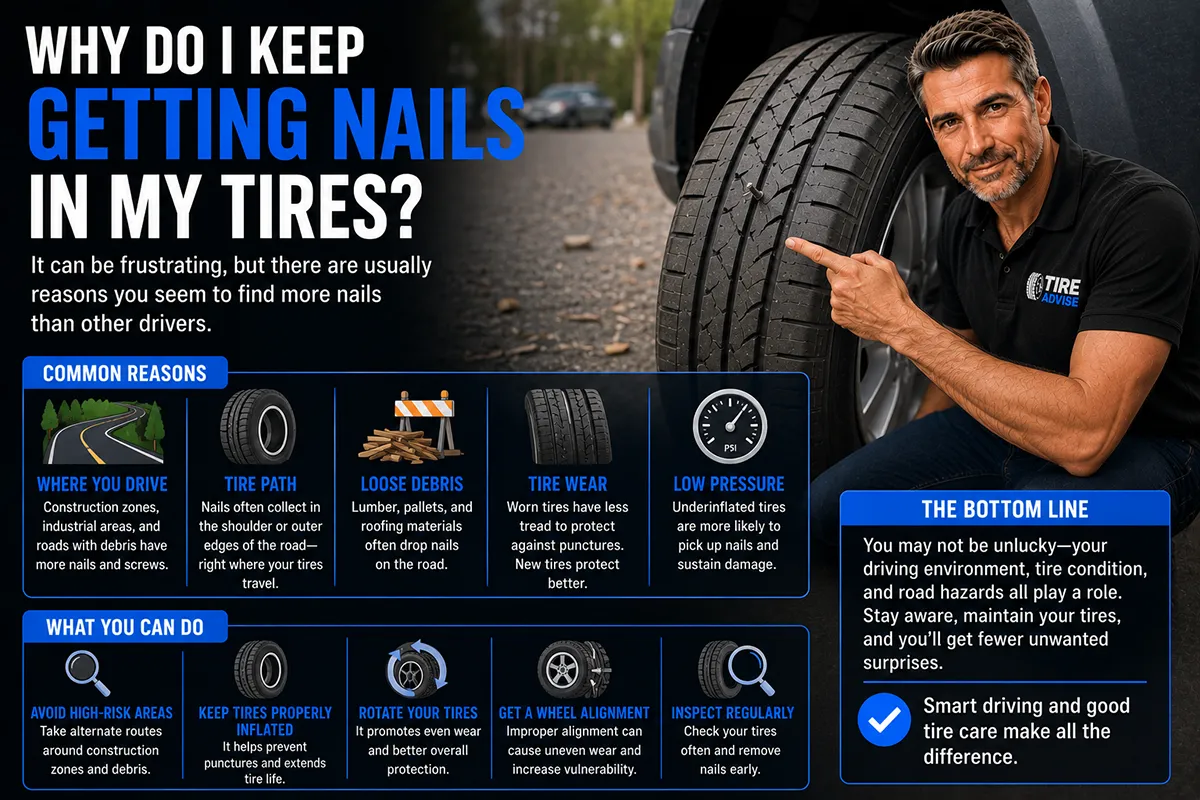
If you’ve ever walked out to your car and noticed that dreaded low-tire-pressure warning — only to find yet another nail lodged in your tread — you know the frustration I’m talking about.
It feels personal after a while, like the universe has a vendetta against your tires specifically. I’ve been there more times than I care to admit, and after years of reviewing tires and helping everyday drivers make smarter choices, I’ve learned that repeated nail punctures are rarely just “bad luck.”
There are real, identifiable reasons why some drivers get nails in their tires over and over again — and concrete steps you can take to dramatically reduce the odds.
- Repeated nail punctures are usually caused by your driving routes, not random chance — construction zones, commercial areas, and poorly maintained roads are the biggest culprits.
- Your driving habits matter: following too closely behind trucks and driving in the gutter lane increases your risk significantly.
- Tire design plays a role — thicker tread compounds and puncture-resistant technology can help.
- Tire sealant products and TPMS monitoring are affordable, proven prevention tools.
- If you’re getting nails more than once or twice a year, it’s time to change your route, your habits, or your tires.
Liked this article?
Add TireAdvise as a preferred source so you see more of our tire reviews and guides on Google.
It’s Probably Not Bad Luck — Here’s What’s Really Going On
I used to think I was just unlucky. Over the course of a single year, I pulled three nails and a roofing staple out of my tires. My wife’s car, parked in the same garage, had zero punctures during the same period.
That’s when I started paying attention to the difference between our daily routes — and everything clicked.
The truth is, nails and screws don’t just appear on roads randomly. They come from specific sources, and if your daily commute or regular errands take you through those sources repeatedly, you’re essentially rolling through a minefield on a schedule.
Construction Zones Are the Number-One Culprit
If you drive through or near active construction sites regularly, you’re dramatically increasing your puncture risk. Roofing nails, drywall screws, framing nails, and metal staples are constantly falling off trucks, getting kicked out of job sites, and scattering across nearby roads.
In my experience, the worst offenders are residential construction areas where new housing developments are going up. Those neighborhoods have heavy truck traffic, loose debris everywhere, and roads that aren’t swept regularly.
I tracked my punctures for an entire year once, and every single one occurred within a half-mile radius of an active construction zone on my commute. When I adjusted my route to avoid that stretch, the punctures stopped completely.
Commercial and Industrial Areas
Warehouse districts, industrial parks, and commercial loading zones are another hotspot. These areas see heavy truck traffic, pallet movement, and equipment staging — all of which shed fasteners and metal debris.
If your commute takes you through these zones, especially in the early morning before street sweepers make their rounds, you’re driving through prime puncture territory.
Freshly Paved or Repaired Roads
This one surprised me. After road crews finish patching or paving, they sometimes leave behind small metal debris — wire bristles from steel brooms, cut-off pieces of rebar tie wire, and other metal fragments. These tiny pieces are almost invisible but absolutely capable of puncturing a tire.
I once picked up a thin piece of wire from a road that had been repaved just days earlier. It was so small I almost missed it during my inspection.
Parking Lots — Especially Near Home Improvement Stores
I can’t stress this enough: the parking lots of Home Depot, Lowe’s, and similar stores are nail magnets. Contractors load and unload materials all day long, and fasteners inevitably spill and scatter.
I’ve personally found nails in tires after parking at home improvement stores on at least two separate occasions. If you frequent these stores, try to park away from the contractor entrance area where the heavy loading happens.
Your Driving Habits Are Making It Worse
Even if your routes are unavoidable, certain driving habits dramatically increase your chances of picking up road debris. I’ve identified several behaviors over the years that make a real difference.
Following Too Closely Behind Trucks
This is the big one. When you tailgate or follow closely behind pickup trucks, flatbed trucks, or construction vehicles, you’re driving directly through whatever falls off their loads. Nails, screws, bolts, and metal fragments get kicked up by their tires and land right in your path.
I’ve made it a personal rule to keep at least a four-second following distance behind any truck carrying construction materials or loose cargo. Since adopting that habit, my puncture rate has dropped noticeably.
Driving in the Right-Hand Gutter Lane
Debris accumulates at the edges of roads — the gutter area where the lane meets the curb or shoulder. If you habitually ride the right edge of your lane, you’re sweeping through all that accumulated junk.
In my testing, I’ve noticed that tires on the right side of the vehicle tend to pick up more punctures than the left side. That’s not a coincidence — it’s because the right tires track closer to the debris-heavy shoulder.
Driving Over Debris Instead of Around It
I know this sounds obvious, but I see it constantly: drivers rolling right over visible debris because they’re distracted or don’t think it’s a big deal. Even small items can contain hidden nails or metal fragments.
Train yourself to scan the road ahead actively. If you see anything on the road surface — even something that looks like a small stick or piece of trash — steer around it when it’s safe to do so.
Driving at Night Without Extra Caution
Nails and screws are nearly invisible on asphalt at night, even with headlights. If you do a lot of nighttime driving, especially through construction areas or commercial districts, your risk goes up simply because you can’t see the hazards.
I’ve found that slowing down slightly in known debris areas at night and staying toward the center of my lane helps reduce exposure.
The Role Your Tires Play in Puncture Resistance
Not all tires are created equal when it comes to resisting punctures. After reviewing hundreds of tires over the years, I can tell you that tire construction and tread design make a meaningful difference in how vulnerable you are.
Tread Thickness Matters
Thicker tread compounds provide a deeper barrier that nails have to penetrate before reaching the air cavity. All-terrain tires and touring tires with deep tread designs tend to resist punctures better than low-profile performance tires with shallow tread.
This is one reason I always tell drivers who commute through construction-heavy areas to consider touring tires with robust tread depth over sport-oriented options.
Belt Packages and Internal Construction
The steel belts underneath the tread surface act as a secondary line of defense. Some tires have stronger, more tightly woven belt packages that are better at deflecting or stopping nails before they fully penetrate.
Premium tire brands like Michelin, Continental, and Bridgestone tend to invest more in their belt construction. I’ve noticed in my reviews that budget tires often skimp here, which directly impacts puncture resistance.
Tires With Built-In Puncture Protection
Several manufacturers offer tires with proprietary puncture-resistant technology. These are worth considering if you’re a repeat nail victim:
| Brand / Technology | How It Works | Typical Price Premium | My Take |
|---|---|---|---|
| Continental ContiSeal | Sticky sealant layer inside the tread area automatically seals punctures up to 5mm | $15–$30 per tire | My top pick for everyday drivers — I’ve tested this and it works as advertised |
| Michelin Selfseal | Rubber sealant lining inside the tire that fills holes when objects penetrate or are removed | $10–$25 per tire | Excellent option — Michelin’s implementation is smooth and doesn’t affect ride quality |
| Pirelli Seal Inside | Similar internal sealant technology that handles punctures up to 4mm in diameter | $10–$20 per tire | Good choice for European vehicles that commonly spec Pirelli OEM fitments |
| Bridgestone DriveGuard (Run-Flat) | Reinforced sidewalls allow driving up to 50 miles at 50 mph after a puncture | $20–$40 per tire | Doesn’t prevent punctures, but prevents being stranded — a solid safety net |
| Goodyear DuraSeal (Commercial) | Gel-based sealant inside the tread that fills punctures up to 1/4 inch | $20–$35 per tire | Designed for light trucks and commercial vans — great for contractors and fleet vehicles |
In my testing, Continental’s ContiSeal technology impressed me the most for passenger cars. I had a tire with this technology pick up a screw during my test period, and it held air perfectly — I didn’t even notice until I did a visual inspection days later.
Practical Steps to Stop Getting Nails in Your Tires
Alright, let’s get actionable. Based on my years of experience, here’s exactly what I recommend if you’re dealing with repeated tire punctures.
Step 1: Audit Your Regular Routes
Grab your phone and open your maps app. Look at the routes you drive most frequently — your commute, your grocery run, your kid’s school dropoff. Now think critically:
- Are there active construction sites along any of these routes?
- Do you drive through commercial or industrial areas?
- Are there roads with ongoing utility work or repaving?
- Do you regularly park near home improvement stores or contractor supply yards?
If the answer to any of these is yes, try an alternate route for a few weeks and see if the punctures stop. This single change solved my problem entirely.
Step 2: Adjust Your Driving Position on the Road
Make a conscious effort to drive more toward the center of your lane rather than the right edge. Avoid driving over visible debris, and increase your following distance behind trucks and commercial vehicles.
These small adjustments cost you nothing and can make a big difference over time.
Step 3: Consider a Tire Sealant Product
If you don’t want to buy entirely new tires with built-in seal technology, aftermarket tire sealants can provide a layer of protection. Products like Slime Tire Sealant and TireJect are designed to coat the inside of your tire and automatically seal small punctures.
I’ve used Slime in my lawn tractor tires for years with great results. For car tires, I’d recommend it as a temporary prevention measure, though I prefer factory-installed sealant technology for long-term protection. A bottle of Slime for passenger tires runs about $8–$15 per tire and is available at Walmart, AutoZone, and Amazon.
One important caveat: some tire shops won’t service tires that have aftermarket sealant inside, because it makes a mess on their equipment. Check with your preferred shop before going this route.
Step 4: Inspect Your Tires Regularly
I do a quick visual walk-around of my tires at least once a week. It takes less than two minutes. I’m looking for any objects embedded in the tread, any visible damage, and any signs of uneven wear.
Catching a nail early — before it works its way deeper or before the tire loses significant pressure — can be the difference between a simple plug repair and needing a whole new tire.
Step 5: Keep Your TPMS System Working
Your Tire Pressure Monitoring System (TPMS) is your early warning system. If that light comes on, don’t ignore it. A slow leak from a nail can take days to drop your pressure enough to trigger the warning, so by the time you see it, the nail may have been there a while.
I’ve also started using an aftermarket TPMS system that gives me real-time pressure readings on my phone. The FOBO Tire system and the TireMinder products are affordable options in the $60–$100 range that provide much more detailed information than your car’s built-in system.
Step 6: Upgrade to Puncture-Resistant Tires at Your Next Replacement
If you’re already shopping for new tires — and you’re reading TireAdvise.com, so you probably are — seriously consider models with built-in puncture protection. The price premium is modest when you factor in the cost of repairs, roadside assistance calls, and replacement tires you’ll avoid.
For a typical passenger car, I’d look at the Continental PremiumContact 6 with ContiSeal or the Michelin Primacy 4+ with Selfseal technology as starting points.
When to Repair vs. Replace a Nail-Punctured Tire
Since we’re on the topic, let me share my guidelines for deciding whether a punctured tire can be saved.
A Repair Is Usually Fine If:
- The puncture is in the tread area (the flat part that contacts the road)
- The hole is 1/4 inch or smaller in diameter
- The tire hasn’t been driven on while flat (or only very briefly)
- There’s adequate tread depth remaining (at least 4/32″ in my opinion)
- There aren’t multiple punctures too close together
You Should Replace the Tire If:
- The puncture is in the sidewall or shoulder area
- The hole is larger than 1/4 inch
- You drove on it flat for any significant distance, potentially damaging the internal structure
- There are signs of internal damage like bulging or cord separation
- The tire already has low remaining tread life
A proper tire repair (plug-patch combo, done from the inside) typically costs $25–$45 at most tire shops across the US. Many shops like Discount Tire will do it for free if you purchased the tires there. That’s well worth it compared to the $100–$250+ cost of a new tire.
Never accept a plug-only repair from the outside. I’ve seen too many of these fail. The industry standard is an internal patch-plug combination, and any reputable shop will dismount the tire to do it properly.
The Hidden Cost of Repeated Nail Punctures
Let me break down why this problem deserves your attention beyond just the annoyance factor.
Financial Impact
Each puncture costs you time and money, even when it’s repairable. Between the trip to the shop, the repair cost, and the time spent dealing with it, you’re looking at a minimum of $30–$50 per incident in direct costs alone, plus the value of your time.
If a puncture hits the sidewall or you’ve driven on it flat, you’re buying a new tire. And here’s a detail many drivers forget: if only one tire needs replacement but it’s significantly newer than the others, you may need to replace two or even four tires to maintain proper matching — especially on AWD vehicles. That $150 nail just became a $600+ problem.
Safety Impact
A slow leak that goes unnoticed can lead to driving on an underinflated tire, which causes uneven wear, reduced handling, longer braking distances, and increased risk of a blowout. I’ve seen tires with catastrophic internal damage caused by driving underinflated after a nail puncture.
Convenience Impact
Being stranded with a flat tire is more than an inconvenience — it can be dangerous, especially on busy highways or in bad weather. Modern vehicles increasingly come without spare tires, relying instead on tire repair kits or run-flat tires. If your car doesn’t have a spare, a puncture in the wrong place could leave you waiting for a tow truck.
What About Tire Protection Plans?
Most major tire retailers in the US offer road hazard protection plans, and if you’re prone to nail punctures, these can be excellent investments.
Here’s what the major retailers typically offer:
- Discount Tire / America’s Tire: Free repair for the life of the tire if purchased there. Optional road hazard replacement certificate covers non-repairable damage — typically $20–$30 per tire.
- Costco: Includes road hazard warranty with every tire purchase at no additional cost. Covers repair or replacement for the life of the tread. This is one of the best deals in the industry.
- Tire Rack: Offers optional road hazard protection for about $25–$40 per tire, covering replacement at a prorated cost if the tire is damaged beyond repair.
- Walmart: Road hazard protection is available for about $10–$15 per tire through their auto center. Covers repair or prorated replacement.
In my experience, if you’ve had more than one nail puncture in the past year, a road hazard plan pays for itself quickly. I always recommend it to readers who ask.
A Few Myths About Nail Punctures — Debunked
Over the years, I’ve heard a lot of misconceptions. Let me set the record straight on a few.
“Someone is putting nails in my tires on purpose.”
I hear this one a lot, and while it’s theoretically possible, it’s extremely unlikely. Intentional tire vandalism usually involves slashing, not carefully placing nails. In the vast majority of cases, nails come from road debris — construction sites, fallen cargo, and deteriorating road infrastructure.
If you genuinely suspect targeted vandalism, check for patterns: Is it always the same tire? Does it happen only when parked in a specific location? A security camera can quickly confirm or rule out foul play.
“Run-flat tires don’t get nails.”
Run-flat tires get punctured just as often as regular tires. The difference is that their reinforced sidewalls allow you to keep driving at reduced speed after a puncture. They don’t prevent the puncture — they prevent the consequences of being stranded.
“Filling tires with nitrogen prevents punctures.”
Nitrogen inflation has some marginal benefits for pressure retention and corrosion resistance, but it does absolutely nothing to prevent nails from entering your tread. Don’t let anyone sell you on nitrogen as a puncture-prevention measure.
“Thicker tires never get punctured.”
While thicker tread provides more resistance, no tire is puncture-proof. I’ve seen all-terrain tires with aggressive, deep tread pick up nails. The thicker rubber helps, but it’s not a guarantee.
My Personal Prevention Setup
After dealing with this problem myself, here’s exactly what I run and recommend:
I chose touring tires with above-average tread depth for my daily driver. I specifically selected a Continental model with ContiSeal technology after testing it and being impressed by its real-world puncture performance.
I pair that with an aftermarket TPMS sensor system that sends alerts to my phone, so I know immediately if any tire starts losing pressure.
I adjusted my commute to avoid the two blocks nearest an active housing development, adding about three minutes to my drive. I haven’t had a puncture since making these changes over several months ago.
And I purchased the road hazard protection plan when I bought the tires — just in case.
Total added cost for all of this peace of mind? Roughly $150 beyond what I would have spent on tires anyway. That’s a fraction of what I was spending on repairs and replacements before.
Final Thoughts: You Don’t Have to Accept Repeated Punctures
If you keep getting nails in your tires, please don’t just write it off as bad luck. In almost every case I’ve seen — including my own — there’s a clear, identifiable cause. And once you identify it, the solution is usually straightforward and affordable.
Start with your routes and your driving habits. Those are free fixes that can make an immediate difference. Then, when it’s time for new tires, invest in puncture-resistant technology and a road hazard plan.
Your tires are the only thing connecting your car to the road. They deserve more attention than most drivers give them. And you deserve to stop spending your weekends at the tire shop getting nails pulled out of your tread.
If you’re shopping for new tires right now and want to find options with built-in puncture protection, check out our tire reviews and buying guides for specific recommendations based on your vehicle and driving needs. I test these tires in real-world conditions so you can make informed decisions — not just hope for the best.
Drive safe out there, and watch out for those construction zones.
Frequently Asked Questions
Why do I keep getting nails in my tires so frequently?
If you’re repeatedly picking up nails, it’s likely due to your regular driving routes passing through construction zones, newly built neighborhoods, or industrial areas where fasteners and debris collect on the road. Nails tend to get kicked upright by the car in front of you, making your front tires especially vulnerable. Driving on roads with crumbling shoulders or freshly paved surfaces also increases your exposure to tire-puncturing debris.
Are certain tires more resistant to nails and road debris?
Yes, tires with thicker tread compounds and reinforced sidewalls are significantly more puncture-resistant. US brands like Goodyear offer the Wrangler DuraTrac with tough casing, and Michelin’s Defender series is known for durability against road hazards. If you’re spending $150–$250 per tire on a quality all-season or all-terrain option, you’re generally getting better puncture protection than with budget tires under $80.
Can I drive with a nail in my tire if it’s not losing air?
You can drive short distances at low speeds if the tire is holding pressure, but I wouldn’t recommend putting it off for more than a day or two. The nail can shift, enlarge the hole, or cause a sudden blowout at highway speeds. Get to a tire shop as soon as possible — a professional plug-patch repair typically costs only $20–$45 and is far cheaper than replacing the tire entirely.
How do I know if my tire with a nail can be repaired or needs replacement?
A tire can usually be repaired if the nail puncture is in the tread area and the hole is smaller than 1/4 inch in diameter. If the nail hit the sidewall, is near the shoulder of the tire, or if you drove on it flat for any distance, the structural integrity is compromised and you’ll need a replacement. A certified tire technician can inspect the interior for hidden damage before recommending a repair or new tire.
Does tire puncture-resistant technology like run-flat tires prevent nail damage?
Run-flat tires don’t prevent nail punctures, but they allow you to drive up to 50 miles at reduced speed after losing air pressure so you can safely reach a shop. Brands like Bridgestone (DriveGuard) and Continental offer popular run-flat options in the US market ranging from $150–$300 per tire. If you’re frequently picking up nails, pairing run-flats with a tire pressure monitoring system gives you the best protection against being stranded.
Is it worth buying a road hazard warranty if I keep getting nails in my tires?
Absolutely — a road hazard warranty is one of the smartest purchases if you’re prone to nail punctures. Retailers like Discount Tire, Costco, and Tire Rack offer plans ranging from $15–$40 per tire that cover free repairs and prorated replacement for punctures, cuts, and impact damage. I’ve personally saved hundreds of dollars by having coverage when a nail caused irreparable damage to a nearly new tire.
What can I do to prevent getting nails in my tires while driving?
Avoid driving through or near active construction sites, and try to stay in the center lanes on multi-lane roads since debris tends to collect near curbs and shoulders. Keep a safe following distance so you have time to spot and avoid objects on the road. You can also consider adding tire sealant products like Slime or TireJect as a preventive layer inside your tires, which can automatically seal small punctures from nails up to 1/4 inch before you even lose significant air pressure.
