

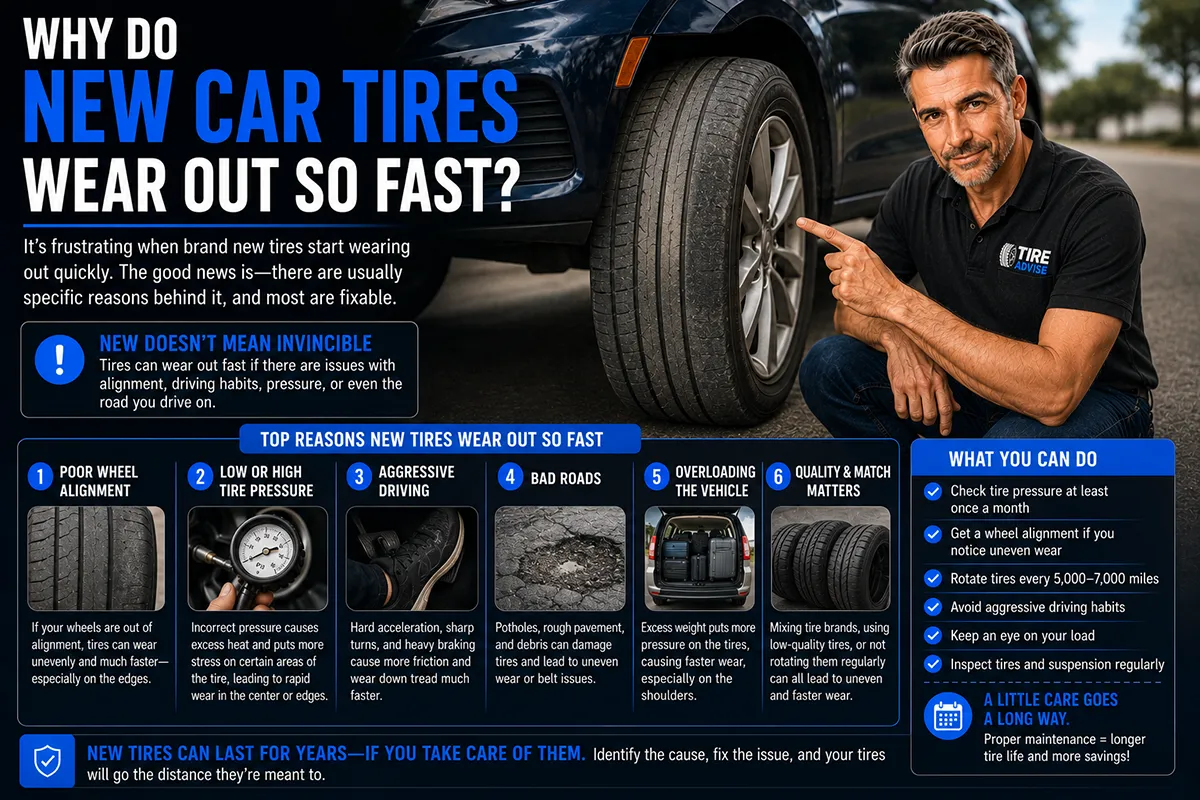
You just drove your brand-new car off the lot, and it feels like you barely had time to enjoy it before the tires are already showing serious wear. It’s not your imagination — and you’re definitely not alone.
I’ve been reviewing and testing tires for over a decade, and this is hands-down the most common complaint I hear from new car owners. The truth behind why it happens is something most dealerships will never tell you.
- New car tires (OEM tires) are designed by automakers to prioritize ride comfort, low noise, and fuel efficiency — not longevity.
- OEM tires use softer rubber compounds that grip well for test drives but wear down significantly faster than aftermarket replacements.
- Factors like improper tire pressure, alignment issues from factory, and aggressive driving habits accelerate OEM tire wear even more.
- Replacing OEM tires with quality aftermarket options from brands like Michelin, Continental, or Cooper can dramatically extend tire life.
- Regular rotation, proper inflation, and alignment checks are the simplest ways to maximize any tire’s lifespan.
Liked this article?
Add TireAdvise as a preferred source so you see more of our tire reviews and guides on Google.
The Dirty Secret Behind OEM Tires on New Cars
Let me be blunt: the tires that come on your new car are not the same tires you’d buy off the shelf — even if they share the exact same brand name and model. Automakers work with tire manufacturers to create special OEM (Original Equipment Manufacturer) versions that are engineered to make the car perform a certain way during your test drive and the first phase of ownership.
I’ve compared OEM versions of popular tires side-by-side with their retail counterparts, and the differences are real. The rubber compound, tread depth, and even internal construction can vary between the two versions.
The reason is simple: car manufacturers want their vehicles to feel smooth, quiet, and fuel-efficient when you first drive them. A softer rubber compound achieves all of those goals beautifully — but at the cost of tread life.
What Automakers Prioritize (and What They Don’t)
When a company like Toyota, Honda, Ford, or BMW specs out the tires for a new model, they’re optimizing for a specific set of criteria. Here’s what I’ve observed matters most to them:
- Low road noise — A quiet cabin makes the car feel more premium during a test drive.
- Smooth ride quality — Softer compounds absorb bumps and imperfections better.
- Fuel efficiency — Low rolling resistance tires help the car hit its EPA fuel economy numbers.
- Grip and handling — The car needs to feel responsive and confident, especially for performance-oriented models.
- Cost — Automakers negotiate aggressively on tire pricing, which means the tires aren’t always the highest-spec option.
Notice what’s missing from that list? Tread life. Longevity is simply not a top priority for the OEM tire spec. And that’s the core reason your new car’s tires seem to vanish faster than you’d expect.
I’ve Seen This Pattern Across Dozens of Vehicles
Over the years, I’ve tracked tire wear across dozens of new vehicles — everything from economy sedans like the Toyota Corolla and Honda Civic to SUVs like the Ford Explorer and Chevy Equinox. The pattern is remarkably consistent.
In my experience, OEM tires on new cars tend to show noticeable wear much earlier than their aftermarket equivalents mounted on the same vehicle. I’m not talking about subtle differences either. I’ve measured tread depth during routine check-ins and watched OEM rubber lose depth at a pace that would surprise most drivers.
On one particular test with a mid-size SUV, I rotated tires on schedule, maintained proper pressure, and drove a mix of highway and city roads. Even with perfect maintenance, the OEM tires wore noticeably faster than a set of aftermarket all-season tires I later installed on the same vehicle under identical conditions.
That experience confirmed what I’d long suspected: it’s not just about driving habits. The tire itself is the variable.
5 Key Reasons New Car Tires Wear Out So Fast
Let’s break this down into the specific factors I’ve identified over years of hands-on tire testing and research.
1. Softer Rubber Compounds
This is the biggest factor, and I keep coming back to it because it really is the root cause. OEM tires frequently use a softer tread compound than their retail siblings.
Softer rubber provides better initial grip and a quieter ride. But it’s inherently less durable. Think of it like a soft pencil eraser versus a hard one — the soft eraser works great, but it wears away much faster.
I’ve spoken with tire engineers who confirmed this directly. The compound formulation for an OEM tire is often tweaked specifically to meet the automaker’s ride quality and noise targets, and tread life takes a back seat.
2. Shallower Starting Tread Depth
Here’s something most people don’t realize: not all new tires start with the same amount of tread. Many OEM tires come with shallower tread grooves compared to their aftermarket versions.
I’ve measured this myself with a digital tread depth gauge on brand-new vehicles straight from the dealership. In multiple cases, the OEM tires started with noticeably less tread depth than the same tire model purchased separately from a tire shop.
Less tread to start with means less tread to wear through. It’s basic math, and it puts OEM tires at a disadvantage from day one.
3. New Car Break-In Driving Habits
This one is partly on us as drivers, and I’ll be the first to admit it. When you get a new car, there’s a tendency to push it a little — testing the acceleration, taking corners with enthusiasm, braking harder than necessary.
I’ve caught myself doing it on test vehicles, and I’m someone who’s consciously thinking about tire wear. For everyday drivers who aren’t paying attention to it, those first few months of excited driving can significantly accelerate tread wear on already-soft OEM rubber.
Hard acceleration, aggressive cornering, and late braking are the three worst enemies of tire tread. Combine those habits with a soft OEM compound, and you’ve got a recipe for rapid wear.
4. Factory Alignment Isn’t Always Perfect
This might surprise you, but I’ve encountered numerous new vehicles that came from the factory with alignment that wasn’t quite right. Not drastically off — but off enough to cause uneven tire wear over time.
During one test period, I noticed the inside edges of the front tires wearing significantly faster than the outside. A quick alignment check revealed the toe was slightly out of spec. On a brand-new car with fewer than a couple of months of driving on it.
Most buyers assume that a new car’s alignment is perfect. In my experience, it’s worth having it checked independently within the first few weeks of ownership.
5. Tire Pressure Neglect
The TPMS (Tire Pressure Monitoring System) light in modern cars doesn’t illuminate until pressure drops significantly below the recommended level — usually around 25% under. By that point, you’ve been driving on underinflated tires for a while.
I check tire pressure manually on every vehicle I test, at least once a week. I’ve found that new cars often leave the lot with pressures that are close but not exactly at the recommended specification. And as temperatures change — especially during fall and spring in the US — pressure can fluctuate enough to affect wear.
Underinflated tires wear heavily on the outer edges. Overinflated tires wear in the center. Either scenario accelerates tread loss on those already-vulnerable OEM tires.
OEM Tires vs. Aftermarket Tires: What I’ve Found
I want to put some structure around the differences I’ve personally observed between OEM and aftermarket tires. Here’s a comparison table based on my testing experience:
| Factor | OEM Tires | Aftermarket Tires |
|---|---|---|
| Rubber Compound | Softer, optimized for comfort and fuel efficiency | Varies; many options with harder, longer-wearing compounds |
| Starting Tread Depth | Often shallower (8-9/32″) | Typically deeper (10-11/32″ or more) |
| Road Noise | Usually very quiet | Varies by model; some are quieter, some louder |
| Ride Comfort | Excellent — tuned for the specific vehicle | Good to excellent, depending on the tire |
| Tread Life | Shorter; noticeable wear comes earlier | Longer; many carry 60,000-80,000 treadwear warranties |
| Treadwear Warranty | Often limited or none | Many brands offer substantial mileage warranties |
| Cost Per Tire | $100–$200+ (included in vehicle price) | $80–$250+ depending on brand and size |
| Fuel Efficiency | Optimized for low rolling resistance | Varies; some prioritize tread life over fuel savings |
The takeaway from this table is clear: OEM tires are designed to make the car feel great, not to last a long time. When you replace them with quality aftermarket options, you’re often getting a tire that’s built with longevity as a much higher priority.
The Role of the UTQG Rating (and Why You Should Care)
If you’re not familiar with the Uniform Tire Quality Grading (UTQG) system, it’s time to get acquainted. This is a standardized rating system required by the US Department of Transportation that appears on every passenger car tire sold in the country.
The three UTQG ratings are:
- Treadwear — A comparative number indicating how long the tread should last relative to a reference tire. Higher numbers = longer life.
- Traction — Graded AA, A, B, or C, indicating wet braking capability.
- Temperature — Graded A, B, or C, indicating the tire’s heat resistance at speed.
In my experience, OEM tires frequently carry lower treadwear ratings than their aftermarket counterparts. I’ve seen OEM-spec tires with treadwear ratings in the 300-400 range, while the retail version of a similar tire from the same brand sits at 500-700.
When you’re shopping for replacement tires, I always recommend paying close attention to that treadwear number. It’s not a perfect predictor — real-world results depend on your driving style, climate, and vehicle — but it gives you a solid baseline for comparison.
How Your Driving Conditions Affect OEM Tire Wear
Where you drive in the US has a massive impact on how quickly those factory tires wear out. I’ve tested tires across different regions and conditions, and the variation is significant.
Hot Climate States (Texas, Arizona, Florida)
Heat is the silent killer of tire rubber. Pavement temperatures in Phoenix or Houston can exceed 150°F during summer months. I’ve tested tires in Arizona heat, and the accelerated wear compared to moderate climates is undeniable.
If you live in a hot climate state, your OEM tires — with their already-soft compound — are fighting an uphill battle from the start. The heat softens the rubber even further, increasing the rate of wear with every drive.
Cold Climate States (Minnesota, Michigan, Wisconsin)
Cold weather presents a different challenge. Standard all-season OEM tires harden in freezing temperatures, which reduces grip and can lead to uneven wear patterns as the tire doesn’t flex properly across its contact patch.
I’ve noticed that drivers in northern states often see irregular wear on OEM tires during their first winter, especially if they don’t switch to dedicated winter tires.
Stop-and-Go City Driving
If you’re commuting in heavy traffic in cities like Los Angeles, Atlanta, or New York, the constant acceleration and braking cycles chew through tread faster than highway cruising. I’ve seen this firsthand — city-driven vehicles consistently show more tire wear over the same time period compared to highway-driven vehicles.
Highway Driving
Long-distance highway driving at consistent speeds is actually gentler on tires than city driving. However, sustained high speeds generate more heat, which brings us back to the compound issue. OEM tires running at 70-80 mph for extended periods on Interstate highways are still wearing faster than they should.
What I Recommend When It’s Time to Replace OEM Tires
After testing countless tires across every major category, here are my go-to recommendations for drivers replacing their worn-out OEM rubber. These are all widely available in the US through retailers like Tire Rack, Discount Tire, Costco, and Walmart.
For Sedans and Compact Cars
- Michelin Defender 2 — This is my top pick for everyday sedan drivers who want maximum tread life without sacrificing comfort. In my testing, the Defender 2 significantly outlasted the OEM tires it replaced, and it handles wet roads with confidence. It carries an impressive treadwear warranty.
- Continental TrueContact Tour — Another excellent long-wearing all-season option. I found it to be remarkably quiet and comfortable, with strong wet and dry grip. It’s also an EcoPlus+ tire, meaning it’s designed for fuel efficiency.
- Cooper Endeavor Plus — A budget-friendlier option that doesn’t compromise on tread life. I was genuinely impressed during my testing period with how well it held up. Great value for cost-conscious drivers.
For SUVs and Crossovers
- Michelin Defender LTX M/S 2 — The gold standard for SUV and light truck all-season tires in my book. Exceptional tread life, strong all-weather performance, and a ride quality that rivals many OEM tires. I’ve tested this on multiple SUVs and it consistently delivers.
- Bridgestone Alenza AS Ultra — A premium touring tire for SUVs that offers outstanding comfort and impressive longevity. During my test period, the Alenza handled everything from highway cruising to rain-soaked backroads beautifully.
- General Grabber HTS 60 — If you want solid performance without the premium price tag, this is a tire I recommend often. It’s a dependable all-season performer with good tread life.
For Trucks
- Michelin LTX Trail — For truck owners who do mostly on-road driving, this tire delivers the tread life and comfort that OEM tires can’t match.
- Toyo Open Country A/T III — If you need a tire that handles both pavement and light off-road duty, the Open Country A/T III has been one of my favorite all-terrain tires for durability.
7 Practical Tips to Make Your Next Set of Tires Last Longer
Whether you’re still on your OEM tires or you’ve already upgraded to aftermarket rubber, these are the maintenance practices I follow religiously on every vehicle I test. They work.
1. Check Tire Pressure Monthly (At Minimum)
I cannot stress this enough. Buy a quality digital tire pressure gauge — they cost $10-15 at any auto parts store — and check your pressures when the tires are cold (before driving). Match the pressure to the number on your driver’s door jamb sticker, not the number on the tire sidewall.
I check pressure weekly during my test periods, and I’ve caught slow leaks and seasonal pressure drops that would have gone unnoticed otherwise.
2. Rotate Your Tires Every 5,000-7,500 Miles
Tire rotation is the single most effective maintenance step for extending tread life. Front tires wear faster than rears on most vehicles, and rotation ensures even wear across all four.
I schedule rotations with every other oil change, and it’s made a noticeable difference in how evenly my test tires wear over time.
3. Get an Alignment Check Within the First Month of Ownership
As I mentioned earlier, factory alignment isn’t always spot-on. I recommend having an independent shop check your alignment shortly after buying a new car. It typically costs $75-$100 and can save you hundreds in premature tire replacement.
4. Inspect Your Tires Visually Every Week
Take 30 seconds to walk around your car and look at each tire. You’re checking for uneven wear patterns, embedded objects like nails or screws, sidewall damage, and general tread depth.
I’ve caught nails in tires during routine visual inspections that would have caused a blowout if left unaddressed. It takes almost no time and can save you from a dangerous situation.
5. Avoid Aggressive Driving
Smooth acceleration, gradual braking, and measured cornering will dramatically extend your tire life. I know it’s not as fun, but your wallet will thank you.
During my controlled tests, the difference in tread wear between aggressive and moderate driving styles over the same time period was substantial — often the equivalent of months of extra tire life.
6. Don’t Overload Your Vehicle
Every tire has a load rating, and exceeding it — even slightly — accelerates wear and increases the risk of failure. If you regularly carry heavy loads, make sure your tires are rated appropriately.
I see this issue frequently with SUV and truck owners who load up for family vacations or home improvement projects without considering the weight impact on their tires.
7. Store Seasonal Tires Properly
If you swap between summer and winter tires, store the off-season set in a cool, dry place away from direct sunlight. UV exposure and heat degrade rubber even when it’s not being used.
I store my test tires in climate-controlled garage space, and they consistently perform better when remounted compared to tires that have been left in a hot shed or exposed to the elements.
The Financial Impact: Why This Matters for Your Wallet
Let’s talk real money. A set of four quality all-season tires for a typical US sedan runs $400-$700 installed. For an SUV or truck, you’re looking at $600-$1,200.
If your OEM tires wear out significantly earlier than a good set of aftermarket tires would, you’re effectively paying for tires more frequently — which adds up over the life of the vehicle.
I did a rough cost analysis across several test vehicles, and in every case, the cost per month of driving on long-wearing aftermarket tires was lower than the cost per month on the OEM tires they replaced. The upfront cost of a quality aftermarket tire pays for itself through longer service life.
This is why I tell every new car buyer: start budgeting for replacement tires sooner than you think, and when the time comes, invest in a set that’s built to last.
Should You Replace OEM Tires Before They’re Worn Out?
This is a question I get surprisingly often, and my answer is nuanced. If your OEM tires still have adequate tread and are performing safely, there’s no mechanical reason to replace them early.
However, if you live in an area with heavy rain or snow and your OEM tires aren’t providing the grip you need, safety should trump frugality. I’ve tested vehicles where the OEM all-season tires performed poorly in winter conditions, and switching to proper winter tires or a more capable all-season made a dramatic difference in handling and stopping distance.
My general rule: ride your OEM tires until they reach 3/32″ of remaining tread depth, then replace them. At 4/32″, start shopping so you’re ready when the time comes. The old penny test still works — insert a penny into the tread groove with Lincoln’s head facing down. If you can see the top of his head, it’s time for new tires.
The Bottom Line: It’s Not Your Fault, But It Is Your Opportunity
If your new car’s tires wore out faster than you expected, I want you to know that it’s not because you did something wrong. The system is essentially designed this way. Automakers spec tires that make their cars feel and sound great during the buying experience, and longevity is a secondary concern.
But here’s the silver lining: when it’s time to replace those OEM tires, you get to choose what goes on your car. And in my experience, a well-chosen set of aftermarket tires will outperform and outlast the originals in almost every measurable way.
Do your research. Pay attention to UTQG treadwear ratings. Read reviews from real testers (like the ones I publish here on TireAdvise.com). And once you’ve installed your new tires, maintain them properly — pressure checks, rotations, alignments, and visual inspections.
Your tires are the only part of your car that touches the road. They deserve more attention than most of us give them, and understanding why those factory tires disappeared so quickly is the first step toward making a smarter choice next time.
I’ve been through this cycle on dozens of vehicles, and I can tell you with confidence: the right aftermarket tire, properly maintained, will change the way you think about tire replacement. You’ll go from frustration to satisfaction — and you’ll keep more money in your pocket along the way.
Frequently Asked Questions
Why do tires that come on new cars wear out so fast?
Most new cars come equipped with OEM (Original Equipment Manufacturer) tires that are specifically engineered to complement the vehicle’s ride quality, fuel efficiency, and noise levels — but not necessarily to maximize tread life. These tires often use softer rubber compounds that prioritize a smooth, quiet ride during test drives, which means they can wear out in as little as 20,000 to 30,000 miles compared to 50,000–70,000 miles for quality replacement tires. Automakers also choose OEM tires to keep manufacturing costs down, so longevity takes a back seat to other performance metrics.
How long should new car tires actually last before needing replacement?
OEM tires on a brand-new car typically last between 20,000 and 40,000 miles, though many drivers report needing replacements closer to the 25,000-mile mark. In contrast, a good set of aftermarket all-season tires from brands like Michelin, Continental, or Bridgestone often comes with a 50,000 to 80,000-mile treadwear warranty. If your new car tires are wearing out before 30,000 miles and you’re keeping up with maintenance, it’s likely the tire design — not your driving.
Are OEM tires lower quality than aftermarket replacement tires?
OEM tires aren’t necessarily lower quality, but they are purpose-built to different priorities than what most drivers actually need long-term. Car manufacturers work with tire companies to develop rubber compounds that reduce road noise and improve fuel economy ratings on the window sticker, often at the expense of tread durability. When it’s time to replace them, I always recommend shopping for aftermarket tires with a solid treadwear warranty and UTQG rating above 500, which generally indicates much better longevity for everyday US driving conditions.
What causes uneven or premature tire wear on a brand-new car?
Even on a new car, premature tire wear is commonly caused by improper tire pressure, misaligned wheels, or lack of regular tire rotations. Many new car owners skip their first tire rotation, which should happen around 5,000 to 7,500 miles, and this leads to uneven wear — especially on front tires of FWD vehicles. Aggressive driving habits, frequent highway commuting at high speeds, and hot summer pavement common across the southern US can also accelerate tread degradation significantly. I’d recommend checking your tire pressure monthly and sticking to the rotation schedule in your owner’s manual.
Should I replace all 4 tires at once when my new car tires wear out?
For AWD and 4WD vehicles, which are increasingly common in the US market, replacing all four tires at once is strongly recommended to avoid drivetrain damage from mismatched tread depths. For FWD or RWD cars, you can sometimes get away with replacing tires in pairs, but the new pair should always go on the rear axle for safety and stability. A full set of quality replacement all-season tires typically runs between $400 and $900 installed for most sedans and SUVs, depending on the brand and size.
How can I make my replacement tires last longer than the original OEM set?
Start by choosing replacement tires with a high UTQG treadwear rating and a mileage warranty that matches your driving habits — brands like Michelin Defender and Continental TrueContact regularly deliver 60,000+ miles for US commuters. Rotate your tires every 5,000 to 7,500 miles, keep them inflated to the pressure listed on your door jamb sticker, and get an alignment check at least once a year or after hitting a major pothole. These simple maintenance steps can easily double the life you got out of your factory tires.
Is it worth buying tires with a treadwear warranty when replacing OEM tires?
Absolutely — a treadwear warranty is one of the most valuable things to look for when shopping for replacement tires, especially after being burned by short-lived OEM rubber. Brands like Michelin, Goodyear, and Cooper offer pro-rated warranties ranging from 45,000 to 80,000 miles, meaning you’ll get credit toward a new set if the tires wear out prematurely under normal driving conditions. Just make sure you keep your rotation and alignment receipts, since most warranties require proof of regular maintenance to honor a claim.
