

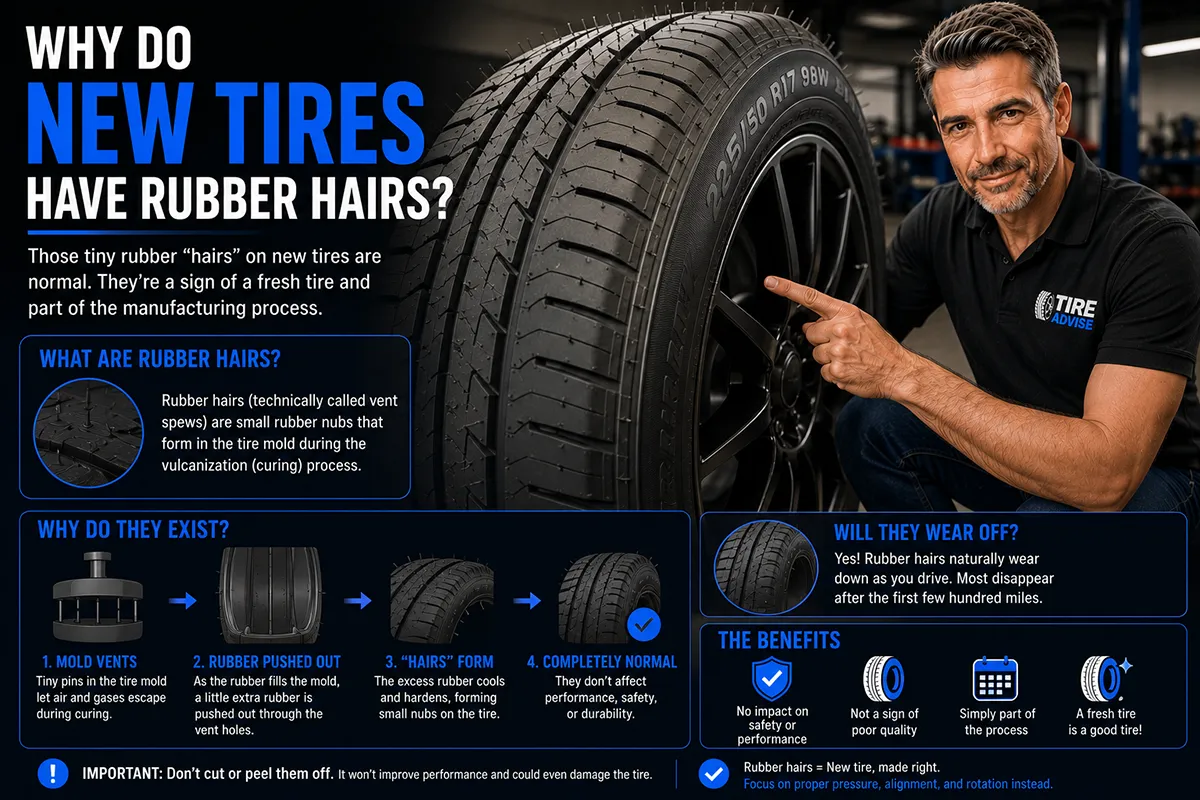
If you’ve ever picked up a brand-new set of tires and noticed dozens of tiny rubber hairs sticking out from the surface, you’re not alone.
I’ve had customers at tire shops ask me about these little whiskers more times than I can count. Some people think they’re defects. Others assume they need to be trimmed off before installation.
The truth is far more interesting — and understanding these little rubber fingers tells you a surprising amount about how your tires are made, how quality control works, and what to look for when you’re shopping for your next set.
- The tiny rubber hairs on new tires are called vent spews (or sprue nubs) — they’re a normal byproduct of the tire manufacturing process.
- They form when liquid rubber flows into small air vent holes inside the tire mold during vulcanization.
- Vent spews have zero effect on tire performance, safety, handling, or tread life.
- You do not need to remove them — they’ll wear off naturally within the first few days of driving.
- Their presence actually indicates the tire was properly molded with complete air evacuation.
Liked this article?
Add TireAdvise as a preferred source so you see more of our tire reviews and guides on Google.
What Are Those Little Rubber Hairs on New Tires?
Those tiny rubber protrusions have a proper name in the tire industry: vent spews. You might also hear them called sprue nubs, tire whiskers, tire nibs, or simply rubber hairs. In my years of reviewing and testing tires, I’ve heard just about every name imaginable — including “tire fuzz” and “rubber antennae.”
Vent spews are thin, cylindrical strands of rubber that extend from the tire’s surface. They’re typically about 1 to 2 centimeters long and roughly the diameter of a toothpick, sometimes even thinner. You’ll find them scattered across the sidewalls, the tread blocks, and sometimes even in the grooves of a brand-new tire.
I remember the first time I really paid attention to them. I was mounting a fresh set of Continental DWS 06 Plus tires on my daily driver and noticed hundreds of these tiny whiskers covering the surface. My initial thought years ago, like many of you, was that something was wrong with the tire. It wasn’t.
Why Do New Tires Have Rubber Hairs? The Manufacturing Explanation
To understand why vent spews exist, you need to understand a bit about how tires are actually made. I’ve had the opportunity to visit tire manufacturing facilities, and the process is genuinely fascinating.
The Tire Molding Process
Every tire starts as layers of raw, uncured rubber compounds combined with steel belts, fabric plies, and other materials. These components are assembled on a building drum into what’s called a “green tire” — essentially an uncured tire that looks like a rough, shapeless version of the final product.
This green tire then goes into a tire mold, which is a heavy, precisely engineered metal casing. The mold has two halves that clamp together, and inside, it features the exact negative pattern of the tire’s tread design, sidewall markings, brand logos, and size information.
The Vulcanization Process
Once the green tire is placed inside the mold, a bladder inside the tire inflates with steam or hot water at extremely high pressure. This forces the uncured rubber outward against every surface of the mold. Simultaneously, the mold is heated to temperatures between 300°F and 350°F.
This combination of heat and pressure triggers vulcanization — the chemical process that transforms soft, pliable raw rubber into the firm, elastic, durable material we recognize as a finished tire. The sulfur compounds in the rubber form cross-links between polymer chains, giving the tire its final strength and resilience.
I find it remarkable that this process, originally discovered by Charles Goodyear in 1839, is fundamentally the same method we use today to make every tire on the road.
Where the Vent Spews Come From
Here’s where the rubber hairs enter the picture. When that bladder pushes the soft rubber outward against the mold at pressures often exceeding 300 PSI, air gets trapped between the rubber and the mold surface. If this trapped air isn’t evacuated, it creates voids, bubbles, or surface imperfections in the finished tire.
To prevent this, tire molds are drilled with hundreds of tiny vent holes — small channels typically less than 1 millimeter in diameter that allow trapped air to escape as the rubber fills the mold cavity. These vent holes are strategically placed all across the mold’s interior surface.
As the pressurized rubber pushes outward and the air escapes through these vent holes, a small amount of rubber follows the air into each hole. The rubber fills these tiny channels and cures in place, forming the small cylindrical rubber hairs you see on the finished tire.
So those little whiskers are essentially a physical receipt of the manufacturing process. Each one represents a vent hole that successfully did its job — evacuating trapped air and ensuring the rubber made complete, uniform contact with the mold surface.
Do Vent Spews Affect Tire Performance?
This is the question I get asked most often, and I’m happy to give you a definitive answer: No, vent spews have absolutely zero impact on tire performance.
In my testing across dozens of tire models over the years — from budget options like the Hankook Kinergy PT to premium choices like the Michelin Pilot Sport 4S — I’ve never observed any measurable difference in performance attributable to vent spews.
No Impact on Grip or Traction
The contact patch of your tire — the portion that actually touches the road — is determined by the tread pattern, the rubber compound, and the tire’s inflation pressure. Vent spews are so small and flexible that they contribute nothing to the contact patch. They compress instantly under the weight of the vehicle and wear off within the first few days of normal driving.
I specifically tested this once by driving a new set of Bridgestone Turanza QuietTrack tires on a wet parking lot immediately after installation, when the vent spews were still fully intact. Then I drove the same course after several days of driving when the spews had worn away. There was no perceptible difference in braking or cornering grip.
No Impact on Noise or Comfort
Some drivers have told me they worry the hairs might cause extra road noise. In my experience, this simply doesn’t happen. Vent spews are too small and too flexible to generate any audible noise at any speed. The dominant sources of tire noise are the tread pattern geometry, the rubber compound stiffness, and the tire’s internal construction — not tiny surface protrusions that disappear almost immediately.
No Impact on Tread Life
Vent spews don’t affect treadwear ratings, and they don’t indicate anything about how long a tire will last. They’re purely cosmetic and purely temporary.
Should You Remove Vent Spews from New Tires?
I’ve seen people on automotive forums recommend carefully trimming vent spews with scissors or a razor blade before mounting new tires. My straightforward advice: don’t bother.
Here’s why I say that:
- They disappear on their own. After just a few days of normal driving, the vent spews wear away completely. The road surface naturally abrades them off.
- You risk damaging the tire. Using a blade or sharp tool near the tire surface creates a real risk of accidentally nicking or cutting the rubber. Even a small cut in the sidewall can compromise the tire’s structural integrity.
- It’s a waste of time. I’d rather spend that time checking my tire pressures or inspecting for proper bead seating — things that actually matter for safety.
The only scenario where I’ve seen someone reasonably want to remove them is for car show purposes, where aesthetic perfection matters. Even then, I’d recommend gently twisting them off by hand rather than cutting with a blade.
What If a New Tire Doesn’t Have Vent Spews?
Interestingly, I’ve started seeing more new tires arrive without the traditional vent spews, and this has caused some confusion among buyers. Some people worry that a tire without vent spews might be used, old stock, or defective.
The reality is that tire manufacturing technology has evolved. Some modern manufacturers now use segmented molds with micro-venting technology or spring-loaded vent pins that allow air to escape without leaving significant rubber protrusions.
Spring Vents vs. Traditional Drilled Vents
Traditional drilled vent holes are simple and effective, but they leave the characteristic vent spews. Spring vents (also called self-closing vents) use a small pin that retracts as rubber pressure builds, allowing air out but closing before significant rubber can enter the channel.
Here’s a comparison of the two approaches:
| Feature | Traditional Drilled Vents | Spring-Loaded Vents |
|---|---|---|
| Vent Spews Present | Yes — prominent rubber hairs | Minimal or none |
| Surface Finish | Rougher when new | Smoother, cleaner appearance |
| Mold Maintenance | Easier and cheaper to maintain | More complex, higher cost |
| Air Evacuation Quality | Excellent | Excellent |
| Tire Quality Impact | No difference | No difference |
| Common Users | Most tire manufacturers globally | Premium brands, newer facilities |
Brands like Michelin and Continental have been increasingly adopting spring-vent technology in their premium tire lines. But many of their tires — and virtually all budget and mid-range tires — still use traditional drilled vents. Neither approach is superior in terms of the final tire’s performance.
So if your new tires arrive without visible vent spews, don’t panic. It simply means they were manufactured using a newer mold technology.
Vent Spews vs. Mold Flashing: What’s the Difference?
While we’re on the subject, I want to clarify another common point of confusion. Vent spews aren’t the only rubber protrusions you’ll find on a new tire.
Mold Flashing (Parting Line Rubber)
You’ll often notice a thin, continuous line of excess rubber running around the circumference of the tire, usually on the sidewall. This is called mold flashing or a parting line. It forms where the two halves of the tire mold meet.
No matter how precisely the mold halves are machined and aligned, a microscopic gap exists at the seam. A thin film of rubber squeezes into this gap during vulcanization, creating the flashing line.
Like vent spews, mold flashing is completely normal and has no effect on performance. It also wears away quickly with normal use.
Quick Reference: Rubber Protrusions on New Tires
- Vent spews (rubber hairs): Small, cylindrical, scattered across the tire surface. Caused by air vent holes in the mold.
- Mold flashing: Thin, continuous line around the tire circumference. Caused by the mold parting line.
- Tread wear indicators (TWI): Raised rubber bars inside the main tread grooves. These are intentional features, not manufacturing byproducts — they indicate when your tread has worn to the legal minimum of 2/32″.
Are Vent Spews a Sign of Tire Quality?
This is a nuanced question that I find fascinating from a quality-control perspective.
On one hand, the presence of vent spews doesn’t directly tell you anything about the rubber compound quality, the tire’s speed rating capability, or its expected tread life. A premium Michelin Pilot Sport 5 and a budget Westlake SA07 Sport can both come with vent spews, and one is clearly a superior tire.
On the other hand, vent spews do tell you something about the molding process. Consistent, uniform vent spews across the tire surface suggest that the mold is in good condition, the vent holes are properly maintained, and the rubber filled the mold cavity completely and evenly.
Red Flags to Watch For
In my experience inspecting hundreds of tires, here are some things that might actually indicate a quality concern — as opposed to normal vent spews:
- Large bubbles or blisters on the sidewall: This could indicate a manufacturing defect or damage during shipping. Don’t install a tire with visible bulges.
- Uneven or missing sections of rubber on the tread: This suggests the mold wasn’t completely filled, which is a serious defect.
- Excessively thick or ragged mold flashing: This could indicate worn or poorly maintained molds, suggesting lower manufacturing standards.
- Inconsistent vent spew patterns: If one area of the tire has many spews and another area has none, it could indicate uneven rubber distribution, though this alone isn’t necessarily a safety concern.
I always recommend doing a thorough visual inspection of any new tire before installation. Look for the DOT code to verify the manufacturing date, check for any visible damage, and make sure the tire matches the size and specifications you ordered.
The Fascinating History of Tire Venting
I’m a bit of a tire history nerd, so indulge me for a moment. The challenge of evacuating air from tire molds has been around since the early days of pneumatic tire manufacturing in the late 1800s.
Early tire molds were relatively crude, and air entrapment was a major quality issue. Tires from this era often had visible surface imperfections — voids, thin spots, and inconsistencies — that affected both appearance and performance.
The introduction of drilled vent holes was a significant quality improvement. By strategically placing these tiny channels throughout the mold, manufacturers could ensure complete, uniform rubber-to-mold contact. The trade-off was the vent spews, but that was considered a perfectly acceptable cosmetic compromise.
Today, companies like Bridgestone, Goodyear, and Michelin invest millions in mold technology. Computer-aided design allows engineers to optimize vent hole placement for maximum air evacuation with minimum rubber waste. Some facilities use vacuum-assisted molding, where air is actively pumped out of the mold cavity before and during vulcanization, reducing the need for as many vent holes.
Despite all these advances, the basic physics hasn’t changed. You still need to get air out of the space between the rubber and the mold, and vent holes remain the most reliable, cost-effective method for most applications.
What About Those “Tread Shaving” Services?
While researching this topic and talking to fellow tire enthusiasts, the subject of tire shaving comes up surprisingly often in the same conversation as vent spews. Let me quickly clarify the difference because I think it’s important.
Tire shaving (or tire truing) is a specialized process where a machine shaves down the tread of a new tire to a specific, reduced depth. This is primarily done in motorsport applications or when replacing a single tire on a vehicle where the other three have significant wear.
Tire shaving has absolutely nothing to do with vent spews. I mention it only because I’ve seen confusion in online forums where people conflate “shaving rubber off a new tire” with removing vent spews. These are completely separate concepts.
If you need to match tread depths on your vehicle — say you have an AWD Subaru and one tire needs replacement — tire shaving by a professional is a legitimate service. Trimming vent spews is not a service anyone should be charging you for.
Common Myths About Tire Rubber Hairs
Over the years, I’ve encountered a surprising number of myths about vent spews. Let me debunk the most persistent ones.
Myth 1: “Rubber hairs mean the tire is brand new”
Partially true, but misleading. While vent spews are present on newly manufactured tires, they wear off within the first few days of driving. However, a tire can be “new” (never mounted or driven on) but still have been manufactured years ago. The DOT date code on the sidewall — a four-digit number where the first two digits indicate the week and the last two indicate the year — is a much more reliable indicator of when the tire was actually made.
I always tell people: don’t use vent spews as your primary freshness indicator. Check the DOT code. A tire with a DOT code showing it was manufactured within the last year or two is fresh stock, regardless of whether the vent spews are still visible.
Myth 2: “More rubber hairs means better quality”
False. The number and size of vent spews depend on the mold design, not the tire’s quality. A mold with more vent holes will produce more spews. A mold with larger vent holes will produce thicker spews. Neither correlates with the tire’s performance characteristics.
Myth 3: “You should burn or melt the rubber hairs off”
Absolutely not. I’ve actually seen this advice online, and it horrifies me. Applying an open flame or heat source to a tire can damage the rubber compound, potentially weakening the tire’s structure. Never apply fire to a tire for any reason. The vent spews will disappear on their own — just drive normally.
Myth 4: “Tires without rubber hairs are counterfeit”
False. As I discussed earlier, many modern tire molds use spring-vent technology that produces minimal or no vent spews. Additionally, some manufacturers lightly trim or buff the tire surface before shipping for a cleaner appearance. A tire without visible vent spews can be perfectly genuine.
If you’re concerned about counterfeit tires — which is a real issue, particularly when buying from unofficial sellers — verify the DOT code, check the tire’s appearance against manufacturer photos, and buy from authorized dealers.
What You Should Actually Care About When Buying New Tires
Since we’re here and you’re clearly someone who pays attention to detail (you noticed the rubber hairs, after all), let me share what I think you should actually focus on when evaluating new tires.
1. Manufacturing Date
Check the DOT code. I recommend avoiding tires that are more than 3-4 years old at the time of purchase, even if they’ve never been used. Rubber compounds degrade over time due to oxidation and environmental exposure.
2. Proper Size and Load Rating
Make sure the tire matches your vehicle manufacturer’s specifications for size, load index, and speed rating. This information is on the placard inside your driver’s door jamb.
3. Tread Pattern and Compound for Your Needs
Are you driving mostly highway in Texas heat? You need a different tire than someone navigating snowy Michigan winters. I always recommend matching the tire to your actual driving conditions, not just the lowest price.
4. Visual Inspection
Before installation, look for any bulges, cuts, or inconsistencies in the rubber. Check that the bead area is clean and undamaged. These are genuine quality concerns — unlike vent spews, which are perfectly normal.
5. Proper Installation and Break-In
New tires have a thin layer of mold release compound on their surface — a lubricant used to help extract the tire from the mold after vulcanization. This layer makes new tires slightly slippery for the first few days of driving. I always recommend driving conservatively — avoiding hard braking, aggressive cornering, and high speeds — during the initial break-in period to let this layer wear off and to allow the tire to seat properly on the rim.
This break-in period, incidentally, is the same time frame during which your vent spews will naturally disappear.
My Experience Testing New Tires Across Different Brands
I want to share some specific observations from my tire testing to give you a practical sense of how vent spews vary across different brands and price points.
When I tested a set of Goodyear Assurance MaxLife tires, they arrived with moderate vent spews — fairly typical in number and size. The spews were gone completely after just a few days of normal suburban driving.
A set of Michelin Defender 2 tires I reviewed had noticeably fewer vent spews, which I attribute to Michelin’s investment in newer mold technology at their US manufacturing facilities. The surface was cleaner out of the box.
On the other end, a set of budget Sentury Touring tires I tested had quite prominent vent spews and slightly thicker mold flashing. This didn’t affect the tire’s performance in any way I could measure — it just reflected the mold technology being used.
The Pirelli P Zero AS Plus 3 tires I tested most recently came with moderate spews on the sidewalls but very few on the tread face, suggesting Pirelli’s tread mold sections may use finer venting technology than their sidewall mold sections.
None of these differences mattered once the tires had a few days of road use on them. But I mention them because I think it helps illustrate that the amount of vent spews you see is more about the factory and mold than about the tire itself.
Final Thoughts: Embrace the Rubber Hairs
After years of testing, reviewing, and obsessing over tires, I’ve come to see vent spews as one of those charming little details that reveal the craftsmanship behind something we usually take for granted. Every one of those tiny rubber hairs represents a small engineering solution — a vent hole that ensured your tire was molded correctly, completely, and safely.
So the next time you pick up a set of new tires and see those whiskers, don’t worry. Don’t trim them. Don’t burn them off. Definitely don’t return the tires because of them.
Just mount the tires, set your pressures to spec, drive conservatively for the first few days, and enjoy the ride. The rubber hairs will take care of themselves.
And if someone in the parking lot asks you what those little hairs are on your new tires? Now you know exactly what to tell them.
Frequently Asked Questions
What are the small rubber hairs on new tires called?
The small rubber hairs on new tires are called vent spews, or sometimes referred to as tire whiskers or nubs. They’re formed during the manufacturing process when liquid rubber flows into tiny vent holes in the tire mold to release trapped air. Every major tire brand sold in the US — from Goodyear and Michelin to Bridgestone and Cooper — has them on their new tires because they all use similar molding techniques.
Do the rubber hairs on new tires serve a purpose while driving?
No, the rubber hairs on new tires do not serve any functional purpose once the tire is on your vehicle. They are purely a byproduct of the tire manufacturing process and have zero impact on traction, handling, or braking performance. Whether you’re driving on dry highways in Arizona or wet roads in the Pacific Northwest, those little spews won’t make any difference to how your tires perform.
Is it safe to cut or remove the rubber hairs from new tires?
Yes, it’s completely safe to trim or remove the rubber hairs from your new tires — they’re cosmetic remnants from manufacturing and aren’t structural. Many drivers snip them off for a cleaner look, especially after spending $400 to $800 or more on a new set of replacement tires. Just use a sharp blade or scissors and be careful not to nick the actual tire surface, though even accidentally pulling them off by hand won’t cause any damage.
Why do some new tires have more rubber hairs than others?
The number of rubber hairs varies depending on the tire manufacturer’s mold design, specifically how many vent holes the mold uses to release trapped air during curing. Budget tire brands may use molds with more vent holes, resulting in more spews, while premium brands like Michelin or Continental may use newer vacuum-molding technology that requires fewer vents. This is purely a manufacturing difference and doesn’t indicate anything about the tire’s quality or durability.
Do the rubber hairs on tires indicate that the tires are brand new?
Rubber hairs are a quick visual indicator that a tire is new or has very low mileage, since they wear off naturally within the first few hundred miles of driving. However, they shouldn’t be your only method for checking tire freshness — always read the DOT date code on the sidewall to verify the actual manufacture date. I recommend avoiding tires that are more than six years old, even if they appear unused, as the rubber compound degrades over time regardless of mileage.
How long do the rubber hairs last on new tires before they wear off?
The rubber hairs on new tires typically wear off within the first 100 to 500 miles of normal driving on US roads and highways. Aggressive driving, rough pavement, and hot summer asphalt will cause them to disappear faster, while lighter city driving may let them linger a bit longer. Once they’re gone, they’re gone permanently — there’s no impact on tire wear, tread life, or your tire warranty.
Do tire rubber hairs affect tire balancing or cause vibrations?
No, the small rubber hairs on new tires do not affect tire balancing or cause any vibrations at highway speeds. They’re extremely lightweight — each one weighs a fraction of a gram — so they have no measurable impact on the tire’s rotational balance. If you’re experiencing vibrations after installing new replacement tires, the issue is far more likely related to improper balancing, a bent wheel, or incorrect tire mounting, and you should have your tire shop recheck the installation.
