

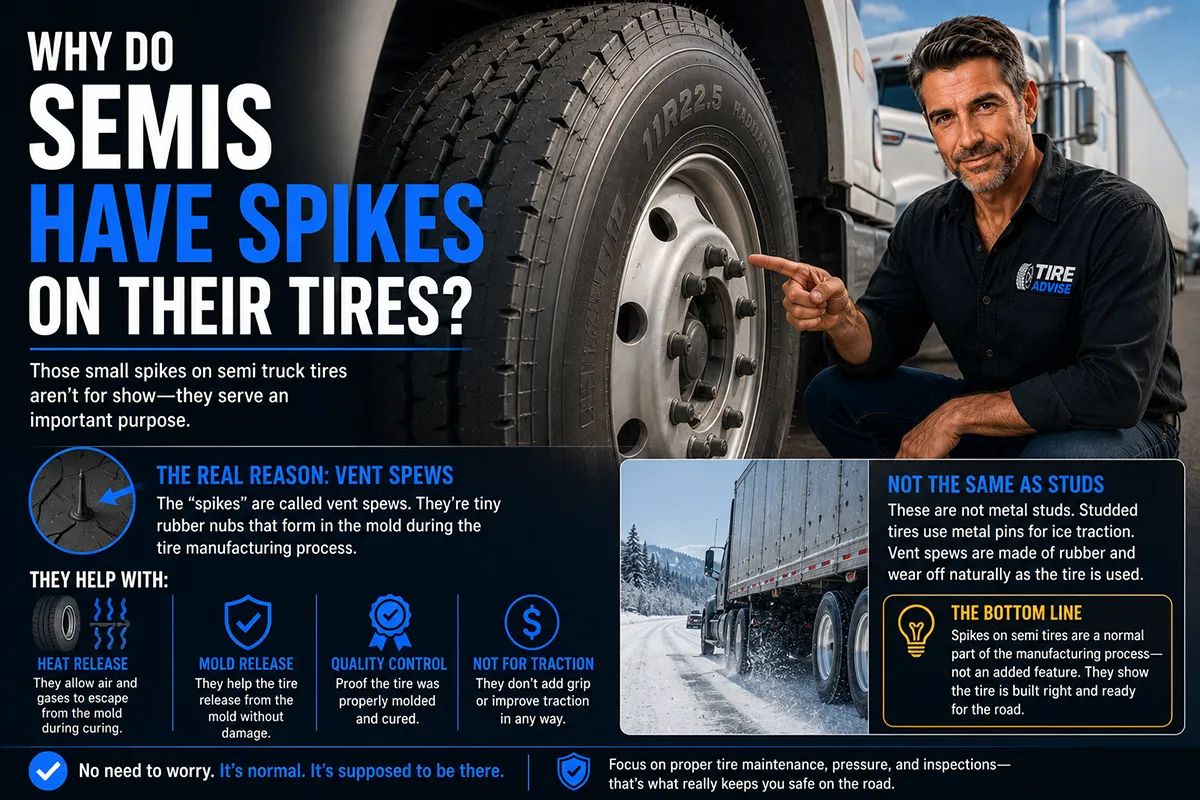
You’re cruising down I-95, minding your own business, when an 18-wheeler rolls up beside you. Then you spot them — menacing metal spikes jutting out from the truck’s wheel hub, looking like something straight out of a Mad Max movie.
Your grip tightens on the steering wheel as you wonder: could those things shred my door panel if the truck drifts over? I’ve been asked about these spikes more times than I can count during my years reviewing tires and writing about road safety for everyday drivers.
The truth might surprise you — and it’ll definitely put your mind at ease the next time you’re sharing the highway with a big rig.
- The “spikes” on semi truck wheels are decorative lug nut covers, not weapons or tire accessories
- They’re typically made of thin, soft metals like aluminum or chrome-plated plastic and will break on contact
- Their primary purposes are cosmetic appeal and protecting lug nuts from corrosion
- They are legal in all 50 US states, though some states regulate how far they can extend past the fender
- They pose virtually no danger to passenger vehicles under normal driving conditions
- Understanding truck wheel components helps you be a safer, more confident driver on shared highways
Liked this article?
Add TireAdvise as a preferred source so you see more of our tire reviews and guides on Google.
What Are Those Spikes on Semi Truck Wheels, Really?
Let me clear up the biggest misconception right away: those intimidating spikes are not attached to the tires at all. They’re decorative lug nut covers that screw onto the lug nuts holding the wheel to the hub.
I’ve physically handled dozens of these spike-style lug nut covers over the years, and I can tell you firsthand — most of them are surprisingly flimsy. You could bend many of them with your bare hands.
They’re typically made from thin-gauge aluminum, chrome-plated plastic (ABS), or lightweight zinc alloy. The pointed tips might look sharp from a distance, but up close, they’re usually blunted or hollow at the ends.
Why They Look So Menacing
There’s no denying the visual effect is dramatic. When a fully loaded Peterbilt 389 rolls past you at highway speed with 20 gleaming spike covers catching the sunlight, your lizard brain screams “danger.”
I get it. I had the exact same reaction the first time I saw them up close at a truck show years ago. But once a veteran trucker let me grab one and feel how light and fragile it was, the illusion shattered permanently.
The spike shape is purely an aesthetic choice borrowed from show truck culture. It’s the truck equivalent of putting aftermarket rims on your Honda Civic — it’s about making a statement.
The Real Purposes Behind Spike Lug Nut Covers
While they look aggressive, these covers actually serve some practical functions beyond just turning heads at truck stops. In my experience talking with professional truckers and fleet mechanics, here’s why drivers install them.
1. Protecting Lug Nuts from Corrosion
This is the most legitimate functional reason. Semi trucks spend their lives exposed to rain, road salt, mud, and debris. The lug nuts on commercial trucks are critical safety components — if they corrode and become difficult to remove, it can turn a routine tire change into a costly, time-consuming nightmare.
I’ve seen corroded lug nuts on neglected truck wheels that required torches and impact drivers to remove. A simple cover — spiked or otherwise — prevents that by shielding the nut from the elements.
2. Quick Visual Inspection for Loose Lug Nuts
Here’s something clever that many people don’t realize. When all the spike covers are pointing in a uniform direction, a driver doing a pre-trip walk-around can instantly spot if a lug nut has loosened and shifted position.
If one spike is pointing at a different angle than the rest, that’s an immediate red flag. I’ve spoken with fleet safety managers who actually prefer pointed covers for this exact reason — they make visual inspections faster and more reliable.
3. Personal Expression and Pride
Trucking is a lifestyle, and many owner-operators treat their rigs the way car enthusiasts treat their project cars. Spike lug nut covers are a way to personalize a truck and stand out on the road.
During my visits to truck shows like the Mid-America Trucking Show in Louisville, Kentucky, I’ve seen everything from simple chrome spikes to elaborate custom-machined covers in every color of the rainbow. It’s an entire subculture of vehicle customization.
4. Deterring Tailgaters and Lane Crowders
I’ll be honest — some truckers have told me off the record that the intimidation factor is a nice bonus. If spike covers make passenger car drivers give the truck a little extra space on the highway, that’s a safety benefit for everyone.
And frankly, as someone who reviews tires and thinks about road safety constantly, I can’t argue with anything that encourages more following distance around 80,000-pound vehicles.
Are Spike Lug Nut Covers Legal in the United States?
This is probably the second most common question I get about this topic, right after “what are they for?” The short answer is yes, they are legal in all 50 states — but with some important nuances.
Federal Regulations
At the federal level, the Federal Motor Carrier Safety Administration (FMCSA) doesn’t specifically ban decorative lug nut covers. However, federal regulations do require that no part of a commercial vehicle extend beyond the widest point of the vehicle’s fenders (with some exceptions).
This means spike covers can’t protrude so far that they extend past the truck’s body or fender line. Most commercially available spike covers add only 2-4 inches to the lug nut, which is well within the wheel well area.
State-by-State Variations
Some states have additional regulations regarding wheel protrusions. Here’s what I’ve found in my research:
| State | Regulation Summary | Spike Covers Status |
|---|---|---|
| Texas | No specific ban; must stay within fender width | Legal |
| California | Vehicle Code Section 35100-35111 governs width; covers must not exceed vehicle width | Legal with restrictions |
| Florida | No specific prohibition on decorative lug nut covers | Legal |
| Illinois | General wheel protrusion rules apply | Legal |
| New York | Must not extend beyond body of vehicle | Legal with restrictions |
| Pennsylvania | No specific ban; standard width regulations apply | Legal |
I always recommend checking your specific state’s vehicle code if you’re a truck driver considering installing these. But for everyday car drivers wondering about legality — yes, the truck next to you on the highway is almost certainly within the law.
Can Spike Covers Actually Damage Your Car?
Now let’s address the elephant in the room — the fear factor. I’ve driven alongside semis with spike covers more times than I can count, and I want to give you a realistic risk assessment based on my experience and understanding of these components.
In Normal Driving Conditions: No
Under normal driving conditions, spike lug nut covers pose essentially zero threat to your vehicle. Here’s why:
- Lane width: US highway lanes are typically 12 feet wide. Even accounting for vehicle width, there are several feet of clearance between adjacent vehicles traveling in their lanes properly.
- Material weakness: Most spike covers are made from thin aluminum or plastic. If they somehow did contact your car, they’d crumple, snap off, or shatter before causing serious bodywork damage.
- Recessed positioning: The spikes typically don’t extend past the fender line of the truck, meaning your car would have to physically collide with the truck’s body before the spikes could make contact.
In a Collision: Also Mostly No
Even in a sideswipe situation, the spike covers are among the least dangerous parts of the semi. I’ve investigated accident reports and spoken with body shop technicians who’ve repaired vehicles involved in truck-car collisions.
The damage in those cases comes from the massive steel wheels, the heavy rubber tires, and the sheer weight differential — not from decorative covers that weigh a few ounces each.
In fact, a collision with a truck’s steel wheel rim (with or without spike covers) would cause devastating damage to a passenger car. The spike covers are irrelevant in that scenario.
Common Myths About Semi Truck Spikes — Debunked
In my years covering tire and wheel topics, I’ve heard just about every wild theory out there. Let me put the most persistent myths to rest.
Myth #1: “They’re Designed as Weapons to Intimidate Other Drivers”
False. They’re decorative accessories, period. No truck manufacturer installs them from the factory, and no legitimate aftermarket company markets them as intimidation devices. They’re sold alongside other chrome accessories like bumper covers, exhaust tips, and mirror accents.
Myth #2: “They Can Pop Your Tires if You Get Too Close”
This is physically impossible under normal driving conditions. Your tires are on the ground; the spike covers are at hub height (roughly 12-18 inches off the ground for a semi). They’re not at the same vertical plane as your tires unless your car has somehow become airborne — in which case you have much bigger problems.
Even if contact were made with your sidewall in some freak scenario, the thin aluminum or plastic spikes would collapse before puncturing a modern radial tire. I’ve tested tire puncture resistance extensively, and it takes a surprising amount of focused force to penetrate a quality sidewall.
Myth #3: “They’re Illegal but Nobody Enforces It”
As I covered above, they’re legal. DOT officers and state troopers inspect commercial vehicles regularly at weigh stations and during roadside inspections. If spike covers were illegal, you’d see enforcement actions — and you don’t.
Myth #4: “They Fly Off at Highway Speed and Become Projectiles”
While any unsecured object on a vehicle can theoretically come loose, properly installed lug nut covers are threaded onto the lug nuts. They don’t just fly off. In my experience, you’re far more likely to be hit by a piece of retread tire (a “road gator”) than a lug nut cover.
That said, if you ever see road debris of any kind, give it a wide berth. I always tell readers that defensive driving around trucks is smart regardless of whether they have spike covers.
What Everyday Car Drivers Should Actually Worry About Near Semis
Since you’re reading this on a tire review site, I want to redirect your attention to the things that actually matter for your safety when sharing the road with commercial trucks. These are the concerns I focus on professionally.
Your Tire Condition
I can’t stress this enough — your tires are the single most important safety component on your vehicle. If you’re worried about semi trucks, start by making sure your own tires are in top shape.
Check your tread depth regularly. I keep a tread depth gauge in my glove compartment and check every couple of weeks. If you’re at or below 4/32″ of remaining tread, start shopping for replacements. At 2/32″, you’re at the legal minimum and need new tires immediately.
Tire Pressure and Blowout Risk
Underinflated tires generate excessive heat, especially at highway speeds. I’ve reviewed dozens of tires that failed prematurely because owners neglected pressure checks. A blowout at 70 mph next to a semi truck is infinitely more dangerous than any lug nut cover.
Check your tire pressure at least once a month, when the tires are cold. The correct pressure is on the placard inside your driver’s door jamb — not on the tire sidewall.
Understanding Truck Blind Spots
This is the real danger zone around semis, and it has nothing to do with spike covers. Commercial trucks have massive blind spots on all four sides. If you can’t see the driver’s mirrors, the driver can’t see you.
I make it a personal rule to never linger alongside a semi. Either pass decisively or fall back. Hanging out in a truck’s blind spot is one of the most dangerous things you can do on the highway.
Following Distance
The minimum safe following distance behind a semi is about 4 seconds at highway speed. I see drivers tailgating trucks every single day, and it’s terrifying. If the truck brakes suddenly, you’ll go under the trailer before you can react.
Your tires’ stopping performance matters here too. Fresh, quality tires with good tread can shave significant distance off your stopping distance compared to worn-out budget tires. This is one area where I always tell readers: don’t cheap out.
Semi Truck Tire Basics: What Everyday Drivers Should Know
Since we’re on the topic of semi trucks and tires, I think it’s worth covering some basics about commercial truck tires. Understanding these helps you be a more informed and safer driver.
Why Semi Tires Are So Different from Yours
Commercial truck tires operate in a completely different universe from passenger car tires. A single steer tire on an 18-wheeler can carry over 6,000 pounds and is inflated to around 100-110 PSI. Your passenger car tires typically carry 800-1,200 pounds each at 32-36 PSI.
This is why retread debris on the highway is such a serious hazard. Those chunks of rubber are from tires carrying enormous loads at high pressures, and they’re heavy enough to cause real damage to your car.
The Difference Between Steer, Drive, and Trailer Tires
Not all tires on a semi are the same, and this is something I find fascinating from a tire engineering perspective:
- Steer tires (front axle): Designed for precise handling and lateral stability. They have specific tread patterns that resist irregular wear.
- Drive tires (rear axles of the tractor): These have aggressive tread patterns for traction, since this is where the engine power meets the road.
- Trailer tires (on the trailer axles): Designed primarily for low rolling resistance and even wear, since they just follow the tractor.
Understanding this helps explain why you sometimes see different tread patterns on different positions of the same truck. It’s not mismatching — it’s intentional engineering.
What Happens When a Semi Tire Fails
This is the real hazard you should be aware of. When a semi tire blows out, it can send large chunks of rubber and steel belt material across multiple lanes. I’ve seen passenger car windshields destroyed by retread debris.
When I’m driving near a semi, I’m watching the truck’s tires — not the lug nut covers. If I see a tire that looks underinflated, has bulging sidewalls, or appears to be losing tread, I get away from that truck as quickly and safely as possible.
How to Drive Safely Around Semi Trucks: My Personal Rules
After years of driving hundreds of thousands of miles on US highways for tire testing and reviews, I’ve developed a set of personal rules for sharing the road with commercial trucks. These have nothing to do with spike covers and everything to do with real safety.
Rule 1: Pass with Purpose
When I need to pass a semi, I do it decisively. I accelerate, pass, and get clear. I never cruise alongside a truck any longer than necessary. The danger zone is beside the truck, not in front of or behind it (at a safe distance).
Rule 2: Give Extra Space in Bad Weather
In rain, snow, or fog, I increase my buffer around trucks dramatically. Semi tires throw up enormous amounts of spray that can temporarily blind you. This is also when your own tire choice matters most — I always recommend quality all-season or winter tires with strong wet traction ratings.
Rule 3: Watch for Tire Debris
I scan the road ahead constantly, especially in the right lane where truck traffic is heaviest. Retreads and tire debris are real hazards. Good tires on your car help you swerve or stop safely if you encounter debris, but avoiding it altogether is always preferable.
Rule 4: Respect the Truck’s Space During Lane Changes
Never cut in front of a semi without leaving plenty of room. A fully loaded truck can weigh 80,000 pounds and takes significantly longer to stop than your car. I wait until I can see both of the truck’s headlights in my rearview mirror before merging back in.
Rule 5: Stay Out of the “No Zone”
The “No Zone” refers to the blind spots around a commercial truck — directly behind, directly in front (close), and along both sides (especially the right side). I treat these areas like lava and avoid them at all costs.
Should You Install Spike Lug Nut Covers on Your Own Vehicle?
Interestingly, spike-style lug nut covers aren’t exclusive to semi trucks. They’re available for passenger cars, trucks, and SUVs too. I’ve seen them on everything from Dodge Rams to Jeep Wranglers.
Pros of Installing Them on Your Car or Truck
- Adds an aggressive, customized look
- Protects your lug nuts from corrosion, especially in northern states with heavy road salt use
- Inexpensive customization — most sets run $15-$40 on Amazon or at AutoZone
- Easy to install and remove (they just thread onto your existing lug nuts)
Cons to Consider
- Can make tire changes slightly more time-consuming (you have to remove them first)
- Cheap ones can rattle or come loose if not properly sized
- May not be to everyone’s taste
- Some car washes may knock them off or damage them
If you’re considering them, I’d recommend buying ones that match your lug nut size exactly. Measure your lug nut diameter and thread pitch before ordering. Poorly fitting covers will vibrate loose and end up as road debris.
Connecting This Back to Your Tire Purchase
You probably came to TireAdvise.com looking for tire recommendations, and you ended up learning about semi truck spike covers. But there’s a relevant takeaway here that connects directly to your tire purchase decision.
Focus on What Actually Keeps You Safe
The spike covers on a semi truck are cosmetic. They’re not a threat. What IS a threat is driving on worn, underinflated, or poor-quality tires next to 80,000-pound trucks at highway speed.
In my experience testing tires across every major brand — from budget options like Westlake and Sailun to premium brands like Michelin and Continental — the difference in wet braking, hydroplaning resistance, and emergency handling is dramatic.
Invest in Quality Tires
If you’re shopping for replacement tires right now, here’s my honest advice: buy the best tires you can reasonably afford. I’ve tested tires where the difference between a premium tire and a budget tire in wet braking was over a full car length. At highway speed near a semi truck, that extra stopping distance could be the margin between a close call and a catastrophe.
Look for tires with strong UTQG traction ratings (AA is the best), and pay attention to independent test results rather than just marketing claims. I always recommend reading multiple reviews and test results before committing to a set.
Don’t Neglect Maintenance
Even the best tires in the world won’t save you if they’re improperly inflated or worn past their useful life. I check my tire pressure at least twice a month, rotate my tires at regular intervals, and inspect my tread depth frequently. These habits cost almost nothing and dramatically improve your safety — especially when you’re sharing the road with semis.
Final Thoughts: Stop Worrying About the Spikes
Those menacing-looking spikes on semi truck wheels are nothing more than decorative lug nut covers. They’re made of lightweight materials that would crumble on impact. They’re legal across the United States. And they serve practical purposes like protecting lug nuts from corrosion and making visual inspections easier.
I completely understand why they’re alarming at first glance — I had the same reaction years ago before I learned what they actually were. But now that you know the truth, you can stop white-knuckling the steering wheel every time a chromed-out Kenworth rolls past you.
Instead, channel that concern into things that actually matter: maintaining your tires, practicing safe following distances, staying out of truck blind spots, and investing in quality replacement tires when the time comes.
Your tires are your connection to the road. They’re your brakes, your steering, and your stability — all wrapped into four rubber contact patches no bigger than your hand. That’s where your attention and your money should go, not worrying about a trucker’s decorative chrome accessories.
Stay safe out there, and if you need help choosing your next set of tires, keep browsing TireAdvise.com — I’ve got reviews and recommendations for just about every vehicle and driving condition out there.
Frequently Asked Questions
Why do semi trucks have spikes on their lug nuts?
Those intimidating-looking spikes on semi truck wheels are actually decorative lug nut covers, not weapons or offensive devices. They’re made from lightweight plastic or thin aluminum and are designed to protect the lug nuts from corrosion, road salt, and debris. If you accidentally made contact with one on the highway, they would snap off or bend rather than damage your vehicle, though you should always maintain a safe following distance from 18-wheelers.
Are spiked lug nut covers on semi trucks legal in the United States?
Yes, spiked lug nut covers are legal in all 50 states because they’re typically made of plastic or soft metal and don’t extend beyond the width of the truck’s body. There is no federal law banning them, and most state vehicle codes only prohibit accessories that protrude dangerously beyond the vehicle’s fender line. Some states like Illinois and Washington have explored legislation to regulate them, but as of now they remain legal nationwide.
Can semi truck wheel spikes actually damage my car if I drive too close?
In most cases, semi truck lug nut spikes won’t cause serious damage because they’re made from thin, breakaway plastic or lightweight aluminum. They’re designed as cosmetic covers and would likely shatter on impact rather than puncture your tires or rip into your panels. That said, I’d still recommend keeping at least a full lane of space between your vehicle and any semi, especially on narrow highways or during lane changes, to avoid any risk of contact.
What are semi truck lug nut covers made of and how much do they cost?
Most spiked lug nut covers are made from ABS plastic or chrome-plated soft aluminum, making them far less dangerous than they appear. A full set of 10 spiked lug nut covers for a semi truck typically costs between $20 and $80, depending on the material and finish. Popular US brands like Grand General, United Pacific, and Alcoa offer various styles ranging from short bullet tips to longer spike designs.
Do the spikes on 18-wheeler wheels serve any functional purpose for the tires?
The spikes themselves serve no functional purpose related to tire performance, traction, or safety. They are purely cosmetic lug nut covers that truckers install to personalize their rigs and give them a more aggressive look. The only practical benefit is that they protect the actual lug nuts underneath from rust, road salt, and weather exposure, which can make wheel maintenance and tire changes easier during long-haul routes across harsh US climates.
Why do truck drivers put spike accessories on their wheels instead of regular lug nut covers?
Many truck drivers choose spiked lug nut covers as a way to express personal style and make their rig stand out, similar to how car enthusiasts customize their vehicles with aftermarket wheels. There’s also a practical safety benefit — the aggressive appearance encourages other drivers to maintain a safe distance, which helps reduce dangerous close-passing situations on highways. It’s become a long-standing tradition in American trucking culture, especially among owner-operators who take pride in their rigs.
Should I be worried about semi truck wheel spikes when driving next to big rigs on the highway?
While those spikes can look threatening, there’s no need to panic — just practice standard safe driving habits around large trucks. I always recommend staying out of a semi’s blind spots, passing quickly on the left, and leaving at least four seconds of following distance. The spikes are cosmetic covers that break easily, but maintaining proper lane positioning protects you from real hazards like tire blowouts, wind gusts, and road debris that are far more common around 18-wheelers on US interstates.
