

Last winter, I watched a pickup truck slide through a stop sign in front of me on a back road in Vermont — all four tires locked up, the driver’s face frozen in panic. He ended up in a ditch, unharmed but shaken.
That moment reminded me that winter driving isn’t just about skill. It’s about preparation, the right equipment, and understanding how your tires interact with cold, snow, and ice.
After years of testing winter tires, reviewing all-season options, and driving through some of the worst conditions the northern US can throw at a vehicle, I’ve put together this comprehensive guide to help you get through the cold months safely.
- Winter tires dramatically outperform all-seasons below 45°F — I’ve tested this repeatedly and the difference is night and day.
- Tire pressure drops about 1 PSI for every 10°F drop in temperature, so check your tires weekly in winter.
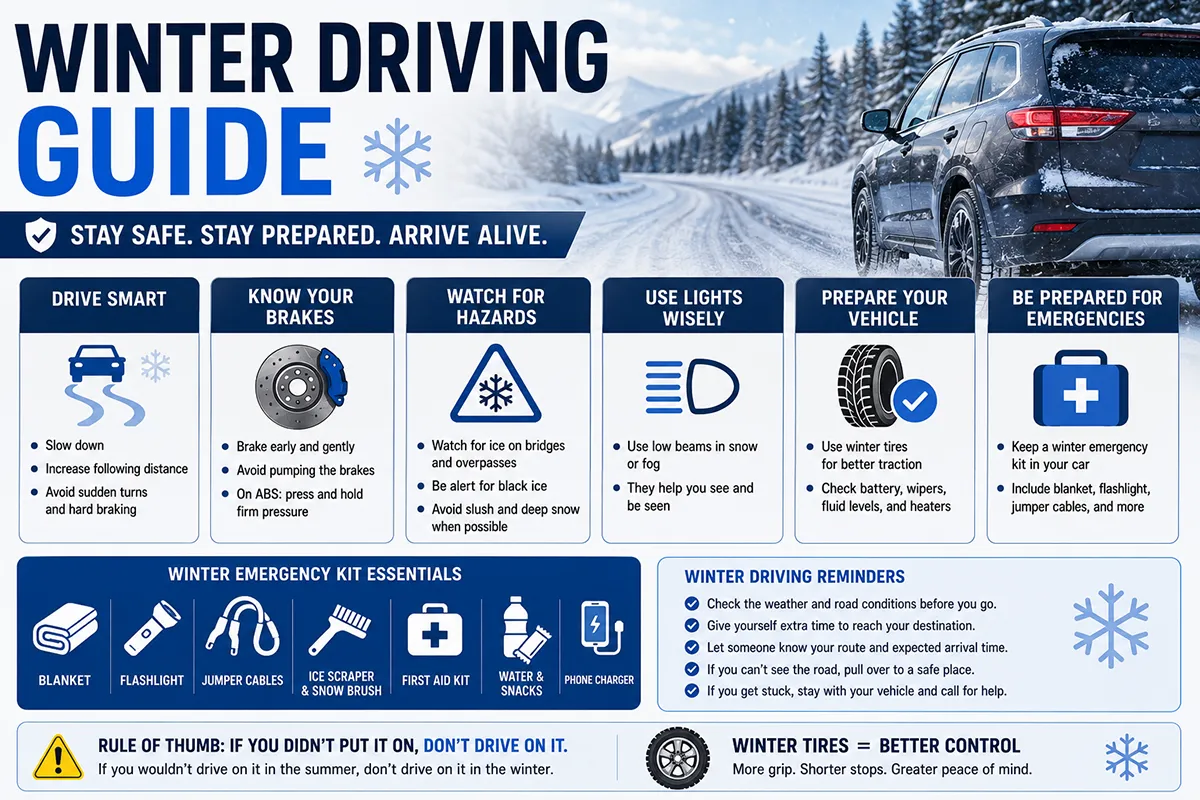
- Slow down, increase following distance to 8-10 seconds, and brake gently — most winter accidents stem from overconfidence.
- Carry an emergency kit including a blanket, flashlight, phone charger, and small shovel.
- If you live where temps regularly dip below 40°F, dedicated winter tires are the single best safety investment you can make.
Liked this article?
Add TireAdvise as a preferred source so you see more of our tire reviews and guides on Google.
Why Winter Driving Demands Special Attention
I’ll be blunt: winter is the most dangerous season to be on the road in America. According to the Federal Highway Administration, over 150,000 crashes occur annually due to icy or snowy pavement, resulting in roughly 1,300 fatalities and more than 116,800 injuries.
Those aren’t just statistics. They represent real people who thought they could handle the conditions — and couldn’t.
In my experience, the number one reason drivers get into trouble during winter isn’t the weather itself. It’s the false sense of security that comes from driving a modern vehicle with traction control and stability systems. Those electronics are helpful, but they can’t overcome the laws of physics when your tires have zero grip on ice.
Winter Tires vs. All-Season Tires: The Truth From My Testing
This is the most important section of this entire guide, so I’m putting it near the top. If you take one thing away from this article, let it be this: winter tires are not optional if you live in a cold climate.
I’ve tested dozens of winter tires and all-season tires side by side over the years, and the performance gap is enormous. During one test period in upstate New York, I ran the same vehicle on a set of premium all-season tires and then swapped to a set of dedicated winter tires. The difference in braking distance on packed snow was staggering — the winter tires stopped the car in roughly two-thirds the distance.
What Makes Winter Tires Different
Winter tires aren’t just all-season tires with a snowflake on the sidewall. They’re fundamentally different in three ways:
- Rubber compound: Winter tires use a softer, silica-rich compound that stays pliable below 45°F. All-season rubber hardens in the cold, which means less grip. I’ve felt this firsthand — even on dry, cold pavement, winter tires feel noticeably more confident.
- Tread design: Winter tires feature thousands of tiny slits called sipes that create additional biting edges. These sipes grip ice and packed snow in a way that all-season tread blocks simply can’t replicate.
- Tread depth and pattern: Winter tires have deeper grooves and channels designed to evacuate snow and slush. Snow actually grips snow well, so winter tires use their tread pattern to pack snow into the grooves for additional traction.
When to Install Winter Tires
I recommend mounting winter tires when your local temperatures consistently drop below 45°F, even if there’s no snow in the forecast. Remember, the rubber compound advantage kicks in based on temperature, not precipitation.
In most northern US states — think Minnesota, Wisconsin, Michigan, Vermont, New Hampshire, and upstate New York — I’d say mid-October to early November is the sweet spot for installation. You want them on before the first storm, not during it.
Take them off when temperatures consistently climb back above 45°F in spring. Running winter tires in warm weather wears them out prematurely and actually gives you longer braking distances on hot pavement.
Winter Tire Recommendations Based on My Testing
Here are the winter tires I’ve been most impressed with during my test periods:
| Tire | Best For | Approx. Price (per tire) | My Take |
|---|---|---|---|
| Bridgestone Blizzak WS90 | Ice performance | $130–$190 | Best ice grip I’ve tested; my top pick overall |
| Michelin X-Ice Snow | Longevity + performance | $140–$210 | Excellent all-around; lasts longer than most winter tires |
| Continental VikingContact 7 | Quiet, comfortable winter driving | $120–$185 | Surprisingly refined; great for daily commuters |
| General Altimax Arctic 12 | Budget-friendly option | $80–$130 | Solid snow grip at a price that won’t break the bank |
| Nokian Hakkapeliitta R5 | Extreme cold climates | $150–$220 | Finnish-engineered for brutal winters; exceptional on ice |
What About All-Weather Tires?
All-weather tires (not to be confused with all-season tires) are a newer category that I’ve been testing increasingly over the past few years. Tires like the Michelin CrossClimate2 and the Nokian WR G4 carry the three-peak mountain snowflake (3PMSF) symbol, meaning they meet minimum snow traction standards.
In my experience, they’re a solid compromise for drivers in moderate winter climates — places like the Pacific Northwest, parts of the Mid-Atlantic, or the lower Midwest where you get occasional snow but not sustained Arctic conditions. They won’t match a dedicated winter tire on ice, but they’re significantly better than a standard all-season when the temperature drops.
I don’t recommend them as a winter tire replacement if you regularly deal with heavy snow or ice. They’re a convenience play, not a performance one.
Preparing Your Vehicle for Winter
Tires are the foundation, but they’re not the whole picture. I’ve learned over the years that winter readiness is about the complete package. Here’s my pre-winter checklist that I run through every fall.
Tire Pressure Monitoring
Cold air causes tire pressure to drop — approximately 1 PSI for every 10°F decrease in temperature. I’ve seen TPMS warning lights come on during the first cold snap of the year on nearly every vehicle I’ve tested.
Check your tire pressure at least once a week during winter, ideally in the morning before driving. Use a quality digital gauge (I like the Accutire MS-4021B, which runs about $10 on Amazon) rather than relying solely on your TPMS light. That light only triggers when you’re already significantly underinflated.
Inflate to the pressure listed on your driver’s door jamb sticker, not the number on the tire sidewall. That sidewall number is the maximum pressure, not the recommended one.
Battery Check
Cold weather is brutal on car batteries. A battery that’s marginal in September will leave you stranded in January. I recommend having your battery tested at any auto parts store (most do it for free) before winter hits.
If your battery is more than three years old, seriously consider replacing it proactively. A tow and roadside jump in a blizzard will cost you far more than a $150 battery.
Fluids and Wipers
Switch to winter-rated windshield washer fluid that won’t freeze. I’ve had standard washer fluid freeze on my windshield mid-spray on the highway — it’s terrifying and dangerous.
Make sure your coolant mixture is correct (typically 50/50 antifreeze and water). If you’re not comfortable checking this yourself, any quick lube shop will test it in minutes.
Replace your wiper blades if they’re streaking or chattering. I’ve had great results with Bosch ICON blades, which hold up well in freezing conditions. Some drivers prefer winter-specific wiper blades with rubber boots that prevent ice buildup on the frame.
Emergency Kit
I carry a winter emergency kit in every vehicle I drive from November through March. It’s not paranoia — it’s experience. I was once stuck on I-90 in Massachusetts for over three hours during a whiteout. Having supplies made the difference between discomfort and genuine danger.
Here’s what I keep in my kit:
- Wool blanket or sleeping bag
- Flashlight with extra batteries
- Portable phone charger (fully charged)
- Small folding shovel
- Bag of kitty litter or sand (for traction)
- Ice scraper and snow brush
- Jumper cables or a portable jump starter
- Non-perishable snacks and bottled water
- First aid kit
- Reflective triangles or flares
- Hand and toe warmers
The entire kit fits in a medium-sized duffel bag and lives in my trunk all winter.
How to Drive Safely in Winter Conditions
Even with the best winter tires and a fully prepped vehicle, your driving technique matters enormously. I’ve spent years refining my winter driving approach, and here’s what I’ve learned works.
Slow Down — More Than You Think
This sounds obvious, but I mean it more literally than most guides suggest. When roads are snow-covered or icy, I typically drive 15-20 mph below the posted speed limit. When conditions are truly bad — freezing rain, whiteout snow, or black ice — I drop to 25-30 mph regardless of what the speed limit sign says.
I’ve watched countless drivers pass me on snowy highways doing 60+ mph, only to find them spun out in the median a few miles later. Speed is the enemy in winter. Your tires have a finite amount of grip, and every mph you add makes everything harder — stopping, turning, and recovering from a slide.
Increase Your Following Distance
In dry conditions, the standard recommendation is 3-4 seconds of following distance. In winter, I extend that to 8-10 seconds.
Here’s why: on dry pavement, stopping from 60 mph takes roughly 120-140 feet with good tires. On packed snow, that distance can triple. On ice, it can increase by six to ten times. You need that buffer.
I use a simple trick — I pick a fixed object ahead (a sign, a bridge abutment) and count the seconds between when the car ahead passes it and when I pass it. If I can’t count to eight, I’m too close.
Gentle Inputs Are Everything
This is the single most important driving technique for winter: do everything gently. Gentle braking. Gentle acceleration. Gentle steering.
Abrupt inputs are what cause loss of control. When you slam the brakes, you overwhelm the available traction. When you crank the steering wheel, you ask the front tires to do more than they can. When you mash the gas, you break the rear tires loose.
I think of winter driving like holding a full cup of coffee without a lid. Every input should be smooth enough that you wouldn’t spill a drop.
Braking on Snow and Ice
Modern vehicles have ABS (anti-lock braking systems), and I’ve tested them extensively in winter conditions. Here’s what I want you to understand: ABS doesn’t shorten your stopping distance on snow — it maintains steering control while you’re stopping.
When you feel ABS activate (that pulsing, chattering sensation in the brake pedal), keep your foot firmly on the brake and steer where you want to go. Don’t pump the brakes — ABS does that for you, far faster and more precisely than your foot ever could.
If you’re driving an older vehicle without ABS, threshold braking is the technique to learn. Apply the brakes firmly until you feel the tires start to lock, then ease off slightly, then reapply. It takes practice, and I strongly suggest finding an empty parking lot after a snowfall to rehearse.
How to Handle a Skid
Despite your best efforts, you may find yourself in a skid. I’ve been there more times than I’d like to admit, and here’s the proper response:
Front-wheel skid (understeer): The front tires lose grip and the car plows straight ahead despite your steering input. Ease off the gas, ease off the brakes, and straighten the steering wheel. Wait for the front tires to regain grip, then gently steer in your intended direction. Turning harder won’t help — it will make things worse.
Rear-wheel skid (oversteer): The back end slides out. Steer into the skid — meaning, turn the steering wheel in the direction the rear of the car is sliding. So if the rear swings to the right, steer right. Ease off the gas. Don’t brake. Wait for the car to straighten, then gently correct.
The key in both cases is to resist the overwhelming instinct to slam the brakes. Braking during a skid removes your ability to steer and makes recovery nearly impossible.
Navigating Hills in Winter
Hills are a frequent winter problem, and I’ve seen drivers make the same mistakes repeatedly.
Going uphill: Build momentum before the hill on the flat section. Don’t accelerate on the hill itself — that’s when your tires are most likely to spin. Keep a steady throttle and try not to stop partway up. If traffic ahead is stopped on a hill, wait at the bottom until the road clears.
Going downhill: Reduce your speed before you begin the descent. Shift to a lower gear if possible and let engine braking help control your speed. Avoid braking on the steepest sections. If you must brake, use gentle, intermittent pressure.
Understanding Different Winter Road Conditions
Not all winter roads are created equal. In my years of testing, I’ve learned that the type of surface matters enormously, and your approach should change accordingly.
Fresh Snow
Fresh, uncompacted snow is actually one of the easier winter surfaces to drive on, assuming it’s not too deep. Winter tires bite into it well, and traction is relatively predictable. The danger here is depth — if snow exceeds your vehicle’s ground clearance, you’re going to get stuck.
Packed Snow
This is what you find on most roads after plows have been through but before salt takes effect. It’s slippery but manageable with winter tires. All-season tires struggle significantly here, especially on curves and during braking.
Black Ice
This is the most dangerous surface you’ll encounter. Black ice is a thin layer of transparent ice on the road surface — it looks like wet pavement but provides almost zero grip.
I’ve encountered black ice most frequently on bridges, overpasses, shaded curves, and in early morning hours when overnight temperatures drop below freezing after a day of melting. If your steering suddenly feels light and the road seems glassy, you’re likely on black ice. Don’t brake, don’t steer, don’t accelerate. Coast through it and hope your trajectory is clear.
Slush
Slush is deceptive. It looks manageable but can cause hydroplaning at surprisingly low speeds. The key with slush is to avoid standing water in ruts and to keep your speed moderate. Winter tires with good slush evacuation channels handle this much better than all-seasons.
AWD and 4WD: What They Can and Can’t Do
I need to address this directly because it’s one of the most dangerous misconceptions in winter driving: all-wheel drive helps you accelerate, but it does NOT help you stop or turn.
I’ve tested AWD and 4WD vehicles extensively in winter, and here’s the reality. An AWD sedan on all-season tires will accelerate more confidently than a front-wheel-drive sedan on all-season tires. But when it comes time to brake for that red light, both cars have the same problem — four tires with limited grip trying to stop a heavy vehicle.
I’ve actually found that AWD can make drivers more dangerous in winter because it masks the lack of grip during acceleration. Drivers feel confident because they can get moving easily, so they drive faster. Then they discover — too late — that stopping and turning are just as treacherous as in any other vehicle.
A front-wheel-drive car on proper winter tires will outperform an AWD vehicle on all-season tires in nearly every winter driving scenario I’ve tested. Tires matter more than drivetrain. Period.
Tire Chains and Traction Devices
In some parts of the US — particularly mountain passes in Colorado, California, Oregon, and Washington — tire chains are legally required during severe conditions. Even if they’re not required where you live, they’re worth understanding.
I’ve used both traditional link chains and modern cable-style chains. Cable chains are easier to install and work fine for occasional use. If you’re regularly driving steep mountain roads, traditional chains provide better grip.
Practice installing your chains in the driveway before you need them. The first time you try to put chains on should not be in a blizzard on the shoulder of I-70 near the Eisenhower Tunnel. Trust me on this.
AutoSock is another product I’ve tested — it’s a textile traction device that slips over your tire. It’s not a replacement for chains in extreme conditions, but it’s remarkably effective for emergency use, and it stores compactly in your trunk.
When to Stay Home
This might be the most underrated piece of winter driving advice I can offer: sometimes, the safest decision is not to drive at all.
I’ve been testing tires and driving in bad conditions for years, and there are still days when I look out the window and cancel my plans. Freezing rain events, whiteout blizzards, and ice storms create conditions where even the best winter tires on the best AWD vehicle aren’t enough.
If your local National Weather Service office issues a Winter Storm Warning or an Ice Storm Warning, take it seriously. These warnings mean conditions will be life-threatening. If you don’t absolutely have to be on the road, stay home.
Regional Winter Driving Considerations Across the US
Winter driving varies enormously across the United States. Here’s what I’ve observed in different regions:
Northeast (New England, New York, Pennsylvania)
Heavy snow, ice storms, and frequent freeze-thaw cycles. Roads are generally well-plowed and salted, but conditions can deteriorate rapidly. I strongly recommend dedicated winter tires. Watch for potholes — freeze-thaw cycles destroy road surfaces.
Upper Midwest (Minnesota, Wisconsin, Michigan, Iowa)
Extreme cold with sustained subzero temperatures. The cold itself is as much an issue as snow. Winter tires are essential. Battery failures are common. Keep your gas tank at least half full to prevent fuel line freezing and to ensure you have heat if stranded.
Mountain West (Colorado, Utah, Montana, Wyoming)
High altitude, steep grades, and heavy mountain snow. Carry chains even if you have AWD and winter tires. Altitude affects engine performance and braking. Be prepared for rapidly changing conditions — you can go from sunshine to whiteout in minutes.
Pacific Northwest (Washington, Oregon)
Wet, heavy snow at higher elevations and freezing rain at lower elevations. Mountain passes frequently require chains. The Cascade Range is no joke in winter. All-weather tires like the Michelin CrossClimate2 work well for the lowland areas around Seattle and Portland.
Southeast and Southern States
This might surprise some readers, but winter driving in the South can be more dangerous than in the North. Southern states have fewer plows, less salt, and drivers with less winter experience. Even a light ice storm can create chaos. If you’re in the South and freezing precipitation is forecast, my advice is simple: stay off the roads.
Winter Tire Storage and Maintenance
If you invest in winter tires (and I sincerely hope you will after reading this), proper storage extends their life significantly.
Store your off-season tires in a cool, dry place away from direct sunlight. Garages and basements work well. Avoid storing them near electric motors or furnaces — ozone from these sources degrades rubber.
If they’re mounted on rims, store them stacked horizontally or hanging from hooks. If they’re unmounted, store them vertically, standing upright, and rotate their position once a month to prevent flat-spotting.
I also recommend buying a second set of inexpensive steel wheels for your winter tires. This makes seasonal swaps fast and cheap — many tire shops charge $60-$80 for a swap when tires are already mounted on rims versus $120-$160 for dismounting and remounting.
The Bottom Line: My Winter Driving Philosophy
After years of testing winter tires and driving in some genuinely awful conditions, my winter driving philosophy comes down to three principles:
Invest in the right tires. Dedicated winter tires are the single most impactful safety upgrade you can make for cold-weather driving. They outperform all-season tires in every metric that matters when temperatures drop below 45°F.
Prepare your vehicle and yourself. Check your battery, top off fluids, pack an emergency kit, and mentally prepare for slower, more deliberate driving. Winter demands patience.
Respect the conditions. No tire, no vehicle system, and no driving technique can overcome truly dangerous conditions. Know when to slow down, and know when to stay home.
Winter driving doesn’t have to be terrifying. With the right tires, a well-prepared vehicle, and a calm, deliberate approach behind the wheel, you can navigate the coldest months safely and confidently. I’ve done it for years, and the drivers who take preparation seriously are the ones who make it through every winter without incident.
Stay safe out there.
Frequently Asked Questions
Do I really need winter tires if my state doesn’t get much snow?
Even if you only experience occasional cold snaps, winter tires outperform all-season tires once temperatures consistently drop below 45°F because their softer rubber compound stays flexible for better grip on cold, dry pavement. I recommend winter tires for drivers in states like Virginia, Tennessee, and Missouri where freezing rain and black ice are common hazards that all-season tires struggle to handle. If you only see a few cold days per year, a quality set of all-season tires with the Three-Peak Mountain Snowflake (3PMSF) rating can be a reasonable compromise.
How much does a full set of winter tires cost in the US?
A full set of four winter tires typically costs between $400 and $1,200 for most passenger cars and SUVs, depending on tire size and brand. Budget-friendly options like the General Altimax Arctic 12 start around $90–$110 per tire, while premium picks like the Bridgestone Blizzak WS90 or Michelin X-Ice Snow run $140–$200 per tire. I always factor in mounting and balancing costs of $60–$100 for the set, and I suggest buying a dedicated set of steel wheels to save on seasonal swap fees over time.
What is the difference between winter tires and all-season tires for snow and ice driving?
Winter tires use a specialized rubber compound that stays pliable in freezing temperatures and feature deeper tread patterns with thousands of tiny sipes that bite into snow and ice for significantly better traction. All-season tires are designed for mild year-round performance but their rubber hardens in cold weather, which reduces braking grip by up to 30% compared to dedicated winter tires on icy roads. If you regularly drive in temperatures below 40°F or face snowy commutes, switching to winter tires is one of the most impactful safety upgrades you can make.
When should I put winter tires on and when should I take them off?
I recommend mounting your winter tires when average daily temperatures consistently fall below 45°F, which is typically late October to mid-November for northern US states and early December for the mid-Atlantic region. You should switch back to all-season or summer tires once spring temperatures regularly stay above 50°F, usually by mid-March to April. Running winter tires in warm weather wears them out prematurely since the soft compound degrades much faster on hot pavement, and it can actually reduce your handling and increase braking distances.
Can I use just two winter tires on my front-wheel drive car to save money?
Installing only two winter tires is something I strongly advise against because it creates a dangerous traction mismatch between your front and rear axles. If you put winter tires on the front of a FWD car, your rear end can swing out unpredictably during braking or cornering on slippery roads, making the vehicle much harder to control. Every major tire manufacturer and the Tire Industry Association recommends installing winter tires in a complete set of four for balanced handling and safe winter driving performance.
Are studded snow tires legal in the US and are they worth it?
Studded tire laws vary by state—they are completely banned in states like Florida, Texas, and Illinois, allowed seasonally in states like Colorado, Pennsylvania, and Washington, and permitted year-round in states like New Hampshire and Wyoming, so you need to check your specific state regulations before buying. Studded tires provide superior grip on pure ice but perform worse than modern studless winter tires like the Michelin X-Ice Snow on packed snow and dry cold pavement. I only recommend studded tires if you frequently drive on icy mountain roads or in rural areas where roads are not regularly treated with salt and plowed.
How do I prepare my car for safe winter driving beyond just installing snow tires?
Beyond mounting a quality set of winter tires, I make sure my tire pressure is checked weekly since cold air causes PSI to drop about 1 pound for every 10°F temperature decrease, which hurts traction and fuel economy. I also keep an emergency kit in the trunk with a blanket, flashlight, ice scraper, and jumper cables, and I top off my windshield washer fluid with a de-icing formula rated to at least -20°F. Getting your battery tested before winter is critical too, since cold weather can cut battery capacity by up to 50%, and a failed battery is the number one cause of winter roadside breakdowns in the US.
