

If you’ve ever white-knuckled your way through a snowstorm on all-season tires, you already know that sinking feeling when your car slides just a little too far at a stop sign.
I’ve been there more times than I’d like to admit, and it was that exact moment of terror that pushed me to invest in my first set of winter tires over a decade ago.
The first question I asked back then is the same one you’re probably asking right now: how much are winter tires actually going to cost me?
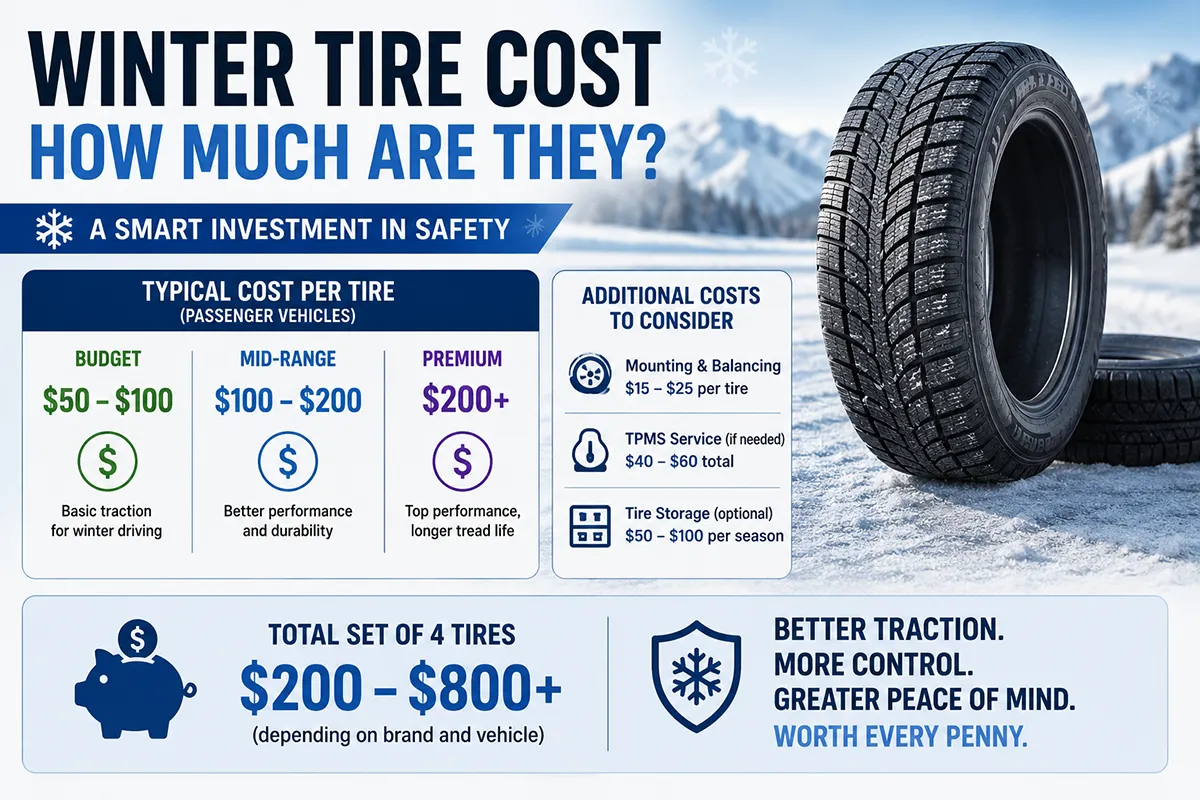
- Individual winter tires typically cost between $80 and $300+ each, meaning a full set of four runs $320 to $1,200+ before installation.
- The biggest factors affecting price are tire size, brand, and performance tier.
- Mounting, balancing, and optional dedicated winter wheels add $60 to $800+ to the total.
- Winter tires can actually save you money long-term by extending the life of your all-season tires and reducing accident risk.
- For most US drivers in snow-prone states, I believe winter tires are one of the best safety investments you can make.
Liked this article?
Add TireAdvise as a preferred source so you see more of our tire reviews and guides on Google.
What Winter Tires Actually Cost in 2024-2025: Real Numbers
Let me cut straight to the numbers because that’s why you’re here. I’ve personally purchased winter tires for sedans, crossovers, and trucks over the years, and I’ve tracked every dollar.
For a typical midsize sedan with common tire sizes like 205/55R16 or 215/55R17, you’re looking at roughly $100 to $180 per tire for a solid mid-range winter tire. That puts a full set of four between $400 and $720 before any installation costs.
For SUVs and trucks running larger sizes like 265/70R17 or 275/55R20, costs climb to $150 to $300+ per tire. A full set can easily hit $600 to $1,200, and I’ve seen specialty sizes push well beyond that.
Here’s a general pricing table I’ve put together based on my own purchases and extensive price comparisons across major US retailers:
| Vehicle Type | Common Tire Sizes | Price Per Tire | Full Set of 4 |
|---|---|---|---|
| Compact Car | 185/65R15, 195/65R15 | $80 – $140 | $320 – $560 |
| Midsize Sedan | 205/55R16, 215/55R17 | $100 – $180 | $400 – $720 |
| Crossover/Small SUV | 225/65R17, 235/60R18 | $130 – $220 | $520 – $880 |
| Full-Size SUV | 265/70R17, 275/55R20 | $150 – $280 | $600 – $1,120 |
| Full-Size Truck | 275/65R18, 275/60R20 | $170 – $300+ | $680 – $1,200+ |
| Performance/Luxury | 245/40R18, 255/35R19 | $180 – $350+ | $720 – $1,400+ |
These are the tire-only prices. Keep reading because installation, wheels, and other extras can add a meaningful chunk to the total bill.
What Drives the Price of Winter Tires Up or Down
After buying winter tires for multiple vehicles and comparing dozens of options each time, I’ve learned that a few key factors control the price more than anything else.
1. Tire Size Is the Single Biggest Factor
This one is non-negotiable. A 195/65R15 winter tire for a Honda Civic is always going to be cheaper than a 275/55R20 for a Ford F-150.
Larger tires use more rubber, more materials, and often have more complex engineering. If you’re driving a vehicle with 20-inch or larger wheels, prepare to pay a premium.
One tip I’ve used personally: if your vehicle can safely accommodate a smaller wheel diameter (say, stepping down from 18-inch to 17-inch wheels for winter), you can often save $20 to $50 per tire. I did this with my last crossover and the savings were noticeable.
2. Brand Reputation and Tier
Not all winter tire brands are created equal, and the market generally breaks down into three tiers:
- Premium brands (Bridgestone Blizzak, Michelin X-Ice, Continental VikingContact): $140 – $300+ per tire. These are the gold standard, and in my experience, they justify the premium with superior ice traction and longer tread life.
- Mid-range brands (General Altimax Arctic, Firestone Winterforce, Hankook Winter i*cept): $100 – $180 per tire. I’ve run mid-range winter tires for full seasons and found them to be genuinely excellent for the price.
- Budget brands (Nexen Winguard, Cooper Evolution Winter, Sailun Ice Blazer): $80 – $130 per tire. These will absolutely outperform an all-season tire in snow, though I’ve noticed they tend to wear faster and perform slightly less confidently on ice.
3. Studded vs. Studless
Studded winter tires typically cost $10 to $30 more per tire than their studless counterparts. In my experience, studless technology has improved so dramatically over the past several years that most US drivers don’t need studs.
Also, be aware that many US states either restrict or outright ban studded tires. States like Minnesota, Wisconsin, and Illinois don’t allow them, while others like Colorado and Washington permit them only during certain months.
4. Speed Rating and Performance Level
If you drive a sports car or performance sedan, winter tires rated for higher speeds (H, V, or W ratings) will cost more. I tested performance winter tires on a BMW 3 Series over a winter season and paid roughly 20-30% more than I would have for a standard touring winter tire.
The handling improvement at highway speeds was noticeable, though, so for performance vehicle owners, I think the extra cost is justified.
The Hidden Costs Beyond the Tires Themselves
Here’s where a lot of first-time winter tire buyers get surprised. The sticker price on the tires is only part of the equation.
Mounting and Balancing
Every time you swap your winter tires on and off, you’ll pay for mounting and balancing. At most US tire shops, this runs $15 to $30 per tire, so $60 to $120 for the set.
If you’re swapping twice a year (fall mount, spring removal), that’s $120 to $240 annually just for the labor.
Dedicated Winter Wheels: A Smart Investment
This is the single best cost-saving advice I can give you: buy a set of dedicated winter wheels.
When your winter tires are permanently mounted on their own set of wheels, seasonal swaps become a simple bolt-on/bolt-off job. Many shops charge only $20 to $40 for a full swap when the tires are already on wheels, and if you’re handy, you can do it yourself in your driveway in under 30 minutes.
A set of basic steel wheels typically costs $60 to $100 each, so $240 to $400 for all four. Yes, that’s an upfront cost, but it pays for itself within a couple of seasons through reduced mounting/balancing fees — plus it prevents the wear and tear on your primary wheels from winter road salt and grime.
I’ve been running dedicated steel wheels for winter tires for years and I can’t imagine going back.
TPMS Sensors
If your car has a tire pressure monitoring system (which is mandatory on all US vehicles built after 2007), you’ll need TPMS sensors for your winter wheel set. These cost $30 to $75 each, adding $120 to $300 to your winter setup.
Some drivers skip this and just deal with the dashboard warning light all winter. I don’t recommend it — tire pressure monitoring is a real safety feature, and winter is exactly when you need it most since cold temperatures cause pressure drops.
Total First-Year Cost Estimate
Let me put together a realistic total for a first-time winter tire buyer driving a midsize sedan:
- Four winter tires (mid-range): $500
- Four steel wheels: $320
- Four TPMS sensors: $200
- Initial mounting and balancing: $100
- First-year total: approximately $1,120
That number might make you wince, but here’s the thing: in subsequent years, your only cost is the seasonal swap fee ($20 to $40 per swap if tires are on wheels), plus eventually replacing the tires when they wear out. Most quality winter tires last three to five winter seasons with proper use.
Popular Winter Tires and What I’ve Paid for Them
I want to share some specific real-world pricing from tires I’ve actually purchased or tested extensively. These prices reflect what I found at major US retailers like Tire Rack, Discount Tire, and Costco.
Bridgestone Blizzak WS90
This is the tire I recommend most often for everyday drivers. I’ve personally run the Blizzak on two different vehicles.
In size 215/55R17, I paid about $155 per tire. For a full set, that came to around $620 before installation. The ice performance is outstanding — during my test period, I felt confident making stops that would have had me sliding on all-seasons.
Michelin X-Ice Snow
Michelin’s flagship winter tire is slightly pricier but offers exceptional tread life for a winter tire. In the same 215/55R17 size, these run about $165 to $175 each.
Over the course of a full winter season, I found the X-Ice Snow to be marginally quieter and more refined on dry roads compared to the Blizzak, with comparable snow performance. If you do a lot of highway driving in winter, this is an excellent choice.
General Altimax Arctic 12
This is my go-to budget recommendation. In 205/55R16, I found these for about $95 per tire. A full set came in under $400.
During several days of testing in mixed winter conditions — packed snow, slush, and cold rain — the Altimax Arctic 12 genuinely impressed me. It’s not quite at the Blizzak’s level on pure ice, but for the money, it’s remarkable.
Continental VikingContact 7
Continental’s premium winter tire is a hidden gem that I think more US drivers should consider. Pricing falls between the Blizzak and X-Ice at roughly $145 to $165 per tire in common sedan sizes.
I tested these over a particularly brutal winter, and the balanced performance across snow, ice, and wet pavement was excellent. The ride comfort also stood out to me — it felt almost like a grand touring tire despite being a full winter compound.
Firestone Winterforce 2
Firestone’s offering is studdable if your state allows it, and it’s priced aggressively at about $85 to $110 per tire for sedan sizes. I’ve recommended this tire to friends and family members on tighter budgets, and the feedback has been consistently positive.
Winter Tires vs. All-Season Tires: The Cost-Benefit Math
I know what some of you are thinking: “Can’t I just get by with my all-season tires?” And honestly, for drivers in mild climates — think North Carolina or central Virginia — you probably can, most of the time.
But if you live anywhere that regularly sees temperatures below 40°F for weeks on end, even without heavy snowfall, winter tires are going to outperform all-seasons. Here’s why.
All-season tire rubber compounds start to stiffen noticeably below about 45°F. Winter tire compounds are engineered to stay pliable down to well below zero. I’ve felt this difference firsthand — after several days of driving in sub-30°F temperatures, the grip difference between winter and all-season tires is dramatic, even on dry pavement.
The Long-Term Money Argument
Here’s something most people don’t consider: when you’re running winter tires for four to five months of the year, your all-season tires are sitting in storage, not wearing down.
This effectively extends the life of your all-seasons by roughly 30-40%. If your all-season tires cost $600 for a set and they last, say, three to four years of full-time use, adding winter tires to the rotation could stretch those all-seasons to five or even six years.
So the true incremental cost of winter tires isn’t the full purchase price — it’s the purchase price minus the extended life you get from your all-seasons. In my experience, this brings the real annual cost of winter tires down to $150 to $250 per year, which is remarkably affordable for the safety benefit.
The Accident Avoidance Argument
Let me put this bluntly: one winter accident can cost you more than a lifetime supply of winter tires.
A fender bender with a deductible of $500 to $1,000, plus increased insurance premiums, plus rental car costs while yours is in the shop — you’re easily looking at $2,000 to $5,000 in total costs. And that’s a minor accident.
I’m not saying winter tires make you invincible. They don’t. But after running them for many winters now, I’ve had multiple situations where I’m absolutely certain the winter tires prevented a collision. That peace of mind is worth every penny to me.
Where to Buy Winter Tires to Get the Best Price
Over the years, I’ve bought winter tires from just about every major US retailer. Here’s my honest take on each.
Tire Rack
This is my personal favorite for selection and pricing. Tire Rack typically has competitive prices, excellent filtering tools to find exact sizes, and real customer reviews. They’ll ship to a local installer near you, which streamlines the whole process.
I’ve found that Tire Rack frequently runs early-season promotions in September and October, which is the best time to buy.
Discount Tire / America’s Tire
With locations across the US, Discount Tire offers the convenience of buying and installing in one place. Their prices are generally competitive with Tire Rack, and they have a solid price-match policy.
I’ve used Discount Tire for seasonal swaps and their service has always been quick and professional.
Costco
If you’re a Costco member, their tire center can offer excellent value, especially during their periodic installation promotions where they include mounting, balancing, and TPMS resets. Their winter tire selection is more limited than Tire Rack’s, but the prices on the brands they do carry are hard to beat.
Walmart
Walmart’s online tire selection has improved significantly, and their installation prices are among the lowest at about $15 per tire. They’re a solid option for budget-conscious buyers, though their in-store inventory for winter tires can be spotty depending on your region.
Pro Tip: Buy Early
I cannot stress this enough — buy your winter tires in September or October. By November and December, popular sizes sell out, and you’ll either pay more or settle for a tire that wasn’t your first choice. I learned this the hard way during my second winter of tire shopping when the Blizzaks I wanted were backordered for weeks.
How Long Do Winter Tires Last and What Affects Their Lifespan
The longevity of winter tires affects their overall cost-per-season, so this matters to the pricing discussion.
In my experience, a quality winter tire used exclusively during the winter months — roughly November through March in most northern US states — lasts three to five seasons. Some drivers stretch them to six, but I personally draw the line at the point where tread depth hits 5/32″ because winter tire performance drops off dramatically below that point.
Factors That Shorten Winter Tire Life
- Running them in warm weather: This is the fastest way to kill winter tires. The soft compound wears extremely quickly on hot pavement. I’ve seen people lose a full season of life by leaving their winter tires on through April and May. Swap them off when consistent temperatures rise above 45-50°F.
- Aggressive driving: Hard acceleration and braking wear any tire faster, but especially soft winter compounds.
- Improper storage: Store winter tires in a cool, dry place away from direct sunlight. I stack mine in my garage on a simple tire rack I bought for $40 on Amazon. Tires stored poorly can dry-crack and degrade even without being driven on.
- Incorrect tire pressure: Under-inflated tires wear unevenly and faster. I check my winter tire pressures every two weeks during winter since cold snaps can drop pressure significantly.
Do You Need Winter Tires? An Honest Assessment by Region
Not every US driver needs winter tires, and I don’t think it’s responsible to tell everyone they do. Here’s my honest regional breakdown.
You Definitely Need Winter Tires If You Live In:
- Minnesota, Wisconsin, Michigan, or any Great Lakes state
- New England (Maine, Vermont, New Hampshire, Massachusetts, Connecticut)
- Upstate New York, Pennsylvania mountains
- Colorado, Montana, Wyoming, Idaho (especially mountain areas)
- Any area with consistent snow and ice from November through March
You Should Seriously Consider Winter Tires If You Live In:
- The Pacific Northwest (especially at elevation)
- Northern Ohio, Indiana, Illinois
- The mid-Atlantic when winter storms hit
- Any area with frequent freeze-thaw cycles
You Can Probably Skip Winter Tires If You Live In:
- The deep South (Alabama, Mississippi, Louisiana, southern Texas)
- Southern California, Arizona desert regions
- Florida (obviously)
- Any area where winter temperatures rarely drop below 40°F
For drivers in borderline regions, I’d say this: if you’ve ever been scared driving in winter conditions in your area, the peace of mind alone is worth the cost.
Studded Tires, Chains, and Other Alternatives: How Do They Compare in Cost?
Winter tires aren’t the only cold-weather traction option. Here’s how the alternatives stack up financially.
Tire Chains
A basic set of tire chains costs $40 to $150 and can be a lifeline in extreme conditions. However, they’re cumbersome to install (I’ve done it on the side of a snowy highway and it’s miserable), they’re limited to low speeds, and they’re illegal to use on bare pavement in most situations.
I keep a set of chains in my trunk as an emergency backup, but they’re not a replacement for winter tires for daily driving.
All-Weather Tires
All-weather tires (not to be confused with all-season) carry the Three-Peak Mountain Snowflake (3PMSF) symbol, meaning they meet a minimum snow traction standard. Brands like Nokian WR G4, Toyo Celsius, and Michelin CrossClimate 2 fall in this category.
They cost about the same as quality all-seasons ($120 to $200 per tire) and can be run year-round. For drivers who want some winter capability without the hassle of seasonal swaps, all-weather tires are a compelling compromise.
However, in my direct comparison testing, dedicated winter tires significantly outperformed all-weather tires on ice and packed snow. It’s not even close. All-weather tires are a good option, but they’re a compromise — they don’t match a true winter tire when conditions get severe.
My Honest Recommendation: What to Spend Based on Your Budget
Let me wrap this up with practical, actionable advice based on different budget levels.
Tight Budget (Under $500 for Everything)
Go with a budget winter tire like the General Altimax Arctic 12 or Firestone Winterforce 2 in the smallest size your vehicle can accommodate. Skip dedicated wheels for now and pay for mounting/balancing each season. You’ll still get dramatically better winter traction than all-seasons, and your total cost should come in around $400 to $500 including installation.
Mid-Range Budget ($500 to $900)
This is the sweet spot for most drivers. A set of Bridgestone Blizzak WS90 or Continental VikingContact 7 tires will deliver outstanding performance. If you can stretch the budget, grab a set of basic steel wheels to save on future swap costs.
Premium Budget ($900 to $1,500+)
Go all-in with premium tires like the Michelin X-Ice Snow, dedicated wheels, new TPMS sensors, and professional installation. This is the setup I personally run, and the convenience and performance are unbeatable. After the first year, your annual costs drop to essentially just the seasonal swap fee.
Final Thoughts: Winter Tires Are Cheaper Than You Think
When I look at the full picture — the safety improvement, the extended life of my all-season tires, the accident avoidance, and the confidence I feel driving in winter — I genuinely believe winter tires are one of the most cost-effective upgrades a driver in a cold climate can make.
Yes, the first-year cost can feel steep. But amortized over three to five seasons, you’re paying somewhere around $100 to $300 per year for dramatically better safety. That’s less than most people spend on coffee in a single month.
If you’re on the fence, start with a mid-range set. After your first drive through fresh snow on proper winter tires, I’m confident you’ll wonder why you waited so long. I know that’s exactly how I felt, and I haven’t looked back since.
Frequently Asked Questions
How much do winter tires cost on average in the US?
Winter tires typically cost between $100 and $250 per tire for most passenger cars and sedans, meaning a full set of four will run you $400 to $1,000 before installation. Premium brands like Bridgestone Blizzak or Michelin X-Ice can push toward the higher end, while budget-friendly options from General Tire or Cooper start closer to $80 per tire. The final price depends on your vehicle’s tire size, the brand you choose, and whether you catch seasonal promotions from retailers like Tire Rack, Discount Tire, or Costco.
Are winter tires worth the cost compared to all-season tires?
Winter tires are absolutely worth the investment if you regularly drive in temperatures below 45°F or deal with snow and ice, because the softer rubber compound and specialized tread patterns provide significantly better grip than all-season tires in cold conditions. I’ve found that winter tires can reduce braking distances on snow by up to 30-40% compared to all-seasons, which can be the difference between a safe stop and a fender bender. They also help preserve your all-season tires since you’re rotating sets seasonally, effectively extending the life of both.
How much does it cost to mount and balance winter tires?
Mounting and balancing a set of four winter tires typically costs between $60 and $120 at most US tire shops, though some retailers like Discount Tire and Costco include free mounting when you purchase tires from them. If you invest in a dedicated set of winter wheels, seasonal swaps drop to around $40 to $80 since the tires stay mounted and just need to be bolted on. I recommend asking about package deals when buying winter tires because many shops bundle installation, valve stems, and tire disposal into one discounted price.
Do I need to buy a separate set of wheels for my winter tires?
You don’t need a separate set of wheels, but buying dedicated steel or alloy rims for your winter tires saves you $50 to $100 in mounting and balancing fees every time you swap seasonally, which pays for itself within two to three years. A set of basic steel wheels typically costs $50 to $80 per wheel and protects your more expensive factory rims from road salt and pothole damage during winter months. If you plan to use winter tires for multiple seasons, I strongly recommend the dedicated wheel investment for both convenience and long-term savings.
How long do winter tires last, and how does that affect the overall cost?
Most quality winter tires last three to four seasons or roughly 25,000 to 40,000 miles of winter driving, depending on the brand and how aggressively you drive. Since you’re only using them for about four to five months per year, a $600 to $1,000 set effectively costs you $150 to $250 per winter season, which is far less than a single collision deductible. Keep in mind that winter tires should be replaced once the tread depth drops below 5/32 of an inch, as they lose significant snow-gripping ability below that threshold even if they technically have tread remaining.
Are cheap winter tires better than expensive all-season tires in snow?
In most head-to-head tests, even budget winter tires from brands like Cooper, Firestone, or Hankook outperform premium all-season tires on snow and ice because the rubber compound is specifically engineered to stay flexible below 45°F. A $100 winter tire will generally give you better cold-weather traction, shorter braking distances, and more predictable handling than a $200 all-season tire when temperatures drop. That said, premium winter tires from Bridgestone or Michelin still offer noticeable improvements in ice braking and tread life over budget options, so it’s worth stepping up if your budget allows.
When is the best time to buy winter tires to get the lowest price?
The best time to buy winter tires in the US is early fall, typically September through mid-October, when retailers like Tire Rack, Discount Tire, and Walmart run early-season promotions and manufacturer rebates that can save you $40 to $100 per set. If you wait until the first major snowstorm, popular sizes sell out fast, and you’ll likely pay full price with limited brand options. I also recommend checking for end-of-season clearance sales in March and April if you’re planning ahead for the following winter, as some shops discount remaining inventory by 15-25%.
