

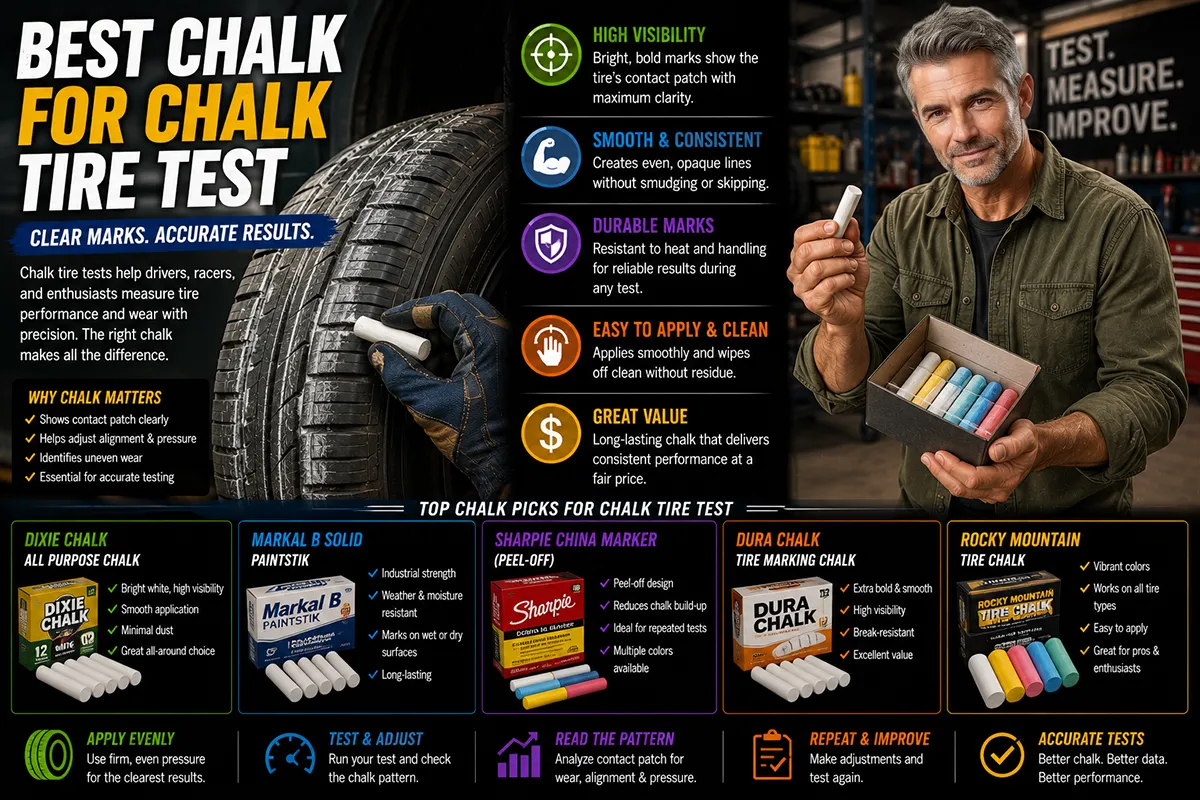
The chalk tire test is a genuinely useful, zero-cost way to visualize how a tire’s contact patch changes with inflation pressure — draw a line across the tread, drive forward, and read the wear pattern left behind.
Before covering which chalk actually works best, it’s worth addressing something most guides skip entirely: the test has real, documented limitations that no chalk can fix. Understanding those limitations first makes the results genuinely more useful, not less.
This guide is based on manufacturer specifications, aggregated forum and owner reports across truck, off-road, and general automotive communities, and independently reported chalk-adhesion testing. Here’s what actually holds up.
- Best overall: Crayola Sidewalk Chalk (white).
- Best budget pick: Boxer’s white chalk blocks.
- Best for damp or dewy conditions: Liquid Grip chalk-based liquid.
- Best for high-visibility readability: Bright yellow sidewalk chalk.
- Avoid: Blackboard chalk and standard “dustless” classroom chalk — both adhere poorly to rubber.
- The chalk test is a genuinely useful diagnostic tool, but it’s not infallible — it works best as a supplement to your door-jamb pressure spec, not a replacement for it.
Liked this article?
Add TireAdvise as a preferred source so you see more of our tire reviews and guides on Google.
A Real Limitation Worth Knowing Before You Test
This is worth addressing directly, since it’s the part most chalk-test guides skip entirely, and it matters more than which specific chalk brand you use — no amount of premium chalk fixes a test being applied to a tire design the method wasn’t built to evaluate cleanly.
A tire’s contact-patch shape is influenced by inflation pressure, but it’s also heavily shaped by the tire’s own engineered tread profile — something the chalk test can’t distinguish between.
Discussion among truck and off-road forum members, including references to tire-engineer feedback and Consumer Reports’ own commentary on the method, points out that some tires are intentionally designed with a crowned or rounded tread profile rather than a perfectly flat one, meaning a chalk test performed on that tire will show uneven wear at every pressure, not because the pressure is wrong, but because that’s how the tire was engineered to look.
This shows up in real, documented cases. Owners of aggressive off-road mud-terrain tires with a deliberately rounded tread report the chalk line staying visible along the shoulders even at surprisingly low pressures, well below what door-jamb figures would suggest — not a sign of over-inflation, but a reflection of that tire’s intentional shoulder geometry.
None of this means the chalk test is worthless — far from it. It remains a genuinely useful way to spot obvious over- or under-inflation and to visualize how pressure changes affect a specific tire’s footprint over time.
The honest takeaway is to treat it as a supplementary diagnostic, not a replacement for the pressure listed on your vehicle’s door jamb placard, and to weigh results with some skepticism on tires with a known rounded or aggressively profiled tread.
How the Chalk Test Actually Works
Draw a thick, straight line of chalk across the width of the tire, from sidewall to sidewall. Drive the vehicle forward in a straight line for at least one full car length — turning the wheel during this step will skew results. Inspect the chalk remaining on the tire and on the ground.
Even wear across the full line indicates correct pressure — the entire contact patch made even ground contact.
Only the center of the line worn away, with chalk still visible at the edges, indicates over-inflation — the tire is bulging outward and touching pavement mainly at the center.
Only the edges worn away, with a strip of chalk still visible down the center, indicates under-inflation — the tire’s center isn’t fully contacting the road.
Adjust pressure in small increments (2–3 PSI) and repeat until the wear pattern reads even, keeping the caveat above in mind for tires with a known rounded profile.
How These Were Evaluated
This comparison draws on manufacturer specifications, aggregated forum and owner reports, and independently reported testing on chalk adhesion to rubber, line visibility, dust and mess generated, and durability through a short test drive.
Evaluation focused specifically on how well each product adheres to tire rubber (a genuinely different surface than a chalkboard or sidewalk), contrast and readability against black rubber, and practical mess during application.
Where specific figures or comparisons are cited, the source is noted rather than presented as a personal measurement.
Quick Comparison: 7 Best Options for the Chalk Tire Test
| Product | Type | Adhesion to Rubber | Visibility | Mess Level | Price |
|---|---|---|---|---|---|
| Crayola Sidewalk Chalk (white) | Solid stick | Excellent | Excellent | Low | $5–$8 |
| Boxer’s white chalk blocks | Solid block | Very good | Excellent | Moderate (fine dust) | $4–$6 |
| Liquid Grip | Liquid, foam applicator | Excellent (moisture-resistant) | Excellent | Low | $12–$18 |
| Bright yellow sidewalk chalk | Solid stick | Excellent | Excellent (best on very dark rubber) | Low | $5–$8 |
| Carpenter’s chalk line refill powder | Fine powder | Good (with damp-rag technique) | Very good | High | $4 |
| “Dustless” classroom chalk | Solid stick | Poor | Poor (fades quickly) | Low | $3 |
| Blackboard/gypsum chalk | Solid stick | Poor | Fair | High | $2–$4 |
1. Crayola Sidewalk Chalk (White): Best Overall
This is the genuinely simplest, most widely available option, and independently reported testing confirms it performs as well as or better than most specialty alternatives.
The relatively soft, chalky composition adheres cleanly to rubber without excessive dust, and the thick stick shape makes drawing a bold, consistent line across the tread genuinely easy. White provides the strongest contrast against black rubber of any color commonly available, and the line remains clearly readable after a short test drive.
Pros: Genuine reliability, widely available at any store, inexpensive, minimal mess.
Cons: Slightly softer than premium alternatives, meaning a very light touch during application can leave a fainter line than intended.
2. Boxer’s White Chalk: Best Budget Pick
This tradesman-oriented chalk comes in compact 2-ounce blocks, and independently reported testing describes it marking cleanly without being overly waxy.
The resulting line is easy to see and wears evenly under the tire during a test drive — a real, practical strength for accurate readings. It does produce somewhat more fine dust than the Crayola option during application, though not enough to meaningfully affect results.
Pros: Genuine value, widely available online, compact and easy to store.
Cons: Slightly dustier during application than top-tier alternatives.
3. Liquid Grip: Best for Damp or Dewy Conditions
Standard chalk has a real, practical weak point: it can fail entirely on damp pavement or during a dewy morning test, since moisture prevents proper adhesion or washes the line away before the test is complete. This chalk-based liquid solves that specific problem.
It comes in a bottle with a foam applicator tip, painted directly onto the tread. Once dry, it forms a slightly rubberized coating that’s genuinely resistant to moisture and incidental contact — a real, meaningful advantage for anyone testing in a humid climate or a garage without perfect climate control.
Pros: Genuine moisture resistance standard chalk can’t match, clean application with a foam tip, durable through a longer test drive.
Cons: Higher price than solid chalk, requires drying time before driving.
4. Bright Yellow Sidewalk Chalk: Best for High-Visibility Readability
For anyone testing in low light, on very worn or already-lightened rubber, or simply wanting maximum contrast, this color option delivers genuinely the highest visibility against black tire rubber.
Independently reported comparisons describe yellow chalk remaining visible slightly longer than white on some tread compounds, likely due to pigment density. Application and adhesion characteristics are otherwise identical to standard white sidewalk chalk.
Pros: Genuine maximum visibility, widely available, inexpensive.
Cons: No meaningful adhesion advantage over white — color is the only real differentiator.
5. Carpenter’s Chalk Line Refill Powder: Best for a Genuinely Even Coat
This is a fine, heavily pigmented powder meant for snap chalk line tools, and independently reported testing found it produces a genuinely even, readable result — with an important technique caveat.
Applying it dry is impractical and messy, coating hands, clothes, and the garage floor. Using a damp rag to pat the powder onto the tread, however, produces results described as “very clearly visible” after a test drive, with the fine powder settling evenly into tread grooves and coating tread blocks consistently.
Pros: Genuine even coverage with the right technique, very fine pigment shows tread detail clearly.
Cons: Messy without the damp-rag technique, less convenient than a stick or liquid for occasional use.
6. “Dustless” Classroom Chalk: Not Recommended
This thinner, more compressed chalk seems like it should work better due to its firmer texture, and application is genuinely easier — the thin stick allows more precise lines across the tread.
The problem is adhesion. The dustless formulation, engineered specifically to minimize chalkboard dust, doesn’t stick to rubber well. Independently reported testing describes lines becoming extremely faint and hard to read after even a short test drive, undermining the entire point of the test.
Pros: Precise, easy application.
Cons: Genuinely poor adhesion to rubber — the line fades before results can be reliably read.
7. Blackboard/Gypsum Chalk: Not Recommended
This is the option most likely to already be sitting in a junk drawer, and it’s genuinely the weakest performer in this comparison.
Gypsum-based blackboard chalk is softer and dustier than sidewalk chalk, creating a real mess during application and adhering poorly to the rubber compound. Independently reported results describe inconsistent, unreliable readings — exactly the outcome the test is meant to avoid.
Pros: Already commonly on hand.
Cons: Poor adhesion, excessive dust, unreliable results — genuinely worth avoiding for this specific use.
Color Matters More Than Most Guides Mention
White or bright yellow are consistently the best choices for this test, providing the highest contrast against black tire rubber and making the resulting wear pattern easiest to interpret accurately.
Darker colors — blue, green, red — are harder to read against black rubber even when adhesion is otherwise fine, adding an unnecessary variable to a test that’s supposed to simplify things.
A Complementary, More Precise Approach
Since the chalk test has real, acknowledged limitations, pairing it with a manufacturer’s own load-and-pressure chart adds genuine precision the chalk test alone can’t provide.
Michelin, among other manufacturers, publishes pressure charts based on actual measured axle weight rather than a generic assumption.
The more rigorous approach: get the vehicle weighed at a certified scale (many truck stops offer this for a small fee), then cross-reference that figure against the tire manufacturer’s own load-inflation table for the specific tire in use.
Using the chalk test as a quick visual sanity check alongside that more precise, weight-based calculation gives a genuinely more complete picture than relying on either method alone — particularly valuable for anyone running a non-stock tire size or carrying a load meaningfully different from the vehicle’s typical configuration.
Step-by-Step: Getting an Accurate Chalk Test
Test in the morning, before sun exposure. Direct sunlight heats tires unevenly and raises pressure, skewing results. Early morning, before driving, gives the most accurate baseline.
Start at a reasonable baseline pressure. A common approach: subtract roughly 10% from the tire’s maximum sidewall inflation rating as a starting point, then adjust from there based on chalk results.
Find a genuinely flat, straight testing area. A driveway or empty parking lot works well. Avoid areas with cracks, bumps, or potholes that could distort the reading, and avoid any area requiring a turn during the test drive.
Drive at least one full car length in a straight line. Turning the steering wheel, even slightly, introduces cornering forces that distort the contact patch and invalidate the reading.
Adjust in small increments. Change pressure by 2–3 PSI at a time and repeat the test, rather than making large jumps that overshoot the correct pressure.
Repeat after significant mileage on new tires. New tire compounds can behave slightly differently once broken in — a second chalk test after the first 500–1,000 miles can refine the initial reading.
When the Chalk Test Is Most and Least Useful
Most useful for: Owners running non-stock tire sizes where manufacturer pressure charts don’t directly apply, off-road tires being adjusted for different terrain, and general visual confirmation that pressure is in a reasonable range.
Least reliable for: Tires with an intentionally rounded or heavily crowned tread profile, situations involving significant load changes between tests, and any test performed while turning or on uneven ground.
Troubleshooting Confusing Results
The line disappeared completely, everywhere. This usually means the chalk itself failed to adhere — likely a “dustless” or blackboard-style product, or the tire was wet during application. Switch to a proven sidewalk chalk or the Liquid Grip option and retest.
Results look identical at every pressure tested. This is a real, documented sign that the tire’s tread profile is dominating the result rather than pressure — common on tires with a rounded or aggressively crowned shoulder design. Cross-reference with the tire manufacturer’s own pressure guidance rather than continuing to chase a “perfect” chalk reading that may not exist for that tire’s design.
One tire reads differently than the others at the same pressure. This can indicate a genuine alignment issue, a bent wheel, or uneven loading (more weight on one side or corner of the vehicle) rather than a pressure problem specific to that tire. Worth investigating before assuming the tire itself is at fault.
The pattern looks fine but the ride feels off. Chalk test results and subjective ride feel don’t always align, and that’s expected — the chalk test measures contact-patch geometry, not comfort. A pressure that produces an even chalk pattern can still feel firmer or softer than personal preference; adjusting slightly from the “textbook correct” reading for comfort is a reasonable, common practice as long as the adjustment stays within the tire’s rated pressure range.
Where to Buy Chalk for a Tire Test
Any grocery store, drugstore, or big-box retailer carries sidewalk chalk in the seasonal or kids’ section year-round in most regions, making the top two picks in this comparison genuinely easy to find without a special trip.
Amazon and hardware store websites stock Liquid Grip and similar liquid alternatives, along with carpenter’s chalk line refill powder in the tool section alongside snap chalk line kits.
Automotive parts stores occasionally carry purpose-marketed “tire chalk” products, though independently reported testing suggests these rarely outperform basic sidewalk chalk at a meaningfully higher price — the marketing label doesn’t reflect a genuinely different formulation in most cases.
Frequently Asked Questions
What is the best chalk to use for a tire pressure chalk test?
White or bright yellow sidewalk chalk, like Crayola or Boxer’s brand, works best for most tires, offering strong adhesion to rubber and high contrast for easy reading. For damp or humid conditions, a liquid option like Liquid Grip provides more reliable, moisture-resistant results.
Is the chalk tire test actually accurate?
It’s a genuinely useful visual diagnostic, but it has real, documented limitations. Tire engineers and outlets including Consumer Reports have noted that a tire’s contact-patch shape is significantly influenced by its designed tread profile, not just inflation pressure — meaning tires with a rounded or crowned tread can show uneven chalk wear even at correct pressure. Use it as a supplement to your door-jamb pressure specification, not a replacement for it.
Can I use regular blackboard chalk for a tire test?
It’s not recommended. Blackboard chalk is typically gypsum-based, which is softer, dustier, and adheres poorly to rubber compared to sidewalk chalk, often producing inconsistent or unreadable results.
How often should I do a chalk tire test?
It’s most useful when installing a new tire size, adjusting pressure for a significant load change, or fine-tuning pressure for off-road use. For routine maintenance, checking pressure with a gauge against your door jamb specification monthly is more practical and reliable than repeating a chalk test regularly.
What color chalk works best against black tire rubber?
White and bright yellow provide the strongest contrast and are the easiest to read accurately. Darker colors like blue, red, or green are harder to distinguish against black rubber, adding unnecessary difficulty to interpreting results.
Does the chalk test work on off-road or all-terrain tires?
It can, but results should be interpreted more cautiously. Off-road and mud-terrain tires often have a rounded or aggressively profiled tread by design, which can cause the chalk test to show uneven wear at every pressure — not because the pressure is wrong, but because of the tire’s intentional shoulder geometry. Cross-referencing with the tire manufacturer’s specific pressure recommendations is genuinely worthwhile for these tire types.
What’s a good alternative to the chalk test for finding the right tire pressure?
Getting your vehicle weighed at a certified scale and cross-referencing that figure against the tire manufacturer’s load-inflation table provides a more precise, weight-based pressure recommendation. Using this alongside a chalk test, rather than relying on either method alone, gives the most complete and accurate picture.
