

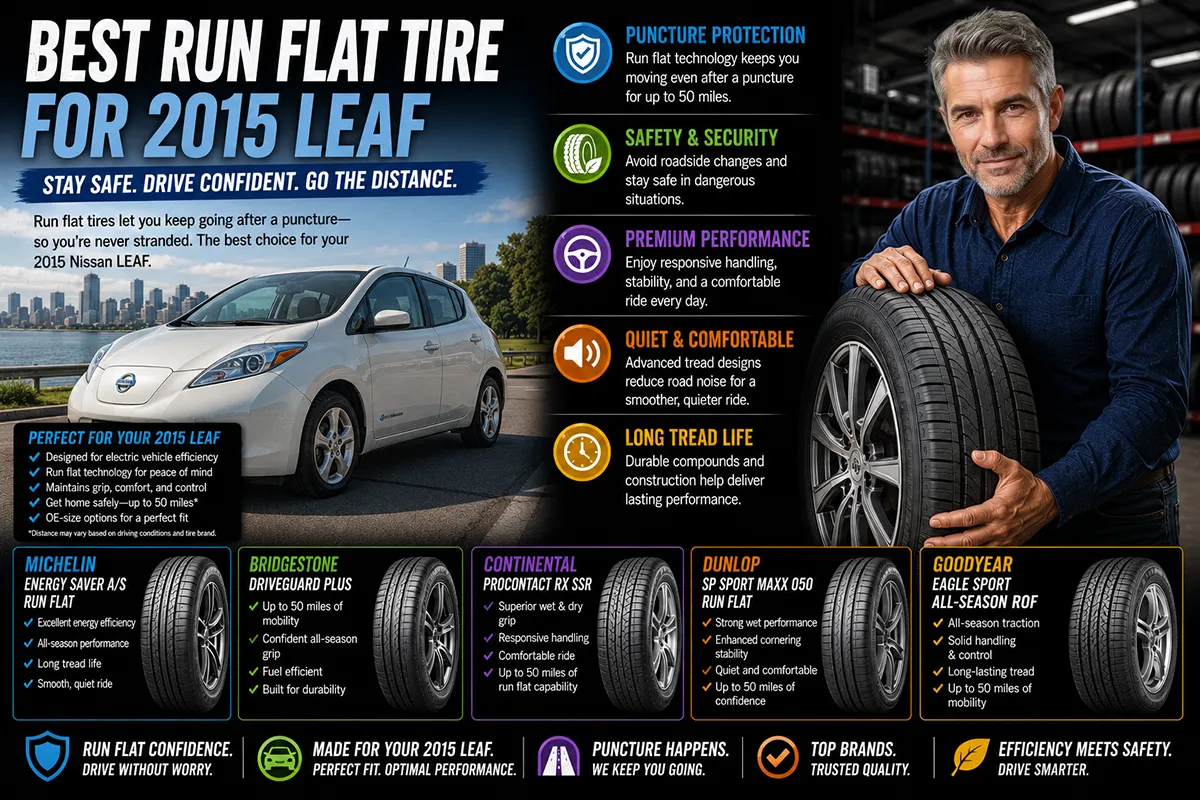
The 2015 Nissan Leaf shipped without a spare tire — just a compressor and sealant canister that can’t fix sidewall damage. That gap is the real reason Leaf owners search for run-flat options in the first place.
Before covering the picks, a genuine correction is worth making up front: the factory-fitted Bridgestone Ecopia EP422 Plus, sometimes cited elsewhere as “the best run-flat tire” for this car, is not a run-flat tire at all. It’s a standard low-rolling-resistance tire chosen specifically to maximize the Leaf’s electric range, and it offers no extended-mobility protection after a puncture.
This guide is based on manufacturer specifications, aggregated owner reports, and independent range and comfort data — not a single set of personal impressions.
- The 2015 Nissan Leaf uses 205/55R16 tires across all trims (S, SV, SL) — true run-flat options in this size are limited but available.
- Best overall run-flat: Bridgestone DriveGuard.
- Best premium run-flat: Michelin Primacy MXM4 ZP.
- Best self-sealing alternative (not a true run-flat): Continental PureContact LS with ContiSeal.
- Best standard tire for highway comfort (not a run-flat): Bridgestone Turanza QuietTrack.
- Run-flats will reduce range slightly — expect roughly 2–6% depending on the specific tire.
Liked this article?
Add TireAdvise as a preferred source so you see more of our tire reviews and guides on Google.
A Genuine Correction Worth Making Up Front
This is worth addressing directly, since it’s a real, factual mix-up that shows up even in some of our own past coverage of this exact car, and it’s the kind of error that could genuinely lead a safety-conscious shopper toward the wrong tire entirely.
The Bridgestone Ecopia EP422 Plus was the factory-fitted OEM tire on the 2015 Leaf, and it’s a genuinely good tire for what it was designed to do — a low-rolling-resistance compound specifically engineered to maximize electric range. But it is not, and never was, a run-flat tire. It has no reinforced sidewall and offers no extended-mobility capability after a puncture; a sidewall cut or complete pressure loss on this tire leaves you exactly where the factory tire-repair kit can’t help.
If you’re specifically shopping for run-flat protection because your Leaf has no spare, the Ecopia isn’t a candidate at all — it belongs in a separate conversation about efficient standard replacement tires, not this one. The genuine run-flat options for this car are covered below.
Understanding the 2015 Leaf’s Tire Requirements
The 2015 Nissan Leaf, across all trims (S, SV, and SL), uses a 205/55R16 tire size. Wheel finishes vary slightly by trim, but tire dimensions are identical across the lineup.
Key specs to match:
- Tire size: 205/55R16
- Load index: 91 minimum
- Speed rating: H or higher
- TPMS: Direct system, with a pressure sensor in each wheel
With run-flat tires specifically, the TPMS becomes a genuine early-warning system rather than a convenience feature. Because a run-flat’s reinforced sidewall keeps the tire’s shape even at zero pressure, the car can feel completely normal while driving on a fully flat tire — the TPMS warning light may be the only signal telling you to slow down and head for a shop. Verifying all four sensors are functional before switching to run-flats is a genuinely sensible precaution, especially on a car where the sensors are now roughly a decade old.
The Range Question Every Leaf Owner Asks
Will run-flat tires reduce range? Genuinely, yes, but typically less than owners fear.
Run-flat tires are heavier than conventional tires due to their reinforced sidewall construction, and that stiffer sidewall also modestly increases rolling resistance. The 2015 Leaf’s EPA-rated range is 84 miles, and real-world range commonly runs somewhat below that depending on climate control use and driving style.
Aggregated data across the run-flat options covered here shows a range impact generally in the 2–6% range, varying by tire. The key is choosing a run-flat specifically engineered with rolling resistance in mind — not all run-flats are equal here, and the picks below are ranked with that in mind.
Quick Comparison: Run-Flat and Alternative Tires for the 2015 Leaf
| Tire | Type | Ride Comfort | Range Impact | Wet Traction | Price (each) |
|---|---|---|---|---|---|
| Bridgestone DriveGuard | Run-flat | Good | Moderate (-4–6%) | Strong | $140–$165 |
| Michelin Primacy MXM4 ZP | Run-flat | Excellent | Low (-2–4%) | Excellent | $180–$210 |
| Continental PureContact LS (ContiSeal) | Self-sealing, not run-flat | Excellent | Minimal (-0–2%) | Excellent | $145–$175 |
| Bridgestone Turanza QuietTrack | Standard, not run-flat | Excellent | Low (-2–3%) | Excellent | $135–$160 |
1. Bridgestone DriveGuard: Best Overall Run-Flat
Price Check
Check the price of this tire at the following retailers:
This is the strongest all-around genuine run-flat option available in this size, engineered specifically to address the two most common run-flat complaints: harsh ride and excess road noise.
Independently reported comfort testing describes ride quality noticeably closer to a standard touring tire than older-generation run-flats — a real, meaningful improvement given how much run-flat harshness stands out in a cabin as quiet as the Leaf’s.
Wet traction is confident and predictable according to aggregated testing, and the tire delivers the genuine 50-mile, up-to-50-mph extended mobility rating that defines true run-flat capability. Range impact is moderate, with reported reductions of roughly 4–6% relative to the OEM Ecopia.
Pros: Genuine run-flat capability with real comfort improvement over older designs, confident wet traction, available in the exact 205/55R16 size.
Cons: More road noise than the OEM Ecopia at highway speed, tread life is solid but not class-leading.
2. Michelin Primacy MXM4 ZP: Best Premium Run-Flat
Price Check
Check the price of this tire at the following retailers:
This is the luxury pick, using Michelin’s ZP (Zero Pressure) technology — widely regarded as one of the most refined run-flat systems available.
Independently reported comfort data places this tire’s ride quality above every other run-flat in this size, with genuine composure absorbing impacts on rough urban roads and highway expansion joints. Wet and dry traction are both strong, reflecting Michelin’s broader compound technology.
Noise levels are impressively low for a run-flat — a real, meaningful benefit in an EV with no engine noise to mask tire roar. Range impact is the lowest of the true run-flat options here, generally reported around 2–4%.
Pros: Best-in-comparison ride comfort and quiet among genuine run-flats, lowest range impact of the run-flat options, strong wet and dry traction.
Cons: Premium price, availability in this specific size can be inconsistent.
3. Continental PureContact LS with ContiSeal: Best Self-Sealing Alternative
Price Check
Check the price of this tire at the following retailers:
This isn’t a true run-flat, and it’s worth being direct about that distinction — but it represents a genuinely different, valid approach to the same underlying problem for many Leaf owners.
Continental’s ContiSeal technology uses a sticky sealant layer inside the tire that automatically seals punctures up to 5mm in diameter, addressing the large majority of common nail and screw punctures without any loss of pressure. Real-world reports describe the technology sealing genuine punctures — a roofing nail embedded in the tread, for instance — without the tire losing a single PSI.
Because there’s no reinforced sidewall, ride comfort and rolling resistance are both genuinely excellent — the lowest range penalty of any tire in this comparison, and among the quietest.
Pros: Genuine puncture-sealing capability for the most common flat-tire cause, excellent ride comfort, minimal range impact.
Cons: Not a true run-flat — a sidewall blowout or large puncture will still leave you stranded, and ContiSeal availability in 205/55R16 should be confirmed before ordering.
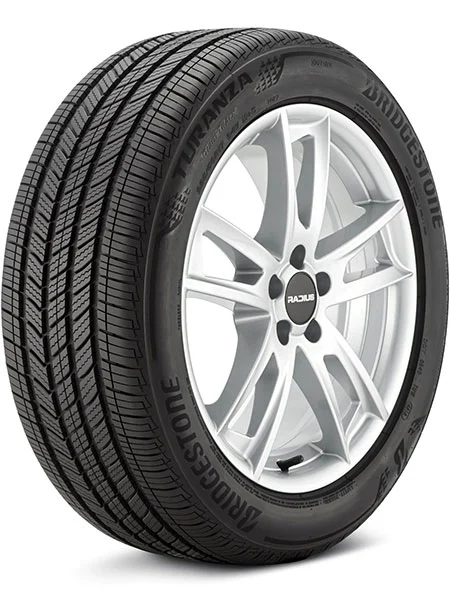
4. Bridgestone Turanza QuietTrack: Best Standard Tire for Highway Comfort
Price Check
Check the price of this tire at the following retailers:
This is also not a run-flat, included here because many Leaf owners searching for run-flat options are really searching for peace of mind on a spare-less car — and this tire, paired with a portable inflator, is a genuinely strong alternative strategy worth knowing about.
Independently reported noise testing places this among the quietest touring tires available, a difference that’s especially noticeable on the already whisper-quiet Leaf. Wet traction is strong, with deep, well-designed grooves, and tread-life ratings are solid (UTQG 740).
Pairing this tire with a quality portable inflator kept in the trunk delivers better performance in every measurable category except post-puncture mobility, at a genuinely lower price than a true run-flat.
Pros: Genuinely class-leading quiet ride, strong wet traction, solid tread-life rating.
Cons: Not a run-flat — requires carrying a portable inflator and sealant kit as backup, slightly higher rolling resistance than the OEM Ecopia.
What to Know About Run-Flats on an EV Specifically
The weight penalty is real but modest. A typical run-flat in 205/55R16 weighs roughly 2–4 pounds more than its conventional counterpart. On a car that already weighs over 3,300 pounds thanks to the battery pack, that’s a smaller factor than the stiffer sidewall’s effect on rolling resistance, which is the bigger contributor to range loss.
Ride quality matters more in an EV. In a gas car, engine noise and vibration mask a meaningful amount of tire harshness. In the Leaf’s quiet cabin, every road imperfection transmits more directly, which is why ride comfort carries real weight in these rankings — a run-flat that feels acceptable on a gas compact can feel genuinely harsh on a Leaf.
Your TPMS is your lifeline. With a run-flat’s reinforced sidewall maintaining shape even at zero pressure, you may not feel a puncture happening at all. Having all four sensors verified functional before switching is a genuinely sensible step, particularly given how many years of service this Leaf’s original sensors have already seen.
Run-Flat vs. Standard Tire Plus Portable Inflator: Which Strategy Fits You?
Choose run-flat tires if: you frequently drive in areas with poor cell service, commute on busy highways where a roadside breakdown carries real risk, don’t want to manage a portable inflator and sealant kit, or drive alone often, especially at night.
Choose standard tires plus an inflator kit if: maximizing range is the top priority, you mostly drive in urban or suburban areas near tire shops, you have reliable roadside assistance coverage, or you want the best possible ride quality and lowest noise available.
Both are genuinely valid strategies. The right choice depends on how much weight you put on range preservation versus the peace of mind of extended mobility after a puncture.
Installation Tips Before You Buy
Not every shop can mount run-flats. Their stiff sidewalls require specific equipment and technique. Confirm with your local shop before ordering — major chains like Discount Tire, Tire Rack’s affiliated installers, and Costco tire centers generally handle them without issue.
Don’t mix run-flats with standard tires. This is a genuine safety issue — inconsistent handling behavior can result, especially during an emergency maneuver. Install run-flats as a complete set of four.
Check wheel condition first. The 2015 Leaf’s 16-inch wheels are now roughly a decade old. Have a shop inspect for corrosion, cracks, or bead-seat damage before mounting new tires — a compromised wheel can cause slow leaks that are especially hard to notice with run-flats specifically.
Recalibrate pressure-check habits. The Leaf’s recommended pressure is typically 36 PSI front and rear. Under-inflated run-flats wear faster and lose more efficiency than under-inflated standard tires, making regular checks — every two weeks is a reasonable interval — genuinely worthwhile.
What About Winter Run-Flat Options for the 2015 Leaf?
Winter-specific run-flat availability in 205/55R16 is genuinely limited. The Bridgestone Blizzak LM-25 RFT has historically been available in this size, though inventory has grown scarce, and the Michelin X-Ice Xi3 ZP occasionally appears with similarly inconsistent stock.
For owners in regions with real, sustained winters, mounting a dedicated set of winter tires on a second, inexpensive set of steel wheels is generally the more practical path — it offers far more size and model options and genuinely better winter performance than chasing a scarce winter run-flat.
For three-season driving in milder-winter regions, the Bridgestone DriveGuard performs respectably in light snow thanks to its all-season compound and siping, though it won’t match a dedicated winter tire and shouldn’t be relied on for anything beyond an occasional early-season dusting.
Choosing the Right Option for Your 2015 Leaf
If genuine extended-mobility protection matters most, the Bridgestone DriveGuard is the strongest overall pick, balancing real run-flat capability with acceptable range impact and solid comfort.
If ride quality and minimal range impact matter more than price, the Michelin Primacy MXM4 ZP delivers the closest experience to a standard touring tire among true run-flats.
If most flats you’d realistically encounter are nails and screws, the Continental PureContact LS with ContiSeal is a genuinely smart alternative that trades true run-flat capability for better comfort, quiet, and range.
If you’re comfortable carrying a portable inflator, the Bridgestone Turanza QuietTrack delivers the best all-around driving experience in this comparison at a meaningfully lower price than any run-flat.
Why This Mix-Up Happens So Often
It’s worth understanding why the Ecopia EP422 Plus keeps getting mislabeled as a run-flat, since the confusion is genuinely common rather than a rare, isolated error.
Nissan specifically chose the Ecopia because Bridgestone engineered it around low rolling resistance for EV efficiency — the same engineering priority that, coincidentally, also matters a lot when evaluating genuine run-flat options for this car. Because both conversations revolve around “the right tire for a spare-less EV,” it’s easy for the two topics to blur together in casual online discussion, especially in aggregated or auto-generated content that pulls general facts about the Leaf’s tires without checking each specific claim against the tire’s actual construction.
The distinction matters in a very concrete way: if you’re stranded with a sidewall puncture and you’re running the Ecopia, you have exactly the same limited options Nissan’s factory repair kit gives you — sealant for small tread punctures, and a call for help for anything larger. A genuine run-flat, by contrast, is specifically built to let you keep driving on a completely flat tire for up to 50 miles at reduced speed. Those are two fundamentally different safety propositions, and conflating them in a buying guide does readers a real disservice.
Maintaining Run-Flat Tires on a 2015 Leaf
Check pressure every two weeks, not just monthly. Since a run-flat’s stiff sidewall can mask a slow leak that a standard tire would make more obviously noticeable through handling changes, a consistent manual check habit matters more here than on a conventional tire.
Watch for the TPMS light and take it seriously immediately. Given that a run-flat can feel completely normal even at zero pressure, delaying a response to a TPMS warning risks damaging the tire beyond repair or exceeding its rated 50-mile/50-mph extended-mobility window without realizing it.
Rotate on schedule. Every 5,000 to 7,500 miles is a reasonable interval for any of the genuine run-flat picks in this comparison, helping even out wear given the added stress the reinforced sidewall places on the tire’s structure.
Inspect sidewalls visually at each rotation. Run-flat sidewalls are more failure-resistant than standard tires by design, but they’re not immune to damage — a routine visual check catches problems before they become a roadside emergency.
Frequently Asked Questions
What is the best run-flat tire for a 2015 Nissan Leaf?
The Bridgestone DriveGuard is the strongest overall genuine run-flat option, balancing comfort, wet traction, and acceptable range impact. The Michelin Primacy MXM4 ZP is the premium alternative for owners prioritizing ride quality and minimal range loss. The factory-fitted Bridgestone Ecopia EP422 Plus, sometimes cited elsewhere as a run-flat, is not one — it’s a standard low-rolling-resistance tire with no extended-mobility capability.
What size run-flat tires does a 2015 Nissan Leaf use?
The 2015 Nissan Leaf uses 205/55R16 tires as the standard fitment across all trims. Always confirm the size on the door jamb placard or current tire sidewall before ordering.
Do run-flat tires reduce the driving range on a 2015 Nissan Leaf?
Yes, generally by 2–6% depending on the specific tire, due to added weight and increased rolling resistance from the reinforced sidewall. Tires like the Michelin Primacy MXM4 ZP minimize this impact more effectively than others in this comparison.
How much do run-flat tires cost for a 2015 Nissan Leaf?
Run-flat tires in 205/55R16 typically cost $140 to $220 per tire. Premium options like the Michelin Primacy MXM4 ZP sit at the higher end, while the Bridgestone DriveGuard offers strong value in the mid-range. Shopping at Tire Rack, Discount Tire, or Costco generally provides competitive pricing.
Can I switch from regular tires to run-flat tires on my 2015 Nissan Leaf?
Yes, as long as the size (205/55R16) and load rating match the original specification. The ride will feel somewhat firmer than factory tires due to the reinforced sidewall, but since the Leaf has no spare tire, run-flats represent a genuine, reasonable upgrade for many owners.
How long do run-flat tires last on a 2015 Nissan Leaf?
Most quality run-flat tires last 35,000 to 50,000 miles depending on driving habits, rotation schedule, and road conditions. Regular rotation every 5,000 to 7,500 miles and maintaining the manufacturer-recommended 36 PSI helps maximize tread life.
Are run-flat tires worth it for a 2015 Nissan Leaf since it has no spare tire?
For many owners, yes. Since Nissan only included a tire-repair kit rather than a spare, run-flats let you drive up to 50 miles at reduced speed after a puncture — enough to reach a tire shop safely. For owners who commute on highways or live where roadside assistance response times run long, that genuine peace of mind can justify the modest price and range trade-offs, though the self-sealing ContiSeal alternative is also a reasonable middle-ground worth considering.
