

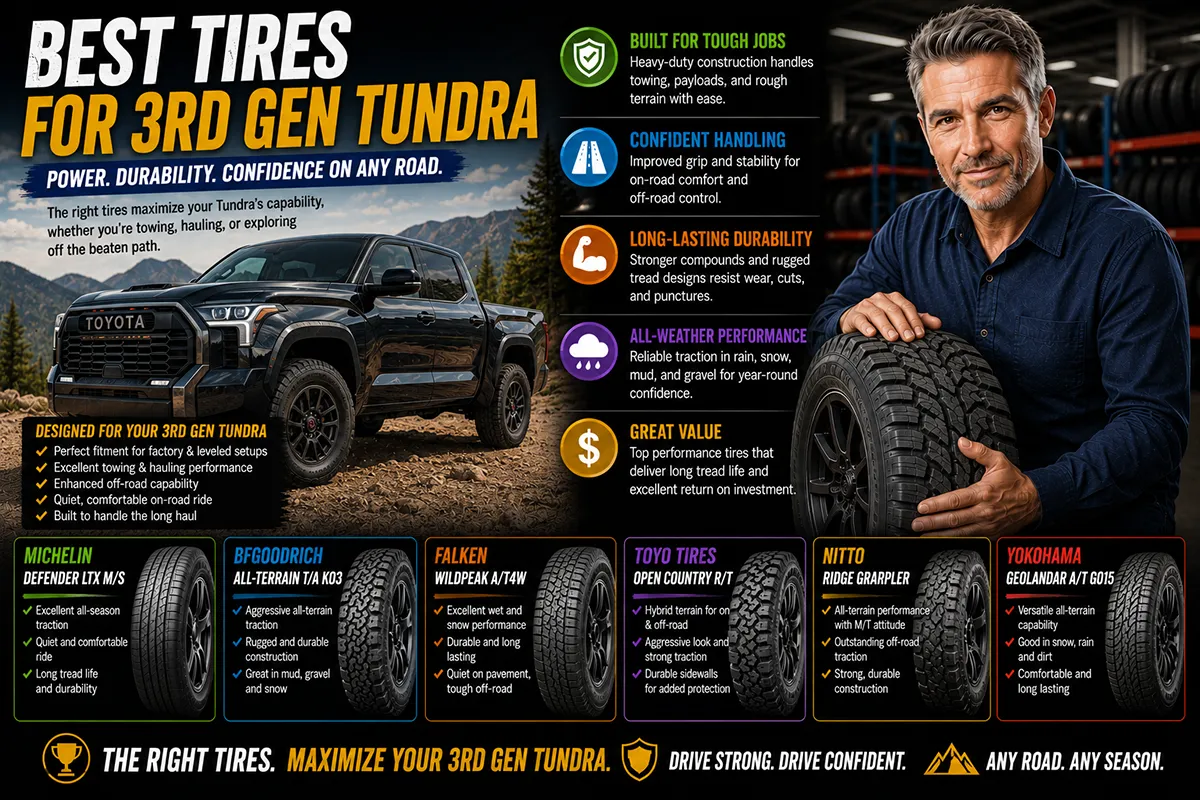
The 2022+ Tundra rides on a completely new platform compared to the 2nd Gen, with a coil-spring rear suspension that genuinely changed ride characteristics — meaning tire choice has an even bigger real-world impact than it did on the older leaf-spring trucks.
The 3rd Gen Tundra is also genuinely heavier than its predecessor, tipping the scales at roughly 5,500–6,300 pounds depending on configuration, which demands tires with solid load ratings and robust sidewall construction.
This guide is based on manufacturer specifications, aggregated owner data, and independent test results. Here’s what actually holds up, by priority.
- Best overall: Michelin Defender LTX M/S2.
- Best all-terrain: BFGoodrich All-Terrain T/A KO3.
- Best for towing: Continental TerrainContact H/T.
- Best budget pick: Falken Wildpeak A/T3W.
- Best for off-road: Nitto Ridge Grappler.
- Best highway tire: Bridgestone Dueler H/L Alenza Plus.
- Best for winter: Michelin X-Ice Snow SUV.
- Full sizing by trim, correcting a real error, is below.
Liked this article?
Add TireAdvise as a preferred source so you see more of our tire reviews and guides on Google.
A Genuine Sizing Correction You Should Know
This is worth addressing directly, since accurate sizing matters more than almost anything else in this guide. Verified current factory data shows the 3rd Gen Tundra’s trim-by-trim sizing differs from what’s commonly repeated online.
SR runs 245/75R18. SR5 runs 265/70R18 standard, with 265/60R20 available as an option. Limited, Platinum, and 1794 Edition all run 265/60R20 — not 275/65R20 as sometimes claimed. TRD Pro genuinely stands apart: it’s the only trim shipping with a true 33-inch tire from the factory, in size 285/65R18, on the same 18-inch wheel diameter as SR5 but a meaningfully wider, taller fitment. Capstone runs 265/50R22.
This TRD Pro detail is genuinely worth knowing on its own. A 285/65R18 tire measures right around 32.6 inches in overall diameter, which is why the TRD Pro is often cited as the one trim that already comes “33s-ready” straight from the factory — no leveling kit or aftermarket wheel swap required to run that popular size.
Always confirm the exact size on the driver’s door jamb sticker before ordering, since minor running changes can occur across model years.
How These Were Evaluated
This comparison draws on manufacturer specifications, aggregated owner reports, UTQG ratings, and independent traction, towing-stability, and durability testing for each tire.
Particular weight went to how each tire’s real-world character matches how Tundra owners actually use the truck — the i-FORCE MAX’s genuine towing capability up to 12,000 pounds rewards a tire built for real load stability, while owners who hit trails need genuine off-road durability.
Where specific figures or comparisons are cited, the source is noted rather than presented as a personal measurement.
Quick Comparison: 11 Best Tires for the 3rd Gen Tundra
| Tire | Type | Best For | Price (per tire) |
|---|---|---|---|
| Michelin Defender LTX M/S2 | All-season | Daily driving | $240–$290 |
| BFGoodrich All-Terrain T/A KO3 | All-terrain | Mixed on/off-road | $260–$310 |
| Continental TerrainContact H/T | Highway | Towing | $210–$260 |
| Falken Wildpeak A/T3W | All-terrain | Budget capability | $180–$230 |
| Nitto Ridge Grappler | Hybrid A/T-M/T | Serious off-road | $280–$340 |
| Bridgestone Dueler H/L Alenza Plus | Highway | Comfort/quiet | $250–$300 |
| Toyo Open Country A/T III | All-terrain | Balanced daily/trail | $220–$280 |
| Goodyear Wrangler Territory AT/S | All-terrain | Modern comfort-focused A/T | $200–$260 |
| Cooper Discoverer AT3 4S | All-terrain | Value all-terrain | $190–$250 |
| Michelin X-Ice Snow SUV | Winter | Dedicated winter | $220–$280 |
| General Grabber HTS60 | Highway | Budget highway | $170–$220 |
Prices are street prices at major online retailers for common Tundra sizes (265/70R18 and 265/60R20) as of mid-2026. Expect regional and seasonal swings, and the TRD Pro’s 285/65R18 and Capstone’s 265/50R22 typically run above these ranges.
What About the Factory Tires?
The 3rd Gen Tundra comes with different OEM tires depending on trim and model year, with common factory fitments including the Dunlop Grandtrek AT23 and Bridgestone Dueler A/T Revo 3. Both are reasonably adequate tires, though neither is exceptional.
Real owner reports commonly describe OEM tires showing limitations within the first year of ownership — accelerated tread wear, rising road noise, and diminishing wet-weather confidence. This is a normal outcome of how manufacturers select factory tires, balancing performance, cost, and availability rather than optimizing purely for the consumer’s long-term experience.
Manufacturers typically negotiate OE tire contracts based on volume pricing and manufacturing timelines rather than picking the single best-performing option in every category, which is exactly why aftermarket replacement often delivers a genuinely noticeable upgrade even when the factory tire looked perfectly reasonable on paper.
Should You Even Replace Your Factory Tires?
If factory tires are wearing evenly and performance still feels acceptable, replacing like-for-like in a comparable category is a reasonable starting point. That said, real owner feedback consistently describes any of the options in this guide as a noticeable upgrade over the OEM Dunlop or Bridgestone fitments.
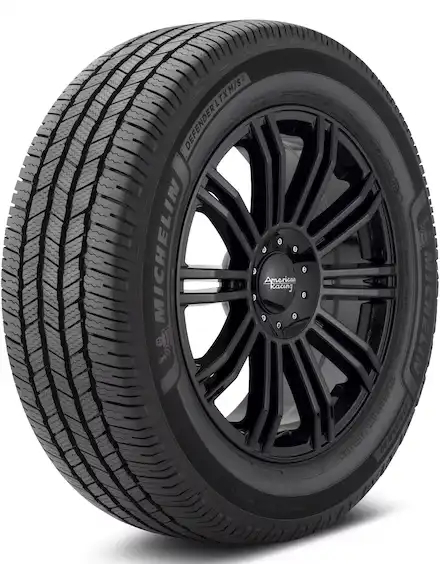
1. Michelin Defender LTX M/S2: Best Overall
Price Check
Check the price of this tire at the following retailers:
This tire is the updated version of the widely popular Defender LTX M/S, and it’s genuinely better across the board.
Ride quality is exceptional — the coil-spring rear end already makes the 3rd Gen smoother than the 2nd Gen, and this tire adds a real, additional layer of refinement. Road noise is genuinely minimal, with independently reported testing describing near-silent highway cruising for an all-season truck tire.
Wet traction is where this tire truly separates itself. Michelin’s EverTread compound and an aggressive siping pattern channel water effectively, with real owner reports describing confident, planted handling during heavy rain.
Pros: Genuinely exceptional ride quality and quiet, outstanding wet traction, strong tread life.
Cons: Not an off-road tire, premium price.
2. BFGoodrich All-Terrain T/A KO3: Best All-Terrain

Price Check
Check the price of this tire at the following retailers:
BFGoodrich retired the legendary KO2 in favor of the KO3, and for Tundra owners who need one tire that handles both pavement and trails, the successor is a real step forward.
Durability remains the calling card — CoreGard Max sidewall technology adds reinforced rubber that resists splitting and bruising, real, meaningful protection for a truck that splits time between highway commuting and weekend off-road runs. The KO3 improves on the KO2’s gravel-road durability, snow traction, and tread wear, and unlike the KO2, it carries the 3PMSF severe-snow rating out of the box.
Off-road traction remains excellent in dirt, gravel, and light mud, with interlocking tread blocks gripping loose surfaces confidently.
Pros: Genuine durability and improved snow-traction over the legendary KO2, real 3PMSF winter certification, composed highway manners for the category.
Cons: Firmer ride than highway-focused tires, premium price.
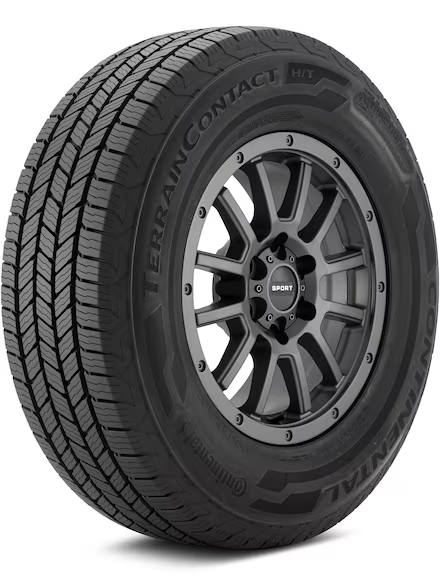
3. Continental TerrainContact H/T: Best for Towing
Price Check
Check the price of this tire at the following retailers:
Towing is one of the 3rd Gen Tundra’s genuine strengths — the i-FORCE MAX can handle up to 12,000 pounds — and this tire is built specifically for that demand.
Stability under load is a real strength, with Continental’s TractionPlus technology optimizing the contact patch under heavy loads. Independently reported testing with loaded trailers describes confident, straight tracking without the vague, squirmy feeling softer all-season tires can exhibit when towing heavy.
Braking distances, both loaded and unloaded, hold up impressively, with consistent pedal feel regardless of bed or hitch load.
Pros: Genuine towing stability, confident braking under load, smooth highway ride.
Cons: Limited off-road capability beyond well-maintained gravel, conservative tread appearance.
4. Falken Wildpeak A/T3W: Best Budget Pick

Price Check
Check the price of this tire at the following retailers:
This tire delivers a genuinely unbeatable value proposition, competing with tires costing $50–$80 more per corner.
On-road manners are composed and off-road grip is genuinely impressive for the price, with real owner reports describing excellent tread life. Snow and ice performance is a real standout — the tire carries the 3PMSF rating, and independently reported winter testing describes confident, controllable handling on packed snow and icy patches.
Real owner reports also describe this tire as noticeably quieter on the highway than several pricier all-terrain competitors.
Pros: Genuine value at the price, real 3PMSF-rated winter capability, surprisingly quiet for an all-terrain tire.
Cons: Wet traction trails premium options, firmer ride than touring-focused tires.
5. Nitto Ridge Grappler: Best for Off-Road

Price Check
Check the price of this tire at the following retailers:
This tire occupies a genuine hybrid space between all-terrain and mud-terrain, and it’s become a popular Tundra upgrade for real reasons.
Trail performance is outstanding — alternating shoulder grooves and reinforced sidewall lugs provide grip and protection that independently reported testing on rocky terrain describes as genuinely superior to standard all-terrains. Despite the aggressive look, variable pitch tread blocks genuinely reduce pattern noise, keeping highway cruising more civilized than a traditional mud-terrain.
Pros: Genuine trail capability with real sidewall protection, surprisingly manageable highway noise for the category, distinctive aggressive styling.
Cons: Shorter tread life than highway-focused tires, premium price.
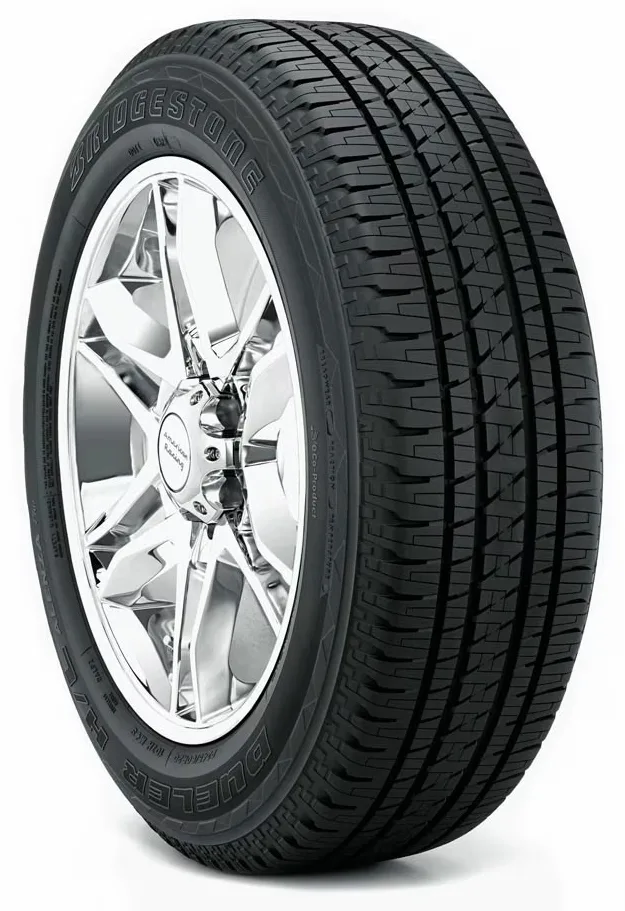
6. Bridgestone Dueler H/L Alenza Plus: Best Highway Tire
Price Check
Check the price of this tire at the following retailers:
For Tundra owners whose truck is primarily a highway cruiser or comfortable daily driver, this tire delivers genuinely class-leading quiet.
Independently reported noise testing places this among the quietest tires available for a full-size truck, with real owner reports describing a dramatic reduction compared to typical factory-fitted rubber. Ride comfort matches the quiet — the tire absorbs road imperfections effectively, delivering a genuinely more refined feel that suits Capstone and 1794 Edition trims’ premium interior.
Pros: Genuinely class-leading quiet, exceptional ride comfort, confident highway handling.
Cons: Essentially no off-road capability, premium price with occasionally limited size availability.
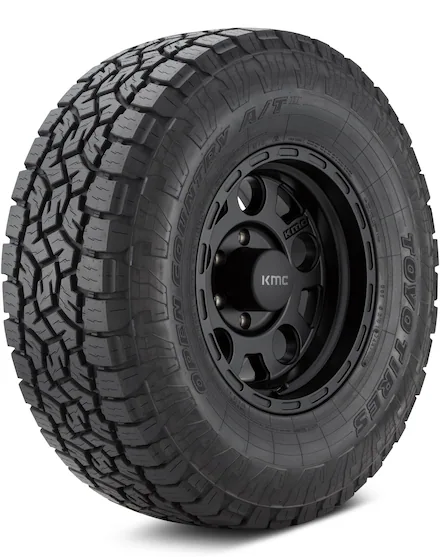
7. Toyo Open Country A/T III: Best Balanced Daily/Trail
Price Check
Check the price of this tire at the following retailers:
For Tundra owners who want a genuinely well-rounded all-terrain tire without leaning too far toward either extreme, this delivers a real, balanced package.
A tread compound with real durability properties holds up to daily highway use, and independently reported testing describes confident traction transitioning between pavement, gravel, and light off-road terrain — a genuinely practical choice for owners who don’t fit neatly into “highway only” or “trail warrior” categories.
Pros: Genuine highway-to-trail versatility, respectable comfort for an all-terrain tire, dependable wet traction.
Cons: Not a specialist in extreme off-road conditions, premium price relative to pure highway tires.
8. Goodyear Wrangler Territory AT/S: Modern Comfort-Focused All-Terrain
Price Check
Check the price of this tire at the following retailers:
This tire represents Goodyear’s newer generation of all-terrain design, genuinely prioritizing on-road comfort and quiet without abandoning real off-road capability.
Independently reported testing describes a noticeably smoother, quieter ride than older-generation all-terrain tires, while still delivering respectable traction on dirt and gravel. This is a genuinely strong pick for Tundra owners who want an all-terrain look and light-duty capability without the harsher ride penalty some competitors impose.
Pros: Genuine comfort improvement over older-generation all-terrain tires, respectable light-duty off-road capability.
Cons: Not built for serious off-road use, moderate pricing.
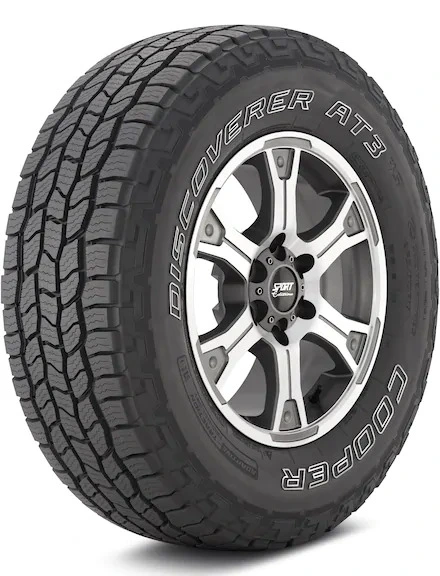
9. Cooper Discoverer AT3 4S: Best Value All-Terrain
Price Check
Check the price of this tire at the following retailers:
This tire delivers genuinely strong all-terrain capability at a price positioned between the budget Falken and premium BFGoodrich options.
Cooper’s Secure-Grip technology with a five-rib all-terrain pattern provides real traction on loose surfaces, and the tire carries genuine 3PMSF certification for real winter capability alongside its off-road credentials.
Pros: Genuine all-terrain capability at a competitive price, real 3PMSF winter certification, respectable warranty coverage.
Cons: Doesn’t match premium all-terrain tires in extreme conditions.
10. Michelin X-Ice Snow SUV: Best for Winter
Price Check
Check the price of this tire at the following retailers:
For Tundra owners in genuinely severe winter climates, this dedicated winter tire delivers real, documented ice performance no all-terrain tire in this comparison can match.
Michelin’s FleX-Ice compound stays flexible in extreme cold, and Cross Z Sipes create micro-pumps that actively absorb water from icy surfaces, genuinely improving traction where standard rubber stiffens and loses grip.
Pros: Genuine best-in-comparison ice and snow traction, real cold-weather compound flexibility.
Cons: Seasonal use only, not built for off-road or towing-heavy use.
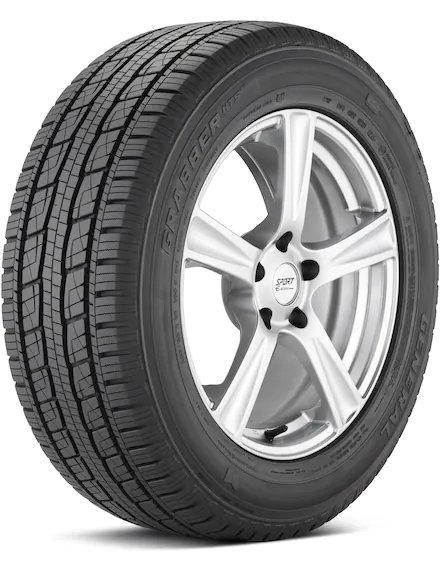
11. General Grabber HTS60: Best Budget Highway
Price Check
Check the price of this tire at the following retailers:
For Tundra owners who stay primarily on pavement and want genuine value without a premium price, this highway-terrain tire delivers dependable, comfortable performance.
Real owner reports describe a respectable ride and good wet traction relative to the price, with tread life competitive against pricier touring options — a genuinely sensible choice for owners who prioritize on-road comfort and budget over aggressive styling.
Pros: Genuine value with a comfortable ride, respectable wet traction, competitively low price.
Cons: Not built for off-road use, doesn’t match premium touring tires in ultimate comfort.
3rd Gen Tundra Tire Sizes by Trim
Confirm the exact size on the driver’s door jamb sticker before ordering.
SR runs 245/75R18. SR5 runs 265/70R18 standard, with 265/60R20 available as an option. Limited, Platinum, and 1794 Edition run 265/60R20. TRD Pro runs 285/65R18 — the only trim shipping a genuine 33-inch tire from the factory. Capstone runs 265/50R22.
Many owners upsize to 285/65R18 (matching the TRD Pro’s factory fitment) or larger for a more aggressive stance. These sizes generally fit without rubbing on most trims, but verifying clearance with your specific suspension setup and wheel offset before buying is genuinely worthwhile — a leveling kit is often the safer starting point beyond a true 33-inch tire.
How to Choose the Right Tire for Your Tundra
Mostly a highway commuter: the Michelin Defender LTX M/S2 or Bridgestone Dueler H/L Alenza Plus maximize comfort and minimize noise. If towing is a regular part of the routine, the Continental TerrainContact H/T splits the difference between comfort and capability under load.
Mix pavement and dirt: the BFGoodrich KO3 or Falken Wildpeak A/T3W are the strongest choices, handling unpaved roads and light trails with confidence while remaining livable on the daily commute.
Hit the trails hard: the Nitto Ridge Grappler delivers the most off-road capability on this list that’s still genuinely drivable to work.
Tire Maintenance Tips for the 3rd Gen Tundra
Check tire pressure weekly. The Tundra’s TPMS alerts to significant pressure drops but won’t catch a slow 2–3 PSI loss over time. Recommended pressure typically runs 33–36 PSI depending on load — confirm against the door jamb sticker.
Rotate every 5,000–7,500 miles. The rear-wheel-drive (or part-time 4WD) layout means rear tires wear differently than fronts; regular rotation keeps wear even across all four corners.
Get an alignment after installation. The 3rd Gen Tundra’s independent front suspension is genuinely sensitive to alignment settings, and even small deviations can cause premature edge wear.
Inspect tread depth regularly. Replace tires before they reach 3/32″ of remaining tread — waiting until the legal minimum increases hydroplaning risk in a rainstorm.
Where to Buy Tires for Your 3rd Gen Tundra
Tire Rack offers a strong online experience with competitive prices and direct shipping to a local installer. Discount Tire/America’s Tire is a dependable brick-and-mortar option with price matching and free rotations for the life of the tire. Costco offers solid pricing and a generous road hazard warranty, though inventory can be limited. Walmart frequently has the lowest prices, though installation quality varies by location.
Always compare total installed price rather than just per-tire cost — installation, disposal fees, valve stems, and balancing can add $80–$120 to the total.
Frequently Asked Questions
What are the best tires for a 3rd gen Toyota Tundra?
Top picks include the Michelin Defender LTX M/S2 for highway comfort, the BFGoodrich All-Terrain T/A KO3 for off-road capability, and the Continental TerrainContact H/T for towing. These fit the stock 18-, 20-, and 22-inch wheel sizes and handle the Tundra’s heavier curb weight well.
What tire size does a 3rd gen Toyota Tundra take?
It depends on trim. SR runs 245/75R18. SR5 runs 265/70R18 standard, or 265/60R20 as an option. Limited, Platinum, and 1794 Edition run 265/60R20. TRD Pro runs 285/65R18 — the only trim shipping a genuine 33-inch tire from the factory. Capstone runs 265/50R22. Always check the door jamb placard for your exact specification.
Are all-terrain tires worth it on a 3rd gen Tundra?
Yes, if the truck sees a genuine mix of highway driving and occasional off-road trips, towing on unpaved roads, or winter driving. Options like the Falken Wildpeak A/T3W and Cooper Discoverer AT3 4S offer strong wet and dry traction without sacrificing too much ride comfort or fuel economy.
How long do tires last on a 3rd gen Tundra?
Most quality all-season or all-terrain tires last 40,000 to 60,000 miles depending on driving habits, alignment, and rotation schedule. The Tundra’s weight wears tires faster than lighter trucks, making regular rotation genuinely important.
Can I put 33-inch tires on a 3rd gen Tundra without a lift?
Yes, in many cases. The TRD Pro already ships with a genuine 33-inch tire (285/65R18) from the factory with stock geometry, confirming that size as a known-good fit. Other trims can generally accommodate similar sizes with careful offset selection, though a leveling kit provides more margin.
What are the best snow tires for a 3rd gen Tundra for winter driving?
The Michelin X-Ice Snow SUV and Bridgestone Blizzak DM-V2 are among the strongest dedicated winter options, offering superior ice and snow traction over any all-season tire. For owners who don’t want to swap seasonally, a 3PMSF-rated all-terrain tire like the BFGoodrich KO3 or Falken Wildpeak A/T3W is a reasonable year-round compromise.
